Typewriters of the moment: Isaac Asimov’s astonishingly prolific career

December 22, 2012

Isaac Asimov remains one of my favorite writers.  He wrote well enough, and his curiosity took him to topics I often find interesting.  At one time having published more books than anyone else in history on a wide variety of topics from quantum mechanics to trivia in the books of the Bible (does he still hold that record?), it was a sure bet one could find at least one book in one’s area of interest penned by Asimov.

When I started the spasmodic feature, “Typewriter of the Moment,” years ago I did a search for Asimov with a typewriter.  I didn’t find an image I thought suitable back when the internet was still operated by steam, and somehow I just never got back to that.

The other night this image popped up on one of my Facebook feeds, from “the Other 98%”:

Painting of Isaac Asimov creating at a typewriter, an early IBM Selectric. Who did the painting?

Painting of Isaac Asimov creating at a typewriter, an early IBM Selectric. Who did the painting?

I appreciate the sentiment in the quote.  Asimov noted the Dunning-Kruger Effect, even if he didn’t have the advantage of Dunning and Kruger having named it yet, and he lamented the powerful undertone of anti-intellectualism that victims of the syndrome exhibit:

Anti- intellectualism has been a constant thread winding its way through our political and cultural life, nurtured by the false notion that democracy means that my ignorance is just as good as your knowledge. (Asimov in an essay for Newsweek: “A Cult of Ignorance,” January 21, 1980, p. 19)

It’s an arresting image, a heckuva a quote, and it would make a good poster.  Plus, it’s an early IBM Selectric typewriter, marrying Asimov’s creativity with a great technological advancement in writing tools.

One boggles at the idea of Asimov with a great word processing program, a fast computer with great memory, and the internet at his disposal.  If Asimov were alive and creating today, we’d think Moore’s Law a great hindrance to the advancement of knowledge.

The painting delights me.  It’s almost photographic, and I like paintings that take great care to get small details right, photographically.  No dig at more spare or even abstract art, but this sort of painting takes great skill and great creativity.  Rising spirit-like from the typewriter’s platen we see a satellite (manned spacecraft, perhaps?), a flask of chemicals, and a leather-bound book, essential components in science fiction, and science.

So, who did the painting?  Was it done solely for that Facebook poster?

English: An IBM Selectric typewriter, model 71...

This is what that typewriter in the painting looks like, from the author’s angle. An IBM Selectric typewriter, model 713 (Selectric I with 11″ writing line), circa 1970. Wikipedia image

I’ve searched on TinEye, and Bing and Google, without success to identify the painter.

One version of the painting, before text was added, showed up at IO9, a site dedicated to science fiction, in an article discussing the writing habits of famous writers.

This does not appear to me to be the original, simply because data on the artist is not contained in the information section of the image.  The artist who did this illustration would be proud of it, and want to advertise her or his work.

This version has a slightly higher resolution; click on the image and note the reflections of lights in Asimov’s glasses, the reflections on the desk, and even the dings on the edge of the desk facing the viewer — this is great stuff!

But still I wonder:  Who was the original artist?

Any ideas, Dear Reader?

Rowena Morrill's painting of Isaac Asimov, before posterization with a quote over his head.

Rowena Morrill’s painting of Isaac Asimov, before posterization with a quote over his head.

Did Asimov write on a Selectric?  Did he switch to the newer version, with a wider carriage, or stick with the old original?  Is there a photo upon which this painting is based?

Almost immediate update:  This site claims the artist is the same as the one at the bottom of the post, Rowena Morrill.  That’s a start.  Here’s more:  At Rowenaart, both pictures appear credited to Rowena.  Mystery solved?  Go buy a poster from her; this is great stuff.

First Amendment Update, January 2015: You will want to read Asimov’s entire essay.  He’s not just insulting ignorants and ignorance; he also urges that Americans, almost all Americans, do not read enough to keep freedom alive.  For example, on the “right to know”:

There are 200 million Americans who have inhabited schoolrooms at some time in their lives and who will admit that they know how to read (provided you promise not to use their names and shame them before their neighbors), but most decent periodicals believe they are doing amazingly well if they have circulations of half a million. It may be that only 1 per cent–or less―of American make a stab at exercising their right to know. And if they try to do anything on that basis they are quite likely to be accused of being elitists.

I contend that the slogan “America’s right to know” is a meaningless one when we have an ignorant population, and that the function of a free press is virtually zero when hardly anyone can read.

More:

English: This image is a reproduction of an or...

Hello! Could this be by the same artist? Caption from Wikipedia: This image is a reproduction of an original painting by renowned science-fiction and fantasy illustrator Rowena http://www.rowenaart.com/. It depicts Dr. Isaac Asimov enthroned with symbols of his life’s work. (Photo credit: Wikipedia)


There was an armed deputy at Columbine High; his story

December 21, 2012

Deputy Sheriff Neil Gardner, talking about his experience at the Columbine High School shootings in Colorado.

More:  

Denver - Columbine High School 097

Denver – Columbine High School Hope Memorial Library – Photo credit: travellingzenwolf


Split in environmental movement? No. Facts still matter

December 21, 2012

Rachel Carson was right in her claims against DDT in Silent Spring, of course, as all subsequent research shows. Drawing by New York Magazine's immortal David Levine.

Rachel Carson was right in her claims against DDT in Silent Spring, of course, as all subsequent research shows. Drawing by New York Magazine‘s immortal David Levine.

Chris Clarke took on Keith Kloor at Pharyngula.  Kloor fell victim to the idea that there is a great split between old “tree-hugger” environmentalists and a newer breed of greens who are willing to work with business and industry to get actual solutions.  Kloor seems to be cheering those he calls “modernists.”

It’s not a new idea, nor is a particularly useful one.  There has long been a minor rift between people who believe it’s impossible to cut deals with polluters, and those who get into the trenches to hammer out or shoot out deals that result in practical legislation.  The group who called for a legislated end to personal automobiles, for example, are still around — but they applaud those who forged the Clean Air Act that drove the invention and development of catalytic converters and cleaned up urban air, even though it left America awash in cars.

Clarke wrote:

Kloor summarizes the better, smarter, more stylish and less embarrassing side’s position thusly:

Modernist greens don’t dispute the ecological tumult associated with the Anthropocene. But this is the world as it is, they say, so we might as well reconcile the needs of people with the needs of nature. To this end, [controversial environmentalist Peter] Kareiva advises conservationists to craft “a new vision of a planet in which nature—forests, wetlands, diverse species, and other ancient ecosystems—exists amid a wide variety of modern, human landscapes.”

That doesn’t seem all that unreasonable on its face, if for no other reason that that it’s currently the best case scenario. You would be extremely hard-pressed to find even the most wilderness-worshipping enviro who disagreed.

In fact, were I to have to rebut Kloor’s whole piece in one sentence, it would be this:  the U.S. non-profit The Wilderness Society, founded by the authors of the Wilderness Act of 1964, is aggressively pushing for industrial development of solar and wind energy generating capacity on intact habitat on the public lands of the American west.

President Lyndon B. Johnson signing the Wilder...

President Lyndon B. Johnson signing the Wilderness Act in 1964 (Photo credit: Wikipedia)

I replied at Pharyngula, noting that the rift Kloor talks about could be exemplified by Rachel Carson and DDT and “modernists” who don’t object to the use of DDT in Indoor Residual Spraying (IRS) to fight malaria — except, those are the same people, working on the same issue.  In short, I sorta agree with Clarke.  There’s no rift, only a lot of misunderstanding.

Heck, if I’m going to that trouble, I may as well capture it here for my indexing purposes.  Here’s my response — I may add links in the body that don’t appear at Pharyngula.

Interesting view of a bit of an inside-baseball (environmental protection politics) issue, but not particularly incisive. Other than its being published at Slate, should we worry about Kloor’s views much?

The piece completely ignores that the views of those he labels “modernists” and “pragmatists” come wholly out of the research demanded by those he ignores in the old movement, whom he unfairly ridicules as hippies.

For example: It’s politically correct (in some circles) today to say (1) Rachel Carson was too strident, and (2) probably wrong about DDT “since it’s (3) not carcinogenic, we now know.” Malaria fighters around the world (4) now have DDT in their arsenal again, this view holds, because (5) pragmatists in the environmental movement finally listened. “(6) Sorry about those ‘unnecessary’ malaria deaths,” some claim the pragmatists would say.

But that view is founded on, grown in, and spreads, historical, legal and scientific error. And the progress made was based on understanding the science, history and law accurately. It’s not that pragmatists finally succeeded where the tree-huggers failed. It’s that the tree-huggers hung in there for 50 years and the world has come around to recognizing good effects, even if it can’t or won’t acknowledge the true heroes who got the work done.

Carson was dead right about DDT. She urged the use of Integrated Vector (Pest) Management (IVM, or IPM) in place of DDT, but she forecasted (in 1962!) that unless DDT use were severely curtailed, it would cease to be useful to fight malaria and other diseases (because, as Carson understood, evolution works, and the bugs evolve defenses to DDT). By 1965, WHO had to end its ambitious campaign to eradicate malaria because, as Carson predicted, mosquitoes in Africa turned up resistant and immune to DDT because of abuse and overuse of the stuff in other applications. Notice, 1965 was seven years BEFORE the U.S. banned DDT use on agricultural crops, and 19 years before the last U.S. DDT manufacturer scurrilously fled to bankruptcy protection to avoid penalties under Al Gore’s SuperFund cleanup bill.

Carson did not claim DDT causes cancer. So the basis of the argument that DDT is “safe for human use” because it doesn’t cause cancer, is an historical non-starter. Research since Carson’s death shows that DDT does indeed cause cancer, though we think its a weak carcinogen in humans. DDT was banned because it’s a deadly poison (else it wouldn’t work!), and it kills for a long time, and it is nonspecific — so it will kill an entire ecosystem before it can eradicate some insect pests. It was in 1971, and it still is.

Photo taken at Rachel Carson's 100th Birthday ...

Photo taken at Rachel Carson’s 100th Birthday celebration at Rachel Carson Homestead in Springdale, Pennsylvania (Photo credit: Wikipedia)

Carson did note that DDT kills birds, in vitro, by incapacitating chicks to thrive, by outright poisoning insect-eating and predatory birds (or anything near the top of the trophic levels) and through a then-mysterious scrambling of reproductive abilities. About ten years after her death, it was discovered DDT also rendered female fowl unable to make competent eggshells, and that provided a fifth path for death for birds.

Much of the research Carson cited formed the foundation for the science-based regulation EPA came up with in late 1971 that ended in the ban on DDT in the U.S. None of those studies has ever been seriously challenged by any later research. In fact, when Discover Magazine looked at the issue of DDT and birds and malaria in 2007, they found more than a thousand peer-review follow-up studies on DDT confirming Carson’s writings.

Over the past decade we’ve seen a few bird species come off of the Endangered Species List. Recovery of at least four top predators should be credited squarely to the ban on crop use of DDT in the U.S, brown pelicans, peregrine falcons, osprey, and bald eagles. 40 years of non-use, coupled with habitat protection and captive breeding programs, brought these birds back. (Five years ago I sat on the lawn of Mt. Vernon and watched a bald eagle cross the Potomac to a snag 100 yards from George Washington’s porch; the director told me they’d been watching several eagles there for a couple of years. 15 years earlier, one nesting pair existed in the whole Potomac region, at a secret site; now tourists are told where to go see them. A friend wrote today he saw a bald eagle in Ft. Worth, Texas. The gains from the DDT ban are real.)

Meanwhile, in Africa and Asia, the war on malaria continued. After the DDT advocates screwed up the malaria eradication program of WHO in the 1960s, progress against malaria continued, but slowed; in the late 1980s malaria flared up in some regions where the malaria parasites themselves had developed resistance to the most commonly-used pharmaceuticals (as Darwin would have predicted, as Carson would have predicted). After struggling to keep malaria from exploding, about 1999 malaria fighters latched on to Integrated Pest Management (IPM), which couples occasional spraying of homes and other residences, even with DDT (which was never banned in Africa or Asia) — but calls for spraying only when it is very effective, and requires that no one pesticide be used to the point that it drives mosquitoes to evolve resistance, and pushes all other means to prevent disease-spreading bug bites.

Largely without DDT (though DDT is not banned), malaria infections fell from peak DDT-use years of 1959 and 1960, from 500 million infections per year, to fewer than 250 million infections today — that’s a decrease of 50%. Phenomenal when we consider the population of the world has doubled in the same time. Deaths dropped from 4 million annually in those peak-DDT-use years to fewer than 800,000 per year today — a decrease of more than 75%. Progress continues, with IPM; bednets now do better, and more cheaply, what DDT used to do but largely cannot anymore — stop the bites. Better medicines, and better educated health care workers, clean up the disease among humans so mosquitoes can’t find a well of infection to draw from.

Notice that at no point was progress made contrary to the “tree-hugger” model, but instead was made at every point because of the tree-hugger model. No compromises enabled the recovery of the bald eagle, but strict enforcement of the environmental laws. No compromises with Rachel Carson’s Silent Spring helped beat malaria, but finally applying what Rachel Carson actually wrote.

Now along comes Kloor to say that Carson and her de facto acolytes block progress, and people who argue for compromise instead have the lighted path to the future?

Let’s review:

  1. Carson was not too strident; in fact the President’s Science Advisory Committee’s report, “Use of Pesticides,” in 1963 called for more immediate and more draconian action than Carson did.
  2. Carson was not wrong about DDT; it is still a deadly poison, and it still kills ecosystems; however, as Carson urged, careful use can provide benefits in a few cases.
  3. Human carcinogenicity was not an issue in DDT’s being banned in the U.S. in 1972, and it’s being only a weak carcinogen now does not rescue DDT from the scientifically-justified ban; we now know DDT is even more insidious, since it acts as an endocrine disruptor in nature, scrambling reproductive organs of fish, amphibians, reptiles and mammals, and probably birds, too.
  4. Malaria fighters always had DDT in their arsenal; no reason to use DDT where it won’t work, nor where it’s harms outweigh its benefits (as the National Academy of Sciences said, in 1970, in a call to get rid of the stuff).
  5. If there were any pragmatists in this story, they abandoned malaria-affected areas of the world years ago and have not returned; they did nothing to help save the birds; to claim they listened is to suggest they did something and can do more. Not sure that’s a case that can be made.
  6. There were not deaths to malaria “unnecessary” due to a ban on DDT which never occurred in Africa or Asia, while DDT was plentiful and cheap to anyone who wanted to use it (still pretty much the case today). Let’s repeat that:  DDT has never been banned in Africa or Asia.  We can’t claim great disease exacerbation when the disease actually was abated so greatly over the period of time in discussion — can’t make that claim and also claim to be honest.

It was the hard-core, wilderness-loving, science-following environmentalists who were responsible for every lick of progress on that issue.

Is DDT unique as an issue? I don’t think so. And I think a fair history of the environmental movement from 1975 to today would point out that it was hard-core, save-the-planet-because-it’s-the-only-home-humans-have types who pulled things out. Do we have great canyons to hike in Colorado and Utah? Yeah, but keeping Exxon from digging up huge portions of those states for a now-failed oil-shale extraction scheme should get some of the credit. Is there wildlife in cities? Sure, but only because we had wilderness areas to protect those species in their darkest hours, and we may need those places again. Do we have other needs for wilderness? Only if we need clean air, clean water, huge sinks for CO2 emissions, and places to dream about so we stay sane and focused, and American (Frederick Jackson Turner was correct enough — Americans are more noble, more creative, wiser and more productive, if we have a frontier and a wild).

Isn’t it required that we compromise on standards to get energy independence, and economic prosperity? Don’t look now, but oil and natural gas production, and exploration, are at highs, under our “tough environmental laws.” If we look around the world, we see that future prosperity is best protected by such laws, even if they sometimes seem to slow some industrial process or other.

New generation of conservationist? Possible only because of the old generation, the Pinchots, Roosevelts (esp. the two presidents), the Lincolns and Grants, the Muirs, the Leopolds, the Bob Marshalls, the Udalls, the Morans, the Douglases (Marjory Stoneman and Justice William, both), the Rockefellers, the Nelsons, the Muskies, the Gores, the Powells, and thousands of others who were then ridiculed for being unpragmatic, and whose methods often required that they not “compromise.” We can’t talk about protecting wilderness today unless the Sierra Club was there to actually do it, earlier. We can’t talk about private efforts, or public-private partnerships, without standing on the ground already protected by the Nature Conservancy. We can’t talk about saving the birds without relying on the history of the Audubon Society. We can’t talk sensibly about protecting humans from cancer or poisons without touching every rhetorical string Rachel Carson plucked.

Get the science right. Keep your history accurate. Read the fine print on the law, and on the pesticide label. Conservation isn’t for the birds, bees, bears, trout and flowers — it’s for humans. That’s news to Kloor? Maybe that’s why his view is skewed.

Progress is made by unreasonable and stubborn people, sometimes? No, Martin Luther King, Jr., said — those are the only people who make progress.

We aren’t going to build a future conservation movement by giving away what has been conserved to now.

More:


Best editorial quote ever: “Yes, Virginia, there is a Santa Claus” (2012 remembrance)

December 20, 2012

“Papa says, ‘If you see it in the Sun, it’s so.'”

Do we, you and I in 2012, stand as witnesses to the end of newspapers in America?  In recent months we’ve seen body blows to the New Orleans Times-Picayune, the San Diego Union, and The Cleveland Plain Dealer, and others.

It’s been a grand history. Newspapering gave us great leaders like Benjamin Franklin. Newspapering gave us wars, like the Spanish-American War. Newspapering gave us Charlie Brown, Ann Landers, the Yellow Kid, Jim Murray, Red Smith, Thomas Nast (and Santa Claus), the Federalist Papers, Watergate, Herblock, news of Vietnam and Pearl Harbor, Neil Armstrong on the Moon, the Pentagon Papers, and coupons to save money on laundry soap.

It’s been a curious history, too. An 1897 editorial vouching for Santa Claus rates as the most popular editorial of all time, according to the Newseum in Washington, D.C.  That’s 115 years ago, and that’s quite some staying power.

Francis Pharcellus Church, New York Sun writer who wrote "Yes Virginia, there is a Santa Claus" - Newseum

The man who saved Christmas, at least for Virginia O’Hanlon: Francis Pharcellus Church – Newseum image

In autumn, 1897, 8-year-old Virginia O’Hanlon of 115 West 59th Street in New York, wrote to the New York Sun with this simple question:

“Please tell me the truth; is there a Santa Claus?”

In the age of Yellow Journalism, the fiercely competitive Sun‘s editors turned the letter to Francis Pharcellus. He responded to little Virginia on September 21, 1897:

Yes, Virginia, there is a Santa Claus.”

Church’s brother, William Conant Church, owned and published the newspaper. Both had followed their father into the news business. They co-founded The Army-Navy Journal in 1863, and went on to a series of journalistic collaborations. Francis was 58 years old when he answered Virginia’s letter. (He died at age 67, in 1906.)

The New York Sun held down the conservative corner in New York journalism at the time, versus the New York Times and the New York Herald-Tribune. But it also had an interesting history, to a blogger intrigued by hoaxes. In 1835 the paper published a series of six newspaper stories falsely attributed to Sir John Herschel, a well-known astronomer, claiming to describe a civilization on the Moon — the Great Moon Hoax. The discovery was credited to a new, very powerful telescope.

In 1844 the paper published a hoax written by Edgar Allen Poe, the Balloon Hoax. Under a pseudonym, Poe wrote that a gas balloon had crossed the Atlantic in three days.

The Sun also featured outstanding reporting. A 1947 and 1948 series about crime on the docks of New York City won a Pulitzer Prize for writer Malcolm Johnson. That series inspired Elia Kazan’s 1954 movie On the Waterfront starring Marlon Brando, Rod Steiger, Eva Marie Saint, Karl Malden and Lee J. Cobb.

The New York Sun ceased publication in 1950.

For all of its history, the Sun and the Churches are most remembered for that defense of belief in Santa Claus.
Virginia O’Hanlon grew up, graduated from Hunter College, got a masters at Columbia, and earned a Ph.D. from Fordham. She taught in the New York City Public School system, from which she retired in 1959. She died in 1971.

Birth of tradition

Columbia University was Church’s alma mater, as well as O’Hanlon’s. Her letter and his response get a reading each year at the Yule Log Ceremony at Columbia College, along with the poem “A Visit from St. Nicholas.” Animated, live-acting, and other television productions have been mounted in 1974, 1991, and 2009.

Is there a Santa Claus? Did Church write a credible defense? The text of the letter and answer, below the fold.

More:  

Read the rest of this entry »


Montreal’s baby-stealing eagle? “Hoax.”

December 19, 2012

It was a class project, a class project in CGI.

The baby-stealing eagle in Montreal?  Computer generated.  No real eagles were harmed in the process (no word about osprey or falcons, though . . .)

Luisa posted this in comments to the previous post:

Je suis désolée: http://blogue.centrenad.com/2012/12/19/centre-nad-reassures-montrealers-no-danger-of-being-snatched-by-a-royal-eagle?lang=en

The blog at CentreNAD said:

19 December 2012

The “Golden Eagle Snatches Kid” video, uploaded to YouTube on the evening of December 18, was made by Normand Archambault, Loïc Mireault and Félix Marquis-Poulin, students at Centre NAD, in the production simulation workshop class of the Bachelors degree in 3D Animation and Digital Design.

The video shows a royal eagle snatching a young kid while he plays under the watch of his dad. The eagle then drops the kid a few feet away. Both the eagle and the kid were created in 3D animation and integrated in to the film afterwards.

The video has already received more than 1,200,000 views on YouTube and has been mentioned by dozens of media in Canada and abroad.

The production simulation workshop class, offered in fifth semester, aims to produce creative projects according to industry production and quality standards while developing team work skills. Hoaxes produced in this class have already garnered attention, amongst others a video of a penguin having escaped the Montreal Biodôme.

Was that enough YouTube views to guarantee an A in the course?

I’ll wager the students who made the film are not “désolée” at all.

Grateful tip of the old scrub brush to Luisa, at Crows and Ravens.

More:

Animated gif showing difficulties in eagle video

.Gif showing shadow inconsistencies used to debunk video: Caption at Poynter.org: “Earlier, social media verification experts at Storyful point to evidence of fakery, including Twitter user @thornae’s animated GIF showing inconsistencies with the eagle’s shadow.”


Ingenious anti-personnel mine finder

December 19, 2012

Brilliant little film about a wonderfully creative guy, a war refugee, who developed a wind-powered device that can find and detonate anti-personnel mines.  It’s part of the GE-sponsored FOCUS/FORWARD film contest:

Description and credits at Vimeo’s site:

MINE KAFON is a Finalist in the $200,000 FOCUS FORWARD Filmmaker Competition and is in the running to become the $100,000 Grand Prize Winner. It could also be named an Audience Favorite if it’s among the ten that receives the most votes. If you love it, vote for it. Click on the VOTE button in the top right corner of the video player. Note that voting may not be available on all mobile platforms, and browser cookies must be enabled to vote.

A short documentary portrait on a designer who has created a low cost solution to landmine clearance.

Check out his website:  massoudhassani.com
or for other films by us at Ardent Film Trust:  ardentfilm.org

DIRECTOR
Callum Cooper
DOP
Michael Latham
CAMERA
Michael Latham
Mahmud Hassani
Callum Cooper
SLOW MOTION CAMERA
Ed Edwards
EDITOR
Anna Meller
COLOR GRADER
Chris Teeder
SOUND MIXER AND DESIGNER
Sandy Milne
TITLE DESIGNER
Ray O’Meara
EXECUTIVE PRODUCER
Bobby Kapur
PRODUCERS
Alicia Brown
Michael Latham
Callum Cooper
THANKS
Lucie Kalmar
Slowmo High Speed
Optimism Films
The RNLA explosive ordnance disposal service
Copyright Ardent Film Trust 2012


NRA reputation damaged

December 19, 2012

An observer of American politics may wonder whether the past few days have changed any of the old political lines on gun control issues and the Second Amendment.

Does a view from Canada tell us anything?  Here’s Aislin‘s cartoon, from the Montreal Gazette,  for December 18, 2012:

Aislin cartoon, Montreal Gazette, 12-18-2012

Aislin, Montreal Gazette, December 18, 2012

Too brutal, or too close to the truth?

A little history quiz in a cartoon, yes?  Can you identify all six symbols?  How many must one know to understand the cartoon?

More:

Summer's End. Lexington Green, 11 September 20...

U.S. flag at half-staff, at the Minuteman Memorial in Lexingon, Massachusetts (Summer’s End. Lexington Green, 11 September 2002. Photo taken in Minute Man National Historical Park. Sculpture : “Minuteman” by sculptor Henry Hudson Kitson (1863-1947), dedicated April 19, 1900. Erected 1899 : SIRIS Image: Wikipedia)


Montreal baby experiences terror of being ‘lifted up by eagle’s wings’ (hoax?)

December 19, 2012

East Coast son Kenny sent this video, noting his reaction was the same as the guy in the film; an encounter with a golden eagle in a Montreal park:

You can take the eagle out of the wild, but you can’t take the wild out of the eagle.

Looks mostly like a golden eagle to me — anyone want to make the case it’s a different bird?

What’s going on in Montreal, I wonder, that would make a golden eagle think a human baby might make a good meal?  (No, I don’t think the bird was trying to give the kid a thrill.)

Other reports of similar incidents around Montreal?

Update:  WHAT?  IT’S FAKED? Thoughtful reader Luisa in comments refers us to Chris Clarke’s Original Blog™ Coyote Crossing, which updates from expert birder Kenn Kauffman who says, as I wondered, it’s not a golden eagle, and other things look hoaxed. (While you’re looking around, check out Luisa’s Crow and Raven; bird photos that will make you jealous.)  You’d think an incident like that would have made it to the newspapers and television stations in Montreal, but I’ve found nothing — have you?)

Update, December 19, 2012:  Now the CBC covers the tale,  noting that it is most likely a hoax.  The film’s maker or YouTube poster has not defended it that I can find.  Watch carefully — the “baby” doesn’t move during the time it’s on the ground, through the bird’s plucking it up and dropping it.  There’s plenty of time to swap a dummy out with a real kid in the stroller while the camera is pointed away.  CBC found a Montreal ornithologist who claims it looks more like an osprey than an eagle.  I’ll buy that.

More:


Prisons, or schools? Prisons, or mental health care? Prisons, or freedom?

December 19, 2012

Here’s one from a maybe-odd source, but with relatively good citations.

If we have limited money to spend in government, can we put spending on a balance to see where it should be spent?  This is one example out of many pending before the U.S. Congress and state legislatures, today — right now, and for the coming several months.  When you hear elected representatives say “we must cut spending to reduce deficits,” you need to understand that their proposal is to cut spending for education, for job training, for employment assistance, for unemployment payments, for health care, for mental health care, for drug rehabilitation programs, but generally NOT for incarceration programs.  In short, they are saying we must cut off the education of poor kids, to build jails to house them if they run afoul of the criminal justice system after being unable to get the education and training to get a job that will produce the income that would have made them great parents and taxpayers.

If we have limited money to spend in government, can we put spending on a balance to see where it should be spent?

  • Prisons, or schools?
  • Prisons, or mental health care?
  • Prisons, or drug rehabilitation?
  • Justice, or incarceration?
No Justice For All poster, prisons vs. education - OnlineJusticeDegree.com

From OnlineJusticeDegree.com; check references listed on the chart.

What do you think?

More:


Pat Bagley tells the truth (Pulitzer committee, are you paying attention?)

December 18, 2012

Bagley on gun control politics

Pat Bagley, in the Salt Lake Tribune, December 17, 2012, on gun safety issues, “Coming to Grips with Gun Control.”

This would explain why the National Rifle Association (NRA) feels like it need not offer condolences to victims of gun violence in a recent mass shooting, and has gone silent on Twitter and Facebook.

Your thoughts?


Education, unions, guns and Superman: A few random thoughts

December 18, 2012

Here, I’ve been quiet for a few days on these issues.  I like to have more facts before forming opinions.  Others don’t feel so constricted, though, and one of the key lessons of life we must learn over and over is that too often we must act without knowing all the facts we’d wish to know.

Ryan Houck, Broken Pencil for Bach

Borrowed art: A Broken Pencil for Bach, drawing by Ryan Houck

This is one of those times.  In Michigan, the governor has been presented bills which he has signed which take away rights of teachers to stand up for themselves, part of a long-standing GOP war on education and teachers.  He has other bills intended to legalize carrying guns in schools, which he has not yet signed.   In several states, legislatures gear up for sessions starting early next year, with pre-filed bills to put the screws to teachers, cut back education spending, take money from public schools and give it to private groups under a pretext of improving education (I say pretext because all research indicates the public schools perform better, but I digress).  In Congress, the GOP demands cuts to health care, mental health care, education, roads, aid to any workers, employed, under-employed or unemployed, and especially in payments to people in poverty or otherwise in economic distress (“no pain to others, no GOP gain”).

Highlighting the intentional sloth the GOP insists on in government, Hurricane/Tropical Storm Sandy hammered one of our nation’s largest cities and most important regions for technology, manufacturing, business, finance and news, and the GOP opposes federal aid to speed up recovery; and in Newtown, Connecticut, a man with learning difficulties and/or behavioral issues broke into an elementary school over-armed with human-killling automatic and semi-automatic weapons legally purchased and legally owned, with which he had legally trained, and murdered 26 people, including 20 children.

My few random thoughts:

  • The unions demonized in Michigan, Texas and Wisconsin, saved children’s lives in Newtown.  (Yes, teachers; cops and firefighters, too.)
  • The teachers who “don’t deserve the pay they get,” according to many speakers in the public fora, laid down their lives in Newtown.
  • Teachers who ask for parental support, chaperones for a trip to the art gallery, a working copier, a full set of books for the students, a working grading machine, enough pencils so every kid can write, a working projector and ten minutes to set it up — and too often don’t get any of that, let alone ten minutes for a body break — now are asked by the crazy gun lobby to arm themselves and take on other beneficiaries of crazy gun lobbyists in the halls of the schools.
  • Waiting for Superman” was a film about how teachers are animals, teachers unions are monsters.  Turns out Superman was already teaching first grade, in Newtown, but is demonized by the filmmakers as someone or something else.
  • Maybe we should rethink who are the monsters, who is Superman, and who deserves our support.  Superman’s already in our schools — what are we waiting for?  Somehow I doubt that Superman’s merely showing up will be enough to resolve the issues and “fix” our schools.

What are your thoughts?

More, and related material:


Kill Devil Hills, North Carolina: Wright Bros. National Memorial

December 17, 2012

Kill Devil Hills monument to theWright Brothers

Wikipedia description: Standing sixty feet (18.3 meters) tall and perched atop a ninety foot (27.4 meters) stabilized sand dune known as Kill Devil Hill, this monument towers over Wright Brothers National Memorial Park in Kill Devil Hills, NC. The park commemorates and preserves the site where the Wright brothers launched the world’s first successful sustained, powered flights in a heavier-than-air machine. The inscription that wraps around the base of the monument states “In commemoration of the conquest of the air by the brothers Wilbur and Orville Wright. Conceived by genius, achieved by dauntless resolution and unconquerable faith.” Photo by Ken Thomas, taken with a Panasonic Lumix DMC-FZ50 in Dare County, NC, USA.

At this site, on December 17, 1903, Wilbur and Orville Wright first achieved flight in a heavier-than-air machine.


December 17, history written in the wind

December 17, 2012

Ten feet in altitude, 120 feet traveled, 12 seconds long. That was the first flight in a heavier-than-air machine achieved by Orville and Wilbur Wright of Dayton, Ohio, at Kittyhawk, North Carolina, on December 17, 1903.

Few witnesses observed the flight.  Though the brothers Wright fully understood the potential of the machine they had created, even they waited before revealing to their supporters, and then the world, what they had accomplished.

From the Library of Congress:

On the morning of December 17, 1903, Wilbur and Orville Wright took turns piloting and monitoring their flying machine in Kill Devil Hills, North Carolina. Orville piloted the first flight that lasted just twelve seconds. On the fourth and final flight of the day, Wilbur traveled 852 feet, remaining airborne for 57 seconds. That morning the brothers became the first people to demonstrate sustained flight of a heavier-than-air machine under the complete control of the pilot.

No lost luggage, no coffee, no tea, no meal in a basket, either.  No ATC (Air Traffic Control) delays.  Neither brother endured a TSA screening.

Resources on the Wright Brothers’ first flight:

(I almost always forget the big dates until the end of the day.  This is mostly an encore post.)


Annals of global warming: 333rd consecutive month above 20th century average temperature

December 17, 2012

Exit polling called this trend 20 years ago; is everybody else ready yet?

333 months of worldwide temperature averages above the 20th century average — a kid younger than 27.5 years has never lived through a single month cooler than the 20th century average for that month.  We’re well into the second generation of people who know nothing but global warming.

A reasonable and smart person might note that one does not need to be a student of advanced statistics to spot a trend here.

Read the NOAA report (you may have to select “November 2012”):

Global temperature highlights: November

  • The combined average temperature over global land and ocean surfaces for November was the fifth highest on record for November, at 56.41°F (13.67°C) or 1.21°F (0.67°C) above the 20th century average. The margin of error associated with this temperature is ±0.13°F (0.07°C).
  • November marked the 36th consecutive November and 333rd consecutive month with a global temperature above the 20th century average. The last below-average temperature November was November 1976 and the last below-average temperature month was February 1985.
  • The global land temperature was the sixth warmest November on record, at 2.03°F (1.13°C) above the 20th century average. The margin of error is ±0.20°F (0.11°C).

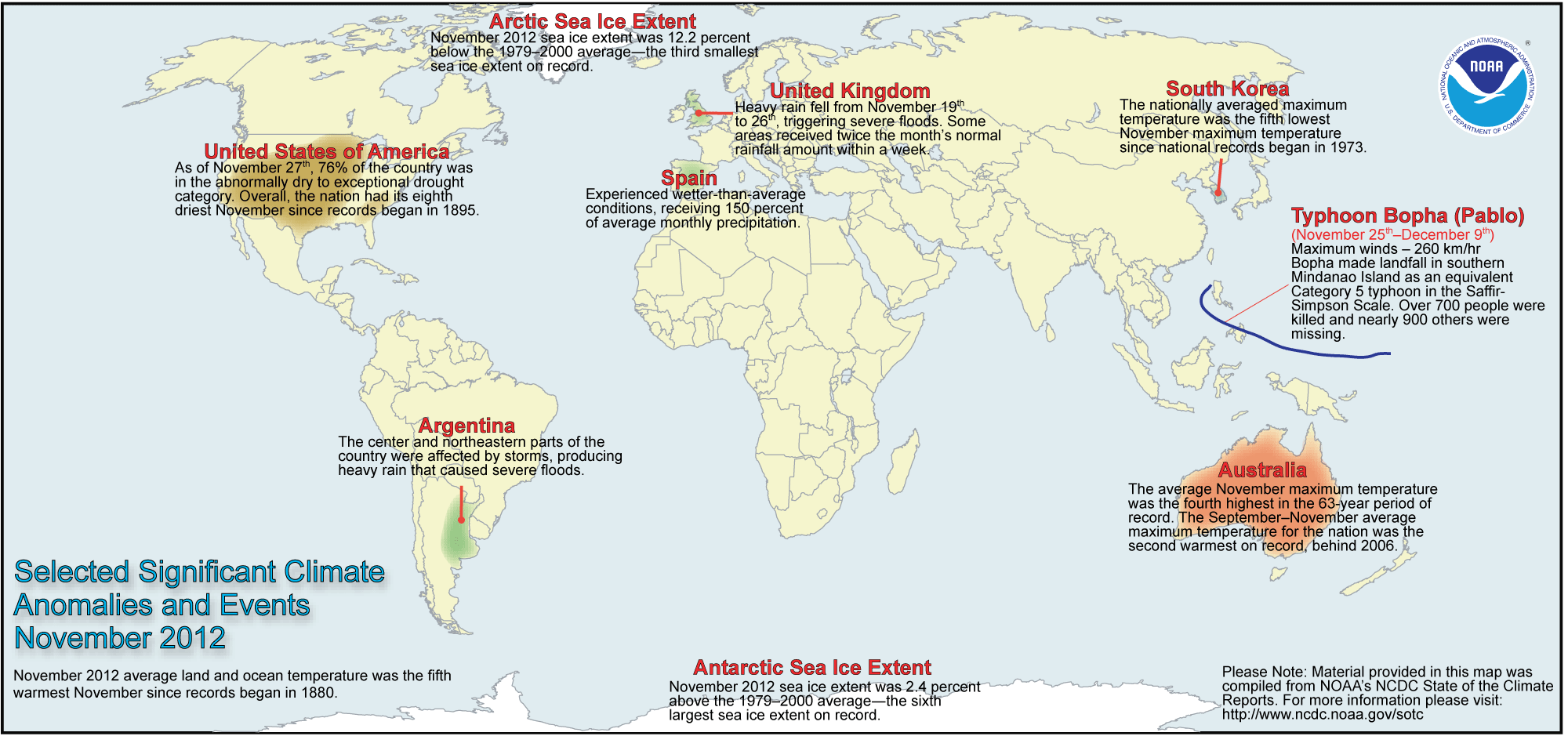
Just a look at the extremes in November should be alarming, especially if you live in the USA.

NOAA chart of climate anomalies and events, November 2012

Selected Significant Climate Anomalies and Events, November 2012; click for larger, more-easily-viewed image

More evidence that Michael Mann‘s “hockey stick” graph is vindicated; more evidence that we should not regard James Hansen as we did Cassandra, but should instead heed his warnings.

More:


Longevity of DDT, in pictures

December 16, 2012

One of the key problems with DDT is its persistence.  That was a selling point early on — one application would last for six months to a year.  In the wild or in a city, DDT can breakdown in about a year, but it breaks down into DDE which is pretty deadly itself and can cause a raft of other trouble while it hangs around.  While DDT will kill young birds and even adult songbirds outright, its most pernicious workings come in the breakdowns.  DDE insinuates itself in the reproductive organs of animals, causing birds to be unable to lay eggs with properly calcified eggshells.  Even if the DDT doesn’t kill the chicks, the DDE gets next year’s generation, making sure the egg cannot protect the chick to hatching.

A treaty adhered to by most of the world’s nations targets DDT specifically, you can tell by the name if you don’t know the content:  The Persistent Organic Pollutants Treaty (POPs), also known as the Stockholm Convention after the city where it was finally negotiated under the direction of the United Nations’ health care arm, the World Health Organization (WHO).

40 years after DDT use essentially ended in the U.S., traces of it still show up in the tissues of creatures in the wild, in plants, in crops, and in human tissue.

Where does it come from?

Most of what shows up is just circulating in the air, soil, water and living things.  There could be other sources.

I doubt this is a significant source, but a lot of DDT remains stored in barns and sheds on farms and in gardens across North America.  Over at a blog operated by an exterminator in Charlotte, North Carolina, we get a glimpse of history and potential disaster all at once.

Today, I traveled up to a Lincolnton, North Carolina Farm house to give a gentleman a price on Termite Protection for his home. After I performed an inspection, he took me out to his barn to show off a couple of old tractors. Immediately catching my eye on an old work bench was anachronistic blast from the past.

There it was, an unopened bottle of DDT. (See images below)  DDT  was Banned in the United States more than 30 years ago, and  it remains America’s best known toxic substance. Like some sort of rap star, it’s known just by its initials; it’s the Notorious B.I.G. of pesticides. And much like the Notorious B.I.G., it has been put to rest.

Electrolux Insecticide with DDT, Charlotte Pest Control Image

Electrolux Insecticide featuring DDT in the formulation, on a barn workbench in 2012, near Charlotte North Carolina – Charlotte Pest Control image

Did it really have DDT?  Look at the next photo.  It’s badly focused, but you can probably make it out, that line at the bottom of the can.

Contents label of Electrolux Insecticide, showing DDT

Label of Electrolux Insecticide can, showing DDT as the contents. Charlottepestcontrol.me image

DDT put to rest?  If only it were that easy. Not only is the stuff in that can still deadly, it’ll hang around for decades if released from the can.

You’re wondering, of course, just what in the world was Electrolux doing selling DDT?  Look at the label: See that woman using the vacuum rather like a spray device?

Cannister vacuums of the 1950s and 1960s were advertised as universal tools.  Not only would they suck up dirt from a floor, but they could also be used as blowers, simply by reversing the hole into which the hose was plugged.  Manufacturers provided attachments to make vacuums into paint blowers, powdered plant fertilizer spreaders, and liquid or powder pesticide sprayers.  See for example this page from a 1960s-era Universal canister vacuum:

Instruction manual for Universal vacuum, showing use as a sprayer of DDT or wax.  VacuumLand image

Instruction booklet for a Universal-brand cannister vacuum, showing the attachments used to turn it into a sprayer — and on page 28, a sprayer of DDT insecticide. Image courtesy of VacuumLand (go to that site to see the entire instruction manual).

The greatest dangers of DDT came from broadcast use outdoors.  These pictures show indoor use, but in application by an untrained, poorly-equipped amateur.  If your exterminator shows up in heels and pearls, fire that company and hire someone else!

In any case, vacuum manufacturers and resellers would often provide virtually every product that could be added to or used with a machine, often at very high markup.  In this case, Electrolux had some other company package DDT in a can with the Electrolux label.  That can must have been sold before 1972 when over-the-counter sales of DDT ended; it probably was before 1970, when most in-home uses of DDT were ordered to stop.   In the photos I have not detected anything to date it, but it must be at least 42 years old.

What a different time it was, when housewives used their vacuums to thoroughly spray their own homes with DDT!

More: