Boys’ Life on YouTube, February issue preview

January 21, 2012

Every time I pick up an issue of Boys’ Life I think how much better students could perform if they just looked that this magazine once a month; you don’t have to be a Scout to subscribe, but why not live the adventures, too?

Will 30-second montages sell more magazines?  What more could/should Boys’ Life do on the web?

Here’s an example of the sorts of skills I wish my students had, again from the Boys’ Life YouTube offerings.  In “Cache Me If You Can,” these are young Scouts, I’m guessing ages 11 to about 13 from a Troop 6 somewhere in Colorado, out navigating a path through the woods using GPS and hand-held ham radios.  I fear most of my 16-18-year-old students would be challenged to do the stuff these younger kids are doing, if they could do it at all.

Of course, while those skills would make them better students more able to understand and use maps and charts, very little of those skills are listed in the Texas Essential Knowledge and Skills.  I’m given neither time nor resources to teach them.

More, resources: 

  • A feature at the Boys’ Life site I really like is the “Wayback Machine,” which allows viewing of many issues of the magazine dating back to 1911 — actualy from March 1911 through December 2009.  Alas, the features uses Google Books, so viewing at the site is about all you can do — no copying of the great covers by Boy Scouts of America art director Norman Rockwell, no copying of articles with teachable skills for use as illustrations in lessons.   This would be a good research site for high school history projects — Scouts in time of war, Scouting and education, map use, youth in exploration, etc.

Stimulus spending: Texans remember how the CCC helped save the nation

January 20, 2012

New video history piece from the Texas Parks & Wildlife people:

63

Uploaded by on Jan 17, 2012

The Civilian Conservation Corps provided jobs for over 3 million young men during the Great Depression and helped establish the foundation of our nation’s park system. 70 years after the creation of the CCC, Conservation Corps veterans reunite in one of the parks they helped build, sharing stories and rekindling old memories.

A pictorial map showing Texas State Parks with significant work performed by the CCC:

Map of Civilian Conservation Corps Legacy Parks in Texas - TPWD image

Map of Civilian Conservation Corps Legacy Parks in Texas - TPWD image - Click on map for original, larger version


The old waiter and tablecloth trick, with a twist

January 20, 2012

As almost always, spending a few minutes at Richard Wiseman’s blog produces interesting stuff.

Here’s a twist on the old trick performed by “fab juggler Mat Ricardo” (Wiseman’s description).  Ricardo’s trick, to me, makes the commercial message much more palatable — do you agree?


Annals of Global Warming: NOAA calls 2011 “year of climate extremes”

January 19, 2012

2011 saw 14 severe weather events that caused more than $1 billion in damage each.  The pre-Halloween snow disaster may push the total up to 15 such events.  NOAA is calling these billion-dollar-plus events “climate disasters.”

On top of the year 2011’s rating in the top 10 of warmest years on record, the sheer number of expensive weather extremes powerfully suggest that global warming already costs Americans billions of dollars in damage, lost production and disease.

NOAA: 2011 a year of climate extremes in the United States

NOAA announces two additional severe weather events reached $1 billion damage threshold, raising 2011’s billion-dollar disaster count from 12 to 14 events

January 19, 2012

Selected Annual Records

Selected Annual Climate Records for 2011 - Green dots show the wettest, yellow dots the driest, red dots the warmest and blue dots the coolest records. Click image for high resolution version from NOAA (NOAA image)

According to NOAA scientists, 2011 was a record-breaking year for climate extremes, as much of the United States faced historic levels of heat, precipitation, flooding and severe weather, while La Niña events at both ends of the year impacted weather patterns at home and around the world.

NOAA’s annual analysis of U.S. and global conditions, conducted by scientists at NOAA’s National Climatic Data Center, reports that the average temperature for the contiguous U.S. was 53.8 degrees F, 1.0 degree F above the 20th century average, making it the 23rd warmest year on record. Precipitation across the nation averaged near normal, masking record-breaking extremes in both drought and precipitation.

On a global scale, La Niña events helped keep the average global temperature below recent trends. As a result, 2011 tied with 1997 for the 11th warmest year on record. It was the second coolest year of the 21st century to date, and tied with the second warmest year of the 20th century.

Key highlights of the report include:

U.S. weather and climate disasters

Extreme Weather Events in 2011

From extreme drought, heat waves and floods to unprecedented tornado outbreaks, hurricanes, wildfires and winter storms, a record 14 weather and climate disasters in 2011 each caused $1 billion or more in damages — and most regrettably, loss of human lives and property. Click image for high resolution version. (NOAA image)

  • Tropical Storm Lee, which made landfall on the Gulf Coast on September 2, caused wind and flood damage across the Southeast, but considerably more damage to housing, business and infrastructure from record flooding across the Northeast states, especially Pennsylvania and New York. The storm occurred in an area that had experienced high rainfall from Hurricane Irene barely a week earlier.

    English: View of Tropical Storm Lee from the G...

    Tropical Storm Lee, on September 3, 2011 - Image via Wikipedia

  • A Rockies and Midwest severe weather outbreak, which occurred July 10-14, included tornadoes, hail and high winds. Much of the damage was from wind, hail, and flooding impacts to homes, business, and agriculture.
  • Together, these two events resulted in the loss of 23 lives (21 from Tropical Storm Lee, 2 from the Rockies/Midwest outbreak).

Nationally

  • Warmer-than-normal temperatures were anchored across the South, Mid-Atlantic and the Northeast. Delaware had its warmest year on record, while Texas had its second warmest year on record. The U.S. has observed a long-term temperature increase of about 0.12 degrees F per decade since 1895.
  • Summer (June-August) 2011 was the second warmest on record for the Lower 48, with an average temperature of 74.5 degrees F, just 0.1 degree F below the record-warm summer of 1936. The epicenter of the heat was the Southern Plains, where Louisiana, New Mexico, Oklahoma and Texas all had their warmest summer on record. The 3-month average temperatures for both Oklahoma (86.9 degrees F) and Texas (86.7 degrees F) surpassed the previous record for warmest summer in any state.
  • With the exception of Vermont, each state in the contiguous U.S. had at least one location that exceeded 100 degrees F. Summertime temperatures have increased across the U.S. at an average rate of 0.11 degrees F per decade. Much of this trend is due to increases in minimum temperatures (“overnight lows”), with minimum temperature extremes becoming increasingly commonplace in recent decades.
  • Despite a “near normal” national precipitation average, regional precipitation outcomes varied wildly. Texas, ravaged by exceptional drought for most of 2011, had its driest year on record. In contrast, seven states in the Ohio Valley and Northeast — Connecticut, Indiana, Kentucky, New Jersey, New York, Ohio, and Pennsylvania — had their wettest year on record.
  • The past nine years have been particularly wet across the Northeast region – since 2003, the annual precipitation for the region is 48.96 inches, 7.88 inches above the 20th century average. Precipitation averaged across the U.S. is increasing at a rate of about 0.18 inches per decade.
  • Precipitation extremes and impacts were most prevalent during spring (March – May) 2011. Across the northern U.S., ten states were record wet, and an additional 11 states had spring precipitation totals ranking among their top ten wettest. These precipitation extremes, combined with meltwater from a near-record snow pack, contributed to historic flooding along several major rivers across the central United States.
  • Meanwhile, drought rapidly intensified in the southern Plains, where Texas had only 2.66 inches of precipitation, its driest spring on record. This led to record breaking drought and wildfires, which devastated the southern Plains. Following 2010, during which drought across the country was nearly erased, the 12 percent of the continental U.S. in the most severe category of drought (D4) during July 2011 was the highest in the U.S. Drought Monitor era (1999-2011).
  • The spring brought a record breaking tornado season to the United States. Over 1,150 tornadoes were confirmed during the March-May period. The 551 tornado-related fatalities during the year were the most in the 62-year period of record. The deadliest tornado outbreak on record (April 25-28th) and the deadliest single tornado (Joplin, Missouri) contributed to the high fatality count.

Globally

  • This year tied 1997 as the 11th warmest year since records began in 1880. The annual global combined land and ocean surface temperature was 0.92 degrees F above the 20th century average of 57.0 degrees F. This marks the 35th consecutive year, since 1976, that the yearly global temperature was above average. The warmest years on record were 2010 and 2005, which were 1.15 degrees F above average.
  • Separately, the 2011 global average land surface temperature was 1.49 degrees F above the 20th century average of 47.3 degrees F and ranked as the eighth warmest on record. The 2011 global average ocean temperature was 0.72 degrees F above the 20th century average of 60.9 degrees F and ranked as the 11th warmest on record.
  • Including 2011, all eleven years of the 21st century so far (2001-2011) rank among the 13 warmest in the 132-year period of record. Only one year during the 20th century, 1998, was warmer than 2011.
  • La Niña, which is defined by cooler-than-normal waters in the eastern and central equatorial Pacific Ocean that affects weather patterns around the globe, was present during much of 2011. A relatively strong phase of La Niña opened the year, dissipated in the spring before re-emerging in October and lasted through the end of the year. When compared to previous La Niña years, the 2011 global surface temperature was the warmest observed.
  • The 2011 globally-averaged precipitation over land was the second wettest year on record, behind 2010. Precipitation varied greatly across the globe. La Niña contributed to severe drought in the Horn of Africa and to Australia’s third wettest year in its 112-year period of record.
  • Arctic sea ice extent was below average for all of 2011, and has been since June 2000, a span of 127 consecutive months. Both the maximum ice extent (5.65 million square miles on March 7th) and the minimum extent (1.67 million square miles on September 9th) were the second smallest of the satellite era.
  • For the second year running, NCDC asked a panel of climate scientists to determine and rank the year’s ten most significant climate events, for both the United States and for the planet, to include record drought in East Africa and record flooding in Thailand and Australia. The results are at http://www.ncdc.noaa.gov/climate-monitoring.

Scientists, researchers and leaders in government and industry use NOAA’s monthly and annual reports to help track trends and other changes in the world’s climate. This climate service has a wide range of practical uses, from helping farmers know what and when to plant, to guiding resource managers’ critical decisions about water, energy and other vital assets.

NOAA’s mission is to understand and predict changes in the Earth’s environment, from the depths of the ocean to the surface of the sun, and to conserve and manage our coastal and marine resources. Join us on Facebook, Twitter and our other social media channels.

Denialist bedbugs complain that there is no definition of “climate disaster” offered from the agency.  (Denialists are dictionary-challenged?)

More, Resources:


Annals of Global Warming: 2011 comes in as 9th warmest year ever recorded

January 19, 2012

If global warming is not reality, if the anti-warmists are to be found correct, we’re going to need some great cooling to start happening, very, very quickly!

From NASA today:

NASA Finds 2011 Ninth Warmest Year on Record

RELEASE : 12-020, January 19, 2012

WASHINGTON — The global average surface temperature in 2011 was the ninth warmest since 1880, according to NASA scientists. The finding continues a trend in which nine of the 10 warmest years in the modern meteorological record have occurred since the year 2000.

NASA’s Goddard Institute for Space Studies (GISS) in New York, which monitors global surface temperatures on an ongoing basis, released an updated analysis that shows temperatures around the globe in 2011 compared to the average global temperature from the mid-20th century. The comparison shows how Earth continues to experience warmer temperatures than several decades ago. The average temperature around the globe in 2011 was 0.92 degrees F (0.51 C) warmer than the mid-20th century baseline.

“We know the planet is absorbing more energy than it is emitting,” said GISS director James E. Hansen. “So we are continuing to see a trend toward higher temperatures. Even with the cooling effects of a strong La Nina influence and low solar activity for the past several years, 2011 was one of the 10 warmest years on record.”

The difference between 2011 and the warmest year in the GISS record (2010) is 0.22 degrees F (0.12 C). This underscores the emphasis scientists put on the long-term trend of global temperature rise. Because of the large natural variability of climate, scientists do not expect temperatures to rise consistently year after year. However, they do expect a continuing temperature rise over decades.

The first 11 years of the 21st century experienced notably higher temperatures compared to the middle and late 20th century, Hansen said. The only year from the 20th century in the top 10 warmest years on record is 1998.

Higher temperatures today are largely sustained by increased atmospheric concentrations of greenhouse gases, especially carbon dioxide. These gases absorb infrared radiation emitted by Earth and release that energy into the atmosphere rather than allowing it to escape to space. As their atmospheric concentration has increased, the amount of energy “trapped” by these gases has led to higher temperatures.

The carbon dioxide level in the atmosphere was about 285 parts per million in 1880, when the GISS global temperature record begins. By 1960, the average concentration had risen to about 315 parts per million. Today it exceeds 390 parts per million and continues to rise at an accelerating pace.

The temperature analysis produced at GISS is compiled from weather data from more than 1,000 meteorological stations around the world, satellite observations of sea surface temperature and Antarctic research station measurements. A publicly available computer program is used to calculate the difference between surface temperature in a given month and the average temperature for the same place during 1951 to 1980. This three-decade period functions as a baseline for the analysis.

The resulting temperature record is very close to analyses by the Met Office Hadley Centre in the United Kingdom and the National Oceanic and Atmospheric Administration’s National Climatic Data Center in Asheville, N.C.

Hansen said he expects record-breaking global average temperature in the next two to three years because solar activity is on the upswing and the next El Nino will increase tropical Pacific temperatures. The warmest years on record were 2005 and 2010, in a virtual tie.

“It’s always dangerous to make predictions about El Nino, but it’s safe to say we’ll see one in the next three years,” Hansen said. “It won’t take a very strong El Nino to push temperatures above 2010.”

For more information on the GISS temperature analysis, visit:

http://data.giss.nasa.gov/gistemp

– end –


text-only version of this release

Tip of the old scrub brush to Rashid’s Blog.


January 19 birthday olla podrida

January 19, 2012

Pick your cause for celebration — interesting list of birthday people for January 19:

  • James Watt, improver or inventor of the steam engine, depending on your text, 1736

    Watt's steam engine patent renewed.

    James Watt, back then – Image via Wikipedia

  • Robert E. Lee, in 1807
  • Edgar Allan Poe, born 1809 (just a few days before Lincoln and Darwin, both born that year on February 12)
  • Robert McNeil, the journalist, 1931
  • Janis Joplin, 1943

    In Concert (Janis Joplin album)

    Janis Joplin, member of the “Dead at 27 Club” – Image via Wikipedia

  • Dolly Parton, 1946 (same year as Linda Rondstadt, if I recall correctly)

    The Best of Dolly Parton

    Dolly Parton, a while ago – Image via Wikipedia

Seems odd to me to think of Dolly Parton younger than Janis Joplin, or the same age as Linda Ronstadt.  But Parton was a star by the age of 14.

Irritates me still that Baltimore hasn’t figured out a good way to fund the Edgar Allan Poe House, which needs about $80,000 to avoid bankruptcy (again, if I recall correctly), in a city with an NFL team named after his most famous poem.  Could they just pass a hat at a couple of games, asking each fan to throw in $1.00?  Or pass the hat in the Ravens locker room?

Linda Ronstadt & Emmylou Harris

Dolly Parton’s friends, Linda Rondstadt and Emmy Lou Harris, in a celebratory mood – Image by armadilo60 via Flickr

Save


Quote of the moment: Gold standard a “barbarous relic” – Keynes

January 18, 2012

Portrait of John Maynard Keynes as a younger man

Portrait of John Maynard Keynes as a younger man (who is the artist? where does it hang?)

  • In truth, the gold standard is already a barbarous relic.
    • John Maynard Keynes, Monetary Reform (1924), p. 172

    Did Keynes foresee the rise of Ron Paul, even in 1924?

    Gold Key, weighing one kilogram is used to acc...

More, resources:


Sherffius cartoons from the mount

January 18, 2012

Mount Rushmore, that is:

John Sherffius cartoon, 11-1-2011, Mt. Rushmore advice

John Sherffius, Boulder Camera, November 1, 2011

Is John Sherffius channeling Mount Rushmore?  What do you think?

To understand political cartoons, one needs to understand the iconography used in them.  Certainly Mount Rushmore and the four presidents it portrays is one of the more powerful icons in the United States, a Great Depression-era monumental sculpting project, the genius of Gutzon Borglum writ very, very large, and now a part of the National Park System, as a National Memorial in South Dakota, one of our smallest states in population, and one of the last frontier states in America.

I don’t have a favorite — there are too many good versions, in cartoons, in parody, as patriotic symbol, as a backdrop for Hitchcock movies,  and as a representation of the heritage of Chicago blues, among others.  What is your favorite use of the Mt. Rushmore icon, or your favorite photo of the carvings?  Give us a link in comments, please.


January 17, and auspicious births

January 17, 2012

The First American, Ben Franklin, was born on this day in 1706.  Exactly a century later, Thomas Jefferson’s daughter, Martha, bore James Madison Randolph, the first child born in the White House (fitting that Thomas Jefferson’s grandson would be named after James Madison, no?).  And in 1990, James Darrell was born in Dallas, Texas.

Happy birthday, James!


Say what? India only now figures out DDT kills birds?

January 17, 2012

Here’s a troubling thought:  What if India’s use of DDT now is just as destructive as the use of DDT in the U.S. in the 1950s and 1960s?

Why even mention it?  We’ve been reminded here that in the 21st century India is the world’s leading producer of DDT, and that the nation uses more DDT than the rest of the world combined.

Mon Town Baptist Church in the mist, Nagaland, India - Wikipedia image

Mon Town Baptist Church in the mist, Nagaland, India. The people of the state of Nagaland are mostly Christian, and local Baptist groups were among the most politically active groups who worked to put an end to fighting in the area in the early 1960s – Wikipedia image

From my perch in Dallas, Texas, it’s difficult to get a perspective on just how much DDT is used in the nation, and how much of the use is abusive, out of doors, or leading to environmental contamination.

One of the news feeds picked up on this opinion piece from Maneka Gandhi, blogging at the Nagaland PostNagaland is India’s most northeastern province.

Blyth’s Tragopan is the state bird of Nagaland, India's most northeastern province. A member of the pheasant clan, this beautiful bird is threatened by overhunting and DDT, even though it is chiefly a seed eater.

Blyth’s Tragopan is the state bird of Nagaland, India’s most northeastern province. A member of the pheasant clan, this beautiful bird is threatened by overhunting and DDT, even though it is chiefly a seed eater.

Among other troubling issues:  Ms. Gandhi talks about “with the disappearance of the vulture.”  Ecologists should sit up and take note of that; what cleans up the roadside carrion in Nagaland?

Killing birds due to human activity

[Maneka Gandhi]

16 Jan. 2012 11:51 PM IST

Last week I wrote about the strange and mysterious deaths of birds and fish that have taken place. But how many birds are killed every year due to human activity? I am not going to take into account the billion chickens that are killed at the rate of 1000 every minute, the turkeys, emus, ducks, quail that are slaughtered in the millions. I am talking about the birds you do not eat but kill anyway with deliberate malice or carelessness. Why are you ignorant of these? Because bird bodies are rarely found on the roads.

Night roaming scavengers finish them off very quickly. Here’s one estimate of numbers. A 2005 paper by Wallace Erickson, Gregory Johnson, and David Young (“A Summary and Comparison of Bird Mortality from Anthropogenic Causes with an Emphasis on Collisions”) estimates that 500 million-1 billion birds are killed each year in the U.S. alone from human-related causes.

This includes: Collisions with buildings – 550 million (58.2%) Collisions with power lines – 130 million (13.7%) Cats – 100 million (10.6%) Cars, trucks, etc. –80 million (8.5%) Pesticides – 67 million (7.1%) Communication towers – 4.5 million (0.5%) Wind turbines – 28.5 thousand (less than 0.01%) Airplanes –25 thousand (less than 0.01%) Other sources (oil spills, fishing by-catch, etc) – did not estimate I would put the same number in India.

Perhaps decrease the collision with buildings and increase the pesticide hit ones. While large mortality events make the news, the constant attrition, the constant killing has put one in six bird species worldwide in danger of extinction because of the factors listed above plus habitat loss, invasive species, and climate change. I was in Kolkata recently to start a campaign to save sparrows. It consisted of caps, drawings, speeches and the distribution of bird feeders.

I hope it will work but this much I learnt – very few of the children in the school had even seen a sparrow. How many kinds of birds have you seen? Most cities now just have crows and kites and a few parakeets. Looking at this list, can you see a number of ways that people – from municipalities to individuals can work to prevent at least some of these deaths.

Things like making windows and other structures more visible to birds, keeping cats indoors, and minimizing use of pesticides are all crucial to the survival of many species. The deaths are huge and quick but they are preventable if we just tweak our lifestyles. If I told you that you stood at the edge of a cliff and a little step forward would kill you but if you just sidestepped, you could reach safety, would you not?  Often the disappearance of a bird species alters entire human lifestyles, forcing them to change.

With the disappearance of the vulture most villages have had to think of what to do with cow/bullock dead bodies.

The carcass which would have been cleaned up in an hour by the vultures now becomes a threat to human life. No solutions have been found as yet. The Parsis will have to find another way to honour their dead as the towers of silence have no vultures so an entire religion has changed. China lost its sparrows (killed all of them) and then lost its grain because the insects proliferated. It finally had to import sparrows and start rebreeding them.

Today it is losing them again – as we are. Animal mortality is actually a far larger problem than these numbers might suggest. Just one example: in the U.S. there are some 70 million house cats. Each year they kill off hundreds of millions of native birds and more than a billion small mammals such as rabbits, chipmunks, and squirrels. The numbers are staggering. But they tend to go unnoticed, except by ecological researchers.

Most people consider what these cats (which are non-native, invasive pets) are doing to be “natural.” While animals are killed by weather fluctuations, lightning generated fires, the impacts of volcanism, earthquakes or other natural threats, all these hazards pale in comparison to what humans do to them. We have become by far the most significant factor in the deaths of individual animals, or entire species over the past several centuries.

There are many lethal artifacts of civilization. These range from agricultural toxins, to industrial pollution, to lawn care chemicals, to windows and glass buildings (which attract birds to collide with reflections), to predatory pets, to wires to loss of crucial habitats. So many birds have been killed by DDT alone – and it is still being used.

When the Americans finally noticed that their national bird, the Bald Eagle, was disappearing due to DDT, they banned it. We have lost all our birds of prey because DDT does a lot more than just kill insects. It impacts birds of prey to such a degree that it causes their eggs to weaken so that they can’t hatch.

Our consumption of fish is killing all the shore birds. With sonar fish finders and GPS technology, fish harvesters are decimating swordfish, tuna, and a host of other “food species” as our world population swells to 7 billion.

Make a New Year resolution that goes beyond not smoking, drinking and being nice to your mother/daughter in law. Start by making your house less toxic and by eating organic wheat/dal/rice. Plant as many fruit trees as you can so that birds have somewhere to nest. Choose a village and see if you can help them clean up their water body.

More, resources: 


Arab Spring spreads to Europe?

January 16, 2012

English: Emil Boc speaking.

Romanian Prime Minister Emil Boc - Image via Wikipedia

Eric Koenig wondered, and wrote:

On December 17, 1989, Romanian security forces fired into a crowd in the city of Timişoara. Scarcely a week later, the Romanian revolution was over and Nicolae Ceaușescu and his wife had been toppled and tried and summarily executed. Now thousands of people are protesting in Romania and calling for the ouster of their President (who has been in some political hot water himself, being “suspended” briefly and narrowly escaping impeachment in 2007, during his first term) and many of the protests started in the same city.

Is history repeating itself?  Stay tuned …

http://www.dailystar.com.lb/News/International/2012/Jan-15/159949-romania-protests-spread-despite-health-bill-withdrawal.ashx#axzz1je7ndQhJ

http://www.bbc.co.uk/news/world-europe-16570860

The story isn’t being followed by many US newspapers. Yet.

I think it’s not quite so simple, nor a repeat of 22 years ago.  Romanians protest austerity cuts to their government-paid health plans, according to BBC:

Romanian Prime Minister Emil Boc has called for dialogue and an end to violence after four days of protests against austerity cuts.

Dozens of people were hurt on Sunday, as demonstrators and riot police clashed for a second day running in the capital Bucharest.

The rallies began in support of an official who quit in protest against health care reforms.

But they have grown into a broader hostility towards government policies.

The alliance of opposition parties has called for early elections.

I think the economic grievances are not of the same kind as those in Africa and Arabia, nor are they so deep as the extreme discontent with Ceaușescu’s communist government 22 years ago.

But, who can tell what’s really going on?  We have to depend on reports from Lebanese newspapers, and rewrites of those stories from the Associated Press?

Government change poses astonishing opportunities in the past year, especially these home-grown, nationalist liberation movements.  New resources, cut back from a century ago, leave us without eyes and ears on the ground in too many foreign capitals.

English: Grave of the former dictator Nicolae ...

Bucharest grave of former Romanian dictator Nicolae Ceaușescu - Image via Wikipedia

Why aren’t we hearing more about the Romanian crisis in U.S. news media?  Well, there’s the war in Afghanistan, the ending war in Iraq, and trouble in Nigeria.  Then there is the South Carolina circus.   For all I know, American Idol is in the news today, too.

It’s not like either you are, or I am, Marie, the Queen of Roumania, right?  What could go wrong that might affect us?

Watch.  U.S. papers will pick up the story in small snippets over the next week or so.

Could you find Romania on an unlabeled map?

Map of Romania, from GreenwichMeanTime.com

Map of Romania, from GreenwichMeanTime.com

Location map of Romania, GreenwhichMeanTime.com

Location map of Romania, GreenwhichMeanTime.com


Fruits of the Republican War on Education

January 16, 2012

You didn’t think it was working already?

This story appeared in the Los Angeles Times, which is why Republicans discourage newspaper publishing, and why they discourage programs to teach people to read well and remember history.

In South Carolina, a discrepancy on federal spending

Campaigning Republicans draw cheers with their calls for cuts to government programs. But the state benefits from such programs to a greater extent than many others.

By Alana Semuels, Los Angeles Times

January 14, 2012, 7:55 p.m.

Reporting from Beaufort, S.C.—

When Rick Santorum stood in front of voters at a yacht club in this small town and pledged to slash government spending, especially entitlement programs, Nancy Garvin knew she had found her candidate.

Garvin, 54, said she was sick of seeing government squander money through agencies that don’t do anything, and wants expenditures cut “in half.”

Washington is throwing money away through a lot of wasteful spending,” she said, sitting at a picnic table beneath trees draped in graying Spanish moss.

But Garvin, whose husband, a carpenter, has been out of work for four years, depends on the very government she wants to see cut back. She collects disability insurance — it is what she and her husband have survived on as he’s looked for work. Her mother is on Social Security. Garvin herself used to work as a nurse at a hospital where many patients paid for services through Medicaid, another program using federal money.

Garvin’s views are similar to those of many Republican voters in this conservative state, where candidates pledging to cut government spending were met with resounding applause last week, and where former Gov. Mark Sanford tried to refuse federal stimulus funding on principle.

South Carolina and its residents benefit from government spending, more so than many other states. For every dollar the state pays in federal taxes, it receives $1.35 in federal government benefits. By contrast, California receives only 78 cents for every dollar it pays in taxes.

“We get more back from the federal government than we send in terms of revenue,” said Doug Woodward, an economics professor at the University of South Carolina. “But I’m not sure that a lot of voters would even care if they heard that. When they say they want to see less spending in the state, they’re referring to entitlement programs.”

Much of the money spent in South Carolina goes to the programs that make up a big chunk of the federal budget — defense, Social Security and Medicaid. The state has seven military bases, and received $7 billion in Defense Department spending in 2010. One in five residents in South Carolina receives Social Security benefits — compared with just 13% in California. As an aging state, South Carolina will be more dependent on federal programs such as Social Security in the coming decade, according to AARP.

“People want to see lower government spending, especially on the Republican side,” said Karen Kedrowski, a politics professor at Winthrop University in Rock Hill, S.C. “But when they’re asked specifically about high-dollar items, including Social Security and defense, they are not willing to accept significant cuts.”

Kedrowski’s university recently polled South Carolina Republicans to ask about reducing the deficit by making cuts to government programs: 73% of voters said they weren’t willing to have their current Social Security or Medicare benefits reduced to address budget concerns. More than half said they weren’t willing to cut defense spending either.

It’s not just wealthy Republican voters in the Palmetto State who say they eschew entitlement programs, Kedrowski said.

“There’s also a disproportionate number of low-income people who vote Republican because they respond to the populist messages, even when it is against their economic interests to do so,” she said.

Sheila Barton, 56, runs a floral shop in Pickens, a town that Rick Perry visited recently to stroll down Main Street and shake hands with store owners and residents.

“Americans don’t want a government that’s playing a bigger role in their lives,” Perry had said at a speech earlier that morning. “No one’s ever come up to me and said, ‘We sure need to have more government in our lives.'”

Barton agrees — in principle.

“There’s a lot of things that are wasteful,” she said, but when pressed to name some, she said she couldn’t really think of any off the top of her head. Defense spending should be increased, she said, and people who have paid into Social Security should receive their benefits. And local government programs need more funding, she said — she’s currently a guardian for local children through the court system.

There is some evidence that South Carolina’s opposition to government spending might further strangle the state’s already weak economy — if it leads to cuts in Social Security. Roberto Gallardo of the Southern Rural Development Center says that economies in many small towns in South Carolina are increasingly dependent on Social Security payments.

The percentage of total personal income in South Carolina coming from Social Security’s Old-Age, Survivors and Disability Insurance programs was 7.6% in 2009, up from 3.8% in 1970. South Carolina ranks eighth in the nation on the group’s Social Security Dependency Index, which measures how reliant local economies are on Social Security payments for job creation and consumer spending. Neighboring North Carolina ranked 23rd.

That means candidates have to walk a fine line here — promising to cut government to alleviate voters’ fears, while still preserving the programs that require most of the spending. How else to appeal to such voters as Clifton Anderson of Camden, who went to see Rick Santorum speak in a diner in Ridgeway?

“His ideas of downsizing government are most important to me,” said Anderson, about Santorum. He continued, in the next breath: “I also like his idea about strengthening defense.”

alana.semuels@latimes.com

Copyright © 2012, Los Angeles Times


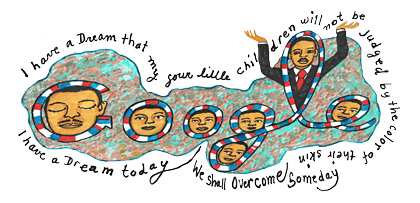
Fly your flag today, in honor of the Rev. Dr. Martin Luther King, Jr.

January 16, 2012

You already have it up and waving, right?  Did I really need to remind you?

Google logo for Martin Luther King, Jr., Day 2012

Google logo for Martin Luther King, Jr., Day 2012 - click for more information

Fly your flag today, in honor of our nation, and in honor of our nation’s honoring the memory and legacy of the Rev. Dr. Martin Luther King, Jr.

U.S. law encourages Americans to fly the U.S. flag on holidays and a few other occasions. Congress set aside the third Monday in January as a holiday to commemorate the life of the Rev. Dr. Martin Luther King, Jr.

To honor Dr. King, for several years civil rights leaders and others have urged us to find some way to serve our communities on this day — Americans have done it long enough to make it a tradition. Here’s the official find-a-way-to-serve page from the the federal government; look out your window, go spend a few minutes at your city hall, post office, or at the biggest church in town, or walk into any middle school in America, and opportunities to serve will caress you at every turn.

More, much more:

King, by photographer Ben Fernandez's "Countdown to Eternity"

King, by photographer Ben Fernandez's portfolio of photos from one year in the life of Dr. King, "Countdown to Eternity"

MLK logo from Google mlk2010

Google's logo for Martin Luther King, Jr. Day, 2010 - click for more information


Typewriter of the moment: Comedian Stan Laurel

January 16, 2012

Stan Laurel at his typewriter, via Mike Lynch Cartoons

Stan Laurel at his typewriter, where he composed notes to fans. Image via Mike Lynch Cartoons

That is Stan Laurel, half of the comedic team of Laurel and Hardy, famous from the movies of the black & white era, famous from the caricatures in the cartoons our children, perhaps, have seen.  The photo is circa 1958.

Oliver Hardy died in 1957 from a series of strokes, and Laurel suffered a stroke himself.  He was unable to make movies any more, he said.  But he did bother to personally answer all his correspondence from fans.  On the typewriter pictured, he typed out short notes in response the fan mail, like this one, from 1958:

Note from comedian Stan Laurel to a fan - via Mike Lynch Cartoons, via Letters of Note

Note from comedian Stan Laurel to a fan - via Mike Lynch Cartoons, via Letters of Note

Laurel died in 1965.  It’s a bygone era.

No, I haven’t identified the typewriter.

The text of the note can be found at Mike Lynch Cartoons.  I gather Lynch got the images from Letters of Note, a blog devoted to written correspondence of some historic value (it’s very interesting).

  • Laurel and Hardy in “Nothing But Trouble,” 1944

Even more: 


Is Fox News a barrier to further evolution of humans?

January 14, 2012

Rob Rogers, cartoonist with the Pittsburgh Post-Gazette, has an answer:

3,756

Tip of the old scrub brush to Devona Wyant.