World malaria report 2013 shows major progress in fight against malaria, calls for sustained financing (but not DDT)

March 21, 2014

News release from the World Health Organization:

World malaria report 2013 shows major progress in fight against malaria, calls for sustained financing

News release

Cover of World Malaria Report 2013

Cover of World Malaria Report 2013

11 December 2013 | Geneva/Washington DC – Global efforts to control and eliminate malaria have saved an estimated 3.3 million lives since 2000, reducing malaria mortality rates by 45% globally and by 49% in Africa, according to the “World malaria report 2013” published by WHO.

An expansion of prevention and control measures has been mirrored by a consistent decline in malaria deaths and illness, despite an increase in the global population at risk of malaria between 2000 and 2012. Increased political commitment and expanded funding have helped to reduce incidence of malaria by 29% globally, and by 31% in Africa.

The large majority of the 3.3 million lives saved between 2000 and 2012 were in the 10 countries with the highest malaria burden, and among children aged less than 5 years – the group most affected by the disease. Over the same period, malaria mortality rates in children in Africa were reduced by an estimated 54%.

But more needs to be done.

“This remarkable progress is no cause for complacency: absolute numbers of malaria cases and deaths are not going down as fast as they could,” says Dr Margaret Chan, WHO Director-General. “The fact that so many people are infected and dying from mosquito bites is one of the greatest tragedies of the 21st century.”

In 2012, there were an estimated 207 million cases of malaria (uncertainty interval: 135 – 287 million), which caused approximately 627 000 malaria deaths (uncertainty interval 473 000 – 789 000). An estimated 3.4 billion people continue to be at risk of malaria, mostly in Africa and south-east Asia. Around 80% of malaria cases occur in Africa.

Long way from universal access to prevention and treatment

Malaria prevention suffered a setback after its strong build-up between 2005 and 2010. The new WHO report notes a slowdown in the expansion of interventions to control mosquitoes for the second successive year, particularly in providing access to insecticide-treated bed nets. This has been primarily due to lack of funds to procure bed nets in countries that have ongoing malaria transmission.

In sub-Saharan Africa, the proportion of the population with access to an insecticide-treated bed net remained well under 50% in 2013. Only 70 million new bed nets were delivered to malaria-endemic countries in 2012, below the 150 million minimum needed every year to ensure everyone at risk is protected. However, in 2013, about 136 million nets were delivered, and the pipeline for 2014 looks even stronger (approximately 200 million), suggesting that there is real chance for a turnaround.

There was no such setback for malaria diagnostic testing, which has continued to expand in recent years. Between 2010 and 2012, the proportion of people with suspected malaria who received a diagnostic test in the public sector increased from 44% to 64% globally.

Access to WHO-recommended artemisinin-based combination therapies (ACTs) has also increased, with the number of treatment courses delivered to countries rising from 76 million in 2006 to 331 million in 2012.

Despite this progress, millions of people continue to lack access to diagnosis and quality-assured treatment, particularly in countries with weak health systems. The roll-out of preventive therapies – recommended for infants, children under 5 and pregnant women – has also been slow in recent years.

“To win the fight against malaria we must get the means to prevent and treat the disease to every family who needs it,” says Raymond G Chambers, the United Nations Secretary General’s Special Envoy for Financing the Health MDGs and for Malaria. “Our collective efforts are not only ending the needless suffering of millions, but are helping families thrive and adding billions of dollars to economies that nations can use in other ways.”

Global funding gap

International funding for malaria control increased from less than US$ 100 million in 2000 to almost US$ 2 billion in 2012. Domestic funding stood at around US$ 0.5 billion in the same year, bringing the total international and domestic funding committed to malaria control to US$ 2.5 billion in 2012 – less than half the US$ 5.1 billion needed each year to achieve universal access to interventions.

Without adequate and predictable funding, the progress against malaria is also threatened by emerging parasite resistance to artemisinin, the core component of ACTs, and mosquito resistance to insecticides. Artemisinin resistance has been detected in four countries in south-east Asia, and insecticide resistance has been found in at least 64 countries.

“The remarkable gains against malaria are still fragile,” says Dr Robert Newman, Director of the WHO Global Malaria Programme. “In the next 10-15 years, the world will need innovative tools and technologies, as well as new strategic approaches to sustain and accelerate progress.”

WHO is currently developing a global technical strategy for malaria control and elimination for the 2016-2025 period, as well as a global plan to control and eliminate Plasmodium vivax malaria. Prevalent primarily in Asia and South America, P. vivax malaria is less likely than P. falciparum to result in severe malaria or death, but it generally responds more slowly to control efforts. Globally, about 9% of the estimated malaria cases are due to P. vivax, although the proportion outside the African continent is 50%.

“The vote of confidence shown by donors last week at the replenishment conference for the Global Fund to Fight AIDS, Tuberculosis and Malaria is testimony to the success of global partnership. But we must fill the annual gap of US$ 2.6 billion to achieve universal coverage and prevent malaria deaths,” said Fatoumata Nafo-Traoré, Executive Director of the Roll Back Malaria Partnership. “This is our historic opportunity to defeat malaria.”

Notes for editors:

The “World malaria report 2013” summarizes information received from 102 countries that had on-going malaria transmission during the 2000-2012 period, and other sources, and updates the analyses presented in 2012.

The report contains revised estimates of the number of malaria cases and deaths, which integrate new and updated under-5 mortality estimates produced by the United Nations Inter-agency Group for Child Mortality Estimation, as well as new data from the Child Health Epidemiology Reference Group.


Ugandan court turned back challenge to DDT use

March 19, 2014

One more news story that demonstrates, first, there is no worldwide ban on DDT (not even with the POPs Treaty); and second, environmentalists probably couldn’t stop DDT use if they tried, in nations where malaria still poses a problem.

Uganda's location in Africa; WorldAtlas.com map

Uganda’s location in Africa; WorldAtlas.com map

Not that the DDT-crazy anti-environmentalist critics of Rachel Carson and WHO will notice, but here’s the news, anyway.

From All Africa, from The Observer in Kampala:

Uganda: DDT Petition Dismissed

By Derrick Kiyonga, 18 March 2014

A petition against the use of DDT to control malaria has been dismissed by the Constitutional court.

Judges said the 2009 petition by the Uganda Network on Toxic-Free Malaria Control (UNETMAC) did not raise any matter for interpretation under article 137 of the Constitution. UNETMAC had argued that indoor residual spraying (IRS) and the continued use of the insecticide was hazardous to Uganda’s agricultural exports.

The ministry of Health had earlier approved IRS in Apac and Oyam districts. The judgment by the five-judge panel was delivered by Justice Kenneth Kakuru.

Uganda’s lack of anti-malaria campaigns due to political unrest through much of the last 40 years appears to have contributed to rather severe problems in some provinces today.  At various points over the past decade, Indoor Residual Spraying (IRS) won court fights from business groups, trade groups, farmers, affected citizens and odd environmental organizations.  In each case, courts ruled in favor of DDT use.

IRS involves spraying the walls of a home where mosquitoes rest after biting a victim.  Hypothetically, the mosquito then gets a fatal does of insecticide, and will not live long enough to develop the next cycle of malaria parasites to pass back to human victims (the life cycle of the malaria parasite takes about 14 days in a mosquito’s gut before the bug becomes infectious).  DDT is not approved for outdoor use, but only for fighting disease, and only inside dwellings.

DDT and about a dozen other insecticides are used for IRS, in rotation, to avoid pushing the mosquitoes to evolve resistance to any one poison.  Even so, DDT grows less effective, and health workers increasingly avoid using it at all, in favor of other insecticides.

Despite a few hotspots of malaria in Africa, across the continent malaria infections and deaths continue to decline, a decline steady since the early 1970s, accelerated since 2000.

More:

Uganda. AfricaDiscovery.com

Uganda. AfricaDiscovery.com


How kids get to school, New Delhi edition

March 19, 2014

From Twitter:

From Twitter: “Another e.g. pic to show that school transport in Asia needs attention on health & safety aspects pic.twitter.com/Mn2FbSSELX”

Do you think the students have wi-fi to finish their homework on the way to school?

(This is not necessarily representative of all Indian school buses.)

One wonders at the stories behind such “buses” and their use.  It might make an interesting geography assignment, to find out how students get to school in other nations.  What is the most exotic, bizarre, dangerous or luxurious ride?

More:


Snow falling on yucca on White Sands

March 18, 2014

Another great shot from America’s public lands:

One of the world'a great natural wonders - the glistening white sands @WhiteSands_NPS. #NewMexico pic.twitter.com/dbzPpIfSRW

Department of Interior Great American Outdoors Tumblr caption: One of the world’a great natural wonders – the glistening white sands @WhiteSands_NPS. #NewMexico pic.twitter.com/dbzPpIfSRW

One of the problems of touring places like White Sands National Monument is that most tourists arrive mid-day; most spectacular views are probably close to sunrise or sunset, when the sky adds colors other than “bright” to the scene.

Like No Place Else on Earth

Rising from the heart of the Tularosa Basin is one of the world’s great natural wonders – the glistening white sands of New Mexico. Great wave-like dunes of gypsum sand have engulfed 275 square miles of desert, creating the world’s largest gypsum dunefield. White Sands National Monument preserves a major portion of this unique dunefield, along with the plants and animals that live here.

Yes, the same White Sands where the Trinity Project first triggered an atomic weapon, in 1945 — but the blast site is actually about 100 miles north of the National Monument on the military’s White Sands Missile Range. Historical reasons to visit, as well as nature and beauty reasons.

I assume that’s some sort of yucca in the photo; can you tell more specifically?

More, related:


A sermon remembering Millard Fillmore’s second wife

March 18, 2014

This was delivered in January.  My search engines found it just a couple days ago, a story about a sermon featuring Millard Fillmore and his second wife, Caroline.

Interesting.  From the Newnan Times-Herald in the suburbs of Atlanta, Georgia:

Almost forgotten president focus at service

Millard Fillmore's second wife, Caroline, and Fillmore's official White House portrait.


Millard Fillmore was president for a few difficult years a decade before the Civil War split the nation into.

He is almost forgotten by most Americans today. When remembered, Fillmore is often the punchline of a joke — he is often erroneously remembered as the first president to have a bathtub in the White House.

Fillmore and his wife, Caroline, however, were points of beginning for a recent sermon at Allen-Lee Memorial United Methodist Church in Lone Oak. Winston Skinner, a member of the church and a staff member at The Newnan Times-Herald who has a great love for history, brought the message.

Skinner was a pastor for more than 24 years and often used events from history as touchstones for sermons and special services. Chad Hill, Allen-Lee’s pastor, asked Skinner to preach on Jan. 12.

“This sermon idea had been rolling around in my head,” Skinner said.

Skinner, who lives in Newnan, has been interested in presidents and first ladies since he was in elementary school. “I had been reading about Caroline Fillmore, who married the former president in 1858. Upon reflection, I saw several points that ‘will preach’ in her life story,” he said.

“The Fillmores were a religious couple. Their home was known as one of clean language and living. She was Baptist. He Unitarian. When the former president had died in 1874, ministers from three different faiths preached at his funeral,” Skinner noted in his sermon.

Caroline McIntosh “was the wife of a former president, but she had never lived in the White House, never experienced the power and burden of the presidency,” Skinner preached.

“In Caroline Fillmore’s story, we find glimpses of our own. We were not there to see Jesus speak to a multitude on the hillside. We did not taste the fish and bread multiplied from a little boy’s lunch. We did not hear the noises as Lazarus, dead three days, rose from his tomb in Bethany and walked into the sunlight,” Skinner said.

“We did not experience any of that, but we who believe know the one who worked those great miracles. We know Jesus intimately. He lives in our hearts. He accompanies us each moment of our lives,” he added.

The hymns used for the service were from Ira Sankey’s Gospel Hymns, published in the 1870s. A copy of the popular hymnal was among Caroline Fillmore’s belongings offered at auction last year.

Shelia Simpson sang “Sweet Hour of Prayer” during the service.

Church members invited visitors on Jan. 12, days after Millard Fillmore’s 214th birthday. A special effort was made to contact members descendants of Coweta County’s pioneer Carmichael family who may be distantly related to Caroline Fillmore.

After the service, a display of some of Skinner’s presidential memorabilia was displayed in the church fellowship hall. There were miniature figures of presidents, coins, stamps and items autographed by four presidents’ wives — Frances Cleveland, Mary Harrison, Rosalynn Carter and Barbara Bush.

I hope there’s an electronic copy of that sermon, and I hope I can get one.


Why is the US flag displayed on the wrong side of basketball backboards?

March 16, 2014

Odd.

Watching the Big 10 Men’s Basketball tournament (Michigan vs. Michigan State) — it was the game that was on, my best chance short of internet to get news of PAC-12 and Mountain West conference results — and I looked at the backboard.

Someone thought college basketball needed to make a patriotic display beyond the usual hoo-haw, I suppose.  “Let’s put U.S. flag decals on the glass backboards.”  Nice little touch.  Every photograph of a ball going through the hoop, every shot of a fight for a rebound or to block a shot at the hoop, and there’s that little U.S. flag, reminding us of something.

In displaying the U.S. flag, the U.S. Flag Code notes that the flag should always be on its own right, or to the left of the audience facing it (See 4 U.S. Code § 7 (k)).

In that arena in Indianapolis, the flag is on the right.  Here’s a still photo from USA Today from an earlier game.

  Brian Spurlock-USA TODAY Sports  Mar 14, 2014; Indianapolis, IN, USA; Michigan Wolverines react as the Illinois Fighting Illini miss the potential winning shot at the buzzer in the quarterfinals of the Big Ten college basketball tournament at Bankers Life Fieldhouse. Michigan defeats Illinois 65-64. Mandatory Credit: Brian Spurlock-USA TODAY Sports

Caption of AP photo: Brian Spurlock-USA TODAY Sports Mar 14, 2014; Indianapolis, IN, USA; Michigan Wolverines react as the Illinois Fighting Illini miss the potential winning shot at the buzzer in the quarterfinals of the Big Ten college basketball tournament at Bankers Life Fieldhouse. Michigan defeats Illinois 65-64. Mandatory Credit: Brian Spurlock-USA TODAY Sports

Looking for an image of the Indianapolis backboard, I came across this image from the 2012 NBA finals.

Ball stuck in Game 5 of NBA finals between Miami and Oklahoma City; note flag decal on right. AP photo

AP caption: A ball is stuck between the backboard and basket during the first half of Game 5 of the NBA finals basketball series between the Oklahoma City Thunder and the Miami Heat, Thursday, June 21, 2012, in Miami (AP Photo by Lynne Sladky) [Note flag decal on right.]

This error of flag display has been around for at least two years.  What’s up with that?

Those who advocate amending the Constitution to make it a crime to desecrate the flag probably don’t anticipate jailing the entire NCAA or NBA.  Maybe we should revise the flag code, to be more reasonable.

More:


Honoring James Madison, the go-to guy, on his birthday

March 16, 2014

James Madison, the fourth President of the United States, and the Father of the Constitution, was born March 16, 1751, in the Tidewater area of Virginia.

Is it sinful that we do not celebrate his birthday with a federal holiday, fireworks, picnics and speeches and concerts?

Maybe you could fly your flag to day.  If the neighbors ask why, tell them you’re flying it for freedom on James Madison’s birthday.  They’ll say, “Oh,” and run off to Google Madison.  You will have struck a blow for the education that undergirds democracy.

A few years ago I was asked to talk about freedom to a group of freedom lovers in North Texas.  I chose to speak about James Madison’s remarkable, and too-often unremarked-upon life. Later, when I started this blog, I posted it here, with an introduction.  All of that is below, in honor of the birth of James Madison.

Did you know that Madison is the shortest man ever to have been president?  His stature is measured in freedom, not in feet and inches.

(Originally a post on July 31, 2006)

James Madison, 1783, by Charles Wilson Peale.  Library of Congress collection

James Madison, 1783, miniature by Charles Wilson Peale. Madison would have been 32. Library of Congress collection

I don’t blame students when they tell me they “hate history.”  Heaven knows, they probably have been boringly taught boring stuff.

For example, history classes study the founding of the United States. Especially under the topical restrictions imposed by standardized testing, many kids will get a short-form version of history that leaves out some of the most interesting stuff.

Who could like that?

Worse, that sort of stuff does damage to the history and the people who made it, too.

James Madison gets short shrift in the current canon, in my opinion. Madison was the fourth president, sure, and many textbooks note his role in the convention at Philadelphia that wrote the Constitution in 1787. But I think Madison’s larger career, especially his advocacy for freedom from 1776 to his death, is overlooked.

Madison was the “essential man” in the founding of the nation, in many ways. He was able to collaborate with people as few others could, in order to get things done, including his work with George Mason on the Virginia Bill of Rights, with George Washington on the Constitution and national government structure, Thomas Jefferson on the structure and preservation of freedom, Alexander Hamilton on the Constitution and national bank, and James Monroe on continuing the American Revolution.

We need to look harder at the methods and philosophy, and life, of James Madison. This is an opinion I’ve held for a long time. Below the fold I reproduce a “sermon” I delivered to the North Texas Church of Freethought in November 2001.

James Madison White House portrait, John Vanderlyn, 1816

James Madison’s official White House portrait, by John Vanderlyn in 1816; in the White House collection

I have left this exactly as it was delivered, though I would change a few things today, especially emphasizing more the key role George Washington played in pushing Madison to get the Constitution — a view I came to courtesy of the Bill of Rights Insitute and their outstanding, week-long seminar, Shaping the Constitution: A View from Mount Vernon 1783-1789. The Bill of Rights Institute provides outstanding training for teachers, and this particular session, at Washington’s home at Mount Vernon, Virginia, is well worth the time (check with the Institute to see whether it will be offered next year — and apply!). I am especially grateful to have had the opportunity to discuss these times and issues with outstanding scholars like Dr. Gordon Lloyd of Pepperdine University, Dr. Adam Tate of Morrow College, and Dr. Stuart Leibiger of LaSalle University, during my stay at Mount Vernon.

James Madison by Gilbert Stuart c. 1821

James Madison, portrait by Gilbert Stuart c. 1821; National Portrait Gallery

My presentation to the skeptics of North Texas centered around the theme of what a skeptic might give thanks for at Thanksgiving. (It is available on the web — a misspelling of my name in the program carried over to the web, which has provided me a source of amusement for several years.)

Here is the presentation:

Being Thankful For Religious Liberty

As Presented at the November, 2001 Sunday Service of The North Texas Church of Freethought

Historians rethink the past at least every generation, mining history for new insights or, at least, a new book. About the founders of this nation there has been a good deal of rethinking lately. David McCullough reminds us that John Adams really was a good guy, and that we shouldn’t think of him simply as the Federalist foil to Thomas Jefferson’s more democratic view of the world. Jefferson himself is greatly scrutinized, and perhaps out of favor — “American Sphinx,” Joseph Ellis calls him. The science of DNA testing shows that perhaps Jefferson had more to be quiet about than even he confessed in his journals. While Jefferson himself questioned his own weakness in his not freeing his slaves in his lifetime, historians and fans of Jefferson’s great writings wrestle with the likelihood of his relationship with one of his own slaves (the old Sally Hemings stories came back, and DNA indicates her children were fathered by a member of the Jefferson clan; some critics argue that Jefferson was a hypocrite, but that was Jefferson’s own criticism of himself; defenders point out that the affair most likely was consensual, but could not be openly acknowledged in Virginia at that time). Hamilton’s gift to America was a financial system capable of carrying a noble nation to great achievement, we are told – don’t think of him simply as the fellow Aaron Burr killed in a duel. Washington is recast as one of the earliest guerrilla fighters, and in one book as a typical gentleman who couldn’t control his expenses. Franklin becomes in recent books the “First American,” the model after which we are all made, somehow.

Of the major figures of these founding eras, James Madison is left out of the rethinking, at least for now. There has been no major biography of Madison for a decade or more, not since Ralph Ketcham’s book for the University of Virginia press. Madison has a role in Joseph Ellis’s Founding Brothers, but he shares his spotlight with Hamilton and Jefferson. I think this is an oversight. As we enter into the first Thanksgiving season of the 21st century, we would do well to take a look back at Madison’s life. Madison gives us a model of reason, and more important, a model of action coupled to reason. America’s founding is often depicted as a time of great thunder — if not the thunder of the lightning Ben Franklin experimented with, an experiment he parlayed into worldwide respect for Americans, it is the thunder of the pronouncements of Thomas Jefferson in the Declaration of Independence, or of George Washington, just generally thundering through history.

The use of a bolt of lightning as a symbol for this group is inspired, I think. I’m a great fan of Mark Twain, and when I see that bolt of electricity depicted I think of Twain’s observation:

“Thunder is good; thunder is impressive. But it is lightning that does the work.”

Thunder at the founding is impressive; where was the lightning?

I’d like to point out two themes that run through Madison’s life, or rather, two activities that we find him in time and again. Madison’s life was marked by periods of reflection, followed by action as a result of that reflection.

We don’t know a lot about Madison’s youth. He was the oldest son of a wealthy Virginia planter, growing up in the Orange County area of Tidewater Virginia. We know he was boarded out for schooling with good teachers – usually clergymen, but occasionally to someone with expertise in a particular subject – and we know that he won admission to Princeton to study under the Rev. John Witherspoon, a recent Presbyterian transplant from across the Atlantic. Madison broke with tradition a bit in attending an American rather than an English school. And after completing his course of study he remained at Princeton for another year to study theology directly under Witherspoon, with an eye toward becoming a preacher.

Witherspoon is often held up as an example of how religion influenced the founders, but he was much more of a rationalist than some would have us believe. He persuaded the young Madison that a career in law and politics would be a great service to the people of Virginia and America, and might be a higher calling. After a year of this reflection, Madison returned to Virginia and won election to local government.

In his role as a county official Madison traveled the area. He inspected the works of government, including the jails. He was surprised to find in jail in Virginia people accused of — gasp! — practicing adult baptism. In fact Baptists and Presbyterians were jailed on occasion, because the Anglican church was the state church of Virginia, and their practicing their faith was against the common law. This troubled Madison greatly, and it directed an important part of his work for the rest of his life. In January of 1774, Madison wrote about it to another prominent Virginian, William Bradford:

“Poverty and Luxury prevail among all sorts: Pride ignorance and Knavery among the Priesthood and Vice and Wickedness among the Laity. This is bad enough. But it is not the worst I have to tell you. That diabolical Hell conceived principle of persecution rages among some and to their eternal infamy the Clergy can furnish their Quota of Imps for such business. This vexes me the most of any thing whatever. There are at this time in the adjacent County not less than 5 or 6 well meaning men in close Gaol for publishing their religious Sentiments which in the main are very orthodox. I have neither patience to hear talk or think of any thing relative to this matter, for I have squabbled and scolded abused and ridiculed so long about it, to so little purpose that I am without common patience. So I leave you to pity me and pray for Liberty of Conscience to revive among us.”

By April, Madison’s views on the matter had been boiled down to the essences, and he wrote Bradford again more bluntly:

“Religious bondage shackles and debilitates the mind and unfits it for every noble enterprise.”

Madison must have done a fine job at his county duties, whatever they were, because in 1776 when Virginia was organizing its government to survive hostilities with England, Madison was elected to the legislative body.

Madison was 25, and still raw in Virginia politics. He was appointed to the committee headed by George Mason to review the laws and charter of the colony. Another who would serve on this committee when he was back from Philadelphia was Thomas Jefferson. George Mason was already a giant in Virginia politics, and by the time Madison got to Williamsburg, Mason had already completed much of the work on a bill of rights to undergird the new Virginia government. Madison noted that freedom of religion was not among the rights enumerated in Mason’s version — but it was too late, Mason said. The work was done.

Madison quietly went to work on Mason, in committee, over dinner, during social occasions — noting the great injustice of jailing people solely because of their beliefs, and urging to Mason that it did Virginia no good to keep these fathers from providing for their families.

Mason ultimately agreed to accept the amendment.

The pattern was set.

Perhaps a better example of this reflection and action cycle occurred nearly a decade later. By 1785 the war was over, independence was won, but the business of government continued. While serving as governor of Virginia, Thomas Jefferson had drafted about 150 proposals for laws, really a blueprint for a free government. About half of these proposals had been passed into law. By 1785, Jefferson was away from Virginia, representing the Confederation of colonies in Paris. Jefferson had provided several laws to disestablish religion in Virginia, and to separate out the functions of church and state. With Jefferson gone, however, his old nemesis Patrick Henry sought to roll back some of that work. Henry proposed to bring back state support for the clergy, for the stated purpose of promoting education. (Yes, this is the same battle we fight today for church and state separation.) After Jefferson’s troubled term as governor, Virginia turned again to Henry – Henry ultimately served six terms as governor. His proposal was set for a quick approval in the Virginia assembly. It was late in the term, and everyone wanted to get home.

Henry was, of course, a thundering orator of great note. Madison was a small man with a nervous speaking style, but a man who knew the issues better than anyone else in almost any room he could be in. Madison came up with an interesting proposal. Picking the religion for the state was serious stuff, he said. A state doesn’t want to pick the wrong religion, and get stuck with the wrong god, surely – and such weighty matters deserve widespread support and discussion, Madison said. His motion to delay Henry’s bill until the next session, in order to let the public know and approve, was agreed to handily.

You probably know the rest of this story. With a year for the state to reflect on the idea, Madison wrote up a petition on the issue, which he called a “Memorial and Remonstrance.” In the petition he laid out 15 reasons why separation of church and state was a superior form of government, concluding that in the previous 1,500 years, every marriage of church and state produced a lazy and corrupt church, and despotic government. Madison’s petition circulated everywhere, and away from Patrick Henry’s thundering orations, the people of Virginia chose Madison’s cool reason.

When the legislature reconvened in 1786, it rejected Henry’s proposal. But Madison’s petition had been so persuasive, the legislature also brought up a proposal Thomas Jefferson had made six years earlier, and passed into law the Virginia Statue for Religious Freedom.

This was a great victory for Madison, and for Virginia. He celebrated by convening a convention to settle disputes between Virginia and Maryland about navigation on the Chesapeake Bay. Having reflected on the nature of this issue — a dispute between colonies — Madison had sought advice from others having the same problems, such as New York and New Jersey. In that effort he got the support of a New Yorker working on the same problems, Alexander Hamilton. In the course of these discussions Madison thought it clear that the difficulty lay with the form of government that bound the colonies together under the Articles of Confederation. Hamilton agreed, and they got their respective states and conferences to agree to meet in Philadelphia in 1787 to try to fix those problems. [Since I first wrote this, I’ve learned that it was George Washington’s desire to get a federal government, to facilitate the settling of the Ohio River Valley where Washington had several thousands of acres to sell, that prompted him to push Madison into the Annapolis Convention, and who made the introduction between Madison and Washington’s old aide and friend, Alexander Hamilton; Madison’s work with Washington runs much deeper than I orignally saw.]

James Madison, 1792 portrait by Charles Wilson Peale, Gilcrease Museum, Tulsa

James Madison, 1792 portrait by Charles Wilson Peale, Gilcrease Museum, Tulsa

Amending the Articles of Confederation was a doomed effort, many thought. The colonies would go their separate ways, no longer bound by the need to hang together against the Parliament of England. Perhaps George Washington could have got a council together to propose a new system, but Washington had stayed out of these debates. Washington’s model for action was the Roman general Cincinnatus, who went from his plow to lead the Romans to victory, then returned to his farm, and finding his plow where he had left it, took it up again.

Madison invited Washington, and persuaded Washington to attend. Washington was elected president of the convention, and in retrospect that election guaranteed that whatever the convention produced, the colonies would pay attention to it.

You know that history, too. The convention quickly decided the Articles of Confederation were beyond repair. Instead, they wrote a new charter for a new form of government. The charter was based in part on Jefferson’s Virginia Plan, with lots of modifications. Because the Constitution resembles so much the blueprint that Jefferson had written, and because Jefferson was a great founder, many Americans believe Jefferson was a guiding light at that Philadelphia convention. It’s often good to reflect that Jefferson was in Paris the entire time. While America remembers the thunder of Washington’s presiding, Franklin’s timely contributions and Jefferson’s ideas, it was Madison who did the heavy lifting, who got Washington and Franklin to attend the meeting Madison had set up, and got Jefferson’s ideas presented and explained.

It was Madison who decided, in late August of 1787, that the convention could not hang together long enough to create a bill of rights, and instead got approval for the basic framework of the U.S. government. In Virginia a few months later, while Patrick Henry thundered against what he described as a power grab by a new government, it was Madison who assembled the coalitions that got the Constitution ratified by the Virginia ratifying convention. And when even Jefferson complained that a constitution was dangerous without a bill of rights, it was Madison who first calmed Jefferson, then promised that one of the first actions of the new government would be a bill of rights. He delivered on that promise as a Member of the House of Representatives in 1789.

It is difficult to appreciate just how deeply insinuated into the creation of America was James Madison. In big ways and small, he made America work. He took the lofty ideas of Jefferson, and made them into laws that are still on the books, unamended and unedited, more than 200 years later.

When the ratification battle was won, when Madison had won election to the House over Patrick Henry’s strong objection, partly by befriending the man Henry had picked to defeat Madison, James Monroe, Madison could have savored the moment and been assured a place in history.

James Madison in 1804, by Gilbert Stuart

James Madison in 1804, by Gilbert Stuart. Colonial Williamsburg Foundation, Williamsburg, Virginia. Gift of Mrs. George S. Robbins

That’s not what a lightning bolt does. Journeying to New York for the opening of the First Congress and the inauguration of Washington as president, Madison stopped off at Mount Vernon to visit with Washington, apparently at Washington’s request. In what was a few hours, really, Madison wrote Washington’s inaugural address. While there at Mount Vernon, Madison stumbled into a discussion by several others on their way to New York, wondering what high honorific to apply to the new president. “Excellency” was winning out over “Your highness,” until Washington turned to Madison for an opinion. Madison said the president should be called, simply, “Mr. President.” We still do.

Once in New York, Madison saw to the organizing of the Congress, then to the organizing of the inauguration. And upon hearing Washington’s inauguration address — which Madison had ghosted, remember — Congress appointed Madison to write the official Congressional response.

Years later, in Washington, Madison engineered the candidacy of Thomas Jefferson for president, and after Jefferson was elected, Madison had the dubious honor as Secretary of State of lending his name to the Supreme Court case that established the Supreme Court as the arbiter of what is Constitutional under our scheme of government, in Marbury v. Madison.

Wherever there was action needed to make this government work, it seemed, there was James Madison providing the spark.

James Madison was the lightning behind the thunder of the founding of America. We should be grateful that he lived when he did, where he did, for we all share the fruits of the freedoms he worked to obtain. And in this Thanksgiving season, let us look for appropriate ways to honor his work.

James Madison circa 1829-1839, portrait by Chester Harding.  National Portrait Gallery

James Madison, 1829, portrait by Chester Harding. National Portrait Gallery. “In 1829, Madison came out of retirement to attend a convention for revising Virginia’s constitution. While there, he posed for this portrait by the Massachusetts painter Chester Harding.”

The Madisonian model of thoughtful reflection leading to action is one that is solidly established in psychological research. It is the model for leadership taught in business schools and military academies.

I would compare religious liberty to a mighty oak tree, under which we might seek shade on a hot summer day, from which we might draw wood for our fires to warm us in winter, or lumber to build great and strong buildings. That big oak we enjoy began its life long before ours. We enjoy its shade because someone earlier planted the seed. We enjoy our freedoms today because of men like James Madison.

How do we give thanks? As we pass around the turkey to our family, our friends, we would do well to reflect on the freedoms we enjoy, and how we got them.

Finally, remembering that someone had to plant those seeds, we need to ask: What seeds must we plant now for those who will come after us? We can demonstrate our being grateful for the actions of those who came before us by giving to those who come after us, something more to be grateful for. A life like Madison’s is a rarity. Improving on the freedoms he gave us might be difficult. Preserving those freedoms seems to me a solemn duty, however. Speaking out to defend those freedoms is an almost-tangible way to thank James Madison, and as fate would have it, there is plenty of material to speak out about. A postcard to your senators and representative giving your reasoned views on the re- introduction of the Istook Amendment might be timely now – with America’s attention turned overseas for a moment, people have adopted Patrick Henry’s tactic of trying to undo religious freedom during the distraction. I have had a lot of fun, and done some good I hope, in our local school system by asking our sons’ science and biology teachers what they plan to teach about evolution. Whatever they nervously answer — and they always nervously answer that question — I tell them that I want them to cover the topic fully and completely, and if they have any opposition to that I would be pleased to lend my name to a suit demanding it be done. We might take a moment of reflection to ponder our views about a proposed Texas “moment of silence” bill to be introduced, and then let our state representatives have our thoughts on the issue.

Do you need inspiration? Turn to James Madison’s writings. In laying out his 15-point defense of religious freedom in 1785, Madison wrote that separation of church and state is essential to our form of government:

“The preservation of a free Government requires not merely, that the metes and bounds which separate each department of power be invariably maintained; but more especially that neither of them be suffered to overleap the great Barrier which defends the rights of the people.”

How can we express our gratitude for such a foundation for religious liberty? Let loose a few lightning bolts, in remembrance of Madison.

Copyright © 2001 and 2006 by Ed Darrell. You may reproduce with attribution. Links added in May 2013.

More:


Thank you, Rachel Carson!

March 16, 2014

An eagle gathering on the upper Mississippi River. 40 years ago there may not have been this many eagles along the entire river. Cornell Ornithology Labs photo.

An eagle gathering on the upper Mississippi River. 40 years ago there may not have been this many eagles along the entire river. Cornell Ornithological Laboratory photo.

Cornell Laboratory of Ornithology said:

A convocation of Bald Eagles at Dam 13 along the upper Mississippi River (between Illinois and Iowa). If this isn’t incredible enough, photographer Michael Descamps reports that this group represents less than half of the eagles that were gathered there the day of the photo. What an incredible event to witness and thanks for sharing!

When the Endangered Species Act passed, and when the new EPA banned most outdoor uses of DDT in the U.S., there may not have been this many eagles on the entire Mississippi River watersheds.  Today, we have healthier ecosystems across the nation, and a lot more eagles, osprey, peregrine falcons, and brown pelicans, among other wildlife.

Gee. Environmental protection works well sometimes.


π Day tribute from Arches National Park

March 14, 2014

Happy Pi Day!

Arches National Park Happy Pi Day! “PsyPhi” by Pete Apicella, 2010 Community Artist in the Parks (kh)

Hey, I wonder when Fibonacci’s birthday falls. π


March 14, 2014: π Day! A π roundup, mostly pie

March 14, 2014

Let’s rerun this one.  I like the photographs. I may go search for a good piece of pie.

Of course you remembered that today is pi Day, right?

Pi Day Pie from Slashfood.com

Happy π Day! Pi Day Pie – Slashfood.com

Oh, or maybe better, π Day.

We’ll start with the brief post from a few months ago, and then build on it with some activities and posts from around the WordPress-o-sphere.

The good people at PiDay.org suggest a few ways you can celebrate:

Make (and Eat) a Pie – These pie recipes for Pi Day from NPR’s McCallister look incredibly tasty. But, there’s no shame in putting a frozen store-bought pie in the oven, or picking up a pie from your local bakery. Any kind of pie is great on Pi Day! If you’re making your own, get inspired by these beautifully designed Pi Day Pies. Tell us on Facebook: What’s your favorite kind of pie for Pi Day?

Hope your π Day is complete as a circle, and well-rounded!

How are others celebrating?  A look around WordPress:

At SocialMediaPhobe, a musical interpretation of pi featuring the music of Michael Blake:

So Long Freedom:

pidaypieToday is March 14th, also known as “Pi Day” for us math geeks out there because March 14th (3/14) is the first 3 digits of π (3.14159…).  To celebrate “Pi Day” I highly recommend doing something mathematical while having some pie at 1:59 pm.  I recommend Yumology‘s S’mores Pie as it has 3 main ingredients (chocolate, marshmallow, and graham cracker) and about 0.14159 other ingredients like sugar, butter, and stuff.  If you are not a math geek, its okay…you can still eat pie and count things like how many stop signs you pass on your way back to work from lunch.  Or you could go to the library and take out a book on something fun like binary code.  As we like to say, “There are only 10 types of people in the world:  Those that understand binary and those that don’t.”  Seriously, binary is as easy as 01000001, 01000010, 01000011.

Miles Free at PMPA Speaking of Precision:

Today 3-14 at 1:59  I will be celebrqting Pi Day. 3.14159 is the value of pi to 5 decimals...

So besides being  the cause of much techie “irrational” exuberance, Pi Day  is a great way to get some engagement with students.

Marymount High School has several activities, last year they had a design competition incorporating pi; the students then made and sold buttons of each design, proceeds going to the Red Cross.

Hmm- math subject matter, design, production, sales, accounting.

Sounds like what we do in manufacturing.
Maybe celebrating Pi Day is not so irrational as first thought.

Free said his pie is peach.

Steve Doyle at CraveDFW:

On March 12, 2009 your lawmakers  passed a non-binding resolution (HRES 224) recognizing March 14, 2009 as National Pi Day. It is one of the more legit holidays we discuss here, and it is actually an homage to geeks everywhere who see the date as a reason to celebrate due to its mathematical implications. We say any reason to celebrate anything is just fine by us.

Since we are predominately about food we will suggest a few places to actually enjoy a pie.

DSC06367

If you followed us at all this week you may have seen the pie at Bowl and Barrel pop up on our pages. This is the uber delicious Butterscotch Pie served as the solo dessert at the bowling alley and restaurant.  Go eat one of these.

He’s got more pi pie, if you click over there.

Gareth Branwyn at MakeZine offers more pie and a mnemonic:

How to Remember Pi to 15 Digits

Pi-Pie--69299

By way of sci-fi author and mathenaut Rudy Rucker’s Facebook wall comes this:

One way to remember the first few digits of pi is to count the letters in the words of this phrase:

“How I need a drink, alcoholic of course, after the heavy lectures involving quantum mechanics.”

[Image via FreakingNews]

Another song, on YouTube, at Awsomesauce:

b.love offers this clock image (is this clock for sale somewhere?):

A clock for pi day

TED Blog offers two videos:

Chirag Singh explains his “passion for pi.”

Daniel Tammet, “Different Ways of Knowing:

Geeks are really out in force today, flaunting pi for all they’ve got.

More:


Happy birthday, Albert Einstein! 135 years, today

March 14, 2014

How many ways can we say happy birthday to a great scientist born on Pi Day?  So, an encore post.

E=mcc - logo from AIP

E=energy; m=mass; c=speed of light

Happy Einstein Day! to us.  Albert’s been dead since 1955 — sadly for us.  Our celebrations now are more for our own satisfaction and curiosity, and to honor the great man — he’s beyond caring.

Almost fitting that he was born on π Day, no? I mean, is there an E=mc² Day?

Albert Einstein was born on March 14, 1879, in Ulm, Germany, to Hermann and Pauline Einstein. 26 years later, three days after his birthday, he sent off the paper on the photo-electric effect; that paper would win him the Nobel Prize in Physics in another five years, in 1921. In that same year of 1905, he published three other papers, solving the mystery of Brownian motion, describing what became known as the Special Theory of Relativity and solving the mystery of why measurements of the light did not show any effects of motion as Maxwell had predicted, and a final paper that noted a particle emitting light energy loses mass. This final paper amused Einstein because it seemed so ludicrous in its logical extension that energy and matter are really the same stuff at some fundamental point, as expressed in the equation demonstrating an enormous amount of energy stored in atoms, E=mc².

Albert Einstein as a younger man - Nobel Foundation image

Albert Einstein as a younger man – Nobel Foundation image

Any one of the papers would have been a career-capper for any physicist. Einstein dashed them off in just a few months, forever changing the fields of physics. And, you noticed: Einstein did not win a Nobel for the Special Theory of Relativity, nor for E=mc². He won it for the photo electric effect. Irony in history.

106 years later Einstein’s work affects us every day. Relativity theory at some level I don’t understand makes possible the use Global Positioning Systems (GPS), which revolutionized navigation and mundane things like land surveying and microwave dish placement. Development of nuclear power both gives us hope for an energy-rich future, and gives us fear of nuclear war. Sometimes, even the hope of the energy rich future gives us fear, as we watch and hope nuclear engineers can control the piles in nuclear power plants damaged by earthquakes and tsunami in Japan.

English: Albert Einstein on a 1966 US stamp

Albert Einstein on a 1966 US stamp (Photo credit: Wikipedia)

If Albert Einstein was a genius at physics, he was more dedicated to pacifism. He resigned his German citizenship to avoid military conscription. His pacifism made the German Nazis nervous; Einstein fled Germany in the 1930s, eventually settling in the United States. In the U.S., he was persuaded by Leo Szilard to write to President Franklin Roosevelt to suggest the U.S. start a program to develop an atomic weapon, because Germany most certainly was doing exactly that. But while urging FDR to keep up with the Germans, Einstein refused to participate in the program himself, sticking to his pacifist views. Others could, and would, design and build atomic bombs. (Maybe it’s a virus among nuclear physicists — several of those working on the Manhattan Project were pacifists, and had great difficulty reconciling the idea that the weapon they worked on to beat Germany, was deployed on Japan, which did not have a nuclear weapons program.)

English: USSR stamp dedicated to Albert Einste...

Everybody wanted to claim, and honor Einstein; USSR issued this stamp dedicated to Albert Einstein Русский: Почтовая марка СССР, посвящённая Альберту Эйнштейну (Photo credit: Wikipedia)

Einstein was a not-great father, and probably not a terribly faithful husband at first — though he did think to give his first wife, in the divorce settlement, a share of a Nobel Prize should he win it. Einstein was a good violinist, a competent sailor, an incompetent dresser, and a great character. His sister suffered a paralyzing stroke. For many months Albert spent hours a day reading to her the newspapers and books of the day, convinced that though mute and appearing unconscious, she would benefit from hearing the words. He said he did not hold to orthodox religions, but could there be a greater show of faith in human spirit?

Einstein in 1950, five years before his death

Einstein in 1950, five years before his death

When people hear clever sayings, but forget to whom the bon mots should be attributed, Einstein is one of about five candidates to whom all sorts of things are attributed, though he never said them. (Others include Lincoln, Jefferson, Mark Twain and Will Rogers). Einstein is the only scientist in that group. So, for example, we can be quite sure Einstein never claimed that compound interest was the best idea of the 20th century. This phenomenon is symbolic of the high regard people have for the man, even though so few understand what his work was, or meant.

A most interesting man. A most important body of work. He deserves more study and regard than he gets.

More, Resources:


It’s π (pi) Day, 2014!

March 14, 2014

One might wonder when a good sociologist will write that book about how our vexing and depressing times push people to extreme measures, dwelling on one particular manifestation:  The invention of new celebrations on the calendar.

In my lifetime Halloween grew from one short dress-up night with candy for kids, to a major commercially-exploited festival, from an interesting social event to a religiously-fraught night of bacchanalia with a weeks-long buildup.  Cinco de Mayo grew into a festival of all things Mexican, though very few people can explain what the day commemorates, even among our Mexican neighbors.  (No, it’s not Mexico’s Independence Day.)

St. Patrick’s Day grew in stature, and Guinness products now are freely available in almost every state.  Bastille Day gets a celebration even in Oak Cliff, Texas.  I’ve pushed Hubble Day, and Feynman Day; this weekend I’ll encourage people to celebrate James Madison’s birthday — and in January, I encourage the commemoration of Millard Fillmore’s birthday.

It could be a fun book, if not intellectually deep.

It will explain why, on Einstein’s birthday, March 14, we celebrate the number π (pi).

That book has not been written down, yet.  So we’re left simply to celebrate.

Down in Austin, at SXSW, some performance artist used the sky as his canvas on π Day Eve; The Austin American-Statesman captured it:

Caption from the Austin American-Statesman: Austin American-Statesman  Tomorrow is pi day, aka March 14, aka 3.14 - which is why mathematical pi was spelled out in a circle over Austin today (Friday isn't supposed to be as good of a day for skywriting)

Caption from the Austin American-Statesman: Austin American-Statesman Tomorrow is pi day, aka March 14, aka 3.14 – which is why mathematical pi was spelled out in a circle over Austin today (Friday isn’t supposed to be as good of a day for skywriting)

Read more about San Francisco-based artist ISHKY’s project on MyStatesman: http://atxne.ws/1cWLF1e

Photo by Austin Humphreys / Austin American-Statesman — with Joseph Lawrence Cantu.

There’s too much good stuff, on Einstein and on pi, for one post.

Happy pi Day!

Here’s to Albert Einstein, wherever you are!

More:

A photo at Life in a Pecan Guild caught a much more informative photograph of the Austin skywriting:

Each letter, and digits (yes, they printed pi in the Sky!) was formed by five airplanes flying in formation.  Wow. Just wow. Photo at Life in a Pecan Guild.

Each letter, and digit (yes, they printed pi in the Sky!) was formed by five airplanes flying in formation. Wow. Just wow. Photo at Life in a Pecan Guild. (Go there for more photos.)

There will be some great photos of that Austin skywriting, I predict.  Will you point them out to us, in comments?


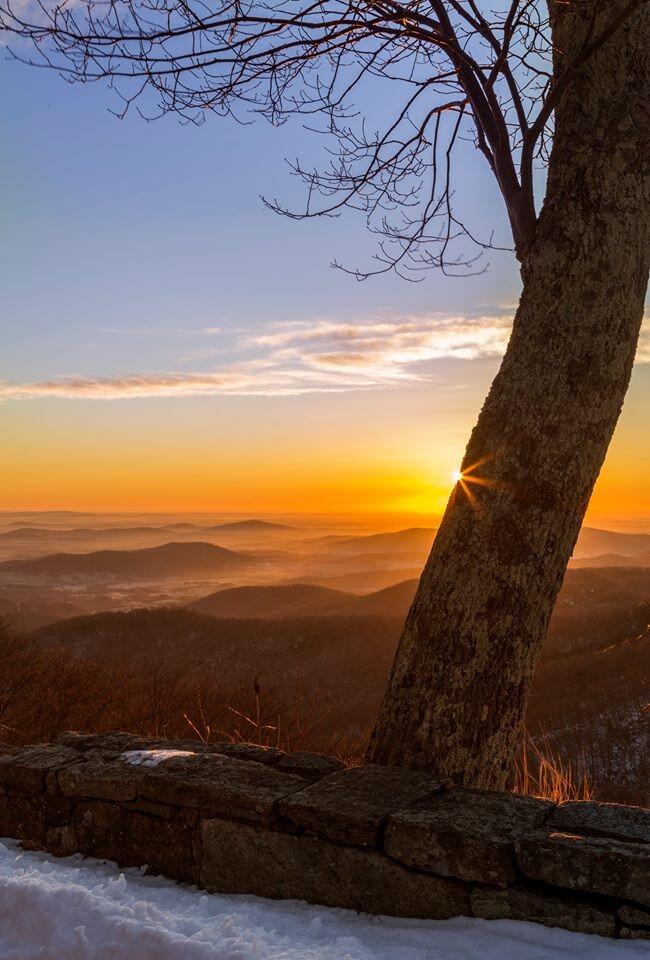
Sunrise on the Shenandoah Mountains

March 11, 2014

This is a hopeful picture.

US Dept of Interior Tweet:  Beautiful #sunrise over @ShenandoahNPS last weekend. #Virginia #travel #nature pic.twitter.com/T2sEgczGsz

US Dept of Interior Tweet: Beautiful #sunrise over @ShenandoahNPS last weekend. #Virginia #travel #nature pic.twitter.com/T2sEgczGsz

Probably taken along the Blue Ridge Parkway.  At the bottom of the photo, note the stone wall, probably built by the Civilian Conservation Corps during the Franklin Roosevelt administration, and still contributing to America’s beauty and economy 80 years later.

I can imagine driving along, catching a beautiful sunrise, but not being at a point to stop to photograph it.  Driving farther along, the photographer found a safe place to stop, but the sunrise itself was gone by 15 minutes.  With the aid of a young tree, however, the photographer can recapture that moment of the Sun’s peeking over the horizon, without special effects.  Nice thought for the shot.


It’s a desert out there: Salmon Research at Iliamna Lake, Alaska 2013 – Jason Ching film

March 6, 2014

Sitting in a hot trailer out on the northern New Mexico desert, Arizona State’s great soil scientist Tom Brown tipped back his cowboy hat, and asked me if I had been lonely over the previous week.  Classes at BYU started up in August, and our other field workers on the project, with the University of Utah Engineering Experiment Station, for EPA and New Mexico Public Service, had gone back to class.  My classes at the University of Utah didn’t start for a few more weeks — so I was holding down the fort by myself.

Dr. Brown’s expertise in reading air pollution damage on desert plants propelled a good part of the work.  He showed me how to tell the difference between sulfur dioxide damage and nitrogen oxide damage on grasses and other plants, and how to tell  when it was insects.  He had some great stories.  As a Mormon, he was also full of advice on life.

The Shiprock, a plug from an ancient volcano, left after the mountain eroded away. Near Shiprock, New Mexico, on the Navajo Reservation. Wikipedia image by Bowie Snodgrass

The Shiprock, a plug from an ancient volcano, left after the mountain eroded away. Near Shiprock, New Mexico, on the Navajo Reservation. Wikipedia image by Bowie Snodgrass

Between Farmington where our hotel was, and Teec Nos Pos where our most distant (non-wet) sampling site was, radio reception was lousy most of the time.  The Navajo-language AM station in Farmington played some of the best music, and sometimes it could be caught as far west as Shiprock .  Most of the time, driving across Navajoland, I had nothing but my thoughts to accompany me.  Well, thoughts and the all-too-frequent Navajo funeral processions, 50 pickups long on a two-lane highway.

“No, not lonely.  There’s a lot of work, I’ve got good books, and sleep is good,” I told him.

“Enjoy it,” Brown said.  “The best time for any researcher is out in the field.  And when you’re young, and you haven’t seen it all, it’s better.”

Indian rice grass in the sunlight (Oryzopsis hymendoides). Photo from the Intermountain Herbarium, Utah State University Extension Service

Indian rice grass in the sunlight (Oryzopsis hymendoides). Photo from the Intermountain Herbarium, Utah State University Extension Service

Brown spent a couple of days.  Within a couple of weeks I turned everything over to other Ph.Ds to shut down the wet sampling for the winter, and caught a ride back to Provo (closer to where I lived) in a Cessna with a pilot who loved to fly low enough to see the canyons along the way.  Get a map and think of the possibilities, with a landing in Moab; if you don’t drool at the thought of such a trip in the air but not too high, if your heart doesn’t actually beat faster thinking of such a trip, go see your physician for treatment.

By that time I was out of film, alas.

My few summers out in the desert chasing air pollution stay fixed in the surface of my memory.  Indian rice grass still excites me in the afternoon sun (Oryzopsis hymenoides) — one of the more beautiful of grasses, one of the more beautiful and soil-holding desert plants.  When hear the word “volcano,” I think of the Shiprock.  When I read of air pollution damage, I think of all the pinon, aspen, cottonwoods, firs and other trees we gassed; when I see aspen in its full autumn glory, I remember those dozen  or so leaves we caused to turn with SO2 (slight damage turns the leaves colors; greater damage makes them necrotic, a bit of a mirror of autumn).

All of that came back as I watched Jason Ching’s film, “Salmon Research at Iliamna Lake, Alaska 2013,” a simple six-minute compilation of shots taken with modern electronic cameras, including the hardy little GoPros, and with assistance from a DJI Phantom Quadcopter drone.  Wow, what we could have captured with that equipment!

Ching’s description of the film:

This video showcases the scenery of Iliamna Lake and shows some of the 2013 research of the Alaska Salmon Program’s Iliamna Lake research station, one of four main facilities in Southwest Alaska . Established in the 1940’s, the Program’s research has been focused on ecology and fisheries management relating primarily to salmon and the environment in Bristol Bay, Alaska. Check out our program at: fish.washington.edu/research/alaska/

Filmed and edited by Jason Ching
Additional footage provided by Cyril Michel

Song:
“The long & quiet flight of the pelican” by Ending Satellites (endingsatellites.com)

Additonal Information:
Shot on a Canon 5d Mark II, Canon T3i, GoPro Hero 2 and GoPro Hero 3
DJI Phantom Quadcopter

JasonSChing.com

I am very grateful to be a part of such a long standing, and prominent program that allows me to work in the field in such an incredible setting with fantastic folks. This is the second video I created, the first one in 2012, to merely show family and friends back at home what I’ve been up to during the summer. This video was often shot between, or during field sampling events so a special thanks goes out to all those who supported me by continuing to work while I fiddled with camera gear.

Do you really want to get kids more interested in science?  Show them this stuff.  Scientists get the front seats on cool stuff — and they often get paid to do it, though they won’t get rich.

Researching life, and rocks, geography and landscape, and water resources, one may be alone in a desert, or a desert of human communication.  Then one discovers just how beautiful the desert  is, all the time.

More:

  • Yes, I know; Indian rice grass has been renomenclaturedAchnatherum hymenoides (Roemer & J.A. Shultes) Barkworth, or Stipa hymenoides Roemer & J.S. Shultes, or Oryzopsis hymenoides (Roemer & J.S. Shultes) Ricker ex Piper.  It is the State Grass of Utah

Nathan Bigelow on Woodrow Wilson, TODAY (March 5), at Austin College

March 5, 2014

Too late for most of us, but history teachers near Sherman, Texas, ought to zip out as soon as school is out this afternoon, and head over to Austin College.

From North Texas e-News:

Nathan Bigelow, Professor of Political Science at Austin College in Sherman, Texas; Bigelow will present

Nathan Bigelow, Professor of Political Science at Austin College in Sherman, Texas; Bigelow will present “The Evolving Political Thought of Professor [Woodrow] Wilson,” March 5, 2014.

Bigelow to share insight on political evolution of Woodrow Wilson

SHERMAN, TEXAS — Nathan Bigelow, Austin College associate professor of political science and chair of the Department of Political Science, will present “The Evolving Political Thought of Professor Wilson” on March 5 at 4:30 p.m. in Wright Campus Center, Room 231. A 4 p.m. reception in nearby Johnson Gallery precedes his presentation, which highlights his recent sabbatical study. The event, free and open to the public, is hosted by the Johnson Center for Faculty Development and Excellence in Teaching.

Bigelow said his talk will focus on the bookends of Woodrow Wilson’s academic career: Congressional Government (1880), in which he made a broad critique of the American constitutional system, and Constitutional Government (1908), written just before he left academia for a career in politics, in which he reassessed many of his original positions. “I contend that his evolving thought can be traced to changes in the political environment during this time – specifically, increased party discipline and invigorated presidential leadership,” Bigelow said.” I will use newly available quantitative measures of this time period to help support my argument.”

The Robert and Joyce Johnson Center for Faculty Development and Excellence in Teaching, is directed by Bernice Melvin, Margaret Root Brown Chair of Foreign Languages and Literatures and professor of French. Within the mission of the center is the encouragement of ‘bold exploration of intellectual frontiers” and “fostering lively intellectual dialogue within and across academic disciplines.”

Austin College is a leading national independent liberal arts college located north of Dallas in Sherman, Texas. Founded in 1849, making it the oldest institution of higher education in Texas operating under original charter and name, the college is related by covenant to the Presbyterian Church (USA). Recognized nationally for academic excellence in the areas of international education, pre-professional training, and leadership studies, Austin College is one of 40 schools profiled in Loren Pope’s influential book Colleges That Change Lives.

Texas history and social studies teachers have been working to bolster teaching of the Progressive Era, Imperialism, and important figures of those times including Woodrow Wilson, after testing indicated Texas students are too often unfamiliar with the times and events.  Sherman area history teachers are lucky to have this close by.

I’ve been unable to discover whether professional education credit will be offered.