Rare, new and alternative Christmas songs: Joni Mitchell’s “River”

December 9, 2017

Joni Mitchell skating away on a river. Photo by Joel Bernstein.

Joni Mitchell skating away on a river. Photo by Joel Bernstein.

Washington Post picked up on it: A lot of musicians make great performances of non-standard Christmas tunes.

Joni Mitchell’s “River” has picked up covers by quite a few artists as a Christmas tune.

Does it just mention Christmas, or is it really a song of the season?

For example, Sam Smith:

In a discussion of Joni Mitchell back in April, here on Millard Fillmore’s Bathtub (with Paul Sunstone), I noted how people appreciate Joni Mitchell as a songwriter more as time goes on, including the use of “River” in Christmas collections:

Joni Mitchell’s fans are superappreciative, including such people as Judy Collins, who covers Mitchell on several songs.

But generally, yes, I think she’s not considered a great composer by those who compile lists of great composers, and she’s not considered a great singer by those who compile lists of great singers.

Part of the issue is that Mitchell came out of Canada as folk-rock took off. When I first bought her albums they were in the folk section; later they moved to the “pop” section (go figure). Her later albums stayed in rock or pop, even as her love of Mingus and Jazz pushed her work solidly into jazz. I’ve never seen her work listed as jazz in any recording sales store.

So she’s tough to categorize. Is she as strong or influential in folk as Joan Baez or Bob Dylan? Is she as strong in Rock as Crosby, Stills, Nash & Young (at least half of whom she had affairs with)? Is she as good at jazz as Ella [Fitzgerald] or Tony Bennett? Is she as good a poet as Leonard Cohen?

I think one can make a solid case that Joni Mitchell’s work is as poetic as Paul Simon’s, deserving as much attention for that reason as his. Simon won the Gershwin Award from the Kennedy Center; has Mitchell ever been considered? Is she less deserving than Billy Joel?

One of my criteria: I think every party I attended as an undergraduate, someone put on the album “Blue.” In graduate school, in a hotter climate, Maria Muldaur made a run (time to get away when “Midnight at the Oasis” came on); but “Blue” has stayed a turntable hit for decades. When our oldest son was at the University of Dallas, on one visit I was struck that “Blue” played out of three different apartments in his complex, at least 40 years after its release. It’s not Pink Floyd’s “Dark Side of the Moon,” but I think it lasts longer on the play list of people who play them both.

In the past three years I’ve been impressed at the appearance of her song “River” on Christmas song compilations. “I wish I had a river I could skate away on,” she and her covering artists sing. She captured a feeling of Christmas much as Irving Berlin did, with a more beautiful melody, if not quite as hummable. Has anyone ever compared her to Irving Berlin?

Long post required. I’m not musicologist enough to do it justice, I think.

See these:

“River” has become a movement!

This one is odd; I wonder if someone did a mashup of Charlie Brown and Joni Mitchell, or if the Schulz cartoon organization really did use Mitchell’s tune.

“River” is not ready for use in churches, I think. Still a good song for the time of year, if not the actual religious celebration.

Any other good versions of “River” you like? Any on Christmas albums? Tell about them.


Reckless Daughter: Yaffe’s book on Joni Mitchell

December 9, 2017

Reckless Daughter, a biography and analysis of Joni Mitchell, by David Yaffe. (Photo: Farrar, Straus & Giroux)

Reckless Daughter, a biography and analysis of Joni Mitchell, by David Yaffe. (Photo: Farrar, Straus & Giroux)

David Yaffe’s biography of Joni Mitchell is out. Reckless Daughter: A Portrait of Joni Mitchell (Sarah Crichton Books/Farrar, Straus & Giroux, 376 pp.) gives solid analysis from a good writer to a favorite artists whose music classed in folk, rock or jazz, always transcended categorization.

Yaffe spoke with PBS NewsHour:

Another interview with Yaffe, from Global News (CBC?):

And a 2014 interview with Joni Mitchell, by Tavis Smiley:


December 7, 2017: Fly flags for Pearl Harbor Remembrance, and for Delaware statehood — and at half staff

December 7, 2017

From Dayton Daily News: Jeff Duford, curator for the National Museum of the U.S. Air Force, with a flag that flew on the U.S.S. St. Louis in Hawaii during the attack on Pearl Harbor on Dec. 7, 1941. The same flag flew aboard the U.S.S. Iowa in Tokyo Bay on September 16, 1944, as Japan signed instruments of surrender aboard the U.S.S. Missouri.

From Dayton Daily News: Jeff Duford, curator for the National Museum of the U.S. Air Force, with a flag that flew on the U.S.S. St. Louis in Hawaii during the attack on Pearl Harbor on Dec. 7, 1941. The same flag flew aboard the U.S.S. Iowa in Tokyo Bay on September 16, 1944, as Japan signed instruments of surrender aboard the U.S.S. Missouri. [This flag was displayed for one day at the museum, on Pearl Harbor Remembrance Day 2016.]

December 7 is a two-fer flag-flying day.

By public law, December 7 is Pearl Harbor Remembrance Day, and Americans fly the U.S. flag in memory of those who lost their lives at Pearl Harbor on December 7, 1941. U.S. flags should be flown at half-staff.

As for Delaware, under the U.S. Flag Code, residents of the relevant state should fly their U.S. flag on the date the state joined the union.

In 1787 Delaware quickly and promptly elected delegates to the former colony’s convention to ratify the Constitution proposed at the Philadelphia convention just over three months earlier. The ratification of the Constitution won opposition from strong factions in almost every state. Pols anticipated tough fights in New York, Virginia, and other states with large populations. They also expected other states would wait to see what the bigger states did.

Delaware didn’t wait.  On December 7 Delaware became the first of the former British colonies to ratify the Constitution. Perhaps by doing so, it guaranteed other states would act more favorably on ratification.

Because Delaware was first, it is traditionally granted first position in certain ceremonies, such as the parades honoring newly-inaugurated presidents. Delaware’s nickname is “The First State.”

In Delaware and the rest of the nation, fly your flags on December 7, 2016. If you can, fly your flag at half-staff to honor the dead at Pearl Harbor; if you have a flag on a pole that cannot be adjusted, just fly the flag normally.

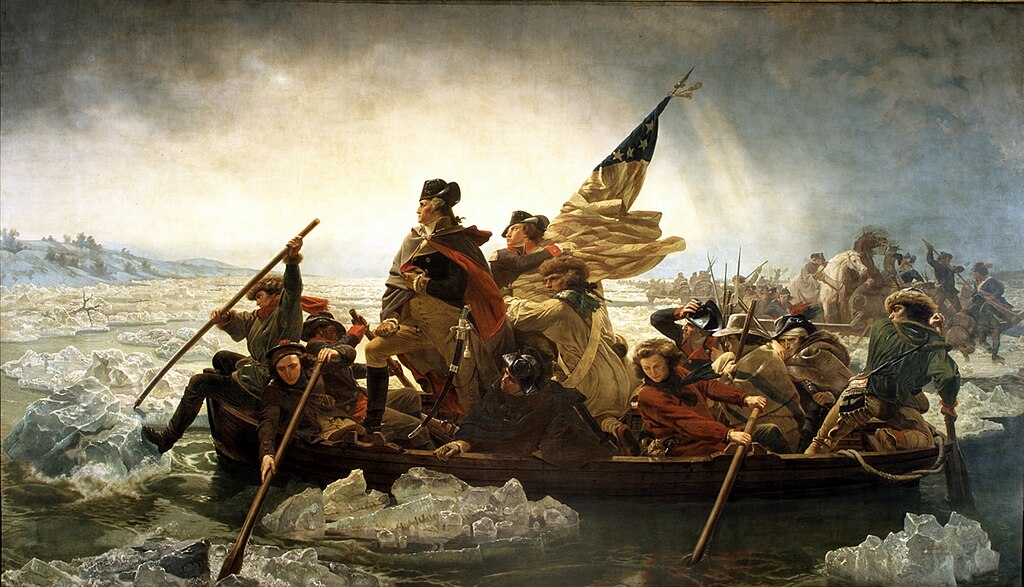
The most famous portrayal of a U.S. flag flying in Delaware is in the painting by Emanuel Leutze (American, 1816–1868).

The most famous portrayal of a U.S. flag flying in Delaware is in the painting by Emanuel Leutze (American, 1816–1868). “Washington Crossing the Delaware,” 1851. The Metropolitan Museum of Art, New York, Gift of John Stewart Kennedy, 1897 (97.34) Among other problems with this portrayal: The flag depicted had not been designated on the date of the crossing, Christmas 1776.

Yes, this is mostly an encore post. Fighting ignorance requires patience.

Yes, this is mostly an encore post. Fighting ignorance requires patience.


It’s Martin van Buren’s birthday, December 5

December 5, 2017

Former President Martin van Buren, circa 1855-1888. Matthew Brady photograph (Imperial print of Martin Van Buren. Salted paper print from glass negative. Provenance from W.H. Lowdermilk & Co., Rare Books, 1418 F Street, Washington, DC) Metropolitan Museum image, via Wikimedia

Former President Martin van Buren, circa 1855-1888. Matthew Brady photograph (Imperial print of Martin Van Buren. Salted paper print from glass negative. Provenance from W.H. Lowdermilk & Co., Rare Books, 1418 F Street, Washington, DC) Metropolitan Museum image, via Wikimedia

Martin van Buren was our nation’s 8th president, serving one term, 1837-1841.

This photo is roughly  15 years after van Buren left office, taken in the Washington, D.C., studio of Matthew Brady, whose photography gained fame from his work photographing battle sites during the American Civil War.

Martin van Buren was born December 5, 1782, in Kinderhook, New York. He is the only president to have the first name Martin. He’d be 235 years old today, and still king of the mutton chop sideburns among presidents.

Van Buren died on July 24, 1862.

More:

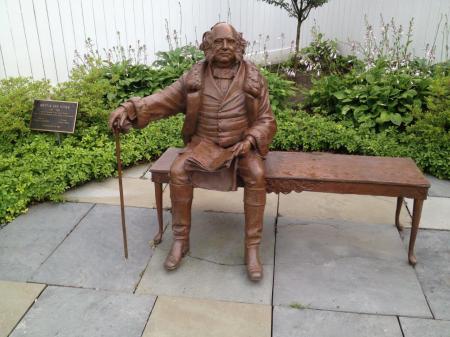
At Broad and Hudson Streets in Kinderhook, New York, one can sit with a statue of Martin Van Buren, and see if one can decipher the newspaper he is reading. PresidentsUSA image

At Broad and Hudson Streets in Kinderhook, New York, one can sit with a statue of Martin Van Buren, and see if one can decipher the newspaper he is reading. PresidentsUSA image


December 2: Millard Fillmore’s Guano Day! 2017 edition

December 2, 2017

Why December 2?

(You couldn’t make this stuff up if you were Monty Python.)

English: Millard Fillmore White House portrait

Millard Fillmore’s White House portrait, via Wikipedia

President Millard Fillmore, in the State of the Union Address, December 2, 1850

Peruvian guano has become so desirable an article to the agricultural interest of the United States that it is the duty of the Government to employ all the means properly in its power for the purpose of causing that article to be imported into the country at a reasonable price. Nothing will be omitted on my part toward accomplishing this desirable end. I am persuaded that in removing any restraints on this traffic the Peruvian Government will promote its own best interests, while it will afford a proof of a friendly disposition toward this country, which will be duly appreciated.

Did any other U.S. President spend so much time thinking about guano?  Did any president ever mention it in a State of the Union Address?  The curious case of Millard Fillmore, Seer, just grows.

Guano, or bird poop (and its relative, bat poop), contains phosphorus, which is an essential element for life.  Consequently, it turns out to be a key ingredient in effective agricultural fertilizers.  In international competition for supremacy in farming and farm exports, guano became a key resource to fight over, in the 19th century.

It’s almost safe to say the fights were economic; but guano did play a key role in wars in South America (see Andrew Leonard’s article, noted below).

Fillmore figured out that the substance had great importance, coupled that with the rather esoteric knowledge that sea birds tended to deposit guano in great abundance on certain islands, often unoccupied, and ordered the U.S. Navy to claim islands found to contain guano deposits that were not claimed by other nations.

By the American Civil War, the importance of phosphorus to the production of gun powder became an issue for the armies of the North and South.  Millard Fillmore had set the stage for the North to win an important advantage in gun powder production, just one of many that led to the defeat of the South.

It’s one more thing we should thank Millard Fillmore for doing. Our study of history should inform us that it is, indeed, important for politicians to understand the importance of guano.

Fillmore knew his guano.

Take a moment on December 2 to toast Millard Fillmore’s prescience, on Guano Day!

More:  

You can purchase Peruvian guano today, from Amazon, GrowOrganic.com, and other sources. It's roughly $15 per pound in the U.S.

You can purchase Peruvian guano today, from Amazon, GrowOrganic.com, and other sources. It’s roughly $15 per pound in the U.S.

This is an encore post.

Yes, this is an edited encore post. Defeating ignorance takes patience and perseverance.


Carl Sagan’s song of the open road; can you spare a penny?

November 29, 2017

NASA image of a launch of one of the Space Shuttles.

NASA image of a launch of one of the Space Shuttles. “The open road still softly calls,” Carl Sagan said.

“The open road still softly calls,” Carl Sagan said, optimistically, in this film.

Can you spare a penny to keep the road open? To answer the call?

More:


December’s dates to fly Old Glory, 2017

November 28, 2017

U.S. flag flies at the U.S. Capitol in a snow storm. Photo by Victoria Pickering, Creative Commons license, from Flickr

U.S. flag flies at the U.S. Capitol in a snow storm. Photo by Victoria Pickering, Creative Commons license, from Flickr. (This photo was actually taken in March.) 

November offers several flag flying days, especially in years when there is an election.

But December may be the month with the most flag-flying dates, when we include statehood days.

December 7 is Pearl Harbor Remembrance Day.  It’s not in the Flag Code, but public law (P.L. 103-308) urges that the president should issue a proclamation asking Americans to fly flags.

December 25 is Christmas Day, a federal holiday, and one of the score of dates designated in the Flag Code. If you watch your neighborhood closely, you’ll note even some of the most ardent flag wavers miss posting the colors on this day, as they do on Thanksgiving and New Years.

Other dates?

Nine states attained statehood in December, so people in those states should fly their flags (and you may join them).  Included in this group is Delaware, traditionally the “First State,” as it was the first colony to ratify the U.S. Constitution:

  • Illinois, December 3 (1818, 21st state)
  • Delaware, December 7 (1787, 1st state)
  • Mississippi, December 10 (1817, 20th state)
  • Indiana, December 11 (1816, 19th state)
  • Pennsylvania, December 12 (1787, 2nd state)
  • Alabama, December 14 (1819, 22nd state)
  • New Jersey, December 18 (1787, 3rd state)
  • Iowa, December 28 (1846, 29th state)
  • Texas, December 29 (1845, 28th state)

December 15 is Bill of Rights Day, marking the day in 1791 when the Bill of Rights was declared ratified; but though this event generally gets a presidential proclamation, there is no law or executive action that requires flags to fly on that date, for that occasion.

Eleven flag-flying dates in December.  Does any other month have as many flag flying opportunities?

Have I missed any December flag-flying dates?  11 events on 10 days (Delaware’s statehood falls on the anniversary of the Pearl Harbor attack).

Here’s a list of the days to fly the flag, under national law, in chronological order:

  1. Illinois, December 3 (1818, 21st state)
  2. Pearl Harbor Remembrance Day, December 7
  3. Delaware, December 7 (1787, 1st state) (shared with Pearl Harbor Remembrance Day)
  4. Mississippi, December 10 (1817, 20th state)
  5. Indiana, December 11 (1816, 19th state)
  6. Pennsylvania, December 12 (1787, 2nd state)
  7. Alabama, December 14 (1819, 22nd state)
  8. New Jersey, December 18 (1787, 3rd state)
  9. Christmas Day, December 25
  10. Iowa, December 28 (1846, 29th state)
  11. Texas, December 29 (1845, 28th state)

Fly your flag with respect to the flag, for the republic it represents, and for all those who sacrificed that it may wave on your residence.

And if you travel for the holidays? You’re away from home?

Astronauts Eugene Cernan and Harrison Schmitt took a flag with them when they visited the Moon in December 1972. Maybe you could carry a small travel flag, too.

NASA caption: Apollo 17 commander Eugene A. Cernan is holding the lower corner of the American flag during the mission's first EVA, December 12, 1972. Photograph by Harrison J.

NASA caption: Apollo 17 commander Eugene A. Cernan is holding the lower corner of the American flag during the mission’s first EVA, December 12, 1972. Photograph by Harrison J. “Jack” Schmitt. Image Credit: NASA


Glorious thread on typewriters and their masters

November 22, 2017

From Dean Frey, posting on Twitter as “Deny Fear @dean_frey.”

Frey posted this wonderful picture of Rachel Carson, taken by Erich Hartmann in 1962 (after publication of Silent Spring?)

Rachel Carson and her typewriter, by Erich Hartmann, 1962.

Rachel Carson and her typewriter, by Erich Hartmann, 1962.

But hold your horses. Frey posted a raft of other artists with their machines. What a glorious little thread!

https://twitter.com/dean_frey/status/933033391447875585

The entire glorious thread.

You have seen some of those photos, some of those artists, and some of those typewriters in other posts at Millard Fillmore’s Bathtub. There are some sparkling photos there I had not seen before.

Thank you, Dean Frey.


Did anybody celebrate North Carolina statehood?

November 22, 2017

U.S. flag flew in at least one spot in North Carolina on statehood day, November 21, 2017. Photo at Chimney Rock State Park, outside of Asheville, North Carolina, near U.S. Highway 64/74A, on the Rocky Broad River.

U.S. flag flew in at least one spot in North Carolina on statehood day, November 21, 2017. Photo at Chimney Rock State Park, outside of Asheville, North Carolina, near U.S. Highway 64/74A, on the Rocky Broad River. History.com image.

Staff at Millard Fillmore’s Bathtub do not always stay ahead of flag flying days. November 21 is North Carolina’s statehood day, and MFB missed noting that earlier.

Looking back, we wonder: Does anyone in North Carolina celebrate North Carolina’s statehood?

Newspapers, television and radio, and other media did not note any celebration, if it occurred. Do North Carolinians fly their U.S. flags on November 21, for statehood day?

North Carolina became the 12th state, ratifying the Constitution on November 21, 1789.

If you’re in North Carolina, did you fly your flag on Statehood Day?

U.S. 25-cent piece commemorating North Carolina, in the series honoring all 50 states. The design follows John T. Daniels's iconic photo of the first well-documented heavier-than-air flying machine flight, by the Wright Brothers, at Kittyhawk, North Carolina, in 1903.

U.S. 25-cent piece commemorating North Carolina, in the series honoring all 50 states. The design follows John T. Daniels’s iconic photo of the first well-documented heavier-than-air flying machine flight, by the Wright Brothers, at Kittyhawk, North Carolina, in 1903.

Notes from Twitter:

More:


“273 words toward a new nation” – Lincoln’s Gettysburg Address

November 20, 2017

Nicolay copy of the Gettysburg Address; only pre-delivery, holographic copy of the address. Given to Lincoln's secretary, John George Nicolay.

Nicolay copy of the Gettysburg Address; only pre-delivery, holographic copy of the address. Given to Lincoln’s secretary, John George Nicolay.

Librarians have it good, living among books.  Librarians at the Library of Congress have it best, with the amazingly complete collection of books, top-notch scholars, and just plain old curious stuff lying around.

Like copies of Lincoln’s Gettysburg Address.

Garry Wills argues that Lincoln rethought and recast America’s image in that speech, in less than two minutes — though it took a century before the recasting was complete.

The Library of Congress just has the history, and notes the power of the speech overall.

Yes, this is mostly an encore post. Fighting ignorance requires patience.

Yes, this is mostly an encore post. Fighting ignorance requires patience.


Remembering Lincoln’s Gettysburg Address, November 19, 1863

November 20, 2017


154 years ago this week, Abraham Lincoln redefined the Declaration of Independence and the goals of the American Civil War, in a less-than-two-minute speech dedicating part of the battlefield at Gettysburg, Pennsylvania, as a cemetery and final resting place for soldiers who died in the fierce battle fought there the previous July 1 through 3.

Interesting news if you missed it: More photos from the Library of Congress collection may contain images of Lincoln. The photo above, detail from a much larger photo, had been thought for years to be the only image of Lincoln from that day. The lore is that photographers, taking a break from former Massachusetts Sen. Edward Everett’ s more than two-hour oration, had expected Lincoln to go on for at least an hour. His short speech caught them totally off-guard, focusing their cameras or taking a break. Lincoln finished before any photographer got a lens open to capture images.

Images of people in these photos are very small, and difficult to identify. Lincoln was not identified at all until 1952:

The plate lay unidentified in the Archives for some fifty-five years until in 1952, Josephine Cobb, Chief of the Still Pictures Branch, recognized Lincoln in the center of the detail, head bared and probably seated. To the immediate left (Lincoln’s right) is Lincoln’s bodyguard, Ward Hill Lamon, and to the far right (beyond the limits of the detail) is Governor Andrew G. Curtin of Pennsylvania. Cobb estimated that the photograph was taken about noontime, just after Lincoln arrived at the site and before Edward Everett’s arrival, and some three hours before Lincoln gave his now famous address.

On-line, the Abraham Lincoln Blog covered the discovery that two more photographic plates from the 1863 speech at Gettysburg may contain images of Lincoln in his trademark stove-pipe hat. Wander over to the story at the USA Today site, and you can see just how tiny are these detail images in relation to the photographs themselves. These images are tiny parts of photos of the crowd at Gettysburg. (The story ran in USA Today last Thursday or Friday — you may be able to find a copy of that paper buried in the returns pile at your local Kwikee Mart.) Digital technologies, and these suspected finds of Lincoln, should prompt a review of every image from Gettysburg that day.

To the complaints of students, I have required my junior U.S. history students to memorize the Gettysburg Address. In Irving I found a couple of students who had memorized it for an elementary teacher years earlier, and who still could recite it. Others protested, until they learned the speech. This little act of memorization appears to me to instill confidence in the students that they can master history, once they get it done.

To that end, I discovered a good, ten-minute piece on the address in Ken Burns’ “Civil War” (in Episode 5). On DVD, it’s a good piece for classroom use, short enough for a bell ringer or warm-up, detailed enough for a deeper study, and well done, including the full text of the address itself performed by Sam Waterson.

Edward Everett, the former Massachusetts senator and secretary of state, was regarded as the greatest orator of the time. A man of infinite grace, and a historian with some sense of events and what the nation was going through, Everett wrote to Lincoln the next day after their speeches:

“I should be glad, if I could flatter myself that I came as near the central idea of the occasion in two hours, as you did in two minutes.”

Interesting note: P. Z. Myers at Pharyngula noted in 2007 that the Gettysburg Address was delivered “seven score and four years ago.” Of course, that will never happen again. I’ll wager he was the first to notice that odd juxtaposition on the opening line.

Resources for students and teachers:

Yes, this is mostly an encore post. Fighting ignorance requires patience.

Yes, this is mostly an encore post. Fighting ignorance requires patience.


She’s 11: America’s top young scientist works to help detect problems in Flint’s water supply, and yours

November 17, 2017

NPR caption: Gitanjali Rao, 11, says she was appalled by the drinking water crisis in Flint, Mich. — so she designed a device to test for lead faster. She was named

NPR caption: Gitanjali Rao, 11, says she was appalled by the drinking water crisis in Flint, Mich. — so she designed a device to test for lead faster. She was named “America’s Top Young Scientist” on Tuesday at the 3M Innovation Center in St. Paul, Minn. Andy King/Discovery Education 3M Young Scientist Challenge

Melinda Gates noticed; you should, too. (And check out the NPR story to which Gates links.)

NPR tells the story:

When the drinking water in Flint, Mich., became contaminated with lead, causing a major public health crisis, 11-year-old Gitanjali Rao took notice.

“I had been following the Flint, Michigan, issue for about two years,” the seventh-grader told ABC News. “I was appalled by the number of people affected by lead contamination in water.”

She saw her parents testing the water in their own home in Lone Tree, Colo., and was unimpressed by the options, which can be slow, unreliable or both.

“I went, ‘Well, this is not a reliable process and I’ve got to do something to change this,’ ” Rao told Business Insider.

Rao tells ABC that while she was doing her weekly perusal of MIT’s Materials Science and Engineering website to see “if there’s anything’s new,” she read about new technologies that could detect hazardous substances and decided to see whether they could be adapted to test for lead.

She pressed local high schools and universities to give her lab time and then hunkered down in the “science room” — outfitted with a big white table — that she persuaded her engineer parents to create in their home.

And she set about devising a more efficient solution: a device that could identify lead compounds in water and was portable and relatively inexpensive.

As she explains at lightning speed in her video submission for the Discovery Education 3M Young Scientist Challenge, her device consists of three parts. There is a disposable cartridge containing chemically treated carbon nanotube arrays, an Arduino-based signal processor with a Bluetooth attachment, and a smartphone app that can display the results.

(Film details:

Published on Jul 18, 2017
“Meet Gitanjali. Gitanjali hopes to reduce the time of lead detection in water by using a mobile app, to connect over Bluetooth to get status of water, almost immediately.”)

Stories like this should give you hope for our future. It’s clear that women should be encouraged to go into science and technology.

Stories like this should also get you out of your chair to yell at policy makers who cut funds for basic research, for education, and who rail against immigration. President Trump will not host the science fair that graced the White House for the past eight years. Time for you and me to stand up to demand support for science, and for women in science.

Tip of the old scrub brush to Melinda Gates.

More:


Oklahoma statehood, November 16, 1907; Oklahomans fly your flags today

November 16, 2017

U.S. Flag Code urges citizens of states to fly the U.S. flag on the anniversary of statehood.

We almost let the whole day slip away without reminding you: President Theodore Roosevelt signed the Oklahoma statehood proclamation on November 16, 1907. Oklahoma became the 46th state, with New Mexico and Arizona to come later to fill out the contiguous 48 states.

Mike Wimmer's 2003 painting of President Theodore Roosevelt's signing of the proclamation that made Oklahoma a member of the union. Oklahoma Arts Council image.

Mike Wimmer’s 2003 painting of President Theodore Roosevelt’s signing of the proclamation that made Oklahoma a member of the union. Oklahoma Arts Council image.

Oklahoma’s pre-history is long, complex and fascinating; the road to statehood is similarly complex and winding, lined with broken promises to Native Americans, tragedy and other drama. Does the state require Oklahoma history be taught in public schools?

And so we hope, you flew your flags today, Sooners!

Did anyone actually fly their flag? Does anyone other than Oklahoma newspapers even care any more?

More: 

Front page of the Daily Oklahoman on November 16, 1907, anticipating President Roosevelt's proclamation to come that morning. Daily Oklahoman image.

Front page of the Daily Oklahoman on November 16, 1907, anticipating President Roosevelt’s proclamation to come that morning. Daily Oklahoman image.

46-star flag used after Oklahoma became the 46th state in 1907. This flag remained in use for four years. RareFlags.com image

46-star flag used after Oklahoma became the 46th state in 1907. This flag remained in use for four years. RareFlags.com image

Yes, this is mostly an encore post. Fighting ignorance requires patience.

Yes, this is mostly an encore post. Fighting ignorance requires patience.

Save

Save

Save

Save


“Your News,” another hoax, false news site to watch out for

November 15, 2017

Masthead of hoax news site. When you see this URL, you can be quite certain the more salacious claims are hoaxed.

Masthead of hoax news site. When you see this URL, you can be quite certain the more salacious claims are hoaxed. Contrary to the claims, “news” reports on the site are truthful only tangentially; and if “unfiltered” means unedited and not fact-checked, it would be almost accurate.

YourNewsWire.com purveys hoax stories. They do it at that website, and on Twitter, and probably on Instagram and Facebook.

Watch out for them, and do not be suckered by their bizarre tales. Hallmarks of hoaxes from this site are stories with some basis in fact, which are then exaggerated beyond reason, to sow dissension.

This is plainly hoax, pure and clear: Jay-Z Caught Shapeshifting On United Airlines Flight To LAX

This story relating to Flint, Michigan’s water crisis takes two deaths of people involved in finding the facts, and works to spin it into a conspiracy story designed to make us fear government. The shooting death of the woman, Sasha Avona Bell, resulted from a domestic dispute with a spurned lover. You can’t learn that from “YourNewsWire.”

You’ll find links to these stories, and others from YourNewsWire, linked all over Twitter and Facebook. Falsehoods spread like wildfire, especially among the gullible. This hoax site was instrumental in spreading false information about the mass shooting deaths in Sutherland Spring, Texas, for example. In this Tweet, nothing is accurate.

https://twitter.com/gal_deplorable/status/927318419703324672

In this story, the site claims the actor Morgan Freeman said “‘Jailing Hillary’ Best Way To ‘Restore Public Faith In Govt,’” but the entire story is false. Hoax investigation site Snopes.com answered why the story is false, in some detail.  Politifact rated the story a “pants on fire” lie. Media Matters also responded, a sign that the story suckered many gullible people. Media Matters reports the site is an outlet for Russian fake news activities.

Wonkette got on it, too.

Here’s what Morgan Freeman REALLY said about politics recently, specifically about Russian interference in U.S. elections — something “YourNewsWire” would prefer to hide. And, as the New York Times reported, Freeman’s video angered Russians, which would explain why they targeted him with the hoax claims.


Annals of Global Warming: Ozone hole shrinks; success shows what can happen when world cooperates to end pollution; what’s the bad news?

November 14, 2017

(NASA caption) Ozone depletion occurs in cold temperatures, so the ozone hole reaches its annual maximum in September or October, at the end of winter in the Southern Hemisphere. Credits: NASA/NASA Ozone Watch/Katy Mersmann

(NASA caption) Ozone depletion occurs in cold temperatures, so the ozone hole reaches its annual maximum in September or October, at the end of winter in the Southern Hemisphere. Credits: NASA/NASA Ozone Watch/Katy Mersmann

Good news from NASA and NOAA: The ozone hole over Antarctica is shrinking, because policy makers heeded warnings from scientists, and they acted in the 1980s to stop the pollution that made the ozone hole grow into hazard.

In other words, cleaning up air pollution works to reduce problems.

If we apply those same principles to global warming climate change, we can save the planet: Listen to scientists, band together internationally, take effective action to stop the pollution.

BUT, much of the shrinkage in the past two years was due to warming atmosphere, which reduces the cold weather period during which the ozone hole grows. In other words, effects of the anti-pollution action isn’t yet clear.

This NASA video explains:

NASA discussed the events in a press release.

“The Antarctic ozone hole was exceptionally weak this year,” said Paul A. Newman, chief scientist for Earth Sciences at NASA’s Goddard Space Flight Center in Greenbelt, Maryland. “This is what we would expect to see given the weather conditions in the Antarctic stratosphere.”

The smaller ozone hole in 2017 was strongly influenced by an unstable and warmer Antarctic vortex – the stratospheric low pressure system that rotates clockwise in the atmosphere above Antarctica. This helped minimize polar stratospheric cloud formation in the lower stratosphere. The formation and persistence of these clouds are important first steps leading to the chlorine- and bromine-catalyzed reactions that destroy ozone, scientists said. These Antarctic conditions resemble those found in the Arctic, where ozone depletion is much less severe.

In 2016, warmer stratospheric temperatures also constrained the growth of the ozone hole. Last year, the ozone hole reached a maximum 8.9 million square miles, 2 million square miles less than in 2015. The average area of these daily ozone hole maximums observed since 1991 has been roughly 10 million square miles.

Although warmer-than-average stratospheric weather conditions have reduced ozone depletion during the past two years, the current ozone hole area is still large because levels of ozone-depleting substances like chlorine and bromine remain high enough to produce significant ozone loss.

Scientists said the smaller ozone hole extent in 2016 and 2017 is due to natural variability and not a signal of rapid healing.

First detected in 1985, the Antarctic ozone hole forms during the Southern Hemisphere’s late winter as the returning sun’s rays catalyze reactions involving man-made, chemically active forms of chlorine and bromine. These reactions destroy ozone molecules.

Thirty years ago, the international community signed the Montreal Protocol on Substances that Deplete the Ozone Layer and began regulating ozone-depleting compounds. The ozone hole over Antarctica is expected to gradually become less severe as chlorofluorocarbons—chlorine-containing synthetic compounds once frequently used as refrigerants – continue to decline. Scientists expect the Antarctic ozone hole to recover back to 1980 levels around 2070.

Ozone is a molecule comprised of three oxygen atoms that occurs naturally in small amounts. In the stratosphere, roughly 7 to 25 miles above Earth’s surface, the ozone layer acts like sunscreen, shielding the planet from potentially harmful ultraviolet radiation that can cause skin cancer and cataracts, suppress immune systems and also damage plants. Closer to the ground, ozone can also be created by photochemical reactions between the sun and pollution from vehicle emissions and other sources, forming harmful smog.

Although warmer-than-average stratospheric weather conditions have reduced ozone depletion during the past two years, the current ozone hole area is still large compared to the 1980s, when the depletion of the ozone layer above Antarctica was first detected. This is because levels of ozone-depleting substances like chlorine and bromine remain high enough to produce significant ozone loss.

More work to do; but at least the damage is not increasing dramatically. While it would be good to be able to report that human action to close the ozone hole had produced dramatic results, it is still useful to track the progress of this action, especially when global warming/climate change dissenters frequently argue falsely that the ozone hole never existed, and warming is a similar hoax.

NASA’s AURA satellite group said the ozone holes should be repaired and gone by 2040, 23 years from now.

We hope they’re right.

(NASA caption) At its peak on Sept. 11, 2017, the ozone hole extended across an area nearly two and a half times the size of the continental United States. The purple and blue colors are areas with the least ozone. Credits: NASA/NASA Ozone Watch/Katy Mersmann

(NASA caption) At its peak on Sept. 11, 2017, the ozone hole extended across an area nearly two and a half times the size of the continental United States. The purple and blue colors are areas with the least ozone. Credits: NASA/NASA Ozone Watch/Katy Mersmann

More:

Tip of Millard Fillmore’s old scrub brush to Sean Sublette at Climate Central

Save