Yeah, I’m a day late. So sue me.
This Tweet made me laugh.
Evan Siegfried @evansiegfried said: “Beware the ides of March.”

Yeah, I’m a day late. So sue me.
This Tweet made me laugh.
Evan Siegfried @evansiegfried said: “Beware the ides of March.”
 Leave a Comment » |
  Humor | Tagged: Humor, Ides of March |
  Permalink
 Posted by Ed Darrell

Maine joined the union on March 15, 1820, the 23rd state. It was created out of what had been lands of the colony of Massachusetts.
Maine gave us a Vice President, Hannibal Hamlin, under Abraham Lincoln. In Hamlin’s term he disappeared from Washington, D.C. At some length, a story goes, Hamlin was tracked back to Maine where he had enlisted in the Civil War effort, cooking for the troops.
James G. Blaine, a newspaper editor, got the Republican nomination for the presidency in 1884. He lost the election to Grover Cleveland, but gave us that memorable phrase from the college U.S. history survey courses: “Blaine, Blaine, James G. Blaine! The Son of a Bitch from the State of Maine.”
Blaine was no slouch. He served 13 years in the U.S. House of Representatives, rising to the position of Speaker, served a term in the U.S. Senate and was twice U.S. Secretary of State, under three different presidents.
Despite its many natural wonders, Maine is one of four U.S. states I have not visited. (Where’s the invitation, Greg Marley?)

Maine has a lot of people flying U.S. colors, judging from photographs. Good on them all. I wonder whether Mainers celebrate statehood, or just let it pass?

More:
Leave a Comment » | Flag etiquette, Fly your flag today, History, Statehood, U.S. Flag | Tagged: Fly your flag today, History, Maine | Permalink
Posted by Ed Darrell
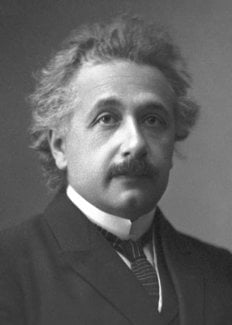
Happy Einstein Day! to us. Albert’s been dead since 1955 — sadly for us. Our celebrations now are more for our own satisfaction and curiosity, and to honor the great man — he’s beyond caring.
Almost fitting that he was born on π Day, no? I mean, is there an E=mc² Day? He’s 140 years old today, and famous around the world for stuff that most people still don’t understand.

Fittingly, perhaps, March 14 now is celebrated as Pi Day, in honor of that almost magical number, Pi, used to calculate the circumference of a circle. Pi is 3. 1415~, and so the American date 3/14 got tagged as Pi Day.
Albert Einstein was born on March 14, 1879, in Ulm, Germany, to Hermann and Pauline Einstein.
26 years later, three days after his birthday, he sent off the paper on the photo-electric effect; that paper would win him the Nobel Prize in Physics in 1921.
In that same year of 1905, he published three other papers, solving the mystery of Brownian motion, describing what became known as the Special Theory of Relativity and solving the mystery of why measurements of the light did not show any effects of motion as Maxwell had predicted, and a final paper that noted a particle emitting light energy loses mass. This final paper amused Einstein because it seemed so ludicrous in its logical extension that energy and matter are really the same stuff at some fundamental point, as expressed in the equation demonstrating an enormous amount of energy stored in atoms, E=mc².
Any one of the papers would have been a career-capper for any physicist. Einstein dashed them all off in just a few months, forever changing the fields of physics. And, you noticed: Einstein did not win a Nobel for the Special Theory of Relativity, nor for E=mc². He won it for the photo-electric effect. Irony in history. Nobel committee members didn’t understand Einstein’s other work much better than the rest of us today.
114 years later, Einstein’s work affects us every day. Relativity theory at some level I don’t fully understand makes possible the use Global Positioning Systems (GPS), which revolutionized navigation and mundane things like land surveying and microwave dish placement.
Development of nuclear power both gives us hope for an energy-rich future, and gives us fear of nuclear war. Sometimes, even the hope of the energy rich future gives us fear, as we watch and hope nuclear engineers can control the piles in nuclear power plants damaged by earthquakes and tsunami in Japan.

If Albert Einstein was a genius at physics, he was more dedicated to pacifism. He resigned his German citizenship to avoid military conscription. His pacifism made the German Nazis nervous; Einstein fled Germany in the 1930s, eventually settling in the United States. In the U.S., he was persuaded by Leo Szilard to write to President Franklin Roosevelt to suggest the U.S. start a program to develop an atomic weapon, because Germany most certainly was doing exactly that. But while urging FDR to keep up with the Germans, Einstein refused to participate in the program himself, sticking to his pacifist views. Others could, and would, design and build atomic bombs. (Maybe it’s a virus among nuclear physicists — several of those working on the Manhattan Project were pacifists, and had great difficulty reconciling the idea that the weapon they worked on to beat Germany, was deployed on Japan, which did not have a nuclear weapons program.)

Einstein was a not-great father, and probably not a terribly faithful husband at first — though he did think to give his first wife, in the divorce settlement, a share of a Nobel Prize should he win it. Einstein was a good violinist, a competent sailor, an incompetent dresser, and a great character.
His sister suffered a paralyzing stroke. For many months Albert spent hours a day reading to her the newspapers and books of the day, convinced that though mute and appearing unconscious, she would benefit from hearing the words. He said he did not hold to orthodox religions, but could there be a greater show of faith in human spirit?
When people hear clever sayings, but forget to whom the bon mots should be attributed, Einstein is one of about five candidates to whom all sorts of things are attributed, though he never said them. (Others include Lincoln, Jefferson, Mark Twain and Will Rogers). Einstein is the only scientist in that group. So, for example, we can be quite sure Einstein never claimed that compound interest was the best idea of the 20th century. This phenomenon is symbolic of the high regard people have for the man, even though so few understand what his work was, or meant.

A most interesting man. A most important body of work. He deserves more study and regard than he gets, in history, diplomacy and science.
Does anyone know? What was Albert Einstein’s favorite pie?
More, and resources:
2 Comments | Albert Einstein, History, Nobel Prizes, Physics, Pi π, Science | Tagged: Albert Einstein, History, Physics, pi Day, Science History | Permalink
Posted by Ed Darrell
/arc-anglerfish-arc2-prod-tronc.s3.amazonaws.com/public/QCCDQF6OBQ5ZTK37HYFDQF6AG4.jpg)
Members of the New York City Fire Department carry 343 U.S. flags honoring the 343 NYFD members killed on 9/11, in the St. Patrick’s Day Parade. New York Post caption: “Despite the cold and gray morning, parade-goers turned out for St. Patrick’s Day to celebrate Irish heritage in New York City on March 17, 2014. FDNY members set the pace as they marched down 5th Avenue holding American flags for the annual event. SHANNON STAPLETON/Reuters”
I usually put up a post near the first of the month listing the occasions upon which U.S. laws urge us to fly Old Glory. March sometimes slips by without such a post.
No good reason, other than in most years, March offers no regular national commemorations upon which flag flying is urged. The odd year is when Easter comes early. Easter is one of the holidays the Flag Code says flags should be flown.
But, most years, Easter falls in April, as it does in 2018.
The Flag Code urges residents of states to fly the U.S. flag on the anniversary of their state’s entering the union, on statehood day. Those are the only dates in March, most years. In March, we have four statehood days in the first four days of the month. If I dawdle, we miss most of the dates.
Flag fly dates, for March (some already past, in 2019):
Okay, all but one already past in March. Apologies to Ohio, Nebraska and Florida. Surely you can find the stories of their big parades and flyovers for statehood in Google News.
St. Patrick’s Day revelers and parade marchers display the U.S. flag, but it’s not an official U.S. observance.
I keep hoping, but I get little traction for a law urging flying the flag to observe Freedom Day, on the birth anniversary of the Father of the Constitution, James Madison (he was born March 16, 1751).
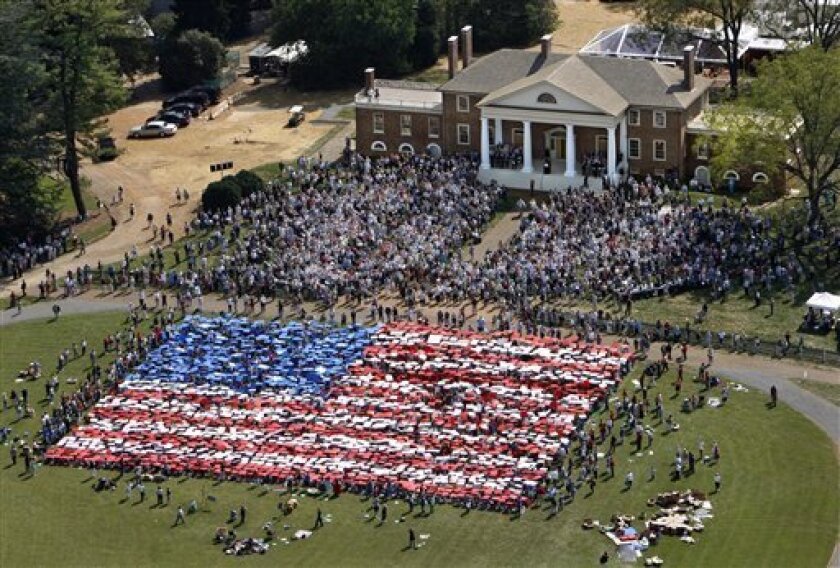
People gathered on the lawn of James Madison’s home in Montpelier, Virginia, to display the U.S. flag in a card display, 2011. AP photo?
Much irony, and great history, in the U.S. colors being shown so dramatically on St. Patrick’s Day, a day relatively uncommemorated in Ireland, and commemorated in the U.S. chiefly to help overcome bias against Irish immigrants.
Some irony in the unmarked birthday of the Father of the Constitution.
Sure, you may fly the U.S. flag every day in March. You need not wait for sanction from a Presidential Proclamation or a Congressional Resolution. You may fly the flag every day. (Just follow flag etiquette when you do.)
I’ll try to keep up better, next year. (I said that last year.)
U.S. flag led the St. Patrick’s Day Parade in Seattle in 2014. Photo from IricsClub.org.

U.S. colors stood out in a field of green at the St. Paul, Minnesota, St. Patrick’s Day parade, 2015(?). Photo from VisitStPaul.com.
More

Yes, this is a bit of an encore post. Defeating ignorance takes patience and perseverance.
Leave a Comment » | Flag etiquette, Fly your flag today, History | Tagged: Flag Code, flag display, Fly your flag today, History, March | Permalink
Posted by Ed Darrell
March 5, 2019, was the 73rd anniversary of Winston Churchill’s speech in Fulton, Missouri. He called the speech “Sinews of Peace,” but it is better known as the speech in which Churchill first used the phrase “Iron Curtain” to describe events in Eastern Europe after World War II.

Winston Churchill delivering the “Iron Curtain” speech, Westminster College, Fulton, Missouri, March 5, 1946 – Photo by George Skadding
“From Stettin in the Baltic to Trieste in the Adriatic, an iron curtain has descended across the Continent. Behind that line lie all the capitals of the ancient states of Central and Eastern Europe. Warsaw, Berlin, Prague, Vienna, Budapest, Belgrade, Bucharest and Sofia, all these famous cities and the populations around them lie in what I must call the Soviet sphere, and all are subject in one form or another, not only to Soviet influence but to a very high and, in many cases, increasing measure of control from Moscow.”
Some historians mark the beginning of the Cold War from this speech, in which a respected world leader (though without portfolio at the moment) first spelled out the enormous stakes at issue, and also pointed out that Russian, communist totalitarian governments were replacing more democratic governments in nations only recently freed from the spectre of Nazi rule, in World War II.
In June 2012, son James and I stopped off in Fulton, on the way back from James’s graduation from Lawrence University in Appleton, Wisconsin. We were treated royally by the people at the Churchill Centre, and got a chance to spend time in a first rate museum. More people should make Fulton a destination, or pause in their summer travels, for the sake of the kids.
Below the fold is the speech in its entirety, from the transcript at the Churchill Centre. Read the rest of this entry »
Leave a Comment » | History | Tagged: Accura, Accuracy, Cold War, Democracy, Famous quotes, freedom, Iron Curtain, Quotes, Westminster College, Winston Churchill | Permalink
Posted by Ed Darrell
I don’t normally make time for these sorts of things, though I often find they lead to other blogs with great content, especially photos.
But when else would I use some of these photos?
So, for Cee’s Fun Foto Challenge, a few quick patterns. See details for what you should post at Cee’s Photography.
Adobe

Fractal mountain erosion, fractal clouds

Dead prickly pear cactus

Windows on the Oquirrhs
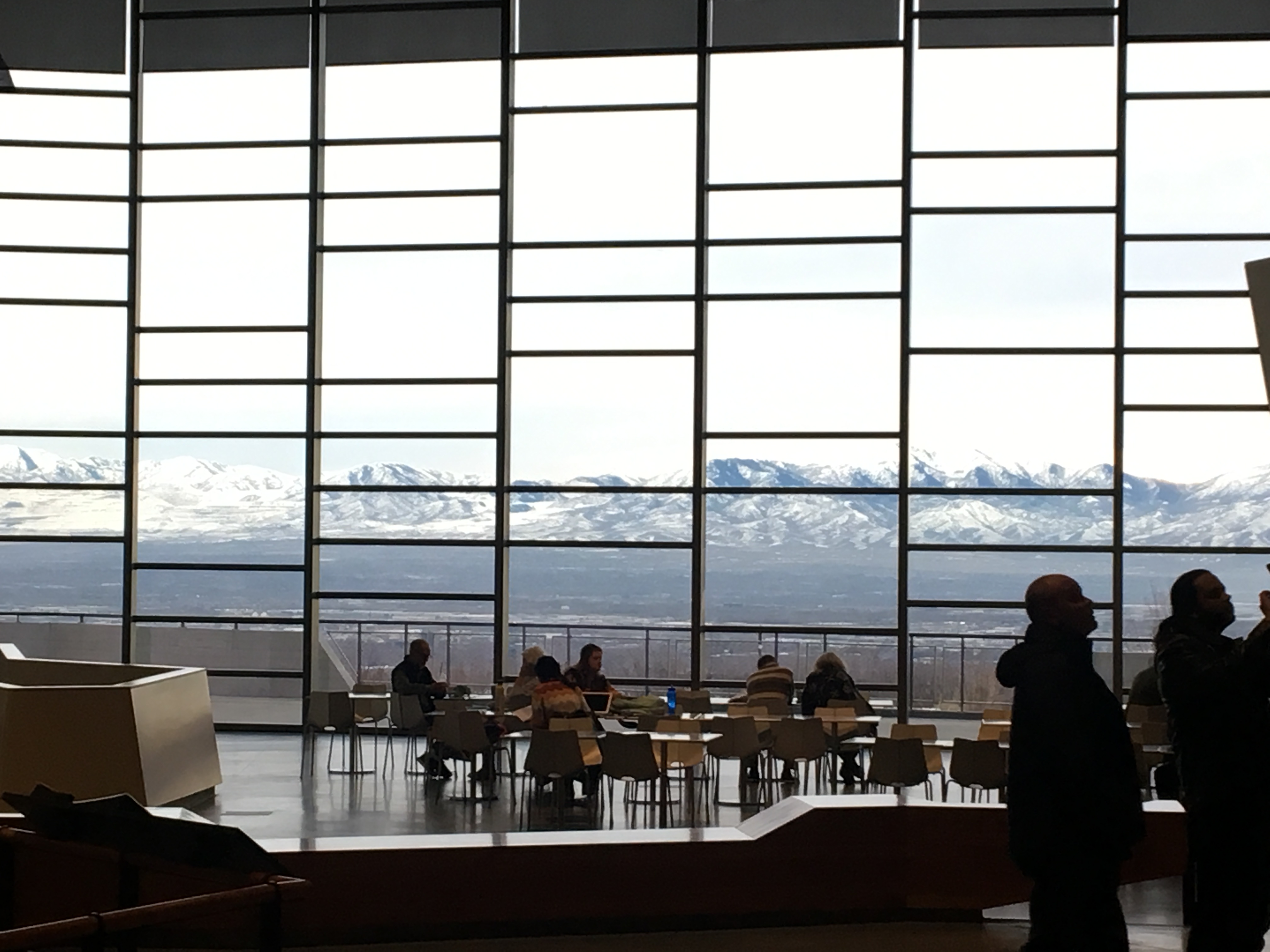
I should probably post more of my photos just to make sure they get preserved somewhere. You should, too.
Tip of the old scrub brush to Deb Kroll at Unexpected in Common Hours.
More:
5 Comments | History, photography, Weblogs | Tagged: CFFC, photography | Permalink
Posted by Ed Darrell

A poem for our time, from our time, for the State of the Union, and 2019, from Houston poet Leah McElrath.
(Untitled)
I have threaded
the balls
that were on
your bodyonto
this special necklace
crafted
for tonightForgive me
but they are mine now
so small
and orange
Special tip of the old scrub brush to Leah McElrath, on Twitter.
1 Comment | History, Nancy Pelosi, Poetry, Politics, State of the Union | Tagged: Donald Trump, History, Nancy Pelosi, Poetry, Politics, State of the Union | Permalink
Posted by Ed Darrell
Barbara Jordan would have been 83 today.

(Thanks to Pam for alerting me to the anniversary, back in 2008.)
In her stirring keynote address at the 1976 Democratic National Convention, held in New York City in Madison Square Garden, Jordan said:
A government is invigorated when each of us is willing to participate in shaping the future of this nation.
In this election year we must define the common good and begin again to shape a common good and begin again to shape a common future. Let each person do his or her part. If one citizen is unwilling to participate, all of us are going to suffer. For the American idea, though it is shared by all of us, is realized in each one of us.
I covered that convention as a stringer for a western television station. I recall the spirit in the hall when Jordan spoke, and the great spirit that enveloped the entire convention and the City of New York. After the convention every night the cops would stop taxis so delegates could ride. I remember watching two cops help a woman out of a wheel chair and into a cab, and the cabbie saying that the cops had never done that before — and he liked it. Jimmy Carter came out of that convention, and won the election, defeating Gerald Ford.
43 years ago. In 2008 I wrote: “Barbara Jordan didn’t live to see her party come up with a woman and an African American man as the top two candidates for the nomination. That’s too bad. She could have given a great, appropriate speech. Maybe the Dems oughtta just run a film of Jordan from 1976.”
Barack Obama won that election in 2008, and Hillary Clinton won the Democratic nomination in 2016. Jordan didn’t live to see that, either.
In 2019, we face a Constitutional crisis again, with a crook in the White House hoping Americans forget about the Constitution. If ever we needed ghosts to come back to help us, we need the ghost of Barbara Jordan now. We could just run a film of her speech at the House Judiciary Committee markup of the articles of impeachment for Richard Nixon.
Also:

Leave a Comment » | Art, Barbara Jordan, Famous quotes, Heroes, Texas, Texas history | Tagged: Barbara Jordan, famous speeches, History, Impeachment, Politics, Texas | Permalink
Posted by Ed Darrell

I love this ad from Allstate Insurance. “Still Standing.”
ISpot describes the ad:
Allstate tells the story of the Angel Oak on Johns Island, South Carolina (known as “The Tree” by locals). It’s rumored that it is the oldest living thing east of the Mississippi River and remains standing despite all the harsh weather and natural disasters it has faced over the past 500 years. Allstate likens its strength to the resilience that resides in us all and says it’s humbled by the courage shown by Hurricane Florence victims, offering up helping hands in partnership with the American Red Cross.
Dennis Haysbert narrates the ad, but without appearing himself, as he does in several other Allstate ads.
It’s not the oldest tree east of the Mississippi; there are cypress trees much older even in South Carolina. The name “Angel Oak” comes from the surname of a man who owned the land once, not from any angelic action or legend.
Even through corrections of the legends, the tree stands, a beautiful monument to endurance of living things, and trees. Allstate’s ad is a feel-good moment, and the feelings are worthwhile. Endurance through adversity is a virtue. The Angel Oak itself suffered great damage in a 1942 hurricane, but recovered.
Here’s a tourist video showing off more the tree, and the supports used to keep branches alive, similar to the supports we saw in China supporting 2,000-year-old trees.
Honoring trees is a worldwide tradition, and a great one. We don’t honor trees nearly enough, in my opinion.
More:

3 Comments | Advertising, Botany, History, Nature, Travel, trees | Tagged: advertising, Angel Oak, Charleston, Nature, South Carolina, Travel, trees | Permalink
Posted by Ed Darrell
Chess games of the rich and famous. Max Ernst, Nasher Sculpture Center, Dallas.

Pattern on the wall is created by the unique louvers in the ceiling, designed to let in natural light, but avoid direct sunlight which might damage the art.
The Nasher describes the work:
Like many of Ernst’s sculptures from this period, The King Playing with the Queen features an assemblage of diverse forms cast from containers and household objects. In a playful allution to the Surrealist love for the game of chess, a large, horned king rises out of a flat, tabletop arrangement of elements resembling a game board. He is at once the only player and one of the game pieces. This witty evocation of gamesmanship also intones darker themes of sexual manipulation and dominance. The king reaches out to grasp and move the much smaller queen, and at the same time, deceptively conceals another piece behind his back.

2 Comments | Art, Chess, Museums | Tagged: Art, Chess, Max Ernst, Nasher Sculpture Museum, Sculpture | Permalink
Posted by Ed Darrell

People wonder what Beto O’Rourke is going to do. He set new standards for ethical campaigning in the race for the U.S. Senate in Texas last year, refusing to go low even when polls showed he could win that way, and came the closest to unseating a Republican statewide office-holder in a couple of decades.
More important, Beto inspired a loyal corps of voters and campaigners to get out and change things.
One of my campaigning colleagues called this morning, alerting me to an e-mail from Beto on February 18, 2019, the first since thank-yous after the election in November.
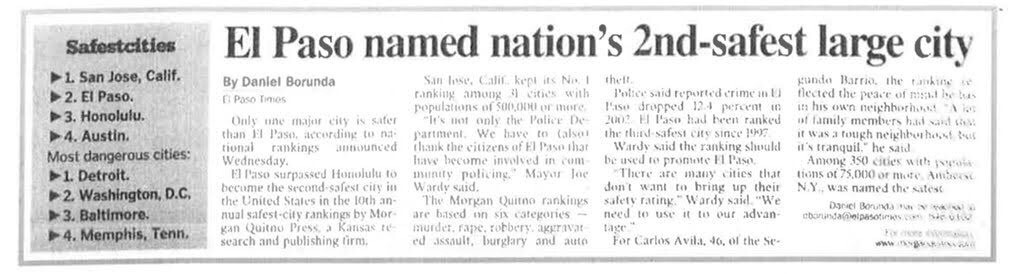
Beto put heft to his comments in El Paso last week refuting claims from the White House that El Paso is a city in crisis, with bumbling leaders. O’Rourke mustered the facts, and held on to the inspiration. His message, below.
Ed,
The President came to El Paso last week. He promised a wall and repeated his lies about the dangers that immigrants pose. With El Paso as the backdrop, he claimed that this city of immigrants was dangerous before a border fence was built here in 2008.
Beyond refuting his comments about border communities like ours (El Paso was one of the safest communities in the United States before the fence was built here), about walls saving lives (in fact, walls push desperate families to cross in ever more hostile terrain, ensuring greater suffering and death), and about immigrants (who commit crimes at a lower rate than those Americans born here), it’s worth thinking about how we got to this place. How it came to be that 11 million undocumented immigrants call America home, how we came to militarize our border, how we arrived at such a disconnect between our ideals, our values, the reality of our lives — and the policies and political rhetoric that govern immigration and border security.
I’ve come to the conclusion that the challenges we face are largely of our own design — a function of the unintended consequences of immigration policy and the rhetoric we’ve used to describe immigrants and the border. At almost every step of modern immigration policy and immigration politics, we have exacerbated underlying problems and made things worse. Sometimes with the best of intentions, sometimes with the most cynical exploitation of nativism and fear. Much of the history of immigration policy (and the source for the graphs that I’m using) is powerfully summarized in a report entitled “Unintended Consequences of U.S. Immigration Policy: Explaining the Post-1965 Surge from Latin America” by Douglas S Massey and Karen A. Pren.
In 1965, the U.S. ended the bracero farmworker program in part because of the substandard wages and conditions in which these Mexican workers labored. And yet, after decades of employing this labor, with our economy dependent on the laborers and the laborers dependent on access to the U.S. job market, the system of low-cost Mexican labor didn’t go away. Many of the same Mexican nationals returned to the U.S., returned to the same back-breaking jobs, only now they were undocumented. Ironically, despite the intent of the 1965 law ending the program, they enjoyed fewer protections and wage guarantees in the shadows as they continued to play a fundamental role in our economy.
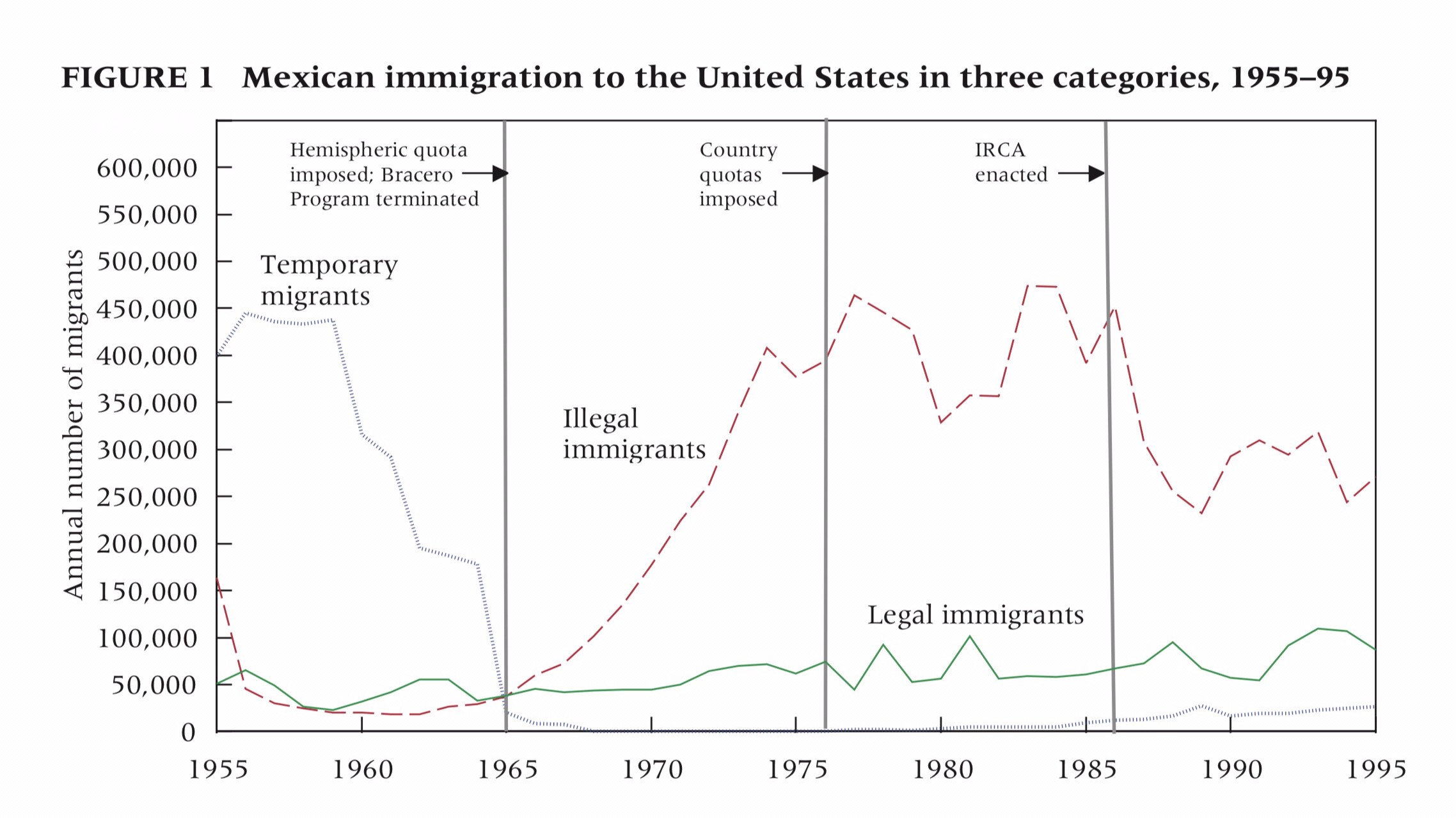
As this same population converted from being documented to undocumented a wave of scary metaphors was employed to gin up anxiety and paranoia and political will to employ ever more repressive policies to deter their entry. It was good for politicians and newspapers, terrible for immigrants and immigration policy. Thus began the “Latino threat” narrative. As Massey and Pren write:
“The most common negative framing depicted immigration as a “crisis” for the nation. Initially marine metaphors were used to dramatize the crisis, with Latino immigration being labeled a “rising tide” or a “tidal wave” that was poised to “inundate” the United States and “drown” its culture while “flooding” American society with unwanted foreigners (Santa Ana 2002). Over time, marine metaphors increasingly gave way to martial imagery, with illegal immigration being depicted as an “invasion” in which “outgunned” Border Patrol agents sought to “hold the line” in a vain attempt to “defend” the border against “attacks” from “alien invaders” who launched “banzai charges” to overwhelm American defenses (Nevins 2001; Chavez 2008).”
The fear stoked by politicians produced the intended paranoia and political constituency demanding ever tougher immigration measures. The result of this was not to stop undocumented immigration. Instead it caused the number of undocumented immigrants in the United States to grow.
Here’s why: as we made it harder for people to cross into the United States, we made it less likely that once here they would attempt to go back to their home country. Fearing an increasingly militarized border, circular patterns of migration became linear, with immigrants choosing to remain in the U.S., many of them ultimately joined by family members from their home country.
This government-created condition continued to feed on itself:
The “sustained, accelerating accumulation of anti-immigrant legislation and enforcement operations produced a massive increase in border apprehensions after the late 1970s, when the underlying flow of migrants had actually leveled off. For any given number of undocumented entry attempts, more restrictive legislation and more stringent enforcement operations generate more apprehensions, which politicians and bureaucrats can then use to inflame public opinion, which leads to more conservatism and voter demands for even stricter laws and more enforcement operations, which generates more apprehensions, thus bringing the process full circle. In short, the rise of illegal migration, its framing as a threat to the nation, and the resulting conservative reaction set off a self-feeding chain reaction of enforcement that generated more apprehensions even though the flow of undocumented migrants had stabilized in the late 1970s and actually dropped during the late 1980s and early 1990s.”
This would only get worse.
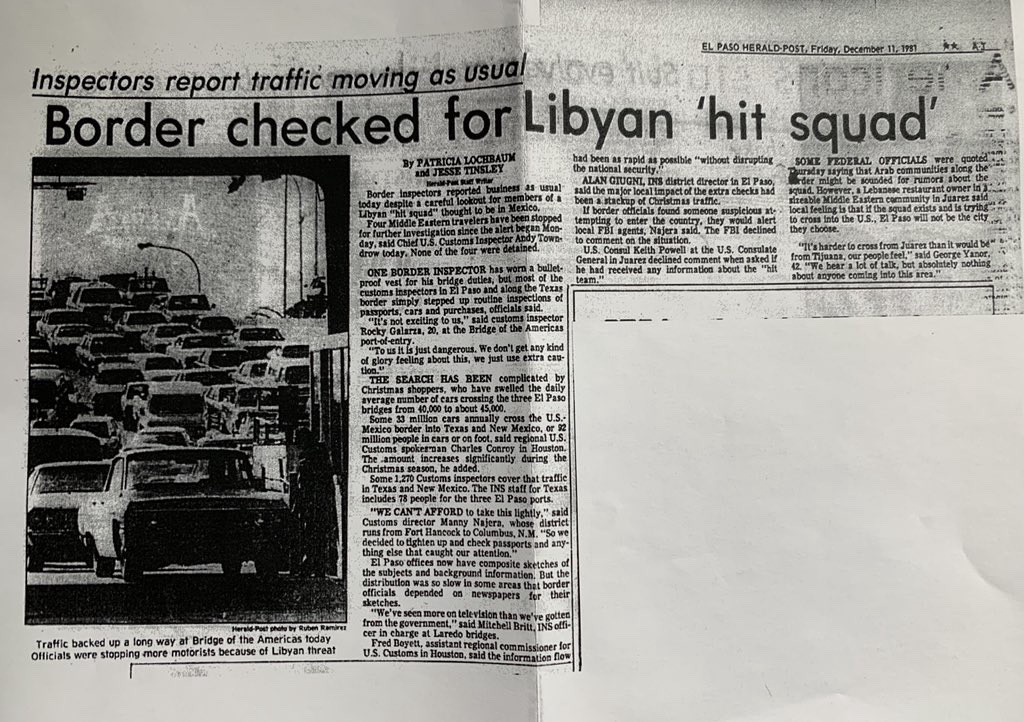
After terror attacks in the 1990s and in 2001, the Mexican immigrant was a ready scapegoat for politicians, and the intensity and brutality of enforcement and deterrence measures increased. In the face of terrorism that originated in Afghanistan and Saudi Arabia, the United States chose to conflate the war on terror with immigration from Mexico and Latin America.
With the passage of the Patriot Act in 2001 the number of deportations skyrocketed, with nearly 400,000 sent back to their country of origin in 2009 alone. Not one of the 9/11 terrorists entered through Mexico — and yet Mexicans bore the brunt of this country’s immigration response to the terror attacks. Last year, the State Department’s Bureau of Counterterrorism found that “there are no known international terrorist organizations operating in Mexico, no evidence that any terrorist group has targeted U.S. citizens in Mexican territory, and no credible information that any member of a terrorist group has traveled through Mexico to gain access to the United States.” This year’s report found much the same: “there was no credible evidence indicating that international terrorist groups have established bases in Mexico, worked with Mexican drug cartels, or sent operatives via Mexico into the United States.”

In addition, walls and fences authorized by the Secure Fence Act of 2006 pushed migration flows to ever more treacherous stretches of the U.S.-Mexico border. More than 4,500 human beings died crossing the border from 2006 to 2017. Far too many of them children.
In recent years, as Mexican migration slowed and then reversed (more Mexican nationals going south to Mexico than coming north to the United States), and as total undocumented immigration reached its lowest levels in modern history, the country was met with the challenge of tens of thousands of Central American families fleeing violence and brutality to petition for asylum in our country.
This too is an unintended consequence. Our involvement in the civil wars and domestic politics of Central American countries, in addition to our ability to consume more illegal drugs than any other country on the planet while leading a military- and law enforcement-first drug control policy, has helped to destroy the institutions of civil society necessary for those countries to function. They can no longer protect their citizens, and their citizens are coming to us.
And how do we meet this challenge? The President, using the same racist, inflammatory rhetoric of years past, seeks to build a wall, to take kids from their parents, to deploy the United States Army on American soil, to continue mass deportations and to end the protection for Dreamers. In other words, he seeks in one administration to repeat all the mistakes of the last half-century. And with past as prologue, we know exactly how that will end.
Not only will it lead to thousands of Americans losing their farms and ranches and homes through eminent domain to build a wall despite the fact that we have the lowest level of northbound apprehensions in my lifetime; it will lead to greater suffering and death for immigrants who are pushed to more dangerous points of crossing; it will fail to meet the legitimate challenge of illegal drugs that are brought to this country (the vast majority crossed at ports of entry); it will further erode our humanity and our standing in the world; and it will not do a single thing to reduce the number of undocumented immigrants and asylum seekers coming to this country.
But we still have a choice. In this democracy, if in fact the people are the government, and the government is the people, we still have a chance to prove it.
We can decide that we’ll get past the lies and fear, focus on the facts and human lives in our midst, and do the right thing. The end goal is a stronger, safer, more successful country. Critical to achieving that goal is having immigration, security and bilateral policies that match reality and our values.
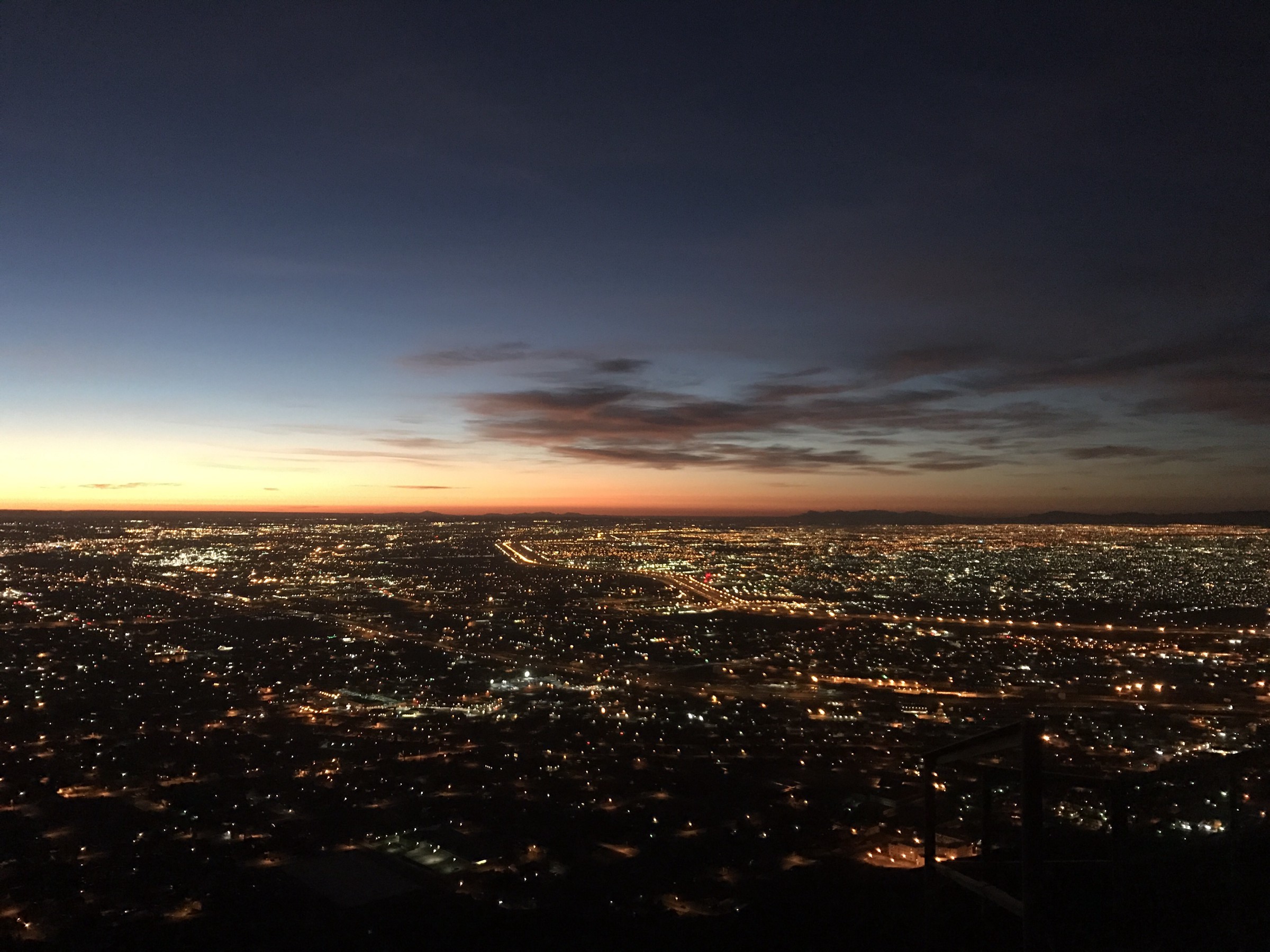
Last week, we welcomed the President to one of the safest cities in the United States. Safe not because of walls, and not in spite of the fact that we are a city of immigrants. Safe because we are a city of immigrants and because we treat each other with dignity and respect. A city that has the opportunity to lead on the most important issues before us, out of experience, out of compassion and out of a fierce determination to see this country live its ideals and rise to its full potential.
We can learn from the errors of our past, have the courage to do what’s right while we still have the chance, and ensure that the President doesn’t commit this country to making mistakes from which we may never recover.
It’s up to us.
Beto
What do you think about immigration and actions Beto proposes? Comments open; as Beto asks, speak with respect, please.

5 Comments | History | Tagged: 2020 Campaign, Beto O'Rourke, Immigration, Politics | Permalink
Posted by Ed Darrell

Of course you’re already flying your flag today, for Presidents Day 2019.
Presidents Day is that hybrid holiday designed to create a three-day weekend, and consolidate previous practices of having two holidays, one on Lincoln’s birthday on February 12, and another on Washington’s birthday on February 22 (Gregorian, or New Calendar).
February 2019 marks the third year in a row the U.S. is without a functioning president, but we celebrate the day anyway.
More:
4 Comments | Flag etiquette, Fly your flag today, History | Tagged: Flag etiquette, Fly your flag today, History | Permalink
Posted by Ed Darrell
This should be worthy of watching, and of future commentary

Bookmark this video. Sadly, you’ll have much use for it over the next two years.
Tip of the old scrub brush to The Weekly Sift.
More:
2 Comments | Dunning Kruger Effect, Dunning-Kruger Effect, History, Management, Science | Tagged: Dunning-Kruger Effect, History, Management, Science | Permalink
Posted by Ed Darrell
Beto O’Rourke, to the Texas State Democratic Convention in Fort Worth, Texas.
Sound feed came from a microphone on the camera, and not from the arena sound system — so it’s rather crummy.
But I’m not finding the official Texas Democratic Party version of this speech all the way through. And I think it ought to be preserved.
It’s not a usual “thanks for supporting me; let’s go win” convention speech. It demonstrates what happens when a thinking candidate tailors remarks to the audience in the hall, somethings thinking as she or he goes.
It’s why Texas should have sent him to the Senate.

Beto O’Rourke keynote at the Texas State Democratic Party Convention in Fort Worth, in June 2018. Fort Worth Star-Telegram video, screen capture.
2 Comments | Campaigns, Democratic Party, Elections, History, Politics, Texas | Tagged: Beto O'Rourke, Elections 2018, History, Politics, Texas State Democratic Convention | Permalink
Posted by Ed Darrell
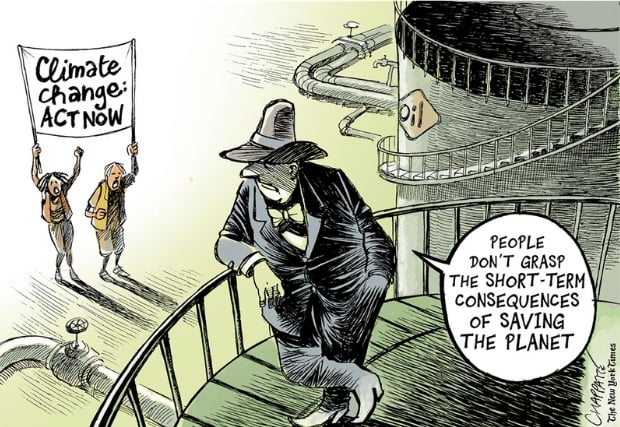
“People don’t grasp the short-term consequences of saving the planet.” Cartoon by Pat Chappatte @PatChappatte, New York Times Syndicate.
From CleanTechnica.com (with additional information added here from the House of Representatives official site):
116TH CONGRESS
1ST SESSION H. RES. 109
Recognizing the duty of the Federal Government to create a Green New Deal.
IN THE HOUSE OF REPRESENTATIVES
Ms. OCASIO-CORTEZ (for herself, Mr. Hastings, Ms. Tlaib, Mr. Serrano, Mrs. Carolyn B. Maloney of New York, Mr. Vargas, Mr. Espaillat, Mr. Lynch, Ms. Velázquez, Mr. Blumenauer, Mr. Brendan F. Boyle of Pennsylvania, Mr. Castro of Texas, Ms. Clarke of New York, Ms. Jayapal, Mr. Khanna, Mr. Ted Lieu of California, Ms. Pressley, Mr. Welch, Mr. Engel, Mr. Neguse, Mr. Nadler, Mr. McGovern, Mr. Pocan, Mr. Takano, Ms. Norton, Mr. Raskin, Mr. Connolly, Mr. Lowenthal, Ms. Matsui, Mr. Thompson of California, Mr. Levin of California, Ms. Pingree, Mr. Quigley, Mr. Huffman, Mrs. Watson Coleman, Mr. García of Illinois, Mr. Higgins of New York, Ms. Haaland, Ms. Meng, Mr. Carbajal, Mr. Cicilline, Mr. Cohen, Ms. Clark of Massachusetts, Ms. Judy Chu of California, Ms. Mucarsel-Powell, Mr. Moulton, Mr. Grijalva, Mr. Meeks, Mr. Sablan, Ms. Lee of California, Ms. Bonamici, Mr. Sean Patrick Maloney of New York, Ms. Schakowsky, Ms. DeLauro, Mr. Levin of Michigan, Ms. McCollum, Mr. DeSaulnier, Mr. Courtney, Mr. Larson of Connecticut, Ms. Escobar, Mr. Schiff, Mr. Keating, Mr. DeFazio, Ms. Eshoo, Mrs. Trahan, Mr. Gomez, Mr. Kennedy, and Ms. Waters) submitted the following resolution; which was referred to the Committee on Committee on Energy and Commerce, and in addition to the Committees on Science, Space, and Technology, Education and Labor, Transportation and Infrastructure, Agriculture, Natural Resources, Foreign Affairs, Financial Services, the Judiciary, Ways and Means, and Oversight and Reform, for a period to be subsequently determined by the Speaker, in each case for consideration of such provisions as fall within the jurisdiction of the committee concerned.
RESOLUTION
Recognizing the duty of the Federal Government to create
a Green New Deal.
Whereas the October 2018 report entitled ‘‘Special Report on Global Warming of 1.5ºC’’ by the intergovernmental Panel on Climate Change and the November 2018 Fourth National Climate Assessment report found that—
Whereas, because the United States has historically been responsible for a disproportionate amount of greenhouse gas emissions, having emitted 20 percent of global greenhouse gas emissions through 2014, and has a high technological capacity, the United States must take a leading role in reducing emissions through economic transformation;
Whereas the United States is currently experiencing several related crises, with—
Whereas climate change, pollution, and environmental destruction have exacerbated systemic racial, regional, social, environmental, and economic injustices (referred to in this preamble as ‘‘systemic injustices’’) by disproportionately affecting indigenous communities, communities of color, migrant communities, deindustrialized communities, depopulated rural communities, the poor, low-income workers, women, the elderly, the unhoused, people with disabilities, and youth (referred to in this preamble as ‘‘frontline and vulnerable communities’’);
Whereas, climate change constitutes a direct threat to the national security of the United States—
Whereas the Federal Government-led mobilizations during World War II and the New Deal created the greatest middle class that the United States has ever seen, but many members of frontline and vulnerable communities were excluded from many of the economic and societal benefits of those mobilizations; and
Whereas the House of Representatives recognizes that a new national, social, industrial, and economic mobilization on a scale not seen since World War II and the New Deal is a historic opportunity—
Now, therefore, be it
Resolved, That it is the sense of the House of Representatives that—
[End of text]
In the Senate, the companion (and matching) resolution sponsored by Massachusetts Sen. Edward J. Markey is S. Res. 59. It was referred to the Senate Committee on Environment and Public Works (See more information in the Congressional Record, pages S1140-1142. Senate cosponsors are, “Mr. Merkley, Mr. Sanders, Mrs. Gillibrand,
Ms. Harris, Ms. Warren, Ms. Hirono, Mr. Wyden, Mr. Blumenthal, Mr.
Booker, Ms. Klobuchar, and Mr. Murphy.”
More:

Tom Toles in the Washington Post, June 18, 2018.
3 Comments | air pollution, Economics, Environment, History, U.S. Congress | Tagged: 116th Congress, air pollution, Economics, environment, Green New Deal, H. Res. 109 | Permalink
Posted by Ed Darrell
You are currently browsing the Millard Fillmore's Bathtub blog archives for the year 2019.


Ed Darrell on Texas's Colorado River


Come on in, the water's fine. Come often: Cleanliness is next to godliness.


 Millard Fillmore's Bathtub