May 23, 1926: Mencken confessed the Millard Fillmore bathtub hoax, “any facts . . . got there accidentally”

May 23, 2013

Reasons for my annual observance of a moment of silence, here on May 23, for the failed confession of Mr. Mencken should be obvious to even a sleepy reader.  Alas, annually the need grows to call attention to the dangers of hoaxing, as hoaxes particularly in the political life of the U.S. grow in number, in viciousness, and in the numbers of gullibles suckered.  Here, again, is our annual reading of the confession with a few photographs and new links thrown in for easy learning:

May 23, 1926, H. L. Mencken‘s newspaper column confessed his hoax of nine years earlier — he had made up whole cloth the story of Millard Fillmore‘s only accomplishment being the installation of a plumbed bathtub in the White House (in the 1850s known as the Executive Mansion).

Alas, the hoax cat was out of the bag, and the hoax information still pollutes the pool of history today.

Text of the confession, from the Museum of Hoaxes:

Melancholy Reflections

On Dec. 28, 1917, I printed in the New York Evening Mail, a paper now extinct, an article purporting to give the history of the bathtub. This article, I may say at once, was a tissue of absurdities, all of them deliberate and most of them obvious…

This article, as I say, was planned as a piece of spoofing to relieve the strain of war days, and I confess that I regarded it, when it came out, with considerable satisfaction. It was reprinted by various great organs of the enlightenment, and after a while the usual letters began to reach me from readers. Then, suddenly, my satisfaction turned to consternation. For these readers, it appeared, all took my idle jocosities with complete seriousness. Some of them, of antiquarian tastes, asked for further light on this or that phase of the subject. Others actually offered me corroboration!

But the worst was to come. Pretty soon I began to encounter my preposterous “facts” in the writings of other men. They began to be used by chiropractors and other such quacks as evidence of the stupidity of medical men. They began to be cited by medical men as proof of the progress of public hygiene. They got into learned journals. They were alluded to on the floor of congress. They crossed the ocean, and were discussed solemnly in England and on the continent. Finally, I began to find them in standard works of reference. Today, I believe, they are accepted as gospel everywhere on earth. To question them becomes as hazardous as to question the Norman invasion.

* * *

And as rare. This is the first time, indeed, that they have ever been questioned, and I confess at once that even I myself, their author, feel a certain hesitancy about doing it. Once more, I suppose, I’ll be accused of taking the wrong side for the mere pleasure of standing in opposition. The Cincinnati boomers, who have made much of the boast that the bathtub industry, now running to $200,000,000 a year, was started in their town, will charge me with spreading lies against them. The chiropractors will damn me for blowing up their ammunition. The medical gents, having swallowed my quackery, will now denounce me as a quack for exposing them. And in the end, no doubt, the thing will simmer down to a general feeling that I have once more committed some vague and sinister crime against the United States, and there will be a renewal of the demand that I be deported to Russia.

I recite this history, not because it is singular, but because it is typical. It is out of just such frauds, I believe, that most of the so-called knowledge of humanity flows. What begins as a guess — or, perhaps, not infrequently, as a downright and deliberate lie — ends as a fact and is embalmed in the history books. One recalls the gaudy days of 1914-1918. How much that was then devoured by the newspaper readers of the world was actually true? Probably not 1 per cent. Ever since the war ended learned and laborious men have been at work examining and exposing its fictions. But every one of these fictions retains full faith and credit today. To question even the most palpably absurd of them, in most parts of the United States, is to invite denunciation as a bolshevik.

So with all other wars. For example, the revolution. For years past American historians have been investigating the orthodox legends. Almost all of them turn out to be blowsy nonsense. Yet they remain in the school history books and every effort to get them out causes a dreadful row, and those who make it are accused of all sorts of treasons and spoils. The truth, indeed, is something that mankind, for some mysterious reason, instinctively dislikes. Every man who tries to tell it is unpopular, and even when, by the sheer strength of his case, he prevails, he is put down as a scoundrel.

* * *

As a practicing journalist for many years, I have often had close contact with history in the making. I can recall no time or place when what actually occurred was afterward generally known and believed. Sometimes a part of the truth got out, but never all. And what actually got out was seldom clearly understood. Consider, for example, the legends that follow every national convention. A thousand newspaper correspondents are on the scene, all of them theoretically competent to see accurately and report honestly, but it is seldom that two of them agree perfectly, and after a month after the convention adjourns the accepted version of what occurred usually differs from the accounts of all of them.

Political boss Harry M. Daugherty (later Attor...

Political boss Harry M. Daugherty (later Attorney General of the United States), left, with Senator Warren G. Harding (later President of the United States) at Harding’s home in Marion, Ohio during the 1920 presidential campaign. (Photo credit: Wikipedia)

I point to the Republican convention of 1920, which nominated the eminent and lamented Harding. A week after the delegates adjourned the whole country believed that Harding had been put through by Col. George Harvey: Harvey himself admitted it. Then other claimants to the honor arose, and after a year or two it was generally held that the trick had been turned by the distinguished Harry M. Daugherty, by that time a salient light of the Harding cabinet. The story began to acquire corroborative detail. Delegates and correspondents began to remember things that they had not noticed on the spot. What the orthodox tale is today with Daugherty in eclipse, I don’t know, but you may be sure that it is full of mysterious intrigue and bold adventure.

Ambassador Myron T. Herrick was part of the U....

Ambassador Myron T. Herrick was part of the U.S. delegation to the International Chamber of Commerce which sailed on Kroonland in 1920. (Photo credit: Wikipedia)

What are the facts? The facts are that Harvey had little more to do with the nomination of Harding than I did, and that Daugherty was immensely surprised when good Warren won. The nomination was really due to the intense heat, and to that alone. The delegates, torn by the savage three cornered fight between Lowden, Johnson, and Wood, came to Saturday morning in despair. The temperature in the convention hall was at least 120 degrees. They were eager to get home. When it became apparent that the leaders could not break the deadlock they ran amuck and nominated Harding, as the one aspirant who had no enemies. If any individual managed the business it was not Harvey or Daugherty, but Myron T. Herrick. But so far as I know Herrick’s hand in it has never been mentioned.

* * *

English: Jack Dempsey and Georges Carpentier i...

Jack Dempsey and Georges Carpentier in arena before fight at Boyle’s Thirty Acres. (Photo credit: Wikipedia)

I turn to a more pleasant field — that of sport in the grand manner. On July 2, 1921, in the great bowl at Jersey City, the Hon. Jack Dempsey met M. Carpentier, the gallant frog. The sympathy of the crowd was overwhelmingly with M. Carpentier and every time he struck a blow he got a round of applause, even if it didn’t land. I had an excellent seat, very near the ring, and saw every move of the two men. From the first moment Dr. Dempsey had it all his own way. He could have knocked out M. Carpentier in the first half of the first round. After that first half he simply waited his chance to do it politely and humanely.

Yet certain great newspapers reported the next morning that M. Carpentier had delivered an appalling wallop in the second round and that Dr. Dempsey had narrowly escaped going out. Others told the truth, but what chance had the truth against that romantic lie? It is believed in to this day by at least 99.99 per cent of all the boxing fans in Christendom. Carpentier himself, when he recovered from his beating, admitted categorically that it was nonsense, but even Carpentier could make no headway against the almost universal human tendency to cherish what is not true. A thousand years hence schoolboys will be taught that the frog had Dempsey going. It may become in time a religious dogma, like the doctrine that Jonah swallowed the whale. Scoffers who doubt it will be damned to hell.

The moral, if any, I leave to psycho-pathologists, if competent ones can be found. All I care to do today is to reiterate, in the most solemn and awful terms, that my history of the bathtub, printed on Dec. 28, 1917, was pure buncombe. If there were any facts in it they got there accidentally and against my design. But today the tale is in the encyclopedias. History, said a great American soothsayer, is bunk.

Mencken’s confession gets much less attention than it deserves.  In a just world, this essay would be part of every AP U.S. history text, and would be available for printing for students to read individually in class and to discuss, debate and ponder.  Quite to the contrary, state legislatures today debate whether to require teaching of the hoax that disastrous climate change is not occurring, only 45% of Americans claim to know better for certain; more legislatures work hard to devise ways to insert hoaxes against biology (evolution and human reproduction, notably), astronomy and physics (Big Bang), history and even education (Islam is a root of socialist thought, President Obama is not Christian, weapons of mass destruction were found in Iraq after the U.S. invasion, teachers are socialists).

In 2013, the governing body of the Boy Scouts of America votes today on whether to allow homosexual boys to be Scouts — as if an 8-year-old kid joining Cub Scouts knows enough about sex and love, and sex predation, to threaten the Constitution of the U.S. if we allow him to learn how to put alphabet macaroni onto a board spelling out “Mom,” or to learn how to carve an automobile out of a block of wood and race it on a closed-course track.  The so-called Family Research Council (FRC) has conducted a campaign of vicious hoaxes against the measure, even going so far as to purloin official logos of the Boy Scouts to suggest they speak for BSA.  The hoax has millions of victims, they claim.

Meanwhile, in Washington, D.C., GOP Members of Congress call for investigations into wrongdoing evidenced in e-mails between the White House and State Department and CIA, over the attack on the U.S. diplomatic mission in Benghazi, Libya, and the death of Ambassador Chris Stevens.  To hear the GOP describe it, you’d never know that the GOP opposed President Obama’s actions to save the city of Benghazi from destruction by dictator Muammar Gadhafy a few months before, that the GOP slashed the security budget for all U.S. diplomatic missions, leaving Ambassador Stevens underprotected, that the GOP was opposed to much of the work of Ambassador Stevens, or that the incriminating e-mails were hoaxed up by GOP Congressional staff.

If you see pale faces among the GOP Congressional staff or the FRC this morning, it may be because the ghost of H. L. Mencken appeared to them last night to give them hell.  We could hope.

More:


Nope, Patrick Henry didn’t say that

April 8, 2013

More misquoting of “the Founders”:

For America misquotes Patrick Henry

For America’s poster featuring a quote falsely claimed to be from Patrick Henry.  The racial right wingers won’t tell you, but the painting is a portrait by George Bagby Matthews c. 1891, after an original by Thomas Sully.

It’s baseball season.  I love a pitch into the wheelhouse.

The radical right-wing political group For America — a sort of latter-day Redneck Panther group — invented this one, and pasted it up on their Facebook site this morning.

You know where this is going, of course.  Patrick Henry didn’t say that.  The poster is a hoax.

Your Hemingway [Excrement] Detector probably clanged as soon as you pulled the poster up.  Patrick Henry was a powerful opponent to the Constitution.

Opposed to the Constitution?  Oh, yes.  It helps to know a bit of history.

Henry was at best suspicious of the drive to get a working, central government after the Treaty of Paris ended the American Revolution. While George Washington needed an interstate authority, at least to resolve disputes between the states, in order to create a commercial entity to build a path into the Ohio Valley, Henry was opposed.  To be sure, Washington was scheming a bit, with his dreaming:  Washington held title to more than 15,000 acres of land in the Ohio Valley, his fee for having surveyed the land for Lord Fairfax many years earlier.  Washington stood to get wealthy from the sale of the land — if a path into and out of the Ohio could be devised.  Washington struggled for years to get a canal through — seen today in the remains of the Chesapeake and Ohio Canal from Washington, D.C., up along the Potomac River.

Henry was so opposed to the states’ working together that he refused to notify Virginia’s commissioners appointed to a commission to settle the fishing and title dispute to the Chesapeake Bay, between Maryland and Virginia especially, and including Delaware.  When Maryland’s commissioners showed up in Fairfax for the first round of negotiations, they could not find the Virginia commissioners at all.  So they called on Gen. Washington at his Mt. Vernon estate (as about a thousand people a year did in those years).  Washington recognized immediately how this collaboration could aid getting a path through Maryland to the Ohio.

Perplexed at the abject failure of Virginia’s government, Washington dispatched messages to the Virginia commissioners, including a young man Washington did not know, James Madison.  Washington was shocked and disappointed to learn the Virginians did not know they had been appointed.  He suggested the Marylanders return home, and immediately began working with Madison to make the commission work.  When this group settled the Chesapeake Bay boundaries and fishing issues, and Washington’s war aide Alexander Hamilton was entangled in a separate but similar dispute between New York and New Jersey over New York Harbor, Washington introduced Hamilton and Madison to each other, and suggested they broaden their work.  Ultimately this effort produced the Annapolis Convention among five colonies, which called for a convention to amend the Articles of Confederation.  The Second Continental Congress agreed to the proposal.

When the delegates met at Philadelphia, they determined the Articles of Confederation irreparably flawed.  Instead, they wrote what we now know as the Constitution.

Patrick Henry opposed each step.  Appointed delegate to the Philadelphia Convention in 1787, he refused to serve.  Instead, he was elected Governor of Virginia, and proceeded to organize opposition to ratification of the Constitution.  Madison’s unique ratification process, sending the Constitution to conventions of the people in each state, instead of to the state legislatures, was designed to get around Henry’s having locked up opposition to ratification in the Virginia Assembly.

Henry led opposition to ratification at the Virginia convention.  Outflanked by Madison, Henry was enraged by Virginia’s ratification.  Virginia had called for the addition of a bill of rights to the document, and the ratification campaign was carried partly on Madison’s promise that he would propose a bill of rights as amendments, as soon as the new federal government got up and running.  Henry sought to thwart Madison, blocking Madison’s appointment as U.S. senator, in the state legislature.  When Madison fell back to run for the House of Representatives, Henry found the best candidate to oppose Madison in the Tidewater area and threw all his support behind that candidate. (James Monroe was that candidate; in one of the more fitting ironies of history, during the campaign Monroe was persuaded to Madison’s side; Madison won the election, and the lifelong friendship and help of Monroe.)

When the new federal government organized, Henry refused George Washington’s invitation to join it in any capacity.  Henry continued to oppose the Constitution and its government to his death.

Consequently, it is extremely unlikely Henry would have ever suggested that the Constitution was a useful tool in any way, especially as a defense of freedom; Henry saw the Constitution as a threat to freedom.

There are good records of some of the things Henry really did say about the Constitution.  Henry regarded the Constitution as tyranny, and said exactly that in his speech against the Constitution on June 5, 1788:

It is said eight states have adopted this plan. I declare that if twelve states and a half had adopted it, I would, with manly firmness, and in spite of an erring world, reject it. You are not to inquire how your trade may be increased, nor how you are to become a great and powerful people, but how your liberties can be secured; for liberty ought to be the direct end of your government.

In the same speech, Henry challenged the right of the people even to consider creating  a Constitution:

The assent of the people, in their collective capacity, is not necessary to the formation of a federal government. The people have no right to enter into leagues, alliances, or confederations; they are not the proper agents for this purpose. States and foreign powers are the only proper agents for this kind of government.

Probably diving into hyperbole, Henry portrayed the Constitution itself as a threat to liberty, not a protection from government:

When I thus profess myself an advocate for the liberty of the people, I shall be told I am a designing man, that I am to be a great man, that I am to be a demagogue; and many similar illiberal insinuations will be thrown out: but, sir, conscious rectitude outweighs those things with me.

I see great jeopardy in this new government. I see none from our present one. I hope some gentleman or other will bring forth, in full array, those dangers, if there be any, that we may see and touch them.

Anyone familiar with the history, with the story of Patrick Henry and the conflicting, often perpendicular story of the creation of the Constitution, would be alarmed at a quote in which Henry appears to claim the Constitution a protector of rights of citizens — it’s absolutely contrary to almost everything he ever said.

Perhaps most ironic, for our right-wing friends:  The quote on the poster above was invented as a defense against abuses of the Constitution by the right.  Wikiquote tracked it back to its invention:

The Constitution is not an instrument for the government to restrain the people, it is an instrument for the people to restrain the government — lest it come to dominate our lives and interests.

  • As quoted in The Best Liberal Quotes Ever : Why the Left is Right (2004) by William P. Martin. Though widely attributed to Henry, this statement has not been sourced to any document before the 1990s and appears to be at odds with his beliefs as a strong opponent of the adoption of the US Constitution.

“History?” For America might say. “We don’t got no history. We don’t NEED NO STINKIN’ HISTORY!”

And so they trip merrily down the path to authoritarian dictatorship, denying their direction every step of the way to their ultimate end.

The rest of us can study history, and discover the truth.

More:


White House Easter Egg Roll tickets go to kids of military

March 20, 2013

Not big news — they do this almost every year — but I want to put down the anchor on this story.

"EASTER EGG ROLLING, WHITE HOUSE" &q...

A photo from the distant, but indefinite past: “EASTER EGG ROLLING, WHITE HOUSE” “1 negative : glass ; 5 x 7 in. or smaller” (Photo credit: Wikipedia)

Why do I want to anchor it?  In about three days, if tradition holds, I’ll get an e-mail from some vet madder than hell that Obama shut out the kids of military veterans from the Easter Egg Roll; the story he sends will probably claim Obama changed it to a Ramadan Relleno Roll, or something.

I post it here so I can find it quickly, then.  Obama H8ers will distort every piece of good news.  You can see the drumbeat start in the “More” section below.  A Continuing Resolution passed the Senate today, and is expected to win approval in the House tomorrow, providing funds to continue the Easter Egg roll on April 13, as well as the rest of the government through the end of the Fiscal Year.

President Barack Obama cheers on children part...

President Barack Obama cheers on children participating in rolling eggs across the South Lawn Monday, April 13, 2009, during the White House Easter Egg Roll. (Photo credit: Wikipedia)

More:

Update:  Turns out that Fox News had already slammed Obama, falsely, for keeping the Egg Roll on the calendar.  As Mediaite reported, Fox News’s Megyn Kelly charged it was all politics, prompting White House press guy Jay Carney to explain the event is paid for out of donations, not out of the budget.


Millard Fillmore: Still dead, still misquoted, 139 years later

March 8, 2013

Millard Fillmore wax head

A wax likeness of Millard Fillmore’s head, appearing to be for sale for $950.00 back in 2007. Did anyone ever buy it? Yes, it does bear an unusual resemblance to Tom Peters.

March 8, 2013, is the 139th anniversary of Millard Fillmore’s death.  Famous lore claims Fillmore’s last words were, “The nourishment is palatable.”

What a crock!

Manus reprints the text from the New York Times obituary that appeared on March 9:

Buffalo, N.Y., March 8 — 12 o’clock, midnight. — Ex-President Millard Fillmore died at his residence in this city at 11:10 to-night. He was conscious up to the time. At 8 o’clock, in reply to a question by his physician, he said the nourishment was palatable; these were his last words. His death was painless.

First, I wonder how the devil the writer could possibly know whether Fillmore’s death was painless?

And second, accuracy obsessed as I am, I wonder whether this is the source of the often-attributed to Fillmore quote, “The nourishment is palatable.” Several sources that one might hope would be more careful attribute the quote to Fillmore as accurate — none with any citation that I can find. Thinkexist charges ahead full speed; Brainyquote removed the quote after I complained in 2007. Wikipedia lists it. Snopes.com says the quote is “alleged,” in a discussion thread.

I’ll wager no one can offer a citation for the quote. I’ll wager Fillmore didn’t say it.

Let’s be more stolid:  The quote alleged to be Fillmore’s last words, isn’t.  No one says “palatable” when they’re dying, not even the man about whom it is claimed that Queen Victoria pronounced him the hansomest man she ever met (just try tracking that one down), and whose strongest legacy is a hoax about a bathtub, started 43 years after he died.  No one calls soup “sustenance.”

The alleged quote, the misquote, the distortion of history, was stolen from the obituary in the New York Times.  Millard Fillmore did not say, “The sustenance is palatable.”

What were Millard Fillmore’s last words?  They may be buried in the notebook of one of his doctors.  They may be recorded in some odd notebook held in the Buffalo and Erie County Historical Society, or in the Library of SUNY Buffalo, or in the New York State Library‘s dusty archives.

But the dying President Fillmore did not say, “The sustenance is palatable.”

Millard Fillmore: We’d protect his legacy, if only anyone could figure out what it is.

This is partly an encore post, based on a post from 2007.

More:


Quote of the Moment: Churchill’s Iron Curtain speech (encore)

March 5, 2013

March 5, 2013, is the 67th anniversary of Winston Churchill’s speech in Fulton, Missouri. He called the speech “Sinews of Peace,” but it is better known as the speech in which Churchill first used the phrase Iron Curtain to describe events in Eastern Europe after World War II.

Winston Churchill delivering the "Iron Curtain" speech, Westminster College, Fulton, Missouri, March 5, 1946 - Photo by George Skadding

Winston Churchill delivering the “Iron Curtain” speech, Westminster College, Fulton, Missouri, March 5, 1946 – Photo by George Skadding

“From Stettin in the Baltic to Trieste in the Adriatic, an iron curtain has descended across the Continent. Behind that line lie all the capitals of the ancient states of Central and Eastern Europe. Warsaw, Berlin, Prague, Vienna, Budapest, Belgrade, Bucharest and Sofia, all these famous cities and the populations around them lie in what I must call the Soviet sphere, and all are subject in one form or another, not only to Soviet influence but to a very high and, in many cases, increasing measure of control from Moscow.”

Sir Winston S. Churchill, in a speech at Westminster College, Fulton, Missouri, on March 5, 1946, titled “The Sinews of Peace.”

Some historians mark the beginning of the Cold War from this speech, in which a respected world leader first spelled out the enormous stakes at issue, and also pointed out that Russian, communist totalitarian governments were replacing more democratic governments in nations only recently freed from the spectre of Nazi rule, in World War II.

Last June son James and I stopped off in Fulton, on the way back from James’s graduation from Lawrence University in Appleton, Wisconsin.  We were treated royally by the people at the Churchill Centre, and got a chance to spend time in what is really a first rate museum.  More people should make Fulton a destination, or pause in their summer travels, for the sake of the kids.

This is an encore post; with a bit of time free, I may post more photographs of our trip.

Oh, why not: Below the fold is the speech in its entirety, from the transcript at the Churchill Centre. Read the rest of this entry »


Obama H8rs complain, “Obama’s not emperor!”

February 18, 2013

President Obama at 2nd Google+ Fireside Hangout, February 14, 2013

Obama’s got good answers and is willing to discuss policy with American citizens; critics keep making stuff up to complain about. Caption from the White House: President Barack Obama participates in a “Fireside Hangout” on Google+ with Americans from around the country to discuss his State of the Union Address, in the Roosevelt Room of the White House. February 14, 2013. (Official White House Photo by Pete Souza)

Can’t make this stuff up as fast as the unthinking anti-Obama folks can dish it out.

Their criticisms often vaporize at the slightest investigation, though.  Why not talk serious policy?  They won’t do it.

Wednesday night, President Obama participated in a Google+ ” Fireside Hangout.”  These sessions take their cue in part from FDR’s Fireside Chats.  In the modern, Google+ version, it’s not just the president talking.  He takes questions from a panel of interrogators, and from people who send in questions by Tweet or e-mail.  Obama took questions from citizens.

One woman, Jackie Guerrero (sp?) complained that the Obama administration enforces our immigration laws with much more toughness than any previous administration, ever.  She said too many people who shouldn’t be deported, are being deported.  She asked President Obama to explain why his administration has done that.

Obama said he’s the executive, and he’s required to carry out the laws.  He urged the woman to support changes in the laws, but he pointed out that must come from Congress.  His answer took two-and-a-half minutes, and he outlined the need for immigration reform.  In a few seconds, he started his answer with this:

“This is something I’ve struggled with throughout my presidency,” said Obama. “The problem is that I’m the president of the United States, I’m not the emperor of the United States. My job is to execute laws that are passed.”

You as a reasonably intelligent and perceptive Dear Reader recognize that Obama is asking for citizen pressure on Congress to pass reform of our immigration laws.

You as a reasonably intelligent and perceptive Dear Reader are also well aware there is a group of people loose in America who say that, whatever Obama says, Obama is wrong.

So, what do those Obama H8rs say?  Do they complain about immigration reform, saying we don’t need it?

No, they don’t even give their listeners and viewers the dignity of talking about the issues. Here’s how Michael Savage butchered the video of the Google session:

Savage posted this wan explanation:

Published on Feb 15, 2013

In a Google hangout last evening February 14, 2013, President Barack Obama explained that his problem is that he’s “not the emperor of the United States”: “This is something I’ve struggled with throughout my presidency,” said Obama. “The problem is that I’m the president of the United States, I’m not the emperor of the United States. My job is to execute laws that are passed.”

In a very technical sense, that’s accurate reporting of part of Obama’s statement.

But it’s not the whole truth, as you can see.  There is no mention whatsoever of the issue at hand, immigration reform, for example.  How can they report it correctly, if they don’t even report what happened?

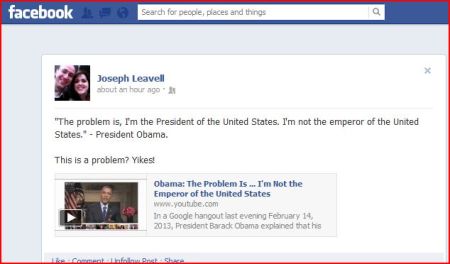
How have others reacted?  Our old friend Joe Leavell leapt at the opening Michael Savage provided, with a Facebook post linking to the video:

“The problem is, I’m the President of the United States. I’m not the emperor of the United States.” – President Obama.
This is a problem? Yikes!

Can you tell Joe’s views on immigration reform?  On enforcing laws?  On not enforcing laws?  Just try to pin him down.

Leavell on Obama as emperor

On Facebook, a complaint leaving the impression that Obama said he wants to be emperor, though of course, that’s not at all what Obama said.

One more demonstration we don’t need that people who truly hate Obama with no good reason will make up crap to claim against him, regardless what he says.

Some wag said, “I hope President Obama comes out tomorrow with a warning against eating yellow snow, just so I can see these guys explain the benefits of eating yellow snow.”

I wish they’d just wake up, read the old Boy Scout Citizenship Merit Badge booklet, and be good citizens without all the hoax complaints.

No, Obama did not say he wants to be emperor.  No, he did not.

No, he didn’t.

Alas, Joe Leavell on Facebook is not the only one who had what should be embarrassing conniptions over the mined quote.

Wall of shame, commenters who fuzzed up the news and ran with the political smear; count ’em:

  1. Weekly Standard (apparently all their fact checkers died; I didn’t realize they really have no regard for the accuracy of stuff they report, before).
  2. Obama: ‘The Problem is … I’m not the Emperor of the United States’ (radio.foxnews.com)
  3. Obama Says the “The Problem Is…I’m Not Emperor of the United States” (gunmartblog.com)
  4. Obama: “The Problem Is I’m President of the United States, I’m Not the Emperor” (Video) (thegatewaypundit.com)
  5. Obama: ‘The Problem Is … I’m Not the Emperor of the United States’ (givemeliberty01.com)
  6. Obama Says ‘The Problem Is That I’m Not The Emperor Of The United States’ (vineoflife.net)
  7. ‘The Problem Is … I’m Not the Emperor of the United States’ (ConservativeActionAlerts.com)
  8. I’m Not The Emperor of the USA (tarpon.wordpress.com)
  9. “The Problem is I’m not Emperor:” Obama’s Freudian Slip (rjblack.wordpress.com)
  10. Barack Obama: ‘The Problem Is … I’m Not the Emperor of the United States’ (ijreview.com)
  11. Obama: ‘The Problem Is I’m Not The Emperor Of The United States’ (conservativebyte.com)
  12. Barack Obama: I’m not emperor of the United States (Twitchy)
  13. Obama made a Freudian slip, The Rio Norte Line
  14. Of course The Blaze misreported it, too
  15. Washington Times blog screwed it up
  16. Victor Medina, a Dallas Republican operative, in the Examiner
  17. TeaParty.org copied the Weekly Standard, a weakly slandering practice of theirs
  18. WeaselZippers honestly stated they got the report “scouring the bowels of the internet” and came up with the same old offal; this is the quality of reporting we’re talking about here
  19. Before It’s News reported it, though it wasn’t news at all
  20. Nothing but the Truth misses its named target, copying the false report at Gateway Pundit

Some of you may remember Spike Jones’s send-up of that classic show tune, “I’m in the Mood for Love.”  One verse of the lyric is, “Funny, but when I’m near you, I’m in the mood for love.”  In Spike’s version, an indignant voice interrupts with, “Funny butt!  Who’se got a funny butt?”

That’s rather what Savage and others have done with Obama’s answer here.

How many of those sites do you think would like it if Obama had said, “Okay, we’ll stop deportations of all but criminal and dangerous undocumented aliens tomorrow?”  How many of those sites will favor action on immigration reform?  How many of them will want their children to know they wrote these things, in ten years?

This cheap and misleading criticism ignored the two-and-a-half-minute response Obama gave to the immigration and deportation question, in which he concisely explained the problems and the urgent need for immigration reform to benefit the U.S. economy.  See the complete answer in the video of the entire session, at the bottom of this post.

Obama’s critics don’t dare allow him a fair chance to state his position.  They have no answers for his clearly thought-out plans.

More:

See for yourself how Obama’s views were covered up and his meanings distorted.  Here’s the entire Google Fireside Hangout, all 47 minutes of it (in HD and stereo); the question on immigration comes about 19 minutes in, and Obama’s answer took about two and a half minutes, all ignored completely by Obama’s H8rs:

Update, post script:  CBS’s guy who keeps all the records, Mark Knoller, accurately reported Obama’s words in a Tweet, with just 140 characters; why can’t conservative wackoes get it right with 1,000 words and video?  They probably don’t intend to get it right, like Knoller works to get it right every day, day in, and day out.


Especially on his birthday, don’t call Darwin racist — he wasn’t

February 12, 2013

Creationists, Intelligent Design proponents, and several other anti-science and historical revisionist groups come unglued every February about this time — February 12 is Charles Darwin’s birthday.  He was born in 1809, on the exact same day as Abraham Lincoln.

Part of creationists’ coming unglued revolves around that fact that the science behind evolution grows stronger year by year, and at this point no argument exists that creationists can make against evolution that has not been soundly, roundly and thoroughly.  This makes creationists nervous in a discussion, because even they recognize when they lose arguments.   Creationists don’t like to lose arguments about how well Darwin’s theories work, because they erroneously believe that if Darwin is right, God and Jesus are wrong.

God and Jesus cannot be wrong, in their view, but intellectually they see they are losing the argument, and they grow desperate.  In their desperation they grasp for claims that shock uneducated or unfamiliar viewers.  Since about 1970, among the more shocking arguments one can make is to claim one’s opponent is racist.

Claiming Darwin, and hence evolution, boost racism, slaps history with irony.  Creationism’s roots were in denying that Europeans and Africans are evolutionarily equal, a claim necessary to allow slave holders to enslave Africans and go to church on Sundays.  The Civil War is 150 years away, the Emancipation Proclamation 148 years old, and even die-hard creationists generally have forgotten their own history.

Creationists accuse Darwin of being a racist, they claim evolution theory is racist, and they claim, therefore, it cannot be scientifically accurate.  There are a lot of holes in that chain of logic.

This is Darwin’s birthday.  Let me deal with major wrong premise, and give creationists room to correct their views with accurate history, so we don’t have a shouting match.

Way back in 2008, nominally-liberal evangelical preacher Tony Campolo got suckered in by a conservative evangelicals claim to him that evolution and Darwin are racist.  Below is my answer to him then — I think Campolo learned his lesson — but this builds on the claims Campolo made which are really copied from creationists.

In short, Darwin is not racist, and here are some explanations why, with a few updated links and minor edits for Darwin’s birthday, and Lincoln’s birthday, in 2013:

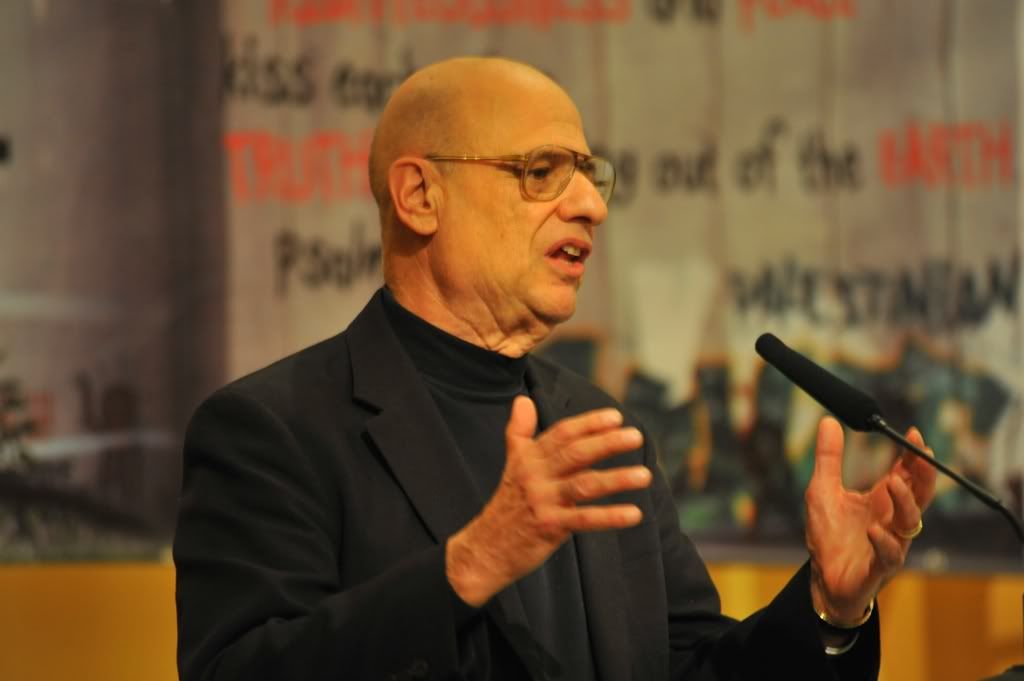
Tony Campolo is an evangelical Christian, a sociology professor and preacher who for the past 15 years or so has been a thorn in the side of political conservatives and other evangelicals, for taking generally more liberal stands, against poverty, for tolerance in culture and politics, and so on. His trademark sermon is an upbeat call to action and one of the more plagiarized works in Christendom, “It’s Friday, but Sunday’s Coming” (listen to it here). 

Tony Campolo

Rev. Tony Campolo

Since he’s so close to the mainstream of American political thought, Campolo is marginalized by many of the more conservative evangelists in the U.S. Campolo is not a frequent guest on the Trinity Broadcast Network, on Pat Robertson’s “700 Club,” nor on the white, nominally-Christian, low-budget knock-off of “Sabado Gigante!,” “Praise the Lord” (with purple hair and everything).

Campolo came closest to real national fame when he counseled President Bill Clinton on moral and spiritual issues during the Lewinsky scandal.

His opposite-editorial piece in the Philadelphia Inquirer back in 2008, “The real danger in Darwin is not evolution, but racism,” is out of character for Campolo as a non-conservative evangelistic thinker — far from what most Christians expect from Campolo either from the pulpit or in the college classroom. The piece looks as though it was lifted wholesale from Jerry Falwell or D. James Kennedy, showing little familiarity with the science or history of evolution, and repeating canards that careful Christians shouldn’t repeat.

Campolo’s piece is inaccurate in several places, and grossly misleading where it’s not just wrong. He pulls out several old creationist hoaxes, cites junk science as if it were golden, and generally gets the issue exactly wrong.

Evolution science is a block to racism. It has always stood against racism, in the science that undergirds the theory and in its applications by those scientists and policy makers who were not racists prior to their discovery of evolution theory. Darwin himself was anti-racist. One of the chief reasons the theory has been so despised throughout the American south is its scientific basis for saying whites and blacks are so closely related. This history should not be ignored, or distorted.

Shame on you, Tony Campolo.

Read the rest of this entry »


A neglected 95th anniversary of Mencken and Millard Fillmore’s Bathtub – National Bathtub and Presidential Obscurity Day

December 28, 2012

A Millard Fillmore’s Bathtub December 28 tradition; mostly encore post, but worthy of note on National Bathtub and Presidential Obscurity Day

95 years ago today, on December 28, 1917, this column by H. L. Mencken was published in The New York Evening Mail:

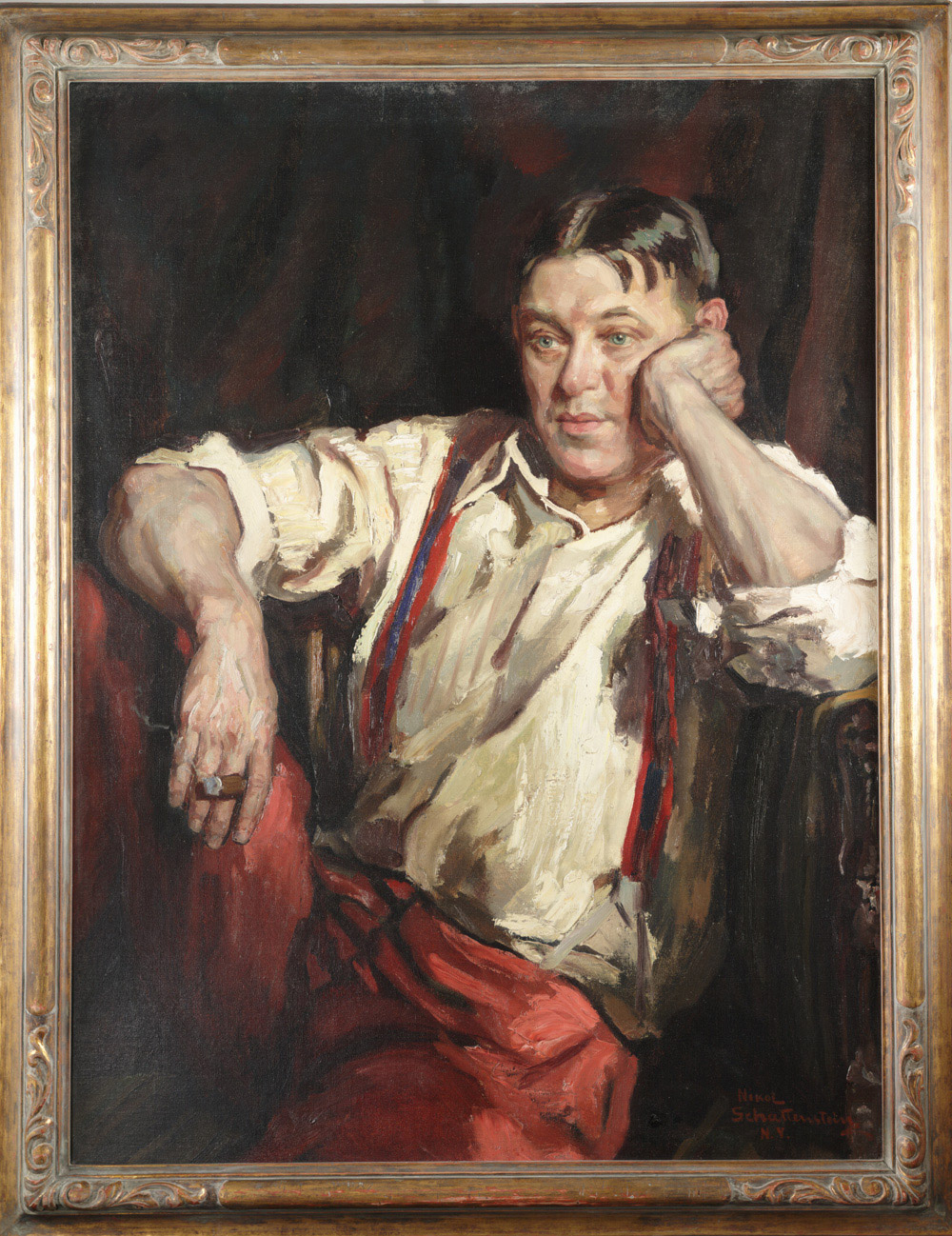
Portrait of H. L. Mencken

1927 Portrait of H. L. Mencken by Nikol Schattenstein; Enoch Pratt Free Library, Baltimore

A Neglected Anniversary

On December 20 there flitted past us, absolutely without public notice, one of the most important profane anniversaries in American history, to wit, the seventy-fifth anniversary of the introduction of the bathtub into These States. Not a plumber fired a salute or hung out a flag. Not a governor proclaimed a day of prayer. Not a newspaper called attention to the day.

True enough, it was not entirely forgotten. Eight or nine months ago one of the younger surgeons connected with the Public Health Service in Washington happened upon the facts while looking into the early history of public hygiene, and at his suggestion a committee was formed to celebrate the anniversary with a banquet. But before the plan was perfected Washington went dry (This was war-time Prohibition, preliminary to the main catastrophe. — HLM), and so the banquet had to be abandoned. As it was, the day passed wholly unmarked, even in the capital of the nation.

Bathtubs are so common today that it is almost impossible to imagine a world without them. They are familiar to nearly everyone in all incorporated towns; in most of the large cities it is unlawful to build a dwelling house without putting them in; even on the farm they have begun to come into use. And yet the first American bathtub was installed and dedicated so recently as December 20, 1842, and, for all I know to the contrary, it may still be in existence and in use.

Curiously enough, the scene of its setting up was Cincinnati, then a squalid frontier town, and even today surely no leader in culture. But Cincinnati, in those days as in these, contained many enterprising merchants, and one of them was a man named Adam Thompson, a dealer in cotton and grain. Thompson shipped his grain by steamboat down the Ohio and Mississippi to New Orleans, and from there sent it to England in sailing vessels. This trade frequently took him to England, and in that country, during the ’30s, he acquired the habit of bathing.

The bathtub was then still a novelty in England. It had been introduced in 1828 by Lord John Russell and its use was yet confined to a small class of enthusiasts. Moreover, the English bathtub, then as now, was a puny and inconvenient contrivance — little more, in fact, than a glorified dishpan — and filling and emptying it required the attendance of a servant. Taking a bath, indeed, was a rather heavy ceremony, and Lord John in 1835 was said to be the only man in England who had yet come to doing it every day.

Thompson, who was of inventive fancy — he later devised the machine that is still used for bagging hams and bacon — conceived the notion that the English bathtub would be much improved if it were made large enough to admit the whole body of an adult man, and if its supply of water, instead of being hauled to the scene by a maid, were admitted by pipes from a central reservoir and run off by the same means. Accordingly, early in 1842 he set about building the first modern bathroom in his Cincinnati home — a large house with Doric pillars, standing near what is now the corner of Monastery and Orleans streets.

There was then, of course, no city water supply, at least in that part of the city, but Thompson had a large well in his garden, and he installed a pump to lift its water to the house. This pump, which was operated by six Negroes, much like an old-time fire engine, was connected by a pipe with a cypress tank in the garret of the house, and here the water was stored until needed. From the tank two other pipes ran to the bathroom. One, carrying cold water, was a direct line. The other, designed to provide warm water, ran down the great chimney of the kitchen, and was coiled inside it like a giant spring.

The tub itself was of new design, and became the grandfather of all the bathtubs of today. Thompson had it made by James Cullness, the leading Cincinnati cabinetmaker of those days, and its material was Nicaragua mahogany. It was nearly seven feet long and fully four feet wide. To make it water-tight, the interior was lined with sheet lead, carefully soldered at the joints. The whole contraption weighed about 1,750 pounds, and the floor of the room in which it was placed had to be reinforced to support it. The exterior was elaborately polished.

In this luxurious tub Thompson took two baths on December 20, 1842 — a cold one at 8 a.m. and a warm one some time during the afternoon. The warm water, heated by the kitchen fire, reached a temperature of 105 degrees. On Christmas day, having a party of gentlemen to dinner, he exhibited the new marvel to them and gave an exhibition of its use, and four of them, including a French visitor, Col. Duchanel, risked plunges into it. The next day all Cincinnati — then a town of about 100,000 people — had heard of it, and the local newspapers described it at length and opened their columns to violent discussions of it.

The thing, in fact, became a public matter, and before long there was bitter and double- headed opposition to the new invention, which had been promptly imitated by several other wealthy Cincinnatians. On the one hand it was denounced as an epicurean and obnoxious toy from England, designed to corrupt the democratic simplicity of the Republic, and on the other hand it was attacked by the medical faculty as dangerous to health and a certain inviter of “phthisic, rheumatic fevers, inflammation of the lungs and the whole category of zymotic diseases.” (I quote from the Western Medical Repository of April 23, 1843.)

The noise of the controversy soon reached other cities, and in more than one place medical opposition reached such strength that it was reflected in legislation. Late in 1843, for example, the Philadelphia Common Council considered an ordinance prohibiting bathing between November 1 and March 15, and it failed of passage by but two votes. During the same year the legislature of Virginia laid a tax of $30 a year on all bathtubs that might be set up, and in Hartford, Providence, Charleston and Wilmington (Del.) special and very heavy water rates were levied upon those who had them. Boston, very early in 1845, made bathing unlawful except upon medical advice, but the ordinance was never enforced and in 1862 it was repealed.

This legislation, I suspect, had some class feeling in it, for the Thompson bathtub was plainly too expensive to be owned by any save the wealthy; indeed, the common price for installing one in New York in 1845 was $500. Thus the low caste politicians of the time made capital by fulminating against it, and there is even some suspicion of political bias in many of the early medical denunciations. But the invention of the common pine bathtub, lined with zinc, in 1847, cut off this line of attack, and thereafter the bathtub made steady progress.

The zinc tub was devised by John F. Simpson, a Brooklyn plumber, and his efforts to protect it by a patent occupied the courts until 1855. But the decisions were steadily against him, and after 1848 all the plumbers of New York were equipped for putting in bathtubs. According to a writer in the Christian Register for July 17, 1857, the first one in New York was opened for traffic on September 12, 1847, and by the beginning of 1850 there were already nearly 1,000 in use in the big town.

After this medical opposition began to collapse, and among other eminent physicians Dr. Oliver Wendell Holmes declared for the bathtub, and vigorously opposed the lingering movement against it in Boston. The American Medical Association held its annual meeting in Boston in 1849, and a poll of the members in attendance showed that nearly 55 per cent of them now regarded bathing as harmless, and that more than 20 per cent advocated it as beneficial. At its meeting in 1850 a resolution was formally passed giving the imprimatur of the faculty to the bathtub. The homeopaths followed with a like resolution in 1853.

But it was the example of President Millard Fillmore that, even more than the grudging medical approval, gave the bathtub recognition and respectability in the United States. While he was still Vice-President, in March, 1850, he visited Cincinnati on a stumping tour, and inspected the original Thompson tub. Thompson himself was now dead, but his bathroom was preserved by the gentlemen who had bought his house from the estate. Fillmore was entertained in this house and, according to Chamberlain, his biographer, took a bath in the tub. Experiencing no ill effects, he became an ardent advocate of the new invention, and on succeeding to the Presidency at Taylor’s death, July 9, 1850, he instructed his secretary of war, Gen. Charles M. Conrad, to invite tenders for the construction of a bathtub in the White House.

This action, for a moment, revived the old controversy, and its opponents made much of the fact that there was no bathtub at Mount Vernon, or at Monticello, and that all the Presidents and other magnificoes of the past had got along without any such monarchical luxuries. The elder Bennett, in the New York Herald, charged that Fillmore really aspired to buy and install in the White House a porphyry and alabaster bath that had been used by Louis Philippe at Versailles. But Conrad, disregarding all this clamor, duly called for bids, and the contract was presently awarded to Harper & Gillespie, a firm of Philadelphia engineers, who proposed to furnish a tub of thin cast iron, capable of floating the largest man.

This was installed early in 1851, and remained in service in the White House until the first Cleveland administration, when the present enameled tub was substituted. The example of the President soon broke down all that remained of the old opposition, and by 1860, according to the newspaper advertisements of the time, every hotel in New York had a bathtub, and some had two and even three. In 1862 bathing was introduced into the Army by Gen. McClellan, and in 1870 the first prison bathtub was set up at Moyamensing Prison, in Philadelphia.

So much for the history of the bathtub in America. One is astonished, on looking into it, to find that so little of it has been recorded. The literature, in fact, is almost nil. But perhaps this brief sketch will encourage other inquirers and so lay the foundation for an adequate celebration of the centennial in 1942.

(Text courtesy of Poor Mojo’s Almanac(k))

The entire history was a hoax composed by Mencken.

Even conservative wackoes appreciate the column.

Content with his private joke, Mencken remained silent about the hoax until a follow-up article, “Melancholy Reflections,” appeared in the Chicago Tribune on May 23, 1926, some eight years later. This was Mencken’s confession. It was also an appeal for reason to the American public.

His hoax was a joke gone bad. “A Neglected Anniversary” had been printed and reprinted hundreds of times in the intervening years. Mencken had been receiving letters of corroboration from some readers and requests for more details from others. His history of the bathtub had been cited repeatedly by other writers and was starting to find its way into reference works. As Mencken noted in “Melancholy Reflections,” his “facts” “began to be used by chiropractors and other such quacks as evidence of the stupidity of medical men. They began to be cited by medical men as proof of the progress of public hygiene.” And, because Fillmore’s presidency had been so uneventful, on the date of his birthday calendars often included the only interesting tidbit of information they could find: Fillmore had introduced the bathtub into the White House. (Even the later scholarly disclosure that Andrew Jackson had a bathtub installed there in 1834—years before Mencken claimed it was even invented—did not diminish America’s conviction that Fillmore was responsible.)

(No, dear reader, probably not correct; surely John Adams brought a bathtub with him when he moved into the White House, then called the President’s Mansion.  Plumbing, hot water, and finally hot water to a bathtub in the president’s residence, were installed between 1830 and 1853, as best I can determine.)

Mencken wrote an introduction to the piece in a later bookA Mencken Chrestomathy (Alfred A. Knopf, 1949):

The success of this idle hoax, done in time of war, when more serious writing was impossible, vastly astonished me. It was taken gravely by a great many other newspapers, and presently made its way into medical literature and into standard reference books. It had, of course, no truth in it whatsoever, and I more than once confessed publicly that it was only a jocosity… Scarcely a month goes by that I do not find the substance of it reprinted, not as foolishness but as fact, and not only in newspapers but in official documents and other works of the highest pretensions.

There’s a moral to the story:  Strive for accuracy!

So, Dear Reader, check for accuracy, and question authority.

Fact checks — what else might need to be corrected in this story?

Resources:

Finally, Dear Readers — have you noticed someone falling victim to the hoax of Millard Fillmore’s Bathtub recently?  Give us details in comments, please.


FactCheck comes clean on political affiliations

December 23, 2012

It was some time ago, but a lot of people appear not to have noticed.

Annenbergs and Reagan in the White House

President Reagan talking to Leonore Annenberg and Walter Annenberg at the President’s birthday party in the East Room, February 6, 1981. Photo from the Ronald Reagan Library

FactCheck.org, the group at the University of Pennsylvania that checks the accuracy of political ads and political statements, made a disclosure of its political leanings — in a post way back in 2009.

The truth?  Right here:

President Reagan, in 1981, spent all or part of 42 days away from the White House “on vacation” at his home in Santa Barbara, Calif, according to Knoller. President Reagan and his wife, Nancy, also spent three or four days around New Year’s Day each year in Palm Springs, Calif., at the home of philanthropist Walter Annenberg. (In 1993 the late Mr. Annenberg founded the nonpartisan Annenberg Public Policy Center of the University of Pennsylvania, which is FactCheck.org’s parent organization.)

So there you have it, in FactCheck’s own words — they’re connected to Ronald Reagan through Walter Annenberg.

So, the next time someone tells you FactCheck.org is founded and run by “libruls,” send ’em here to see the real photographic evidence.

More:

Walter Annenberg, Ronald Reagan, and hangers on, December 31, 1985

Official White House photo: From left, Walter Annenberg, President Ronald Reagan, Charles Price, William French Smith, George Shultz, and Donald Regan, December 31, 1985. Photo taken at Annenberg’s estate, Sunnylands: “Sunnylands, the impeccably haute-moderne Shangri-la completed in Rancho Mirage, California, in 1966 by the late billionaire publisher, philanthropist, and power broker Walter Annenberg and his wife, Lee, was a haven for presidents and monarchs, stars and tycoons: the history-makers of the late 20th century.”


Gilding lilies with PhotoShop – Mount Fuji and cloud version

November 16, 2012

Take a photo of amazing stuff:

Lenticular cloud over Mt. Fuji, 2003 (?)

Lenticular cloud over Mt. Fuji, 2003 (?)

Then mess it up with PhotoShop:

Photoshopped version of a 2003 photo of Mt. Fuji

Photoshopped version of a 2003 photo of Mt. Fuji

Why?  It’s the old question of why do we need fairies in the garden — isn’t the garden itself enough?

Phil Plait at Bad Astronomy called attention to other fantastic lenticular clouds near Mt. Fuji — are those fantastic formations not enough?

Did the PhotoShopper add anything of value to the picture?  Of what use is a gilded lily?

(Please help — the original photo is identified as an award winner in 2003 — do you know the original photographer?  We should give credit appropriately; I’ve not found the person’s name, yet.)

More:

English: This is the final slide to Phil's pre...

Final slide to Phil’s presentation at the JREF’s TAM6 The Amazing Meeting convention. (Photo credit: Wikipedia)


Quote of the moment: What John Adams DID NOT SAY about Congress

November 15, 2012

It’s a great line, an almost-Mark Twain-ism that makes people of all political strips smile.  It’s attributed to John Adams:

I have come to the conclusion that one useless man is called a disgrace; that two are called a law firm; and that three or more become a Congress!

There’s a problem: John Adams didn’t say it.

It’s a line from the 1969 Broadway musical comedy 1776!

The character John Adams in the play said it.

Playwright Peter Stone, Theatrical Rights image

Playwright Peter Stone wrote the witticism attributed to John Adams.  Theatrical Rights image

We should more accurately attribute it to the play’s book’s author, Peter Stone.

What John Adams did not say about Congress, Peter Stone wrote.  Such wit deserves proper attribution.

Mention of “law firms” gives away the origin’s being much later than Adams’s — Adams died, as you know, on July 4, 1826, the 50th anniversary of the Declaration of Independence.   “Law firms” is 20th century language.

A day after Fulbright & Jaworski LLC announced a merger with Norton Rose, one might almost wish that law firms would be just three people.  Norton Rose Fulbright starts out with 3,800 lawyers in 55 offices around the world.  [Conflict of interest note:  My spouse works at Fulbright & Jaworski.]  The distaste with lawyers in the Stone quote also doesn’t ring to the times of the American Revolution.  Good lawyer jokes probably existed then, but they didn’t really rise until the lawyerly pettifogging of the 19th century — see Dickens’ Mr. Bumble in Chapter 51 of Oliver Twistor the entire text of Bleak House, for examples.   Twain joked about Congress, but a joke about both Congress and lawyers probably was rare before 1910.  (I am willing to be disabused of this idea, if I am wrong . . . comments are open.)

Wikiquote’s rapid improvement provides us with a good check on whether Adams said it — Wikiquote points us clearly to Peter Stone instead.

Stone died in 2003, much underappreciated if you ask me.  Stone might be said to be among the greatest ghost speechwriters in history based on 1776! alone,  creating lines for John Adams, Ben Franklin and Thomas Jefferson — three of the greatest authors and (sometimes reluctant) speakers of their day, and of all history.  Stone’s plays include Titanic and Two by Two, his screenplays include Charade, Arabesque, Mirage, The Taking of Pelham 123, and Father Goose.

More:


U.S. actions to support Agenda 21: Soil conservation, farm and rural development; no population control, no black helicopters

October 24, 2012

Not sure what Agenda 21 is?  It’s the larger program of the United Nations to pick up where the U.S. Soil Conservation Service left off (SCS is now the U.S. Natural Resources Conservation Service, NRCS).  Erosion control.  Don’t deplete the soils.  Keep water sources clean and flowing.  Use wise plowing practices to prevent another Dust Bowl.  Get Girl Scouts and Boy Scouts and Future Farmers of America and 4-H Clubs to build check dams and plant beneficial trees.

See a quick explanation of Agenda 21 here (courtesy of Grist, here).

Keenan Wynn and a Coke machine, Dr. Strangelove (publicity still?)

Keenan Wynn as Col. Bat Guano, pauses before shooting open a Coke machine to get change to place a call to the President of the United States to save the world, in Stanley Kubrick’s “Dr. Strangelove, Or How I Learned to Stop Worrying and Love the Bomb,” (publicity still?).  Agenda 21 is not like “Dr. Strangelove,” except perhaps in the minds of those poisoned by dramatic over-consumption of Coca-Cola or Monster Cola.

You can’t find that stuff easily on Google, nor Bing, usually.  Instead you’ll find people worrying about black helicopters, the massive, unseen and never-detected UN Army poised to take over U.S. golf courses, and unhinged rants about forced population control, rants worthy of Col. Bat Guano but lacking Kubrick’s and Southern’s and George’s wit or Keenan Wynn‘s sharp delivery.  (Yes, if you hear someone complaining about Agenda 21, you may and perhaps should say, “That’s Bat Guano!”)

Agenda 21 is the umbrella agency under which nations who are members of the UN undertake studies of Earth’s resources, human effects upon those resources, and which makes recommendations about how to save our planet’s resources from depletion.  KyotoRio CopenhagenIPCC.

Agenda 21 is about as milk toast a policy initiative as it is possible to get.  Why all the angst among so-called neo-conservatives and so-called libertarians?  Beats me.  I can only imagine that they have never read any of the documents, know nothing of the issues discussed, and have slept through much of the past 50 years on farm and food production issues.

Should we fear, as Paul Sadler‘s GOP opponent for the Texas U.S. Senate seat does, that Agenda 21 will require Texas to turn over all its golf courses to the UN?  No, we should instead pay attention to what the government has actually done in support of Agenda 21 initiatives — all of which are voluntary under the Agenda 21 program and the UN Charter.  Also, perhaps, we should make sure to vote against anyone who tries to instill fear by misstating what Agenda 21 is, or does, or “requires” (Yeah, you, Ted Cruz — what sort of crazy are you on? and this is why we’re voting for Paul Sadler instead; we need rational people who love Texas more than crazies who speak smack about golf courses and people who golf).

Here’s the White House list of activities to support Agenda 21 in the last four years; can you find the black helicopters and UN takeover of U.S. territory?  No, neither can anyone else:

Policy Initiatives

President Obama’s administration understands that a strong American economy is contingent upon a strong rural economy. Since the creation of the White House Rural Council, the President has made historic investments in rural America designed to drive job growth.  The actions will help ensure the development of a rural economy built to last.  These actions include:

Doubling Small Business Administration (SBA) Investment Funds for Rural Small Businesses
Announced August 2011

The Administration established a rural “carve-out” in the Small Business Investment Company (SBIC) Impact Investment Program that will invest in distressed areas and emerging sectors such as clean energy.  SBA will provide up to a 2:1 match to private capital raised by the fund.  SBA and the U.S. Department of Agriculture (USDA) are committed to partnering to drive $350 million of investment capital through the fund and existing SBICs into rural small businesses over five years, doubling the current rate of investment.

Providing Job Search Information through USDA Field Offices
Announced August 2011

The USDA and Department of Labor (DOL) partnered to offer job training information and better utilize the rural footprint of the USDA field offices across the country to provide them with greater access to job search resources by reducing the driving times and distances for rural customers seeking program information.

Expansion of the National Health Service Corps to Critical Access Hospitals
Announced August 2011

The Department of Health and Human Services (HHS) expanded eligibility for the National Health Service Corps loan repayment program so that Critical Access Hospitals, those with 25 beds or fewer, can recruit new physicians, using student loan repayment incentives.  This program will help hospitals across the country recruit needed staff.  Once a hospital has qualified as a service site, it can then apply for student loan repayment on behalf of its primary care physicians, nurse practitioners, and physician assistants.

Expanding Health Information Technology in Rural Communities
Announced August 2011

USDA and HHS signed an agreement to improve access to capital for rural hospitals and other providers seeking to implement health information technology and expand the health IT workforce in rural communities.

Commercial Aviation Biofuels Partnership
Announced August 2011

The Navy, the Department of Energy, and USDA have joined forces to spur the creation of an advanced biofuels industry that will support commercial aviation, with a pledge of $510 million, over three years, under the Defense Production Act of 1950.

Promoting a Bioeconomy through BioPreferred
Announced February 2012

To support the Administration’s “Blueprint for a Bioeconomy,” the President is utilizing the purchasing power of the Federal government by directing Federal agencies to take additional steps to significantly increase the purchase of biobased products over the next two years, which will create thousands of new rural jobs and drive innovation where biobased products are grown and manufactured. Utilizing the existing BioPreferred program, the Federal government will use its procurement power to increase the purchasing and use of biobased products, promoting rural economic development, creating new jobs, and providing new markets for farm commodities. Biobased products include items like paints, soaps and detergents and are developed from farm grown plants, rather than chemicals or petroleum bases. The biobased products sector marries the two most important economic engines for rural America: agriculture and manufacturing.

Rural Jobs Accelerator
Announced February 2012

The “Rural Jobs Accelerator” will link Federal programs to facilitate job creation and economic development in rural communities by utilizing regional development strategies. The “Rural Jobs Accelerator” will allow multiple agencies to coordinate technical assistance and grant/loan programs so that a consortium of public and private rural entities can have a single access point within the Federal government, allowing for improved access, streamlining of programs, and better leveraging of resources.  USDA and EDA will leverage approximately $14 million in funding, with technical support from Delta Regional Authority, Appalachian Regional Commission, Department of Housing and Urban Development, and the Department of Education.

Development of Rural Health IT Workforce
Announced February 2012

HHS and the DOL signed a memorandum of understanding to link community colleges and technical colleges that support rural communities with available materials and resources to support the training of HIT professionals.  Rural health care providers face challenges in harnessing the benefits of health information technology (HIT) due to limited capital and a workforce that is not trained to work within the expanding field of HIT. Due to lower financial operating margins and limited capital, funds for hiring new staff or training existing staff in HIT implementation and maintenance are often simply not available to rural health care providers.  The Bureau of Labor Statistics estimates that the needed HIT workforce will increase by 20 percent by the year 2016.  A significant part of that growth will come in rural areas, which are served by approximately 2,000 rural hospitals, 3,700 Rural Health Clinics as well as the more than 3,000 Community and Migrant Health Centers that are either located in or serve rural communities.

Timber and National Forest Restoration
Announced  February 2012

USDA’s Forest Service, in conjunction with the White House Rural Council, released a strategy to increase the scale of restoration treatments like forest thinning, reforestation, and other activities to restore and sustain the health of our forests.  In addition to environmental benefits, these activities create jobs in the forest industry which has been hurt significantly by the economic downturn.  The strategy relies on (1) using collaborative approaches to broaden public support for forest restoration; (2) expanding restoration tools like the Collaborative Forest Landscape Restoration Program and stewardship contracting; (3) better targeting budget resources; and (4) streamlining forest planning and analysis without sacrificing quality.

Mortgage Refinancing
Announced February 2012

The Administration announced an initiative to assist rural homeowners refinance their mortgages at lower interest rates through USDA’s Rural Development agency. By reallocating existing funding, at no additional cost to taxpayers, USDA will have almost doubled the amount of funds available to homeowners seeking to lower their mortgage payments or avoid foreclosure.  Under the new allocation, the amount of the $24 billion program dedicated to refinancing will increase from $520 million to $1.1 billion, allowing USDA to meet the growing demand for refinance transactions.

Task Force on Tourism and Competitiveness
Announced January 2012

On January 19, the President signed an Executive Order creating a Task Force charged with developing a National Travel and Tourism Strategy with recommendations for new policies and initiatives to promote domestic and international travel opportunities throughout the United States. The strategy will include recommendations to promote visits to the United States public lands, waters, shores, monuments, and other iconic American destinations, thereby expanding job creation in the United States, as well as tourism opportunities in rural communities. The Task Force is co-chaired by Secretary Salazar and Secretary Bryson, with participation from USDA, other agencies and WH offices.

Advancing Water Quality Conservation across the U.S.
Announced May 2012

The United States Department of Agriculture (USDA) announced the launch of a new National Water Quality Initiative committed to improving one to seven impaired watersheds in every U.S. state and territory. The Initiative is part of the Obama Administration’s White House Rural Council which is working in partnership with farmers, ranchers and forest owners to improve conservation of working lands in rural America. The 157 selected watersheds were identified with assistance from state agencies, key partners, and USDA’s Natural Resources Conservation Service (NRCS) State Technical Committees. NRCS will make available at least $33 million in financial assistance to farmers, ranchers and forest landowners this year to implement conservation practices to help provide cleaner water for their neighbors and communities.

Small Business Administration Investing in Rural Small Businesses
Announced June 2012

The Administration extended more than $400 million in FY 2011 of investments in rural America through the Small Business Investment Company (SBIC) Impact Investment Program, at no cost to taxpayers. Nearly $2 billion in additional funding will be invested by the end of fiscal year 2016. These investments will continue to help finance, grow, expand, and modernize rural small business operations around the country.

MOU to Improve Support in the Colonias
Announced June 2012

The U.S. Department of Agriculture-Rural Development (USDA-RD), Housing and Urban Development, and Department of Treasury’s Community Development Financial Institutions Fund (CDFI) partnered to create the Border Community Capital Initiative. This collaboration is designed to expand access to capital in the U.S/Mexico border region which includes some of the poorest communities in the country. The Memorandum of Understanding (MOU) will provide up to $200,000 to nonprofit and/or tribal financial institutions that serve colonias. This funding will go to increase access to basic necessities such as safe drinking water, adequate sewage systems, and safe, sanitary housing.

U.S Department of Education Investing in Rural Schools
Announced June 2012

Through the national broadband plan, the Obama Administration will leverage the power of technology to overcome distance and increase collaboration to accelerate student achievement in rural schools. The White House Rural Council partnered with the U.S Department of Education to deliver a new online community of practice groups for rural schools. This online tool will create virtual communities of practice for educators to connect to resources, tools, colleagues, experts, and learned activities both within and beyond schools. The Administration is using technology to break down geographic barriers and address rural isolation in education.

Accelerating Broadband Infrastructure Deployment
Announced June 2012

On June 14, 2012 President Obama signed an Executive Order to make broadband construction along Federal roadways and properties up to 90 percent cheaper and more efficient. U.S agencies that manage Federal properties and roads will partner to offer carriers a single approach to leasing Federal assets for broadband deployment. Providing a uniform approach for broadband carriers to build networks will speed the delivery of connectivity to communities, business, and schools in rural America. In order to further expand the nations broadband service, more than 25 cities and 60 national research universities are partnering to form “US Ignite.” US Ignite will create a new wave of services that will extend programmable broadband networks to 100 times the speed of today’s internet. This partnership will improve services to Americans and drive job creation, promote innovation, and create new markets for American business.

Supporting Appalachian Communities
Announced June 2012

Facilitated through the White House Rural Council, the Appalachian Regional Commission (ARC) developed a Livable Communities Initiative. This initiative is a partnership between ARC, the U.S Environmental Protection Agency (EPA), and the U.S Department of Agriculture Rural Development (USDA RD). The initiative provides technical assistance to small rural towns to help them develop and implement strategies for making the communities more livable and competitive. The partnership will focus on expanding transportation choices, supporting thriving and distinctive rural communities by investing in rural town centers, and extending affordable housing opportunities.

There is nothing seriously objectionable in that list of activities.  If you’re an astute, patriotic American, you’ll recognize a lot of actions that strengthen our nation.  Maybe opposition to Agenda 21 is a virus spread by an insect vector — there is no rational explanation for it, certainly.

More:

Highlights from the video, as listed at the White House blog:

Drought Relief: President Obama also toured McIntosh Family Farms in Missouri Valley, Iowa to see drought damage first-hand and offer relief to those being effected. The President announced that the Department of Agriculture will begin to buy up to $170 million worth of pork, chicken, lamb, and catfish. And the President is directing the Department of Defense — which purchased more than 150,000 million pounds of beef and pork in the last year alone — to encourage its vendors to accelerate meat purchases for the military and freeze it for future use.

“Understand this won’t solve the problem. We can’t make it rain,” the President said. “But this will help families like the McIntoshes in states across the country, including here in Iowa. And we’re going to keep doing what we can to help because that’s what we do. We are Americans. We take care of each other.”

To learn more, the Department of Agriculture is collecting resources for farmers, ranchers, and small businesses wrestling with this crisis at USDA.gov/drought. More information still is available at WhiteHouse.gov/drought.

Banner Year for the U.S. Wind Industry: Also this week, the Energy Department and Lawrence Berkeley National Laboratory released a new report highlighting strong growth in America’s wind energy market in 2011 and underscoring the importance of continued policy support and clean energy tax credits to ensure that the U.S. remains a leading producer and manufacturer in this booming global industry.As President Obama has made clear, we need an all-of-the-above approach to American energy and the U.S. wind industry is a critical part of this strategy. In fact, wind energy contributed 32 percent of all new U.S. electric capacity additions last year, representing $14 billion in new investment.

Wall of Shame on Agenda 21; sites that promote the crazies:


Mermelstein: The man who forced us to remember

August 20, 2012

I first posted a version of this back in August 2006.  Since that time not much showed up on the internet to commemorate the story of Mel Mermelstein, nor to burn his deeds into the history books.  Millard Fillmore’s Bathtub had many fewer readers each day, then too.  This is a story that should not be forgotten about a story that must not be forgotten.

Mr. Mel Mermelstein, in 1993, recording an oral history for the US Holocaust Memorial  Museum

Mr. Mel Mermelstein, in 1993, recording an oral history for the US Holocaust Memorial Museum

In early August 1985, Melvin Mermelstein struck a powerful blow against bogus history and historical hoaxes. Mel won a decision in a California court, in a contract case.

A group of Holocaust deniers had offered a $50,000 reward for anyone who could prove that the Holocaust actually happened. Mermelstein had watched his family marched to the gas chambers, and could testify. He offered his evidence. The Holocaust deniers, of course, had no intention of paying up. They dismissed any evidence offered as inadequate, and continued to claim no one could prove that the Holocaust actually occurred.

Mermelstein, however, was a businessman and he knew the law. He knew that the offer of the reward was a sweepstakes, a form of contract. He knew it was a contract enforceable in court.  He sued to collect the offered reward.  The reward was an offer, and Mel Mermelstein accepted the offer and, he said, he performed his part of the bargain. The issue in court would be, was Mermelstein’s evidence sufficient?

Mermelstein’s lawyer had a brilliant idea. He petitioned the court to take “judicial notice” of the fact of the Holocaust. Judicial note means that a fact is so well established that it doesn’t need to be evidenced when it is introduced in court — such as, 2+2=4, the freezing point of water is 32 degrees Fahrenheit, 0 degrees Celsius, etc.

The court ruled that the evidence presented overwhelmingly established that the Holocaust had occurred — the court made judicial note of the Holocaust. That ruling meant that, by operation of law, Mermelstein won the case. The only thing for the judge to do beyond that was award the money, and expenses and damages.

You can read the case and other materials at the Nizkor Holocaust remembrance site.

Appalachian State University takes the Holocaust seriously — there is a program of study on the issue, reported by the Mountain Times (the school is in Boone, North Carolina — not sure where the newspaper is).

Teaching the Holocaust to Future Generations

Mountain Times, August 17, 2006

As co-directors of Appalachian State University’s Center for Judaic, Holocaust and Peace Studies, Rennie Brantz and Zohara Boyd are always eager to expand and improve the center’s methods of education. Seldom, though, does this involve airfare.

Brantz and Boyd recently visited Israel to participate in the Fifth International Conference for Education: Teaching the Holocaust to Future Generations. The four-day conference was held in late June at Yad Vashem, an institute and museum in Jerusalem that specializes in the Nazi Holocaust. [link added]

“Yad Vashem is an incredible institute,” Brantz said. “It was founded in the ’50s to remember and commemorate those who perished in the Holocaust, and has been the premier international research institute dealing with the Holocaust.”

As Santayana advises, we remember the past in order to prevent its recurring. Clearly, this is a past we need to work harder at remembering.

Despite having been ordered to acknowledge the Holocaust, pay up on their sweepstakes offer, and apologize to Mr. Mermelstein, Holocaust deniers continue to publish claims that Mr. Mermelstein’s account is not accurate, or that it is contradictory or in some other way fails to measure up to the most strict tests of historical accuracy.  So it is important that you remember the story of Mel Mermelstein, and that you spread it far and wide.

More:


Shorter Anthony Watts: Ignore cities, discount all NOAA sites that show warming, and global warming doesn’t look so bad

July 30, 2012

Since he prefers a Kim Jong Il-style commenter policy –“only those who flatter the Premier need comment” — Anthony Watts‘s site doesn’t get the pleasure of my visits much, anymore.  Consequently I missed the announcement he made last week that he was “suspending” his blog, at least temporarily, until some great news came out.

English: Anthony Watts, June, 2010. Speaking i...

Anthony Watts, June, 2010. Speaking in Gold Coast, Australia, on a tour searching to find some place on Earth not affected by global warming. (Photo: Wikipedia)

Now the great news is out.  I think.  Watts may have been right to suspend blogging.  He should have kept the suspension longer.

Watts says NOAA‘s temperature measurement in the U.S. is way off, and that if we ignore all the cities, and if we ignore sites that show the greatest increases in temperature over the past century or so, global warming doesn’t look so bad.

Watts said he is the lead author on a new paper questioning all warming calculations:

This pre-publication draft paper, titled An area and distance weighted analysis of the impacts of station exposure on the U.S. Historical Climatology Network temperatures and temperature trends, is co-authored by Anthony Watts of California, Evan Jones of New York, Stephen McIntyre of Toronto, Canada, and Dr. John R. Christy from the Department of Atmospheric Science, University of Alabama, Huntsville, is to be submitted for publication.

Wait a minute.  “Prepublication draft paper?”  ” . . . to be submitted for publication?”

Yes, Dear Reader, that claxon you hear is your and my Hemingway III Solid Gold [Excrement] Detectors™ going off.  It may be a false alarm, but still — isn’t this how bogus science is done, isn’t this what Robert Park warns us about?  Indeed, in the Seven Warning Signs of Bogus Science, Park says to pay attention to key indicators:  “1. The discoverer pitches the claim directly to the media.”  It is, indeed, a press release from Watts, about a paper he hopes to get through the peer review process at some point in the future — but it has not yet been pitched to the science journals.  (Yes, that’s also one of the Seven Warning Signs of Bogus History . . . one discipline at a time, please.)

What’s the rush?  Oh:  Tuesday, July 31, is the deadline for peer reviewed papers to be submitted to the international agency studying climate change, the Internatioinal  (IPCC), for consideration and inclusion in the next report.

Same old stuff, new day.  Watts has been arguing for years that NOAA’s temperature measurements err, but after the Berkeley Earth Surface Temperatures (BEST) Project determined that warming exists, even using Watts’s modified measurements and accounting for his claimed errors, some of us hoped Watts might turn to blogging about science, instead.

No, Watts turned to finding a hint of a methodology that might support his preconceived notions.  He found one.

So, Watts’s big announcement is that he’s found a methdology which favors his criticisms of NOAA; so we should ignore temperature readings from cities, because cities are hot, and we should ignore temperature readings from suburbs of cities, because suburbs are warm; and if we do that, then warming in the U.S. doesn’t look so bad.

Were I allowed to ask questions at Watts’s blog, I’d ask why we should ignore warming in cities, because are they not part of the planet?  Oh, well.

The Twitter version:

Watts: Ignore city temps (hot!) and ‘burbs (warm!), temps on farms don’t show so much global warming!  Oops – did we say that before?

Anthony, how about you suspend your blog until you get the paper accepted at a good journal?  Make sure you got the numbers right . . .

More:


Fact vs. Fiction on the Affordable Care Act (Sen. Leahy)

July 2, 2012

From the good offices of Vermont’s Sen. Pat Leahy (a few links added):

Fact vs. Fiction

It is disappointing that inaccurate and purposely misleading information regarding health care reform continues to be widely circulated. Throughout the past two years during the lengthy debate on Health Care Reform, Senator Leahy has continued to post updated information regarding the various health care legislative proposals being debated, including the full text of proposals, questions asked by directly by Vermonters, and daily updates on floor proceedings in the Senate in an effort to provide Vermonters with accurate and timely information on the health care reform debate.

Below are some of the most common myths regarding the Affordable Care Act with accurate information dispelling those myths and providing information about where to learn more.

To review some of the most commonly questions by Vermonters please also visit the Frequently Asked Questions page on this website.

To test your knowledge about what is actually included in the health care reform law visit the Kaiser Family Foundation website and take their Affordable Care Act quiz.

Fact vs. Fiction

  • Fiction

    If you don’t buy health insurance, you will be sent to jail.

  • Fact

    Taxpayers who are required to purchase health insurance and do not will receive a notice from the Internal Revenue Service (IRS) with the amount of the penalty they owe. Individuals who fail to pay the penalty are not subject to criminal prosecutions and the government cannot file notice of lien or levy any property for a taxpayer who doesn’t pay the penalty.

    The obligation for individuals to purchase health insurance beginning in 2014 was included as part of the Affordable Care Act.  The provision requires individuals to maintain minimum essential coverage for themselves and their dependents or pay a penalty of $95 in 2014. Families would pay half the amount for children, and the requirement includes a cap on the total allowable fine per family. If affordable health insurance coverage is not available to an individual, then the penalty would be waived.  Along with the individual responsibility requirement, the Affordable Care Act also provides subsidies to some individuals beginning in 2014 to help pay for their health insurance premiums and other costs associated with their health insurance.

    Taxpayers who are required to pay a fine but fail to do so will receive a notice from Internal Revenue Service (IRS). If an individual still neglects to pay the fine, the IRS can attempt to collect the funds by reducing the amount of their tax refund in the future.  Individuals who fail to pay the penalty, however, will not be subject to criminal prosecution. The government cannot file notice of lien or levy on any property for a taxpayer who does not pay the penalty.

    The aim of this provision is to encourage all Americans to obtain health insurance, which will result in lower health care costs for everyone. The Affordable Care Act relies on the shared responsibility of individuals, employers, states and the federal government.

    For additional information regarding the individual responsibility requirement please visit the Kaiser Family Foundation website.


  • Fiction

    Members of Congress are exempt from the health care reform law.

  • Fact

    No one has received a special exemption from the Affordable Care Act. In fact, the health care reform law explicitly includes language regarding the health insurance plans for Members of Congress and their staff.

    As a United States Senator, Senator Leahy’s health plan options are the same options offered to all federal employees.  Included in the Affordable Care Act, was a provision that requires that “the only health plans that the Federal Government may make available to Members of Congress and Congressional staff shall be health plans that are created under this Act or offered through an Exchange established under this Act.”  Members of Congress and their staffs can only purchase health insurance coverage from the health insurance exchanges that are made available for uninsured Americans. The full text of this provision is available on pages 80-81 in section 1312 of the Affordable Care Act which you can read here.


  • Fiction

    Health care reform will jeopardize Medicare and will mean cuts in services and benefits for seniors.

  • Fact

    Health care reform will help strengthen Medicare so that seniors can continue to receive quality health coverage for years to come.

    The Affordable Care Act explicitly states that no benefits guaranteed under Medicare will be cut as a result of health care reform legislation.  Today’s forecasts estimate that Medicare will be insolvent by 2017 because of ever-rising health care costs.  The Affordable Care Act takes aim at that unfolding threat by addressing cost inefficiencies now, instead of waiting until later.  The Affordable Care Act strengthens the financial stability of Medicare by targeting fraud and ending wasteful overpayments to insurance companies, while maintaining the benefits and services to seniors who use Medicare.  The Act also helps Medicare users by offering prescription drug discounts to seniors who are trapped in the “donut hole,” by creating a better pathway for generic drugs to enter the marketplace, by eliminating the cost-share for preventative services, and by promoting coordinated care to prevent avoidable hospital readmissions.

    For more information about what the health care reform law means for Medicare beneficiaries read Medicare and the New Health Law -What it Means for You prepared by the Center for Medicare and Medicaid Services.

    • Beginning January 1, 2011, Medicare beneficiaries entering the Medicare donut hole will get a 50% discount on brand name prescription drugs. Click here to learn more about this provision.

  • Fiction

    The health care reform law includes a tax on all real estate sales.

  • Fact

    Under the Affordable Care Act, only certain real estate transactions for certain individuals above a particular income level would be subject to a Medicare Tax.

    Unfortunately, much of the information widely circulated about a tax on home sales and other real estate transactions inaccurately describes the purpose and the effect of this provision. The 3.8 percent Medicare tax is often misunderstood, and has frequently been described as a 3.8 percent “sales tax” on all real estate transactions, which is inaccurate.

    The provision that establishes this tax can be found on page 946, Section 1402 of the Affordable Care Act.  This tax is often referred to as the “Medicare tax,” because it was designed to raise funds for Medicare. The Medicare tax goes into effect after December 30, 2012.

    The Medicare tax is not a tax on all new home sales; it only applies to the profit that certain high income Americans make from the sale of their home.  The groups that may be affected by this provision are individuals with annual incomes over $200,000 and married couples with a joint income of over $250,000. The only home sellers who will be affected by this provision are those who fit the above description, and who sell their home for a profit of more than $250,000. The tax will not apply to the first $250,000 in profits for the individual selling his or her home or to the first $500,000 in profits for a married couple.

    While undoubtedly some home sales will see a tax increase under this provision, the tax will affect only a small percentage of home sales.  A report released by the Tax Foundation on April 15, 2010 predicts that the new tax on investment income (including real estate) will affect only the top-earning 2 percent of American families.

    The full text of the Affordable Care Act is available on the health care reform page of this website.


  • Fiction

    Health care reform will hurt small businesses.

  • Fact

    The Affordable Care Act will help small businesses, many of which are struggling now to even afford health plans for their employees.

    Small businesses are a vital engine of Vermont’s economy. Unfortunately, rising health care costs are hitting small businesses especially hard, putting them at an even greater disadvantage against larger corporations. The Affordable Care Act will help level the playing field and give affordable options to small businesses that wish to offer insurance to their workers.

    For example, the Affordable Care Act:

    • Provides tax credits to small businesses to help them offer health insurance to their employees;
    • Requires insurance companies to provide free preventative care so businesses do not suffer productivity costs because of sick employees;
    • End the “hidden insurance tax” that has prevented small businesses from being able to afford to offer insurance to their employees.  This hidden tax is built in to the premiums for insurance to compensate for the unpaid care given to the uninsured.  Health reform will help get Americans health insurance and will end the inflated premium costs.  And investments to lower health care costs overall will help spur the economy, enabling more businesses to thrive;

    For more information regarding how health care reform efforts will help small businesses please visit the Implementation Center on this website as well as the Small Business Administration website and the Small Business Majority website for additional resources.


  • Fiction

    The Affordable Care Act provides subsidies for illegal immigrants to receive health insurance.

  • Fact

    The Affordable Care Act explicitly defines who is eligible for federal payments, credits or subsidies for health insurance coverage and makes clear that undocumented immigrants are ineligible.

    Some have expressed concerned that undocumented immigrants will have the ability to receive subsidies for health insurance under the reform proposals in Congress.  Senator Leahy does not support using government funding to subsidize insurance for those who have entered the United States illegally or who are residing in the United States in an undocumented status. The full text of the law clearly defines who is eligible for federal payments, credits or subsidies.

    The relevant statutory language is below:

    Patient Protection and Affordable Care Act
    Subtitle D—Available Coverage Choices for All Americans
    PART II–Consumer Choices and Insurance Competition Through Health Benefit Exchanges

    • Section 1312 (f)(3) makes clear that undocumented immigrants are ineligible to participate in the health insurance exchanges: “ACCESS LIMITED TO LAWFUL RESIDENTS- If an individual is not, or is not reasonably expected to be for the entire period for which enrollment is sought, a citizen or national of the United States or an alien lawfully present in the United States, the individual shall not be treated as a qualified individual and may not be covered under a qualified health plan in the individual market that is offered through an Exchange.”

    Subtitle E—Affordable Coverage Choices for All Americans
    PART I—PREMIUM TAX CREDITS AND COST SHARING REDUCTIONS
    Subpart B—Eligibility Determinations

    • Section 1412(d) unambiguously states “NO FEDERAL PAYMENTS FOR INDIVIDUALS NOT LAWFULLY PRESENT.—Nothing in this subtitle or the amendments made by this subtitle allows Federal payments, credits, or cost-sharing reductions for individuals who are not lawfully present in the United States.”

    The Act also establishes a fair process to accurately verify eligibility for participation in the benefits of health insurance reform that does not place unnecessary bureaucratic hurdles for U.S. Citizens nor undue administrative costs on the government.

    Patient Protection and Affordable Care Act

    Subtitle E—Affordable Coverage Choices for All Americans
    PART I—PREMIUM TAX CREDITS AND COST SHARING REDUCTIONS
    Subpart B—Eligibility Determinations

    • Section 1411(a) required that the Secretary of Health and Human Services “shall establish a program . . . for determining . . . whether an individual who is to be covered in the individual market by a qualified health plan offered through an Exchange, or who is claiming a premium tax credit or reduced cost-sharing [is] a citizen or national of the United States or an alien lawfully present in the United States.”
    • Section 1411(b) requires applicants for enrollment in a qualified health plan offered through an Exchange in the individual market to provide “name, address, and date of birth.”  For those individuals claiming eligibility based on an attestation of citizenship, they must provide their social security number.  For those individuals whose eligibility is based on an attestation of their immigration status, they must provide “the enrollee’s social security number (if applicable) and such identifying information with respect to the enrollee’s immigration status as the Secretary, after consultation with the Secretary of Homeland Security, determines appropriate.”

    Senator Leahy has also heard from Vermonters with small businesses who employ seasonal workers and their concern about the requirement that employers purchase health insurance for their employees.

    The Act exempts small businesses from the employer mandate to provide health insurance for employees, and employers are not subject to penalties if they employ 50 or fewer employees.  Seasonal workers do not count towards the 50 employee threshold.  And for those employers subject to the penalty, they are only responsible for providing health insurance for full-time employees.

    Patient Protection and Affordable Care Act
    Subtitle F—Shared Responsibility for Health Care
    PART II—EMPLOYER RESPONSIBILITIES
    Section 1513—Shared Responsibility For Employers

    • Section 1513(a) states:

    (B) EXEMPTION FOR CERTAIN EMPLOYERS-

    (i) IN GENERAL- An employer shall not be considered to employ more than 50 full-time employees if—

    (I) the employer’s workforce exceeds 50 full-time employees for 120 days or fewer during the calendar year, and

    (II) the employees in excess of 50 employed during such 120-day period were seasonal workers.

    (ii) DEFINITION OF SEASONAL WORKERS—The term `seasonal worker’ means a worker who performs labor or services on a seasonal basis as defined by the Secretary of Labor, including workers covered by section 500.20(s)(1) of title 29, Code of Federal Regulations and retail workers employed exclusively during holiday seasons.”


  • Fiction

    Health care reform will lead to rationing of health care

  • Fact

    Health care reform is aimed at increasing the options for Americans, not limiting them.

    Unfortunately, prior to the passage of the Affordable Care Act rationing of health care happened all too often. Insurance companies decided whether or not beneficiaries could have a certain test or procedures, based not on medical necessity, but on the insurance plan and whether the test is affordable. This rationing left millions of Americans without adequate care or coverage and is taking away the decision making from patients and their doctors, putting those decisions instead in the hands of insurance company bureaucrats.

    The Affordable Care Act is intended to improve the ability of patients to receive the care they need by setting ground rules for insurance companies to follow.  No longer will insurance companies be allowed to deny coverage for preexisting medical conditions or to discriminate against consumers because of their gender. No longer will insurance companies be allowed to revoke insurance coverage from a patient who has been ill and deemed too sick for coverage. The government will have no role in telling patients what tests they can and cannot have. In fact, for the first time, the Affordable Care Act prohibits insurance companies from limiting choice of doctors.  The Affordable Care Act guarantees your right to choose a primary care doctor from any available participating provider, designate any available participating pediatrician as your child’s primary care provider, and prohibits insurers or employer-sponsored plans from requiring a referral for obstetrical or gynecological (OB-GYN) care. Additionally, the Affordable Care Act prohibits health insurers and plans from restricting access to and charging patients more for out-of-network emergency care.

    Health care reform is about improving choice for all Americans.


  • Fiction

    The health care reform law will force individuals to pay taxes on their health benefits.

  • Fact

    Health benefits will not be taxed under the Affordable Care Act, even though the value of your health insurance will be included on your W-2 form.

    Title IX of the Affordable Care Act, Section 9002 on page 800 states that beginning in the tax year 2011, employers are required to report the value of the health insurance coverage they provide employees on each employee’s annual W-2 Form so that employees can be informed consumers and know the full cost of their plan. The amount reported does not affect tax liability and the value of the employer contribution to health coverage will continue to be excludible from an employee’s income and is not taxable.

    Updates and guidance will be posted regularly on the IRS website regarding all tax provisions included in the Affordable Care Act.


  • Fiction

    The government will encourage or force seniors to choose euthanasia as an end-of-life option.

  • Fact

    This has been shown over and over again to be another false rumor.  Nothing in the Affordable Care Act requires that seniors participate in consultations about their end-of-life wishes.

    Unfortunately, this rumor has been spreading fast and is worrying many Vermonters and Americans across the country. Nothing in the Affordable Care Act will force seniors to have consultations regarding their end-of-life choices, or have a consultation to discuss suicide.

    Currently, voluntary end-of-life planning is covered as a part of the “Welcome to Medicare” doctor visits available to seniors with in the first year of joining the program.   The Affordable Care Act authorized Medicare coverage of yearly physician exams, or wellness visits for beneficiaries. Specifically, section 4103 of the Affordable Care Act provides coverage under Medicare, with no copayments or deductible, for an annual wellness visit and personalized prevention plan services.  Often times patients are not given the time to ask important questions about options available to them such as hospice, or home care, or additional services available to seniors.  This provision would simply give seniors the choice to have a discussion during their wellness visit, about the topics of their choosing, with their doctor. It empowers seniors to have conversations about living wills and other questions they might have but do not have the opportunity to ask.  In no way does the law mandate these conversations or tell doctors what options to discuss.  If seniors do not wish to have these discussions with their doctors and families, nothing will force them to.