Killer CO2 cloud – the story climate change “skeptics” hope you won’t read

October 14, 2009

From Neat-o-rama: Grazing cattle killed in the 1986 Lake Nyos disaster (Image Credit: Water Encyclopedia)

From Neat-o-rama: Grazing cattle killed in the 1986 Lake Nyos disaster (Image Credit: Water Encyclopedia)

It’s not even secret.  But those propagandists who run advertising claiming that carbon dioxide is natural and, therefore, harmless, hope against hope that you don’t know the true history, that you’ve never heard of Cameroon, that you don’t know about volcanic emissions, and that you forgot the story of the killer CO2 cloud of 1986.

Read it here, “Cameroon:  The Lake of Death.”

More information:

Lake Nyos, in Cameroon, shortly after the 1986 killer CO2 cloud. Image from Neat-o-rama.

Lake Nyos, in Cameroon, shortly after the 1986 killer CO2 cloud. Image from Neat-o-rama.

Help make a cloud of witnesses:

Add to FacebookAdd to NewsvineAdd to DiggAdd to Del.icio.usAdd to StumbleuponAdd to RedditAdd to BlinklistAdd to TwitterAdd to TechnoratiAdd to Furl

Save


“The GOP used to be the party of business”

September 10, 2009

Santayana’s Ghost notes there’s an 1852 Whiggy smell about the Republican Party these days.

Thomas L. Friedman writes at the New York Times:

The G.O.P. used to be the party of business. Well, to compete and win in a globalized world, no one needs the burden of health insurance shifted from business to government more than American business. No one needs immigration reform — so the world’s best brainpower can come here without restrictions — more than American business. No one needs a push for clean-tech — the world’s next great global manufacturing industry — more than American business. Yet the G.O.P. today resists national health care, immigration reform and wants to just drill, baby, drill.

“Globalization has neutered the Republican Party, leaving it to represent not the have-nots of the recession but the have-nots of globalized America, the people who have been left behind either in reality or in their fears,” said Edward Goldberg, a global trade consultant who teaches at Baruch College. “The need to compete in a globalized world has forced the meritocracy, the multinational corporate manager, the eastern financier and the technology entrepreneur to reconsider what the Republican Party has to offer. In principle, they have left the party, leaving behind not a pragmatic coalition but a group of ideological naysayers.”

Drum up some business:

Add to FacebookAdd to NewsvineAdd to DiggAdd to Del.icio.usAdd to StumbleuponAdd to RedditAdd to BlinklistAdd to TwitterAdd to TechnoratiAdd to Furl


Global cooling? Sure, if only warming weren’t overpowering nature

September 5, 2009

If you do not read Robert Park regularly, you should.  His weekly missive on September 4 succinctly deals with the two big climate change stories of the week, with vim and vigor:

1.  CLIMATE CHANGE: HOTTEST ARCTIC SUMMER IN 2,000 YEARS.
A major study published in today’s Science marks a seminal advance in Sediments from Arctic lakes were used to compile proxy for the last 2000 years.  Arctic summer temperature declined for thousands of years due to a shift in Earth’s orbit.  Although the orbital shift has been going on for 8000 years and will continue, an increase in greenhouse gases produced by the overpowered the cooling trend. The warming has been more rapid since about 1950.  Moreover, thawing permafrost will release methane into the atmosphere, accelerating warming.  The latest study comes just months after scientists at NOAA warned that within the next 30 years Arctic sea ice could vanish completely during the summer; that will further accelerate warming due to decline in reflective ice cover.

2.  CLIMATE SOLUTIONS: IN THE LONG RUN, THERE IS ONLY ONE.
Even as the study on Arctic warming was making its way into print, a group at the controversial Center proposed a quick geo-engineered solution to.  The group is headed by statistician Bjorn Lomborg, a follower of the late Julian Simon, the libertarian economist at the University of Maryland, who believed there are no limits.  Lomborg proposes puffing lots of white clouds into the atmosphere to reflect sunlight.  It would be the perfect job for Lomborg, who has been puffing clouds of obscurantism since he wrote
(Cambridge, 2001).  Presumably we should just keep puffing out bigger white clouds to compensate for the ever growing population.

White clouds of vapor indeed.  Park is a great fog-cutter.

For example, there is this note from his August 28 edition:

3. SCOPES REDUX: LOBBYISTS MAY BE NOSTALGIC FOR DAYTON.
Newspapers around the country have carried the story of the US Chamber of Commerce, the top US lobbying group, calling for the EPA to hold a Scopes- like hearing on the evidence that climate change is man-made. The EPA dismisses such a stunt as a “waste of time,” but that’s the least of its problems. Having lost the contest over scientific peer review of journal articles, the global warming deniers are accused have cooked up a Hollywood stunt.

Global warming deniers are steamed, and may just stew.

More:


How about another cup of coffee? (Global Warming Conspiracy)

August 18, 2009

Encore post from September 17, 2007 — maybe more appropriate today than ever before.

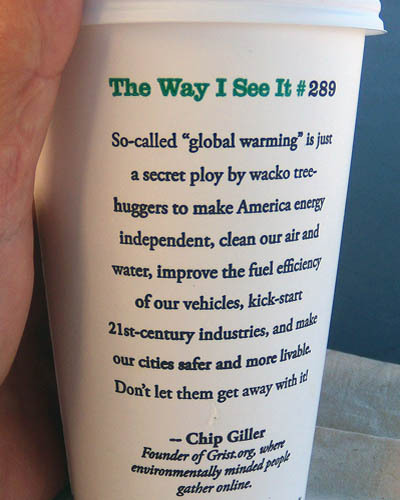
Found this on my coffee cup today:

The Way I See It #289

So-called “global warming” is just

a secret ploy by wacko tree-

huggers to make America energy

independent, clean our air and

water, improve the fuel efficiency

of our vehicles, kick-start

21st-century industries, and make

our cities safer and more livable.

Don’t let them get away with it!

Chip Giller
Founder of Grist.org, where
environmentally-minded people
gather online.

Starbucks Coffee Cup, The Way I See It #289 (global warming)

Look! Someone found the same cup I found!

Add to FacebookAdd to NewsvineAdd to DiggAdd to Del.icio.usAdd to StumbleuponAdd to RedditAdd to BlinklistAdd to TwitterAdd to TechnoratiAdd to Furl

Save


Climate skeptic shell game: ‘Please don’t read how CO2 amplifies warming’

August 8, 2009

In heated political discussions, I’ve discovered that when people stretch the facts, sometimes they do it to protect their interests; but if they exaggerate and stretch things when the facts are on their side, it’s pathological and you can’t trust them on anything.

As the old joke goes, ‘I once knew a guy who cheated at golf so bad that when he got a hole-in-one, he wrote down “zero” on the score card.’

Scientists at Oregon State University released a study that shows the tilt and wobble of the Earth can trigger ice ages and the ends of ice ages. As you can imagine, climate change skeptics and denialist will jump on this study to say we don’t need to worry about carbon dioxide — ‘warming can’t be blamed on carbon dioxide.’

In fact, Anthony Watts has already done that.

Read the entire press release, and don’t skip over the parts that are important to policy on air pollution and climate change.  The paper indeed says that planetary wobble causes ice ages, and warming between ice ages.  That’s part of the climate change debate, probably a sizable win for climate skeptics.

But they can’t leave well enough alone; the study explicitly warns of the warming effects of human-released CO2.  Watts left out this paragraph:

“Solar radiation was the trigger that started the ice melting, that’s now pretty certain,” said Peter Clark, a professor of geosciences at OSU. “There were also changes in atmospheric carbon dioxide levels and ocean circulation, but those happened later and amplified a process that had already begun.”

Watts left this out, too, and this qualifies the Oregon State study as “alarmist” under usual skeptic rubrics:

Sometime around now, scientists say, the Earth should be changing from a long interglacial period that has lasted the past 10,000 years and shifting back towards conditions that will ultimately lead to another ice age – unless some other forces stop or slow it. But these are processes that literally move with glacial slowness, and due to greenhouse gas emissions the Earth has already warmed as much in about the past 200 years as it ordinarily might in several thousand years, Clark said.

“One of the biggest concerns right now is how the Greenland and Antarctic ice sheets will respond to global warming and contribute to sea level rise,” Clark said. “This study will help us better understand that process, and improve the validity of our models.”

Peter Clark of Oregon State and his associates published an important study in Science on Friday.  The study points to variations in the usual 23-degree tilt of the Earth’s access as triggers for glaciation and retreat of glaciers, over time.  The study poses important questions, such as:  Has human contribution to greenhouse gases prevented cooling in the past two centuries?  The study offers potential insights into research into climate change and human contributions to climate change.

The study in no way exonerates carbon dioxide from implication as a major, human-contributed component to the mix of factors driving climate change in the 21st century.  The study is really pretty cool; it should be fodder for geography and environmental science classes this fall, and it should be one factor in the discussion over warming and what we need to do about it.

Watch:  Some will try to make it the latest political shuttlecock instead.

Here’s the full press release:

8-6-09

Media Release

Long debate ended over cause, demise of ice ages – may also help predict future

CORVALLIS, Ore. – A team of researchers says it has largely put to rest a long debate on the underlying mechanism that has caused periodic ice ages on Earth for the past 2.5 million years – they are ultimately linked to slight shifts in solar radiation caused by predictable changes in Earth’s rotation and axis.

In a publication to be released Friday in the journal Science, researchers from Oregon State University and other institutions conclude that the known wobbles in Earth’s rotation caused global ice levels to reach their peak about 26,000 years ago, stabilize for 7,000 years and then begin melting 19,000 years ago, eventually bringing to an end the last ice age.

The melting was first caused by more solar radiation, not changes in carbon dioxide levels or ocean temperatures, as some scientists have suggested in recent years.

“Solar radiation was the trigger that started the ice melting, that’s now pretty certain,” said Peter Clark, a professor of geosciences at OSU. “There were also changes in atmospheric carbon dioxide levels and ocean circulation, but those happened later and amplified a process that had already begun.”

The findings are important, the scientists said, because they will give researchers a more precise understanding of how ice sheets melt in response to radiative forcing mechanisms. And even though the changes that occurred 19,000 years ago were due to increased solar radiation, that amount of heating can be translated into what is expected from current increases in greenhouse gas levels, and help scientists more accurately project how Earth’s existing ice sheets will react in the future.

“We now know with much more certainty how ancient ice sheets responded to solar radiation, and that will be very useful in better understanding what the future holds,” Clark said. “It’s good to get this pinned down.”

The researchers used an analysis of 6,000 dates and locations of ice sheets to define, with a high level of accuracy, when they started to melt. In doing this, they confirmed a theory that was first developed more than 50 years ago that pointed to small but definable changes in Earth’s rotation as the trigger for ice ages.

“We can calculate changes in the Earth’s axis and rotation that go back 50 million years,” Clark said. “These are caused primarily by the gravitational influences of the larger planets, such as Jupiter and Saturn, which pull and tug on the Earth in slightly different ways over periods of thousands of years.”

That, in turn, can change the Earth’s axis – the way it tilts towards the sun – about two degrees over long periods of time, which changes the way sunlight strikes the planet. And those small shifts in solar radiation were all it took to cause multiple ice ages during about the past 2.5 million years on Earth, which reach their extremes every 100,000 years or so.

Sometime around now, scientists say, the Earth should be changing from a long interglacial period that has lasted the past 10,000 years and shifting back towards conditions that will ultimately lead to another ice age – unless some other forces stop or slow it. But these are processes that literally move with glacial slowness, and due to greenhouse gas emissions the Earth has already warmed as much in about the past 200 years as it ordinarily might in several thousand years, Clark said.

“One of the biggest concerns right now is how the Greenland and Antarctic ice sheets will respond to global warming and contribute to sea level rise,” Clark said. “This study will help us better understand that process, and improve the validity of our models.”

The research was done in collaboration with scientists from the Geological Survey of Canada, University of Wisconsin, Stockholm University, Harvard University, the U.S. Geological Survey and University of Ulster. It was supported by the National Science Foundation and other agencies.

About the OSU College of Science: As one of the largest academic units at OSU, the College of Science has 14 departments and programs, 13 pre-professional programs, and provides the basic science courses essential to the education of every OSU student. Its faculty are international leaders in scientific research.

Watts did note the abstract of the paper, at Science (to get the full text, you must be a subscriber or pay a high fee for the one article):

Science 7 August 2009:
Vol. 325. no. 5941, pp. 710 – 714
DOI: 10.1126/science.1172873

Research Articles

The Last Glacial Maximum

Peter U. Clark,1,* Arthur S. Dyke,2 Jeremy D. Shakun,1 Anders E. Carlson,3 Jorie Clark,1 Barbara Wohlfarth,4 Jerry X. Mitrovica,5 Steven W. Hostetler,6 A. Marshall McCabe7

We used 5704 14C, 10Be, and 3He ages that span the interval from 10,000 to 50,000 years ago (10 to 50 ka) to constrain the timing of the Last Glacial Maximum (LGM) in terms of global ice-sheet and mountain-glacier extent. Growth of the ice sheets to their maximum positions occurred between 33.0 and 26.5 ka in response to climate forcing from decreases in northern summer insolation, tropical Pacific sea surface temperatures, and atmospheric CO2. Nearly all ice sheets were at their LGM positions from 26.5 ka to 19 to 20 ka, corresponding to minima in these forcings. The onset of Northern Hemisphere deglaciation 19 to 20 ka was induced by an increase in northern summer insolation, providing the source for an abrupt rise in sea level. The onset of deglaciation of the West Antarctic Ice Sheet occurred between 14 and 15 ka, consistent with evidence that this was the primary source for an abrupt rise in sea level ~14.5 ka.
1 Department of Geosciences, Oregon State University, Corvallis, OR 97331, USA.
2 Geological Survey of Canada, 601 Booth Street, Ottawa, Ontario K1A 0E8, Canada.
3 Department of Geology and Geophysics, University of Wisconsin, Madison, WI 53706, USA.
4 Department of Geology and Geochemistry, Stockholm University, SE-10691, Stockholm, Sweden.
5 Department of Earth and Planetary Sciences, Harvard University, Cambridge, MA 02138, USA.
6 U.S. Geological Survey, Department of Geosciences, Oregon State University, Corvallis, OR 97331, USA.
7 School of Environmental Science, University of Ulster, Coleraine, County Londonderry, BT52 1SA, UK.

Supporting online material, including a solid discussion of methods and several charts that are not contained in the full publication, is available, free, in .pdf form.  Warning to creationists:  This is heavy on science using radioactive isotopes for dating.  For that matter, it’s loaded with a lot of other science that climate change skeptics generally dismiss as “computer simulation” instead of hard data.  How will they treat this study?  Skeptically?  Don’t bet on it.

Resources:

Share this story and the science:

Add to FacebookAdd to NewsvineAdd to DiggAdd to Del.icio.usAdd to StumbleuponAdd to RedditAdd to BlinklistAdd to TwitterAdd to TechnoratiAdd to Furl


Christian environmental stewardship: Disciples of Christ and the Alverna Covenant

August 5, 2009

I learned something new tonight.  The Disiciples of Christ formally adopted wise environmental stewardship as a denominational goal in 1981.

History of the Alverna Covenant

The Alverna Covenant was written by members of the Task Force on Christian Lifestyle and Ecology of the Christian Church (Disciples of Christ) while meeting at Alverna Retreat Center, a Franciscan retreat in Indianapolis, Ind. The name has added significance. Alverna is named for Mt. Alverna in Italy, the mountain retreat given to Francis of Assisi. Francis is honored for his concern for the care of and relatedness of all creation. The 800th anniversary of Francis’ birth was celebrated in 1981, the year the Alverna Covenant was first introduced at the General Assembly of the Christian Church (Disciples of Christ).

The Alverna Covenant

Whereas:

  • God has created the world with finite resources;
  • God has given to us the stewardship of the earth;
  • God has established order through many natural cycles.

And it is evident that:

  • We are consuming resources at a rate that cannot be maintained;
  • We are interrupting many natural cycles;
  • We are irresponsibly modifying the environment through consumption and pollution;
  • We are populating the earth at a rate that cannot be maintained;

As a member of the human family and a follower of Jesus Christ, I hereby covenant that:

  • I will change my lifestyle to reduce my contribution to pollution;
  • I will support recycling efforts;
  • I will search for sustainable lifestyles;
  • I will work for public policies which lead to a just and sustainable society;
  • I will share these concerns with others and urge them to make this Covenant.
  • What other denominations have statements on wise resource stewardship? What do they say?

    Tip of the old scrub brush to Darrel Manson, who writes at Hollywood Jesus.

    Resources:


    Drought: Heckuva way to run the end to global warming

    July 30, 2009

    “This is a hell of a way to run a desert.”
    Utah Gov. Scott Matheson, during floods in 1983

    A new Dust Bowl?

    A new Dust Bowl? (Image updated January 2013; old links dead)

    No, I’m not repeating the error of many who take every snowflake as bizarre evidence that global warming has ended.

    I think we need to stick to the facts.

    2009 may be cooler than 1998, one of the hottest years on record, but that in no way suggests an end to the climate crisis scientists have been tracking for the past couple of decades.

    Cooler weather in New York does not offset the rest of reality.

    Reality is we have crushing droughts in California and Texas.

    California drought explained by USA Today:

    FIREBAUGH, Calif. — The road to Todd Allen’s farm wends past irrigation canals filled with the water that California‘s hot Central Valley depends on to produce vegetables and fruit for the nation. Yet not a drop will make it to his barren fields.

    Three years into a drought that evokes fears of a modern-day dust bowl, Allen and others here say the culprit now isn’t Mother Nature so much as the federal government. Court and regulatory rulings protecting endangered fish have choked the annual flow of water from California’s Sierra mountains down to its people and irrigated fields, compounding a natural dry spell.

    “This is a regulatory drought, is what it is,” Allen says. “It just doesn’t seem fair.”

    For those like Allen at the end of the water-rights line, the flow has slowed to a trickle: His water district is receiving just 10% of the normal allocation of water from federal Bureau of Reclamation reservoirs. He says he’s been forced to lay off all his workers and watch the crops die on his 300 acres while bills for an irrigation system he put in are due.

    “My payments don’t stop when they cut my water off,” Allen says.

    Although some farmers with more senior water rights are able to keep going, local officials say 250,000 acres has gone fallow for lack of water in Fresno County, the nation’s most productive agriculture county. Statewide, the unplanted acreage is almost twice that.

    Unemployment has soared into Depression-era range; it is 40% in this western Fresno County area where most everyone’s job is dependent on farming. Resident laborers who for years sweated in fields to fill the nation’s food baskets find themselves waiting for food handouts.

    “The water’s cut off,” complains Robert Silva, 68, mayor of the farm community of Mendota. “Mendota is known as the cantaloupe capital of the world. Now we’re the food-line capital.”

    Three years of dry conditions is being felt across much of the nation’s most populous state.

    Gov. Arnold Schwarzenegger declared a water emergency in February and asked for 20% voluntary cuts in water use. The U.S. Department of Agriculture’s Drought Monitor lists 44% of the state as in a “severe” drought.

    In arid Southern California, cities and water districts have raised rates to encourage conservation and imposed limits on use

    Texas drought, detailed in the Dallas Morning News:

    AUSTIN – The drought that has gripped Central Texas is approaching the severity of Texas’ most famous drought, the 1950s dry spell that lasted several years, Lower Colorado River Authority officials say.

    But the current drought, which began in the fall of 2007, has seen more intense concentrations of high temperatures and less rainfall than the majority of the earlier drought.

    “It was hot, yes, it was dry” in the 1950s, said LCRA meteorologist Bob Rose, “but it wasn’t crazy hot like this year.” Soil moisture is negligible now. And with spotty precipitation, “we haven’t been able to generate any runoff” to replenish reservoirs, he said.

    “What makes our current drought unique is not the duration but the severity,” Rose said this week at a drought briefing for meteorologists and reporters.

    With state officials warning of wildfire dangers, and water restrictions spreading rapidly across the state, Texas Gov. Rick Perry (R) issued disaster declarations for 167 of the states 254 counties.

    Texas suffers more than California, across a broader area with deeper drought, according to the Associated Press:

    According to drought statistics released by the U.S. Department of Agriculture, 77 of Texas’ 254 counties are in extreme or exceptional drought, the most severe categories. No other state in the continental U.S. has even one area in those categories.

    John Nielsen-Gammon, the Texas state climatologist at Texas A&M University, said he expects harsh drought conditions to last at least another month.

    In the bone-dry San Antonio-Austin area, the conditions that started in 2007 are being compared to the devastating drought of the 1950s. There have been 36 days of 100 degrees or more this year in an area where the total usually is closer to 12.

    Among the most obvious problems are the lack of water in Lake Travis and Lake Buchanan near Austin, two massive reservoirs along the Colorado River that provide drinking water for more than 1 million people and also are popular boating and swimming spots. Streams and tributaries that feed the lakes have “all but dried up,” according to the Lower Colorado River Authority.

    San Antonio, which relies on the Edwards Aquifer for its water, is enduring its driest 23-month period since the start of recorded weather data in 1885, according to the National Weather Service. The aquifer’s been hovering just above 640 feet deep, and if it dips below that, the city will issue its harshest watering restrictions yet.

    Self-professed climate skeptics will argue that everything is hunky-dory and we can continue blundering along pollutiong willy-nilly because droughts alone are not evidence of warming, and so cannot rebut spot evidence of increased rainfall or local cooling.  Notice how they try to have the argument both ways?  Local weather counts for their side, but can’t count against it.

    It’s more complex than that.  Much of the damage from climate change occurs in the upset of a balance in local ecosystems.  The Green Blog at the Boston Globe site discusses the subtle, ecosystem distorting effects and how easy they are to miss in the grand schemes of things.

    A lot of the problem has to do with timing. About half of the water that recharges the [Northeast] region’s aquifer is from spring snowmelt, said [USGS hydrologist Thomas] Mack, allowing it to be plentiful to residents for summer lawn watering and other uses.

    But global warming is causing the snow to melt earlier by around two to four weeks. At the same time, more rain, instead of snow, is expected to fall in the winter. That means the aquifer is filling up earlier in the spring.

    The problem is the region’s bedrock aquifer can’t hold water for a long time – filling it up when it is needed the least and draining before the busy summer.

    All environmental problems are complex, and global “warming” is massively more complex than any other environmental issue humans have recognized and dealt with.  Climate change deals with the entire Earth, and with the two great pools of fluids on the Earth, the oceans and the atmosphere, where the sheer physics of change are nearly impossible to understand, let alone predict.

    Perhaps, as local conditions in more and more places demonstrate damages from climate change, skeptics can be brought around to understand that action is required even when we don’t have all the possible data points we’d like.

    Resources:


    Unintentional climate change humor at the Washington Post

    July 15, 2009

    Despite the woes afflicing the daily press, The Washington Post still makes space for humor, even on its opposite-editorial page.  Here’s a humorous piece on cap-and-trade legislation to fight climate change, published I would guess with an eye to the date of July 14, the anniversary of Bastille Day.  Is it unintentional humor?

    Unemployed?  Let ’em eat airplane-hunted caribou soaked in petroleum, eh, Sarah?

    Palin’s piece doesn’t ramble as much as her press conference on quitting the governor’s chair, but it makes about an equal amount of sense.  While whining that the current legislative proposal is the wrong way to go, Palin doesn’t hint at what might be the right way to go to reduce air pollution, help prevent global warming, and keep energy available.

    Churchill noted that democracy is the worst form of government ever devised by men, except, of course, for all the others.  Obama supports cap-and-trade legislation that is the worst thing we could do, except for anything else proposed, and especially except for doing nothing at all.

    Resources:


    Insurance experts: Get ready for climate change now

    July 12, 2009

    Climate change denialism is an astounding ball of contradictions and conundrums.

    For example, while most denialists claim to be free-market devotees, they pointedly ignore market indications that climate change is real, aggravated by human actions (and inaction), and that humans can do anything about it.

    Look at the insurance industry.  I’ve noted often that, here in Texas, we pay higher premiums on home insurance because climate change has produced worse weather, which costs insurance companies a lot.  Insurance company actuaries are paid to predict the future, reliably.  If they fail, insurance companies die quickly.

    Weather-related catastrophes, such as wildfires, are posing a serious threat to the insurance industry worldwide. (Photograph source: John McColgan, Bureau of Land Management, Alaska Fire Service.) Caption from Berkeley Lab Research News

    Weather-related catastrophes, such as wildfires, are posing a serious threat to the insurance industry worldwide. (Photograph source: John McColgan, Bureau of Land Management, Alaska Fire Service.) Caption from Berkeley Lab Research News

    The “market” girds itself to fight climate change that governments are not going to move fast enough to prevent.  This will cost you a lot of money.

    A good place to go for information about climate change and how it affects is the Lawrence Berkeley Laboratories, a group that studies the future and is no longer limited (if it ever was) to nuclear future issues.

    Insurance in a Climate of Change, The Greening of Insurance in a Warming World, is loaded with information about insurance industry calculations of what the future is, and how insurance companies might and should react to the changes.

    How relevant are weather-related natural disasters for insurers, and is there any evidence that the situation is worsening?

    Globally, we are seeing about $80 billion/year in weather-related economic losses, of which $20 billion (about a quarter) are insured. This is like a “9/11” every year. Weather-related losses represent about 90% of all natural disaster losses, and the data I just cited do not include an enormous amount of aggregate losses from small-scale or gradual, non-catastrophic events (e.g., lightning, soil subsidence, gradual sea-level rise).

    Inflation-adjusted economic losses from catastrophic events rose by 8-fold between the 1960s and 1990s and insured losses by 17-fold. Losses are increasing faster than insurance premiums. The insured share of total losses has increased dramatically in recent decades, and variability is increasing (a key trouble sign for risk-wary insurers). Weather-related catastrophes have clearly visible adverse effects on insurance prices, and availability. Of particular concern are the so-called “emerging markets” (developing countries and economies in transition”, which already have $375 billion per year in insurance premiums (about 12% of the global market at present, but rising). They are significantly more vulnerable to climate change than are industrialized countries. Emerging markets are the center of growth for the industry, yet they are also the center of vulnerability.

    Increased exposures are surely influenced—and no doubt heavily in some areas—by rising demographic and socioeconomic exposures. Yet, the rise in losses has outpaced population, economic growth, and insurance penetration. The science of “attribution analysis” is still in primitive stages, and thus we cannot yet quantify the relative roles of global climate change and terrestrial human activities. Some have prematurely jumped to the conclusion [PDF] that demographic trends explain the entire rise in observed losses. In the year 2005, three independent refereed <!– –>scientific articles drew linkages between hurricane trends and climate change.

    Denialists claim weather stations are badly-placed, and so we need not worry about climate change since warming can’t accurately be measured — never mind the worldwide rise in temperatures of atmosphere and oceans.   Denialists claim that the greenhouse effect cannot be blamed on carbon dioxide emissions since carbon dioxide is such a small proportion of the gases in the atmosphere, apparently wholly unaware of the greenhouse effect in atmospheric gases, or unaware that only a thin pane of glass makes a greenhouse work.  Denialists claim that polar bears do not decline precipitously, yet, so all wildlife will be unaffected – nevermind the dramatic shifts in migration patterns of birds and migrating mammals, and the dramatic shift in the arrival of spring.  Denialists claim that Boston Harbor has survived 300 years of human development, so all harbors can survive any increase in ocean levels, nevermind the pending disasters of islands sinking out of site and destroying entire nations in the South Pacific, and never mind the drownings in Bengla Desh at every cyclone.

    Most denialists rent apaartments or own homes.  Denying the insurance increases will be more difficult, though I fully expect Anthony Watts and Co. will deny that the insurance company actions and studies of global warming are warranted or accurate.

    Is there any good news in all of this?

    By all means. Insurers need to look no farther than their roots as founders of the original fire departments, early advocates for building codes and fire safety, etc. That is to say that insurers’ history is all about risk management and loss prevention. The same thinking can apply in the case of climate change. Just as insurers fought fire risks through encouraging fire safety, better modeling, and fire suppression, so too can they be part of the climate change solution. This can take many forms, ranging from providing new insurance products (e.g., for carbon trading or energy savings insurance [PDF]), to promoting energy-efficient and renewable technologies [PDF] that also help prevent everyday losses, to engaging in the broader policy discussion on climate change. Insurers can also be part of improving the underlying science of climate change, modeling, and impacts assessment. We maintain an extensive compilation of examples of how leading insurers are stepping into the arena in a constructive manner.

    Alas, there is no insurance against the dithering of climate change denialists.

    Go, with all thy internet getting, get thee wisdom.