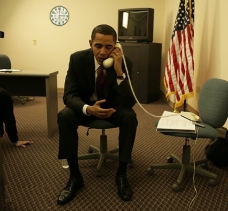
George C. Wallace, and Barack Obama

November 5, 2008

Would George Wallace, the late segregationist Governor of Alabama and one-time threat to win the presidency, have voted for Barack Obama?

Ask George Wallace’s daughter, Peggy Wallace Kennedy.  You might be surprised.

Wallace’s politics were a southern response to what was perceived as Washington’s abandoning of the southern states.  Bush’s policies, especially in the wake of hurricanes that destroyed New Orleans and many other communities in the south, look the same to many southerners.

So, which way would Wallace have voted?


Is our children learning science? O, woe is Texas

November 5, 2008

So, last week or so I commented on the woes of Kentucky, where, the polls showed, 28% of voters were yoked with the millstone belief that our president-elect is Muslim. Someone commented, and sent me the link that showed 23% of Texans carry a similar burden in their own swim.

Can it get much more weird, more divorced from reality?

How about we marry bizarre, untrue beliefs about religion with bizarre, untrue beliefs about science? And then — God save us, please — how about let’s put that person on the state school board during a rewrite of science standards?

Meet Cynthia Dunbar, member of the Texas State Board of Education.

Cynthia Dunbar, Texas State Board of Education member

At the tinfoil hat website “Christian Worldview” (as if Christians are unable to see normally), Dunbar posted this bizarre statement:

So we can imagine the blatant disregard for our Constitution, but what other threats does an Obama administration pose? We have been clearly warned by his running mate, Joe Biden, that America will suffer some form of attack within the first 6 months of Obama’s administration. However, unlike Joe, I do not believe this “attack” will be a test of Obama’s mettle. Rather, I perceive it will be a planned effort by those with whom Obama truly sympathizes to take down the America that is threat to tyranny.

Challenged by the Texas Freedom Network to do the American, patriotic thing and take the comments down, Dunbar refuses.

Dunbar was not worried about martial law when President George W. Bush actually took the steps she claims to worry about now, assigning troops to domestic crowd control in the U.S. It’s the marriage of presidential power with the bizarre phantasms of “the Christian worldview” that makes Ms. Dunbar’s views so nutty. It’s her position on the Texas State Board of Education that makes her views troubling, if not downright dangerous.

Her statement is as crazy as if she had accused John McCain of being a communist sympathizer, and Manchurian candidate, for ‘having spent so much time schmoozing with North Vietnamese officials.’ It’s also every bit as offensive as such a claim would be.

One mystery remains: Do wacko views produce creationism, or does creationism produce these wacko views? We await the creationist who can make an argument in favor of creationism without making a detour off the deep end.

It’s going to take more than tinfoil to protect Texas’s children, and Barack Obama, from these nuts.

If you want to pray, pray that God grants us reason, to save us and our children from such nuts, and this one especially.

Tip of the old scrub brush to Chris Comer.

_________________


‘No red America, no blue America – a United States of America’ (Please vote)

November 3, 2008

Who said this?

Yet even as we speak, there are those who are preparing to divide us, the spin masters and negative ad peddlers who embrace the politics of anything goes. Well, I say to them tonight, there’s not a liberal America and a conservative America — there’s the United States of America. There’s not a black America and white America and Latino America and Asian America; there’s the United States of America. The pundits like to slice-and-dice our country into Red States and Blue States; Red States for Republicans, Blue States for Democrats. But I’ve got news for them, too. We worship an awesome God in the Blue States, and we don’t like federal agents poking around our libraries in the Red States. We coach Little League in the Blue States and have gay friends in the Red States. There are patriots who opposed the war in Iraq and patriots who supported it. We are one people, all of us pledging allegiance to the stars and stripes, all of us defending the United States of America.

In the end, that’s what this election is about. Do we participate in a politics of cynicism or a politics of hope? John Kerry calls on us to hope. John Edwards calls on us to hope. I’m not talking about blind optimism here — the almost willful ignorance that thinks unemployment will go away if we just don’t talk about it, or the health care crisis will solve itself if we just ignore it. No, I’m talking about something more substantial. It’s the hope of slaves sitting around a fire singing freedom songs; the hope of immigrants setting out for distant shores; the hope of a young naval lieutenant bravely patrolling the Mekong Delta; the hope of a mill worker’s son who dares to defy the odds; the hope of a skinny kid with a funny name who believes that America has a place for him, too. The audacity of hope!

In the end, that is God’s greatest gift to us, the bedrock of this nation; the belief in things not seen; the belief that there are better days ahead.

I could vote for a guy who said that.


Hoaxers promise to slam Obama to the end

November 2, 2008

The Economist, that august, conservative British publication about economics, endorsed Barack Obama for president. (I added highlights, below):

IT IS impossible to forecast how important any presidency will be. Back in 2000 America stood tall as the undisputed superpower, at peace with a generally admiring world. The main argument was over what to do with the federal government’s huge budget surplus. Nobody foresaw the seismic events of the next eight years. When Americans go to the polls next week the mood will be very different. The United States is unhappy, divided and foundering both at home and abroad. Its self-belief and values are under attack.

For all the shortcomings of the campaign, both John McCain and Barack Obama offer hope of national redemption. Now America has to choose between them. The Economist does not have a vote, but if it did, it would cast it for Mr Obama. We do so wholeheartedly: the Democratic candidate has clearly shown that he offers the better chance of restoring America’s self-confidence. But we acknowledge it is a gamble. Given Mr Obama’s inexperience, the lack of clarity about some of his beliefs and the prospect of a stridently Democratic Congress, voting for him is a risk. Yet it is one America should take, given the steep road ahead.

We face tough issues, and tough times.  The world’s economy is in a fix, America is involved in two protracted wars, our reputation internationally is at a low ebb for the past 125 years, and too many of America’s institutions just are not working.

Serious issues won’t stop the hoaxsters from trying to hoax Americans about Barack Obama right up to election day, and probably beyond.

For example, there’s a guy named Mitchell Langbert, who insists that there remains an issue about Barack Obama’s birth certificate.  He goes so far as to claim that Obama might be committing fraud merely by running for office, and then he stretches a biased assessment of U.S. election law to say Obama’s running is a violation of voters’ rights.  The birth certificate hoaxers roll on despite their nuisance lawsuits being dismissed solidly in at least two jurisdictions, and despite the complete lack of any cogent or coherent case that there is a problem with Obama’s citizenship.

Consider this:  Obama’s birth was recorded by the State of Hawaii, in Hawaii, in 1961.  As many newspapers did at the time, the Honolulu Advertiser listed births in the state, and it listed Barack Obama’s birth there.  This issue would have been checked again on at least three occasions.  First, when he applied for his own passport, the U.S. State Department would have required a showing of a birth certificate.  Second, when he applied for a law license, he had to make such a showing to the National Conference of Bar Examiners (as we all did); I haven’t checked, but Illinois may have required a separate confirmation.  And third, when he was elected to the U.S. Senate, the FBI would have checked the issue in their routine checkings of senators for top secret clearances (Obama is a member of the Foreign Relations Committee, where secret information is often passed to senators).

Finally, it is the duty of the state secretary of state (SOS) to verify that candidates are eligible for listing on the ballots.  I suspect most SOS offices take a certification from the candidate without much checking; however, what this means is that the SOS is the person who would have authority to challenge for citizenship.  Knowing that they have no case, none of the birth certificate hoaxers, not Langbert or Texas Darlin’, nor anyone else, has bothered to ask their SOS to check things out.

Other hoaxers are worse, creating whole cloth fictions, just for the sake of malice.  (See here, too, for a solid example of just plain malice in hoaxing.)

Remember the 7 Signs of Bogus History?  (You’ll find a link just under the masthead here.)  The first is that the work is conducted by press release, and not in the archives, or in serious searches for the facts.  Each of these anti-Obama hoaxes originates either with a press release or a blog post.  Not one has withstood scrutiny of any court, nor of any editor at any serious mass media outlet who seriously worries about libel, slander, or otherwise getting the facts straight.  That’s a serious indictment.

Gone are the days when one needed a printing press at least to make one’s views known broadly.  Web tools, like the blogging software and servers used by this blog, allow any fool (as I may well be) to throw his hat, brain too often included, into the public arena as a pundit.

The Economist conclude in their endorsement editorial:

He has earned it

So Mr Obama in that respect is a gamble. But the same goes for Mr McCain on at least as many counts, not least the possibility of President Palin. And this cannot be another election where the choice is based merely on fear. In terms of painting a brighter future for America and the world, Mr Obama has produced the more compelling and detailed portrait. He has campaigned with more style, intelligence and discipline than his opponent. Whether he can fulfil his immense potential remains to be seen. But Mr Obama deserves the presidency.

*  *  *  *  *  *  *  *

Update, November 2, 2008: Langbert appears to be censoring comments at his blog, as well – none of my responses other than my first post have been allowed to get through his personal filtering.  This is a pattern we’ve seen in many of the hoax blogs that complain about Obama, and the McCain sympathizer blogs that pose as disgruntled Democrat blogs.  Any post that offers serious criticism is dangerous to their posing as informed seekers of the truth — so posts that contain real information rebutting their claims are not allowed through their “moderation,” or are edited to say inane things.

For Obama voters, this confirms their fears that a McCain administration would probably continue the Bush administration’s suppression of views and filtering of helpful criticism.  Also, it means bloggers like Langbert are bullies who can’t take the hurly-burly of serious discussion.


Why we liked Obama then

October 31, 2008

On July 27, 2004, candidate for the U.S. Senate from Illinois, Barack Obama, delivered the keynote address to the National Democratic Convention.

It was a turning point speech.  Obama went on to win the Illinois senate race.  His candidate for president, John Kerry, lost.  But the power of his speech and its ready reception earned Obama consideration as a candidate for the presidency in 2008.

As the 2008 campaign winds down to election day next Tuesday, it’s interesting to revisit Obama’s debut on a national stage.  What was it that made his speech so well received?  What was it about the biographical portions that made Obama look like a potential president?

PBS’s Online Newshour described the speech:

Illinois Senate candidate Barack Obama introduced himself to Democrats and a national television audience Tuesday, giving the keynote address at the Democratic National Convention. Obama told the story of his working class family and urged the nation to elect Democratic presidential candidate John Kerry, saying he would ensure more educational and economic opportunities for all.

Here is the full text (borrowed from PBS), so you can see for yourself.

A YouTube capture of the CSPAN broadcast:

BARACK OBAMA: On behalf of the great state of Illinois, crossroads of a nation, land of Lincoln, let me express my deep gratitude for the privilege of addressing this convention. Tonight is a particular honor for me because, let’s face it, my presence on this stage is pretty unlikely. My father was a foreign student, born and raised in a small village in Kenya. He grew up herding goats, went to school in a tin-roof shack. His father, my grandfather, was a cook, a domestic servant.

But my grandfather had larger dreams for his son. Through hard work and perseverance my father got a scholarship to study in a magical place; America which stood as a beacon of freedom and opportunity to so many who had come before. While studying here, my father met my mother. She was born in a town on the other side of the world, in Kansas. Her father worked on oil rigs and farms through most of the Depression. The day after Pearl Harbor he signed up for duty, joined Patton’s army and marched across Europe. Back home, my grandmother raised their baby and went to work on a bomber assembly line. After the war, they studied on the G.I. Bill, bought a house through FHA, and moved west in search of opportunity.

And they, too, had big dreams for their daughter, a common dream, born of two continents. My parents shared not only an improbable love; they shared an abiding faith in the possibilities of this nation. They would give me an African name, Barack, or “blessed,” believing that in a tolerant America your name is no barrier to success. They imagined me going to the best schools in the land, even though they weren’t rich, because in a generous America you don’t have to be rich to achieve your potential. They are both passed away now. Yet, I know that, on this night, they look down on me with pride.

I stand here today, grateful for the diversity of my heritage, aware that my parents’ dreams live on in my precious daughters. I stand here knowing that my story is part of the larger American story, that I owe a debt to all of those who came before me, and that, in no other country on earth, is my story even possible. Tonight, we gather to affirm the greatness of our nation, not because of the height of our skyscrapers, or the power of our military, or the size of our economy. Our pride is based on a very simple premise, summed up in a declaration made over two hundred years ago, “We hold these truths to be self-evident, that all men are created equal. That they are endowed by their Creator with certain inalienable rights. That among these are life, liberty and the pursuit of happiness.”

That is the true genius of America, a faith in the simple dreams of its people, the insistence on small miracles. That we can tuck in our children at night and know they are fed and clothed and safe from harm. That we can say what we think, write what we think, without hearing a sudden knock on the door. That we can have an idea and start our own business without paying a bribe or hiring somebody’s son. That we can participate in the political process without fear of retribution, and that our votes will be counted — or at least, most of the time.

This year, in this election, we are called to reaffirm our values and commitments, to hold them against a hard reality and see how we are measuring up, to the legacy of our forbearers, and the promise of future generations. And fellow Americans — Democrats, Republicans, Independents — I say to you tonight: we have more work to do. More to do for the workers I met in Galesburg, Illinois, who are losing their union jobs at the Maytag plant that’s moving to Mexico, and now are having to compete with their own children for jobs that pay seven bucks an hour. More to do for the father I met who was losing his job and choking back tears, wondering how he would pay $4,500 a month for the drugs his son needs without the health benefits he counted on. More to do for the young woman in East St. Louis, and thousands more like her, who has the grades, has the drive, has the will, but doesn’t have the money to go to college.

Don’t get me wrong. The people I meet in small towns and big cities, in diners and office parks, they don’t expect government to solve all their problems. They know they have to work hard to get ahead and they want to. Go into the collar counties around Chicago, and people will tell you they don’t want their tax money wasted by a welfare agency or the Pentagon. Go into any inner city neighborhood, and folks will tell you that government alone can’t teach kids to learn. They know that parents have to parent, that children can’t achieve unless we raise their expectations and turn off the television sets and eradicate the slander that says a black youth with a book is acting white. No, people don’t expect government to solve all their problems. But they sense, deep in their bones, that with just a change in priorities, we can make sure that every child in America has a decent shot at life, and that the doors of opportunity remain open to all. They know we can do better. And they want that choice.

In this election, we offer that choice. Our party has chosen a man to lead us who embodies the best this country has to offer. That man is John Kerry. John Kerry understands the ideals of community, faith, and sacrifice, because they’ve defined his life. From his heroic service in Vietnam to his years as prosecutor and lieutenant governor, through two decades in the United States Senate, he has devoted himself to this country. Again and again, we’ve seen him make tough choices when easier ones were available. His values and his record affirm what is best in us.

John Kerry believes in an America where hard work is rewarded. So instead of offering tax breaks to companies shipping jobs overseas, he’ll offer them to companies creating jobs here at home. John Kerry believes in an America where all Americans can afford the same health coverage our politicians in Washington have for themselves. John Kerry believes in energy independence, so we aren’t held hostage to the profits of oil companies or the sabotage of foreign oil fields. John Kerry believes in the constitutional freedoms that have made our country the envy of the world, and he will never sacrifice our basic liberties nor use faith as a wedge to divide us. And John Kerry believes that in a dangerous world, war must be an option, but it should never be the first option.

A while back, I met a young man named Shamus at the VFW Hall in East Moline, Illinois. He was a good-looking kid, 6’2” or 6’3”, clear eyed, with an easy smile. He told me he’d joined the Marines and was heading to Iraq the following week. As I listened to him explain why he’d enlisted, his absolute faith in our country and its leaders, his devotion to duty and service, I thought this young man was all any of us might hope for in a child. But then I asked myself: Are we serving Shamus as well as he was serving us? I thought of more than 900 service men and women, sons and daughters, husbands and wives, friends and neighbors, who will not be returning to their hometowns. I thought of families I had met who were struggling to get by without a loved one’s full income, or whose loved ones had returned with a limb missing or with nerves shattered, but who still lacked long-term health benefits because they were reservists. When we send our young men and women into harm’s way, we have a solemn obligation not to fudge the numbers or shade the truth about why they’re going, to care for their families while they’re gone, to tend to the soldiers upon their return, and to never ever go to war without enough troops to win the war, secure the peace, and earn the respect of the world.

Now let me be clear. We have real enemies in the world. These enemies must be found. They must be pursued and they must be defeated. John Kerry knows this. And just as Lieutenant Kerry did not hesitate to risk his life to protect the men who served with him in Vietnam, President Kerry will not hesitate one moment to use our military might to keep America safe and secure. John Kerry believes in America. And he knows it’s not enough for just some of us to prosper. For alongside our famous individualism, there’s another ingredient in the American saga.

A belief that we are connected as one people. If there’s a child on the south side of Chicago who can’t read, that matters to me, even if it’s not my child. If there’s a senior citizen somewhere who can’t pay for her prescription and has to choose between medicine and the rent, that makes my life poorer, even if it’s not my grandmother. If there’s an Arab American family being rounded up without benefit of an attorney or due process, that threatens my civil liberties. It’s that fundamental belief — I am my brother’s keeper, I am my sisters’ keeper — that makes this country work. It’s what allows us to pursue our individual dreams, yet still come together as a single American family. “E pluribus unum.” Out of many, one.

Yet even as we speak, there are those who are preparing to divide us, the spin masters and negative ad peddlers who embrace the politics of anything goes. Well, I say to them tonight, there’s not a liberal America and a conservative America — there’s the United States of America. There’s not a black America and white America and Latino America and Asian America; there’s the United States of America. The pundits like to slice-and-dice our country into Red States and Blue States; Red States for Republicans, Blue States for Democrats. But I’ve got news for them, too. We worship an awesome God in the Blue States, and we don’t like federal agents poking around our libraries in the Red States. We coach Little League in the Blue States and have gay friends in the Red States. There are patriots who opposed the war in Iraq and patriots who supported it. We are one people, all of us pledging allegiance to the stars and stripes, all of us defending the United States of America.

In the end, that’s what this election is about. Do we participate in a politics of cynicism or a politics of hope? John Kerry calls on us to hope. John Edwards calls on us to hope. I’m not talking about blind optimism here — the almost willful ignorance that thinks unemployment will go away if we just don’t talk about it, or the health care crisis will solve itself if we just ignore it. No, I’m talking about something more substantial. It’s the hope of slaves sitting around a fire singing freedom songs; the hope of immigrants setting out for distant shores; the hope of a young naval lieutenant bravely patrolling the Mekong Delta; the hope of a mill worker’s son who dares to defy the odds; the hope of a skinny kid with a funny name who believes that America has a place for him, too. The audacity of hope!

In the end, that is God’s greatest gift to us, the bedrock of this nation; the belief in things not seen; the belief that there are better days ahead. I believe we can give our middle class relief and provide working families with a road to opportunity. I believe we can provide jobs to the jobless, homes to the homeless, and reclaim young people in cities across America from violence and despair. I believe that as we stand on the crossroads of history, we can make the right choices, and meet the challenges that face us. America!

Tonight, if you feel the same energy I do, the same urgency I do, the same passion I do, the same hopefulness I do — if we do what we must do, then I have no doubt that all across the country, from Florida to Oregon, from Washington to Maine, the people will rise up in November, and John Kerry will be sworn in as president, and John Edwards will be sworn in as vice president, and this country will reclaim its promise, and out of this long political darkness a brighter day will come. Thank you and God bless you.


Federal judge dismissed the challenge to Obama’s birth certificate

October 26, 2008

As expected, a federal judge in Philadelphia late Friday dismissed a challenge to the campaign of Barack Obama to produce yet another copy of his birth certificate. District Judge R. Barclay Surrick ruled that the plaintiff, screwball attorney Philip J. Berg, lacked standing to sue.

Appearing to take his inspiration from the Monty Python character, the Black Knight, Berg promised to appeal the decision to the Supreme Court of the U.S.

Among reputable media, only the Philadelphia Daily News took note of the dismissal early on:

Obama and the Democratic National Committee had asked Surrick to dismiss Berg’s complaint in a court filing on Sept. 24.

They said that Berg’s claims were “ridiculous” and “patently false,” that Berg had “no standing” to challenge the qualifications of a candidate for president because he had not shown the requisite harm to himself.

Surrick agreed.

In a 34-page memorandum and opinion, the judge said Berg’s allegations of harm were “too vague and too attenuated” to confer standing on him or any other voters.

Surrick ruled that Berg’s attempts to use certain laws to gain standing to pursue his claim that Obama was not a natural-born citizen were “frivolous and not worthy of discussion.”

The judge also said the harm Berg alleged did “not constitute an injury in fact” and Berg’s arguments to the contrary “ventured into the unreasonable.”

For example, Berg had claimed that Obama’s nomination deprived citizens of voting for Sen. Hillary Clinton in November. (Berg backed Clinton in the primaries.)

Berg could not be reached for comment last night.

Obama was born in Honolulu on Aug. 4, 1961, and the campaign posted a document issued by Hawaii on its Web site, fight thesmears.com, confirming his birth there.

Berg said in court papers that the image was a forgery.

The nonpartisan Web site FactCheck.org examined the original document and said it was legitimate.

Further, a birth announcement in the Aug. 13, 1961, Honolulu Advertiser listed Obama’s birth there on Aug. 4.

Dozens of bloggers bought new rolls of aluminum foil to make protective hats, and questioned the dismissal, or jumped to other equally unwarranted conclusions. Near total insanity.

Resources:

________

Update, 10-27-2008:  Here’s an example of how lunatic this issue is, and how bizarre are the arguments.  This blog argues that Judge Surrick had the decision dictated to him from someone else in the Obama camp — the same lunatic argument creationists made against the decision of Judge Jones in the Dover, Pennsylvania, “intelligent design” trial.  Could it be that all lunatics are creationists?  Or is it just that lunatics all stumble into the same lunatic arguments?


Dad the Mechanic, vs. Joe the Plumber

October 22, 2008

Ms. Cornelius at A Shrewdness of Apes nails things down again. Tip of the old scrub brush, with extra bubbles, to JD2718.

My father tended to vote Republican, too.  For the first nine years of my life he remained a small business owner, in Burley, Idaho.  When the workers at J. R. Simplot went out on strike one November (1961 as I recall, but I was a child), it doomed several furniture stores in and around Cassia County, and my parents’ was just one.  For the rest of my life my father worked for other people, until he retired.

Still he voted Republican.  He even had a union card, from the old plumbers and pipefitters union in Los Angeles, from when he worked on Liberty Ships during World War II.  I never could figure it.

I do recall the stern lecture I got when I went to the Democrats’ mass meeting my first election, and then when I got elected as a delegate for McGovern and — the only one in my town, as I recall — I put up the McGovern bumpersticker (McGovern finished third in parts of Utah County, behind the American Party candidate).  My father told me that no one in the family had ever voted Democratic before.

It was a great comic scene, somthing right out of Woody Allen.  My father lecturing me about how voting Republican was rather a family duty, with my mother behind him shaking her head “no,” and mouthing “Don’t believe him.  Not true.  No.”

The only president I ever smuggled him in to see was Jimmy Carter.  Carter showed up in Salt Lake City, and spoke in the Latter-day Saints’ Tabernacle on Temple Square, as I recall.  I wangled the tickets, got Dad there and sat with him.  Better than Christmas.  Almost as good as when we watched Henry Mancini from nearly the same seats.

I don’t really know how my father would vote in this election, though.  He was nervous about the civil rights campaigns, about Martin Luther King, Jr.  He’d tell the stories about why he had problems with unions, about how the unions kept him from promoting African Americans he’d hire at United Cigar Stores in Los Angeles (before the Liberty Ship gig).  And he’d say that he wouldn’t have any problem voting for a black man who had a history of accomplishment in areas outside of civil rights, too.   He said he could vote for a black man from Harvard, someone who had the educational background of Kennedy, though he voted for Nixon against Kennedy (and Nixon twice more). Barack Obama might be the guy my father would have voted for.

Life sometimes imitates Thomas Kuhn’s observations about scientific revolutions.  Sometimes the children have to go vote the interests of the parents, especially when the parents don’t, or won’t.

My father voted against Lyndon Johnson, too — twice.  Johnson’s reforms of Social Security, designed to keep American senior citizens out of the county poor houses, kept my father out of poverty after he finally retired (at 75?  77?).  The Republican businessmen he’d put his faith in managed to squander the pension funds he might have had, or cheat him out of the share of the business that would have kept him from having to rely on Social Security.  My father put his faith in Republicans, but Lyndon Johnson rescued him.

I don’t know this “Joe the plumber.”  I knew my father, the former plumber and pipefitter, the erstwhile small business owner, the man who worked from the time he was 14 to help his family get enough education to get out of poverty, first his sisters in college, then his own family.  He never made enough to benefit from tax cuts for the rich.  My father was real, and deserved better.

Go read Mrs. Cornelius’s story.


Obama “most liberal,” McCain “most absent”

October 20, 2008

Anyone who has staffed Congress knows the various ratings of the votes of Members of Congress are most often skewed by the organizations that make them.  They pluck a dozen votes out of several hundred cast by a member in a year, to claim that special dozen can tell the character, or value, or liberalness or conservativeness of the member.

So when campaign surrogates claim that one of the candidates is “the most” whatever, it need be taken with a few grains of salt.

Presidential campaigns can wreak havoc on a members voting record — heck, reelection campaigns can do the same — because candidate forums and primary election dates almost always conflict with the work of Congress.  A candidate for president might be lucky to make even the major votes.

Obama missed several key votes, but got enough in to get rated.  According to one rating, by National Journal, Obama is “the most” liberal U.S. senator.  In today’s U.S. Senate, that’s not really saying much, since moderate Republicans have gone extinct there, and most of the liberal lions of the Democrats are at least retired, if not dead.

Listening to the Sunday talk shows today, I wondered why McCain’s people, always anxious to brand Obama as “most liberal,” don’t point to McCain’s own ranking.  Why not show the differences between the two on the issues, where it counts, in the votes?

So I checked.  John McCain missed more than half the votes in most areas rated by National Journal, and so could not be ranked. It looks worse when you look at the company McCain keeps in the “unranked” category.

Three senators do not have scores for 2007 because they missed more than half of the rated votes in an issue area: John McCain, R-Ariz., who was running for president; Tim Johnson, D-S.D., who was recuperating from a brain hemorrhage and returned to work on September 5, 2007; Craig Thomas, R-Wyo., who died on June 4, 2007; and John Barrasso, R-Wyo., who was appointed to succeed Thomas on June 22, 2007.

John McCain:  Most absent.


Atomic history, nuclear future

October 19, 2008

We’re going to see more nuclear power plants in the U.S., it’s a safe bet.  Both presidential candidates support developing alternatives to oil and coal.  Nuclear power is one of the alternatives.

John McCain kept repeating his comfort words, that ‘storage of wastes is not a problem.’ There is not a lot of evidence to support his claims.  With turmoil in financial markets, however, the nuclear power issue has gotten very little serious attention or scrutiny.  From the push to get compensation for radiation victims of atomic weapons and development in the U.S., I learned that the issue is not really whether wastes and other materials can be safely used and wastes stored. The issues are entirely issues of will.

Advantage to Obama, I think.  He’s not claiming that the storage problems are all solved.  A clear recognition of reality is good to have in a president.

Son Kenny sent a link to a history site, Damn Interesting, and it tells the story of the Techa River in the old Soviet Union — a place condemned for generations by the nuclear excesses of the past.

To make the story briefer, in their rush to produce nuclear weapons, the Soviets did nothing to protect Russia from radioactive waste products until it was much too late.  Efforts to reduce radioactive emissions, by storing them in huge underwater containers, resulted in massive explosions that released more radiation than Chernobyl (What?  You hadn’t heard of that, either?).

It’s a reminder that safety and security with peaceful uses of nuclear power depend on humans doing their part, and thinking through the problems before they arise.

Can we deal with radioactive wastes?  We probably have the technology.  Do we have the will? Ask yourself:  How many years has the U.S. studied Yuccan Mountain to make a case to convince Nevadans to handle the waste?  How many more decades will it take?

How is our history of dealing with nuclear contamination issues?  Not good.

Last spring SMU’s history department sponsored a colloquium on a power generation in the southwest, specifically with regard to coal and uranium mining on the Navajo Reservation.   We’ve been there before.

One of the photos used in one of the lectures, by Colleen O’Neill of Utah State, showed two Navajo miners outside a uranium mine during a previous uranium boom.  Neither one had a lick of protective equipment.  Underground uranium mining exposes miners to heave concentrations of radon gas, and if a miner is unprotected by breathing filters at least, there is a nearly 100% chance the miner will get fatal lung cancers.

Of the 150 Navajo uranium miners who worked at the uranium mine in Shiprock, New Mexico until 1970, 133 died of lung cancer or various forms of fibrosis by 1980 ([Ali, 2003] ).

Our Senate hearings on radiation compensation, in the 1970s, produced dozens of pages of testimony that Atomic Energy Commission officials understood the dangers, but did nothing to protect Navajo miners (or other miners, either).  It is unlikely that anyone depicted in those photos is alive today.

AP Photo  (borrowed from ehponline.org)

"Mine memory - Navajo miners work the Kerr-McGee uranium mine, 7 May 1953. Today, uranium from unremediated abandoned mines contaminates nearby water supplies. image: AP Photo" (borrowed from ehponline.org) This photo is very close to the one used by Prof. O'Neill. It may have been taken at nearly the same time. If you know of any survivors from this photo, please advise.

At a refining facility on the Navajo Reservation, highly radioactive wastewater was stored behind an inadequate earthen dam.  The dam broke, and the wastes flowed through a town and into local rivers.  Contamination was extensive.

Attempts to collect for the injuries to Navajo miners and their families were thrown out of court in 1980, on the grounds that the injuries were covered under workers compensation rules (where injury compensation was also denied, generally).

Navajos organized to protest the power plant. One wonders whether they can win it.

Sen. McCain seems cock sure that radioactive wastes won’t kill thousands of Americans in the future as they have in the past.  The uranium mining and uranium tailings issues occurred in Arizona, the state McCain represents.  Does he know?

We regard ourselves in the U.S. as generally morally superior to “those godless communists.”  Can we demonstrate moral superiority with regard to development of peacetime nuclear power, taking rational steps to protect citizens and others, and rationally, quickly and fairly compensating anyone who is injured?

That hasn’t happened yet.

When [uranium] mining [on the Navajo Reservation] ceased in the late 1970’s, mining companies walked away from the mines without sealing the tunnel openings, filling the gaping pits, sometimes hundreds of feet deep, or removing the piles of radioactive uranium ore and mine waste. Over 1,000 of these unsealed tunnels, unsealed pits and radioactive waste piles still remain on the Navajo reservation today, with Navajo families living within a hundred feet of the mine sites. The Navajo graze their livestock here, and have used radioactive mine tailings to build their homes. Navajo children play in the mines, and uranium mine tailings have turned up in school playgrounds (103rd Congress, 1994 ).

Think of the story of Techa River as a warning.

Resources:


Obama didn’t start the sub-prime mortgage crisis

October 12, 2008

The intensity of the rabid attacks on Barack Obama is troubling. The issues grow more bizarre, the links to Obama grow more tenuous, and the shouts more shrill.

And that’s from the reasonable opponents of Obama.

For example, over at the oddly-named IUSB Vision Weblog (Indiana University – South Bend), there is much yammering about how Barack Obama personally is responsible for the sub-prime mortgage industry collapse, because he represented an ACORN client in a redlining case and won the decision from the judge.

From there, the story trails off into a rabbit warren of wild conspiracy theories and the granting of supernatural powers to Obama (though the authors wouldn’t admit it’s supernatural). For example, there is this post about a letter Sen. McCain signed urging some action on oversight of federal mortgage refinancers.

The authors stoutly defend their bizarre claim that Congress is the agency responsible for the regulation of Fannie Mae and Freddie Mac through the OFHEO, Office of Federal Housing Enterprise Oversight. Congress maintains its usual oversight over the executive branch agency, but it is, after all, an executive branch agency. Think about your high school civics classes: Separation of Powers, Checks and Balances.

Congress is not the superintendent of OFHEO

Here is OFHEO’s mission statement — notice no reference to being in Congress’s chain of command:

OFHEO’s mission is to promote housing and a strong national housing finance system by ensuring the safety and soundness of Fannie Mae (Federal National Mortgage Association) and Freddie Mac (Federal Home Loan Mortgage Corporation). OFHEO works to ensure the capital adequacy and financial safety and soundness of two housing government-sponsored enterprises (GSEs) — Fannie Mae and Freddie Mac. Fannie Mae and Freddie Mac are the nation’s largest housing finance institutions. They buy mortgages from commercial banks, thrift institutions, mortgage banks, and other primary lenders, and either hold these mortgages in their own portfolios or package them into mortgage-backed securities for resale to investors. These secondary mortgage market operations play a major role in creating a ready supply of mortgage funds for American homebuyers. Combined assets and off-balance sheet obligations of Fannie Mae and Freddie Mac were $4.2 trillion at year-end 2005.

Fannie Mae and Freddie Mac are Congressionally-chartered, publicly-owned corporations whose shares are listed on the New York Stock Exchange. Under terms of their GSE charters, they are exempt from state and local taxation and from registration requirements of the Securities and Exchange Commission. Each firm has a back-up credit line with the U.S. Treasury.

OFHEO’s oversight responsibilities include:

Conducting broad based examinations of Fannie Mae and Freddie Mac; Developing a risk-based capital standard, using a “stress test” that simulates stressful interest rate and credit risk scenarios; Making quarterly findings of capital adequacy based on minimum capital standards and a risk-based standard; Prohibiting excessive executive compensation; Issuing regulations concerning capital and enforcement standards; and Taking necessary enforcement actions.

OFHEO is funded through assessments of Fannie Mae and Freddie Mac. OFHEO’s operations represent no direct cost to the taxpayer. In its safety and soundness mission, OFHEO has regulatory authority similar to such other federal financial regulators as the Federal Deposit Insurance Corporation, the Office of the Comptroller of the Currency, the Office of Thrift Supervision and the Board of Governors of the Federal Reserve System.

The legislation that established OFHEO also requires Fannie Mae and Freddie Mac to meet certain affordable housing goals set annually by the Secretary of Housing and Urban Development. These goals specify the share of mortgages that the two GSEs are required to purchase annually from low-income, moderate-income and central-city homebuyers.

And, explaining its role in mortgage refinance regulation:

OFHEO was established as an independent entity within the Department of Housing and Urban Development by the Federal Housing Enterprises Financial Safety and Soundness Act of 1992 (Title 13 of P.L. 102-550). The agency is headed by a Director appointed by the President for a five-year term.

OFHEO’s primary mission is ensuring the capital adequacy and financial safety and soundness of two government-sponsored enterprises, the Federal National Mortgage Association (Fannie Mae) and the Federal Home Loan Mortgage Corporation (Freddie Mac). Fannie Mae and Freddie Mac are congressionally-chartered, publicly-owned corporations whose shares are listed on the New York Stock Exchange.

Fannie Mae and Freddie Mac are the nation’s largest housing finance institutions. They buy mortgages from commercial banks, thrift institutions, mortgage banks, and other primary lenders, and either hold these mortgages in their own portfolios or package them into mortgage-backed securities for resale to investors. These secondary mortgage market operations play a major role in creating a ready supply of mortgage funds for American homebuyers. Combined assets and off-balance sheet obligations of Fannie Mae and Freddie Mac were more than $4.2 trillion at year-end 2005, which represents over 40 percent of mortgages outstanding.

In fulfilling its role in the secondary mortgage market, OFHEO promotes housing and a strong national housing finance system.

OFHEO’s oversight responsibilities include the following:
– Conducting broad-based and targeted examinations of Fannie Mae and Freddie Mac
– Making quarterly findings of capital adequacy based on a minimum capital standard and a risk-based capital standard
– Administering a risk-based capital standard, using a “stress test” that simulates interest rate and credit risk scenarios
– Prohibiting excessive executive compensation
– Issuing regulations concerning capital and enforcement standards
– Taking necessary enforcement actions
– Issuing an annual Report to Congress on the financial and operational condition of the Enterprises

OFHEO is funded through assessments on Fannie Mae and Freddie Mac. OFHEO’s operations represent no direct cost to the taxpayer.

The website for the agency is clear that it resides in the Department of Housing and Urban Development (HUD), though it is an independent agency whose director is appointed by the president for a five-year term. When I posted this information at IUSB Vision, however, it was censored. Instead, I got this charming response from the immoderator:

Ed – Stop lying,

You did not read the links. You need to start reading at OFHEO.gov and go and read the links I provided. OFHEO reports to Congress, not the administration. It is a fact. Deal with it. All you have to do is go read on their site THEY will tell you.

Charming fellow. He has censored all of my comments since then. At one point he was lecturing me that I didn’t know the organization. I pointed out to him that the Constitution makes clear the lines of organization in this case: OFHEO is an independent agency within the executive branch. It works closely with the Secretary of HUD. The organization charts show it is not a Congressional agency.

Similarly, this fellow is convinced that Obama, as a lawyer, made the federal courts dance to his tune. He appears to have no understanding for how federal courts work, nor for how a federal judge would regard any attorney acting as arrogantly as they claim Obama did.

Object lesson: You cannot reason a person out of a position he did not get to by reason in the first place.

Election, come soon!

Resources:


What if Obama carried Alaska?

October 6, 2008

Just wondering, after reading the latest news from Mudflats:  “McCain Palin Rally vs. Obama Biden Rally in Anchorage!  The blow by blow.


McCain on Eisenhower’s two letters

September 27, 2008

In the first of the 2008 debates between presidential candidates, Sen. John McCain pointed to Gen. Dwight Eisenhower’s two letters, written on the eve of the D-Day invasion in June 1944.  One letter would be released.  The first letter, the “Orders of the Day,” commended the troops for their work in the impending invasion, giving full credit for the hoped-for success of the operation to the men and women who would make it work.

The second letter was to be used if the invasion failed.  In it, Eisenhower commended the troops for their valiant efforts, but said that the failure had been in the planning — it was all Eisenhower’s fault.  (It was not a letter of resignation.)

You can find the first letter, the one that was released, through links at this post at the Bathtub, “Quote of the Moment:  Eisenhower at D-Day Eve.”

The second letter, you’ll find in image and text with links to other sources at this Bathtub post, “Quote of the Moment:  Eisenhower, duty and accountability.”  Last year I wrote:

In a few short sentences, Eisenhower commended the courage and commitment of the troops who, he wrote, had done all they could. The invasion was a chance, a good chance based on the best intelligence the Allies had, Eisenhower wrote. But it had failed.

The failure, Eisenhower wrote, was not the fault of the troops, but was entirely Eisenhower’s.

He didn’t blame the weather, though he could have. He didn’t blame fatigue of the troops, though they were tired, some simply from drilling, many from war. He didn’t blame the superior field position of the Germans, though the Germans clearly had the upper hand. He didn’t blame the almost-bizarre attempts to use technology that look almost clownish in retrospect — the gliders that carried troops behind the lines, the flotation devices that were supposed to float tanks to the beaches to provide cover for the troops (but which failed, drowning the tank crews and leaving the foot soldiers on their own).

There may have been a plan B, but in the event of failure, Eisenhower was prepared to establish who was accountable, whose head should roll if anyone’s should.

Eisenhower took full responsibility.

Our landings in the Cherbourg-Havre area have failed to gain a satisfactory foothold and I have withdrawn the troops. My decision to attack at this time and place was based upon the best information available. The troop, the air [force] and the navy did all that bravery and devotion to duty could do. If any blame or fault attaches to the attempt, it is mine alone.

Who in the U.S. command would write such a thing today?

It was a case of the Supreme Commander, Allied Forces, taking upon himself all responsibility for failure.

McCain has called for the resignation of the chairman of the Securities and Exchange Commission, which he points to as part of his plan for accountability.  The analogy fails, I think.  The proper analogy would be George Bush taking blame for the current financial crisis.  In his speech earlier this week, Bush blamed homebuyers, mortgage writers, bankers and financiers.  If Bush took any part of the blame himself, I missed it.

I wonder if McCain really understands the Eisenhower story.  I still wonder:  Who in the U.S. command would write such a thing today?


Robert Reich: Prophet? Or just a very good observer?

September 21, 2008

Is Robert Reich a prophet, an economic and employment Jonah sent to Nineveh-on-the-Potomac?

Read Reich’s remarks, about the economics conditions of most Americans, including people in Pennsylvania, and Barack Obama’s observation that some people left behind by our economy are bitter.

Especially read the final three paragraphs, where he warns we are headed into even more turbulent economic waters.

Now notice the date of that piece.

What is your definition of “prophet?”


Obama hoaxers crawl out of the woodwork, onto the internet

August 31, 2008


Dennis at Thinking in a Marrow Bone — not an Obama supporter, mind you — posted a conversation he had with a guy who posted a hoaxed photo of Barack Obama, purporting to show him holding a landline telephone upside down.

This is the hoax photo

Dennis called him on the hoax.  After a few rounds of weak defense, and then moral waffling of significant proportion, the hoaxer deleted the comments from his blog.  Dennis preserved the conversation at TMB.

Moral of the story:  Don’t believe much of what you hear or see, without corroboration.  If a claim casts aspersions on someone, and comes on the internet, check it out before granting credence. Thanks to Dennis, an honest guy, for exposing the hoax and preserving the record of it.

Hoaxers are malicious and will do almost anything to damage Obama, even if it requires bringing down the U.S. and burning the flag.  No wonder George Washington wanted out of this sort of politics.

Question:  What’s the deal with the clock in the doctored photo?  [Oh – it says “3:00 o’clock”]

Honor roll:  Bloggers and others who exposed the hoax:

Dishonor roll, the Little List, bloggers who tried to perpetrate and perpetuate the hoax, or who got suckered themselves:

Special Consideration:


McCain sticks it to the PUMAs

August 29, 2008

Ya gotta feel for the die-hard PUMAs, the people who were so much for Hillary Clinton that they couldn’t bring themselves to vote for Obama, so they defected to George Bush’s party and hope to sign on with John McCain. (PUMA is an acronym:  “Party Unity My [mild profanity dealing with gluteal muscles]”)

“That will show Obama he can’t trample a good woman in an election race,” they were muttering until about 11:00 a.m. Central Time today.

Then, John McCain picked one of those classic Republican women office holders, one who is female in gender only, who looks at the good politics and wisdom of genuine feminism and instead does her best to act like Attila the Hun with a streak of intolerance, though occasionally acting rational enough to hold on to the few rational conservatives who vote.  John McCain is so certain of their support that he can spit on their issues and kick dust in their faces. Or worse.

McCains boys and former supporter of Hillary Clinton?

McCain's boys and former supporter of Hillary Clinton?

McCain must figure the PUMAs will only love him more for it.

Gov. Sarah Palin, R-Alaska.  That’s about as far from Hillary Clinton as Vladimir Putin is from Harry Truman.

What will the PUMAs do? Maybe they should follow Hillary’s example, and endorse Obama.

What do you think?