WikiMedia’s appropriate pic of the day

April 30, 2008

Well, it woulda been more appropriate in April 25, perhaps — though the species is not a malaria-carrying mosquito.

Still, you gotta love it, Wikimedia’s Picture of the Day for April 30, 2008:


Culex spp., larva, near the surface of a body of water.

This would make a great background for a PowerPoint presentation with just a bit of work, I think. The browns are about the same intensity as the blues and greens. Nice background for a presentation on mosquitoes — outstanding background for slide of a chart on mosquito populations or somesuch.

Warm up for biology class:  Invert the photo, ask kids to explain what it is.


2008 economy: 8 views

February 9, 2008

The Christian Science Monitor presented a series of eight different views of the world economy for 2008: 2008, a look ahead. Since the Monitor is one of the better newspapers on Earth, the series presents outstanding reporting with important insights into economics.

Photo of Chinese corn farmer, Christian Science Monitor

These are custom made for warm-ups and student projects:

  1. Why the era of cheap food is over
  2. Global elections watch: All eyes on U.S. race
  3. Global flash points: How to spot signs of peace
  4. As oil passes $100, the question: will it stop?
  5. The Olympics in China: a moment for pride – and world scrutiny
  6. As violence ebbs, the next hurdle for Iraq is political progress
  7. Will nations build on climate-change momentum of 2007?
  8. How a credit crunch may hurt the world economy

Should voting be required?

February 6, 2008

“Paul Revere” at Effects Measure muses on the effect of one vote in the grand scheme of things, and comes up wondering whether it wouldn’t be a good idea to require voters to vote — as indeed is done in Australia (voters pay a fine for failing to vote).

It’s a good discussion of the impact one citizen’s vote really makes, a discussion leavened by the science background of Revere.  The article would make a wonderful warm-up exercise for classes in civics, government, economics and U.S. history.

Voting is a privilege, but it’s also a duty of good citizenship. Should we require people to vote, by law, with criminal penalties for those who fail to make a choice at the polls?

What do you think?


Geography bell ringer: What’s wrong with this map?

December 4, 2007

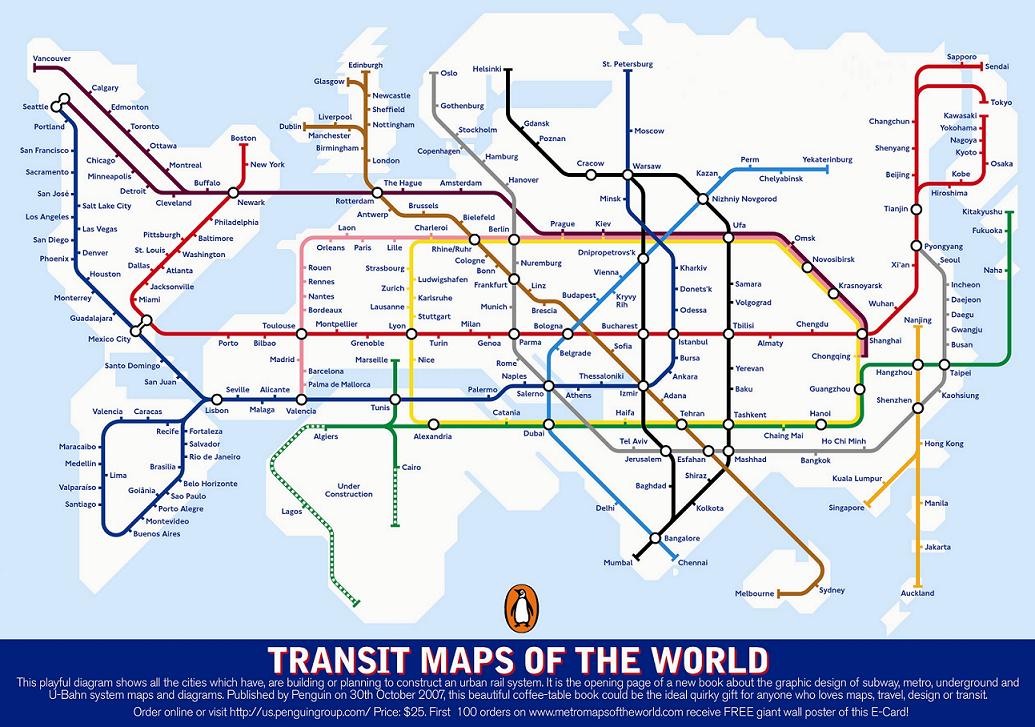
Penguin Transit Map of the World

Fun map. Readers at Strange Maps noted lots of geographical challenges in these train routes. Wouldn’t this make a great warm-up/bell-ringer, to have students find the geographical difficulties, errors and impossibilities?

And then there’s the book itself. The perfect gift for Dr. Jack Rhodes*, perhaps, or for Jim Lehrer, or someone else to whom transportation has been a great and grand pastime, as it has been for author Mark Ovenden.

Cover, Transit Maps of the World

Cool. Funny. Maybe instructive.

This would be a heckuva two-week study in geography, no? There are those great films on the construction of the New York subway system; there must be wonderful photos of the art in the Moscow system.

Or am I being too pedantic?

(Click thumbnail below for a larger view of the map.)

transit-map-of-world-ecardtransitmaps.jpg

Tip of the old scrub brush, and go visit, Strange Maps.

* Jack Rhodes was director of forensics at the University of Utah when I was an undergraduate there — my old debate coach. He was so familiar with bus and train schedules, as a hobbyist, that we frequently tried to stump him with questions about a passing train or bus we’d see driving around the nation. To my knowledge, he always got the name of the train right, and the bus’s scheduled next stop right. You sorta had to be there, but it was an amazing series of feats of memory.


Make ocean foam in your classroom!

December 2, 2007

I’m not sure exactly why, but my post on ocean foam in Australia continues to be one of the most popular.

Now you can make ocean foam in your classroom! I suppose this was planned for a science class, but why not use it in geography or world history?

Kid making ocean foam, at NY Hall of Science

Instructions here: What Molecules are in Ocean Foam? (repeated below the fold). This is one of several easy-to-do science experiments promoted at the Pfizer Foundation Discovery Lab at the New York Hall of Science.

Also see this explanation from New Scientist about how foam forms on ocean waves in the first place.

Go ahead. Cover the entire school with it.

Read the rest of this entry »


Why landlords don’t go green

December 2, 2007

I always have trouble explaining the value of environmentally-sound policies in non-AP economics. Especially as presented in the texts, environmentalism looks like an externally imposed cost. The possibility that conserving resources might also conserve money — or make money, as one corporation I advised did — doesn’t jump out of the supply-demand equations.

So I admire anyone who can explain these issues in serious economic terms.

Common Tragedies explains why landlords and tenants miss great opportunities to save money, in explaining why a third party sees an business opportunity in getting office and warehouse landlords to make their buildings greener. Basically, it is an asymmetry of information, or lack of information on the part of the owners and lessees.

Market failures:

The first paragraph indicates that there is a knowledge problem, or asymmetric information: building owners don’t have the same specialized knowledge that the energy auditors presumably do.

The second paragraph makes it sound like building owners don’t have as ready access to capital as the investors. Although it isn’t clear from the article whether this is the case here, many times in building management the use of energy is troubled by principal-agent problems. A classic example is a landlord and tenant: the landlord has access to capital but lacks a day-to-day incentive to save energy, while the tenant would like to save energy but lacks a long-term incentive to make capital investments to do so.

Common Tragedies looks like a good source for real-world examples of economic problems. Don’t miss the “Friday Beer Post,” ripe with warm-up exercise possiblities all it’s own ( “Assume 40 million U.S. families keep a second fridge in the garage . . .”)

( “Common Tragedies” is a play on the title of Garrett Hardin’s 1968 essay, “Tragedy of the Commons,” I suppose?)


Diogenes, call your office: Honest man returns $2 million

November 25, 2007

Over 100 million boys in the U.S. have repeated the Scout Law, “Trustworthy, Loyal, Helpful, Friendly, Courteous, Kind, Obedient, Cheerful, Thrifty, Brave, Clean, Reverent.”

Jerry Mika of Draper, Utah, lives it.

Jerry Mika, of Draper Utah, with $2 million check sent to him in error - Jeremy Harmon photo, SL Tribune

Mika returned a check for $2,245,342 that the State of Utah had sent him in error (see the Associated Press story in the Provo Daily Herald — photo, above, by Jeremy Harmon, Salt Lake Tribune).

Mika returned the check — a mistake that occurred when an employee entered a serial number, not an amount — to state finance offices Wednesday.

“Clearly we have an honest, honest citizen. I wish I could do something more than say thanks,” commerce department director Francine Giani said.

Can’t Utah grant him a kingdom — half of Millard County or something? A little duchy in Fillmore, Utah?

Mika, who runs the nonprofit Providence Foundation to help Nepalese sherpas, said he’s had great fun showing off the state’s mistake.

“Everybody looked at it, started giggling and asked why I wasn’t already in Switzerland,” he said.

He admits to being tempted to deposit the money and draw a bit interest before the state asked for its return.

“That money would have gone a long way,” he said.

When a company comptroller complained to me once that the $4 million in refunds to our company would mess up his quarterly bookkeeping because he expected the money in the next quarter, I volunteered to park the money in an account for him. He quickly came to his senses. At low, passbook interest rates, the $4 million would have paid $141/hour, 24 hours a day — more than $3,300 a day. A few weeks of that and you’re talkin’ big money.

Because the check was state-issued, cashing it would probably have been easy, despite the large amount, Giani said.

“It was a valid check,” said Rick Beckstead, the state accounting operation manager whose signature is stamped on the check.

How honest are you, Dear Reader? How much of a temptation would it have been to cash that check? (I’ll wager this man is a former Boy Scout; how much does that account for his actions?)

Perhaps you could reward Mr. Mika’s honesty with a contribution to the foundation he operates, The Providence Foundation.

Teachers: Can you see how to make this into a bell-ringer, warm-up exercise?

Read the rest of this entry »


Working out of poverty in Ethiopia

November 10, 2007

Joseph Stiglitz, from Kristof blog

Nobel-winner economist Joseph Stiglitz is in Ethiopia. His comments on the value and the problems of economic development in order to fight poverty could provide important background or discussion material for your economics unit on international economics, international trade, and world financing systems.


Ten minutes on Yellowstone NP in winter, with outdoor writer Tim Cahill

November 4, 2007

Yellowstone National Park is just a cool place. If you’re not using it for anything in your geography and U.S. history courses, you’re missing out.

Here’s a ten-minute video that the producers hope you’ll show far and wide to encourage television stations to pick up the series. It’s a ten-minute pilot for “Travelers’ Tales,” featuring outdoor writer Tim Cahill, a founder of Outside magazine, and photographer Tom Murphy.

Here are some of the points you might use in class:

  • Yellowstone in winter, especially the wildlife, like bison, elk and coyotes (all shown), and wolves (not shown)
  • Volcanic geology — Yellowstone is the world’s largest caldera, after all
  • Diversity of landforms in the U.S., or in the world. More than half the hot water features on the planet are in Yellowstone
  • Travel and adventure
  • What makes good writing (travel writing in this case)
  • Western geography
  • Development of the west, especially after the Lewis and Clark Expedition

The video features a lot of snow, elk, bison and coyotes, hot springs flowing into a river making swimming in January feasible, Mammoth Hot Springs and the travertine pools, and the cold northern desert of sagebrush and juniper.

Questions you might consider to turn this into a warm-up exercise (bell ringer):

Geography, not answered in the video (map or internet exercise):

  1. Yellowstone National Park covers parts of which three states?
  2. Yellowstone National Park is mostly located in which state?
  3. What is the most famous feature of Yellowstone National Park?
  4. Ashfall Beds State Park features ancient mammals killed by an eruption in the Yellowstone Caldera. Where is Ashfall Beds State Park?
  5. Thomas Moran played a key role in getting Congress to designate Yellowstone as a park. What did he do to help convince Congress to act?

Geography, answered in the video:

  1. What year was Yellowstone designated a National Park by Congress?
  2. What sort of volcanic feature is the entire Yellowstone area?
  3. The Yellowstone Caldera explodes catastrophically about every 600,000 years, according to some geologists. How long has it been since the last such catastrophic explosion?
  4. The wags say there are two seasons in Yellowstone, ______ and winter.
  5. What is a “hot pot?”

They come in threes: Stooges, branches of government

July 25, 2007

Is it true that a survey shows more teenagers know the names of the Three Stooges than know the three branches of government?

Justice Sandra O'Connor, by Matt York, AP

Former Supreme Court Justice Sandra O’Connor warned the National Governors Association that lack of education — ignorance — threatens justice in the U.S. According to the Detroit News:

O’Connor said growing disrespect for judges and erosion of independence of the judicial branch are partly due to students not learning much about American government in school.

“The key to maintaining our system lies in the education of our citizens,” O’Connor told the 19 governors who stuck around for the final day of the summer meeting.

She added in her 12-minute speech that surveys have shown fewer teenagers can identify the three branches of government than can name the Three Stooges.

“Now I enjoy Larry, Moe and Curly, but” it’s distressing that students don’t know the most basic concepts of government, said O’Connor, a Reagan appointee who retired last year after 24 years on the high court.

But, the Three Stooges? That’s almost too perfect a quote. It seems even more fantastic when one considers that the Three Stooges are not broadcast nearly so much as they were in the 1960s, 1970s and even 1980s. Where did O’Connor get that factoid?

  • Photo: Justice Sandra Day O’Connor by Matt York, Associated Press

Read the rest of this entry »