Washington, by Ron Chernow – great scholarship, a good read, significant light

October 28, 2010

Welcome, Book Tourists!  This is the last stop on a virtual book tour for Ron Chernow’s biography, Washington.

Virtual cocktails afterward, I hope.  Then sit down and read the book.

In a piece of great fortune for me, six years ago I spent a week at Mount Vernon, George Washington’s home in Virginia, through the good graces of the Bill of Rights Institute and the National Endowment for the Humanities, studying George Washington’s role in the creation of the U.S. Constitution.

Cover of Ron Chernow's book, Washington

Washington, by Ron Chernow. Penguin Press, 2010; 906 pages, $40.00

My academic interest leaned more toward James Madison’s role.  I thought then, and I still think, that Madison deserves a good, popular biography to complement the great recent work of others on the American Revolution and post-revolutionary organization of the nation.  We’ve had recent books by Edmund Morris, Ron Chernow, David McCullough, Joseph Ellis, Walter Isaacs  and others on Franklin, Jefferson, Adams, the “founding brothers,” Hamilton and Washington.   But for Garry Wills’ short and crabby assessment of Madison’s presidency, I am unaware of a good, popularly-readable Madison book.    As a professional journalist, as a civil libertarian, as a lawyer and occasional investigator, my studies of the era favored Franklin, Jefferson and Madison.  George Washington took the center stage, in my conception of events, while those working around him and in the wings frantically worked to put on the production that made America and allowed Washington to play the role of a hero, the face of the “Father of His Country” role — while the truth was that such success really did have many fathers.

For most history purposes in elementary and secondary schools, for most of the past 200 years, Washington is the easy center of attention, and I suspected a different story.  Jefferson wrote better, and more thoughtfully, did he not?  Madison’s legislative work in Virginia alone shone above Washington’s.  Washington had military experience, and he managed to cling on through the revolution — but his role as president was often more as a referee between the great creative forces driven by Hamilton, Madison and Jefferson.

What I hoped to find at the Mount Vernon meetings were sources to reveal the true role of James Madison — maybe I could get the story together and write it myself.

Simply put, I was not prepared to confront the genius of Washington, nor did I appreciate the depth of his involvement in so many areas where our common understanding of history simply gave Washington the title of hero, but without telling much of the backstory.

I looked for the evidence of Madison’s genius.  What I found was the overwhelming evidence of Washington’s genius, too.

Washington’s economic genius now displays proudly at Mount Vernon, with the reconstruction of his 16-sided barn for wheat thrashing, and with the reconstruction of the distillery which made the man who put down the Whiskey Rebellion, ironically, the leading distiller of whiskey in America shortly before his death.  I learned that Washington got out of tobacco a decade before the revolution, because he didn’t like the economics of sending a crop to agents he did not fully trust in London, for sales in markets whose prices he could not track, for sales to purchasers he could not see.  Instead, he took his business into wheat, a commodity much in demand since most other farmers locally grew tobacco.  Washington became a leading wheat producer, and grew richer as a result of that and other similar decisions of clear-thinking economics.  By the end of his life, he was producing a surplus of wheat — which excited his Scotland-born farm foreman, who had a recipe for whiskey.

Washington was not merely the frontman for the convention in Philadelphia in 1787.  It became clear to me that he was a driving force, introducing Madison to Hamilton, and mentoring both in their work to get the convention approved, and then to get the Constitution written and ratified.   Washington had financial interests in seeing a great, united nation out of the 13 colonies:  He had land in the Ohio River Valley to sell, to get rich, if only there were an authority to made transportation into the valley hospitable to settlers, and transportation out to let those settler farmers get rich from their produce.   Washington’s vision, I learned, was much greater than I had understood.

Ron Chernow’s thick biography of Alexander Hamilton excited historians in 2004.  As studies of Jefferson lead to studies of Madison, and vice-versa, so do studies of Hamilton inevitably lead to studies of Washington.  We are fortunate that Chernow wrote the thick biography of Washington, the first great study of the man for the 21st century.

Chernow’s Washington, A Life (2010, Penguin Press, 906 pages) is every bit the great study of Washington we need and can use.  My bias as a teacher of high school students leans toward usefulness in the classroom — a higher standard than most imagine, since, for a high school classroom, a book must be eminently readable as well as accurate and clear.

Chernow had me at the Prelude.  In a brisk five pages he tells the story of Gilbert Stuart, an often-economically-bereft artist who saw fortune in Washington’s election.  Stuart arranged to get the great man to sit for a portrait — Washington did not like it — but Stuart never finished Washington’s commission in Washington’s life.  Instead, Stuart used the portrait to copy, for others.    Stuart’s fortune came not from Washington, but from the vast throng of Washington admirers who would pay handsomely for an image of the man.  It’s a well-told story, and a great introduction to the lionizing of Washington and his image, the reality of the man who sat for the portrait, and the way history has treated the man and the myth.  [Courtesy of the New York Times, you may read the Prelude, here.]

Readers of McCullough’s 1776 know of some of Washington’s genius at war, and some of his attention to details of making things work right — whether it be the way latrines were dug so an army could relieve itself and avoid disease, or the the exact tints of the color of green paint applied to the massive dining room he had added to the house at Mount Vernon.  McCullough’s book is a taste, a sampling of the work Chernow has.  One may compare Chernow’s story-telling ability to McCullough’s, and Chernow may suffer a bit.  For Washington, the drama is so often in the details, however — and details we have, galore.

Is it too much detail?  For the life of another, it may be.  Not for Washington.  Chernow is able to make readable even the details.  One may open this book at any page, start with a paragraph, and learn something about Washington — most often, learning something one did not know precisely before.  Chernow relied on the massive project at the University of Virginia to publish all the papers of Washington, collected from various sources.  Washington had not been quite so assiduous as Jefferson in making copies of everything he wrote for posterity, though much he was an assiduous diarist and taker of notes.  No biographer before had the advantage of the catalogueing done at Virginia, nor perhaps of the scope of the material there.

For this reason alone, this book should be read.

Chernow’s portrait is painstaking.  What emerges in the end is a George Washington whose vanity would be quirky and irksome in others, but necessary to the building of the image history graces to him, as the standard-bearer for the founders of the nation, truly the Father of His Country.  The vanities quickly become clear as careful consideration by a man who understood, especially as president, that each move he made would be a precedent for those who would follow, he hoped.   One example:  Washington’s work on the bank bill of 1791, made possible as we know by the dinner at Jefferson’s where Hamilton and Madison struck the bargain that sited the District of Columbia on the Potomac, and set up the finances that would make the nation successful in business and international relations over the next 200 years.

Though he had sat through every session of the Constitutional Convention, Washington did not pretend to expertise in constitutional nuances — he nce wrote that he had ‘had as little to do with lawyers as any man of my age” — and engaged in much hand-wringing over the bank bill.  He would be forced to issue a black and white opinion that would alienate some, gratify others, and irrevocably shape the future government.  He called in Madison, supremely well versed in the Constitution, for a series of quiet, confidential talks.  “The constitutionality of the nation bank was a question on which his mind was greatly perplexed,” Madison would recall, noting that Washington was already biased in favor of a national bank and “a liberal construction of the national powers.”  On the other hand, Washington was shaken by uncompromising verdicts from Randolph and Jefferson and asked Madison, as a precaution, to draft a veto message for the bank bill.

When Washington turned to Hamilton, he made plain that, unless he could vanquish the arguments of Randolph and Jefferson, he planned to veto the bank bill, telling him that he wished to “be fully possessed of the arguments for and against the measure before I express any opinion of my own.”  By this point Washington knew the vigor of Hamilton’s mind and his extraordinary knack for legal argument.  In little more than a week, Hamilton, in a superhuman burst of energy, produced more than thirteen thousand words that buried his opponents beneath an avalanche of arguments.  His exegesis of the “necessary and proper” clause not only made way for a central bank but would enable the federal government to respond to emergencies throughout American history.  Hamilton interpreted the “necessary and proper” clause to mean that “every power vested in a government is in its nature sovereign and includes, by force of the term, a right to employ all the means requisite and fairly applicable to the ends of such power.”  In other words, the Constitution gave the federal government not only the powers explicitly enumerated but also a series of unstated or “implied powers” indispensable to attain those ends.  (circa page 649)

Two paragraphs, easily read without seriously taxing the vocabulary of an SAT-studying high school junior.  They clearly detail Washington’s care in analyzing all sides of an issue.  They reveal Washington’s ability to harness the good work of men of greatly differing viewpoints, to the enlightenment of Washington and benefit of the nation — which benefit likely would not have occurred had another man been in Washington’s place (can you imagine anyone else mediating Madison and Hamilton — and keeping them both as friends?).  Chernow gracefully slips from telling a good story to providing scholarly details (I have omitted footnotes here), but not in an eye-glazing fashion — weaving the scholarship into a story fantastic enough that it would not sell for fiction, as Twain warned because it does not stick to the probabilities.

A few years ago a student offered what I considered a great insight.  We were comparing the American Revolution to the French Revolution; naturally, considering the Reign of Terror and the rise of the dictatorial Emperor Napoleon, students wondered where the French went wrong, and where the Americans got luck and went right.  Israel Pena summed it up neatly:  “The French didn’t have George Washington.  Americans came out of their revolution with George Washington; France came out of their revolution with Napoleon.”

Napoleon would have done well to have studied George Washington.

It is reported that when King George III learned that Gen. George Washington had, at the end of the American Revolution and the peace treaty negotiations, resigned his commission to the Continental Congress, the news was met with disbelief.  Washington improbably held together a ragamuffin mob of an army, disciplined them into a fighting force, and through evasion tactics, inspiration and sheer luck, and great aid from the King of France and the French Navy, defeated Great Britain in a war where no one, probably  including Washington had thought it possible to do so.  Many Europeans expected Washington would assume the crown of America and have himself declared king.

Instead, following the story of his Roman hero, Cincinnatus, Washington declined the power, deferring to civilian and more democratic rule, sublimating military might and prowess to the greater powers of reason.  (Washington, following Cincinnatus again, bowed out after two terms in the presidency — the power of story and early education over the fate of a nation.)

King George said he didn’t believe the news.  “But if it is true, [Washington] is the greatest man who ever lived.”

Without unnecessary shine, Ron Chernow has written more than 800 pages of the brief for the case proving King George’s judgment.  In these times, when people claim to wish to follow Washington and the Constitution, we would do well to study what Washington said, wrote and did, and how he came to create the Constitution and the nation it frames.

Note: My review copy did not include an index. The book, Washington covers the man as an encyclopedia.  For the sake of high school teachers and researchers, I hope an index comes with the published text.

More, and resources; other reviews:

Other stops on the virtual book tour:


Quote of the moment: Lewis Carroll on Republican politics, climate skeptics, DDT advocates and creationism

October 26, 2010

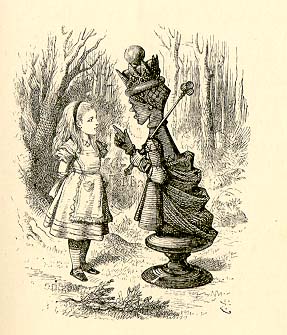
Alice and the Red Queen

Alice and the Red Queen – illustration by Sir John Tenniel

Alice laughed: “There’s no use trying,” she said; “one can’t believe impossible things.”

“I daresay you haven’t had much practice,” said the Queen. “When I was younger, I always did it for half an hour a day. Why, sometimes I’ve believed as many as six impossible things before breakfast.”

Charles Lutwidge Dodgson, writing under the name Lewis Carroll,
Alice in Wonderland, 1866

[Yes, the illustration is from Through the Looking Glass, 1871]


Literary mushrooms in Rockport, Maine

October 20, 2010

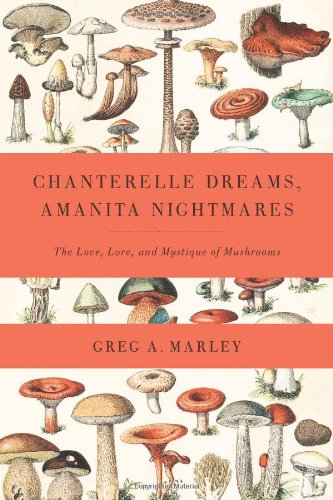
Greg Marley’s new book on mushrooms is out, and there is a launch party set for October 30, in Rockport, Maine.

Can you be there?

Greg’s book party:

Book Release Party and Mushroom Talk

Chanterelle Dreams, Amanita Nightmares, by Greg Marley
Cover of Chanterelle Dreams, Amanita Nightmares, by Greg Marley

Saturday, October 30 from 4-6:00 pm
at Farmers Fare on Route 90 in Rockport [Maine]
Light refreshments served and beverages available

Chanterelle Dreams, Amanita Nightmares: The Love, Lore and Mystique of Mushrooms

Welcome a new book by Greg Marley, celebrating the wonder and mystery of mushrooms. Enjoy a readable, captivating and informative collection of great mushroom stories. From world-class edibles (with recipes) to the most deadly, learn about the mushrooms in your neighborhood and how to invite them into your life, or even how to grow your own.


Hey, if you’re in the neighborhood, drop in.


Read a book for International Literacy Day, September 8

September 8, 2010

I almost never remember on time:  September 8 is International Literacy Day, a day designated by the United Nations to celebrate literacy.  International Literacy Day logo 2010

From the Dag Hammerskjöld Library:

Literacy is a cause for celebration since there are now close to four billion literate people in the world. However, literacy for all – children, youth and adults – is still an unaccomplished goal and an ever moving target. A combination of ambitious goals, insufficient and parallel efforts, inadequate resources and strategies, and continued underestimation of the magnitude and complexity of the task accounts for this unmet goal. Lessons learnt over recent decades show that meeting the goal of universal literacy calls not only for more effective efforts but also for renewed political will and for doing things differently at all levels – locally, nationally and internationally.

In its resolution A/RES/56/116, the General Assembly proclaimed the ten year period beginning 1 January 2003 the United Nations Literacy Decade. In resolution A/RES/57/166, the Assembly welcomed the International Plan of Action for the Decade and decided that Unesco should take a coordinating role in activities undertaken at the international level within the framework of the Decade.

Sources listed by the Dag Hammerskjöld Library:

Links to UN and UN System sites:

Unesco

United Nations

UNICEF

United Nations Development Programme

World Bank Group

Additional resources:

The additional resources links on this page are provided for information purposes only and do not necessarily represent an endorsement by the United Nations.

Asia-Pacific Literacy Database

Center for Literacy Studies

Commonwealth of Learning

Education International

International Reading Association
—   International Literacy Day

Literacy Online

Proliteracy Worldwide

SIL International – Literacy

StoryPlus Foundation

Even more resources:

It’s fascinating to me that activities on International Literacy Day seem to be noted in out-of-the-way U.S. newspapers, and even there not much.  Do Americans care about literacy, really?

I half expect the Texas State Board of Education to pass a resolution condeming literacy, since the UN worries about it.


Books dead? Barnes & Noble for sale

August 4, 2010

News of the death of books panicked some stockholders in Barnes & Noble.  Responding to those concerns, the company put itself up for sale (Wall Street Journal article).

The pen didn’t kill the book.  The typewriter didn’t kill the book.  The pencil didn’t kill the book.  Radio didn’t kill the book.  Movies didn’t kill the book.  Television didn’t kill the book.  Telephone didn’t kill the book.  Personal computers didn’t kill the book (much to the chagrin, perhaps, of the designers of the Apple Lisa — and if you remember that, and it’s coming with all the works of Shakespeare loaded on the harddrive, you’re older than your colleagues think you are).

In “A Dangling Conversation,” recorded in 1966 by Simon and Garfunkel, Paul Simon’s lyrics say, “We speak of things that matter/With words that must be said./’Can analysis be worthwhile?/Is the theatre really dead?'”  Some other questions are similarly and equally unstuck in time, and I think “Is the book dead?” is one of them.

So long as there are books, and readers who demand books, there is a need for a bookstore.  They may move to our libraries, but we’ll still need and want them.

Add to FacebookAdd to NewsvineAdd to DiggAdd to Del.icio.usAdd to StumbleuponAdd to RedditAdd to BlinklistAdd to TwitterAdd to TechnoratiAdd to Furl


Eleanor Knowles Laney

August 3, 2010

We’re all mourning the recent loss of our Aunt Ellie.  A more formidable foe at Scrabble cannot be imagined.

Eleanor wrote books, edited books, but mainly read books voraciously.   Her love of books is assumed happily by dozens of nieces and nephews, literally.

An appropriate remembrance I have not written — maybe cannot — but there is a good story about her life in the Ogden Standard-Examiner.


Typewriter of the moment: Ayn Rand

July 15, 2010

Ayn Rand at her typewriter

Ayn Rand at her typewriter

Ayn Rand at her typewriter, in an undated photo (do you know the date?).

Contrary to a popular myth, Rand did not take her name from the typewriter.  From the website of the Ayn Rand Institute:

What is the origin of “Rand”?

[From ARI’s monthly newsletter Impact, 06/2000]
“Ayn Rand, born Alisa Rosenbaum, based her professional first name on a Finnish one [see above]. The source of her last name, however, has been a mystery.

“Although its origin is still uncertain, recent biographical research by Drs. Allan Gotthelf and Michael Berliner has eliminated one possible source. An oft-repeated story claims that Ayn Rand took her last name from her Remington Rand typewriter while she was living in Chicago in 1926. This is false and we would like to put the error to rest.

“While still in Russia, c. 1925, and long before Remington-Rand typewriters were produced, Alisa Rosenbaum had adopted the name ‘Rand.’ Letters written in 1926 from Ayn Rand’s family in Russia already refer to the name ‘Rand.’ These were sent from Russia before Ayn Rand had communicated from America. The Remington and Rand companies did not merge until 1927; ‘Rand’ did not appear on their (or any) typewriters until the early 1930s.

“One lead to the actual source of the name comes from Ayn Rand herself. In 1936, she told the New York Evening Post that ‘Rand is an abbreviation of my Russian surname.’ Originally, we thought that this was a red herring in order to protect her family from the Soviet authorities.

“In 1997 Dr. Berliner noted an interesting coincidence when looking at a copy of Miss Rand’s 1924 university diploma. On the diploma was the name Rosenbaum in the Cyrillic alphabet:

The last three letters clearly look like the Roman letters ‘ayn.’ Richard Ralston then noticed that by covering those letters—and dropping out the second and fourth letters—what remains bears a strong resemblance to the Roman letters ‘Rand.’

“Although far from certain, it appears that the quote in the New York Evening Post may not have been a decoy.”

Her most often used typewriter was a Remington, I’ve read (but can’t find a reference now that I need it).  So far as I have found, however, typewriters were always manufactured under the “Remington” marque, and never as “Remington-Rand.”  Contrary to the implications from the ARI, Remington typewriters were produced from Reconstruction times (circa 1870), originally by the Remington Arms company.  Typewriter manufacturing was spun off from the arms producer in 1886; that company merged with Rand, forming Remington-Rand in 1927.


Quote of the moment: David Brooks, books vs. internet

July 12, 2010

Wisdom comes in keen insights:

These different cultures foster different types of learning. The great essayist Joseph Epstein once distinguished between being well informed, being hip and being cultivated. The Internet helps you become well informed — knowledgeable about current events, the latest controversies and important trends. The Internet also helps you become hip — to learn about what’s going on, as Epstein writes, “in those lively waters outside the boring mainstream.”

But the literary world is still better at helping you become cultivated, mastering significant things of lasting import. To learn these sorts of things, you have to defer to greater minds than your own. You have to take the time to immerse yourself in a great writer’s world. You have to respect the authority of the teacher.

Right now, the literary world is better at encouraging this kind of identity. The Internet culture may produce better conversationalists, but the literary culture still produces better students.

It’s better at distinguishing the important from the unimportant, and making the important more prestigious.

David Brooks, “The Medium is the Medium,” New York Times, July 9, 2010, page A23


Malaria tough to beat: Canadian Press review of The Fever

July 5, 2010

At Canadian Press, Carl Hartman reviewed The Fever: How Malaria Has Ruled Humankind for 500,000 Years, a dramatic work of non-fiction about malaria and mosquitoes by Sonia Shah (Sarah Crichton Books/Farrar, Straus and Giroux 2010).  Hartman concluded:

Evidence of mosquito resistance to the drug has been recently reported.

Shah is skeptical of a surge of private charity that emphasizes the use of mosquito nets following the decline of government-led anti-malaria programs in the 1990s. Acknowledging the contributions of Bill Gates and former Presidents George W. Bush and Bill Clinton, she lists Veto the ‘Squito, a youth-led charity; Nothing but Nets, an anti-malarial basketball charity; and World Swim Against Malaria. She quotes The New York Times as decrying “hip ways to show you care.”

Her own comment: “Just because something is simple doesn’t necessarily mean that people will do it.”

“(T)he schools, roads, clinics, secure housing and good governance that enable regular prevention and prompt treatment must be built,” she concludes. “Otherwise the cycle of depression and resurgence will begin anew; malaria will win, as it always has.”

Anti-environmentalists, anti-scientists, and other conservatives won’t like the book:  It says we can’t beat malaria cheaply by just spreading a lot of poison on Africa and Africans.

Especially if you’re doing the noble thing and vacationing in the Gulf of Mexico in Alabama, or Mississippi, or Louisiana, you may want to read this.  If you’re vacationing in the Hamptons, Martha’s Vinyard, or Cannes, buy several copies to pass out at dinner with your friends.

More:


Quote of the moment: Books as lighthouses in the dark sea of time

July 3, 2010

Jeffrey Robbins, a human character in the animated cartoon series,

Jeffrey Robbins, a human character in the animated cartoon series, “The Gargoyles”

The written word is all that stands between memory and oblivion. Without books as our anchors, we are cast adrift, neither teaching nor learning. They are windows on the past, mirrors on the present, and prisms reflecting all possible futures. Books are lighthouses, erected in the dark sea of time.

Jeffrey Robbins, a character in the cartoon series, “The Gargoyles”

Now available on Youtube.  To get the quote above, to go to 21:30 in this video:

Tip of the old scrub brush to James Kessler.


Quote of the moment: William Faulkner, on the passing of the past

June 24, 2010

William Faulkner, with dogs

William Faulkner, with dogs

The past is never dead.  It’s not even past.

— William Faulkner’s character Gavin Stevens, Requiem for a Nun, 1951

Tip of the old scrub brush to Michael Sacasas at The Frailest Thing

See also:


One hopes it’s a joke

June 9, 2010

TV is gooder then books is

Everyone is a critic

You need to read the sign.  Click the picture for a larger view.

Can anyone identify the location of this muffler shop?


Typewriter of the moment: Wallace Stegner

June 4, 2010

Wallace Stegner and his typewriter - KUED image

Wallace Stegner and his typewriter – KUED image (via What Fresh Hell Is This?)

Wallace Stegner's books, KUED imageI’ve lived with Wallace Stegner’s work since I first got to the University of Utah.  Stegner was the biographer of Bernard DeVoto, whose works I read in a couple of different classes.

More important, Stegner wrote about the West and wild spaces and places, and how to save them — and why they should be saved.

Salt Lake City’s and the University of Utah’s KUED produced a program on Stegner in 2009 — he graduated from and taught at Utah — a film that wasn’t broadcast on KERA here in Dallas, so far as I can find..

In conjunction with the University of Utah, KUED is honoring alumni Wallace Stegner – the “Dean” of western writers. WALLACE STEGNER, a biographical film portrait, celebrates the 2009 centennial of his birth. Wallace Stegner was an acclaimed writer, conservationist, and teacher. He became one of America’s greatest writers. His books include the Pulitzer Prize-winning “Angle of Repose” and “Beyond the Hundredth Meridian.” His “The Wilderness Letter” became the conscience of the conservation movement. Wallace Stegner mentored a generation’s greatest writers including Ken Kesey, Edward Abbey, and Larry McMurtry. Former Supreme Court Justice Sandra Day O’Connor was a student.

It’s difficult to tell from the photo, but his typewriter here looks a lot like a Royal.

Have you seen the film?

More:


Towel Day 2010

May 25, 2010

After the train wreck in the Star Chamber of the Texas State Soviet of Education last week, I’m glad to have my towel.

How big a towel would it take to fix the McLeroy Massacre?

Remember the words of Douglas Adams, wherever he is:  “Don’t panic.”

More:

Towel Day display, 2010

Towel Day display, 2010 - from http://wxpython.org/blog/about-42/

So long!  And, thanks for the fish!


The rear of the horse that measles rode in on

May 23, 2010

Why would people fail to inoculate their kids against measles, and thereby contribute to deadly epidemics?

There was this guy in Britain, Andrew Wakefield, who published a study suggesting a link between measles vaccines and autism.  But it turned out his research didn’t support that claim.  Then it turned out he was under contract to produce a paper that made that claim regardless the science, for a lawsuit.

Darryl Cunningham's graphic account of measles vaccine hysteria, one page

A page from Darryl Cunningham's graphic account of measles vaccine hysteria, "The Facts in the Case of Dr. Andrew Wakefield." TallGuyWrites (Darryl Cunningham)

Darryl Cunningham created a concise, 15-page graphic accounting of the story of how the misdeeds of one physician led to a world-wide, child-killing panic.  If you do not know the story, go read it.  You should be troubled by the story it tells.  Be sure to read it through.  Cunningham is thorough in his debunking of the hysteria the anti-vaxxers promote, and you should know it all.

Darryl Cunningham's graphic story, "The Facts in the Case of Dr. Andrew Wakefield"

Another page from Darryl Cunningham's graphic story, "The Facts in the Case of Dr. Andrew Wakefield" about the motivations behind the hysteria.

Then send a copy to Jenny McCarthy, or anyone else who carries the torch of ignorance-based hysteria against vaccines and in favor of disease.

Dr. Wakefield’s original paper was retracted by the publisher — it’s no longer considered valid science.  It’s a hoax.  No subsequent research confirmed any links to autism.  Serious, large-scale follow-up studies revealed no connection whatsoever between measles vaccine and autism.

Measles is a nasty disease, tough to eradicate, and working hard to come back and get your children and grandchildren.  Don’t be suckered.

Andrew Wakefield created a hoax.  Those who rely on his study rely on bogus science, voodoo science.  History tells us that, if we stop the fight against measles, people will die.

Would you contribute to publishing this comic for distribution in pediatrician’s waiting rooms?

More:

Tip of the old scrub brush to JD 2718.