June 15: Magna Carta anniversary, #797

June 15, 2012

Today, June 15, 2012, is the 797th anniversary of the signing of the Magna Carta.  The document laid a foundation for freedom, almost 800 years ago, upon which we stand today.

Runnymede, Magna Carta Isle, photo by Wyrdlight, Antony McCallum, 2008 (Wikimedia)

What event critical to western history and the development of the democratic republic in the U.S. happened here in 1215?

A teacher might use some of these photos explaining the steps to the Constitution, in English law and the heritage of U.S. laws. Other than the Magna Carta, all the events of Runnymede get overlooked in American studies of history. Antony McCallum, working under the name Wyrdlight, took these stunning shots of this historic meadow. (He photographs stuff for studies of history, it appears.)

Maybe it’s a geography story.

View of Runnymede Meadow from Engham Village -- Wyrdlight photo through Wikimedia

View of Runnymede Meadow from Engham Village — Wyrdlight photo through Wikimedia

Several monuments to different events of the past millennium populate the site. The American Bar Association dedicated a memorial to the Magna Carta there — a small thing open to the air, but with a beautiful ceiling that is probably worth the trip to see it once you get to England.

Wikipedia explains briefly, with a note that the ABA plans to meet there again in 2015, the 800th anniversary of the Great Charter:

Magna Carta Memorial


The Magna Carta Memorial & view towards the ‘medes’


Engraved stone recalling the 1985 ABA visit

Situated in a grassed enclosure on the lower slopes of Cooper’s Hill, this memorial is of a domed classical style, containing a pillar of English granite on which is inscribed “To commemorate Magna Carta, symbol of Freedom Under Law”. The memorial was created by the American Bar Association to a design by Sir Edward Maufe R.A., and was unveiled on 18 July 1957 at a ceremony attended by American and English lawyers.[5]

Since 1957 representatives of the ABA have visited and rededicated the Memorial renewing pledges to the Great Charter. In 1971 and 1985 commemorative stones were placed on the Memorial plinth. In July 2000 the ABA came:

to celebrate Magna Carta, foundation of the rule of law for ages past and for the new millennium.

In 2007 on its 50th anniversary the ABA again visited Runnymede and during the convention installed as President Charles Rhyne who devised Law Day which seeks in the USA an annual reaffirmation of faith in the forces of law for peace.

The ABA will be meeting at Runnymede in 2015 on the 800th anniversary of the sealing of the original charter.

The Magna Carta Memorial is administered by the Magna Carta Trust, which is chaired by the Master of the Rolls.[10]

In 2008, flood lights were installed to light the memorial at night, but due to vandalism they now lie smashed.

I’ll wager the lights get fixed before 2015.

Detail of the Magna Carta monument at Runnymed...

Detail of ceiling of the Magna Carta Memorial detailing play of light, and star pattern, Runnymede – Wikimedia image

More, resources:

This is mostly an encore post.


Texas primary TODAY! Voter ID law not applied

May 29, 2012

Registered voter in Texas?   Remember to vote today in the Texas primary.  Twice delayed due to the shenanigans on biased redistricting by the Republican Lege, we finally get going on voting — after the precinct and Senate district political conventions have already occurred (just two weeks from the Texas Democratic State Convention).

texas our texas

Flags fly at the Texas Capitol; fly your flags today for election day (Photo credit: jmtimages)

Happy to see the Texas Democratic Party sending out notices that voters won’t be turned away from the polls for identification issues. Texas’s Jim Crow Voter Identification Hurdle Law has been stayed in litigation separate from the redistricting law suit.  It’s a clear effort to deflate the voting discouragement campaign of State Attorney General Greg Abbott, Gov. Rick Perry, and the Republicans of the Texas Lege.

Earlier letter from the Texas Democrats:

TDP Banner

Dear Ed,

On Monday, the polls will open [TODAY] for early voting for the May 29th Democratic Primary Election. We’ll be selecting the Democratic nominees who will lead the charge towards taking back our state in 2012.

Here’s how you can make your voice heard:

Confirm that you’re registered to vote. You can verify your registration on the Secretary of State’s website.

Find your early voting location by contacting your county elections office. Early voting for the Primary Election runs from Monday, May 14th through Friday, May 25th.

Request to have a ballot mailed to you. Your application for a mail ballot must be received no later than Tuesday, May 22nd.

Use the same documents that you’ve used in the past to vote. No photo ID is required! The photo voter id legislation is not in effect for this election. All you need is:

  • Your voter registration card;
  • A driver’s license or personal identification card issued to you by Texas or another state (even if the license or card has expired);
  • A form of identification that contains your photograph and establishes your identity;
  • A birth certificate or other document confirming birth that is admissible in a court of law and establishes your identity;
  • Your United States citizenship papers;
  • Your United States passport;
  • Official mail addressed to you by a governmental entity; or
  • A copy of a current utility bill, bank statement, government check, paycheck, or other government document that shows your name and address.

Want to know who’s on the ballot? A list of the Democratic candidates is available on our website.

Want to know more about voting in Texas? Visit VoteTexas.gov.

Want to help elect Democrats in your county? Have questions about local races? Contact your Democratic County Chair.

Sincerely,

Boyd L. Richie

Boyd L. Richie
Chairman
Texas Democratic Party

Did the Republicans inform their voters of the ID requirements, or do they want to discourage even Republican voters?   They keep booting me off their lists. Anybody got a similar letter from them, especially one showing how the Texas Voter Identification law does not apply to this primary election?

_____________

* The elections were delayed by federal court orders. Texas is a place that historically discriminated against minority voters, and so under the 1965 Voting Rights Act, reapportionments by the legislature must be approved by the Justice Department or a federal court as complying with the nondiscrimination laws. AG Abbott tried to do an end run around Justice, suing for approval as a first step. As part of its War on Democracy, the Texas Lege wrote a spectacularly Gerrymandered reapportionment plan, depriving Texas Hispanics from new representation despite the dramatic increase in their populations. Consequently the federal courts balked at quick approval. Instead, they asked for more information.

In the delay, the Washington courts ordered the federal court in San Antonio to draw up a more fair plan, giving at least three new seats to districts where historically minority voters hold broad sway.

Litigation against the Texas Jim Crow Voter Identification law is separate.

ALEC CROW - 21st Century Disenfranchisement

ALEC CROW – 21st Century Disenfranchisement (Photo credit: DonkeyHotey) — not in effect for today’s Texas primary elections


Still looking? Again, here’s how to find “separation of church and state” in the Constitution

May 16, 2012

It’s an election year. People get crazy. I’ve already heard from a dozen wacko candidates that “separation of church and state isn’t in the Constitution.”

Yes it is. Separation of church and state resides in the Constitution.  Here’s a post from 2010 to help them find it.

_____________

It’s been at least 20 years since I first heard the old canard of an argument that “there’s no separation of church and state in the Constitution.” I think I first heard it attributed to David Barton, which would make sense, since he doesn’t understand the Constitution, but neither does he fear sharing his misunderstandings.

It was an incorrect statement then, and it’s been incorrect since September 1787. Separation of state and church is woven throughout the Constitution, part of the warp and woof.

Recently, latter-day Constitution ignorami repeat the old canard.

Toles cartoon on dangers of marrying church and state

Toles cartoon on dangers of marrying church and state

I was surprised to discover I’ve not posted this before on this blog. So here’s a slightly-edited version of a response I gave many months ago to someone who made that silly claim, a basic description that I developed years ago to explain the issue, in speeches by members of the Senate Subcommittee on the Constitution:

Separation of church and state: It’s in the Constitution.

I don’t play a constitutional lawyer on television, I am one*, but it seems to me anyone can read the Constitution and see. Especially if one understands that the Constitution sets up a limited government, that is, as Madison described, one that can do only what is delegated to it. The Constitution is a short document.

Where should you look to find separation of church and state in the Constitution?

First, look in the Preamble. It is made clear that the document is a compact between citizens: “We the people . . . do ordain and establish this Constitution . . .” The usual role of God ordaining (in some western nations) is altered, intentionally. It is not God who establishes this government, but you and I, together. From the first words of the Constitution, there is separation of church and state. The power of our government grows out of a secular compact between you and me, and 308 million other residents of the nation. We have a government created by consent of the governed, as the Declaration of Independence said a just government should be. It is not a government created by the will of God directly (though some, including the Mormons, argue it is divinely inspired). We have no divine right kings or other monarchs. The government is not the grantor of rights from God, but is instead the protector of the rights of citizens, whatever the source of the rights.

Second, look in the key parts of the document itself. Start with Article 1. The legislative branch is given no role in religion; neither is any religion given any role in the legislature. In Article 2, the executive branch gets no role in religion, and religion gets no role in the executive branch. In Article 3, the judicial branch gets no role in religion, and religion gets no role in the judicial branch. In Article 4, the people get a guarantee of a republican form of government in the states, but the states get no role in religion, and religion gets no role in state government. This is, by design of the founders, a perfect separation of church and state.

Third, in Article 6, the convention wrote the hard and fast rule that no religious test can be used for any office in government, federal, state or local, means that no official will have a formal, governmental role in religion, and no religion can insist on a role in any official’s duties.

Fourth, Amendment 1 closes the door to weasling around it: Congress is prohibited from even considering any legislation that might grant a new bureaucracy or a new power to get around the other bans on state and church marriage, plus the peoples’ rights in religion are enumerated.

Fifth: In 1801 the Baptists (!) in Danbury, Connecticut, grew concerned that Connecticut would act to infringe on their church services, or teachings, or right to exist. So they wrote to President Jefferson. Jefferson responded with an official declaration of government policy on what the First Amendment and Constitution mean in such cases. Jefferson carefully constructed the form of the device as well as the content with his Attorney General, Levi Lincoln, to be sure that it would state what the law was. This “letter” is the proclamation. It’s an official statement of the U.S. government, collected in the president’s official papers and not in his personal papers. Make no mistake: Jefferson’s letter to the Danbury Baptists was an official act, an official statement of the law of the United States. Jefferson intended it to assuage the Baptists in Danbury, to inform and warn the Connecticut legislatures, and to be a touchstone to which future Americans could turn for information. It was only fitting and proper for the Supreme Court to use the letter in this capacity as it has done several times.

Sixth: The phrase, “separation of church and state” dates back another 100 years and more, to the founding of Rhode Island. It is the religion/state facet of the idea of government by consent of the governed without interference from religious entities, expressed so well in the Mayflower Compact, in the first paragraphs of the Declaration of Independence, and carried through in the Constitution (see especially the Preamble, above).

No, the phrase “separation of church and state” never appears in the Constitution. The principles of separation of church and state are part of the warp and woof, and history, of the document, however. The law is clear, the law was clear, the law has always been clear, and denying the Constitution says what it says won’t change it or make it go away. You could just as easily point out that the word “democracy” or “democratic” never appears in the document, though we rely on democratic mechanisms and institutions to make it work. You could point out that nowhere does it say that our national government is a republic, though it is. The Constitution doesn’t say “checks and balances,” nor does it say “federalism.” The Constitution doesn’t mention political parties. The Constitution was written before the advent of broadcasting, and makes no mention of radio nor television, nor of the internet — but the First Amendment freedoms apply there anyway. The Constitution doesn’t say “privacy,” though it protects your right to privacy.

You won’t find “separation of church and state” as a phrase in the Constitution. If you read it, you’ll find that the concept of the separation of state and church can’t be taken out of the document, either — it’s a fundamental principle of our government.

More, and Resources:

__________

* A non-practicing one. We have way more than 50,000 lawyers in Texas. That’s enough trouble for one lifetime. Someone has to look out for the welfare of the world.


Texas: No voter identification required for May 29 primary

May 13, 2012

Early voting for the twice-delayed* Texas primary elections opens this week.  The election is set for May 29.

Happy to see the Texas Democratic Party sending out notices that voters won’t be turned away from the polls.  It’s a clear effort to deflate the voting discouragement campaign of State Attorney General Greg Abbott, Gov. Rick Perry, and the Republicans of the Texas Lege.

Letter from the Texas Democrats:

TDP Banner

Dear Ed,

On Monday, the polls will open for early voting for the May 29th Democratic Primary Election. We’ll be selecting the Democratic nominees who will lead the charge towards taking back our state in 2012.

Here’s how you can make your voice heard:

Confirm that you’re registered to vote.  You can verify your registration on the Secretary of State’s website.

Find your early voting location by contacting your county elections office.  Early voting for the Primary Election runs from Monday, May 14th through Friday, May 25th.

Request to have a ballot mailed to you.  Your application for a mail ballot must be received no later than Tuesday, May 22nd.

Use the same documents that you’ve used in the past to vote. No photo ID is required! The photo voter id legislation is not in effect for this election. All you need is:

  • Your voter registration card;
  • A driver’s license or personal identification card issued to you by Texas or another state (even if the license or card has expired);
  • A form of identification that contains your photograph and establishes your identity;
  • A birth certificate or other document confirming birth that is admissible in a court of law and establishes your identity;
  • Your United States citizenship papers;
  • Your United States passport;
  • Official mail addressed to you by a governmental entity; or
  • A copy of a current utility bill, bank statement, government check, paycheck, or other government document that shows your name and address.

Want to know who’s on the ballot? A list of the Democratic candidates is available on our website.

Want to know more about voting in Texas? Visit VoteTexas.gov.

Want to help elect Democrats in your county? Have questions about local races? Contact your Democratic County Chair.

Sincerely,

Boyd L. Richie

Boyd L. Richie
Chairman
Texas Democratic Party

I’d be interested to see that the Republican Party in Texas is doing something similar. They keep booting me off their lists. Anybody got a similar letter from them, especially one showing how the Texas Voter Identification law does not apply to this primary election?

_____________

*  The elections were delayed by federal court orders.  Texas is a place that historically discriminated against minority voters, and so under the 1965 Voting Rights Act, reapportionments by the legislature must be approved by the Justice Department or a federal court as complying with the nondiscrimination laws.  AG Abbott tried to do an end run around Justice, suing for approval as a first step.  As part of its War on Democracy, the Texas Lege wrote a spectacularly Gerrymandered reapportionment plan, depriving Texas Hispanics from new representation despite the dramatic increase in their populations.  Consequently the federal courts balked at quick approval.  Instead, they asked for more information.  In the delay, the Washington courts ordered the federal court in San Antonio to draw up a more fair plan, giving at least three new seats to districts where Hispanics hold broad sway.

Litigation against the Texas Jim Crow Voter Identification law is separate.


51 years they’ve pursued this woman who marched with Dr. King . . .

May 6, 2012

. . . and now they’ve figured out how to keep her from voting:  A “voter I.D. law” in Pennsylvania.  Viviette Applewhite is suing to keep her right to vote.

From the website of ACLU of Pennsylvania:

On May 1, 2012, the ACLU of Pennsylvania, the Advancement Project, the Public Interest Law Center of Philadelphia (PILCOP), and the Washington, DC law firm of Arnold & Porter LLP filed a lawsuit in the Commonwealth Court of Pennsylvania to overturn the voter ID law passed by the General Assembly in March 2012.

The lawsuit alleges that the state’s voter photo ID law violates the Pennsylvania Constitution by depriving citizens of their most fundamental constitutional right – the right to vote. The plaintiffs are asking the Commonwealth Court to issue an injunction blocking enforcement of the law before November’s election. If the law is not overturned, most of the plaintiffs will be unable to cast ballots in the fall, despite the fact that many of them have voted regularly for decades.

Voter identification laws passed through several legislatures in the past half decade frequently cause more voters to lose their voting privileges than frauds prevented.  While there is no evidence of significant voter fraud caused by someone stealing another’s identity to vote — the only voter fraud voter identification laws is aimed at — there are thousands, or tens of thousands of people in every state where these laws are passed who cannot get suitable identification papers to vote.

Although these citizens often are long-time voters, good citizen parents who have raised outstanding children and performed their civic duties thr0ughout their lives, they often lack the technically picky identity documents to get a voter identification card.  Their stories are not unique, but surprisingly common, shared by millions of Americans:

  • Many were born outside hospitals, and lack birth certificates.  Though no one doubts their life history, the voter laws do not allow usual forms of identification to get a voter card.  These people can get credit cards, can buy and sell property, and can cash checks in their towns.  But the identification used to secure financial transactions do not satisfy the voter identification laws.
  • A significant portion of these people are simply elderly, and gave up driving.  Consequently they lack a current drivers license.  Clearly they cannot get a new drivers license, but they also cannot get a voter identification card without great effort, sometimes without great cost, and almost always, in time to vote in this year’s elections.
  • In Texas, the now-stayed-by-a-federal-court voter ID law allows a handgun license to be used as identification, but not a photo identification from a state college or university.  Among other arguments the courts found convincing in staying the law, in 81 of Texas’s 254 counties, there is no office of any state agency that can issue an accepted voter identification card.  In other words, in a third of Texas counties, it’s impossible to get a valid voter identification card if you don’t already have one.
  • (Updated; see comments) Young people — students, soldiers at basic training, high school graduates still living at home to save money while working to make money — frequently cannot produce the documentation the voter identification laws ask for, like a utility bill in their name.  See the story at Radula, where Dorid discusses one state’s rejecting another state’s birth certificates (as if we hadn’t known that would happen . . .) and other problems; young voters don’t vote as they should, and now we know many who want to vote, will probably be denied.

Meanwhile, from time to time a real case of voter fraud shows up.  I have yet to find one that could have been prevented by voter identification laws.

How many of the voter identification laws were drafted in the smoke-filled, alcohol-laced backrooms of ALEC conferences?

Resources: 

More (with help from Zemanta):


“And yet, here you stand.” Give Pat Bagley a hug, and a Pulitzer

May 1, 2012

Pat Bagley cartoon from the Salt Lake Tribune, May 2, 2012:

Pat Bagley cartoon, Salt Lake Tribune, May 2, 2012

Pat Bagley cartoon, Salt Lake Tribune, May 2, 2012

Wow.
More:


Film in a high school class: Atticus Finch as a role model

April 30, 2012

This year is the 50th anniversary of the release of the film “To Kill a Mockingbird.”

In the American Film Institute‘s polling to find the greatest hero in the movies, Atticus Finch finished first.  Interesting that a class from Arlington, Virginia’s Washington-Lee High School found one of the best venues anywhere to watch the film to study it.

TO KILL A MOCKINGBIRD ranks 25th on AFI’s 100 Years…100 Movies list of greatest American films, and AFI named Atticus Finch the greatest hero in this history of American film when it announced its AFI’s 100 Years…100 Heroes and Villains list in 2003. AFI also recognized the film for its #1 ranking of Best Courtroom Dramas in AFI’s 10 Top 10 list and its #2 ranking on AFI’s 100 Years…100 Cheers America’s Most Inspiring Films list, just behind IT’S A WONDERFUL LIFE. The film, which premiered in Los Angeles on Christmas day in 1962 and opened wide in 1963, was directed by Robert Mulligan and produced by Alan J. Pakula.  [Screenplay was by the great Texas playwright Horton Foote.]

From the White House YouTube site:

President Obama hosted a film screening of To Kill a Mockingbird in the Family Theater at The White House to commemorate its 50th anniversary with guests including local students from Washington-Lee High School, Mary Badham Wilt, the actress who played Scout, and Veronique Peck, widow of Gregory Peck who played Atticus Finch. The President also acknowledged the American Film Institute for their commitment to the fine arts and NBC Universal and USA Network for their efforts to commemorate this important film.

What venues could one use in Dallas?  Check with the Sixth Floor Museum, to see if their 7th floor facility is available.  Check to see if there is a room available at the Earl Cabell Federal Building, or the George L. Allen Court building.  The old, renovated Texas Theater on Jefferson Boulevard might cut a deal.  Surely there is a room big enough at the Belo Mansion, the home of the Dallas Bar Association — if it’s not totally booked up for other events.  With the Horton Foote connection, perhaps the Wyly Theater could find a rehearsal room to throw up a screen. Odds are pretty good you could get an attorney to come talk law and civil rights at any of those locations.

How could a teacher sneak a viewing of this movie into the curriculum?  Isn’t it tragic that we have to sneak in great classics?

More: 


Paying homage to civil rights pioneers: Remembering Rosa Parks’ courage

April 20, 2012

President Obama, sitting on the bus on which Rosa Parks was arrested in 1955 - White House photo by Pete Souza

President Obama, sitting on the bus on which Rosa Parks was arrested in 1955 - White House photo by Pete Souza.

In USA Today (via The Detroit Free Press), reporter David Jackson described the event:

When President Barack Obama went to the Henry Ford Museum in Dearborn on Wednesday, he got to visit one of the shrines of the civil rights movement that helped lead to the nation’s first African-American president.

Rosa Parks’ bus.

Obama described a moving scene to supporters later that morning.

“I actually had the chance to sit in Rosa Parks’ bus,” Obama said. “I just sat there for a moment and pondered the courage and tenacity that is part of our very recent history, but is also a part of that long line of folks — sometimes nameless, oftentimes didn’t make the history books — but who constantly insisted on their dignity, their stake in the American Dream.”

Parks’ refusal to move to the back of that bus on Dec. 1, 1955, in Montgomery, Ala., led to her arrest, which led to a bus boycott by African Americans, which led to the creation of the Montgomery Improvement Association, which led to the elevation of a young minister named Martin Luther King Jr.

Eventually came the Civil Rights Act of 1964 and the Voting Rights Act of 1965, and an ongoing sea change in American race relations that includes the 2008 election of Barack Obama.

Said Obama at another stop: “It takes ordinary citizens to bring about change, who are committed to keep fighting and keep pushing, and keep inching this country closer to our highest ideals.”

More, and Resources:


Can you help Ruthelle to keep her right to vote?

April 10, 2012

An 84-year-old Wisconsin woman, told she can’t vote for the first time in 75 years, because she lacks an “appropriate” birth certificate, and perhaps she’s been spelling her name differently from how Wisconsin wants her to spell it, for more than 80 years.

Meanwhile, has anyone ever found any voter fraud that I.D. can stop?

Since voting is a civil liberty, the ACLU is working to keep Ruthelle voting.

Volunteer to help, here.


Alfre Woodard channels Sojourner Truth, “Ain’t I a woman?”

March 9, 2012

We should be grateful for Sojourner Truth, we should be grateful for the women’s suffrage movement, we should be grateful for Howard Zinn‘s preservation and telling of history, and we can be grateful for inspired readings of original works by great performers like Alfre Woodard.

Alfre Woodard reads “Ain’t I a Woman?“, a speech delivered by abolitionist Sojourner Truth at the Women’s Convention in 1851. Part of a reading from Voices of A People’s History of the United States (Howard Zinn and Anthony Arnove,)February 1, 2007 at All Saints Church in Pasadena, CA.

In my year at the University of Arizona I had the joy of working with David Williams’ speech department students in readers theatre.  We had a couple of performers whose readings of Sojourner Truth stirred audiences greatly (Martha Isom, where are you?).  This is a piece one does best to absorb from oral performance.  It is a piece that one should hear repeatedly, to understand.

Woodard nails this one well, I think.

Ms. Truth’s speech needs careful reflection.  She was not just speaking for women’s rights, but was lecturing the suffragists as well on their having overlooked the plight of women of color and working women, and women in poverty.  She’s talking to you, and to me, and asking us to confront our stereotypes of what women are and what women do, to recognize that women are humans, deserving of full respect for that reason alone.

Tip of the old scrub brush to the folks at MoveOn.org.

More, resources:


NAACP, 103 years old today

February 12, 2012

The national Association for the Advancement of Colored People (NAACP) rose up to fight racism on February 12, 1909, the 100th anniversary of the birth of Abraham Lincoln.

For the NAACP, today is Founders Day. I get e-mail:

NAACP

Dear Ed,

Today marks the 103rd birthday of the NAACP.

For more than a century, Americans have relied on the NAACP to right the nation’s injustices, often against seemingly impossible odds.  From ending the barbaric practice of lynching to dismantling segregation to fighting for equality of opportunity for all Americans, the NAACP’s first century changed the world. And our second will be no different..

Founders’ Day has always been a time for reflection and renewal for the NAACP family. We are grounded in our past and focused firmly on the future.

Please join us Wednesday, February 15 for an historic phone briefing hosted by the leadership of the NAACP, as we discuss the next century of NAACP priorities. The call starts at 8:00 PM Eastern/5:00 PM Pacific, and space is limited to the first 5,000 callers. Click on the link below to RSVP, and we will send you call-in details on Wednesday afternoon:

http://www.naacp.org/phone-briefing

This will be a special event— a shared moment of fellowship with thousands of other members of the NAACP family as we recommit to changing the world, again.  Click on the link to RSVP.

http://www.naacp.org/phone-briefing

Sincerely,

Roslyn M. Brock, Chairman, and
Benjamin Todd Jealous, President & CEO
NAACP.

PS:  Founders’ Day is an excellent time to Join or renew your NAACP membership. Click here to go to our online Membership center:  www.naacp.org/join.

Find the NAACP on Facebook Follow the NAACP on Twitter

Donate | Join the NAACP | Blog | Take Action | Find Your Local Unit | Unsubscribe


NAACP petition to Hollywood movie makers for Black History Month

February 11, 2012

Good idea, I think:

NAACP

Ed,

Growing up, I remember marveling at the stories about the bravery, courage, and patriotism demonstrated by the Tuskegee Airmen.

I was happy to see them gain renewed recognition through the recent film Red Tails. Their story of persevering through a pervasive culture of prejudice to become American heroes is one we should tell more often.

But as we celebrate Black History Month and honor the African-American heroes in our lives, we must remember that films celebrating the contributions of people of color remain few and far between. That’s why I’m asking you to sign onto a letter asking movie studios to bring more of these stories to the silver screen.

Sign our letter encouraging Hollywood to create more films like Red Tails, celebrating the contributions of African-Americans throughout our history:

http://action.naacp.org/letter-to-studio

The facts about the production of films showing African-American heritage, and the employment of African-Americans in Hollywood, are alarming.

In 2009, Screen Actors Guild President Ken Howard said, “the diverse and multicultural world we live in today is still not accurately reflected in the portrayals we see on the screen.” And last year, the Writers Guild of America released a study showing the minority share of employment in feature films had fallen to 5%, its lowest level in ten years.

We must reverse these trends. With your help, we can send a message to the Hollywood studios that the public wants to see more films on the contributions of diverse communities, written, directed, and produced by filmmakers from all walks of life.

Make no mistake — we have come a long way since the Tuskegee Airmen flew in the face of a society that thought them incapable of achieving the feats of bravery they regularly demonstrated. Now we must ensure their legacy will be passed on to future generations.

Join us in telling Hollywood we need more films celebrating African-American culture and contributions:

http://action.naacp.org/letter-to-studio

After you sign the letter, I hope you’ll go see Red Tails in the theaters this weekend. It’s a great way to continue celebrating Black History Month. And if you have already seen it, see it again!

Thank you,

Vic Bulluck

Executive Director
NAACP Hollywood Bureau

P.S. Join us on February 17th as we honor those who have achieved milestones in the fields of social justice and art. The 43rd Annual NAACP Image Awards will air live on NBC at 8:00 p.m. (7:00 p.m. central).

Have you seen “Red Tails” yet?  What did you think?

(Oy.  Have you heard the controversy in Dallas about taking classes to see it?)

More:


Quote of the moment: Una Mulzac, ‘learn, teach’

February 11, 2012

From her obituary in the New York Times, Sunday February 5, 2012:

Ms. Mulzac’s profession was selling books at Liberation Bookstore, a Harlem landmark that for four decades specialized in materials promoting black identity and black power.  On one side of the front door, a sign declared,

“If you don’t know, learn.”

On the other:

“If you know, teach.”

Ms. Mulzac died at a hospital in Queens on January 21, at the age of 88.

Sign of Liberation Bookstore, Harlem, founded by Una Mulzac (1923-2012)

Una Mulzac at the door of Liberation Bookstore, in Harlem.  Harlem World image

Una Mulzac at the door of Liberation Bookstore, in Harlem. Harlem World image

More:


“I’ll have a cup of soup, a grilled cheese sandwich, a cup of coffee, and my civil rights, please”

February 1, 2012

Today is the 52nd anniversary of the Greensboro sit-in. Be sure to read Howell Raines’ criticism of news media coverage of civil rights issues in last year’s New York Times: “What I am suggesting is that the one thing the South should have learned in the past 50 years is that if we are going to hell in a handbasket, we should at least be together in a basket of common purpose.”

Four young men turned a page of history on February 1, 1960, at a lunch counter in a Woolworth’s store in Greensboro, North Carolina.

Ezell A. Blair, Jr. (now Jibreel Khazan), Franklin E. McCain, Joseph A. McNeil, and David L. Richmond, sat down at the counter to order lunch. Because they were African Americans, they were refused service. Patiently, they stayed in their seats, awaiting justice.

On July 25, nearly six months later, Woolworth’s agreed to desegregate the lunch counter. One more victory for non-violent protest.

Ezell A. Blair, Jr. (now Jibreel Khazan), Franklin E. McCain, Joseph A. McNeil, and David L. Richmond leave the Woolworth store after the first sit-in on February 1, 1960. (Courtesy of Greensboro News and Record)

Ezell A. Blair, Jr. (now Jibreel Khazan), Franklin E. McCain, Joseph A. McNeil, and David L. Richmond leave the Woolworth store after the first sit-in on February 1, 1960. (Courtesy of Greensboro News and Record) (Smithsonian Institution)

News of the “sit-in” demonstration spread. Others joined in the non-violent protests from time to time, 28 students the second day, 300 the third day, and some days up to 1,000. The protests spread geographically, too, to 15 cities in 9 states.

On the second day of the Greensboro sit-in, Joseph A. McNeil and Franklin E. McCain are joined by William Smith and Clarence Henderson at the Woolworth lunch counter in Greensboro, North Carolina. (Courtesy of Greensboro News and Record)

Smithsonian caption: "On the second day of the Greensboro sit-in, Joseph A. McNeil and Franklin E. McCain are joined by William Smith and Clarence Henderson at the Woolworth lunch counter in Greensboro, North Carolina. (Courtesy of Greensboro News and Record)"

Part of the old lunch counter was salvaged, and today is on display at the Smithsonian Institution’s Museum of American History. The museum display was the site of celebratory parties during the week of the inauguration as president of Barack Obama.

Part of the lunchcounter from the Woolworths store in Greensboro, North Carolina, is now displayed at the Smithsonians Museum of American History, in Washington, D.C.

Part of the lunchcounter from the Woolworth's store in Greensboro, North Carolina, is now displayed at the Smithsonian's Museum of American History, in Washington, D.C.

Notes and resources:

Student video, American History Rules, We Were There – First person story related by Georgie N. and Greg H., with pictures:

Associated Press interview with Franklin E. McCain:

This is mostly an encore post.


Fly your flag today, in honor of the Rev. Dr. Martin Luther King, Jr.

January 16, 2012

You already have it up and waving, right?  Did I really need to remind you?

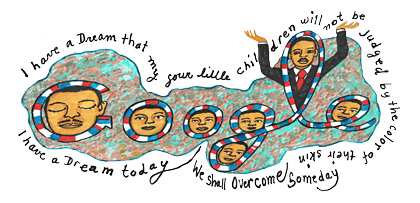
Google logo for Martin Luther King, Jr., Day 2012

Google logo for Martin Luther King, Jr., Day 2012 - click for more information

Fly your flag today, in honor of our nation, and in honor of our nation’s honoring the memory and legacy of the Rev. Dr. Martin Luther King, Jr.

U.S. law encourages Americans to fly the U.S. flag on holidays and a few other occasions. Congress set aside the third Monday in January as a holiday to commemorate the life of the Rev. Dr. Martin Luther King, Jr.

To honor Dr. King, for several years civil rights leaders and others have urged us to find some way to serve our communities on this day — Americans have done it long enough to make it a tradition. Here’s the official find-a-way-to-serve page from the the federal government; look out your window, go spend a few minutes at your city hall, post office, or at the biggest church in town, or walk into any middle school in America, and opportunities to serve will caress you at every turn.

More, much more:

King, by photographer Ben Fernandez's "Countdown to Eternity"

King, by photographer Ben Fernandez's portfolio of photos from one year in the life of Dr. King, "Countdown to Eternity"

MLK logo from Google mlk2010

Google's logo for Martin Luther King, Jr. Day, 2010 - click for more information