Cicada hawks a month early – another sign of climate change?

July 2, 2009

Well I remember summer camp as a Boy Scout, annually at Maple Dell, a few miles up Payson Canyon, Utah.  Troop 17 camped the week of July 4th, by tradition.  Most other troops avoided that week so families could get together on the holiday — there would be half the usual number of Scouts, and we had a lot more opportunities to hit the rifle range, archery range, rowboats and canoes.  Over four years, we noticed that the annual cicada invasion would usually start near the end of that week, as the Utah heat started its march toward August records.  It was a good week to camp, to avoid the heat and the astounding noise of those insects.

As an Explorer, and junior camp staff member later, I spent entire summers at Maple Dell.  We’d start in early June, when the Payson River still ran icy from the snow runoff, and when our sleeping bags would be coated with frost in the morning.  Cicadas in July said it was warming.  Cicadas in August screamed it was hot — sometimes near 100° F, a dramatic shift from the frost just eight weeks earlier.

In Maryland, one year we lived through the confluence of the 13-year and 17-year locusts, which are related to cicadas. (Bug Girl?  You out there?  Help me out on these details.)  The adults would literally coat trees.  They’d mate and die, and fall to the street, where cars would smush them — driving was more treacherous than driving on ice.  What few predators there were — and the predators seemed awfully few in relation to the billion locusts per acre — would eat their fill, and then ignore the rest of the mob.  The locusts came earlier than the cicadas, as I recall — but still later in the summer.

A post I wrote two years ago has been getting a lot of hits. In late July 2007 I wrote of the return of the cicada hawks, here in Dallas.  Each summer since, about the time the cicada hawks return, people start cruising the web to find out how to get rid of them, mostly (don’t, they’re practically harmless).   As I watched the traffic counts, I noticed that I had posted it on July 20 back in 2007.  I wrote that the wasps had been around for about ten days, then.  Last year I posted a welcome to the wasps on July 8.

Cicada killers at Boisenberry Lane, Dallas

Cicada killer wasps on Boisenberry Lane, Dallas, 2008 - copyright Ed Darrell

I saw my first cicada-killer wasp in 2009 about  June 10.  We didn’t have cicadas, then, that I could find.  The cicadas started buzzing on June 21, the first day of summer.  Our backyard is quite busy with cicada hawks right now, tracking down the cicadas and digging the holes in which to store the cicada zombies.

I hate to crash the denialists’ parties, but it sure seems to me that this cicada season thing is moving up.  The tilt of the Earth is still 23°.  The amount of daylight is the same.  What factors other than climate warming would cause these insects to come earlier each year?  What’s your experience?

More information:


I get e-mail from climate denialists

June 30, 2009

I took issue with JCScuba’s characterizing water conservation as “Nazi.”  First he purged my posts, and then I started getting e-mails.

The last one — at least I hope it’s the last one from this guy — sic:

Obama is a nazi in the making, don’t tell me what I can write on my blog, you polliticially correct asshole, I think you are doing a great deal of projection as you try to psychoalalyze me. I wouldn’t bother to give you the press, and I doubt if I’ve been on your blog just answere one of your inane remarks. So crawl back under your bed with your blanket and suck you thumb, don’t worry about you bed being wet all Lib’s are bed weters.

He’s forgotten he posted here earlier today, and he thinks Obama, on the way  to being a socialist, is also becoming a “nazi.”

Forgive me, but I think he needs to conserve on the stuff he’s mixing with his water.  It’s the high cost of denying green.  Is this just a manifestation of Denialism Disease?  What do you think?


Jesus would have wept, but He was dehydrated from the heat

June 30, 2009

This rather captures it well, don’t you think?

But if you watched the debate [on climate change fighting legislation in the U.S. House of Representatives] on Friday, you didn’t see people who’ve thought hard about a crucial issue, and are trying to do the right thing. What you saw, instead, were people who show no sign of being interested in the truth. They don’t like the political and policy implications of climate change, so they’ve decided not to believe in it — and they’ll grab any argument, no matter how disreputable, that feeds their denial.

Indeed, if there was a defining moment in Friday’s debate, it was the declaration by Representative Paul Broun of Georgia that climate change is nothing but a “hoax” that has been “perpetrated out of the scientific community.” I’d call this a crazy conspiracy theory, but doing so would actually be unfair to crazy conspiracy theorists. After all, to believe that global warming is a hoax you have to believe in a vast cabal consisting of thousands of scientists — a cabal so powerful that it has managed to create false records on everything from global temperatures to Arctic sea ice.

Yet Mr. Broun’s declaration was met with applause.

Those are the words of Nobel Prize-winning economist Paul Krugman.  If Krugman gets a second Nobel for following the IPCC’s Nobel-winning advocacy, Rep. Broun will cite that as evidence of conspiracy, probably claim it as a conspiracy of “smart, intelligent people.”

See all of Krugman’s column in the New York Times.


Watt’s Up censors dissents on claims of climate report censorship

June 27, 2009

Want to wager whether this post will ever escape the censors at Watt’s Up?

Anthony Watts is trying to make hay out of the two EPA guys who disagree with EPA’s position on global warming.  In contrast to the Bush administration, EPA is not suppressing agency scientists who argue EPA and the nation need to act on climate change, and Watts and his coterie of followers now claim that clinging to the majority view is “suppression” of the corporate, pro-pollution folks.

Is there suppression?  As I understand it, no one at EPA has been told to shut up.  The White House no longer dictates report conclusions contrary to the scientists at EPA.  In this case, it’s a couple of economists who argue with the science conclusions, so it’s difficult to argue that there is suppression of science.  Their complaint is that their views did not prevail at EPA.

But just to put icing on the issue, the dissenting report of well over 100 pages was published sub-rosa by the Competitive Enterprise Institute (CEI), the crank science, radical, private-enterprise-is-right-facts-be-damned group that is wrong on every other science issue they touch (DDT, for starters).

Early on I wrote to Watts that I am disappointed he’s fallen in with the former (current?) tobacco lobbyists at CEI.  In a second post, I pointed out that CEI is not a science-interested group, as evidenced by their parody of an Apple ad, zinging Al Gore, mainly.  That’s not science work, but pure propaganda (and false to boot).  That got a couple of responses, and this morning I offered the post below.  I think they’ve round-canned my comment.  Dissent is something they regard as sacred only when it suits them.

But tell me, am I wrong?  Is CEI well within bounds to argue that the Clean Energy Act will make the U.S. a totalitarian state?

And, has CEI ever been right about an issue?  Anybody got such evidence?

The post, sent just after 10:00 a.m. CDT:

David Hagan, interesting survey — of course, it covered the Bush administration and the efforts you now support to suppress evidence of global warming and the human contributions to it.  So, now that EPA is going the other way, are you urging a return to suppression of scientists?

Sam [Kazman, CEI]:

But do you really think that Al Gore’s serving on Apple’s board “speaks to his technical acumen”? Could it possibly speak, instead, to his political clout?

In my work with Gore, I’ve noticed that he’s way ahead of almost all other politicians in science.  He was right on air pollution in the ’70s, right on water pollution, right on DDT, right on orphan drugs, right on organ transplantation, and right on saving AARPANET, which is now the internet.  Yes, he’s there because of his technical acumen.  No one at CEI has the science chops of Al Gore — which is a sad testament to both the political acumen and the poor science content at CEI more than anything else, but still a fact.

The point of our video is that political attempts to restrict CO2 emissions may well produce a “1984”-style society. The war on carbon footprints will become very similar to the never-ending war portrayed in Orwell’s novel, with constantly shifting battlefronts and alliances, all resulting in increasing regulation of our lives.

Watts hates it when I call such statements bovine excrement, so let me just say that that statement alone contributes more methane to global warming than a herd of dairy cows.

It’s silly, and in this case insulting to everyone, to pretend these sorts of things are really in the offing.  CEI didn’t exist then, but this is the same sort of unfounded fear mongering we heard when the Clean Air Act was passed.  Perhaps not surprisingly, we’ve discovered that the companies that worked hardest to comply with the provisions of the act also are the more successful, 40 years later, with the possible exceptions of Exxon-Mobil and Chevron.

When we read “1984,” it’s good to recall that among the chief warnings of the book is the call to stick to the facts, to avoid false propaganda, and to beware large corporate interests who tell us they are taking our money for our own benefit.

The Clean Air Act did not result in militant totalitarianism, nor will controls on carbon emissions.

Ironically, there’s a good case to be made that the control on particulate emissions achieved by the Clean Air Act now contributes to global warming, because the particulates no longer offset the greenhouse gases.  No serious person would conclude that the answer is to increase particulate pollution.

Nor would a serious person, looking at the regulatory effects of the Clean Air Act, make such a radical claim as you make here.  Such overblown rhetoric is a danger to serious discussion — note how it’s raised my ire — and a clear indication that CEI is not about science in any shape or form.  Your statement is irresponsible in the highest degree, unsupported by history and current legislation.  Shame on CEI.

Godwin’s law seems entirely inadequate here.  CEI claims the Clean Energy Act — which has yet to pass the Senate, so we don’t really know what it will look like if it gets close to becoming law — will make the U.S. a totalitarian state.  These claims are reckless, irresponsibly alarmist at best.

Why won’t the climate change denialists like Anthony Watts allow discussion about the more radical, more reckless claims?


Clean energy bill needs your help

June 25, 2009

Call your Congressman, the person who represents you in the U.S. House of Representatives, and urge a “yea” vote on the comprehensive clean energy bill.

You can check your representative at several places, or follow the instructions through RePower America, listed below the video from our old friend Al Gore.

Repower America said in an e-mail:

Clean energy bill needs our support

Any moment now, the House will be voting on the boldest attempt to rethink how we produce and use energy in this country. The bill’s passage is not assured. Call your Representative today.

  • Call 877-9-REPOWER (877-9-737-6937) and we’ll connect you to your Representative right after providing you with talking points. (We’re expecting high call volume, and if you are unable to be connected please use our secondary line, 866-590-0971.)
  • When connected to your Representative’s office, just remember to tell them your name, that you’re a voter, and that you live in their district. Then ask them to “vote ‘yes’ on comprehensive clean energy legislation.”

They’d like you to report your contact, here.

What?  You haven’t been following the debate?  Here’s what the pro-pollution, give-all-your-money-to-Canada, Hugo Chavez, and the Saudis group hopesHere’s where the anti-pollution, pro-frog and clean environment people say the proposed act is way too weak as it stands.  Here’s the House Energy and Commerce Committee drafts and discussion of the billConsumer Reports analyzed the bill here (and said it can’t be passed into law fast enough despite its flaws).

Call now.  Pass the word to your friends.  Tell your children to call — their kids deserve better than the path we’re on now.

More information and discussion:


Maybe estimates of sea level increases are low; maybe climate change damage will be greater than expected

June 20, 2009

Eternal Hope at Daily Kos wonders what happens if the conservative estimates of sea level rise — the ones you usually see cited in the press — turn out to be way too conservative.  What happens if sea levels rise about double what some are estimating now?

If the severity and frequency of storms does not increase much, we may be able to accommodate the changes over time (though remember, some say we can do it easily).

How willing are the skeptics and denialists to tell cities and insurance actuaries that the fears of ocean-level increases are piffles?

Speaking of insurance:  Texas has been hammered over the past 20 years by unseasonal and much more-severe-than-usual thunderstorms, ice storms, straightline winds, tornadoes and hurricanes.  Home insurance rates skyrocketed.  State regulators argue with insurance companies about whether rate increases are justified.  Insurance companies cite claims for problems that did not exist earlier, and which may be blamed on climate change.  (How much excess mold will occur due to warming?)

Sometimes the arguments erupt into lawsuits and regulatory action.  One such argument drags on now, with up to a $1 billion in overcharges at stake.  How much of the fight from the insurance companies comes from their fears of the effects of global warming?


Can carbon dioxide be classed as a pollutant?

June 10, 2009

From Compound Interest

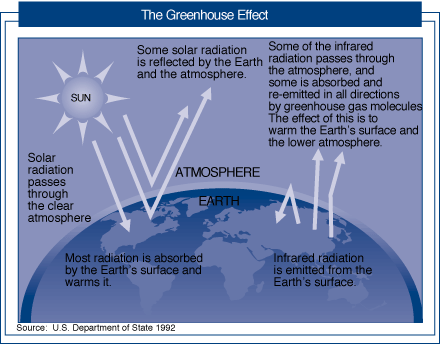
U.S. Department of State slide explaining the greenhouse effect, 1992. National Archives.

U.S. Department of State slide explaining the greenhouse effect, 1992. National Archives.

Sure.  Too much oxygen to a newborn baby can cause blindness; oxygen in that case is a pollutant.  Certainly, if an essential gas like oxygen can be classed as a pollutant, since too much carbon dioxide can be deadly as an acute poison, it’s fair to class it as a pollutant when it appears where it should not appear, or when it appears in concentrations too great to be safe for what we need it to do, or when it is destructive.

The tougher question is, can Congress do anything about it?

Arguments about whether carbon dioxide is a pollutant distract and detract from, and delay the critical arguments about how to act to mitigate harmful effects of climate change and how to prevent the most disastrous effects, if possible.

Barry Rabe teaches at the University of Michigan and studies policies of government on climate change, and the policy making of government on climate change.

Take a look at some of his work, under the title, “Can Congress Govern the Climate?”

Full report in pdf, here: “Can Congress Govern the Climate?” Or download 0423climatechange_rabe

Common atmospheric pollutants, from Compound Interest. CO2 is a pollutant

Common atmospheric pollutants, from Compound Interest. CO2 is a pollutant

See also:

Tip of the old scrub brush to U Town Blog.

Help cut through the fog of disinformation:


Add to FacebookAdd to NewsvineAdd to DiggAdd to Del.icio.usAdd to StumbleuponAdd to RedditAdd to BlinklistAdd to TwitterAdd to TechnoratiAdd to Furl


Is Texas the state most vulnerable to global climate change?

June 6, 2009

John Mashey occasionally graces these pages with his comments — a cool, reasoned head on hot issues like global warming/global climate change, despite his history in computers or maybe because of it (which would put the lie to the idea that computer programming explains why so many computer programmers are wacky intelligent design advocates).

Mashey offered a comment over at RealClimate on a post about hoaxer and science parodist Christopher Monckton — a comment you ought to read if  you think about Texas ever, and especially if you like the place.  It’s comment #413 on that Gigantor blog.

Monckton wrote a letter to the New York Times and attached to it a graph.  The graph, it turns out, probably would need to be classified in the fiction section of a library or book store, were it a book.  Much discussion occurs, absent any appearance by Monckton himself who does not defend his graphs by pointing to sources that might back what his graphs say, usually.

In short, the post and the extensive comments shed light on the problems of veracity which plague so many who deny either that warming is occurring, or that air pollution from humans might have anything to do with it, or that humans might actually be able to do anything to mitigate the changes or the damage, or that humans ought to act on the topic at all.

So I’ve stolen Mashey’s comment lock, stock and barrel, to give it a little more needed highlight.

If you follow environmental issues much, you probably know Count Christopher Monckton as a man full of braggadocio and bad information on climate.  He is known to have worked hard to hoodwink the U.S. Congress with his claims of expertise and policy legitimacy, claiming to be a member of the House of Lords though he is not (some climate change deniers in Congress appear to have fallen for the tale).  He pops up at denialist conferences, accuses scientists of peddling false information, and he is a shameless self-promoter.

After much discussion, Mashey turned his attention to claims that Texans don’t know better than Monckton, and other things; Mashey notes that denialists cite Monckton’s performance at a conservative political show in Texas, instead having paid attention to real climate scientists who were meeting just up the road, for free:

AGW’s impact depends on where you live
OR
Texas is Not Scotland, even when a Scottish peer visits

1) SCOTLAND
Viscount Monckton lives in the highlands of Scotland (Carie, Rannoch, 57degN, about the same as Juneau, AK, but warmer from Gulf Stream.)

a) SEA LEVEL, STORMS
Most of Scotland (esp the highlands) is well above sea level, and in any case, from Post-Glacial Rebound, it’s going up. [Not true of Southern England.]

b) PRECIPITATION
Scotland gets lots of regular precipitation. From that, he likely gets ~1690mm or more rainfall/year, noticeably more than Seattle or Vancouver.

Scotland has complex, variable weather systems, with more rain in West than in East, but has frequent precipitation all year.

c) TEMPERATURE
Scotland’s climate would likely be better with substantial warming. See UK Met Office on Scotland, which one might compare with NASA GISS Global Annual Mean Surface Air Temperature Change. Scotland average maximum temperatures are 18-19C in the summer, i.e., in most places it might occasionally get up to 70F, although of course it varies by geography. +3C is no big deal. The record maximum was 32.9C (91F), set in 2003. Maybe there is yet a good future for air-conditioning/cooling vendors.

If one does a simple linear regression on both sets of annual data, one finds that SLOPE(Scotland) = .0071C/year, SLOPE(world) = .0057C/year, i.e., Scotland is warming slightly faster than the world as a whole.

d) AGRICULTURE
The combination of b) and c) is, most likely *good* for agriculture in Scotland. There is plenty of rain, and higher temperatures mean less snow and a longer growing season. Great!

In addition, the British geoscientist/vineyard archaeologist Richard Selley thinks that while it may be too hot for good vineyards in Southern England by 2080, it will be fine for some areas of Scotland.
Future Loch Ness Vineyard: great!

e) OIL+GAS, ENERGY
Fossil fuel production (North Sea oil&gas) is very important to the Scotland economy. Wikipedia claims oil-related employment is 100,000 (out of total population of about 5M).

Scotland has not always been ecstatic to be part of the UK.

2) TEXAS
The Viscount Monckton spoke for Young Conservatives of Texas, April 28 @ Texas A&M, which of course has a credible Atmospheric Sciences Department. Of course, many of them were unable to hear the Viscount because they were in Austin at CLIMATE CHANGE Impacts on TEXAS WATER, whose proceedings are online. See especially Gerald North on Global Warming and TX Water.

Monckton delivered his message: “no worries, no problems” which might well fit Scotland just fine, at least through his normal life expectancy.

The message was delivered to Texans typically in their 20s, many of whom would expect to see 2060 or 2070, and whose future children, and certainly grandchildren, might well see 2100.

Texas is rather different from Scotland, although with one similarity (oil+gas).

a) SEA LEVEL, STORMS

Texas has a long, low coastline in major hurricane territory.
Brownsville, TX to Port Arthur is a 450-mile drive, with coastal towns like Corpus Christi, Galveston, and Port Arthur listed at 7 feet elevations. The center of Houston is higher, but some the TX coast has subsidence issues, not PGR helping it rise. The Houston Ship Canal and massive amounts of infrastructure are very near sea level. More people live in the Houston metropolitan area + rest of the TX coast than in all of Scotland.

Of course, while North Sea storms can be serious, they are not hurricanes. IF it turns out that the intensity distribution of hurricanes shifts higher, it’s not good, since in the short term (but likely not the long term), storm surge is worse than sea level rise.

Hurricane Rita (2005) and Hurricane Ike (2008) both did serious damage, but in some sense, both “missed” Houston. (Rita turned North, and hit as a Category 3; Ike was down to Category 2 before hitting Galveston).

Scotland: no problem
TX: problems already

b) RAINFALL
Texas is very complex meteorologically, and of course, it’s big, but as seen in the conference mentioned above (start with North’s presentation), one might say:

– The Western and Southern parts may well share in the Hadley-Expansion-induced loss of rain, i.e., longer and stronger droughts, in common with NM, AZ, and Southern CA. Many towns are dependent on water in rivers that come from the center of the state, like the Brazos.

– The NorthEast part will likely get more rain. [North’s comment about I35 versus I45 indicates uncertainty in the models.]

– Rain is likely to be more intense when it happens, but droughts will be more difficult.

Extreme weather in TX already causes high insurance costs, here, or here.

Scotland: no problem
Texas: problems.

c) TEMPERATURE

Texas A&M is ~31degN, rather nearer the Equator than 57degN.
Wikipedia has a temperature chart. It is rather warmer in TX, but is also more given to extremes.

Scotland: +3C would be dandy,
Texas: +3C not so dandy.

d) AGRICULTURE
Between b) and c), less water in dry places, more water in wet places, more variations in water, and higher temperatures (hence worse evaporation/precipitation difference) are not good news for TX agriculture, or so says Bruce McCarl, Professor of Agricultural Economics at TAMU.

For audiences unfamiliar with Texas A&M, the “A” originally stood for Agriculture, and people are called Aggies. One might assume that agricultural research is valued.
Politically, “Aggie-land” would not be considered a hotspot of hyper-liberal folks prone to becoming climate “alarmists”.

Scotland: warmer, great! Wine!
Texas: serious stress.

d) OIL+GAS, ENERGY
Here, there is more similarity: fossil fuels are economically important.

On the other hand, Scotland was settled long before the use of petroleum, and while places like the highlands are very sparse, cities like Edinburgh and Glasgow are relatively dense, and many villages are quite walkable. Warmer temperatures mean *lower* heating costs.

Texas has naturally developed in a very different style, and with forthcoming Peak Oil, this may be relevant. In 2006, according to EIA, Texas was #1 in energy consumption, 5th per-capita (after AK, WY, LA, ND) and uses 2X/capita of states like NY or CA. Some of that is inherent in different climate and industry.

Sprawling development in a state with water problems, subject to dangerous weather extremes, and already seriously-dependent on air-conditioning, may end being expensive for the residents.

Scotland: makes money from fossil energy, but it was mostly built without it. Warmer temperatures reduce energy use.
Texas: already uses ~2.5-3X higher energy/capita, compared to Scotland. Warmer temperatures likely raise energy use.

3. SUMMARY

Gerald North’s talk ended by asking:
“Is Texas the most vulnerable state?”

That sounds like an expert on trains, hearing one coming in the distance, standing on the tracks amidst a bunch of kids, trying to get them off the tracks before there’s blood everywhere.

On the other side, someone safely away from tracks keeps telling the kids that experts are wrong, there is no danger, so they can play there as long as they like.

You will be well informed if you also read Mashey’s comments at #120 and #132.


Do climate change deniers wear sunscreen?

May 25, 2009

How to weigh evidence of climate change, or not.

Dr. Ben McNeil calls out Australian climate change deniers. Are their bodies red?


Desperation in AGW denial ranks?

May 17, 2009

One might hope it is a sign of desperation, and not just one more ratcheting up on the dishonesty scale.

Anthony Watts has a post that looks at Boston Harbor, a post borrowed from a sleepy blog called Climate Sanity, by Tom Moriarty.  Watts, a leader among denialists, notes the warnings about sea level rising, and then offers maps of Boston as evidence everyone is safe.

The maps show the shoreline expanding around the peninsula where the main part of Boston sits.

Consequently, the authors claim, rising sea levels won’t do damage anyone should worry about.

Changes in Boston Harbor, from the denialist blog Climate Sanity

Changes in Boston Harbor, animation from the denialist blog Climate Sanity

It’s an odd sort of claim.  Anyone with any knowledge of the growth of harbor cities will look at the maps and notice the extension of lands from fill. Watts and Moriarty do not specifically claim that ocean levels have no effect, though some reading the headlines alone may get that idea.  They argue that humans will respond to negate the bad effects of climate change. 

That’s not what the maps show at all. The maps show that, in the absence of wetlands protection, people will use fill to expand commercial opportunities at a busy harbor.  That is true whether the fill requires the destruction of local landmarks, or whether the fill arrives accidentally from other major natural events.

The climate change denialists’ claims make an argument based in deception.  Harbor areas are always better fortified against sea and weather changes than other areas.  Boston Harbor is a comparatively small area, when contrasted with the Atlantic coastline of North America.

Do they know they’re just pulling our leg?  Or is this one more sign of the desperation denialists get over the realization the facts are against them?

At root the argument fails, and fails offensively: Watts and company argue that climate change and rising sea levels are not a problem, if we have enough concrete and fill to expand land close to the water and harden seawalls.  We also would need a lot of commercial development to make it cost effective to fill in the threatened lands.  That sort of development will involve only a very small area of any nation’s coastline.

Of course, that sort of hardening of sites is exactly what the wetlands protection under Section 404 of the Clean Water Act aimed to slow or stop, and it is part of the cause of trouble in the Mississippi Delta and other places unhardened, where the effects of hardening ports are pushed.

Watts also fails to account for the more serious immediate issues:  It’s not permanent inundation that we need to worry about with ports, but rather, the effects of stronger storms with higher sea levels.  The U.S. Environmental Protection Agency has been on that issue for years.  Boston Harbor is an example of a place that we need to protect from effects of climate change, at great expense, in order to preserve the filling done in the past and the development on that filled-in land that once was sea.

For examples, consult the white paper from EPA in July 2008, “Planning for Climate Change Impacts at U.S. Ports.  From the very first lines, you can begin to see why the denialists’s claims don’t wash:

Over the coming decades, climate change is likely to cause sea levels to rise, lake levels to drop, more frequent and severe storms, and increases in extreme high temperatures. These effects can have mild to severe impacts on port infrastructure and operations, depending on their geographical setting and design. Ports are critical to the trade and transportation networks of the United States. Specifically, ports handle 78% of all U.S. foreign trade by weight and 44% by value.1 The United States’ ports also represent billions of dollars in capital improvements and new investments. While the risk that climate change poses to ports is unclear, what is clear is that ports need to better understand climate change, how it may impact them, and what they can do to ensure reliable services for their customers.

Stakes are too high for analysis so shallow as simple map overlays.  In reality many factors mean that ports and harbors are threatened from many different problems arising from climate change.  The EPA white paper lists specifics.

Changes in water level:

The most immediate concern related to rising sea levels is the need to raise the level of infrastructure to prevent flooding. Ports will need to consider anticipated sea levels when building new infrastructure. In cases where current infrastructure may not be high enough for its useful lifespan, ports will need to increase infrastructure heights.

Higher sea levels may threaten ports’ environmental mitigation projects. Also, many ports have contaminated or potentially contaminated industrial land on their premises.17 Higher water levels may require new containment methods to prevent leeching of contaminants.

Many climate models predict that climate change will cause water levels to drop in the Great Lakes and the Mississippi River Basin, which would make shipping there more difficult. When lake levels decreased from 1997-2001, ships in the Great Lakes were forced to carry less cargo. Future decreases in water level would again require cargo restrictions or perhaps the redesign of vessels. Either one would increase the cost of shipping on interior waterways. Decreased depths could be mitigated by increased dredging, but at a financial and environmental cost.

Storm events and precipitation:

Globally, extreme precipitation events are expected to become more frequent, and severe storms are expected to become more intense. Stronger wave action and higher storm surges, especially when coupled with higher sea levels, are the primary threat to ports. These impacts can damage bridges, wharfs, and piers, terminal buildings, ships, and cargo. Harbor infrastructure may need to be raised or reinforced to withstand these impacts.

In addition to contributing to storm surge, wind can also have its own damaging impacts. High winds particularly threaten unreinforced terminal structures. For example, Hurricane Katrina tore roofs and doors off warehouses at the Port of New Orleans. One possible response to these threats is to change design standards for terminals, cranes, lighting systems, and other infrastructure to incorporate the risk of stronger storms.

Higher temperatures:

Higher incidences of extreme high temperatures could also affect some auxiliary port infrastructure. For example, paved surfaces may deteriorate more quickly in hotter conditions. Cranes and warehouses made of metal may require design changes to withstand higher temperatures. Higher temperatures may also require more energy for cooling of goods stored at ports.

Higher temperatures could impact the human and natural environments associated with ports as well. Many employees at ports work primarily outdoors. Operational changes may be required to protect workers from extreme heat. Warmer temperatures may also increase the risk of transferring invasive species from region to region on cargo vessels.

For ports in northern states, including Alaska, higher temperatures could provide some benefits. Operating conditions may improve as ice accumulation on port infrastructure decreases. Shipping seasons would lengthen as more ports and waterways become ice free for more of the year. These effects could increase volume and reduce costs for northern shipping.

Indirect impacts, including insurance:

Ports are also likely to face changes in insurance coverage and possible higher insurance premiums because of climate change. The insurance industry is one of the leading commercial sectors expressing concern about and exploring adaptive responses to climate change. Several large companies that provide business insurance services are incorporating risk from climate change into insurance offerings. Strategies include shifting a greater share of risk onto customers and providing technical support and pricing incentives for customers to reduce their exposure to climate-related risks.

Denialist arguments frequently come with unintended irony.  Part of Boston Harbor was filled in by a the New England hurricane of 1938.  Castle Island, one of the areas the animation highlights as being filled out, ostensibly by humans, is connected to the mainland now as a testament, a warning of the potential for nature to change the place quickly, contrary to the plans of humans.  One day in 1938 a hurricane converted the place from an island to a peninsula.  Is this really the best the denialists have to persuade us that we shouldn’t be concerned about the power of nature now?

Climate warming is real.  The effects of warming are real and quite problematic already.  Filling in wetlands around busy harbors, even just to raise elevation, is not a viable solution to the problems, regardless their cause.

Resources:


Climate Denial Crock of the Week: Ocean levels

May 10, 2009

Blue Ollie carried a YouTube video that got me to look at Peter Sinclair’s marvelous series of amateur videos, “Climate Denial Crock of the Week.” Sinclair posts under the handle GreenMan at YouTube.

Here’s the Climate Denial Crock of the Week video on ocean levels, and the denial that they are rising — in line with my post a few hours ago about peoples in the South Pacific and in Alaska losing their homes to climate change:

Pat Frank’s work keeps reminding us that, in science, it’s often difficult to establish a clear, indisputable proximate cause.  Something is going on in Newtok, Alaska, and in the Carteret Islands, Papua New Guinea.  Those things should not be ignored, and cannot be ignored safely for long.

(Teachers:  Note most of these videos are around 5 minutes in length — more than suitable for classroom use, perhaps even as a bell ringer.  Notice also that, if you don’t know how to make these videos, as I don’t, you’re behind the curve.)


What if we changed the climate and no one paid attention?

May 10, 2009

Rush Limbaugh, Pete DuPont, Michael Savage, the Discovery Institute and other great exponents of reality denial (generally, but not always, without drugs) will continue to rail at James Hansen’s science chops, but the universe goes on in the Real World™Global warming, climate change, takes a severe toll on inhabitants of this planet.

It’s a tribute to the propaganda value of Anthony Watts that this milestone earned so little note:  Residents of Carteret Island, Papua New Guinea, began their move to higher ground last week. The rising ocean is reclaiming their land; seasonal high tides make agriculture impossible.

Who noticed?

You can read about the refugees in The Solomon Times.  You can read about it in the Papua New Guinea Post -Courier. You can’t read it about it much of anywhere else.  The revolution is not televised, it’s not even in print.

Meanwhile, in Alaska, without serious action by the world to enact some sort of program out of the Kyoto meetings to combat climate change by nations united, indigenous peoples are meeting to figure out what they can do without government help.  The place of their meeting carries a message:

The summit is taking place about 500 miles from the Alaskan village of Newtok, where intensifying river flow and melting permafrost are forcing 320 residents to resettle on a higher site some 9 miles away in a new consequence of climate change, known as climigration.

Newtok is the first official Arctic casualty of climate change. A U.S. Army Corps of Engineers study indicates 26 other Alaskan villages are in immediate danger, with an additional 60 considered under threat in the next decade, Cochran said.

Here’s how the warming denialists’ diary entries should run:

“Climate change chased the Carteret Islanders out of their homes, but I wasn’t concerned because I am not a Carteret Islander, and probably couldn’t find the place on a map.”

Further reading:

http://alphainventions.com/rss


Rachel Carson’s critics: No shame, no morals, no brains

April 18, 2009

So, Friday night in Seattle (April 22) the anti-science, anti-environmental wackos will premiere a film.  Among other things, the film claims Rachel Carson was wrong about DDT, but her Svengali-fu was so great that she persuaded John F. Kennedy, Richard Nixon, Ronald Reagan, Idi Amin, the National Academy of Sciences and a host of others to ban DDT needlessly, and that millions of people died from diseases the DDT could prevent at low cost and no harm.

The film premieres at an elementary school:  Rachel Carson Elementary.

Get it?  See the joke?

These wackos, Phelim McAleer and Ann McElhinney, have no shame about mocking the kids in second and third grade at that school who rightly look on Carson as a heroine and great human.  Is it possible to be more cynical than that?  Would it be possible for them to be bigger jerks about it?

The screening is sponsored by the right wing, and now clearly anti-science, Washington Policy Center.

McAleer and McElhinney are poster children for the decline of morality in America.  They have no shame about bullying elementary school kids in their efforts to sully the good reputation of a great scientist and writer.   Judging by their unfair and inaccurate screed against Carson and Al Gore, it appears they lack the moral sense to feel the shame.   I can see their next film project now:  They’ll do an exposé of how the brutal bank examiners forced bankers to live on only their salaries, foregoing the multi-million-dollar bonuses they deserved — and noting that malaria in Uganda now is worse because U.S. bankers are not compensated highly enough.

John Fund’s blog at the Wall Street Journal site has details.

Irish documentary filmmakers Phelim McAleer and Ann McElhinney have stirred up trouble before by debunking smug liberal hypocrisy. Their latest film, “Not Evil, Just Wrong” takes on the hysteria over global warming and warns that rushing to judgment in combating climate change would threaten the world’s poor.

[Al Gore]

The film reminds us that environmentalists have been wrong in the past, as when they convinced the world to ban the pesticide DDT, costing the lives of countless malaria victims. The ban was finally reversed by the World Health Organization only after decades of debate. The two Irish filmmakers argue that if Al Gore’s advice to radically reduce carbon emissions is followed, it would condemn to poverty two billion people in the world who have yet to turn on their first light switch.

*    *    *    *    *    *

The two filmmakers are skilled at using provocative publicity tactics. On April 22, they will hold a public showing of their film at the Rachel Carson Elementary School in the suburbs of Seattle. “Since it was Rachel Carson who touched off the campaign to ban DDT, we thought showing ‘Not Evil, Just Wrong’ there would be appropriate,” says Mr. McAleer.

Local environmentalists will probably not appreciate the gesture and will be appalled that the school agreed to rent out its auditorium to the renegade skeptics. But somebody might point out that it’s not evil, just appropriate, to hold a debate about the real-world consequences of acting on global warming fears.

The little Seattle Weekly has the good sense to call it for what it is.

As you may already know, April 22 is Earth Day. At noon, inside City Hall, the Seattle City Council will be showing a movie about Rachel Carson, the biologist whose book, Silent Spring, is frequently credited with spurring the modern environmental movement.

Meanwhile that same evening, at Rachel Carson Elementary School in Sammamish, conservative think tank the Washington Policy Center will be showing Not Evil Just Wrong: The True Cost of Global Warming Hysteria. (Tagline: “This is the film Al Gore and Hollywood don’t want you to see.”) It’s by the same folks who brought you that mining industry–funded classic, Mine Your Own Business. We know you’re in your grave. But you can roll over now, Ms. Carson.

That’s good news:  The film showing at the Seattle City Council chamber is “A Sense of Wonder,” which will get more viewers in Seattle than the other film will get nationwide. (Presented by the Seattle City Council; 600 Fourth Street, Seattle; contact Phyllis Shulman, 206-684-8816; or see the council’s website; film shows at noon to 1:00 p.m., free admission.)

Of course, there is a little joke on these evil film makers McAleer and McIlhenny:  The school isn’t just named after Rachel Carson, by popular vote of the children, it’s also green.

A total of 75 names were submitted by students. Nominees had to meet the district’s requirement of “deceased persons famous for their work in science, the humanities, letters, or education.” This list was narrowed to those that had more than one nomination, which left eight finalists. Those eight finalists were put on a ballot with a description of each nominee. Ballots were mailed to the families of children who will attend the new school next year.

A total of 320 students voted. The top three choices were Carson, Clara Barton and Amelia Earhart. The Lake Washington School District Board of Directors approved the use of any of those top three choices at its May 5 meeting. Shortly thereafter, Principal Mary Cronin received word that permission was granted to use the name of Rachel Carson. Frances Collin, literary agent for her estate, wrote that she believed Miss Carson would have been pleased.

In her writings, Carson encouraged people to discover and help children discover the wonder of the natural world. After earning a master’s degree in zoology, Carson spent 15 years working for the U.S. Government as a scientist and editor. She rose to Editor in Chief of the U.S. Fish and Wildlife Service. Her writing in her free time included many essays on the ocean. These essays led to three books about the ocean and a career as a science writer who shared her knowledge as well as her love of nature. One of those books, The Sea Around Us, won the National Book Award.

Carson’s concerns about the misuse of synthetic pesticides led to her book, Silent Spring, which sounded the alarm about the environmental impact of indiscriminate use of such powerful chemicals on nature. First serialized in the New Yorker magazine, it became a runaway best seller. Testifying before Congress in 1963, Carson asked for policies that that would protect against irreversible damage to humans and nature alike, urging study and consideration of safer alternatives.

Carson’s work led to the ban on most uses of DDT in the U.S. and a subsequent worldwide ban on DDT for agricultural use. The DDT ban has been cited as a major factor in the comeback of the bald eagle in the U.S. In 1980, Carson was posthumously awarded the Presidential Medal of Freedom.

The new Rachel Carson Elementary will feature such environmentally friendly features as a green roof, extensive use of daylight and a geothermal heat pump. It is located at 1035 244th Ave. NE in Sammamish.

The school’s good practices contradict the preachings of the film makers.  The elementary school kids have more sense than the climate change deniers and DDT-poisoned anti-environmentalists.

Oh.  The anti-environmental film is named “Not Evil, Just Wrong.”  When the film is done on its producers, it will carry an even shorter title:  “Evil and Wrong.”

What would the film makers do if a bunch of 3rd graders from the school showed up at the screening, and in the Q&A after, asked, “Why are you telling such lies about Rachel Carson and Vice President Gore?”


Olla podrida, end of spring break 2009

March 23, 2009

A lot of stuff to catch up on, and no time to do it.


Cargo cults in global warming, and Arthur Robinson

March 14, 2009

Cargo cult science has deep roots among those who deny global warming or who allow that warming is occurring, but claim we can do nothing about it.  So, it’s no surprise that, at the voodoo science 2nd International Conference on Climate Change, somebody would trot out the old falsehoods about DDT.

According to Traditional Catholic Reflections (you can tell its traditional Catholic because it brooks no comments — you can’t correct an error there):

Speaking at the conference hosted by the Heartland Institute in New York City,[Dr. Arthur Robinson, Director of the Oregon Institute of Science and Medicine] said, “There is a current example of genocide by the removal of technology, and that is the ban on DDT, and that has resulted in the deaths of 30 to 40 million people and has left half a billion infected with malaria.”

It’s malaria that kills people, not a lack of DDT.  The removal of DDT from spraying cotton crops  in Texas and California did absolutely nothing to promote malaria in Africa.  Dr. Robinson needs a basic geography course.  Mosquitoes do not migrate from the U.S. to Africa or Asia.

Stopping the spraying of DDT in the U.S. in 1972 wasn’t a factor in the cessation of usage of DDT in Africa seven years earlier, either.  Dr. Robinson could use some basic math sequencing and calendar reading remediation, too.

Dr. Robinson could use some history and public policy instruction, too.  DDT was never banned in Africa, nor was it banned in India or China which together now produce almost all the DDT used in the world, which is a lot.  There’s no ban on DDT in Uganda, where Dr. Robinson’s friends in the business world are suing to stop the spraying of DDT in huts in affected regions — because they are afraid it will harm their tobacco business.

It’s a heckuva lot easier to throw darts at health care workers and disease fighters than it is to talk about real solutions with these guys.

If Robinson is dead wrong on a one-liner about DDT, how wrong do you think he is in the rest of his presentation on climate change?

Is there any crackpot “scientist” who was not at the Heartland Institute’s wing-ding?