Clay Bennett cartoons

December 13, 2007

I love Thomas Nast cartoons, partly for their dated look. They look like they are 100 years old from the style of the art.

For much the same reason, I love Herblock cartoons. They look like the middle of the 20th century. And Pat Oliphant cartoons look like post-Kennedy modern ideas.

Clay Bennett, winner of the 2007 Curie UN Cartoon Award

Clay Bennett, winner of the 2007 Curie UN Cartoon Award

Clay Bennett cartoons look like 21st century clean to me. There’s a smoothness, a silkiness of color that lends an immediacy to them. They really look good, and they look like they’d project well in a classroom (though I’ve not tried any of Bennett’s, actually).

All four of these cartoonists had or has something to say, too. I’ve enjoyed Bennett’s work in the Christian Science Monitor for some time. His work is clean, but it has a cutting edge that can’t be missed.

So, I was happy to see that he had won a commendation from the Ranan Lurie Cartoon Competition at the UN Correspondents’ Association dinner. Other people see good stuff in his drawings — I’m not alone.

Here’s his UN Lurie award-winning cartoon:
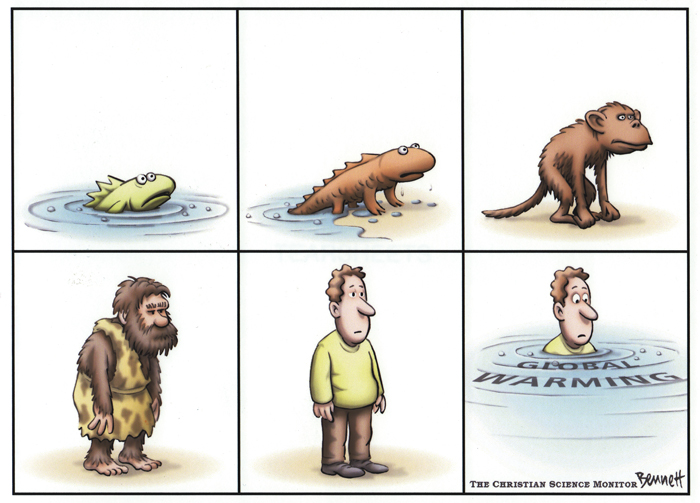
Evolution of Man, to drowning by global warming

Cartoon winner of the 2007 Curie UN Cartoon Award

More of Bennett’s cartoons can be seen here, at the Clay Bennett Archives.

Bennett’s last cartoon in the Monitor was November 17.  The good news:  He’s moving to the Chattanooga Times-Free Press.  We can hope that means one more opening is available for a cartoonist.

One more, below the fold. Read the rest of this entry »


Students rise to the challenge

December 2, 2007

Who will do something about global warming (weirding)?

“We are the people we have been waiting for.”


What if they gave a disaster and nobody cared?

November 15, 2007

Day in and day out, this cartoon of a poor African kid getting hit by a tsunami of drought is among the most popular posts on this blog, and one of the most popular cartoon images on the web. I think the cartoonist Alberto Sabat was trying to make a point, that kids in SubSaharan Africa were (are) being clobbered by a disaster as great as the great tsunami that hit the Indian Ocean after Christmas 2005.

In other words, there were other disasters, other victims, and we ignore them.

If Al Gore had a lot of media clout and enjoyed bias from media in his favor, you’d hear about a great storm ready to smash one of the poorest, lowest countries on the planet, where recent increases in povery-struck populations has put millions of people in a great river’s delta, in a most dangerous place to be in a cyclone. But you’re not hearing the story.

If our news media were biased to the liberal side, a story about such a pending disaster would be on the front page of every liberal newspaper, and leading every liberal television news broadcast.

If our private charity groups were groveling to the climate change Cassandras, they’d be begging for money to evacuate people from the path of a category 5 cyclone, now.

If Katrina’s aftermath alerted us to the dangers of powerful storms hitting areas of great poverty, we’d be glued to our television sets if there were another such drama unfolding anywhere on Earth.

If the Bush administration were concerned about preventing the growth of al Quaeda and similar movements, it would be doing what it could to help out a nominally friendly government of an Islamic nation in the path of a great storm.

Right?

The photos are spectacular. The news is . . . eerily quiet.

Cyclone Sidr, on the way to Bengla Desh

This is Cyclone Sidr. It’s a category 5, and it keeps defying predictions that it will weaken as it moves north, oddly acting as if it has targeted the low river delta regions of Bengla Desh. Chris Mooney calls it “beautiful but deadly.P. Z. Myers raises an alarm about our ignorance of the storm. More details from Mooney. Lamentations from Mooney’s co-blogger Kirshenbaum (are they playing the role of Jeremiah or Cassandra? Rather depends on your reaction, no?)

Do any high school geography, world history, government or economics courses still do current events? Here’s the raw material for a good, consciousness-raising warm-up. Prelude to a disaster, we hope not. The lack of news coverage is disturbing.

Resources:

Horrible thought: Is the dearth of reaction partly because broadcasters don’t know how to pronounce the name of the storm?


Climate hoax|hoax author speaks

November 11, 2007

He did it to expose the climate change skeptics.

Nature‘s blog has the interview, here.

Why did you decide to construct the fake website? Was it purely a joke or did you set out to make people taking your paper at face value look foolish?

Its purpose was to expose the credulity and scientific illiteracy of many of the people who call themselves climate sceptics. While dismissive of the work of the great majority of climate scientists, they will believe almost anything if it lends support to their position. Their approach to climate science is the opposite of scepticism.

Are you surprised at the pick up your coverage has generated?

Not really. Equally ridiculous claims – like those in the paper attached to the “Oregon Petition” or David Bellamy’s dodgy glacier figures – have been widely circulated and taken up by the ‘sceptic’ community. But you can explain this until you are blue in the face. To get people to sit up and listen, you have to demonstrate it. This is what I set out to do.

Still waiting for someone to back up junk science purveyor Steve Milloy’s claim that the hoax was exposed by the skeptics it was aimed at. The hoaxer doesn’t think so.

[Yeah, I know — Nature is a British publication, and they use the British spelling for “skeptic.”]


Global warming a hoax? No, the hoax claim is a hoax

November 9, 2007

Global warming a hoax? No, the hoax was the claim that there was a study that said global warming is a hoax.

Bob Parks put it succinctly:

4. GLOBAL WARMING HOAX: OR WAS IT JUST A HOAX OF A HOAX?
There was a wild scramble on Wednesday about the death of the manmade global warming theory, except the authors didn’t exist, nor their institution, nor the journal. It took two minutes to find this out, so what was the purpose? Just a prank?

What was it?

Nature reports the hoax site, looking like the website of a research journal, took the article down (that’s the link to the article; it’s gone, as you can see. The hoax included a purported article and a purported editorial from the journal.

But nothing checked out. The journal doesn’t exist. The researchers probably are bogus, too, nor does their purported institution/department exist.

Rush Limbaugh fell for it, though, as did several others who profess to be skeptical of global warming.

Certainly a hoax — but by whom? For what purpose?

In the meantime, junk science purveyor Steven Milloy claims that it was the skeptics of global warming who smoked out the hoax, not the many scientists who immediately smelled fishiness. Does he suggest the name of even one warming “skeptic” who called it? No.

Did Limbaugh apologize yet? Do you think he’ll be more skeptical next time?

Update, November 11, 2007:  Nature interviews the hoax creator and perpetrator. Explanation, excerpt, and links to the article.


Errors page one, corrections page 2: Gore film okay for classroom

October 14, 2007

Al Gore, from Ventura County Star (stock photo?)

Tim Lambert at Deltoid tracked down the facts in the really odd story about a court in Britain ruling that the film Inconvenient Truth contains errors — a case I noted in a post about Al Gore’s winning a Nobel Prize for his work on climate change. Deltoid said:

A UK High Court judge has rejected a lawsuit by political activist Stuart Dimmock to ban the showing of Al Gore’s An Inconvenient Truth in British schools. Justice Burton agreed that

“Al Gore’s presentation of the causes and likely effects of climate change in the film was broadly accurate.”

There were nine points where Burton decided that AIT differed from the IPCC and that this should be addressed in the Guidance Notes for teachers to be sent out with the movie.

Unfortunately a gaggle of useless journalists have misreported this decision as one that AIT contained nine scientific errors.

Got that? The British Court said Gore is right.

I’ll bet I’ve seen that case cited a half dozen times today, with claims that Gore’s film is generally wrong.

Tim’s detail on the case, and the nine allegations of “error” (scare quotes from the judge in the original opinion) should be read by anyone following the climate change debates. I doubt that any Gore critics will read, nor, just to be nasty, that many of them can.

This is another political hoax in the making. Bad reporting, caused largely because the news of the case hit as the announcement of Gore’s Nobel Prize win crossed the news wires, makes Gore a target for the denialist and right-wing spin machines. Though their charges are inaccurate, they will make the charges, and repeat them endlessly. Buckle up — it’s going to be a bumpy night.


Peace Nobel: Al Gore and IPCC

October 12, 2007

2007’s Nobel Prize for Peace sailed out to Al Gore and the UN’s Intergovernmental Panel on Climate Change (IPCC), “for their efforts to build up and disseminate greater knowledge about man-made climate change, and to lay the foundations for the measures that are needed to counteract such change.”

Observations:

First, this is a big win for science. The IPCC has been victim of political knee-capping as virulent as any we’ve seen in the last 25 years. Science wins out with the Nobel.

Second, if, in October 2000, we had been able to see a headline, “Al Gore wins Nobel Peace Prize,” what would we have thought that meant about the results of the 2000 election? It’s an indictment of the inaction of the Bush regime that in 6 years Al Gore has done enough to win a Nobel for his efforts, while the Bush administration has not.

Third, while Gore is U.S. citizen, he’s a graduate of St. Alban’s School in Washington, D.C., a good private school. I’m 0-4 on public school grads winning Nobels this year. So much for my predictions. Of course, P. Z. Myers argues Nobels are at best a lagging indicator (how’s that for zipping in an economic term, social studies teachers?). But he’s talking about science, not education in general. P. Z. says the real disaster for U.S. awards is ahead, when our failure to support science in research and graduate study starts to “pay off.”

Al Gore is a good guy, in my experience. He’s knowledgeable about a lot of things, he has foresight (we’d not have this internet but for Gore’s work to save it in its infancy), and he’s a mensch. Ah, for the things that could have been.

Sources:

Read the rest of this entry »


Starbucks controversy: The Way I See It #289 (global warming)

September 17, 2007

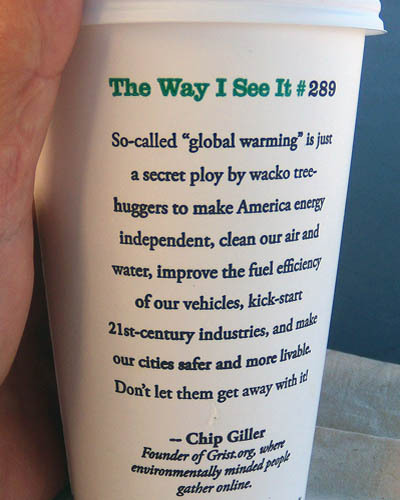
Found this on my coffee cup today:

The Way I See It #289

So-called “global warming” is just

a secret ploy by wacko tree-

huggers to make America energy

independent, clean our air and

water, improve the fuel efficiency

of our vehicles, kick-start

21st-century industries, and make

our cities safer and more livable.

Don’t let them get away with it!

Chip Giller
Founder of Grist.org, where
environmentally-minded people
gather online.

Starbucks Coffee Cup, The Way I See It #289

Add to FacebookAdd to NewsvineAdd to DiggAdd to Del.icio.usAdd to StumbleuponAdd to RedditAdd to BlinklistAdd to TwitterAdd to TechnoratiAdd to Furl

Save


Tipping point: Greenland ice melt shakes Earth

September 8, 2007

Stephen Leahy’s headline sounds almost hysterical: “Greenland Ice Collapse Producing Earthquakes.”

Here’s the article in The Guardian with the backup data.

Something to think about.

Greenland is melting; photo showing ice sheets breaking up

Read the rest of this entry »


Blog for the environment: Blog Action Day, October 15

September 8, 2007

Blog Action Day, October 15: Organizers hope to have as many as 10,000 blogs writing about environmental issues and environmental action.

Blog Action Day 2007, the environment

If you blog, perhaps you could join in. If you read and comment only, feel free to urge others to join in.

It’s headed up by a bunch from downunder. U.S., Canadian and Mexican bloggers haven’t got on the bandwagon a lot, yet. As the organizers describe it:

On October 15th – Blog Action Day, bloggers around the web will unite to put a single important issue on everyone’s mind.

In its inaugural year, Blog Action Day will be co-ordinating bloggers to tackle the issue of the environment.

What Each Blogger Will Do

Bloggers can participate on Blog Action Day in one of two ways:

  1. Publish a post on their blog which relates to an issue of their own choice pertaining to the environment.For example: A blog about money might write about how to save around the home by using environmentally friendly ideas. Similarly a blog about politics might examine what weight environmental policy holds in the political arena.Posts do not need to have any specific agenda, they simply need to relate to the larger issue in whatever way suits the blogger and readership. Our aim is not to promote one particular viewpoint, only to push the issue to the table for discussion.
  2. Commit to donating their day’s advertising earnings to an environmental charity of their choice. There is a list of “official” Blog Action Day charities on the site, however bloggers are also free to choose an alternate environmental charity to donate to if they wish.

And that’s it.

A gentle nudge to a better planet. Seems like a good idea to me.

Tip of the old scrub brush to Meeyauw.


Hurrican Dean, climate change, political action

August 21, 2007

Chris Mooney, the Storm Pundit, dishes out the news on the record-making severity of Hurricane Dean. Mooney’s latest book is Storm World: Hurricanes, politics, and the battles over global warming.

Hurricane Dean at landfall in Yucatan, from Weather Underground False color satellite image of Hurricane Dean as it struck the Yucatan Peninsula; image from Weather Underground, via the Intersection.

Mooney’s information on Dean is at his blog, The Intersection, at the Huffington Post stable, and at the Daily Green.

Mooney said:

Dean was officially the most powerful hurricane that we’ve seen globally so far in 2007, and was by far the strongest at landfall. It was also the first Category 5 Atlantic hurricane seen since the record-setting Hurricane Wilma of October 2005. In fact, Dean set some records of its own. Its pressure was the ninth lowest ever measured in the Atlantic, and the third lowest at landfall. Indeed, there hasn’t been a full Category 5 landfall in our part of the world since 1992’s Hurricane Andrew. Dean was in all respects a terrifying storm, and we can only hope that the damage will somehow be less than expected as it tears across the peninsula and then, after crossing the Bay of Campeche, moves on to a presumed second Mexican landfall.

Dean is already in the record books in ways that should make policy makers think hard about what to do in terms of disaster preparation, and in terms of what political entities can do to prevent actions that intensify such storms:

1. Dean is the ninth most intense Atlantic storm by pressure, and six of the top ten (Wilma, Rita, Katrina, Mitch, Dean, and Ivan) have occurred in the past ten years.

2. Dean is the strongest hurricane anywhere this year, and by far the strongest at landfall. It is the tenth category 4 or 5 hurricane globally and the 3rd Category 5.

Texas has mobilized disaster relief efforts as never before. School buses have been mustered near San Antonio for evacuations. 90,000 gallons of gasoline have been delivered to potential hurricane zones, to aid in self-evacuations. Helicopters are being mustered just outside potential storm zones. Someone is paying attention to the damage mitigation and clean up.


Shooting past skepticism: Solutions to global warming

August 21, 2007

It’s been about a week since some global warming skeptic pointed me toward a recent piece from Freemon Dyson, claiming that if Dyson didn’t believe in global warming, no one should. Tip of the old scrub brush to whoever that skeptic was.

Dyson’s piece is online at The Edge, dated August 8, 2007:  “Heretical Thoughts about Science and Society.” (If you are unfamiliar with Dyson, you should at least check out his biography there.  A more comprehensive biography at Wikipedia reveals why you should be familiar with him as a great father, good physicist and astronomer who tends to work well in groups, and winner of the Templeton Prize.  Then, next time you see the Star Trek: The Next Generation episode that deals with Dyson Spheres, you can nod your head as if you understand what’s going on.)

I read Dyson’s piece, and while he’s cranky, he’s not denying global warming. A good chunk of his piece discusses how to capture carbon dioxide to prevent further warming, or perhaps even reverse current atmospheric trends. Skeptics of warming who seize on Dyson’s piece as a rebuttal make a common error among the scentifically unquestioning ranters: They assume any criticism of part of an argument is a refutation of the whole. Dyson suggests we should spend time and money on figuring out how to get the microbiota in the soil to capture more CO2.

Much of the rest of the piece is hopeful.  Dyson disagrees with hysteric concerns about melting glaciers; he doesn’t think they’ll all melt or cause dramatic rises in sea level.  At the same time, he urges caution and study, noting the holes in our knowledge that most arm-chair global warming skeptics want to ignore, including the possibilities that global warming itself would trigger a dramatic shift to a new ice age, which would be at least as catastrophic.

We can separate the climate cranks from the true skeptics if we look for similar flights of reality from people:  The true skeptics will note how difficult it is to predict climate and weather, but do not deny the need to act against pollutants which are thought to cause climate change.  This is a crucial difference.  Bush administration officials originally denied the existence of global warming as an excuse to do nothing about air pollution; now they claim to recognized global warming, but still do little that might control human dumping into the air.  In sharp contrast, Dyson proposes a partly-neglected sink of CO2 and urges that we work hard to increase its effectiveness.

In the past year I have posed that question in several climate discussions:  Do you oppose controlling air pollution?  The question quickly separates cranks from others; while the scientifically literate may argue about whether we can predict human effects on weather, few argue that we should continue our present trends of dumping.

In short, regardless the science, Melissa Etheridge is right.  It’s time to wake up.