Slight fluctuations from 1998’s record heat doesn’t mean warming is done

December 14, 2009

Sometimes you find rational discussion and good information in the newspaper.

This story moved on the McClatchy wire last August (I just recently came across it):

Drop in world temperatures fuels global warming debate

By Robert S. Boyd | McClatchy Newspapers

WASHINGTON — Has Earth’s fever broken?

Official government measurements show that the world’s temperature has cooled a bit since reaching its most recent peak in 1998.

That’s given global warming skeptics new ammunition to attack the prevailing theory of climate change. The skeptics argue that the current stretch of slightly cooler temperatures means that costly measures to limit carbon dioxide emissions are ill-founded and unnecessary.

Proposals to combat global warming are “crazy” and will “destroy more than a million good American jobs and increase the average family’s annual energy bill by at least $1,500 a year,” the Heartland Institute, a conservative research organization based in Chicago, declared in full-page newspaper ads earlier this summer. “High levels of carbon dioxide actually benefit wildlife and human health,” the ads asserted.

Many scientists agree, however, that hotter times are ahead. A decade of level or slightly lower temperatures is only a temporary dip to be expected as a result of natural, short-term variations in the enormously complex climate system, they say.

McClatchy’s story would be accurate today, even after the records show that the last decade is the hottest ever — such a long shelf-life shows good research and writing by McClatchy’s reporters.  McClatchy’s story doesn’t contradict this press release last week from the World Meteorological Organization (WMO):

2000–2009, THE WARMEST DECADE

Geneva, 8 December 2009 (WMO) – The year 2009 is likely to rank in the top 10 warmest on record since the beginning of instrumental climate records in 1850, according to data sources compiled by the World Meteorological Organization (WMO). The global combined sea surface and land surface air temperature for 2009 (January–October) is currently estimated at 0.44°C ± 0.11°C (0.79°F ± 0.20°F) above the 1961–1990 annual average of 14.00°C/57.2°F. The current nominal ranking of 2009, which does not account for uncertainties in the annual averages, places it as the fifth-warmest year. The decade of the 2000s (2000–2009) was warmer than the decade spanning the 1990s (1990–1999), which in turn was warmer than the 1980s (1980–1989). More complete data for the remainder of the year 2009 will be analysed at the beginning of 2010 to update the current assessment.

This year above-normal temperatures were recorded in most parts of the continents. Only North America (United States and Canada) experienced conditions that were cooler than average. Given the current figures, large parts of southern Asia and central Africa are likely to have the warmest year on record.

If only all reporting were so accurate.


If only hysteric, misplaced paranoia could reduce greenhouse gases . . .

December 10, 2009

“I got this idea for a movie!”

“Not another vampire who sucks the sap of only endangered species plants, please, Bob.”

“No, really, you gotta hear this!  Heck, it might even be real.”

“Whaddya mean by that, Bob?”

“I mean this whole Copenhagen thing!  World leaders getting together in secret to plot the destruction of world industry!”

“Copenhagen’s meetings are wide open, Bob.  It’s on the news everywhere.  And did you ever notice that most of the world leaders there are capitalists, and that they owe their election to other capitalists, frequently of the oil-drilling and coal-mining sort?”

“That’s what they want you to think!”

“Well, I think that way whether they want me to or not, Bob.  Money, you know?  I love it.  I follow it.  There’s no money in controlling climate change.  If there were, I’d be Copenhagen right now.”

“You’re missing the point!  These guys are meeting to take the money away from guys like you.”

“Pierre, here at the restaurant, does a pretty good job of taking money from guys like me, in return for a good arugula salad and a chunk of rare roast beef.”

“That’s not what I mean!”

“I think you’ve got another crazy idea that won’t make a good movie.  I’ll let you talk through the arugula, Bob.  When the roast beef comes, I don’t want stupid plots that won’t sell on the table — so it better be good, or we’ll change the topic.”

“Okay, here goes:  Mad climate scientists create a scare about global warming, and everybody gives them their money, and they the rest of the movie is about the chase to catch them before they get to a secret beach in the Maldives or Marshall Islands where they’ll hide forever in their secret lair.”

“I’m not impressed yet, Bob.  Why would anyone think a climate scientist would be so power hungry?

“They meet in Al Gore’s mansion.  Al Gore’s the power-hungry villain!”

“Al Gore?  He lost an election to George F. Bush, for cryin’ out loud.  Nobody would believe that.”

“You mean W — ‘George W. Bush.'”

“Have you seen what the stock market’s been like lately, Bob?  No, of course not.  You don’t own stocks in regular companies — gun makers and gold dealers only — but after what happened to my portfolio, I mean F.  He’s George F. Bush to me.”

“C’mon, it’s ripped from the headlines!”

“It’s about as exciting as the crossword puzzle, Bob.  That’s not a movie — it’s a new sleep drug.  I couldn’t sell it to a religious group trying to make a movie about Charles Darwin, even if we dressed Gore up as Darwin.  Even they’d see through the plot, Bob.”

“Archie!  It’s a great movie!  Think of the special effects!”

“Think of the NoDoz concession.  Theatres don’t have ’em.  Climate scientists taking over the world is like the Joffrey Ballet as the perps on the St. Valentine’s Day Massacre.  It’d be like getting toe-shoed to death.”

Oh, c’mon, Arch.  I got half the screenplay already done!”

“Well you need more research.”

“What?”

MaldivesMarshall Islands.  They’re the poster islands for climate change.  They’re the first nations to go as the sea rises.  All the geeks will know that, and so they’ll laugh at your movie.  Geeks laughing at you isn’t good box office.”

“We can do it like Superman!  You know a Fortress of Solitude somewhere in the ice.”

“No ice would kinda make that plot device not work, wouldn’t it, Bob?”

“Oh, c’mon.  No one really thinks the ice is disappearing!”

“Bob — remember our agreement?”

“What?”

“Beef’s here.  Shuttup.”

“Huh?  Oh, yeah.  Oh.  Yeah.”

“Okay, Archie.  How about this:  There really are gods, and hysteria makes them happy.”

“Hysteria.  Yeah.  There’s value in that.”

“No, I mean it.  Hysteria makes the gods happy, and so then they do good things for people.”

“Like what?”

“Well . . . like . . . like cleaning up global warming.  Yeah, that’s it!  Blind hysteria makes global warming go away!”

“Nobody’ll believe that, either, Bob.  If that worked, global warming would have been gone ten years ago.  Shuttup and eat your beef.”


The Curse of “Not Evil, Just Wrong” — still evil and wrong

December 10, 2009

At the first post on this material, the thread got a little long — not loading well in some browsers, I hear.

So the comments are closed there, and open here.

In fashion we wish were different but seems all too typical, so-called skeptics of global warming defend their position with invective and insult.  But they are vigorous about it.  What do you think?  What information can you contribute?

Here’s the post that set off the denialists, anti-science types and DDT sniffers, and a tiny few genuinely concerned but under-informed citizens:

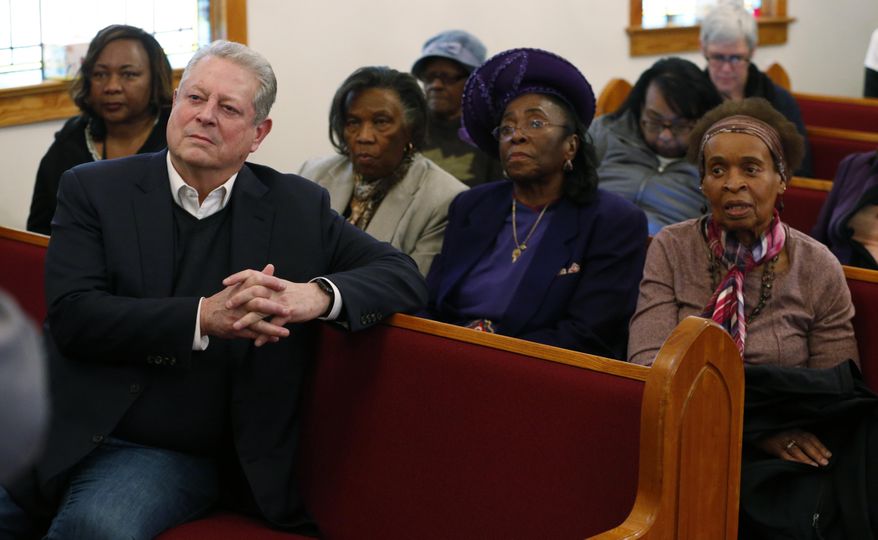
AP caption: Former Vice President Al Gore, left, listens to speakers during a meeting at the Grove Missionary Baptist Church in Buckingham, Va., Tuesday, Feb. 19, 2019. Gore visited the area that is the proposed site for a compressor station for the Atlantic Coast Pipeline. (AP Photo/Steve Helber)
Should be obviously silly for anyone to argue former divinity student Al Gore is evil, as this film implies despite the demurrer. It should also be obviously that it’s evil to call Gore wrong on these issues; but that doesn’t stop brown Earther critics of scientists and Al Gore.

I warned you about it earlier. Crank science sites across the internet feature news of another cheap hit on Rachel Carson and science in movie form.

“Not Evil, Just Wrong” is slated for release on October 18. This is the film that tried to intrude on the Rachel Carson film earlier this year, but managed to to get booked only at an elementary school in Seattle, Washington — Rachel Carson Elementary, a green school where the kids showed more sense than the film makers by voting to name the school after the famous scientist-author.

The film is both evil and wrong.

Errors just in the trailer:

  1. Claims that Al Gore said sea levels will rise catastrophically, “in the very near future.” Not in his movie, not in his writings or speeches. Not true. That’s a simple misstatement of what Gore said, and Gore had the science right.
  2. ” . . . [I]t wouldn’t be a bad thing for this Earth to warm up. In fact, ice is the enemy of life.” “Bad” in this case is a value judgment — global warming isn’t bad if you’re a weed, a zebra mussel, one of the malaria parasites, a pine bark beetle, any other tropical disease, or a sadist. But significant warming as climatologists, physicists and others project, would be disastrous to agriculture, major cities in many parts of the world, sea coasts, and most people who don’t live in the Taklamakan or Sahara, and much of the life in the ocean. Annual weather cycles within long-established ranges, is required for life much as we know it. “No ice” is also an enemy of life.
  3. “They want to raise our taxes.” No, that’s pure, uncomposted bovine excrement.
  4. “They want to close our factories.” That’s more effluent from the anus of male bovines.
  5. The trailer notes the usual claim made by Gore opponents that industry cannot exist if it is clean, that industry requires that we poison the planet. Were that true, we’d have a need to halt industry now, lest we become like the yeast in the beer vat, or the champagne bottle, manufacturing alcohol until the alcohol kills the yeast. Our experience with Rivers and Harbors Act of 1899, the Clean Air Acts and the Clean Water Act is that cleaning the environment produces economic growth, not the other way around. A city choked in pollution dies. Los Angeles didn’t suffer when the air got cleaner. Pittsburgh’s clean air became a way to attract new industries to the city, before the steel industry there collapsed. Cleaning Lake Erie didn’t hurt industry. The claim made by the film is fatuous, alarmist, and morally corrupt.

    When the human health, human welfare, and environmental effects which could be expressed in dollar terms were added up for the entire 20-year period, the total benefits of Clean Air Act programs were estimated to range from about $6 trillion to about $50 trillion, with a mean estimate of about $22 trillion. These estimated benefits represent the estimated value Americans place on avoiding the dire air quality conditions and dramatic increases in illness and premature death which would have prevailed without the 1970 and 1977 Clean Air Act and its associated state and local programs. By comparison, the actual costs of achieving the pollution reductions observed over the 20 year period were $523 billion, a small fraction of the estimated monetary benefits.

  6. “Some of the environmental activists have not come to accept that the human is also part of the environment.” Fatuous claim. Environmentalists note that humans uniquely possess the ability to change climate on a global scale, intentionally, for the good or bad; environmentalists choose to advocate for actions that reduce diseases like malaria, cholera and asthma. We don’t have to sacrifice a million people a year to malaria, in order to be industrial and productive. We don’t have to kill 700,000 kids with malaria every year just to keep cars.
  7. “They want to go back to the Dark Ages and the Black Plague.” No, that would be the film makers. Environmentalists advocate reducing filth and ignorance both. Ignorance and lack of ability to read, coupled with religious fanaticism, caused the strife known as “the Dark Ages.” It’s not environmentalists who advocate an end to cheap public schools.
  8. The trailer shows a kid playing in the surf on a beach. Of course, without the Clean Water Act and other attempts to keep the oceans clean, such play would be impossible. That we can play again on American beaches is a tribute to the environmental movement, and reason enough to grant credence to claims of smart people like Al Gore and the scientists whose work he promotes.
  9. “I cannot believe that Al Gore has great regard for people, real people.” So, this is a film promoting the views of crabby, misanthropic anal orifices who don’t know Al Gore at all? Shame on them. And, why should anyone want to see such a film? If I want to see senseless acts of stupidity, I can rent a film by Quentin Tarantino and get some art with the stupidity. [Update, November 23, 2009: This may be one of the most egregiously false charges of the film. Gore, you recall, is the guy who put his political career and presidential ambitions on hold indefinitely when his son was seriously injured in an auto-pedestrian accident; Gore was willing to sacrifice all his political capital in order to get his son healed. My first dealings directly with Gore came on the Organ Transplant bill. Gore didn’t need a transplant, didn’t have need for one in his family, and had absolutely nothing to gain from advocacy for the life-saving procedure. It was opposed by the chairman of his committee, by a majority of members of his own party in both Houses of Congress, by many in the medical establishment, by many in the pharmaceutical industry, and by President Reagan, who didn’t drop his threat to veto the bill until he signed it, as I recall. Gore is a man of deep, human-centered principles. Saying “I can’t believe Al Gore has great regard for real people” only demonstrates the vast ignorance and perhaps crippling animus of the speaker.]

That’s a whopper about every 15 seconds in the trailer — the film itself may make heads spin if it comes close to that pace of error.

Where have we seen this before? Producers of the film claim as “contributors” some of the people they try to lampoon — people like Ed Begley, Jr., and NASA’s James E. Hansen, people who don’t agree in any way with the hysterical claims of the film, and people who, I wager, would be surprised to be listed as “contributors.”

It’s easy to suppose these producers used the same ambush-the-scientist technique used earlier by the producers of the anti-science, anti-Darwin film “Expelled!

Here, see the hysteria, error and alarmism for yourself:

Ann McElhinney is one of the film’s producers. Her past work includes other films against protecting environment and films for mining companies. She appears to be affiliated with junk science purveyors at the Competitive Enterprise Institute, an astro-turf organization in Washington, D.C., for whom she flacked earlier this year (video from Desmogblog):

Remember, too, that this film is already known to have gross inaccuracies about Rachel Carson and DDT, stuff that high school kids could get right easily.

Anyone have details on McElhinney and her colleague, Phelim McAlee?

More:

Related posts, at Millard Fillmore’s Bathtub:


What if Al Gore were wrong about global warming? That would be great news.

December 6, 2009

It’s a point that the denialists just don’t get.  If Gore were wrong, if warming isn’t occurring, or if the warming were found to be part of a deeper cycle and all we need to do is hang on for another five or six years until the cycle shifts, that would be great news.

No one would complain about a study that actually showed that.

But no study shows that.  And the e-mails that somebody purloined from an English research center, if the worst allegations about scientists were true, can’t affect warming.  In fact, as I understand it, the chart that was “doctored” got its new, non-tree-ring data from actual thermometer readings — which, of course, show warming.

Worse, the chart’s predictions for following years turn out to be low!  Warming is outpacing some of the pessimists’ predictions.

Johann Hari, a columnist with the internet-fueled London Independent, discusses how good the news would be, in a missive at Huffington Post.

Every day, I pine for the global warming deniers to be proved right. I loved the old world – of flying to beaches wherever we want, growing to the skies, and burning whatever source of energy came our way. I hate the world to come that I’ve seen in my reporting from continent after continent – of falling Arctic ice shelves, of countries being swallowed by the sea, of vicious wars for the water and land that remains. When I read the works of global warming deniers like Nigel Lawson or Ian Plimer, I feel a sense of calm washing over me. The nightmare is gone; nothing has to change; the world can stay as it was.

But then I go back to the facts. However much I want them to be different, they sit there, hard and immovable. Nobody disputes that greenhouse gases trap heat in the atmosphere, like a blanket holding in the Sun’s rays. Nobody disputes that we are increasing the amount of those greenhouse gases in the atmosphere. And nobody disputes that the world has become considerably hotter over the past century. (If you disagree with any of these statements, you’d fail a geography GCSE).

Alas, there is no significant or credible evidence that warming is not occurring, nor that we humans are not playing a huge role.

So, in Copenhagen where the world’s leaders and other policy makers are meeting this week to discuss the situation, there will be no champagne to toast an end to global warming.

That would be good news.  It’s not the news we get.

Also see:


Starlings of climate change denial do about-face on data-corruption and fraud

November 29, 2009

Funny.  Zumwalt never complained when the data-corruption and fraud were all on the denialists’ side.

I am reminded that, as of the end of November 2009, there are incredibly few science papers (see CCPO’s note) — meaning papers based on research, published in peer-review journals — which make any case contrary to global warming occurring, nor even against the link that much of current warming is caused by human activities.

Under softball rules, the game would have been called against denialists long ago.  Now they want to claim victory on a disqualification, when they violated that rule with gusto through the entire game so far?


Yeah, it’s ironic (hacked e-mails and global warming)

November 26, 2009

James’s Empty Blog:

It is hard to miss the irony in people eagerly poring through illegally-obtained private email, looking for ethical breaches by the writers! I’m sure we can all imagine the outrage if one of the emails revealed that a scientist had hacked into one of the sceptics’ computers and was reading all their correspondence. So a bit of perspective is called for here.

James Is A Scientist (IANAS), and he has much good stuff to say (read some of the other posts about the hacked e-mails while you’re there) — but you gotta wonder about a blog that follows such a post with this:

Prawns, Jules Berry

Prawns not in their native habitat. Probably Tastimus deliciousus

Tip of the old scrub brush to Stoat.


Purloined CRU e-mails on climate science: One scientist pleads for accuracy

November 24, 2009

Here is what he said.  Edward Cook, one of the world’s foremost authorities on ancient trees and how to learn from them (Dendrochronology),  wrote to Michael Mann, both men scientists involved in making their science understandable and available to the public and the International Panel on Climate Change (IPCC).  Both men thought their communication would be private, probably forever.  When no one is looking, this is what they say to one another:

From: Edward Cook <drdendro@xxxxxxxxx.xxx>
To: “Michael E. Mann” <mann@xxxxxxxxx.xxx>
Subject: Re: hockey stick
Date: Wed, 2 May 2001 15:25:41 -0400
Cc: tom crowley <tom@xxxxxxxxx.xxx>, esper@xxxxxxxxx.xxx, Jonathan Overpeck <jto@u.arizona.edu>, Keith Briffa <k.briffa@xxxxxxxxx.xxx>, mhughes@xxxxxxxxx.xxx, rbradley@xxxxxxxxx.xxx, p.jones@xxxxxxxxx.xxx, srutherford@xxxxxxxxx.xxx

Hi Mike,

No problem. I am quite happy to work this stuff through in a careful way and am happy to discuss it all with you. I certainly don’t want the work to be viewed as an attack on previous work such as yours. Unfortunately, this global change stuff is so politicized by both sides of the issue that it is difficult to do the science in a dispassionate environment. I ran into the same problem in the acid rain/forest decline debate that raged in the 1980s. At one point, I was simultaneous accused of being a raving tree hugger and in the pocket of the coal industry. I have always said that I don’t care what answer is found as long as it is the truth or at least bloody close to it.

Cheers,

Ed

This note appeared at the end of a rough-and-tumble debate over what data can be trusted, the motives of scientists involved, and how to make the best use of data collected, clear and unclear, in order to make an accurate portrayal of what is happening in our atmosphere.

I’ll wager no critic of these scientists bothered to quote this one today, nor will they.  In toto, the purloined e-mails show a devotion to science, and the requisite devotion to accuracy and ethical behaviors.  But in a political debate where television weathermen feel compelled to demonize scientists to promote their political beliefs, who can afford to look at the big picture?

My apologies to Dr. Cook for the purloining of the e-mail (though of course I had no role in the hacking); my appreciation to Dr. Cook for standing up for what’s right, damn the critics, when he th0ught no one was looking.

That’s the definition of character, isn’t it?

E-mail this:

Add to FacebookAdd to NewsvineAdd to DiggAdd to Del.icio.usAdd to StumbleuponAdd to RedditAdd to BlinklistAdd to TwitterAdd to TechnoratiAdd to Furl


Smoking guns in the CRU stolen e-mails: A real tale of real ethics in science

November 22, 2009

Climate skeptics fear that some climate scientists have cooked their data in order to produce a pre-ordained outcome from their research.  Many of these people are excited this weekend at the public release of e-mails purloined from Climate Research Unit at East Anglia University in England, from one of the leading climate research labs.  Every crank science and crackpot political site has a story touting the end of research on global warming.

Sure enough, with just a few minutes of searching the e-mails, I found references to ethical breaches in cooking of data, and a discussion about how to talk about  the data and the issue in public.

The paper involved is this one:

David H. Douglass, John R. Christy, Benjamin D. Pearsona and S. Fred Singer, “A comparison of tropical temperature trends with model predictions,” INTERNATIONAL JOURNAL OF CLIMATOLOGY, Int. J. Climatol. (2007).  Published online in Wiley InterScience (www.interscience.wiley.com) DOI: 10.1002/joc.1651

Unless you follow this issue closely, you probably don’t see the problem with publicizing the ethical breaches scientists thought they saw in this paper and its publication.  Also, if you are a “skeptic” who is chronically apoplectic over Al Gore’s success in informing people about climate change and winning prizes and making money, you may be thrilled that there is a scientist anywhere worried about ethical lapses by scientists involved in this controversy, and you can’t wait to see them brought to justice (cooking data is a federal crime in the U.S., if done with federal research money).

[Yes, I think there are ethical questions about publishing anything from these e-mails, let alone links so the viewing public can read them completely.  However, since much of this material has already been cherry picked and quote mined by political activists who hope to stop action to mediate and stop global warming, I think a good case can be made that, to be fair, we should look at the entire collection to see what they really reveal.  There may be criminal liability for some of the disclosures I’m discussing here — but that liability does not fall on the scientists who have been unfairly impugned in the last few days.  The liability falls instead on the critics of warming.  Let’s be fair.  In  a fair fight, truth wins.]

So, hold your high-fives and “I-told-you-sos” until you look at the data, at the information found.

One of the e-mails is quite explicit:

I think the scientific fraud committed by Douglass needs to be exposed. His co-authors may be innocent bystanders, but I doubt it.

Fraud?  Right there in front of everyone?  In the climate debate?

In the end, the scientists in the discussion determined not to hold a press conference to announce a finding of fraud, but instead to hunker down and work on publishing datasets that would contradict the alleged fraudulent paper, and establish their case with data instead of invective and press conferences.

They even declined to rush to inform the public of the fraud after a lengthy series of attempts to duplicate the results with well-known, accurate methods on accepted data:

Bottom line: Douglass et al. claim that “In all cases UAH and RSS satellite trends are inconsistent with model trends.” (page 6, lines 61-62). This claim is categorically wrong. In fact, based on our results, one could justifiably claim that THERE IS ONLY ONE CASE in which model T2LT and T2 trends are inconsistent with UAH and RSS results! These guys screwed up big time. [emphasis added by MFB]

Anthony Watts and others may be justified in asking that the scientists who wrote this fraudulent paper should be summarily dismissed, and in questioning why other scientists dallied in exposing the fraud.

But there is this to consider:  The paper in question is a paper critical of warming hypotheses, and it was co-authored by at least a couple of the most strident critics of Al Gore, James Hansen, the International Panel on Climate Change (IPCC).

The smoking gun was used to shoot down a hasty effort to brand climate-change critics as unprofessional and wrong.  The smoking gun was used to enforce the hard ethical rules of science:  Don’t speak until your data allow a fair conclusion.

The smoking gun e-mails show correct and careful behavior by the scientists who contributed to the IPCC report, but unethical behavior by the critics whose backers, we might assume, stole the e-mails in the first place, and published them without understanding the depth of moral character demonstrated by most scientists in the conduct of their professions.

Now, I have not analyzed every possible permutation of this thread, only those with the title shown.  I used the “Alleged CRU e-mails — searchable” cited by Anthony Watts and others.  I stumbled into the thread discussing the paper by “Douglass, et al.”  I then did a search for e-mails discussing “Douglass,” and limited it to the thread on this point.  I suspect there are other e-mails in that thread in which Douglass’s name is wholly missing, and which did not turn up  in the search.

Now you know the rest of the story.  Fred Singer is a leading denialist, one of the organizers of the political campaign to blunt the publication and discussion of evidence of global warming and what to do about it.  The Douglass, et al. paper under discussion was a key component of the denialists’ campaign in 2007.  The purloined e-mails point to unethical behaviors by the scientists on the anti-warming side, the so-called “skeptics.”

So, from a quick dive into the data we learn:

  1. Climate scientists talk like Boy Scouts trying to impress a Board of Review.
  2. Climate scientists are extremely careful with data.
  3. When they think no one is looking, climate scientists behave ethically.
  4. When they think have found a piece of fraud, climate scientists are careful to recheck their numbers several times and in several ways before saying anything.
  5. Instead of holding a press conference, climate scientists like to keep the fisticuffs in the confines of juried journals.
  6. Climate “skeptics” are full of themselves, and probably wrongly accuse climate scientists of fixing data.
  7. Fraud in climate science may occur, but generally on the side of those who argue against warming or who advocate inaction as a response.
  8. The claims of smoking guns that negate the case for doing something about global warming are most likely hoaxes.

Here are the texts I looked at:

Update, November 25, 2009: Be sure to check out these posts, at George Monbiot’s blog in the comments, at Stoat,  and here at the Bathtub. This is the best judgment on the affair, I think, from Our Kingdom at Open DemocracyRespect to any climate-deniers who invest all their pension funds in seashore hotels in the Maldives… otherwise, they should step aside, and let the work of saving the future begin.”

Smoke this:

Add to FacebookAdd to NewsvineAdd to DiggAdd to Del.icio.usAdd to StumbleuponAdd to RedditAdd to BlinklistAdd to TwitterAdd to TechnoratiAdd to Furl


Newtongate shakes anthropogenically-generated mathematics at the foundation

November 22, 2009

Satire, hoax, fact — how can we tell the difference?

Maybe more importantly, how can we tell early on that the “Climategate” kerfuffle, involving purloined, but otherwise dull e-mails from climate scientists, is nothing to worry about?

Look at history!  Remember Newtongate?  Read it here, at Carbon Fixated.

If you own any shares in companies that produce reflecting telescopes, use differential and integral calculus, or rely on the laws of motion, I should start dumping them NOW. The conspiracy behind the calculus myth has been suddenly, brutally and quite deliciously exposed after volumes of Newton’s private correspondence were compiled and published.

When you read some of these letters, you realise just why Newton and his collaborators might have preferred to keep them confidential. This scandal could well be the biggest in Renaissance science. These alleged letters – supposedly exchanged by some of the most prominent scientists behind really hard math lessons – suggest:

Conspiracy, collusion in covering up the truth, manipulation of data, private admissions of flaws in their public claims and much more.

But perhaps the most damaging revelations are those concerning the way these math nerd scientists may variously have manipulated or suppressed evidence to support their cause.

What kind of conspiracy keeps calculus being taught to innocent children today?  Exactly the same conspiracy that causes scientists to sound the alarms about climate change.

Tip of the old scrub brush to Tim Lambert at Deltoid.


Al Gore shows how green investing works

November 3, 2009

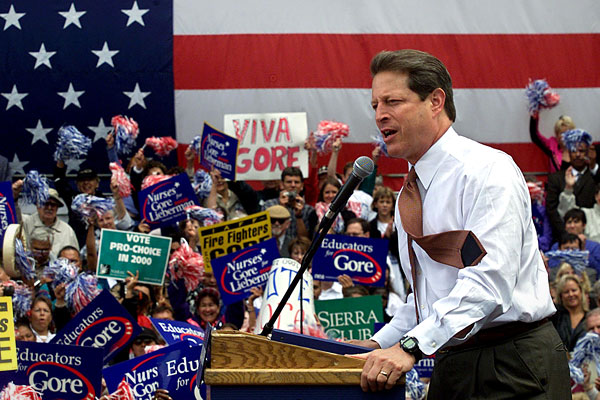
Then Vice President Al Gore campaigning in Des Moines, Iowa, November 25, 1999.

Then Vice President Al Gore campaigning in Des Moines, Iowa, November 25, 1999.

Among the more amusing about-faces in conservative knee-jerk politics is conservative criticism of Al Gore for being a successful investor.

No, I’m not kidding.

Back in April, Gore testified to a House Energy and Commerce Committee in April — one of the committees where Gore was a shining star when he was a Member — and he ran into a challenge from Tennessee Rep. Marsha Blakburn who tried to play bad cop in grilling Gore about his investment work.  Since leaving politics Gore has worked to put his money where his advocacy is, backing green industries and energy efficiency projects. Blackburn is a Republican representing Tennessee’s 7th District. Blackburn appears not to understand how cross-examination works.

In most discussions I’ve had on warming issues over the past two months, advocates for doing nothing almost always bring up Gore as as “profiteer” for investing in green businesses.

It’s as if conservatives and Republicans have forgotten how business works in a free-enterprise system, and they think that free enterprise is tantamount to communism.

T. Boone Pickens used to be a favorite witness for Republicans to call at Congressional hearings.  Pickens was, and still is, a staunch advocate of free enterprise, and he advocates a lot less regulation than most Democrats want.  Then Pickens’s investments, especially his vulture investments in dying companies where he’d sell off the assets and put the company out of existence, were touted by Republicans as indication that Pickens is a genius.

A hard look at Gore’s investments shows him to be nothing more than a free-enterprise advocate who leads the way in green investments.  He has made huge gambles in businesses that warming skeptics claim won’t work — and his investments have tended to pay off, to the great consternation of warming do-nothings who understand markets.

This story in the New York Times suggests just how well Gore has done, and how much his leadership in investing might benefit us.  It’s worth bookmarking for your next discussion on what we should do about global warming — because you know somebody will try to make it about Al Gore.  It just galls the heck out of conservatives and anti-science folks that Gore is right so often, and that he is such a practitioner of the Scout Law.

Anti-pollution is good business.  Reducing the dumping of poisons into the air and water makes sense, and it makes a better economy in the long run.  Sometimes it makes a better economy in the short run, too.  Gore stepped into the marketplace, a very capitalist act.  His investments paid off, demonstrating that markets do work, and demonstrating that green business is smart business.  What are Republicans and conservatives thinking in taking after Gore’s business success?

Oh — Boone Pickens? He used to have an office in Trammell Crow Tower when our offices at Ernst & Young LLP were a floor or so away.  We shared elevator rides many times, and he is in person as gracious and smart as he appeared in those Congressional hearings years ago.

His money today?  He’s investing in wind power, because he thinks we need to act now to reduce dependency on oil imports.

Maybe Republican anti-green politics is coming home to roost.

Add to FacebookAdd to NewsvineAdd to DiggAdd to Del.icio.usAdd to StumbleuponAdd to RedditAdd to BlinklistAdd to TwitterAdd to TechnoratiAdd to Furl


Naomi Oreskes: The lecture Lord Monckton slept through, which he hopes you will not see

October 23, 2009

Here’s another example of where historians show their value in science debates.

Naomi Oreskes delivered this lecture a few years ago on denialism in climate science.  Among other targets of her criticism-by-history is my old friend Robert Jastrow.  I think her history is correct, and her views on the Marshall Institute and denial of climate change informative in the minimum, and correct on the judgment of the facts.

You’ll recognize some of the names:  Jastrow, Frederick Seitz, S. Fred Singer, and William Nierenberg.

Oreskes details the intentional political skewing of science by critics of the serious study of climate warming.  It’s just under an hour long, but well worth watching.  Dr. Oreskes is Professor of History in the Science Studies Program at the University of California at San Diego.  The speech is titled “The American Denial of Global Warming.”

If Oreskes is right — and I invite you to check her references thoroughly, to discover for yourself that her history and science are both solid — Lord Monckton is a hoaxster.  Notice especially the references after the 54 minute mark to the tactic of claiming that scientists are trying to get Americans to give up our sovereignty.

Nothing new under the sun.

“Global warming is here,  and there are almost no communists left,” Oreskes said.

Nudge your neighbor:

Add to FacebookAdd to NewsvineAdd to DiggAdd to Del.icio.usAdd to StumbleuponAdd to RedditAdd to BlinklistAdd to TwitterAdd to TechnoratiAdd to Furl


Watts falls victim to Monckton’s voodoo

October 19, 2009

Among those who call themselves “skeptical” of claims about climate change, Anthony Watts has distinguished himself from time to time for often using solid science and raising good questions.  His campaign to look at the placement of weather reporting stations indicates an understanding of the way science should work (though we haven’t seen results).

So, what’s Watts doing repeating Monckton’s hysterical, inaccurate rantWe already know Monckton’s testimony is impeached.

Is Watts so politically naive as to think any nation would cede sovereignty on an issue of climate change? One more indication that people should stick to their knitting, and not venture into areas where they have no expertise.


Monckton lies again (and again, and again, and again, and again . . .)! The continuing saga of a practicer of fictional science

October 18, 2009

When Monckton claimed that Jackie Kennedy was responsible for malaria in Africa, I thought it a great stretch.

Holy cow!  Monckton gave a speech in Minnesota, and if this quote is representative, it was a one man re-enactment of the Burlington Liar’s Club quarterfinals for 2002 through 2008 (he was disqualified for lack of humor).  Monckton spoke at Bethel University in St. Paul on October 15, 2009:

Here is an excerpt from his speech:

Here is why the truth matters. It was all very well for jesting Pilate to ask that question and then not to tarry for an answer. But that question that he asked, “what is the truth?” is the question which underlies every question and in the end it is the only question that really matters. When you ask that question what you are really asking is “what is the truth about the matter?” And we are now going to see why it matters morally, socially, and politically, as well as economically and scientifically. That the truth, the whole truth and nothing but the truth should inform public policy on this question. Now, 40 years ago, DDT, the only effective agent against the malaria mosquito was banned. And you saw in that film [Cascade Policy Institute film “Climate Chains” was shown prior –ed] what the effect of that ban was. Before the ban, the inventor of DDT got the Nobel Peace Prize because he had saved more lives than anyone else in the history of the planet. Malaria, one of the greatest killers of children in the Third World had all but been eradicated. There were still 50,000 deaths per year. But when DDT was banned by exactly the same faction, that is now trying to tell us we must close down five sixths of the United States economy that figure is actually in the Waxman- Markey bill. That same faction banned DDT worldwide. The consequences are on the slide there. The number of deaths went up from 50,000 to a million a year and stayed there. For 40 years. 40 million people, nearly all of them children, died of malaria solely and simply because DDT had been banned for no good scientific reason or environmental reason whatsoever. And it was only after every single one of the people responsible for that dismal, murderous decision had retired or died that on September the 15th 2006, Dr. Arata Kochi of the World Health Organization said “Normally in this field, science comes second and politics comes first. But we will now take a stand on the science and the data, and he ended that ban on DDT and made it once again the front line of defense against the malaria mosquito. After pressure from me, among others.

Right there Monckton disqualified himself from ever being a Boy Scout with egregious disregard for the first point of the Scout Law. Oh, Monckton is dependable, but dependable only to tell falsehoods and stink up the place.  That excerpt provides the Recommended Annual Dose of both voodoo science and voodoo history.  Count the problems with me:

1.  DDT has never been the only effective means to fight malaria-carrying mosquitoes. DDT was  a very effective pesticide, though dangerous — but never the “only effective agent against the malaria mosquito.”  The U.S., for one example beat malaria (and yellow fever, and other mosquito-borne diseases) well enough to finish the Panama Canal in 1915 without DDT, by controlling mosquito breeding areas and using screens to protect sleeping workers from mosquitoes.  Malaria, once endemic in much of the U.S., was practically eliminated by 1939.  DDT was used in limited fashion to complete the eradication in the U.S., after World War II — but most of the work had already been done.  The Centers for Disease Control (CDC) (founded to control malaria) relates at its website:

Control efforts conducted by the state and local health departments, supported by the federal government, resulted in the disease being eradicated by 1949. Such measures included drainage, removal of mosquito breeding sites, and spraying (occasionally from aircrafts) of insecticides.

Aircraft spraying insecticide,  1920's
Aircraft spraying insecticide, 1920s
Drainage activities, Virginia, 1920's
Drainage activities, Virginia, 1920s

We still have the non-pesticide solutions, and they still work.  But 40 years ago, there were other pesticides that worked against the malaria vector mosquitoes.

The national library of the ancient Kingdom of Ghana had volumes on how to eradicate malaria, more than 500 years ago.  Monckton can’t even be bothered to Google the topic, let alone visit one of America’s more than 15,000 free county libraries, to get the facts?

2.  No Nobel Peace Prize was ever given for DDT, and the prize given wasn’t for saving malaria victims. Paul Müller won the Nobel in Physiology or Medicine in 1948, for his discovery that DDT killed insects.  There was no Peace Prize awarded in 1948.  A chemist working in biological chemicals won the Peace Nobel later — but it was Linus Pauling, who won in 1962 for his work against the proliferation of nuclear weapons.  [UPDATE:  Listening to Monckton’s speech, I note that the transcriber made a serious error.  Monckton did not specify the Nobel Peace Prize; it is still true that the Medicine Prize that Müller won was not on the basis of DDT’s saving an uncountable number of lives.  The chief medical advantage cited was the use of DDT fighting typhus; malaria gets a mention.  Monckton can’t be bothered with accuracy on such things, however, as is clearly shown.]

The bizarre claim about saving “more lives than anyone else in the history of the planet” comes from a wacko claim of the Lyndon Larouche cult, apparently based on a typographical error in a 1980 book from the National Academy of Sciences.

3.  Malaria rates have been greatly reduced in the 20th century, but malaria has never been “all but eradicated.” In the past 120 years, malaria has always killed more than 900,000 people a year; for most of the past 60 years, the death toll has been more than a million people a year, sometimes as high as 4 million people killed.  Annual malaria deaths have never been under a half million, let alone as low as 50,000.

4.  DDT has never been banned for use to control malaria. 40 years ago, in 1969, DDT was freely available world wide.  Sweden banned the stuff from agricultural use in 1970; the U.S. followed with a ban on agricultural use of DDT, especially sprayed from airplanes.  DDT for fighting malaria has always been a feature of the U.S. ban.  As a pragmatic matter, DDT manufacture on U.S. shores continued for more than a dozen years after the restrictions on agricultural use of the stuff.  In an ominous twist, manufacture in the U.S. continued through most of 1984, right up to the day the Superfund Act made it illegal to dump hazardous substances without having a plan to clean it up or money to pay for clean up — on that day the remaining manufacturing interests declared bankruptcy to avoid paying for the environmental damage they had done.  See the Pine River, Michigan Superfund site, or the Palos Verdes and Montrose Chemical Superfund sites in California,  the CIBA-Geigy plant in McIntosh, Alabama, and sites in Sand Creek, Colorado, Portland, Oregon, and Aberdeen, North Carolina, for examples.

5.  Nothing in Waxman-Markey anticipates closing down any part of the U.S. economy. This is a claim Monckton appears to have plucked from between his gluteals.  Here’s one summary of the bill (notice the money allocated to boost industry), here’s another, and here’s the summary from the House Energy and Commerce Committee.

6.  There’s no way to blame malaria deaths on a lack of DDT. As noted, DDT has been available for use in Africa and Asia since its patent.  More importantly, malaria death rates have been influenced by the failure of effectiveness of pharmaceuticals against the malaria parasite itself in humans.  DDT fights only the mosquitoes that carry the parasite.  But the difficulty wasn’t in beating the mosquitoes; the difficulty was in curing humans (from whom the mosquitoes get the parasite to pass along).

7.  DDT was restricted on the basis of overwhelming evidence of harms. This is one of those charges that is self-refuting in the hands of DDT advocates and anti-science people.  You don’t have to go far to find claims that EPA acted contrary to an extensive hearing record that took months to compose.  But then they turn around and claim, as Monckton does here, that there is no such record?  The facts are that the Environmental Protection Administration (EPA) hearings were conducted under the gun.  Two different federal courts had ordered the review, which had been started with the Department of Agriculture before the creation of EPA.  The hearing record itself fell out of favor with some officials, and even EPA’s library had difficulty finding a copy of the decision by Administrative Law Judge Edmund Sweeney — but intrepid fact seekers like Jim Easter tracked down the documents and posted them for all to see.  Easter notes that the record is clear on harms to wildlife, bio-magnification, and other dangers of DDT.  In fact, the only place Ruckelshaus differed from Sweeney was on the issue of cotton.  Sweeney thought he couldn’t prohibit use on cotton, Ruckelshaus found authority in the law and did so.

Be clear:  EPA banned DDT use on agricultural products, especially cotton, and broadcast spraying.  EPA’s “ban” allowed continued manufacture of DDT, and it allowed use for health emergencies and other emergencies.

8.  There never was a ban on DDT by the World Health Organization (WHO). So Monckton’s bizarre fiction that “. . . it was only after every single one of the people responsible for that dismal, murderous decision had retired or died that on September the 15th 2006, Dr. Arata Kochi of the World Health Organization said normally in this field, science comes second and politics comes first,” and then Kochi ended the ban, is whole cloth.

9.  There is no evidence anybody ever paid any attention to Monckton on DDT, but Monckton took credit for the imaginary end of the imaginary ban: ” After pressure from me, among others.”  There’s a distant possibility that Monckton might have written a letter to WHO — but let Monckton produce the thing from the archives of WHO.  Until that time, we should classify Monckton as an emboldened prevaricator, perhaps a victim of Munchausen’s Syndrome (not by proxy in this case).   I’m calling Monckton’s bluff.   Let’s see his cards on this issue:  When did he say anything to WHO about DDT, to whom, and what did he say?  He’ll not be able to produce any documentation, I’ll wager — and I’ll bet he can’t even produce hearsay testimony.

Nine falsehoods in a paragraph — a rate of falsehood not equalled even by Jon Lovitz’s pathological liar character. What is wrong with the excrement detectors of the people who sit in those audiences with this guy?

How far out of bounds is Monckton?  Even the shrill discussion at Little Green Footballs puts Monckton in the not-to-be-taken-seriously category.

Monckton, the Burlington Liars Club called:  They want their good reputation back.  Check your answering machine, too — the Bethel College group should be calling any minuted, to ask you to pay for the exorcism of their building after you spoke there.

By the way, how do we know Monckton is a coward?*  He has refused to debate me.  As he notes, anyone who refuses a debate is a coward.  And yet, he refuses each of my challenges.  Now he’s refusing to debate a Tenderfoot Boy Scout using Boy Scout Law rules.  How much of a coward does that make him?

_______________

* Of course that logic is flawed.  But he uses it against Al Gore.  Monckton can’t get Gore to suffer him, and so, Monckton, a moral pipsqueak, calls Gore a coward.  The “Freemarket Institute” people ate it up.  It’s more likely that Gore simply refuses to get into a urination contest with a known skunk.  Still, Monckton refuses to debate — what is he afraid of?

No lie!

Add to FacebookAdd to NewsvineAdd to DiggAdd to Del.icio.usAdd to StumbleuponAdd to RedditAdd to BlinklistAdd to TwitterAdd to TechnoratiAdd to Furl


Killer CO2 cloud – the story climate change “skeptics” hope you won’t read

October 14, 2009

From Neat-o-rama: Grazing cattle killed in the 1986 Lake Nyos disaster (Image Credit: Water Encyclopedia)

From Neat-o-rama: Grazing cattle killed in the 1986 Lake Nyos disaster (Image Credit: Water Encyclopedia)

It’s not even secret.  But those propagandists who run advertising claiming that carbon dioxide is natural and, therefore, harmless, hope against hope that you don’t know the true history, that you’ve never heard of Cameroon, that you don’t know about volcanic emissions, and that you forgot the story of the killer CO2 cloud of 1986.

Read it here, “Cameroon:  The Lake of Death.”

More information:

Lake Nyos, in Cameroon, shortly after the 1986 killer CO2 cloud. Image from Neat-o-rama.

Lake Nyos, in Cameroon, shortly after the 1986 killer CO2 cloud. Image from Neat-o-rama.

Help make a cloud of witnesses:

Add to FacebookAdd to NewsvineAdd to DiggAdd to Del.icio.usAdd to StumbleuponAdd to RedditAdd to BlinklistAdd to TwitterAdd to TechnoratiAdd to Furl

Save


Quick assist for students doing papers on climate change

October 14, 2009

So, you’re a student doing a paper on climate change, and you need help limiting the topic, or finding information about related topics.

Hot Topic has just the thing:  Interactive “debate maps.

Hot Topic is a website dedicated to the issue climate change in New Zealand — after the book by the same name.

Does anyone know where similar maps might exist for other social studies topics?