Monckton in New Zealand: His reputation for fabrication preceded him

August 9, 2011

John Abraham’s work ended up giving Christopher Monckton a bumpy ride into New Zealand, according to Country 99 News:

Monckton was lucky the news channel labeled him “Climate Skeptic” and not “Barking Mad.”

More: 


Climate denialists on Texas weather 2011: Ain’t no heat wave, on average

August 8, 2011

You couldn’t make this stuff up.

In defense of his claim that Texas has not warmed over the last century (“Texas temperatures not rising; Wisconsin temperatures not rising”) and, therefore, Texas does not suffer from global warming, and therefore there is no global warming and no ill effects from warming, Steve Goddard posted this today:

Year-To-Date In Texas

Posted on August 7, 2011 by stevengoddard

Almost as warm as 1927, 1925 and 1953. Only a degree cooler than 1911.

http://www.ncdc.noaa.gov/oa/climate/research/cag3/tx.html

It’s heading for 105°, but since it was 15° one day in February, that averages to 60°, so Texas is okay, according to Goddard.  In their drive to fuzz up the facts and surround policy debates with snark, the denialists will deny anything, leave no weather record untwisted, and deny the sweat on the nose on their face.  According to Goddard, snow in the Great Basin means no drought in Las Vegas, as shown by there being no drought affecting Lake Powell.

Remember Straight Dope’s Cecil Adams’s old line?  “Fighting ignorance since 1973 (it’s taking longer than we thought.)”  Yeah, that applies to climate denialists in quantity.

Here’s what’s going on in Texas right now:

Vodpod videos no longer available.

  •  Texas A&M says the drought of 2011 is the worst ever 1-year drought in Texas history; note how their press release describes the event, and the increasing heat:

    Preliminary reports from the National Climatic Data Center indicate that July 2011 was the warmest month ever recorded statewide for Texas, with data going back to 1895, [State Climatologist John] Nielsen-Gammon reports. The average temperature of 87.2 degrees broke the previous record of 86.5 degrees set in 1998. The June average temperature of 85.2 was a record for that month and now ranks fifth warmest overall.

    Rainfall totals were also unusually light across the state. The July monthly total of 0.72 inches ranks third driest, surpassed by the 0.69 inches recorded in both 1980 and 2000. This is the fifth consecutive month in which precipitation totals were among the 10 driest for that month, says the Texas A&M professor.

Drought and searing heat in Texas.  Caused by climate change?  That’s difficult to say, difficult to trace.  Made worse by climate change?  Most likely.

Dallas media track the consecutive days over 100° F.  It’s a form of misery index — people can recover from a day or two over the century mark.  But more than a couple of days and the heat begins to take a heavier toll on people, on plants and animals, on houses, on cars, on crops, on everything we do in Texas.  It’s difficult to make news make sense on weather stories.  Tracking the number of days over 100° gives a quick graphic for television news, and puts the story into the vein of a sports record story, a narrative people know.

Here’s how things stack up in Dallas, in terms of days over 100°:

Rank Year Consecutive 100° days
1 1980 42
2 2011 37 (and counting)
3 1998 29
4 1952 25
5 1999 24
6 1954 20
7 2006 19
8 2010 18
8 1978 18
10 1956 17

If one looks at the heat streaks, one cannot help but notice that all of the top ten streaks have come since 1952, and that three are in the last decade, five since 1998.  Brutal heat streaks appear to be coming more frequently, many close on the heels of previous heat streaks, and with greater severity.

That is what one would expect from global warming.

Moreover, the recent streaks show greater oscillations.  2011 also saw snow and freezing weather in Dallas, a rarity.  Greater oscillations in weather also would be expected from global warming.

Goddard offers a comparison of January to June temperatures — the coolest part of the calendar year, and leaving out most of the heat-streak days — and on that basis of a half-comparison, he suggests (doesn’t say — he doesn’t want to be caught lying outright) that there isn’t a warming problem in Dallas in 2011.

Heat stroke?  It’s a figment of your socialist imagination.  14 dead?  They probably were smokers.  Global warming?   Not if Steve Goddard can find a statistic somewhere that can be manipulated to appear to deny it.

What do his charts show for July and August of those years?

Finally, there is this:   Assume for a moment that there has been no significant warming in Texas as a complete landmass over the past 100 years:  Does that mean Texas is not battered by any warming that occurs elsewhere?

Of course not.  The current drought in Texas is thought to be triggered in no small part by the La Niña effect, a chilling of the surface of the Pacific in a broad band that stretches west of Peru for about 5,000 miles to the far South Pacific.  La Niña is a counterpart to El Niño, a warming of the same band of water that produces different, not-average weather effects.  The cycles are not well understood as to cause — there are good hypotheses being tested — but it has been observed that, especially in the latter part of the 20th century and the first decade of the 21st, these cycles are speeding up.  The best, not-disproven hypothesis is that these cycles react and speed up due to global warming.

So, to the best of our hypothesizing today, the Texas drought is a function of global warming, in timing, frequency and severity.

This demonstrates the ultimate problem with using a local temperature readings to make authoritative statements about global warming, even averaged over about a hundred million acres like Texas:  Problems of global warming are not always simply problems of temperature, and non-local causes may cause local effects that will not show up in temperature, especially local effects in precipitation, in timing and amounts.

Botanists, foresters, range scientists and biogeographers noticed effects of warming 50 years ago, with the migration of species northward, and up mountainsides.  Wildlife managers noticed altered migrations of game birds and non-game birds about the same time, migration alterations that continue to today.  Plant zones used by farmers and gardeners demonstrate a good deal of change, generally favoring warming, over the past century.  Evidence for warming is quite solid without a single temperature reading.

A bastion of average temperature non-increases, if Texas is one, may still be hammered by warming and its effects in the Pacific, and especially in the Gulf of Mexico.  Is it fair to say the entire system shows no signs of warming?

So we should ask:  Are temperatures and precipitation averages, frequencies, timing and totals, about average for the last century or two?  Then  the case for global warming is a bit weaker.

Dallas will eclipse the previous record string of 100° F days in the next week.  All of Texas is in severe drought, and most of the state is in extreme drought.  Sounds as if there is something going on with the climate.

Last year the denialism sites lit up with a report that a fourth grade student in South Texas had a science project that disproved global warming, and which won an award from the National Science Foundation.  It was a sad hoax.  The speed with which these sites pounced on the report should have warned us that a school of thought devoid of practical results from the lab bench or observation in nature gets too desperate for results, and will cut corners to claim them.  Goddard’s reports repeat the bad methodology of that hoax.

Richard Feynman once wrote, wryly, “Science is the belief in the ignorance of experts.”  Goddard and other denialists appear to read that wrongly, thinking that experts are not to be trusted, and that all experts are ignorant of all things, and therefore stupid.

Politics and especially the politics of science cry out for someone to read Feynman — actually read what he wrote.  Feynman said we should not assume all scientists are infallible.  He did not write that all scientists are fallible and wrong.


Wind power, more than just talk

July 30, 2011

I missed Global Wind Day on June 15 — too much static from the ironically long-winded anti-winders.

Voice of America claims wind power offers great potential.  Climate denialists, used to denying all facts especially if they are hopeful, will deny it any way they think they can.*

These posts are for examples only, and should not be interpreted to mean that the blogs sampled are composed entirely of denials, or that the blog authors and editors are themselves pure denialists — certainly they will deny that.  We will gladly post links to posts at those blogs that promote benefits of harnassing wind energy, if anyone can find them.


History and economics of energy use and conservation – a more accurate version

July 30, 2011

Our memorial to George Washington neared completion in the 1880s.  For an obelisk more than 550 feet tall to honor the Father of Our Country, planners decided to top it with a “capstone” made of the what was, then the most precious metal known on Earth.  The top is a pyramid, and the top of the pyramid is a one-pound block of this precious metal.

What was the most precious metal known to humans in 1880?  Gold?  Platinum?  Tungsten, perhaps, not yet chosen to be filaments in the yet-to-be-perfected Edison “A” lightbulb?

Washington’s Monument is topped with aluminum.

Yeah, aluminum.

“But,” you begin to sputter in protest, “aluminum is almost ubiquitous in soils, and it’s cheap — we use it in soda cans because it’s cheaper than steel or glass, for FSM’s sake!”

Today, yes.  In 1880, no.  Aluminum requires massive amounts of energy to refine the stuff from ore.  Aluminum is common in soils and rocks, but it couldn’t be refined out easily for use.

That problem’s solution was electricity, generated from coal or especially falling water.  For a while, our nation’s biggest aluminum refining plants resided in the state of Washington, not because they were close to aluminum ore deposits, but because there was a lot of cheap electricity available from the Grand Coulee and other dams on the mighty Columbia River.  It was cheaper to transport the ore long distances for refining than to transport the electricity.

This history reveals a lot about science, history, energy use, resource conservation and economics — areas in which most climate denialists appear to me to lack knowledge and productive experience.

Peter Sinclair more often explains why climate denialists get things wrong.  In this video, the first of what could be a significant series, Sinclair explains how we got to where we are today in energy use and conservation — or energy overuse and lack of conservation, if the Tea Party and Rand Paul get their way.  (Notice the ingots of aluminum shown in the historic film footage.)

This is history which has been largely covered up, partly because so much critical stuff happened in the 1960s, 1970s and 1980s, a time the internet doesn’t cover well.

5,842

Annals of Global Warming: Toles cartoon, seven years ago we were a decade overdue for action

July 14, 2011

Tom Toles cartoon on global warming inaction, from 2004

A Tom Toles cartoon from 2004

Insert a definition of “filibuster” here.

Then pray for action.

Then call your congressman, and him/her to act, now.

_____________

Note on Tom Toles from the Department of Earth Sciences, G-107 Environmental Geology, Indiana University-Purdue University at Indianapolis (IUPUI):  “A political cartoon from the Washington Post on climate change. Tom Toles, a political cartoonist, often pens cartoons on environmental issues. His cartoons are often reprinted in other newspapers (Washington Post/Universal Press Syndicate).”


Are you ready to deal with effects of global warming?

July 12, 2011

Why not?  These guys argue that the most rational solution is to get ready to deal with the problems, and stop worrying about the science behind “whether.”

If a global warming debate about certainty and cause only deepens doubt and defensiveness, what kind of debate would create support for action? We saw Hurricane Katrina as an opportunity to shift from the tired debate over cause and prevention to a new discussion about preparedness, thus reframing global warming from certainty to uncertainty and from limits on human activity to greater activity. Regardless of the cause, global warming is here and we need to prepare for it in the same way we prepare for any other imaginable natural disaster, not knowing exactly when or where it will strike. Global Warming Preparedness was created to test the possibility that action on global warming could be taken, not in spite of uncertainty, but because of it. (Breakthrough Institute, Plan for Global Warming Preparedness)

Are they right?

(Reminds me of the old wisdom from the Starbucks coffee cup.)


Meanwhile, in the evolution debates, where we find the Mother of All Denialism . . .

June 29, 2011

Other fronts in the War on Education may have earned more attention here in the Bathtub, lately — and in state legislatures.  Threats from the dilution and elimination of good, hard science courses continue to pose problems, especially from creationists and their shyer, camouflage troops from the Chapel of Intelligent Design.

We need to stay aware of the creationist/creationism threat.  At its heart, creationism requires adherents to reject the facts of science, to reject the workings of science, and to reject the functions of debate about what is real, and what is not.  It is to me a rather simple discussion of the quality of evidence.

Eugenie Scott and her colleagues from the National Center for Science Education provide a great update in what is going on, with a great video, and an informative and troubling explanation of the links between creationism and the “unbelievers” in climate change.

Be sure to watch the first ten minutes, to see the video update on the fight to keep good science education in schools, especially the teaching of evolution.


Blame global warming for wild weather? NASA says, “Blame La Nada”

June 27, 2011

Here’s what NASA said:

What’s to Blame for Wild Weather? “La Nada”

Such sheets of fire, such bursts of horrid thunder,
Such groans of roaring wind and rain, I never
Remember to have heard; man’s nature cannot carry
The affliction nor the fear
… from Shakespeare’s Tragedy of King Lear

June 21, 2011: Record snowfall, killer tornadoes, devastating floods: There’s no doubt about it. Since Dec. 2010, the weather in the USA has been positively wild. But why?

Some recent news reports have attributed the phenomenon to an extreme “La Niña,” a band of cold water stretching across the Pacific Ocean with global repercussions for climate and weather. But NASA climatologist Bill Patzert names a different suspect: “La Nada.”

“La Niña was strong in December,” he says. “But back in January it pulled a disappearing act and left us with nothing – La Nada – to constrain the jet stream. Like an unruly teenager, the jet stream took advantage of the newfound freedom–and the results were disastrous.”

Wild Weather (La Nina, 558px)

The blue and purple band in this satellite image of the Pacific Ocean traces the cool waters of the La Niña phenomenon in December 2010. (from Ocean Surface Topography Mission (OSTM)/Jason-2 satellite, Credit: NASA JPL)

La Niña and El Niño are opposite extremes of a great Pacific oscillation. Every 2 to 7 years, surface waters across the equatorial Pacific warm up (El Niño) and then they cool down again (La Niña). Each condition has its own distinct effects on weather.

The winter of 2010 began with La Niña conditions taking hold. A “normal” La Niña would have pushed the jet stream northward, pushing cold arctic air (one of the ingredients of severe weather) away from the lower US. But this La Niña petered out quickly, and no El Niño rose up to replace it. The jet stream was free to misbehave.

“By mid-January 2011, La Niña weakened rapidly and by mid-February it was ‘adios La Niña,’ allowing the jet stream to meander wildly around the US. Consequently the weather pattern became dominated by strong outbreaks of frigid polar air, producing blizzards across the West, Upper Midwest, and northeast US.”1

The situation lingered into spring — and things got ugly. Russell Schneider, Director of the NOAA-NWS Storm Prediction Center, explains:

“First, very strong winds out of the south carrying warm, moist air from the Gulf of Mexico met cold jet stream winds racing in from the west. Stacking these two air masses on top of each other created the degree of instability that fuels intense thunderstorms.”

Extreme contrasts in wind speeds and directions of the upper and lower atmosphere transformed ordinary thunderstorms into long-lived rotating supercells capable of producing violent tornadoes.2

Wild Weather (La Nada, 558px)

This satellite image, taken in April 2011, reveals La Niña’s rapid exit from the equator near the US coast. The cool (false-color blue) water was gone by early spring. (from Ocean Surface Topography Mission (OSTM)/Jason-2 satellite, Credit: NASA JPL)

In Patzert’s words, “The jet stream — on steroids — acted as an atmospheric mix master, causing tornadoes to explode across Dixie and Tornado Alleys, and even into Massachusetts.”

All this because of a flaky La Niña?

“La Niña and El Niño affect the atmosphere’s energy balance because they determine the location of warm water in the Pacific, and that in turn determines where huge clusters of tropical thunderstorms form,” explains Schneider. “These storms are the main energy source from the tropics influencing the large scale pattern of the jet stream that flows through the US.”

In agreement with Patzert, he notes that the very strong and active jet stream across the lower US in April “may have been related to the weakening La Niña conditions observed over the tropical Pacific.”

And of course there’s this million dollar question: “Does any research point to climate change as a cause of this wild weather?”

“Global warming is certainly happening,” asserts Patzert, “but we can’t discount global warming or blame it for the 2011 tornado season. We just don’t know … Yet.”3

What will happen next? And please don’t say, “La Nada.”

Author: Dauna Coulter | Editor: Dr. Tony Phillips | Credit: Science@NASA

End Notes

(1) Other atmospheric factors also contributed to the inflow of frigid polar air, says Patzert. One of the most significant was a weakening in the whirlpool motion of the air around the North Pole. As a result of this weakening, more cold air flowed away from the pole and down toward the states. Climatologists call this an “arctic oscillation.”

(2) Imagine a paddle wheel oriented like a Ferris wheel and placed in winds that that are much stronger at the top than at the bottom. The wheel will spin in the direction of the strong winds above. This spring, these strong, turning winds led to ongoing rotation of the supercells themselves. So we ended up with intense rotation and updraft close to Earth’s surface — conditions ripe for strong tornadoes.

(3) On May 26, 2011, Patzert posted a comment about this topic on Andrew Revkin’s The New York Times’ DOT EARTH Blog, “Demography, Design, Atom Bombs and Tornado Deaths.” See comment 6 at this URL.

Looks to me as if the people at NASA are saying we should go slow, and not rush to blame our weather woes on climate change. Climate change “skeptics” should be so skeptical.


“When we’re telling whoppers about Obama and government, please don’t pester us with the facts” Department

June 27, 2011

First:  American Elephant, a blog that insults pachyderms with its mendacious ways, stretches for ways to complain about President Obama.  In a recent post, the author tried to poke ill-humored fun at Obama and companies he’s visited over the past couple of years.  It’s the headline that caught my attention:

“President Obama has never held a private job, but picks the winners and losers for the economy”

The premise is false, of course — it’s based on that Republican smear meme that Obama and his cabinet lack experience in the private sector, a smear that breaks down quickly if anyone looks at the biographies of the cabinet.  Obama also comes from the private sector, though when confronted with the facts the meme spreaders tend to make rash and foolish claims like “the Catholic church is public sector” and “lawyers all work for the government.”

Conspiracy theory cartoon by Chris Madden

Cartoon by Chris Madden, via TV Tropes

I left a response there, but don’t expect the blog owner to show the decency of allowing it through moderation:

President Obama worked for a private group providing services to people below the poverty line, and then he worked for a very large private law firm, while teaching at the privately-run University of Chicago.  He had never worked for government until his election to the Illinois State Senate (is that salaried?).

You should probably correct the headline.

As if.  Not only is the headline wrong, but the evidence doesn’t support the second premise, and there are other serious problems with the claims and arguments advanced there.  True American elephants probably take to drink to try to forget what’s being done under their name.

Second, and probably third:  There is the minor kerfuffle of the hoax report out of Pakistan that nuclear power plants in Nebraska are either near meltdown, or already melted down, and you don’t know about it because President Obama ordered a news blackout to avoid panic but at the same time condemning hundreds of thousands of Midwesterners to radiation poisoning deaths.  It’s an absurd story on several fronts and several levels — news of the flood plight of the power plants has been reported around the world, for example — but those bent on being suckered by every conspiracy claim to come down the pike, or bent on criticizing President Obama no matter how much they must twist the fact to do it, cannot be dissuaded.

Take for example this odd blog:  A discussion of the imagined meltdown quickly disintegrates into defense of holding on to birther views despite Obama’s release of his “long form” birth certificate (no good information goes un-urinated upon).  Then discussion veers off into all sorts of paranoia — UN “control” of U.S. lands, occupation of several states by rogue Transportation Security Agents (you didn’t hear about it due to the news blackout, most likely), Obama’s being controlled by or controlling GE (‘didn’t GE have something to do with the design of those nuclear reactors?’), Army Corps of Engineers plots to flood the Midwest (????), Obama’s overturning the Constitution through the use of executive orders (which no one there can find at the moment, but they’re sure they exist, somewhere . . .  gee, did we misplace it?) including a wholly imaginary order to take over all rural lands in the U.S. (why?), and complaints that the U.S. is not deporting U.S. soldiers or their families quickly enough.

Such a ball of delusional paranoia and errors of history, law, and other facts!  One might imagine these people so involved in tracking down misinformation and distorting real information that they forget to kick their dogs.  (Seriously, I’d tend to think these people could be helped by having a dog or a cat, except for the very real fear I have they’d forget to feed the creatures; like a drowning person, fighting all efforts to save them.)

Our nation has a collective inability to deal with the facts of too many situations, because too many people simply deny the facts in front of our collective national faceJonathan Kay’s recent book, Among the Truthers, gets at the problem — you can imagine how strongly any of these bloggers and commenters would resist even reading Kay’s book.  It’s not that they seek information to make good decisions on policy, but that they seek the misinformation to justify their paranoid claims that “we are all really, really screwed!

As with the blogs noted above, we witness the birth of voodoo history, bogus history, and intentional ignorance.

There is a great danger from these cesspools of willful ignorance.  As more people refuse to grant credence to facts, to reality, it becomes more difficult to muster a consensus on what to do about any particular problem.  Wildfires and drought in Texas this year already wiped out more than three-fifths of the state’s wheat harvest; floods in the upper Midwest will surely do serious damage to wheat crops there.  We face a shortage of the surpluses of wheat the nation has used to bring peace and vanquish hunger around the world for the past 60 years — think of our “sale” of wheat to the old Soviet Union, stopping the starvation death toll under 10 million and indebting the USSR to the U.S. and the non-communist West — a debt the USSR never could pay off, and a debt which was the hammer to start the crumbling of the foundations of Soviet Communism.  In short, we have a wheat supply problem, caused in no small part by weather extremes that are, mostly likely, aggravated by global warming.

Can we agree to take action?  Probably not, not so long as so many people deny that warming is happening and throw every roadblock in the path of action, in the name of “preventing government takeover.”

As a nation, we have problems with flood control, and emergency preparedness, and the management of undeveloped lands and farm lands — not to mention the many urban problems we face.  What are the odds we can get a consensus on any of those problems, at least enough of a consensus to take constructive action?

For want of a nail, the horseshoe was lost, begins the old saw.  We can’t even get agreement that horseshoes should be nailed to a horse’s hoof — how can we get the consensus to make sure there are enough nails to do the job?


Good news? One denialist non-think-tank shuttered

June 24, 2011

Britain’s Independent reported on June 21 that the London version of the International Policy Network closed its doors.  The group was known for its anti-environmental protection, anti-science, pro-rapacious development stands.

Alas, the U.S. version clings on.

The International Policy Network, once the most persuasive and active think tanks campaigning against climate change science, has disbanded in the UK after what appears to be a spilt between its leading members.

A document released following a Freedom of Information request shows that the charity’ s chairwoman Linda Whetstone and her brother Michael Fisher held a private meeting in which they agreed to abandon the name of IPN UK after more than a decade. The meeting, held by telephone in November 2010, was perfectly within the charity’s rules.

The minutes of the meeting, which cover a single side of an A4 sheet of paper, were obtained by The Independent this week and reveal that Whetstone also resigned from the board of the International Policy Network in the United States, despite being a leading member of the organisation.

This newspaper has also confirmed that Professor Julian Morris, the founding director of the IPN in the UK and then president, is no longer working for the sister organisation in the US where he was earning $137,000. He is now vice president for research at a rival think tank, the Reason Foundation.

Professor Morris, after speaking at a meeting on Wednesday, June 15 being held by a new think tank called the Legatum Institute, said: “The IPN is scaling down. There were two organisations, the IPN US Inc and IPN UK and now the two organisations are pursuing independent paths.”

Asked whether the IPN had split over climate change, he added: “It is a long and complex story. It is what it is. I can see where you’re going with this.”

I wish I were so omniscient.  I wonder where Morris thought that line of questioning was going?

The Independent  summarized some of the less savory parts of the funding issues for the organization (John Mashey surely knows all this):

The closure of the free market IPN follows years of controversy about Exxon funding, alleged links to the tobacco industry and contested claims about AIDs and the pesticide DDT.

It is possible, however, that the closure may be linked to family connections involving David Cameron that meant IPN could no longer exist as a major force of climate denial.

Whetstone is the mother-in-law of Steve Hilton, who is the director of strategy for the prime minister and was godfather to his son Ivan. Hilton is the man who persuaded the Conservative leader to adopt a robust stance on climate change and hug Huskies on the Norwegian glacier to illustrate his commitment.

Hilton’s wife, Rachel Whetstone, is a vice president at Google for communications, which has donated millions to climate change causes, including creating 21 Google Science Communication Fellows.

Linda Whetstone and her brother Michael, the trustees present at the private meeting, are the children of Sir Anthony Fisher who was an ideological disciple and former student of the father of neoliberalism, Friedrich Hayek. Fisher senior masterminded the global network of neoliberal think tanks, including setting up more than 150 organisations himself.

IPN was home to unlikely and highly-questionable science claims, and a refuge for cranks like Roger Bate, whom readers of this blog will recognize from the DDT and Rachel Carson hoax propaganda.

The launch of the International Policy Network’s first publication Adapt or Die was reported in November 2004. The charity claimed climate change was a myth, that sea levels were not rising and that global warming would benefit humans by increasing fish stocks.

At that time Dr Roger Bate was also a director of the IPN. Morris and Bate were both named in a letter asking the tobacco company RJ Reynolds for £50,000 in funding for a book about the “myth of scientific risk assessment” which would deny the effects of passive smoking.

Morris denied involvement, but a book titled What Risk? edited by Bate was later produced in which Bate acknowledged Morris for his support.

The IPN name soon became associated with ExxonMobil after the American oil giant revealed in its own publications that it granted almost £250,000 ($400,000) to the IPN in the US between 2003 and 2006. An examination of IPN UK accounts registered at Companies House revealed that from 2003 to 2005 the US think tank in turn granted £204,379 to the IPN in London.

Exxon stopped funding the IPN following a letter in 2006 from Bob Ward who was then at the Royal Society calling on the world’ s largest seller of fossil fuel to stop funding organisations that were actively spreading misinformation about the science of human forced climate change. Ward is now at the Grantham Institute at the LSE in London.

An IPN statement at the time said: “The implication that IPN is somehow being funded by Exxon to promote ‘climate change denial’ (per the Guardian’s salacious headline) is preposterous nonsense. IPN’s founder and executive director, Julian Morris, has personally been involved in the climate change debate since writing his undergraduate thesis on the subject in 1992 and neither his views nor those of IPN have ever been influenced by any financial contributor.”

It is nothing but good news when such a cloud over the bright sunshine of good science, good information, and good policy, goes out of business.  One may wish there were more good news in store, or that more of the denialist groups would follow the example.

The good a non-profit may do oft dies with its disincorporation papers and is buried in some musty, dusty archive.  The evil such groups do lives on long after — sometimes propogated, zombie-like, in other organizations.

Until its dissolution the IPN has been central to the climate change denial machine. While receiving funding from Exxon, the organisation launched Adapt or Die in Washington in 2004 and published two further climate change books in time for the COP-10 meeting held that year in Argentina.

The IPN also attended the inquiry into the economics of climate change held by the House of Lords economic affairs committee, which was attended by Lord Lawson. Lawson claims in his book, Memoirs of a Tory Radical, that he began to question the science of climate change during the hearings. He would then go on to form the sceptic Global Warming Policy Foundation.

The think tank also established and launched the Civil Society Coalition on Climate Change which, it claims, included 40 other organisations around the world. The IPN then “ coordinated participation of CSCCC members” at the UN climate meeting in Bali in 2008, distributing hundreds of copies of its report to delegates, participants and journalists for free.

The IPN was launched when the UK charity Atlas Economic Research Foundation, which was founded in July 1971, became part of the international network. During its existence the London office of the think tank raised more than £2.5million from donors. The organisation will continue in some form under the name Network for a Free Society.

Despite repeated attempts to contact her Linda Whetstone was unavailable for comment.

Against damaging climate change, we needed to start major pollution clean-up efforts two or three years ago.  IPN’s legacy may yet lie in the destruction yet to be done to to the human race by the harmful effects of uncontrolled, and perhaps, now uncontrollable climate change.  IPN shares some of the blame for the lack of anti-pollution action at the Copenhagen conference at the end of 2009, and for the lack of other coordinated international work to control pollution since then.


Punchline too brutal for work: Why it is that environmentalists are the real humanitarians

June 21, 2011

The fictional but very popular memes that environmentalists hate humans, humanity and capitalism wouldn’t bother me so much if they didn’t blind their believers to larger truths and sensible policies on environmental protection.

One may argue the history of the environmental movement, how most of the originators were great capitalists and humanitarians — think Carnegie, Laurance Rockefeller, Theodore Roosevelt, Gifford Pinchot, and all the early medical doctors who warned of the dangers of pollution-caused diseases — but it falls on deaf ears on the other sides.

Here’s the 30-second response, from Humon, in cartoon form:

Mother Gaia explains to humans that they will not be missed when they kill themselves off.

Facts of life and environmental protection – from Humon at Deviant Art

Mother Gaia explains why environmental protection is important, from Humon at Deviant Art

Facts of life and environmental protection – from Humon at Deviant Art

Tip of the old scrub brush to P. Z. Myers, and Mia, whoever she is.  Myers noted, “Environmentalism is actually an act of self defense.”


Annals of global warming: Al Gore didn’t invent it, Isaac Asimov explained in 1989

June 8, 2011

Amber Jenkins wrote over at NASA’s site:

I stumbled upon this video earlier today. It’s Isaac Asimov, famous science fiction writer and biochemist, talking about global warming — back in January 1989. If you change the coloring of the video, the facial hair style, and switch out Asimov for someone else, the video could pretty much have been made today.

Asimov was giving the keynote address at the first annual meeting of The Humanist Institute. “They wanted me to pick out the most important scientific event of 1988. And I really thought that the most important scientific event of 1988 will only be recognized sometime in the future when you get a little perspective.”

What he was talking about was the greenhouse effect, which, he goes on to explain, is “the story everyone started talking about [in 1988], just because there was a hot summer and a drought.” (Sound familiar, letting individual weather events drive talk of whether the Earth’s long-term climate is heating up or cooling down??)

The greenhouse effect explains how certain heat-trapping (a.k.a. “greenhouse”) gases in our atmosphere keep our planet warm, by trapping infrared rays that Earth would otherwise reflect back out into space. The natural greenhouse effect makes Earth habitable — without our atmosphere acting like an electric blanket, the surface of the earth would be about 30 degrees Celsius cooler than it is now.

The problem comes in when humans tinker with this natural state of affairs. Our burning of fossil fuels (coal, oil and gas) constantly pumps out carbon dioxide — a heat-trapping gas — into the atmosphere. Our cutting down of forests reduces the number of trees there are to soak up some of this extra carbon dioxide. All in all, our atmosphere and planet heats up, (by about 0.6 degrees Celsius since the Industrial Revolution) with the electric blanket getting gradually thicker around us.

“I have been talking about the greenhouse effect for 20 years at least,” says Asimov in the video. “And there are other people who have talked about it before I did. I didn’t invent it.” As we’ve stressed here recently, global warming, and the idea that humans can change the climate, is not new.

As one blogger notes, Asimov’s words are as relevant today as they were in 1989. “It’s almost like nothing has happened in all this time.” Except that Isaac Asimov has come and gone, and the climate change he spoke of is continuing.

Asimov’s full speech can be seen here.

Scientists have been on the job that long, yes.  Al Gore didn’t invent global warming or climate change, contrary to the working beliefs of much of the “no human warming” crowd.

One of the commenters at Jenkins’ blog put things in perspective:

Jim
January 8, 2011 – 10:22 PST

Interestingly, 1988 was
• the last year that we were not in ecological overshoot
• the last year we were at 350 Parts per million CO2
• the publication date of Joseph Tainter’s he Collapse of Complex Societies http://intersci.ss.uci.edu/wiki/index.php/The_Collapse_of_Complex_Societies


Quote of the moment: Why does the Clean Air Act mention “climate?” – Naomi Oreskes

June 3, 2011

From “The Invention of Lying” at the American Prospect:

This is ultimately about regulation — its’ about the proper role of government — and what we’re seeing in Congress right now is nothing new. We saw it back in the Newt Gingrich years. It’s about gutting the regulatory structure of the federal government and the main agenda now is to gut the EPA. The Supreme Court ruled very clearly that the EPA does have legal authority — not just authority, legal responsibility — to regulate carbon dioxide under the Clean Air Act.

You know, no journalist has ever asked me why the Clean Air Act, signed in 1973, mentions climate.

Q:  Why does the Clean Air Act mention climate?

Thank you. Because people already knew back in the 1960s that pollution could change the climate.

– Naomi Oreskes to Robert S. Eshelman, “The Invention of Lying,” The American Prospect, June 3, 2011


Chronic drought complicated by chronic denialism

May 26, 2011

Which is worse:  To be in the depths of a drought, or to deny drought where it exists?

I ask the question because, as one cannot tear one’s eyes away from a train wreck about to occur, I watch Steve Goddard’s blog.  Occasionally Steve or one of his fellow travelers says something so contrary to reality or fact that I can’t resist pointing it out.

In some discussion over there, Goddard suggested that because there is above-average snowpack around Salt Lake City and in Northern Utah, Lake Powell’s decade-long struggle with extreme drought is over.  Therefore, to Goddard, global warming does not exist.

(No, I’m not really exaggerating.  Seriously.  Go look.  No one there seems to have ever had a course in logic, nor in English composition and essay writing.  If Al Gore got svelte, one suspects half the commenters there would never be able to speak again.)

It is true that this year, contrary to the past decade, snowpack is high along the Wasatch Front and in the Uinta Mountains of Utah, and in Wyoming and Colorado areas that drain into the Green and Colorado Rivers.  Consequently, forecasters say that Lake Powell may gain a few feet of depth this year.  Powell is down about 50 feet, however, and even a record snowpack won’t erase the effects of drought on the lake.  (Yeah, I know:  The Wasatch doesn’t drain into the Colorado system — it drains to the Great Salt Lake, as indeed do many of the streams that have great snowpack in Utah — so a lot of the record snowpack won’t get within 400 miles of Lake Powell.  That’s geography, and it would be one more area that commenters would embarrass themselves in.  Don’t ask the pig to sing if you aren’t going to spend the time to teach it; if you need the aphorism on teaching pigs to sing, look it up yourself.)

Since Lake Powell won’t lose a lot of elevation this year, the Goddardites (Goddardians?  Goddards?  Goddardoons?) pronounce the U.S. free of drought.

Right.

Check it out for yourself, Dear Reader.  Here’s an animation from the National Drought Center, showing drought measurements in the contiguous 48 states plus Alaska and Hawaii, over the past 12 weeks:

Drought in the U.S., 12 weeks ending May 17, 2011, National Drought Mitigation Center, U of Nebraska-Lincoln

Drought in the U.S., 12 weeks ending May 17, 2011, National Drought Mitigation Center, U of Nebraska-Lincoln - click on map for a larger version at the Drought Monitor site.

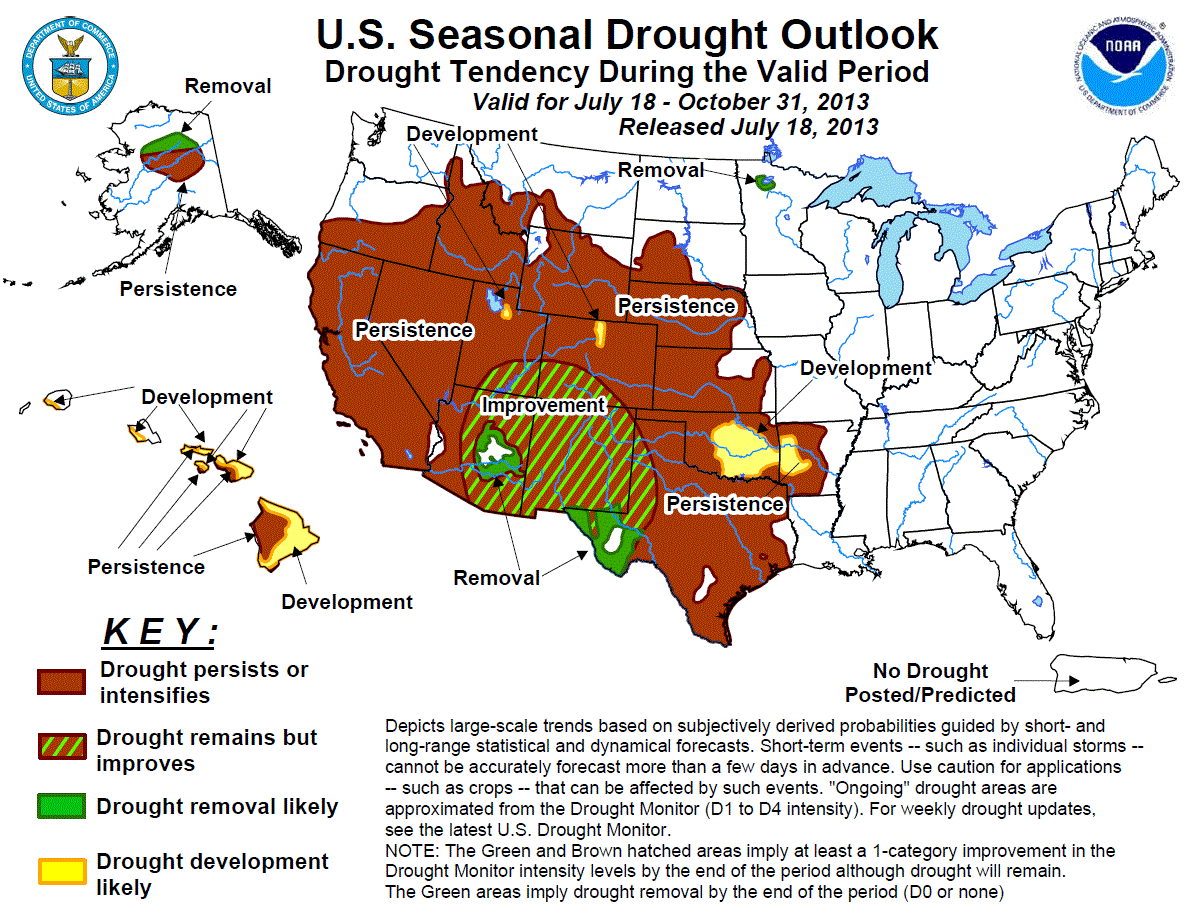
Here’s the drought outlook map from the Climate Prediction Center at NOAA:

U.S. Seasonal Drought Outlook Map, released May 19, 2011, NOAA and the Climate Prediction Center

U.S. Seasonal Drought Outlook Map, released May 19, 2011, NOAA and the Climate Prediction Center - click image for a larger version at NOAA's site.

It would be wonderful were these droughts to break soon.  But that is very unlikely.

So, why would anyone deny it?

Then, just to indicate the bait-and-switch logic these guys use, Goddard came back with a claim that the 1956 drought in Texas was worse, as if that means the current drought doesn’t exist.  Fore reasons apparent only to those whose heads get pinched by tinfoil hats, he also notes the CO2 levels for 1956.  I think I know what point he’s trying to make, but someone should tell him that apples are not oranges, and comparing apples and oranges to pomegranates doesn’t increase the supply of tennis balls.

Let’s just stick to the facts.  The experts who must operate the dams and lakes and get water to Mexico on schedule say the drought along the Colorado persists.  Who are we to gainsay them?

Resources:  

GEOSat photos of Lake Powell and drought, 2000 to 2004 - Dr. Paul R. Baumann, SUNY - Oneonta College

GEOSat photos of Lake Powell and drought, 2000 to 2004 - Dr. Paul R. Baumann, SUNY - Oneonta College


What sort of crazy is the warming denialist?

April 21, 2011

I’ve got to stop looking over there.

Goddard’s got a post up showing the great disregard he has for the facts, and the law, and history, etc., etc., etc.  It may be an unintentional showing, but there it sits, “like a mackerel in the moonlight, both shining and stinking.”

Jerome Corsi, that serial fictionalizer of vital issues, has a book out promoting his slimy schemes besmirch President Obama.  Goddard urges people to buy it.

But they really pile on in the comments.  It’s almost as if Casey Luskin had a whole family just like himself, and they got together to whine about Judge Roberts again.

Warming denialism, creationism and birthers — is it all just three minor variations on the same brain-sucking virus?  Or could three different diseases produce the same sort of crazy on so many different issues?

I’m reminded of the old saw that you cannot reason a person out of a position he didn’t reach by reason.  These guys will never see the light.  Heaven knows, it ain’t evidence that gets ’em where they are now.

Previous posts at Millard Fillmore’s Bathtub:

Special kind of birther crazy: