Hoaxing Congress: Claiming DDT as pixie dust

March 9, 2011

Tuesday morning, March 8,  the Republican-controlled House of Representatives Committee on Energy and Commerce opened hearings on global warming, staging an assault on science with a series of witnesses, some of whom recently have made a career out of mau-mauing scientists.

Dr. Donald Roberts' testimony to the House Committee on Energy and Power, on March 8, 2011, presented a grand collection of Bogus History, coupled with Bogus Science.

Dr. Donald Roberts’ testimony to the House Committee on Energy and Power, on March 8, 2011, presented a grand collection of Bogus History, coupled with Bogus Science. Roberts has an unfortunate history of presenting doctored data and false claims to Congress.

One witness took after the EPA directly and Rachel Carson by implication, with a specious claim that DDT is harmless.  Donald Roberts is a former member of the uniformed public health service.  Since retiring, and perhaps for a while before, he started running with a bad crowd.  Of late he’s been working with the Merry Hoaxsters of the unrooted Astroturf organization Africa Fighting Malaria (AFM), a group dedicated to publishing editorials tearing down the reputation of Rachel Carson, the World Health Organization (WHO) and the Environmental Protection Agency (EPA).

(That would all be purple prose, were it not accurate in its description of people, organizations and their actions.)

Here’s a link to Roberts’ written testimony at the committee website.

(Here’s a link to all the other written stuff from the March 8 hearing.) [April 27, 2015: These two cites now link to the Democratic Minority record; GOP site was moved or taken down.]

Why was Roberts testifying at a hearing on global warming?  He’s carrying water for the anti-science, “please-do-nothing” corporate crowd.  It’s a tactic from the old tobacco lobbyist book:  Roberts claims that scientists got everything wrong about DDT, and that the ban on DDT done in error has wreaked havoc in the third world.  Therefore, he says, we should never trust scientists.  If scientists say “duck!” don’t bother, in other words.

Roberts is in error.  Scientists, especially Rachel Carson, were dead right about DDT.  Because corporate interests refused to listen to them, the overuse and abuse of DDT rendered it ineffective in the fight against malaria, and DDT use as part of a very ambitious campaign to eradicate malaria had to be abandoned in 1965.  The entire campaign had to be abandoned as a result, and more than 30 million kids have died since.

So don’t grant credence to Roberts now.  He’s covering up one of the greatest industrial screw-ups in history, a screw up that, by Roberts’ own count, has killed 30 million kids.  What in the world would motivate Roberts to get the story so wrong, to the detriment of so many kids?

Roberts said:

Putting issues of EPA budget aside, I want to introduce my technical comments with a quote from a recent Associated Press article with a lead statement “none of EPA’s actions is as controversial as its rules on global warming.”  In my opinion, this is wrong.
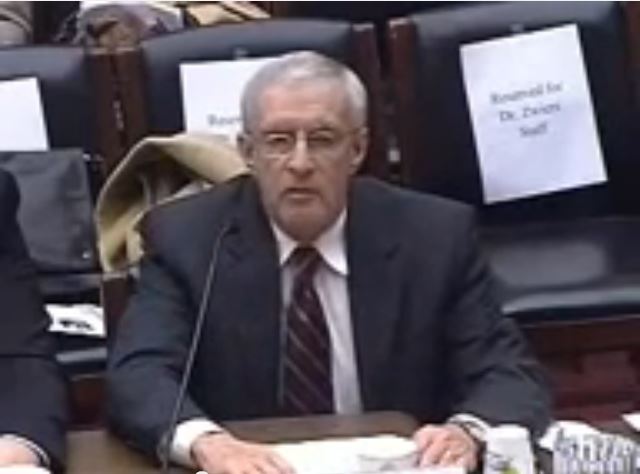
Dr. Donald Roberts testifying to the House Energy Committee, March 8, 2011. Screen capture from Committee video.

Dr. Donald Roberts testifying to the House Energy Committee, March 8, 2011. Screen capture from Committee video.

Roberts is correct here in his opinion.  It is simply wrong that EPA’s rules on global warming and controls of the pollutants that cause it should be controversial.  Among air pollution scientists the rules are not controversial.  Among climate scientists the rules are not controversial.  Roberts and his colleagues at the so-called Competitive Enterprise Institute, Africa Fighting Malaria (AFM), and American Enterprise Institute (AEI) work hard to manufacture controversy where the science does not support their case.

It is wrong.  Roberts should be ashamed.

Roberts said:

Almost forty years ago EPA banned DDT in the United States. Its action against DDT was extraordinarily controversial, and still is. As activists advanced fearful claims against DDT, the EPA was warned, over and over again, a ban would destroy critically important disease control programs and millions upon millions of poor people in developing countries would die as consequence. Leaders of the World Health and Pan American Health Organizations, and even the U.S. Surgeon General warned against the ban. The EPA banned DDT anyway, and the doomsday predictions of those public health leaders proved prescient.

Hmmm.  Roberts signed a “truth in testimony” statement — but that’s not the truth, even if no one paid him to fib.

EPA’s ban on DDT in the U.S. was limited to the United States.  Roberts doesn’t say it flat out, but he implies that the U.S. ban on spraying DDT on cotton fields in Texas and Arkansas — and cotton was about the only crop where DDT was still used — somehow caused a ban on DDT in Africa, or Asia, or South America, or other places where malaria still occurs.

Not so.

In fact, EPA Director William Ruckelshaus defied two federal courts who had ordered a complete ban on DDT use and manufacturing — and left U.S. manufacturing to continue for export markets.  This met all objections to the U.S. ban from all health officials.  DDT use could be allowed in the U.S. for health reasons, or for other emergencies (DDT was used in the Pacific Northwest against the tussock moth in 1974, after the “ban”).  Because U.S. DDT manufacturing was dedicated to export, the ban on domestic use of DDT effectively multiplied the stocks of DDT available to fight malaria, or river blindness, or any other insect vector disease.

I’m also not sure that health officials “pleaded” to stop the U.S. ban on any grounds, but certainly they did not plead with Ruckelshaus to keep spraying DDT on cotton.  Roberts is making stuff up in effect, if not in intent.

Probably more to the point, health officials had stopped significant use of DDT in Africa in 1965, seven years before EPA acted in the U.S., because overuse of DDT on crops in Africa had bred mosquitoes that were resistant and immune to the stuff. Since 1955, in close cooperation with the malaria-fighting experts from the Rockefeller Foundation including the great Fred Soper, WHO carried on a methodical, militant campaign to wipe out malaria.  The program required that public health care be beefed up to provide accurate malaria diagnoses, and complete treatment of human victims of the parasitic disease.  Then an army of house sprayers would move in, dosing the walls of houses and huts with insecticide.  Most malaria-carrying mosquitoes at the time would land on the walls of a home or hut after biting a human and getting a blood meal, pausing to squeeze out heavy, excess water to make flight easier.  If the wall were coated with an insecticide, the mosquito would die before being able to bite many more people, maybe before becoming capable of spreading malaria.

DDT was Soper’s insecticide of choice because it was long-lasting — six months or more — and astonishingly deadly to all small creatures it contacted.

But, as Malcolm Gladwell related in his 2001 paean to Soper in The New Yorker, Soper and his colleagues well understood they were racing against the day that mosquitoes became resistant enough to DDT that their program would not work.  They had hoped the day would not arrive until the late 1970s or so — but DDT is such an effective killer that it greatly speeds evolutionary processes.  In the mid-1960s, before an anti-malaria campaign could even be mounted in most of Subsaharan Africa, resistant and immune mosquitoes began to stultify the campaign.  By 1965, Soper’s crews worked hard to find a substitute, but had to switch from DDT.  By 1972 when the U.S. banned DDT use on cotton in the U.S., it was too late to stop the resistance genes from killing WHO’s anti-malaria program.  In 1969 WHO formally abandoned the goal of malaria eradication.  The fight against malaria switched to control.

Roberts claims, implicitly, that people like those who worked with Soper told EPA in 1971 that DDT was absolutely essential to their malaria-fighting efforts.  That could not be accurate.  In 1969 the committee that oversaw the work of the UN voted formally to end the malaria eradication project.  In effect, then, Roberts claims UN and other health officials lied to EPA in 1971.  It is notable that Soper is credited with eradicating malaria from Brazil by 1942, completely without DDT, since DDT was not then available.  Soper’s methods depended on discipline in medical care and pest control, and careful thought as to how to beat the disease — DDT was a help, but not necessary.

Interestingly, the only citation Roberts offers is to his own, nearly-self-published book, in which he indicts almost all serious malaria fighters as liars about DDT.

Can Roberts’ testimony be trusted on this point?  I don’t think we should trust him.

In fact, DDT and the eradication campaign had many good effects.  In 1959 and 1960, when DDT use was at its peak in the world, malaria deaths numbered about 4 million annually.  The eradication campaign ultimately was ended, but it and other malaria-fighting efforts, and general improvements in housing and sanitation, helped cut the annual death toll to 2 million a year by 1972.

After the U.S. stopped spraying DDT on cotton, mosquitoes did not migrate from Texas and Arkansas to Africa.  As noted earlier, the EPA order stopping agricultural use, left manufacturing untouched, to increase U.S. exports.  So the ban on DDT in the U.S. increased the amount of DDT available to fight malaria.

Malaria fighting, under Soper’s standards, required great discipline among the malaria fighters — the sort of discipline that governments in Subsaharan Africa could not provide.  Had WHO not slowed its use of DDT because of mosquito resistance to the stuff, WHO still would not have been able to mount eradication campaigns in nations where 80% of residences could not be sprayed regularly.

Advances in medical care, and better understanding of malaria and the vectors that spread it, helped continue the downward trend of malaria deaths.  There was a modest uptick in the 1980s when the parasites themselves developed resistance to the drugs commonly used to treat the disease.  With the advent of pharmaceuticals based on Chinese wormwood, or artemisinin-based drugs, therapy for humans has become more effective.  Today, the annual death toll to malaria has been cut to under a million, to about 900,000 per year — a 75% drop from DDT’s peak use, a 50% drop from the U.S. ban on farm use of DDT.

With the assistance of WHO, most nations who still suffer from malaria have adopted a strategy known as Integrated Vector Management, or IVM (known as integrated pest management or IPM in the U.S.).  Pesticides are used sparingly, and insect pests are monitored regularly and carefully to be sure they are not developing genetic-based resistance or immunity to the pesticides.  This is the method that Rachel Carson urged in 1962, in her book, Silent Spring.  Unfortunately, much of the malaria-suffering world didn’t come to these methods until after the turn of the century.

Progress against malaria has been good since 2001, using Rachel Carson’s methods.

Don Roberts’ blaming of science, EPA, WHO, and all other malaria fighters is not only misplaced, wrong in its history and wrong in its science, but it is also just nasty.  Is there any way Roberts could not know and understand the facts?

These are the facts Roberts works to hide from Congress:

  1. “Science” and scientists were right about DDT.  DDT is a dangerous substance, uncontrollable in the wild according to federal court findings and 40 years of subsequent research.  If we were to judge the accuracy of scientists about DDT, we would have to conclude that they were deadly accurate in their judgment that use of DDT should be stopped.
  2. If the ban on DDT was controversial in 1972, it should not be now.  All research indicates that the judgment of EPA and its director, William Ruckelshaus, was right.
  3. EPA was not warned that a ban on agricultural use of DDT would harm public health programs, in the U.S., nor anywhere else in the world.  In any case, EPA’s jurisdiction ends at U.S. borders — why would WHO say anything at all?
  4. DDT use to fight malaria had been curtailed in 1965, years before the U.S. ban on farm use, because overuse of DDT on crops had bred DDT-resistant and DDT-immune mosquitoes.  Consequently, there was not a huge nor vociferous lobby who warned that health would be put at risk if DDT were banned.  Claims that these warnings were made are either false or grossly misleading.
  5. Malaria death rates declined to less than 50% of what they were when DDT was banned from farm use in the U.S. — there was no “doomsday” because the U.S. stopped spraying DDT on cotton, and there never has been a serious shortage of DDT for use against malaria, anywhere in the world.

How much of the rest of the testimony against doing something about global warming, was complete hoax?

More:

[Editor’s note:  My apologies.  I put this together on three different machines while conducting other activities.  On proofing, I find several paragraphs simply disappeared, and edits to make up for the time of composing and fix tenses, got lost.  It should be mostly okay, now, and I’ll add in the links that disappeared shortly . . . oh, the sorry work of the part-time blogger.]

Update, 2015: Video of the hearing, from YouTube:


“Massive populations of misquotes” said to kill millions

March 5, 2011

“Over 1 million people a year die because of the massive populations of misquotes.”

I preserve it here just because it gives me a smile; here is the sentence above with what I presume is a typographical error that carries great humor, in its natural habitat:

While there is a a discussion going on whether DDT should be used or not in America, it is undeniable that It should be used in 3rd world countries like in Africa to stop the spread of Malaria. Over 1 million people a year die because of the massive populations of misquotes. No doubt that this number could be lowered dramatically. Not only is DDT a type of pesticide, it is a pest repellent, meaning that even if the bug has grown immunity to the pesticide, it will invariably avoid area’s where DDT is sprayed. To use it to a maximum effect, it would be a good idea to spray it on 1 wall inside a home. That’s all that is required to stop the malaria epidemic in Africa. —Preceding unsigned comment added by Delata38 (talkcontribs) 14:48, 10 August 2010 (UTC)

From Wikipedia’s discussion of the article on DDT.

I have no idea who Delata38 is, and hope she or he is not offended at my preservation of the typo.  The error may have been caused by an over-enthusiastic autocorrect function, and no fault of the author at all.  The statement may be completely correct in a few other contexts, something that should give all journalists pause and cause to strive harder for greater accuracy.

Heck, this should be a candidate for inclusion in the next edition of Bartlett’s Familiar Quotations.

In typographical error, truth.


Jay Ambrose: Still wrong about DDT and malaria

February 27, 2011

Propagandists against Rachel Carson and — inexplicably — for DDT awoke a few weeks ago.  We’re seeing a flurry of op-eds, opinion pieces and other editorial placements making false claims for DDT, and against Rachel Carson, one of the science heroes of the 20th century.

The campaign of hoaxes, urging more and heavier use of DDT, and falsely impugning environmentalists, continues.  Alas.

Jay Ambrose of Scripps Howard News Service, still wrong about DDT

Jay Ambrose of Scripps Howard News Service, still wrong about DDT

Jay Ambrose used to be a full-time editor for the Scripps Howard newspapers.  Since he retired he writes occasional opinion pieces.  In the past three years or so he’s mentioned his desire to bring back the poison DDT, to poison Africa in the hope it might also get malaria, for example.

A few weeks ago he went after global warming with the same alacrity and lack of accurate information.

Let’s review a few facts about the history of DDT:

  • The World Health Organization (WHO) carried on a super-ambitious campaign to eradicate malaria from the world starting in 1955.  It was a race against time — super malaria-fighter Fred Soper, who spearheaded early campaigns for the Rockefeller Foundation , understood that overuse of DDT in agriculture or any other venue could push malaria-carrying mosquitoes to develop resistance to DDT.  WHO’s campaign involved Indoor Residual Spraying of DDT, coating the walls of homes with the stuff; then with biting mosquitoes reduced, a careful campaign of medical care would cure human victims of the disease.  When the mosquitoes came roaring back at the end of the campaign, there would be no infected humans from whom the insects could get the parasite that causes the disease — voila! — no more malaria.  WHO lost the race; by 1965 Soper’s group already found resistant and immune mosquitoes in central Africa, and most of the nations in the Subsaharan Africa had not  been able to mount an anti-malaria campaign. DDT use in Africa was scaled back, therefore, and by 1969, WHO’s international board voted to abandon the campaign, made impossible to complete by abuse of DDT.
  • Seven years after WHO was forced to stop using DDT by DDT abuse, the U.S. Environmental Protection Agency banned DDT from use outdoors on agricultural crops, under the watchful eye of two federal courts who had previously determined DDT to be dangerous and uncontrollable in the wild. EPA Administrator William Ruckelshaus short-circuited a total ban on DDT, however; his order specifically allowed U.S. manufacturers to continue making DDT, greatly increasing the amount of DDT available to any nation who wanted to use it to fight malaria or any other disease.
  • Even though DDT was cheap and plentiful, however, many African nations found it simply did not work anymore. Work continued to fight DDT through all other means including especially treating the disease in humans, and malaria incidence and deaths continued to decline.
  • At the end of the 1970s, the malaria parasites began to develop resistance to chloroquine and other traditional drugs used to cure humans of the stuff.  It was a shortage of drugs to treat humans that caused the uptick in malaria over a decade ago, not a lack of DDT.  Progress against malaria slowed for a few years, until artemisinin-based drugs were discovered to work against the disease, and means could be found to speed up production of the drug (originally from a Chinese plant, a member of the wormwood family).
  • By the turn of the century, it became clear that a miracle, one-punch solution to beat malaria is unlikely to be found.  Many nations turned to a method of malaria control including “integrated vector management,” which includes the use of pesticides (including DDT) in careful rotation to prevent mosquitoes from developing resistance or immunity to any one poison. This is the method championed by Rachel Carson in her 1962 book, Silent Spring.
  • At the time of the U.S. ban on DDT use on crops, annual malaria deaths ran about 2 million.  By 2000, that rate had been cut in half, to about 1 million annually.  Today, and since 2005, the annual death toll to malaria has been estimated by WHO to be under 900,000 — less than half the death rate in 1972 when the U.S. banned DDT use on crops, and a 75% reduction in deaths in 1960, when DDT use was at its peak.  Malaria deaths today are the lowest in human history.
  • DDT Malaria continues to be a priority disease, with added emphasis in the past decade with massive interventions funded by the Bill and Melinda Gates Foundation, and the President’s Initiative on Malaria.   Bill Gates is regarded as a great optimist, but he says he is working to eradicate malaria from the world.   Key tools of the eradication campaign are bednets, which are cheaper and more effective than DDT, and integrated vector management.  The Gates Foundation campaign strikes continuing blows of great magnitude against the disease in those nations where it can work.

Few of these facts are acknowledged by Jay Ambrose, who wrongly claims that DDT had alone been the great vanquisher of malaria, and who claims that Africans, unduly swayed by a long-dead Rachel Carson, had failed to use DDT though they knew in their hearts it would save their children.

About once a year Ambrose trots out his misunderstandings of history, law and science, and slams Rachel Carson and those who banned DDT from cotton crops in Texas, falsely blaming them for malaria deaths in Africa.  His article of the past few weeks was picked up by the Detroit News.  Warning that our fight against global warming is as wrong-headed as saving the bald eagle from DDT, he wrote:

The main thing is to avoid what happened with DDT. Because of a ban to protect wildlife from the pesticide in this country, it became more scarce, and a consequence was its being employed sparingly if at all in wildlife-safe, indoor spraying to combat malaria in Africa. Though not always, DDT can be enormously effective in stopping the disease while posing minimal threats.

The estimate is that millions of African children died because of misplaced values and overreactions.

That’s worse than heartbreaking.
From The Detroit News: http://detnews.com/article/20110221/OPINION01/102210305/Don’t-overreact-to-possible-global-warming#ixzz1FDv1ZhkY

When I chided Ambrose for getting the facts wrong many months ago, he angrily promised to come back to this blog and provide evidence to make his case.  Of course, he never did.  There is no such evidence.

Then why does he continue to falsely indict Rachel Carson, William Ruckelshaus and EPA, and “environmentalists,” and wrongly urge the poisoning of Africa with DDT?

I do not know.

Are his views on global warming similarly in error?  If history shows a trend, yes.


Debunking Junk Science’s hoax “100 Things You Should Know About DDT”: #14, William Ruckelshaus’s bias

February 17, 2011

Another in a continuing series, showing the errors in JunkScience.com’s list of “100 things you should know about DDT.” (No, these are not in order.) In the summer of 2009, the denialists have trotted this error out again.

At the astonishingly truthfully-named site “Junk Science,” Steven Milloy creates a series of hoaxes with a page titled “100 things you should know about DDT.”  It is loaded with hoaxes about DDT, urging its use, and about Rachel Carson, and about EPA and the federal regulation of DDT, and about malaria and DDT’s role in the ambitious but ill-fated campaign to eradicate malaria operated by the World Health Organization (WHO) from 1955, officially until 1969.  Milloy knows junk science, and he dishes it out with large ladles.

Among what must be 100 errors, Milloy makes this claim, I suppose to suggest that William Ruckelshaus was biased when Rickelshaus headed the Environmental Protection Agency:

14.  William Ruckelshaus, the administrator of the U.S. Environmental Protection Agency who made the ultimate decision to ban DDT in 1972, was a member of the Environmental Defense Fund. Ruckelshaus solicited donations for EDF on his personal stationery that read “EDF’s scientists blew the whistle on DDT by showing it to be a cancer hazard, and three years later, when the dust had cleared, EDF had won.”

This is a false statement on Milloy’s site.  After finding no credible source for the claim that Ruckelshaus was ever affiliated with EDF in any way, I contacted Ruckelshaus’s office, and got confirmation that Ruckelshaus was not and never has been affiliated with EDF.  It should be a clue that this claim appears only at sites who impugn Ruckelshaus for his action in banning DDT use in U.S. agriculture.


Junk Science's oddly apt logo and slogan

Hiding the truth in plain view: Junk Science is a site that promotes junk science, an unintended flash of honesty at a site that otherwise promotes hoaxes about science. Note the slogan. Does this site cover its hoaxes by stating plainly that it promotes “all the junk science that’s fit to debunk?”

It is also highly unlikely that he ever wrote a fund-raising letter for the group, certainly not while he was a public official.  The implicit claim of Junk Science.com, that William Ruckelshaus was not a fair referee in the DDT case, is a false claim.

I asked Milloy to correct errors at his site, and he has steadfastly refused.

Here is what Milloy’s point #14 would say, with the falsehoods removed:

14.  William Ruckelshaus [was] the administrator of the U.S. Environmental Protection Agency who made the ultimate decision to ban DDT in 1972[.], was a member of the Environmental Defense Fund. Ruckelshaus solicited donations for EDF on his personal stationery that read “EDF’s scientists blew the whistle on DDT by showing it to be a cancer hazard, and three years later, when the dust had cleared, EDF had won.”

Below the fold:  William D. Ruckelshaus’s “official” biography, if you call him today, February 17, 2011.  You should note, there is no mention of any work with EDF.

Read the rest of this entry »


USAID policy statement on DDT and malaria control

February 16, 2011

USAID-paid tools and pesticides used to prevent malaria in a campaign coordinated with the government in Tanzania. USAID photo.

USAID-paid tools and pesticides used to prevent malaria in a campaign coordinated with the government in Tanzania. USAID photo.


The U.S. Agency for International Development (USAID) issued a statement on their support for the use of DDT, where appropriate.  I don’t have a date — if you know the date, please let me know — but for the record, here’s the statement.

Those who claim the U.S. discourages the use of DDT to the detriment of African and Asians, are incorrect in their claims, once again.

USAID Support for Malaria Control in Countries Using DDT

USAID and Malaria

USAID activities for malaria control are based on a combination of internationally-accepted priority
interventions and country-level assessments for achieving the greatest public health impact, most importantly, the reduction of child mortality (deaths).

Contrary to popular belief, USAID does not “ban” the use of DDT in its malaria control programs. From a purely technical point of view in terms of effective methods of addressing malaria, USAID and others have not seen DDT as a high priority component of malaria programs for practical reasons. In many cases, indoor residual spraying of DDT, or any other insecticide, is not cost effective and is very difficult to maintain. In most countries in Africa where USAID provides support to malaria control programs, it has been judged more cost-effective and appropriate to put US government funds into preventing malaria through insecticide-treated nets, which are every bit as effective in preventing malaria and more feasible in countries that do not have existing, strong indoor spraying programs.

USAID country missions provide support to national malaria control programs in about 21 countries in sub-Saharan Africa, where the burden of malaria deaths is the highest. This support covers a broad range of activities, according to local priorities, resource availability and complementary activities by other donors and multinational institutions in each country.

International efforts to fight malaria are largely coordinated by Roll Back Malaria (RBM), a global partnership that includes leaders from across Africa, African health institutions, the World Health Organization (WHO), UNICEF, World Bank, UNDP, multi-lateral agencies, international, national and local NGOs, and the private sector. USAID is a key RBM partner. RBM has identified three priority interventions to reduce deaths and illness from malaria. These are consistent with USAID ’s priority areas for investment in malaria. These are:

1. Insecticide-Treated Nets (ITNs) for young children and pregnant women.
2. Prompt and Effective Treatment with an anti-malarial drug within 24 hours of onset of fever
3. Intermittent Preventive Therapy (IPT) for pregnant women as a part of the standard ante –
natal services.

Each of these interventions is backed by solid evidence of effectiveness under program conditions and effective in reducing the sickness and death from malaria, especially in Africa. For example, proper use of ITNs can reduce overall child deaths by up to 30% and significantly reduce sickness in children and pregnant women.

DDT in Malaria Programs

DDT is only used for malaria control through the spraying of interior house walls – Indoor Residual Spraying, or (IRS). A number of other insecticides can also be used for IRS, and are in many countries when those alternative insecticides are safer and equally effective. IRS, when efficiently conducted in appropriate settings, is considered to be as efficacious as ITNs in controlling malaria.

In most countries in Africa where USAID provides support to malaria control programs, it has been judged more cost-effective and appropriate to put US government funds into other malaria control activities than IRS. USAID has funded non-IRS support to malaria control programs in countries in which DDT is being used, for example, Eritrea, Zambia, Ethiopia and Madagascar.

USAID regulations (22 CFR 216) require an assessment of potential environmental impacts of supporting either the procurement or use of pesticides in any USAID assisted project, but if the evidence assembled in preparing such an environmental review indicates that DDT is the only effective alternative and it could be used safely such as interior wall spraying undertaken with WHO application protocols, then that option would be considered. The U.S. government is signatory to the Stockholm Convention on Persistent Organic Pollutants (the POPS treaty), which specifically allows an exemption for countries to use DDT for public health use in vector control programs, as long as WHO guidelines are followed and until a safer and equally effective alternative is found. The US voted in favor of this exemption.

There are a few situations in which IRS with DDT is generally found to be appropriate. For example, in South Africa when certain mosquitoes developed resistance to the major alternative class of insecticides, the synthetic pyrethroids, DDT was used. Such situations are relatively rare, however, and demonstrate the value of the provisions of the POPs Treaty, which restrict and document use of DDT, but provide for its use when appropriate.

USAID Interventions

USAID is emphasizing prevention via mosquito nets dipped in pyrethriods – a synthetic insecticide originally found in chrysanthemums. USAID is supporting an innovative Africa regional public-private venture for the commercial distribution of ITNs. In 2003 USAID’s NetMark Project launched insecticide-treated net products in Zambia, Senegal, Ghana, and Nigeria selling more than 600,000 nets and 500,000 insecticide re-treatments during its first five months of operation. In 2004, NetMark will launch in at least five more countries in Africa.

USAID also invests in development of new tools for malaria control, particularly vaccine development and the response to increasing drug resistance. USAID is funding projects to discover and dispense new drugs such as Arteminisin-based combination therapies (ACT), which have proven to be more effective against malaria than the traditional drugs chloroquine and mefloquine. USAID also supports the development of new policies and strategies for use of these new therapies, as well as the improvement of both public and private health systems. Since 1998, the agency has aggressively supported the development of the combination therapy as a safe and effective alternative treatment.  In addition, USAID and its global partners in RBM are working to ensure sustained financing of the drugs. USAID has played a critical role in drawing attention to the spread of drug resistance in Africa and in assisting countries in effectively treating malaria, including the use of combination therapy.

In summary, USAID directs its support for malaria control programs based on evidence for maximum impact on reducing child deaths. Based on this criterion, for most countries with USAID support for malaria control in sub-Saharan Africa, indoor residual spraying (regardless of the choice of insecticide) has not been judged to be the most effective use of US government funds. USAID continues to plan its support for national malaria control programs in sub -Saharan Africa on a country by country basis, and will continue to strive to use US taxpayer funds as efficiently and effectively as possible with the most appropriate tools at our disposal to reduce deaths from malaria.

I suspect that statement is dated.  Here is a site at USAID that details the policy on DDT, malaria and mosquitoes, and includes a different statement under the same title as the above:

USAID and Malaria

USAID activities for malaria control are based on a combination of internationally accepted priority interventions and country-level assessments for achieving the greatest public health impact, most importantly, the reduction of child mortality (deaths).

USAID backs a comprehensive approach to prevent and treat malaria. This includes:

  • Spraying with insecticides (“indoor residual spraying,” or IRS) in communities: IRS is the organized, timely spraying of an insecticide on the inside walls of houses or dwellings. It is designed to interrupt malaria transmission by killing adult female mosquitoes when they enter houses and rest on the walls after feeding, but before they can transmit the infection to another person. IRS has been used for decades and has helped eliminate malaria from many areas of the world, particularly where the mosquitoes are indoor-resting and where malaria is seasonally transmitted. USAID and the President’s Malaria Initiative (PMI) activities include conducting environmental assessments, training spray teams, procuring insecticide and equipment, and developing and evaluating spraying activities.
  • Insecticide-treated mosquito nets (ITNs): Bednets treated with insecticide have been proved highly effective in killing mosquitoes. In addition, the netting acts as a protective barrier.  Consistently sleeping under an ITN can decrease severe malaria by 45 percent, reduce premature births by 42 percent, and cut all-cause child mortality by 17 to 63 percent. PMI is expanding access to free and highly subsidized nets while also creating commercial markets in African countries.
  • Lifesaving drugs: Artemisinin-based combination therapies (ACTs) are the most effective and rapidly acting drugs currently available for treating malaria.  PMI activities include purchasing ACT drugs; setting up management and logistics systems for their distribution through the public and private sectors; and training health care workers and community caregivers in their use.
  • Intermittent preventive treatment for pregnant women (IPTp): Each year, more than 30 million African women living in malaria-endemic areas become pregnant and are at risk for malaria. IPTp involves the administration of at least two doses of sulfadoxine-pyrimethamine (SP) to a pregnant woman through antenatal care services.  The treatment helps to protect pregnant women against maternal anemia and low birthweight, which contributes to between 100,000 and 200,000 infant deaths annually in Africa.  PMI activities include purchasing SP, training health care workers in administering the drug, and providing information about IPTp to pregnant women.

USAID and DDT

USAID supports indoor residual spraying (IRS) with DDT as an effective malaria prevention strategy in tropical Africa in those specific situations where it is judged to be the best insecticide for IRS both epidemiologically and entomologically and based on host-country policy. Its use for IRS to prevent malaria is an allowable exception under the Stockholm Convention – also known as the Persistent Organic Pollutants Treaty or POPs Treaty – when used in accordance with WHO guidelines and when safe, effective, and affordable alternatives are not available. For a variety of reasons, some countries do not conduct IRS or have not registered DDT for use in their malaria control programs.  The reasons may include the epidemiological situation of the country, the organizational capacity of the program, or in some cases, concerns related to their agricultural export market.  The Stockholm Convention aims to eventually end the use of all POPs, including DDT.

The determination of which of the WHO-approved insecticides to use for USAID’s IRS programs is made in coordination with the host-country malaria control program, with the primary objective of preventing as many malaria infections and deaths as possible.  That determination is based on cost-effectiveness; on entomological factors; on local building materials; and on host-country policy.  USAID adheres to strict environmental guidelines, approval processes, and procedures for the use of DDT and all other WHO-approved insecticides in its malaria control programs. As part of our environmental assessments and safer use action plans, we help countries build capacity for safe and judicious use of all chemicals used in their malaria control programs, including DDT

The fact is that DDT is more effective and less expensive than many other insecticides in many situations; as a result, it is a very competitive choice for IRS programs.   DDT specifically has an advantage over other insecticides when long persistence is needed on porous surfaces, such as unpainted mud walls, which are found in many African communities, particularly in rural or semi-urban areas.

USAID has never had a “policy” as such either “for” or “against” DDT for IRS.  The real change in the past two years has been a new interest and emphasis on the use of IRS in general – with DDT or any other insecticide – as an effective malaria prevention strategy in tropical Africa.  (Recent successful applications of IRS, particularly in the southern Africa region, have also contributed to the keen interest among donors and among African malaria control programs.)  For example, in Fiscal Year 2005, USAID supported less than $1 million of IRS in Africa, with programs utilizing insecticides purchased by the host government or another donor.  For fiscal year 2007, in the PMI and in other bilateral programs, USAID will support over $20 million in IRS programs in Africa, including the direct purchase of insecticides.  This dramatic increase in the scale of our IRS programs overall is the greatest factor in DDT’s recent prominence in USAID programs.

USAID Issue Briefs

President’s Malaria Initiative (PMI)

Tanks of pesticide (DDT?) used for Indoor Residual Spraying (IRS) against malaria in Africa bear the labels to indicate USAID paid for the tools and the pesticide, contrary to hoaxsters' claims.

Tanks of pesticide (DDT?) used for Indoor Residual Spraying (IRS) against malaria in Africa bear the labels to indicate USAID paid for the tools and the pesticide, contrary to hoaxsters’ claims.

Update: If you’re here from a religious discussion group that veered off into malaria and DDT, you’d do well to use this site’s search feature, and search for DDT.  Most of the statements from those favoring DDT in your discussion are pure, buncombe, junk science, as this site and several others reveal.


No, DDT is not the easy answer to malaria

February 13, 2011

Roger Bate and Richard Tren, the Dynamic Duo of DDT, have been busy lately.  Bate appears to have found additional funding from the radical right-wing American Enterprise Institute, where I gather he has been prowling the halls trying to sell others there on the idea that DDT is an easy solution to malaria, and only mad, despotic environmentalist megalomaniacs have stopped DDT from saving Africa from malaria, the American economy from depression, and Major League Baseball from the designated hitter rule.  (I thought it odd that his bio doesn’t mention his work for tobacco interests as integral to his organizing.)

Graphic from a 1950s-era ad for DDT

Graphic from a 1950s-era ad for DDT. No, it's not right -- it's Madison Avenue then, expressing the claims of the "DDT-is-good-for-you" hoaxsters of today.

I don’t exaggerate much, if at all.

So, I’ll bore you with rebuttals over the space of the next few days.  Especially among the right-wing echo chambers, comments are frequently moderated to oblivion when they are allowed at all.

For example, there is a site that calls itself Minnesota Prager Discussion Group — a site for Dennis Prager groupies.  Here’s a post that may have been prompted by a Dennis Prager broadcast, but which cites a scurrilous pamphlet written by Bates and Tren, with Donald Roberts, carrying all sorts of calumny against environmentalists, health care professionals, diplomats, environmentalists and scientists — cloaked in a high degree of disrespect for readers who, they hope, have never bothered to read Rachel Carson and have forgotten everything they may have ever read about DDT and environmental harms it causes.

Here’s the post on DDT and malaria there:

Malaria Can Be Easily Controlled by DDT

Posted on February 2, 2011 by Glenn H. Ray

DDT Still Critical in Fight against Insect-Borne Diseases

Through a mix of environmental fervor, self-interest and disregard for evidence-based policy, United Nations (UN) agencies are misleading the public about the insecticide DDT — mistakenly claiming it is not needed and can be eliminated globally by 2020, says Donald Roberts, emeritus professor of tropical medicine at Uniformed Services University of the Health Sciences, Roger Bate, the Legatum Fellow in Global Prosperity at the American Enterprise Institute, and Richard Tren, the executive director of Africa Fighting Malaria.

  • UN agencies are misleading the public by claiming that malaria can be controlled without insecticides, notably DDT; the stated aim is to stop DDT use globally by 2020.
  • UN agencies are committing scientific fraud by deliberately and incorrectly interpreting data on malaria control using noninsecticide methods.

While DDT is no panacea, it is still a critical weapon in the battle against malaria and other insect-borne diseases, say Roberts, Bate and Tren.

Source: Roger Bate, Donald Roberts and Richard Tren, “The United Nations’ Scientific Fraud against DDT,” American Enterprise Institute, January 21, 2011.

Above information came from the National Center of Policy Analysis

Dennis Prager regularly reminds his listeners that many tens of thousands of lives can be saved by approving DDT uses in certain areas in Africa.

Oy.  Helluva lotta error and deception packed in a couple hundred words.

So, I tried to help the “discussion group” get to some more accurate understanding of DDT and malaria.

Ed Darrell, on February 2, 2011 at 4:53 pm said:

1. There is no shortage of DDT.

2. Not only is DDT not a panacea, it is increasingly not effective against malaria-carrying mosquitoes.

3. Richard Tren leads an astro-turf organization that collects hundreds of thousands of dollars, but does very little if anything to actually fight malaria. These sorts of diatribes increase contributions to his organization’s coffers, but they don’t help fight malaria.

4. In actual practice over the last decade, bednets have proven to reduce malaria by 50% to 85% in areas where they are deployed; DDT is only 25% to 50% effective.

5. Bednets cost about $10 and last about five years — $2.00 per year. DDT costs upwards of $12 per application, and must be applied twice per year — $24.00 per year. Bednets stop mosquitoes cold. DDT depends on mosquitoes biting people first, then resting on a DDT-coated wall — and we hope that it’s a young mosquito that has not yet contracted malaria itself and is not shedding the parasites.

6. Malaria deaths, worldwide, are lower now than at any other time in human history. Since the U.S. stopped using DDT on cotton in 1972, the death rate to malaria has been cut in half. The death toll to malaria is, today, less than 25% of what it was when DDT use was at its peak. Statistically, it appears that cutting DDT use also cuts malaria.

7. We know that’s not the case, but those statistics prove that we can beat malaria without DDT — as indeed, the U.S. Army beat malaria without DDT to build the Panama Canal by 1915, 24 years before DDT was discovered to have any insecticidal properties. In the U.S., with the great aid of the Tennessee Valley Authority, malaria was essentially wiped out by 1939 — seven years before DDT became available for use against mosquitoes. No nation relying on DDT has been able to eradicate malaria.

Roger Bate, Donald Roberts and Richard Tren commit health care terrorism when they tell their fraud-laced stories against the UN and the health care professionals who fight malaria. Shame on them.

Did the author read anything I wrote?  He responded, politely for a guy who didn’t quite get it:

Glenn H. Ray, on February 9, 2011 at 12:19 pm said:

Ed Darrell: Thank you very much for this information.

Let us assume every item you mention is accepted beyond debate..

Malaria still ravages populations in Africa. We are not beating malaria without DDT.

Dennis Prager agrees with you regarding the value of bed nets and from his visits to Africa, has encouraged financial support to increase their availability.

The question still remains, why is DDT still banned rather than being available for use where needed?

My responses:

Sometimes the facts stare us in the face and we can’t see them.

You said:

Malaria still ravages populations in Africa. We are not beating malaria without DDT.

We have cut malaria 75% from when DDT was heavily used. We are beating malaria as best we can since DDT advocates overused DDT and made it ineffective against most populations of mosquitoes. (WHO’s program to eradicate malaria was effectively ended in 1965 because overuse of DDT by large agricultural interests had bred mosquitoes resistant to and immune to DDT; today, every mosquito on Earth carries the alleles that make them resistant and immune to DDT.)
It doesn’t matter how much we whine about DDT being “banned,” DDT doesn’t work to beat malaria now, and it was never intended to be more than a very temporary solution while medical care, treating the humans, did the real work.

When we beat malaria (as in the U.S.), the fact that humans do not have the disease means that mosquitoes cannot catch it from humans. That means the mosquito bites go back to being annoyances, and we don’t need to worry about them.

Malaria is a disease of humans. If we concentrate on the mosquitoes, we can reduce it, temporarily. If we concentrate on treating the disease, and preventing the disease in humans, we can forget about mosquitoes.

Dennis Prager agrees with you regarding the value of bed nets and from his visits to Africa, has encouraged financial support to increase their availability.

Then why is he talking smack against them? He’s talking untruths about DDT, untruths carried by the anti-bednet lobby, like the so-called “Africa Fighting Malaria” lobbying group. Bednets are twice to almost four times as effective as DDT, if they are used exclusive of each other. You don’t get that impression from Prager. Bednets cost a fraction of what DDT treatments cost. Bednets are effective longer than DDT treatments.

We can beat malaria without DDT. We can’t beat malaria without bednets. If he has no truck against bednets, Prager should get out of the bed of the anti-bednet, pro-DDT lobby, and talk about beating malaria.

The question still remains, why is DDT still banned rather than being available for use where needed?

No, the question is, why aren’t you listening?

DDT is not banned anywhere in Africa, and never has been. DDT is freely available to any government who wishes to use it — or private groups who wish to use it.

DDT doesn’t work as it once did, plus, it’s a deadly poison to fish, amphibians, reptiles, birds and small mammals. DDT is unsafe in use outside of Indoor Residual Spraying, where it is increasingly less effective — and Africans are nervous about IRS because their children keep getting sick with strange new diseases even when the kids are safe from malaria. There may be no solid connection between the new syndromes and DDT, but since DDT is not a panacea, not as effective as untreated bednets, and much less effective than treated bednets — why take a chance?

Opposition to DDT today comes from Dennis Prager’s and AFM’s friends in business in Africa. The only serious opposition to DDT I’ve found in Africa was in Uganda, where businessmen sued to stop spraying two years ago.

What in the world makes you think there isn’t all the DDT out there that health workers need?

Any discussion of fighting malaria that involves DDT takes away from the serious fight to beat malaria. A lot of westerners think DDT is a magic potion, and that if we just poison the hell out of Africa with the stuff, we can beat malaria without serious effort, without serious research, without improving the lives of the poor people of Africa who are victimized by the disease.

We beat malaria in the U.S. by improving housing, beefing up public health services, and increasing incomes of families of victims. It took 20 years of concentrated work — all before DDT was even discovered to kill bugs.

To beat malaria in Africa, we must improve housing, beef up medical care, both diagnoses and treatment of the disease, and improve the lives of the families of victims to prevent new disease-causing bites.

It’s tough work. Prager appears not to have the stomach for it. If so, he should say so, instead of claiming, falsely, that DDT could do the job.

Malaria proves a tough foe, difficult to beat. DDT could play a very small role in the defeat of malaria, but more DDT won’t help, and malaria isn’t winning because DDT isn’t available. DDT is readily available. DDT doesn’t work anymore, and DDT was never intended to be a sole weapon.

And:

Lancet recently devoted most of an issue to fighting malaria, and how to beat it. Lancet is perhaps the world’s leading medical journal, certainly among the top three, with no axe to grind, and concerned with improving the condition of humans throughout the world — from a medical care perspective.

The articles come from the world’s leading malaria fighters and those in the vanguard of research on how to beat malaria.

Here’s the executive summary (8 pages in .pdf form).

Did you notice? No call for DDT.

Can you and Dennis Prager please get on board with the campaign to beat malaria? Howling about false, junk science claims that DDT should be used to poison Africa isn’t a ticket to get on that malaria-fighting train.

Mr. Ray responded again:

Thank you again for your interaction. It has been my understanding that many of the claims about the toxicity of DDT to the living groups you have listed has been exaggerated, particularly in regard to the bird populations.
As you might note, malaria control is not my field of expertise, but I have read this claim from two sources over the past decade, but I cannot refer you to them.
I shall remember your ‘corrections’ in any discussion I might have in the future about DDT.

I am certain Dennis has no connections with any businesses in Africa dealing with DDT.

Denial among people who admit that they don’t know much about the topic is really quite amazing, isn’t it?

I made one more comment, but Ray has held it in his site’s moderation queu for enough days I am convinced he plans to leave it there.  Here is what I posted that he has not yet let through:

Ed Darrell, on February 10, 2011 at 12:49 am said: Your comment is awaiting moderation.

Thank you again for your interaction. It has been my understanding that many of the claims about the toxicity of DDT to the living groups you have listed has been exaggerated, particularly in regard to the bird populations.

Peer review research over the past 40 years has borne out the early research from 1945 through 1961 that showed DDT is a killer of birds, reptiles, fish, amphibians and small mammals. I am unaware of any study anywhere that denies this toxicity, except with regard to insects who produce new generations quickly enough to evolve resistance and immunity.

Discover magazine looked for studies saying DDT doesn’t harm larger animals, but found none. In November 2007 the magazine noted:

In fact, Carson may have underestimated the impact of DDT on birds, says Michael Fry, an avian toxicologist and director of the American Bird Conservancy’s pesticides and birds program. She was not aware that DDT—or rather its metabolite, DDE—causes eggshell thinning because the data were not published until the late 1960s and early 1970s. It was eggshell thinning that devastated fish-eating birds and birds of prey, says Fry, and this effect is well documented in a report (pdf) on DDT published in 2002 by the Department of Health and Human Services’ Agency for Toxic Substances and Disease Registry (ATSDR). The report, which cites over 1,000 references, also describes how DDT and its breakdown products accumulate in the tissues of animals high up on terrestrial and aquatic food chains—a process that induced reproductive and neurological defects in birds and fish.

DDT kills birds outright, through acute poisoning. That was what first sounded the alarms at Michigan State University, the University of Wisconsin, and a dozen other places across the U.S. DDT accumulates in fat tissues, and poisons the brains of migrating birds when they are under stress during migration. DDT poisons chicks of birds in the eggs, killing them outright, or making them unable to feed after hatching. DDT makes female birds unable to lay competent eggs (thins the eggshells), which means even if the chick is free of the toxins, the egg can’t protect it through incubation. DDT scrambles the sex organs of birds, making hermaphrodites, and making both genders unable to mate successfully.

Most of these death mechanisms apply in other species, too. The saving grace for humans is that we are so large. DDT doses required for much of this documented damage is much higher than we get. Still, in humans, modest amounts of DDT mimic estrogen, producing premature onset of menses in little girls, and swollen mammaries and shrunken testes in boys.

There are several studies that indicate the carcinogenic effects of DDT are weak in humans. Those studies frequently are touted as having “proven DDT harmless.” Not at all. They only show that DDT isn’t as bad as tobacco in causing cancers. That’s not an endorsement of health.

As you might note, malaria control is not my field of expertise, but I have read this claim from two sources over the past decade, but I cannot refer you to them.

Any source you have will trace back to the junk science promulgated by Steven Milloy, a former henchman of the tobacco lobby, and Gordon Edwards, a formerly respected entomologist who appears to have gone off the deep end with an obsession against Rachel Carson. Neither ever published any research to back up their claims. Edwards is dead, and Milloy is a long-time political propagandist — you won’t see any research from them.

Search Pub-Med. Check the ornithology and wildlife journals. Under U.S. law, were DDT not a deadly toxin, EPA could not ban it. DDT manufacturers sued EPA to overturn the ban, and they lost twice. The courts agree that the evidence against DDT is more than sufficient for regulation of the stuff as EPA did.

I shall remember your ‘corrections’ in any discussion I might have in the future about DDT.

Thank you. Feel free to check my blog, Millard Fillmore’s Bathtub, for further developments on malaria.

The hoax case for DDT, and against Rachel Carson, the UN, the World Health Organization and all of science and medical care, is getting a significant set of boosts from Tren, Bate and Roberts this winter.  Let us hope, if only for the sake of truth and accuracy, that their stuff doesn’t get any more traction than it already has.

Other recent postings on DDT and malaria and policy


Annals of Hoaxes: American Enterprise Institute sends out hoax backgrounder on DDT and trade barriers

January 25, 2011

How do hoaxes get started?

The self-proclaimed august American Enterprise Institute issued a “backgrounder” today on foreign trade.  Backgrounder #2509, written by James Roberts.

The first paragraph is complete fiction:

Decades ago, the use of DDT (dichlorodiphenyltrichloroethane) was banned worldwide for what were generally seen as noble and unassailable environmental and public health reasons. Today, ample evidence shows that the ban on DDT spraying has been a tragic mistake. In developing countries, it is linked to millions of preventable deaths from malaria. Worse, some protectionist European business sectors and activist groups continue to exploit the fears of DDT in ways that increase the suffering of the poor around the world.

Here are the errors of fact:

  1. DDT has never been banned worldwide, so there could never be a decades-old worldwide ban. A nearly-world-wide ban was agreed upon by treaty  in late 2001, less than one decade ago.  However, any nation may ignore the ban, legally, by simply writing a letter to the World Health Organization (WHO) saying the nation will be using DDT.  DDT manufacturing continues in a few nations today, including North Korea and India.  India is far and away the largest user of DDT now, using more than all other nations combined.  No worldwide ban on DDT ever existed, and DDT use has been continuous since 1946.
  2. Earlier bans on DDT were assailed in court as unreasonable infringements on commerce. The U.S. banned DDT use on agricultural crops in 1972, but only after two federal district courts had ruled the substance essentially uncontrollable in the wild, and after a lengthy administrative law hearing at the Environmental Protection Agency (EPA) covering most of 1971 and more than 9,000 pages of testimony.  EPA’s rule left DDT available in the U.S. for emergency use, or for health use.  EPA’s rule left manufacturing alone so the U.S. could export DDT to any other nation who wanted to use it.  Still, DDT manufacturers fought hard in court to overturn the ruling.  Manufacturers argued that the science was thin to back the ban, and that the ban was too much regulation for small gain.  Appeals courts ruled that the science backing the ban was ample.
  3. 39 years after the U.S. ban on crop spraying with DDT, benefits are enormous — history and science show the recovery of dozens of beneficial species, ranging from mosquito-eating Mexican free-tail bats in Texas, through fish in Oklahoma, to osprey, peregrine falcons, brown pelicans and bald eagles in the rest of the U.S. Unknown at the time EPA acted, DDT has been shown to be an endocrine disruptor of the sort that scrambles the sex organs of fish and amphibians in the Potomac and Susquehanna Rivers in the U.S.  Also unknown in 1972, EPA now is listed by the American Cancer Society as a “probable human carcinogen,” though it is thought to be a weak carcinogen to adults directly exposed.
  4. Malaria deaths have been cut by 75% since DDT was indicted as a harmful substance. Perhaps more surprising, without DDT, health workers around the world have sharply reduced malaria incidence and especially malaria deaths.  Nearly four million people died from malaria, worldwide, at the height of DDT use in 1959 through 1961.  Today that death toll has been cut to under 900,000, through wise use of curative pharmaceuticals, careful use of prophylactic nets and home improvements, and the development of new, better-targeted pesticides.  Malaria fighters especially are redoubling efforts to make the disease at least rare, now encouraged by the dramatic strides made without relying on DDT.  Ironically, India has a growing malaria problem, despite its being the greatest user of DDT today.  (Even more ironic:  Roberts claims about half the death rate WHO does — a 90% reduction in malaria deaths.)
  5. No preventable death to malaria has been tied to a lack of DDT. No nation has ever had difficulty getting DDT if it wanted it.  The fight against malaria was hampered when the malaria parasites developed resistance to traditional pharmaceuticals used to treat the disease in humans, but the promulgation of artemisinin-based combination therapies made up the gap. Nations have difficulty developing a health care system that can quickly and accurately diagnose malaria, and which form of malaria, and then deliver the necessary therapeutic regimen of pharmaceuticals to cure humans.  DDT cannot make up for that difficulty, partly because DDT use itself now requires rather extensive testing to make sure it works.  As Jonathan Weiner noted in his Pulitzer Prize-winning The Beak of the Finch, nearly every mosquito on Earth today carries at least one of two alleles which make them resistant or wholly immune to DDT.  DDT cannot be used without first testing to be sure the mosquitoes are killed by it.
  6. No otherwise noble European or “western” business groups nor environmental groups work against the minor use of DDT for indoor residual spraying (IRS). For example, the Environmental Defense Fund was one of the groups that lobbied the Bush administration to allow USAID money to buy DDT for IRS in Africa, a use the Bush administration inexplicably had not allowed.  Opposition to this minor DDT use in Uganda was organized by Uganda businessmen who sued to stop it, not by European groups — generally.  BAT, British-American Tobacco, did organize opposition to use of DDT, on specious grounds — highly ironic since the people who run the pro-DDT publicity machine are, several of them, former tobacco propagandists whose organizations go seed money from tobacco companies.  Generally, DDT use for IRS in Africa is supported by everyone involved, including environmentalists and the U.S. government.

Four sentences and six grievous errors of fact from the American Enterprise Institute.  And this is just the first paragraph of their “background” paper.

James Roberts may have tried to pluck an example from a history he does not understand.  There may be a problems with trade and pharmaceuticals and pesticides — but none of the problems he cites for DDT is accurate and true.  He may have fallen for the hoaxes perpetrated by others.

Watch:  A hundred others will cite the hoax conclusions Roberts lists, claiming American Enterprise Institute as the source.  Likely they will assume AEI had its facts straight, and wasn’t the victim of a hoax.

And that’s how hoaxes get started, big time. This is how no-think tanks wage the War on Science.

Will AEI issue a correction?

Does anyone take such publications as authoritative?  May God forbid.

With such a sloppy start, can the rest of the paper be any better?

(Oy, now I scan down the document, and I see Roberts cited Rachel Carson’s Silent Spring as saying DDT use would lead to extinction of birds, “offering no proof.”  Since Carson made no such direct claim, and since the book was loaded with citations to the studies that proved her points, that is it was loaded with “proof,” we must conclude that Roberts did not bother to actually open the book, let alone read it.  That doesn’t speak well for the chances of getting a correction.)


George Clooney’s malaria? DDT didn’t cure it

January 25, 2011

Not sure why, but pro-DDT sites have been harping about George Clooney’s having contracted malaria, a second time, while performing one of his humanitarian acts in southern Sudan.

George Clooney in Sudan, Time Magazine photo

George Clooney in Sudan, Time Magazine photo

True, Clooney got malaria.  His take?

“This illustrates how with proper medication, the most lethal condition in Africa can be reduced to bad ten days instead of a death sentence.”

Sometimes it may pay to remember that malaria is disease caused by a parasite who must live part of its life cycle in humans, and part of its life in mosquitoes.  Killing mosquitoes only works until the next susceptible mosquito comes along to bite an infected human.

The goal of malaria prevention and eradication campaigns generally is to cure the humans, so regardless how many mosquitoes may be in a given location and regardless how many people they may bite, there is no malaria pool for the mosquitoes to draw from, to spread to other humans.

To beat malaria, we need to prevent the spread of the disease.  At some point that requires providing quick and accurate diagnoses of which parasites cause the infection, and a complete and completed regimen of therapeutic pharmaceuticals to actuall cure the human victims.  DDT is mostly a bystander in that crucial part of the fight.

What was Clooney doing in Sudan?  According to the New York Daily News:

Clooney was in Sudan in December to work with Google and the UN on a human rights project that combines satellite imagery analysis and field reports to prevent a new war from occurring in the troubled country.

“We want to let potential perpetrators of genocide and other war crimes know that we’re watching, the world is watching,” he said in a statement at the time. “War criminals thrive in the dark. It’s a lot harder to commit mass atrocities in the glare of the media spotlight.”

Do you consider it odd that Clooney’s contracting malaria might gather more news in western outlets than his actual trip to Sudan, to call attention to the campaign against genocide?

Roger Bate’s simple lie about DDT

January 22, 2011

In the last two weeks we’ve seen a virtual-world assault by Richard Tren, Roger Bate and Don Roberts, alternately telling fantastic tales about how Rachel Carson from beyond the grave organized a mass murder that rivals Joseph Stalin, or saying that environmentalists conspire to keep life-saving chemicals from getting to Africa and Asia.

This morning’s e-mail brought a release from the often-fact-challenged American Enterprise Institute, under the by-line of Roger Bate — “The UN’s Scientific Fraud Against DDT.”

Fraud?  That’s all on Bate.  Here are things Bate will not tell you:

  • No malaria fighting organization claims it needs more DDT.
  • DDT has never been banned in Africa, nor Asia.
  • If any nation wishes to use DDT to fight malaria, that nation need only write a letter to the World Health Organization informing WHO of that fact.
  • If anyone violates the Persistent Organic Pollutants Treaty (POPs) and uses DDT without telling WHO first, there is no penalty.
  • Malaria death rates are, now, at the lowest level in human history.  While there is a threat of a resurgence of malaria, the threat comes because the malaria parasites themselves develop resistant to the pharmaceuticals used to treat the disease in humans — no connection to DDT.
  • DDT use cannot stop malaria.  Consider:  India is one of two or three nations today who still manufacture DDT, and India uses more DDT than all the rest of the world’s nations put together.  Malaria is still a problem for India.
  • Beating malaria requires more than poisoning the hell out of Africa.

Roger Bate:  Walking science, history, law and policy fraud.  His claims are hoaxes.

Update: Tim Lambert at Deltoid looked at the claims of Bate and Roberts, and found that they appear to have made many errors in simple math and statistics.  Read about it here.


Annals of DDT: 1946 warning of the dangers of DDT

January 6, 2011

Warnings from this article in Popular Science in February 1946 are almost eerie in their accuracy.

Cover of Popular Science, February 1946; Google Books and Ebay image

Experiments in Ontario by the Dept. of Lands and Forests show what happens when DDT is used out of doors.  Damage to trees was limited to burning of leaf edges.  Carnivorous water beetles and some other aquatic animals were not greatly affected but died because the insects on which they fed were destroyed.  Other aquatic insects were killed directly.  Crayfish, which feed on insects and themselves serve as fish food, were very susceptible.  Minnows were killed by contact and trout died from eating poisoned insects.  Six kinds of frogs and two kinds of snakes were killed, either by contact or by eating poisoned insects.  Any DDT field spray is likely to destroy more than half of these amphibians.  (page 72)

There is an interesting reference to a case of several human deaths due to DDT — these reports of human deaths disappeared from research reports rather quickly, and today critics of environmental protection policies often say that no human ever died from DDT.  What happened to those reports, and are there others?

A further objection to the wide use of DDT in larvae control is the dangers of contaminating the water supply.  Fear of this led us to abandon plans to use DDT extensively at Bear Mountain Park.  Heavy rains might wash the DDT into reservoirs.  We were not fully aware of the deadly effects of the chemical then, but we received word from Okinawa later than several natives had died from eating DDT, and post-mortem examination revealed nerve lesions similar to those produced by strychnine.  (p. 72)

Brownfielders working against Rachel Carson sometimes claim she manufactured controversy about DDT with the publication of her book in 1962.  Go see this article from 16 years earlier, and see the warnings offered by the author, Dr. C. H. Curran, who was Associate Curator, Department of Insects and Spiders, at the American Museum of Natural History.

Rachel Carson was right, and still is.

More history:


Lens incompetence: Watts Up looks through the wrong end of the telescope

December 27, 2010

The wags and denialists over at Anthony Watts’ joint are up to their old tricks, accusing others of their own errors.  Today it’s a guest post by Bernie Lewin, in which he claims that climate warming was all psychological, a “scare”:

Yet we can find precedents to this science-base scare in many health scares of recent decades, and also in environmental scares since the DDT cancer scare triggered by Silent Spring, politicised by the EDF and legalized by the newly formed EPA. (See Scared to Death which finds a repeating pattern to these science-based scares.)

Woman looking through the wrong end of a telescope

This woman might be corrected; global warming denialists will staunchly insist she knows what she’s doing and doesn’t need YOUR advice.

He fails to even think that Rachel Carson was right.  Lewin demonstrates incompetence at history, law and science, and the first point of the Scout Law, all in one sentence.

So much error.  So little time to correct.

  1. Carson didn’t claim DDT caused cancer. She noted that we create thousands of chemicals that may cause cancer, that cancers were rising in frequency, and that there was no testing of the new substances prior to their marketing.   Was there a DDT/cancer scare?  Lewin doesn’t offer any evidence.  (We had to correct Matt Ridley on this a couple of weeks ago — see his post here.)
  2. EDF (Environmental Defense Fund, now known as Environmental Defense) was on DDT without Carson — suing to stop DDT spraying (for no good reason) on Long Island in 1968.  EDF relied on science that was courtroom ready.  (I had misremembered the year of EDF’s suit in an earlier version of this post; my apologies to the two or three who may have read it.)  EDF’s suits established, on the basis of science, that DDT is an uncontrollable poison in the wild.  Lewin ignores science and law in his off-hand indictment of Carson’s book and ED.
  3. EPA didn’t act against DDT until 1972.  EPA banned DDT use on agricultural crops in the U.S. because DDT kills non-target species and, basically, entire ecosystems.  EPA was specific:  The ban had nothing to do with cancer.  Once again, Lewin ignores history, science and law.

So, in Lewin’s guest post, we see the pattern that continues at Watts’s place — unfair and wrong indictments of science, ignorance of history, little understanding of law.

All while trying to mock scientists:  ‘Of course scientists are almost always wrong,’ Watts’s blog argues, once again.

Watts won’t let me correct his errors there, even though he’s still coddling those who misdescribe Rachel Carson as a mass murderer, while denying he does it himself.  Consequently his readers won’t be alerted to this post because Watts or his minions will edit out the automatic ping his blog gets that this post is here.  Propaganda promoting falsehood can’t stand the sunlight of fact and truth.

Just because there’s a scare doesn’t mean there’s not a reason to be scared.  DDT is a deadly toxin, so long-lived that it almost cannot ever be eradicated from the environment.  It kills everything small, quickly, unless so much of it is used that the small things evolve quickly to be resistant and immune to it.

So, if we are to assume, as Lewin wrote, that the anti-warming bunch is to warming what the campaign against Rachel Carson by the DDT manufacturers was to DDT’s harms, we get a hint of what’s really up at Watts Up:  Any anti-warming claim is a hoax.  Why put it so cryptically, if that’s what they meant to say?

When Lewin looks at the history of DDT and Rachel Carson, he’s looking at the false history, and he draws the wrong conclusions.  Should we trust a guy so sloppy with the facts to be right on anything else?


EPA at 40: Director Jackson claims too much?

December 18, 2010

EPA turned 40 on December 2.* EPA Director Lisa Jackson somehow wangled a few inches from the Wall Street Journal’s opinion page to extol the virtues of the agency.

She’s come under fire from some quarters, including especially the Home for Unwed Crabs,  for overstating the case.  Did she?

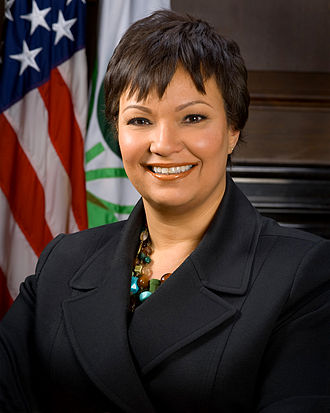
EPA Director Lisa P. Jackson

EPA Director Lisa P. Jackson

Or is this one more case of using environmentalists as scapegoats by the hard right, and other know-nothings and know-not-enoughs?

Jackson’s piece makes mild defense of a great idea in government, I think.  To me, the critics appear hysterical in comparison.

In tracking this down, I discovered that Matt Ridley had been given some really bum information about Rachel Carson, DDT and malaria, which appears in his new book, The Rational Optimist. To his credit, Ridley made a quick correction of the grossest distortions.  He defends the premises, still, however, which I find troubling. There may be subject for a later comment.

Disinformation is insidious.  Claims against the accuracy and reputation of Rachel Carson follow the stories of Millard Fillmore’s bathtub, but with darker, malignant intent.

Seriously:  What does Lisa Jackson overstate here?

The EPA Turns 40

‘Job-killing’ environmental standards help employ more than 1.5 million people.

Forty years ago today, the U.S. Environmental Protection Agency opened its doors, beginning a history of improvements to our health and environment. We reach this milestone exactly one month after the midterm elections strengthened the influence of groups and individuals who threaten to roll back the EPA’s efforts.

Last month’s elections were not a vote for dirtier air or more pollution in our water. No one was sent to Congress with a mandate to increase health threats to our children or return us to the era before the EPA’s existence when, for example, nearly every meal in America contained elements of pesticides linked to nerve damage, cancer and sometimes death. In Los Angeles, smog-thick air was a daily fact of life, while in New York 21,000 tons of toxic waste awaited discovery beneath the small community of Love Canal. Six months before the EPA’s creation, flames erupted from pollution coating the surface of Cleveland’s Cuyahoga River, nearly reaching high enough to destroy two rail bridges.

These are issues that are above politics. The last 40 years have seen hard-won advances supported by both sides of the aisle, and today the EPA plays an essential role in our everyday lives. When you turn on the shower or make a cup of coffee, the water you use is protected from industrial pollution and untreated sewage. In fact, drinking water in Cleveland was recently shown to be cleaner than a premium brand of bottled water. You can drive your car or catch a bus without breathing dangerous lead pollution. At lunch, would you prefer your food with more, or less, protection from pesticides?

The most common arguments against these protections are economic, especially as we continue to recover from the worst downturn since the Great Depression. Fortunately, the last 40 years show no evidence that environmental protection hinders economic growth. Neither the recent crisis nor any other period of economic turmoil was caused by environmental protection. In fact, a clean environment strengthens our economy.

Special interests have spent millions of dollars making the case that we must choose the economy or the environment, attacking everything from removing lead in gasoline to cleaning up acid rain. They have consistently exaggerated the cost and scope of EPA actions, and in 40 years their predictions have not come true.

We have seen GDP grow by 207% since 1970, and America remains the proud home of storied companies that continue to create opportunities. Instead of cutting productivity, we’ve cut pollution while the number of American cars, buildings and power plants has increased. Alleged “job-killing” regulations have, according to the Commerce Department, sparked a homegrown environmental protection industry that employs more than 1.5 million Americans.

Even in these challenging times, the EPA has been part of the solution, using Recovery Act investments in water infrastructure, clean-diesel innovation and other projects to create jobs and prepare communities for more growth in the years ahead.

The EPA’s efforts thrive on American ingenuity and entrepreneurship. Holding polluters accountable sparks innovations like the Engelhard Corporation’s catalytic converter, which pioneered the reduction of toxic emissions from internal combustion engines, and DuPont’s replacements for chlorofluorocarbons (CFCs), which protected the ozone layer while turning a profit for the company. One executive told me that the EPA’s recent standards for greenhouse gas emissions from cars will help create hundreds of jobs in a state where his company operates—a state whose U.S. senators have both opposed the EPA’s authority to regulate greenhouse gases.

These attacks are aimed at the EPA, but their impacts are felt by all Americans. Pollutants like mercury, smog and soot are neurotoxins and killers that cause developmental problems and asthma in kids, and heart attacks in adults. We will not strengthen our economy by exposing our communities and our workers to more pollution.

In these politically charged times, we urge Congress and the American people to focus on results from common-sense policies, not inaccurate doomsday speculations. That is how we can confront our nation’s economic and environmental challenges and lay a foundation for the next 40 years and beyond.

Ms. Jackson is administrator of the Environmental Protection Agency.

* [Oops. Same birthday as Donna. Happy birthday, Donna! Happy EPA’s 40th (yours, too? can’t be much more, can it?)]


President’s Malaria Initiative: Plans for FY 2011

December 14, 2010

Barack Obama continued George W. Bush’s Africa-oriented fight against malaria.  The President’s Malaria Initiative (PMI)continues to target malaria for control and, if possible, eradication.

PMI announced today plans for work in 2011, country by country:

Malaria Operational Plans for Fiscal Year 2011

These Malaria Operational Plans have been endorsed by the U.S. Global Malaria Coordinator and reflect collaborative discussions with the national malaria control programs and partners in country. If any further changes are made to these plans, it will be reflected in revised postings.

How long before some wag complains that Obama’s program is anti-Africa because it doesn’t propose enough poisoning of the place?  “Not enough DDT!” they will complain, I wager.  And, for the record, I make this prediction not having read any of the country operational plans — in nearly complete ignorance of what the plans actually propose.  Can you find “enough” DDT in any country’s plan?

More:


Mandy Moore Talks Mosquito Nets – ABC News

December 13, 2010

Don’t ask me what work she’s done, because I couldn’t tell you.  I can tell — based on the headlines of the clipping services — that Mandy Moore is popular.

Ironically, in her brief tour of Africa and — shall we label it? — probably-shallow understanding of the issues, Ms. Moore has a deeper understanding of malaria and how to fight it than the most erudite of the DDT denialists, like Michael Crichton, or Rutledge Taylor.  Innocence wins.

For ABC News, the actress talked about charity work in Africa:

Vodpod videos no longer available.

Mandy Moore Talks Mosquito Nets – ABC News, posted with vodpod

It’s a case of a celebrity doing “Do a Good Deed” duty, most likely.  In the video, Mandy Moore puts DDT denialists to shame.  In writing?  Moore doesn’t come off as well.  (Did she write that piece herself?  Maybe she should write what she talks.)


Ducking the quacks on DDT

December 9, 2010

Howard Stern may not re-up with Sirius, I hear.  That would make it easier to avoid the quackings of one of the latest and greatest cranks on DDT and malaria.

Rutledge Taylor, the erstwhile (still?) beauty-cream peddler to the stars, spoke with Stern on the telephone the day after the Pearl Harbor anniversary, apparently on the air, and demonstrated greater lunacy about DDT and malaria than in the past; the conversation was posted to YouTube.  Among other things Taylor gets dead wrong he claims:

  • Bedbugs did not develop resistance to DDT as reported in the 1950s and confirmed by recent detailed studies
  • No one studied bedbugs in the past three decades or so
  • DDT was banned to kill people, not due to any danger
  • Mosquito nets are “antiquated”
  • DDT doesn’t harm birds, doesn’t thin eggshells
  • Linus Pauling’s vitamin C studies show that DDT works
  • William Ruckelshaus completely banned DDT use everywhere, by himself, with no science to back the action

Taylor claims to have five file cabinets full of the studies on DDT, but it becomes clear that he hasn’t read any of them.  For example, he cites the erroneous claim that DDT saved 500 million lives, from a 1970 study by the National Academy of Sciences — but he’s not got the honor to tell his listeners that NAS then concluded that despite its value, DDT is too dangerous to keep using.

Stern’s newsletter said, for the December 8, 2010 program:

THE DUDE WHO DRANK DDT

Howard got Dr. Rutledge Taylor on the line to discuss his DDT advocacy: “This is the guy who believes in DDT.” Robin remembered Dr. Rutledge’s infamous YouTube video: “He drank it!” Dr. Rutledge said anti-DDT activists cited faulty–or just plain old–research: “There’s not been a study on DDT and bedbugs in 30 years…it’s the safest pesticide on the planet.” Howard asked about the common claim that DDT thins bird eggs, so Dr. Rutledge said he’d never seen proof: “Total bullshit. I’ve got every study going back to 1940.”
Howard asked if Dr. Rutledge was really dating 80s pop star Debbie Gibson, and the doc confirmed it: “She’s right here. Right now.” Debbie grabbed the phone: “I’m the crazy-supportive girlfriend up in the middle of the night making this phone call with him. Look, he’s saving the world and I wrote ‘Shake Your Love.’ It’s a match made in heaven.” Howard joked: “Does Dr. Rutledge ever bring DDT into the bedroom? Rub it on you?” The doc laughed: “It’s better than chocolate.”

Back in the olden days, broadcasters had to demonstrate that they broadcast in the public interest.  Sirius needs to make no such demonstration.  Otherwise, Stern’s Know-Nothing rants on DDT, alone, would put their license into question.

Instead of urging people to donate $10 to Nothing But Nets to save a kid from malaria, Taylor insists that people should go see his movie, “3 Billion and Counting,” instead.

Fortunately, the movie is no longer in release.  So, Dear Reader, make Howard Stern apoplectic, and save a kid’s life, by sending $10 to Nothing But Nets, and ignore Stern completely.

The facts?  You can’t get them from Stern or Taylor: