A history of environmental disasters (Day After Blog Action Day)

October 16, 2007

Blog Action Day, 2007: We’re writing about environmental issues.

Blog Action Day 2007

Each January 1 I reflect on one of many forgotten environmental disasters, because it’s a focus of television coverage. Oh, the disaster itself isn’t covered — most often it’s not even mentioned — but it’s there if you know anything at all about it.

The Tournament of Roses Parade.

With the Bowl Championship Series game in town, and thousands of tourists out to see the parade, the games, and other festivities, no one really wants to talk about the why of the Rose Bowl, and the Rose Parade.

But once upon a time, under the sunny skies of southern California, Pasadena hosted a flower industry. Cut flowers were the produce. The Los Angeles Basin around Pasadena produced $1 billion in cut flowers annually by the late 1940s. Partly to promote that industry, local civic movers pushed a festival named to celebrate the flowers, to promote them, to feed local industry. The shtick was this: Parade floats had to be decorated exclusively with flowers and flower petals. What better way to showcase the local agricultural miracle?

Nearly 60 years later, I’ll wager less than 0.1% of the flowers used in the parade come from the Los Angeles Basin.

Air pollution forced the flower growers to move. Air pollution mottled the petals of the roses, browned the daisies, and otherwise spoiled blossoms. The greenhouses, the fields, the entire industry left the area. And today, all that is left is the parade and football game. Parade floats are decorated with flowers imported from Venezuela, Israel, Europe, Hawaii, Mexico, South America and Asia.

And so it goes. Significant upheavals in human activities, prompted by environmental goofs by humans, get shuffled out of the history books, out of our collective consciousness — and as Santayana warned, we repeat them, over and over. Los Angeles is not the only city ever to have suffered from air pollution — there were killer fogs in London and Pennsylvania within a decade after World War II. Surely people learned, no?

Consider Mexico City today. Consider Beijing today.

So I just want to list some environmental disasters that we would be better off, if we remembered them and considered how to avoid them in the future, rather than forget them and be doomed to repeat them.

(I reserve the right to post links and edit this list to add to it, as I find additional information, and as readers may add information in comments.)

Environmental disasters you should know

It’s not an exhaustive list by any means — I wager some of these are new to most readers. I wager some of you can provide better information, and other disasters that I, perhaps, have forgotten. Please, inform us.


Hey Bush, Perry! Texas hurricane victims need your help

September 25, 2007

Don’t forget about the victims of Katrina who still need help. But add to your worries the more than 50,000 families in Texas whose homes were seriously damaged by Hurricane Rita who have had no inkling of help, now two years after the storm.

Hurricane Rita hitting Texas

Gov. Rick Perry declared the state disaster; Pres. George Bush declared the national distaster — but only about 1% of the money allocated has been spent, and Texans are hurting.

FrecklesCassie, the author of the blog Political Teen Tidbits, makes the case for action here: “Hurricane Damage isn’t the Only Problem .”

Drop a letter to Rick Perry; drop a letter to George Bush. Tell them to get off their duffs and do something. That’s what they get the big hair and make the big bucks for.

Copy Cassie’s post and send it to your best friends in e-mail; put up a blog post and link to Cassie’s post.

Where are Sens. Kay Bailey Hutchison and John Cornyn when Texas needs them? Cornyn is up for election next year, and he’s not all over this?

Looks to me like the Democrats could pick up a U.S. Senate seat in Texas, too. Texas wouldn’t be ignored like this if Phil Gramm and George Bush were still alive . . .


Tipping point: Greenland ice melt shakes Earth

September 8, 2007

Stephen Leahy’s headline sounds almost hysterical: “Greenland Ice Collapse Producing Earthquakes.”

Here’s the article in The Guardian with the backup data.

Something to think about.

Greenland is melting; photo showing ice sheets breaking up

Read the rest of this entry »


Unstrange maps: Security, health, economics

September 3, 2007

Strange Maps features odd maps, often fictional. I like the site, especially for the inherent humor in some of the maps — and since it’s such a popular site among the more than 1 million WordPress weblogs, it’s clear others share my enthusiasm.

Global map of energy security risk - Maplecroft Maps

There are a lot of unstrange and beautiful maps based on reality, too, used to give a quick, graphic image to the brains of people working on serious problems. Maps guide policy makers, and illustrate geographical range of problems, and sometimes geographical causes and vulnerabilities.

Here’s a source of interactive maps that every economics, government, history, and health teacher should bookmark: Maplecroft Maps.

Maps at this site cover a nearly complete range of issues that worry leaders of businesses and nations. I found the site looking for information about malaria.

Of special note is the wealth of information available from the interactive features. Clicking on nations or on symbols on the map provides details of issues the map covers; three tabs with the maps take the viewer of most of the maps to an extensive list of resources on the issue, and case studies, and analysis. These sources seem tailor made to help students doing geography projects.

Issue maps include disasters, malaria, child labor, climate change, poverty, land mine risk, political risk and a wide variety of others. You’ll need Macromedia Flash on your computer; there does not appear to be any way to download the maps, so you’ll need a live internet link to use these in class.

Information from these maps will be more current than any geography, history or economics book. Go see.

Maplecroft is a network of academic and business consultants. These maps are made to help their clients; Maplecroft’s description of the series is below the fold.

Read the rest of this entry »


Life-saving mine communicators: No deal, operators say

August 30, 2007

Via The Pump Handle, a very good blog on public health issues, we get an article by Tom Bethell noting that a revolutionary mine communication system saved 45 lives in Utah during a mine fire in 1998.  Unfortunately, most U.S. mine operators refuse to use the system, including the Crandall Mine in Huntington Canyon, Utah, where nine miners have died in the last three weeks.

Bethell is an old United Mine Workers Union writer, and might be considered biased because of his past affiliations.  However, I’ve watched his work since I staffed the Senate committee that dealt with mine safety, and my experience is that his work is very good, tilted toward workers and increased safety for very good reasons.

Bethell’s article ran in the award-winning weekly newspaper, The Mountain Eagle in Whitesburg, Kentucky — operated by Tom and Pat Gish since 1956.   Though nominally a small-town weekly, the newspaper’s influence is multiplied by solid reporting and followup on stories and issues that are vital to the local community.  Coal mining is a big part of life in that area of Kentucky.

I cannot improve on Bethell’s writing, nor on the drama his story has naturally from its topic and the tragedy it reveals.  Bethell’s article is below the fold:

Read the rest of this entry »


Great Wall of China crumbling

August 29, 2007

Nothing lasts forever.

From MSNBC comes an Associated Press report that the Great Wall of China is falling down in places, the victim of blowing sands. The blowing sands are the result of a Dust-Bowl-like overplowing spree after World War II.

Crumbling section of Great Wall of China, in Mongolia

Observations:

1. Geography teachers should copy this story and follow it; soil erosion killed Babylon and several other civilizations in the Fertile Crescent (and Carthage, if we allow that the erosion was promoted by the Romans as a weapon of genocide); the Great Wall is one of those features that most people think strong an permanent. This is also a great insight into construction methods — the parts of the Wall that are crumbling appear to have been made of mud. Adobe construction, anyone (someday I have to finish that post).

2. World history teachers ought to note it for the same reasons as geography teachers. U.S. history teachers will want to keep this to compare it to the Dust BowlThere are also signs that humans may have significantly altered the local biota and, perhaps, climate, with their construction and agriculture methods.

3. China’s ascent in world position brings responsibilities it may have hoped to avoid, such as protecting the environment. Ending the encroachment of the desert in this case is a tall order — but if it can be done there, perhaps it can also be done around the Sahara, around the Namib, around the Syrian Desert, and other places where grasses once grew, but dust now blows. These sites are more common than one might think.

4. Santayana’s ghost: Didn’t China pay attention to the events of the U.S. Dust Bowl?

Tip of the old scrub brush to Jonathan Turley’s new blog — Turley’s a good lawyer with very interesting cases; his views are a welcome addition. Most of his blog simply points to interesting legal issues.


Hurrican Dean, climate change, political action

August 21, 2007

Chris Mooney, the Storm Pundit, dishes out the news on the record-making severity of Hurricane Dean. Mooney’s latest book is Storm World: Hurricanes, politics, and the battles over global warming.

Hurricane Dean at landfall in Yucatan, from Weather Underground False color satellite image of Hurricane Dean as it struck the Yucatan Peninsula; image from Weather Underground, via the Intersection.

Mooney’s information on Dean is at his blog, The Intersection, at the Huffington Post stable, and at the Daily Green.

Mooney said:

Dean was officially the most powerful hurricane that we’ve seen globally so far in 2007, and was by far the strongest at landfall. It was also the first Category 5 Atlantic hurricane seen since the record-setting Hurricane Wilma of October 2005. In fact, Dean set some records of its own. Its pressure was the ninth lowest ever measured in the Atlantic, and the third lowest at landfall. Indeed, there hasn’t been a full Category 5 landfall in our part of the world since 1992’s Hurricane Andrew. Dean was in all respects a terrifying storm, and we can only hope that the damage will somehow be less than expected as it tears across the peninsula and then, after crossing the Bay of Campeche, moves on to a presumed second Mexican landfall.

Dean is already in the record books in ways that should make policy makers think hard about what to do in terms of disaster preparation, and in terms of what political entities can do to prevent actions that intensify such storms:

1. Dean is the ninth most intense Atlantic storm by pressure, and six of the top ten (Wilma, Rita, Katrina, Mitch, Dean, and Ivan) have occurred in the past ten years.

2. Dean is the strongest hurricane anywhere this year, and by far the strongest at landfall. It is the tenth category 4 or 5 hurricane globally and the 3rd Category 5.

Texas has mobilized disaster relief efforts as never before. School buses have been mustered near San Antonio for evacuations. 90,000 gallons of gasoline have been delivered to potential hurricane zones, to aid in self-evacuations. Helicopters are being mustered just outside potential storm zones. Someone is paying attention to the damage mitigation and clean up.


Update your list of Utah mine disasters

August 7, 2007

When I put together the addendum list of disasters, to append to the Popular Science list of ten worst natural disasters in the last century in the U.S., I found it difficult to make a natural cutoff of mine disasters. From growing up in Utah I recalled the 1924 Castle Gate mine fire, which was covered fleetingly in Utah history texts, but became relevant during the 1963 potash mine incident. Local newspapers opened their archives, people who had roles in the incidents gave new interviews, and history came alive in the newspapers for a brief period.

A few years later, when I worked public policy for Utah politicians, in discussions of mine safety and the expansion of coal mining, I discovered that the history of Utah accidents had once again slipped from general public recall, and from the text books.

Once again, an accident of unbelievable proportions occurred in a massive coal mine in Utah, in an out-of-the-way place; a handful of people are trapped, and the nation hopes for their safety and prays for their rescue.

To its credit, the Salt Lake Tribune opened its archives again, and provides some historical context; somebody will need this list of Utah mine accidents in a few months, so I preserve it below the fold.

Read the rest of this entry »


Disasters, on sale

August 3, 2007

Cover of NYTimes book on disastersFollow-up on yesterday’s post on disasters:  Looking at the sale books at the New York Times site, I discovered this one on sale:  The New York Times Book of Natural Disasters.  $8.48, while supplies last.

Tuesday’s Science sections in the Times are weekly delights.  This series of books on one topic contains several that I use regularly (especially archaeology and fossils).  Generally these books hold some of the best articles by the stable of thoroughbred science writers on the topic at hand.

Did I say “science?”  Social studies teachers need to know science, too.


Disasters!

August 2, 2007

Popular Mechanics features the “Ten Worst Disasters of the Century,” showing how Americans fought back after natural disasters in — roughly — the 20th century.

It’s an odd century used — it leaves out the Galveston, Texas, hurricane disaster of 1900, but it includes Hurricane Katrina in 2005 (maybe it would more accurately be titled “disasters of the last 100 years”). The list is limited to natural disasters, so the Texas City harbor disaster of 1947 isn’t even considered, and the New London, Texas, school explosion doesn’t make the list. Those are quibbles; Texas teachers, and others, can supplement the list to accommodate other local, national and man-made disasters.

The Dust Bowl, which I would argue was greater than any of the other disasters listed, is also left off — too long a disaster?

The Popular Mechanics list is still a treasure trove for geography and history teachers. You might want to go out today to find the magazine at a newsstand, and pick up a copy or two. Throughout this post I sprinkled several links to the website of Popular Mechanics.

Here is the Popular Mechanics list of top 10 natural disasters, in chronological order:

1. 1906 San Francisco Earthquake

2. The Big Burn of 1910

3. 1918 Spanish Flu Epidemic

4. Tri-state tornado of 1925 (one tornado across Missouri, southern Illinois and Indiana)

5. The New England Hurricane of 1938

6. The Great Alaskan Earthquake and Tsunami of 1964

7. 1974 Super Tornado Outbreak

8. Mt. St. Helens Eruption, 1980

9. 1993 Storm of the Century (snow)

10. Hurricane Katrina, 2005

There you have ten disasters of the 100 years between 1905 and 2005. For a geography or history class, that could be ten days of study — a map each day, a history timeline each day featuring especially who was president at the time (and how the president reacted), a story of geology or meteorology or public health each day. At the end of a ten-day unit the class could have made ten different maps covering most of the U.S. but Hawaii, covering the technology developments of the 20th century, especially the development of radio, air travel, and space technology (weather satellites), and covering the development of human institutions to cope with disasters and prevent future disaster, especially communication, transporation, medical care, banking and other investments (the rise of the Bank of America from the San Francisco Earthquake is a great little piece of history all by itself), and government.

This is not the curriculum most of the state testing authorities envision. Students will remember the geography, history and technology of these ten days with a lot more clarity and depth than most other units a teacher might cover.

Alternatively, these could be ten Disaster Fridays, reinforcing geography and history in particular. I’m sure I’ve just scratched the surface — how do you use disasters, especially these ten, in your classroom now? Tell us about it in the comments, please.

Other disasters?

No rule says you have to stick with ten, or that you need to stick with the 20th century, or with natural disasters. Here are several other disasters that you may want to include in your curricula, again in chronological order:

The Great Chicago Fire of 1871 (October 8), which every school kid ought to know about; coupled with the fire in Peshtigo, Wisconsin, the same night, which was the deadliest fire in American history; news was slow to get out because nearly every person in Peshtigo died, and the town was literally burned off the map.

The blizzards of 1888 — the Schoolhouse Blizzard of January 12, which killed more than 200, mostly school students, and the Great Blizzard of 1888 which paralyzed much of the nation a couple of months later, from March 12 to March 14.

The Johnstown Flood, May 31, 1889 — a disaster seriously compounded by the folly of men and a leaky dam.  2,200 dead.

The Galveston Hurricane of 1900, memorialized in the best-selling history Isaac’s Storm. At least 8,000 people died in Galveston, Texas’s largest city — and maybe as many as 15,000. There were too many bodies to count. Galveston invented a new form of government to help recover from the storm, the city commission style of government, which has been adopted widely throughout the U.S. Another large hurricane struck Galveston in 1915, killing 235 people — but it was so small in comparison, it is usually forgotten.

The 1909 Cherry Mine Fire (Bureau County, Illinois) — 259 men and boys died in a coal mine fire.

Dawson, New Mexico, Mine Disaster, October 22, 1913. 263 dead.

The Sinking of the Steamer Eastland on Lake Michigan, July 24, 1915. 840 people died.

The Boston Molasses Disaster of 1919, which featured walls of hot molasses 35 feet high careening through the streets of Boston — 21 died.

The Tulsa Riot, 1921 — a race riot that killed 300 people and destroyed the African American “Wall Street.”

The Great Mississippi Flood of 1927, which shook the social and civic foundations of riverside cities and towns.

The Dust Bowl, 1931-1939

The Ohio River Flood of 1937, which killed over 200 and pushed a million people out of their homes.

The New London, Texas, School Explosion, March 18, 1937.  In Texas’s richest school district, a gas pipeline heated the building for free.  In the era before odorfactants were added to natural gas to alert people of leaks, no one suspected the leak.  Nearly 300 died in the explosion, mostly children.

The 1946 Aleutian Islands Earthquake and Tsunami, and the April Fools Tsunami in Hawaii. An earthquake registering 7.8 struck the Aleutian Islands in far western Alaska. Six people died there. 159 people died in Hawaii when the resulting tsunami struck several hours later — the death toll perhaps increased because many people thought the warnings of a coming wave to be an April Fool’s prank.

The Texas City Explosion, 1947

The Montana-Yellowstone Earthquake, 1959, a 7.3 shaker which killed 28 people and created a new lake, Quake Lake, on the Madison River.

The Watts Riots, August 1965.

The Detroit and Newark Riots, 1967. Yes, it was “the Summer of Love.” Still, there were 164 “civil disorders” (riots) in 128 different U.S. cities. Detroit and Newark were the worst.

The Yellowstone Fires, 1988.

The Great Flood of 1993 (Mississippi River).

The 1997 Red River Flood (North Dakota, Minnesota and Manitoba, Canada).

Good heavens. That’s a depressing list. Still, I wonder — have I left anything off? Tell me in the comments, if you see something missing.

Other sources:


Collateral damage from magic bullets

July 22, 2007

In an earlier post I noted Norman Borlaug’s receiving the Congressional Gold Medal. In comments, Bernarda noted those who disagree with the claim that Borlaug’s Green Revolution was much of a benefit, or perhaps more accurately, those who note the problems that result from such advances — and there are many. Bernarda pointed to a BBC lecture from Vendana Shiva, detailing the problems that Punjab experienced as a result of governmental and society structures unable to deal with the changes required by high-yield crops: “Poverty and Globalisation.” It’s worth a read or a listen.
Similarly, in another BBC lecture in that series, Gro Harlem Bruntland details problems from “progress” that includes cutting the forests, in “Health and Population.” Relevant to other discussions here, she notes a rise in malaria due to deforestation, raising an issue that the junk science purveyors opposed to Rachel Carson’s honoring would like to ignore. Here is a small excerpt of her talk — note that deforestation is not a problem that more DDT can solve:

Gro Harlem Bruntland:  Recently, in Mozambique, I saw children with their eyes glazed with fever from a malaria that could have been prevented if their parents could afford bed nets. Deforestation had changed malaria from a nuisance to a curse in a matter of twenty years. 

Gro Harlem Brundtland, former Director General of the World Health Organization (WHO). Wikiquote image.

Gro Harlem Brundtland, former Director General of the World Health Organization (WHO). Wikiquote image.

More people are suffering from this killing and debilitating disease now than ever before, and deforestation, climate change and breakdowns in health services have caused the disease to spread to new areas and areas that have been malaria-free for decades, like in Europe.

In the Philippines, I have watched how beggars sit exhausted on the pavements convulsed with coughing. Tuberculosis, which we long believed had been brought under control by effective treatment, is on the rise again. Increasingly, we see forms of tuberculosis which are resistant to all but a very expensive cocktail of drugs.

I think that HIV/AIDS may be the most serious threat to face sub-Saharan Africa and other developing regions. space. Already, the AIDS epidemic is the leading cause of death in several African countries. AIDS has reversed the increases in life expectancy we have seen over the past thirty years. The social and economic devastation in countries that could lose a fifth of their productive populations is heart-rending.

I believe we are facing this alarming situation largely because of an outdated approach to development. Our theories have to catch up with what our ears and eyes are telling us – and fast.

There was a period in development thinking – not so long ago – when spending on public services, such as health and education, would have to wait. Good health was a luxury, only to be achieved when countries had developed a particular level of physical infrastructure and established a certain economic strength. The implicit assumption was that health was to do with consumption. Experience and research over the past few years have shown that such thinking was at best simplistic, and at worst plainly wrong.

I maintain that if people’s health improves, they make a real contribution to their nation’s prosperity. In my judgement, good health is not only an important concern for individuals, it plays a central role in achieving sustainable economic growth and an effective use of resources.

As in Europe at the end of the 19th and beginning of the 20th century, we have seen that developing countries which invest relatively more, and well, on health are likely to achieve higher economic growth.

In other words, malaria prevention grows on trees, or malaria grows with the cutting of trees.


Radio history, historic radio

May 7, 2007

Internet connections can really boost history with sound and film presentations. History is really still in infancy stages, but some sites flash through with brilliant views of what can be done.

Old Time Radio posts a wealth of sound clips from throughout radio history, coupled with essays detailing much of the history that isn’t in the soundclips. The site seems to have almost all the episodes from Captain Midnight, for example. You can also hear Terry and the Pirates, or Fred Allen or Jack Benny.

The real gems, to me, are the newscasts and the stories of the newscasters. The 1937 broadcast of the Hindenberg Disaster is available, but so are some of the later and more important, and more rare, broadcasts of World War II: the Austrian Crisis, Neville Chamberlain with Britain’s declaration of war, news bulletins of the Pearl Harbor attack, on-the-scene accounts of the D-Day invasion of Normandy (with more accounts here), the battle for Iwo Jima now famous from two Clint Eastwood films, and V-J Day (“Victory-Japan”).

Later clips make this a standout site, and tantalize us with possibilities.  Ernest Hemingway’s suicide report, the 6-Day War between Israel and Egypt and Syria in 1967, and a report on the funeral of Robert F. Kennedy in 1968 flesh out events that the high school history texts tend to stroll quickly over, and offer possibilities of classroom enrichment beyond the texts.

Surely more radio broadcasts exist that could be used in history classrooms.  Radio and broadcast history sites like The Broadcast Archive have the history of broadcast, but few actual broadcasts.   Other sites carry a few important broadcasts, but like this one, come weighted with polemics (the politics and religion on this site make it questionable for school use, though students may not think to look at the home site from the broadcast links — where did this guy get these broadcasts, and does he have the rights correctly listed?).

Some research suggests that students learn history partially through repetition, as with any other topic.  The old “repeat it four times” rule gets boring in class, but can be kept alive by repetition in other media.  Teachers who use the actual broadcasts of news of what are now historic events can make history speak to students.  Can.

More radio broadcast history:

BBC News historic broadcast archives  (This site has broadcasts through current times, including, for example, broadcasts of Nelson Mandela’s rise to the presidency of South Africa, a much-ignored era in too many classrooms.)

Earthstation 1 CDs and DVDs for purchase

Timeline of radio, from the California Historical Radio Society

Radio broadcasts 1939-1943 from the University of San Diego’s history server

Ken Burns’ “Empire of the Air” companion site

First commercial broadcast in the U.S., KDKA-AM, Pittsburgh, Pennsylvania, with results of the Cox-Harding presidential election, November 2, 1920


Moment in history: May 6, 1937, the Hindenberg crash

May 6, 2007

May 6, 2007, is the 70th anniversary of the Hindenberg tragedy. Docking at its station in New Jersey, after crossing the Atlantic, a spark ignited the aluminum-based paint on the airship, and the entire craft exploded into flame.

35 people died on the airship, and one on the ground — did you know a few survived? The Associated Press interviewed a man who was 8-years old that day, and a passenger on the airship.

Werner Doehner, an 8-year-old passenger aboard the Hindenburg, saw chairs fall across the dining room door his father had walked through moments before the disaster. He would never see his father alive again.

“Just instantly, the whole place was on fire,” said Doehner, of Parachute, Colo., who is the last surviving passenger. “My mother threw me out the window. She threw my brother out. Then she threw me, but I hit something and bounced back. She caught me and threw me the second time out. My sister was just too heavy for her. My mother jumped out and fractured her pelvis. Regardless of that, she managed to walk.”

Hindenberg on fire

Hindenberg on fire, May 6, 1937.

The disaster erroneously condemned hydrogen in the public’s mind. Despite widespread use of hydrogen gas for cooking and some transportation during World War II (including in the U.S.), use of hydrogen as a fuel beyond that has always faced the hurdle of the “Hindenberg Syndrome,” the fear that the gas would explode. Fact is that gasoline is much more volatile, more explosive, and generally more dangerous, than hydrogen.


Global warming effects: More nasty bugs

May 1, 2007

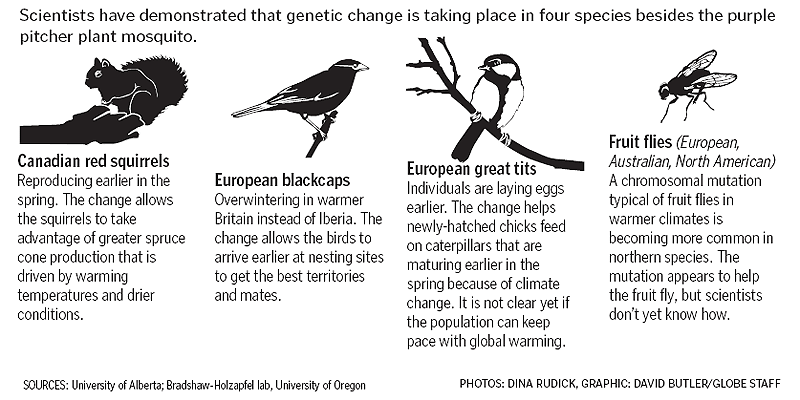
This news can fit into curricula in several ways, in several courses: Insects have already evolved in response to climate shifts due to global warming.

The Boston Globe has a series on global warming, and a recent article detailed how mosquitoes on the Maine frontier have already changed their breeding seasons in response to warming weather.

A mosquito that can barely fly is one of only five known species that scientists say have already evolved because of global warming. The unobtrusive mosquito’s story illustrates a sobering consequence of climate change: The species best suited to adapting may not be the ones people want to survive.

Such news enhances biology studies of genetics and insects, geography studies of climate, animal dispersal patterns and disease and pest ranges (a subject more technically known as biogeography), and the articles lend urgency to studies of how governments react to natural crises, a topic suitable for government classes, economics, and U.S. and world history.

Global Warming illustration Click on the thumbnail to see four examples of genetic change credited to global warming. (Graphic by David Butler of the Boston Globe staff.) Read the rest of this entry »


Interactive disaster maps for geography

April 15, 2007

Would tracking disasters add more than a little interest to your geography units?

Cliotech, a blog by a Pennsylvania social studies teacher, gives pointers to Alertmap, a group based in Budapest (hey, that’s a geography lesson right there!). Alertmap charts disasters — fires, floods, earthquakes, etc. — and what student is not interested in disaster?

Be careful not to unnecessarily scare students — but do point out that the world is full of danger, and natural and man-made disasters continue to plague mankind the world over.