Human rights lawyers arrested in Vietnam, Iran

June 18, 2009

Get the story here, at Accumulating Peripherals, from Matthew Steinglass.

While eyes are on Iran — as best eyes can be on a place where the government has the fog machines turned on high — Vietnam also arrestsed a leading human rights defender, with too few watching.

On Tuesday, according to NPR’s Mark Memmott, Iranian Nobel Prize winner Shirin Ebadi told NPR reporter Davar Iran Ardalan that a prominent human rights lawyer had been arrested by security agents posing as clients.

That lawyer, Abdolfattah Soltani, spoke with Davar just yesterday — telling her that the Iranian government should recount all the votes in last Friday’s disputed presidential election, in which President Mahmoud Ahmadinejad was declared the winner by a 2-1 margin.

“Once they were inside they immediately confiscated his computer and other documents and they arrested Mr. Soltani,” Ebadi said in today’s interview. “As far as we know, they did not have an arrest warrant.”

And in Vietnam:

On the other side of Asia last weekend, Vietnamese plainclothes security agents entered the offices of the Ho Chi Minh City dispute resolution firm PIAC and arrested US-trained lawyer and former Fulbright scholar Le Cong Dinh. As a lawyer at White & Case in 2003, Dinh defended Vietnamese catfish farmers against US anti-dumping tariffs. Then, in 2007, he served as defense counsel for two Hanoi human rights lawyers, Nguyen Van Dai and Le Thi Cong Nhan, who were ultimately sentenced to several years in prison for spreading information “harmful to the State”. While continuing his corporate and civil work, Dinh also defended the well-known political blogger known as Dieu Cay in 2008, when the blogger was arrested on tax charges.

Dinh was arrested Saturday on charges of “colluding with domestic and foreign reactionaries to sabotage the Vietnamese state.”

Resources:


Crankery under the microscope: Denialism as pathology

June 10, 2009

You can see it in this little-noted blog.  Someone drops by to tell me I’m in error, that Rachel Carson really did plot with Pol Pot to murder millions, and then they also show up in the creationism threads defending the view that dinosaurs never existed, or in a tangentially-related note on climate change, perhaps arguing that ocean levels rising are either not a problem, or the product of Atlantis’s rising from the depths (and therefore no problem, since the denizens of that city had better science than we do and will be able to fix things, never mind their being dead for 5,000 years).  [That last description is mostly fictional – mostly.]

What is it that makes one person deny reality on so many different fronts?

Mark Hoofnagle hit the research journals, listing results at denialism blog, demonstrating that crankery can be studied.  This raises in my mind the interesting little question of whether such crankery is a pathology, and perhaps treatable or curable.

Our recent discussions of HIV/AIDS denial and in particular Seth Kalichman’s book “Denying AIDS” has got me thinking more about the psychology of those who are susceptible to pseudoscientific belief. It’s an interesting topic, and Kalichman studies it briefly in his book mentioning the “suspicious minds”:

At its very core, denialism is deeply embedded in a sense of mistrust. Most obviously, we see suspicion in denialist conspiracy theories. Most conspiracy theories grow out of suspicions about corruptions in government, industry, science, and medicine, all working together in some grand sinister plot. Psychologically, suspicion is the central feature of paranoid personality, and it is not overreaching to say that some denialists demonstrate this extreme. Suspicious thinking can be understood as a filter through which the world is interpreted, where attention is driven towards those ideas and isolated anecdotes that confirm one’s preconceived notions of wrong doing. Suspicious thinkers are predisposed to see themselves as special or to hold some special knowledge. Psychotherapist David Shpairo in his classic book Neurotic Styles describes the suspicious thinker. Just as wee see in denialism, suspiciousness is not easily penetrated by facts or evidence that counter individuals’ preconceived worldview. Just as Shapiro describes in the suspicious personality, the denialist selectively attends to information that bolsters his or her own beliefs. Denialists exhibit suspicious thinking when they manipulate objective reality to fit within their beliefs. It is true that all people are prone to fit the world into their sense of reality, but the suspicious person distorts reality and does so with an uncommon rigidity. The parallel between the suspicious personality style and denialism is really quite compelling.

Go read it at denialism.

Denialism may be a little greater problem than is generally acknowledged, in my opinion.  When it infects policy makers it causes legislative and executive crackups, like Oklahoma’s Sen. Tom Coburn, who held up the naming of the Rachel Carson Post Office for a year under the bizarre misconception that she played a role in spreading malaria (ditto for Utah Rep. Rob Bishop, who shared the view but was unable to stop the bill in the House), or like the Bush administration officials at the U.S. Agency for International Development who kept refusing to authorize spending for pesticides in Africa, claiming environmental groups would oppose them while the environmental groups were lobbying the agency to spend the money on those pesticides.

Former South Africa President Thabo Mbeki denied that HIV causes AIDS.  Mbeki’s refusal to act on the best science available may have led to as many as 350,000 deaths, some accounts say.  Ashley Montagu told the story of Adolf Hitler’s odd views of heritage being spread by blood transfusions — to avoid any possibility of his soldiers’ being turned Jewish by a blood transfusion, Hitler forbade the use of blood banks.  Tens of thousands of German soldiers died unnecessarily from lack of blood for transfusing during World War II.  Partisans and scientists still debate whether  and how much Ronald Reagan’s belief that AIDS was a syndrome caused by sin rather than a virus early in the AIDS crisis created a cascade of actions that still frustrates the development of a vaccination or cure.

Denialism in high school students is interesting, but most often a classroom problem.  When kids take great issue with the course material the class can get derailed.  Even when a teacher is able to keep the class on track, the denialist student may feel marginalized.  A colleague reported a student had informed that historians now concur that George Washington was African-American.  She could not be dissuaded from the view.  I had a student who insisted well into the second semester than Adolf Hitler was a great leader, smart and humanitarian, framed for war crimes of the British and Americans.  Unfortunately, I could not put him in contact with the earlier student who believed Hitler had been framed by the Soviet Union, and that the Americans and British were victims of the cruel hoax.

As the nominal head of public relations in the old (Pleistocene?) office of Sen. Orrin Hatch, my crew and I got the brunt of denialists and crazies.  We had one woman in Salt Lake City, “Mrs. B,” who regularly called the Salt Lake office to complain about Hatch’s actions and what she assumed his beliefs must be.  For a while she complained that, as someone born outside of Utah, he could never appreciate the views of the Latter-day Saints in Utah.  When at last we persuaded her that he was also a Mormon, she began complaining that he ignored Utah’s non-Mormon population.  Her ability to switch sides in an argument so as always to remain on the opposite side of Sen. Hatch got noticed.

Near the end of a summer session just before the recess the Senate had a lot of late-night meetings.  The news of these sessions did not always make the morning papers.  On one issue of some Utah import, Hatch had suggested he would probably vote one way, because of some issue of agency direction that had him concerned.  In the end the agency agreed to amendments that assuaged all of Hatch’s concerns and he was happy to support the bill (I forget what it was — the issue is absolutely irrelevant to the story).

I had caught a late-night flight to Salt Lake, and arrived at the SLC office early enough to catch our Utah problem solver Jack Martin explaining to Mrs. B that Hatch did indeed care about Utah . . .   Jack and I could carry on a conversation with only his occasional remarks to Mrs. B keeping her going, a scene out of a Cary Grant comedy, perhaps.  “Yes, Mrs. B . . .  No, Mrs. B  . . . I think I see your point.”  What he said was unimportant.  I could hear her rant on the telephone, while I was on the other side of the room.  I finally asked Jack what her issue was, and he explained it was the bill that Hatch had reveresed his position on.  She was complaining at great length about his original position.  I explained to Jack that an accommodation had been reached and that Hatch changed his vote in the final tally.

Jack smiled broadly as he handed me the phone.  “You tell her!”  It took a long time to get her to stop talking so I could explain who I was and that I had new information.  Finally she fell silent and I explained that she should be happy because Hatch had come around to her position.  There was a silence of a few more seconds, and she started in again:  “Hatch is an idiot!  Only a fool would vote that way.”  And she was off again on a rant against Hatch, eviscerating the views that she herself had held less than a  minute earlier.

The issue wasn’t important to her.  Hatch was wrong, whatever he did, even when he supported her views.

That’s denialism in full force, a raw, unmitigated power of nature.

Hoofnagle concludes at denialism:

So what do these studies mean for our understanding of cranks? Well, in addition to providing explanations for crank magnetism, and cognitive deficits we see daily in our comments from cranks, it suggests the possibility that crankery and denialism may be preventable by better explanation of statistics. Much of what we’re dealing with is likely the development of shoddy intellectual shortcuts, and teaching people to avoid these shortcuts might go a long way towards the development and fixation on absurd conspiracy theories or paranormal beliefs.

Wouldn’t you love to see that study replicated on readers of Watt’s Up With That?, Texas Darlin’ , Junk Science, or one of the antivaxxer blogs?

You may also want to read:


Reagan years: A contrarian’s view

June 4, 2009

California abandoned the memory of the guy who worked tirelessly to keep California in the Union during the Civil War, Unitarian Universalist preacher Starr King, replacing his statue in the U.S. Capitol’s pantheon of state heroes (two to a state) with a statue of Ronald Reagan.  June 4 marks the fifth anniversary of Reagan’s passing.

Statute of Thomas Starr King of California, then in National Statuary Hall (U.S. Capitol)

Statute of Thomas Starr King of California, then in National Statuary Hall (U.S. Capitol)

Older son Kenny sent a note today, saying he now understands why I was so troubled by the Reagan years.  Some guy at The Free Speech Zone added it up — it has what AP history classes call a “point of view,” but calculate the serious factual error to fact ratio:

1) Treason: As a private citizen, and BEFORE the election, in contravention of both law and tradition, Reagan’s minions and handlers illegally negotiated with the Iranians to induce them hold the American Embassy hostages until after the elections,to embarrass President Carer and to prevent his successful negotiation of an “October Surprise.” Sent future VP George Bush, Sr., and future CIA chief William Casey to Paris to negotiate the deal.

2) Sent arms, including chemical weapons, to both Iraq and Iran during the decade-long Iran-Iraq war, making those two countries the two biggest US arms trading partners at precisely the time when it was illegal to trade with either due to both US and UN laws.

3) Iran/Contra: Used drug traffickers to transport illegal arms to Nicaragua, ignoring the contraband which was brought back on the return trip, creating  a massive and immediate increase in cocaine trade in urban California. Illegally used the CIA to mine harbors and ferry Contra troops in Nicaragua. Eventually, several administration staffers were convicted of crimes ranging from lying to Congress to conspiracy  to defraud the U.S. The scandal involved the administration selling arms  to  Iran and using proceeds from the sales to fund a guerrilla insurgent group in Nicaragua

4) Created alQaeda in Afghanistan to oppose the Soviet puppet/occupation there

5) Sponsored right-wing, State terrorism in El Salvador,  Honduras, Haiti, and Guatemala against indigenous insurgents who were fighting the dictatorial, hereditary regimes there. Illegally invaded  and occupied Grenada, overthrowing the democratically elected President

6) Lied about ALL of this activity before Congress, and suborned his Secretary of Defense to perjury, as well.

7) Rescinded Carter policy that all US international financial support be based upon valid human rights records.

8) Took the world to the brink of nuclear war, putting nuclear weapons into Europe, violating the very provision that was the settlement to the Cuban missile crisis.

9) Instituted the so-called “Mexico City” doctrine, effectively barring recipients of U.S. foreign aid from promoting abortion as a  method of family planning.

10) Instigated trickle-down/voodoo economics, which was the beginning of what has recently culminated in the crash of the bubbles. Here is a subset of his regime’s economic sins:

a) Within the first year of the policy, we were in a depression caused in large measure by the policy. The “historic” 27% tax-cut was skewed two to one in favor of those making over $200,000 per year, in percentages, and far more in real dollars. By the end of the second year, increases in state and local taxes more than replaced the cuts for the middle class. b) Wages throughout Reagan/Bush remained stagnant in real dollars for the next 12 years, the longest and worst growth performance in middle class wages in US history. Average national growth was the lowest since the early 30s.

c) Conspired with corpoRat and congressional allies to sustain spending by loosening credit, to replace the wages they were  not going to increase.

d) Named Ayn Rand acolyte and free-market apostle Alan Greenspan as Chief of the Federal Reserve.

11) The HUD/DoI Scandals: Samuel Pierce and his associates were found to have rewarded wealthy  contributors to the administration’s campaign with funding for low  income housing development without the customary background checks, and lobbyists, such as former Secretary of the Interior James G. Watt, were rewarded with huge lobbying  fees for assisting campaign contributors with receiving government loans and  guarantees. Sixteen  convictions were eventually handed down, including several members of the Reagan  administration.

12) Appointed some of the “worst” Federalist Society/strict constructionists to the federal bench, including Scalia, Kennedy, and O’Connor, ALL of whose votes were crucial in (illegally) installing GW Bush in the presidency in 2000, and named Rehnquist Chief Justice.

13) Ordered the revocation of the FCC regulation called “the Fairness Doctrine,” and opened up the Press to the rash of consolidations which has led, now, to a compromised, toothless, stenographic, lap-dog “Fourth Estate.”

14) Initiated the attack on labor unions by attacking PATCO, the Air Traffic Controllers union, creating a crisis in airport control towers nation-wide, and importantly, started the slow erosion of US worker wages and benefits.

15) Through the appointment of James Watt, who claimed that the environment was “expendable” since the “second coming of Christ was at hand,”, Reagan reduced clean water and air standards, reduced labor, mine, and industrial safety standards,and cut funding to supervisory and regulatory agencies charged with monitoring those industries.

16) Increased the defense budget to 240% previous levels.

17)  Systematically ignored the beginning of the AIDS/HIV epidemic, blaming the victims publically.

18)The S&L collapse: Reagan’s “elimination of loopholes” in the tax code included the elimination of  the “passive loss” provisions that subsidized rental housing. Because this was  removed retroactively, it bankrupted many real estate developments made with  this tax break as a premise. This with some other “deregulation” policies  ultimately led to the largest political and financial scandal in U.S. history:  The  Savings and Loan crisis. The ultimate cost of the crisis is estimated to have totaled around USD $150 billion, about $125 billion of which was consequently and directly subsidized by the U.S.  government, which contributed to the large  budget deficits of the  early 1990s.

19) Called ketchup a vegetable for the purposes of school-lunch funding and reduced early education and head-start funding.

20) Symbolically ripped the solar panels, installed by Pres. Carter, from the White House,and blamed trees for causing air pollution.

I had thought the savings and loan crisis more the result of Senate Banking Committee Chairman Jake Garn’s doing, but the dates are right.  Nobel Economics Memorial Prize winner Paul Krugman offered some insight there, don’t miss Krugman’s column on our current economic woes.

He didn’t mention the killing of the program to wipe out measles, in the 1981 Budget Reconciliation.  Paltry program cost $3 million a year, should have been done by 1985.  Savings of about $12 million.  Without the program, measles roared back.  I could come up with a half dozen similar stories.

History teachers, got enough for a POV question on Reagan?

Scared yet?


Putting the Tea Parties into the history books

April 24, 2009

Ghost in the Machine has the story, really, “U.S. History for Dummies.”  Well worth clicking over to read it in full.

But I also want to call attention to this brilliant graphic — a sort of photographic political cartoon, and it’s quietly, subtly, savage:

We dont like taxes!  Dont need em!

What things in this photograph were paid for by taxes?

Oh, there are a couple of inaccuracies — the phone lines were probably paid for by the telephone company, but eminent domain was used to get the easements in many cases.  (Who did the photo and the captioning?  Anyone know?)

Ben Sargent was a little less subtle, in the Austin American-Statesman, using that Oliver Wendell Holmes quote we looked at some time ago.

Ben Sargent, Austin American-Statesman, copyright 2009

Ben Sargent, Austin American-Statesman, copyright 2009


DFH were right

March 19, 2009

Some guy who goes by Joeyess seems to be the one who put this together — wrote the song?  Performed?

Call it sequencing.  Students often ask — at least once a week — whether I was a hippie.  They figure that’s a possibility since I don’t like much of the rock of the ’80s, and they don’t know much history of the ’50s and ’60s.  They don’t believe me when I tell them I thought college was a better idea.  They look confused when I tell them I was a plainclothes hippie.

Noodling around the radio dial the other day, I wondered how an antiwar movement could work with ClearChannel running so much of the radio formats, and none of the formats being exactly friendly to the slightest political commentary.

So, take a look. Tell us what you think in comments.

Political folk music in the Internet Age, Pete Seeger channeled through Lawrence Lessig (profanity in lyric makes it NSFW, NSFC, alas):

Tip of the old scrub brush to Pharyngula.


Separation of church and hate

November 18, 2008

Florida protest, photo found at Quark Soup

Florida protest, photo found at Quark Soup

We’re in the middle of grading; I confess I do not know what this protest is about (Proposition 2?  What is that?).

The line is priceless, regardless.

Who is going to order the bumperstickers?

Found the photo at Quark Soup.


Ian Hamilton’s blog is back; “Stone of Destiny” is on the screen

October 15, 2008

We need good news from any quarter:  Ian Hamilton’s blog is back in action.  You remember Hamilton, one of the more recent heroes in the saga of the Stone of Destiny.

Maybe just in time, too.  Charles Martin Smith’s movie of Ian Hamilton’s story, “Stone of Destiny,” is just recently released, with dates booked in the UK and Canada.  You may have to call your local theatre in the U.S. to ask that they book the film.

Poster for Charles Martin Smiths Stone of Destiny, based on Ian Hamiltons story.

Poster for Charles Martin Smith's "Stone of Destiny," based on Ian Hamilton's story.

Hamilton captured the Stone of Destiny, the Stone of Scone, from Westminster Abbey on Christmas Day, 1950.  The Stone is the traditional seat of power for the throne of Scotland, and its presence in London was a source of irritation to Scot nationalists.

The Stone of Scone is reputed to be the stone upon which Jacob slept when he dreamed of ladders to heaven (see Genesis 28).

You cannot make this stuff up.  This is great history.

Resources:


“Dare to call for justice, get labeled ‘terrorist'”

October 10, 2008

This is where we are: Marylanders who exercised their rights guaranteed under the First Amendment, peacefully gathering to call for changes in law, were labeled “terrorists” by the Maryland State Police, and reported to federal databases that way.

Do you wonder why you get searched every time you fly?  Remember that letter you wrote to your Congressman complaining about high taxes?  Remember that phone conversation with your brother-in-law over whether either of you would serve in the military today, without the threat of a draft?

Remember that time you taught the Cub Scouts how to fold the flag?

All of these things used to thought of as patriotic participation in government by citizens.  But not any more.

All of these things are protected under the First Amendment.  But if you use those First Amendment rights, and you’re in Maryland, watch out.

The abuses of the system were discovered and exposed by the Maryland attorney general.

And if you don’t live in Maryland?  That doesn’t make you safe.  It only means your state’s attorney general has not investigated what the cops are doing.

Your vote on November 4 is important.

You can also vote in a poll at the Baltimore Sun, asking whether such surveillance is okay.  (No, it’s not.)

Below the fold:  The New York Times editorial on the issue.  Also, the editorial from the Baltimore Sun.

Read the rest of this entry »


Bush readies troops to suppress American dissent

September 26, 2008

William K. Wolfrum writes “satire and commentary.”  This would make great satire — but, darn it, it’s not:  “Bush unleashes surge in War on Americans.”

What sort of riots does Bush expect?  When?

Is there a Poe’s Law of politics?  Can we impeach someone who follows that law, and quickly, please?

From Army Times:

The 3rd Infantry Division’s 1st Brigade Combat Team has spent 35 of the last 60 months in Iraq patrolling in full battle rattle, helping restore essential services and escorting supply convoys.

Now they’re training for the same mission — with a twist — at home.

*     *     *     *     *

They may be called upon to help with civil unrest and crowd control or to deal with potentially horrific scenarios such as massive poisoning and chaos in response to a chemical, biological, radiological, nuclear or high-yield explosive, or CBRNE, attack.

Training for homeland scenarios has already begun at Fort Stewart and includes specialty tasks such as knowing how to use the “jaws of life” to extract a person from a mangled vehicle; extra medical training for a CBRNE incident; and working with U.S. Forestry Service experts on how to go in with chainsaws and cut and clear trees to clear a road or area.

The 1st BCT’s soldiers also will learn how to use “the first ever nonlethal package that the Army has fielded,” 1st BCT commander Col. Roger Cloutier said, referring to crowd and traffic control equipment and nonlethal weapons designed to subdue unruly or dangerous individuals without killing them.

“It’s a new modular package of nonlethal capabilities that they’re fielding. They’ve been using pieces of it in Iraq, but this is the first time that these modules were consolidated and this package fielded, and because of this mission we’re undertaking we were the first to get it.”

The package includes equipment to stand up a hasty road block; spike strips for slowing, stopping or controlling traffic; shields and batons; and, beanbag bullets.

“I was the first guy in the brigade to get Tasered,” said Cloutier, describing the experience as “your worst muscle cramp ever — times 10 throughout your whole body.

“I’m not a small guy, I weigh 230 pounds … it put me on my knees in seconds.”

The brigade will not change its name, but the force will be known for the next year as a CBRNE Consequence Management Response Force, or CCMRF (pronounced “sea-smurf”).

“I can’t think of a more noble mission than this,” said Cloutier, who took command in July. “We’ve been all over the world during this time of conflict, but now our mission is to take care of citizens at home … and depending on where an event occurred, you’re going home to take care of your home town, your loved ones.”

You read it right.  The Army is coming to “take care of you in your home town.”

Were they being deployed to rebuild New Orleans, I’d regard it as a noble undertaking.  Am I wrong to worry about what is up with this?

Whatever happened to the posse comitatus nuts?

Comments are open.  What do you think?

Resources:


“The War Prayer” of Mark Twain

September 3, 2008


Here’s Twain’s stuff.

It’s largely forgotten now, especially in history texts in high schools.  After the Spanish-American War, when the U.S. wrested several territories from Spain, including Guam, Cuba, Puerto Rico and the Philippines, the U.S. quickly got mired in one of the original guerrilla wars in the Philippines.  It took 15 years, but the U.S. finally put down the rebellion — 15 brutal, bloody years.  The conduct of that war shocked many people, including Mark Twain.

This piece was written partly in response to that war.

Many Americans, like Twain, who questioned the war, in turn had their patriotism questioned.  Why wouldn’t they get on board with the war, and kill off those Filipino rebels? the critics asked.

Here’s a film in two parts, a stunning production, perhaps by Markos Kounalakis (who uploaded the thing); go to the film’s website for a copy of the text.

Part I:

Part II:


Dangers of failing to teach evolution, part I

August 24, 2008

From comments at the website of the New York Times today, on the story, “A Teacher on the Front Line as Faith and Science Clash”:

I teach biology and I would like to add a story in encouragement to other biology teachers. About 15 years ago I was teaching a botany course to college sophomores and started discussing the evolution of land plants. Expressions began to harden. Students stopped taking notes. So I stopped and asked if my discussion of evolution was bothering them. Many nodded and one said, “Why do teachers act like evolution is a fact?” At the time I had little experience and had assumed they had a working knowledge of evolution from previous classes at college as well as from high school biology. They did not. I didn’t have much time left that day, but I did explain some of the lines of evidence that support evolution.

The next day, one of my students came in and slammed a stack of books onto her table. She said, “I am so mad! I am so angry!” She looked near tears. She said, “My parents never let me even hear the word, evolution! They said it was all lies! I went to the library last night and got out books about it!” (and here she held up Origin of Species) Then she said, “It makes so much SENSE! I am so angry I never got to learn about it before!”
Now I teach a class entirely about evolution and I think of her often. She still gives me inspiration to keep on trying to open up minds.

— Bio prof, Ohio

Related resources:


Open thread, open comments

June 19, 2008

Several readers have dropped notes saying they couldn’t find a place to comment on something here, and they didn’t want to mess up a thread.  So, here’s a thread to put those comments in.  (Now watch:  Cat will get the typing fingers of everybody . . .)

And for those of you from the Christian blogs where comments are censored, other than editing out profanity and links to pornography, we generally don’t censor here.

Comments are open – discuss away!


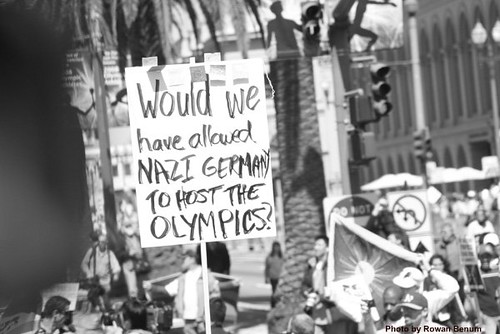
Olympic history FAIL!, or great PhotoShop

May 11, 2008

Ed Brayton found it.

Olympic torch relay protestor with really dumb sign

Do you think the sign maker was jesting? Or do you think the sign maker genuinely didn’t know? (See: 1936 Olympics in Berlin)

While we wait to see whether someone will confess to PhotoShopping this picture, we teachers might consider using this photo as a hook for a lesson on the differences between the rising totalitarian state of Nazi Germany in 1936, and the rising, increasingly economically free state of the People’s Democratic Republic of China today.

One more lesson plan for this year — it’s reusable next fall, with the added bonus then that by then you’ll have the headlines of the actual Olympics to add to the discussion.

Update: The photo is said to have been was taken by Rowan Benum at a California site (see Mr. Benum’s comment). Since it’s all the rage on conservative sites, where the history ignorance is condemned but the conservative bloggers can’t quite bring themselves to endorse the Communist Chinese, I strongly suspect wondered about a PhotoShop origin. The torch was run through San Francisco; there are few palms in San Francisco (Californians: Can you identify the location?).

Update 5-13-2008: The photographer kindly dropped by comments to note the authenticity of the photo. I agree, the Tibetan prayer flags suggest authenticity; would a hoaxer think of such details?

Discussion questions for the classroom:

Students should look at the photo, and read coverage of the torch relay, such as CNN’s story about the San Francisco relay where Mr. Benum took the photo. Students should have access to information about the International Olympic Committee and its organization, especially the tradition of Olympic Truce. The Charter of the Olympics is probably too long for practical classroom use, but Paragraph 2 can be copied for the students, or perhaps the full page of the “Fundamental Principles of Olympism”:

“Olympism is a philosophy of life, exalting and combining in a balanced whole the qualities of body, will and mind. Blending sport with culture and education, Olympism seeks to create a way of life based on the joy found in effort, the educational value of good example and respect for universal fundamental ethical principles.”
Olympic Charter, Fundamental principles, paragraph 2

There is a wealth of information for classroom use at the website of the IOC. If you’re particularly adventurous, or deep into this topic, check out the podcasts of Olympic history from amateur historian Eli Hunt.

Students should also have some information about Tibet, and the Dalai Lama and Tibet’s government in exile, about the history of Tibet and China’s actions since World War II. Students should have some history of the 1936 Olympics, and they should be familiar with the stories of Jesse Owens’ accomplishments there and his return to a segregated U.S. You may want to provide an article about the U.S. protest of the 1980 Olympics in Moscow, and the Soviet protest of the 1984 Olympics in Los Angeles, and other Cold War moments of Olympic tension.

  1. Since the International Olympics Committee (IOC) is an avowedly non-political international agency, is it fair or rational to protest the siting of an Olympics on political grounds?
  2. What do the protesters ask the IOC to do? What do the protesters ask others to do?
  3. Under international law, what are the rights and duties of the Peoples Republic of China (PRC)?
  4. Did the IOC ask anything of the government of the Peoples Republic of China of a political nature? Would such requests be fair, or rational?
  5. Other international organizations function in other nations where governments do not have good records on human rights, such as the Red Cross/Red Crescent, Scouting, UNICEF, and others (can you add to this list?). What considerations must such organizations give to local politics where human rights are at issue?
  6. Compare and contrast the issues surrounding the Beijing Olympics with issues surrounding the Myanmar relief efforts after Cyclone Nargis (2008).
  7. Look at other protests involving the Olympics, especially in 1980 and 1984. Did those protests achieve what the protesters had hoped? Does the success or failure of past protests augur well for current protests?
  8. The creator of the protest sign in the photograph appears to have not known about the 1936 Olympics, which were hosted in Berlin, then under the control of the Nazi government of Germany. The Olympics were sited in Berlin prior to the rise of the Nazi government. Does the protester’s ignorance of history affect the message of the sign? Does it reflect well on the cause the protester advocates?
  9. What other famous or notorious examples of ignorance of history can you find?
  10. Do you ever get embarrassed for the people captured in Jay Leno’s “Jaywalking” segments?
  11. Georges Santayana (1863-1952) famously said, “Those who cannot remember the past are condemned to repeat it.” Do you find that statement to be true? Does this affect the course of history? (Students may want to explore the history of invasions of Russia by Napoleon and Hitler, or the history of invasions of Afghanistan by Britain, the Soviet Union, and the U.S.)

More but not enough freedom of speech in Turkey

January 26, 2008

Turkey changed its laws that completely forbade criticism of the government. Recent changes promoting freedom of conscience and speech do not change the fact that this blog, and a million others on WordPress, are still blocked in Turkey.

Remember the old Radio Free Europe? We need a Blog Free Turkey; a Blog Free China; a Blog Free Duncanville Independent School District.


Banksy’s graffiti sells: $407,000

January 15, 2008

A few days ago, via Peoples Geography, I discovered the work of graffiti artist Banksy — rather behind the curve, judging from his history. I posted a particularly provocative work of his in this post within the past week.

Today CBS Evening News and other outlets report some enterprising building owner in London who recognized Banksy’s work, preserved it, and has auctioned it away on eBay. It fetched $407,000 US. (CBS video here)

Banksy art from a London wall

The work, depicting an artist in old-fashioned clothes putting the finishing touches on the word “BANKSY” spray-painted in red, was scrawled on a wall on the Portobello Road in the west London district of Notting Hill.

It was offered for sale on the e-Bay auction site and went for 208,100 pounds after attracting 69 bids.

The winner of the auction may well get the painting and the wall it is on, but they will have to calculate how to get the whole work delivered and pay to replace the wall.

“I am selling the wall because I can’t really justify owning a piece of art worth as much as it is,” said Luti Fagbenle, the owner of the property on which the graffiti is sprayed.

A political cartoon changed the life of one London building owner.