Wattsupgate: Denialists claim all knowledge is wrong

January 31, 2010

It really is that bad.  Climate science denialists now attack any information simply for not being what they want it to be.  Lysenko’s Ghost smiles broadly.

Anthony Watts is just the most prominent of the bloggers making hoax charges of error and worse in the fourth report from the Intergovernmental Panel on Climate Change (IPCC), because of a footnote that cites a rock climbing magazine.

Here’s the trouble for Watts:  There is no indication that the citation is in error in any way.  Watts’s move is more fitting of King George III’s campaign against Ben Franklin’s lightning rods, the prosecution of John Peter Zenger, the pre-World War II campaign against Einstein’s work because he was born a Jew, or the hoary old Red Channels campaign against Texas history told by John Henry Faulk.  It’s as bad as the Texas State Board of Education’s attack on Brown Bear, Brown Bear, What Do You See? Watts’ and others’ complaint is simply that Climbing magazine’s story on the worldwide retreat of glaciers suitable for climbing is not published in a juried science journal.

In other words, they indict the science, not because it’s wrong — they have no evidence to counter it — but because it’s too American Patriot correct Jewish left Texan mistakenly thought to be political well-known, too accessible, (small “d”) democratically-reported.

And of course, any comment that points that out at Watts’s blog goes into long-term “moderation,” keeping it from the light of day in the best tradition of the Crown’s defense of Gov. Cosby’s misadministration of New York (see “John Peter Zenger”).  Watts said in a quote that should have been attributed to the Daily Telegraph:

The IPCC’s remit is to provide an authoritative assessment of scientific evidence on climate change.

In its most recent report, it stated that observed reductions in mountain ice in the Andes, Alps and Africa was being caused by global warming, citing two papers as the source of the information.

However, it can be revealed that one of the sources quoted was a feature article published in a popular magazine for climbers which was based on anecdotal evidence from mountaineers about the changes they were witnessing on the mountainsides around them.

The other was a dissertation written by a geography student, studying for the equivalent of a master’s degree, at the University of Berne in Switzerland that quoted interviews with mountain guides in the Alps.

The revelations, uncovered by The Sunday Telegraph, have raised fresh questions about the quality of the information contained in the report, which was published in 2007.

It comes after officials for the panel were forced earlier this month to retract inaccurate claims in the IPCC’s report about the melting of Himalayan glaciers.

By those standards, Watts’s own readers should eschew his blog — it’s not peer reviewed science by any stretch, and Watts isn’t an established authority in climate science (he’s not even working for an advanced degree).  Consistency isn’t a virtue or concern among climate change denialists.  Watt’s entire modus operandi is much more anecdotal than the story in Climbing, which was written by a physicist/climber who studies climate change in the world’s mountains.

And did you notice?  They’re whining about research done by a scientist in pursuit of a degree, complaining about the second citation.  That’s the exaclty kind of research that they claim the magazine article is not.  Their complaint is, it appears, that a scientist in pursuit of education is not the right “kind” of person to do climate research. It’s the chilling sort of bigotry that we spent so much time in the 20th century fighting against.  In the 21st century, though, it appears one can still get away with demonizing knowledge, education and research, part of the campaign to indict “elitism,” the same sort of elitism aspired to by America’s founders.  Too much of the criticism against scientists involved in documenting global warming is the cheap bigotry the critics claim to find in science, falsely claimed in my view.

Topsy-turvy.

And the glaciers?  Yeah, the evidence tends to show they are in trouble.  Those Himalayan glaciers?  The IPCC report was accurate in everything except the speed at which the glaciers decline — they should be with us for another three centuries, not just 50 years, if we can reduce warming back to 1990s levels (oddly, denialists rarely deal with the facts of accelerating warming, preferring to point to a local snowstorm as a rebuttal of all knowledge about climate).

Oh, and the research?  The author of the story in Climbing magazine is Mark Bowen.  Dr. Bowen’s Ph.D. is in physics from MIT. He’s a climber, and he researches climate change on the world’s highest mountains.  His 2005 book, Thin Ice, focused tightly on what we can learn about climate from the world’s highest mountains.   Bowen is the expert Anthony Watts would like to be.
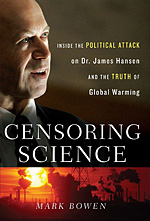
Cover of Mark Bowen's book defending climate science, "Censoring Science."

Cover of Mark Bowen’s book defending climate science, “Censoring Science.”

Bowen’s newest book:  Censoring Science:  Inside the political attack on James Hansen and the truth of global warming. Watts doesn’t want anyone to read that book.  It is easy to imagine Watt’s s attack is, he hopes, pre-emptive, against Bowen’s book.

I’ll wager Watts hasn’t read the article in Climbing, and didn’t know who Bowen was when he launched his attack, though.  The denials of bias coming out of the denialists’ camp will be interesting to watch.

Let the denialists roll out the rope far enough, they’ll inevitably hang themselves.

More:

Do something for freedom: Spread the news

Add to FacebookAdd to NewsvineAdd to DiggAdd to Del.icio.usAdd to StumbleuponAdd to RedditAdd to BlinklistAdd to TwitterAdd to TechnoratiAdd to Furl


Chinese government behind “climategate” hacking?

January 1, 2010

Conspiracy fans — a category which appears to include almost all climate change denialists — won’t like the news from Planet Green’s “Planet 100.”  This little news show claims evidence that China was the source of the hacking of the University of East Anglia’s climate related e-mails.

Why won’t the denialists like it?  They won’t like it because it makes sense:  Who stood to profit from embarrassing scientists just before the Copenhagen meetings?  China, who wished to avoid any binding agreements, would gain simply by sowing confusion.

Evidence is pretty thin, but for the first time since the hacked e-mails were published, there’s a plausible motive.   Also, the source is also not wholly pristine or reputable in science stuff — the Daily Mail of London, which specializes in gossipy tabloid news.  Watch that space.

P.S.  — Don’t miss the squid invasion story in the same newscast.

Resources:


Chet Raymo on devils and angels of our own creation

December 26, 2009

Chet Raymo continues to read Linda Lear’s biography of Rachel Carson, and ponders:

Did Rachel Carson save songbirds (and humans) in Massachusetts and put babies at risk in Mozambique? Albert Schweitzer once said: “Man can hardly even recognize the devils of his own creation.” We are not that good at recognizing the angels, either. Let’s hope the current generation of young people has more success balancing the perils and blessings of technology than did those of us who lived through the dueling certainties of DDT and Silent Spring.

Add to FacebookAdd to NewsvineAdd to DiggAdd to Del.icio.usAdd to StumbleuponAdd to RedditAdd to BlinklistAdd to TwitterAdd to TechnoratiAdd to Furl


Investigative report: Climate science e-mails ugly, science is correct; “skeptics'” response even uglier

December 14, 2009

Associate Press put a team of five reporters on the e-mails purloined from the Hadley climate science group in England.  AP sought advice on interpreting the messages from other scientists involved in ethical science issues.

To the best of my knowledge, this is the only group that has gone through the entire mass to see what is really shown — more than a million words, the AP story estimated.

Veteran climate issue reporter Seth Borenstein wrote up the story:  Scientists in the heat of research and interpretation, on deadline with government policy makers, often attacked unfairly — one received death threats for his work on climate change.  Under those conditions, one might understand that the scientists were defensive and rude, in private, about their critics.  One of the critics harassed scientists with repeated FOI requests, then didn’t use the data.  In one case, a critic published a paper based on bad data — what the critics accused the scientists of doing.

But in the end, there was no pattern of data fixing.   Independent reviews today confirm that independently-generated studies confirm the warming the scientists wrote about.

Of course, that doesn’t stop the hecklers of the scientists from complaining, either about the science or the way it’s reported.  Rather than deal with the material AP reported, for example, warming blogger Anthony Watts attacked the reporter who wrote the story, complaining that he is “too close” to the story, since he seems to have been covering the story long enough that his e-mail appears in the purloined e-mails.

‘You can’t report the news because you know too much,’ is Watts’s complaint.

In the e-mail cited, Seth Borenstein wrote to some of the world’s best scientists in the field and asked their opinions about a paper making some contrary claims.

To Watts, seeking information from the experts is beyond the pale.  He calls it an ethical infraction.

Watts is unbound by such ethical rules, however, and so can make up stuff like this with abandon.  Watts’ charge is hooey, foul play, and stupid.  In the headline to his post, Watts wrote, “AP’s Seth Borenstein is just too damn cozy with the people he covers – time for AP to do something about it.”

That’s right, AP — it’s time Borenstein got a promotion for doing the legwork, honestly, that critics of the science have refused to do.  Borenstein’s reporting is important.  The story goes beyond mere repeating of press releases, beyond the mere “he-said/he-said” norm.  Borenstein, in unemotional, clear and cool terms, indicted the critics of warming, by factually reporting the events.  Give that man and his team a Pulitzer Prize.

Why shouldn’t reporters go to the experts?  Why shouldn’t they ask the opinions of all sides in a science debate?

Think about it for a moment:  Watts’s complaint is that Borenstein sought fairness in reporting on Watts’s side’s claim.  Because Borenstein refused to show the bias Watts wants, Watts went after Borenstein.

Could there be a more clear and dramatic illustration of why the scientists’ ire is raised by such silly criticism?

Watts quotes at length from the Associated Press Statement of News Values and Principles, slyly implying by doing so that Borenstein violated the rules somewhere.  Not so.

Watts worries about “getting too cozy with sources.”  Read his blog.  Watts prefers to be the source — but he also reports on the debate.

Watts would do well to read that AP ethical statement again, and take it to heart.

His charges are groundless, scurrilous in the light of the AP team’s going to great lengths to be fair to all sides.  Watts and other critics bank on people being shocked that scientists get angry.   Watts and his colleagues have campaigned across the web, on television and in print, to have these scientists tarred and feathered, and their science dismissed — though there is not handful of feathers to weigh against the mountains of evidence the scientists accumulated and published over the past 50 years.

Do not take my word for it.  Read the AP storyRead Watts’s rant.  Read the e-mails, if you wish (you can find them from my opinionated take on the flap).  Check with the scientists you know and trust on their views of the science done and reported.

I won a couple of minor investigative journalism awards in college.  I have been a member of the Society of Professional Journalists off and on since 1974 (not much since I quit doing that stuff full time).  I have worked with some of the best investigative journalists and Congressional investigators in my duties with the Senate.  I’ve been a member of the FOIA committees in Utah and Maryland.  I’ve lobbied in three states for freedom of information.  I know a little bit about investigative reporting and fairness.  And yes, IAAL.

Borenstein’s piece is solid and good.  In light of the firestorm Watts hopes to bring down on it, Borenstein’s article is a shining example of high ethics in journalism.  It deserves your reading.

If the critics had data denying warming, or denying human causation of warming, why are they hiding it so well?  If they have the data to prove the scientists are in error, why not publish it, instead of sniping at a wire service reporter who merely tells the story?

Critics don’t have the data to contest the hard work of the scientists.  They don’t have the data to make a case against either warming or human causation.  And now we all know.

Post Script:  Um, and , you know, it’s not like Borenstein hasn’t done some stuff over the years to make it look like he’s been on Watts’s side:  Stoat, Mooney’s Intersection, Island of Doubt.  Watts’ fit may put a gloss on Borenstein’s work that wasn’t there to begin with.

Help others investigate the facts:

Add to FacebookAdd to NewsvineAdd to DiggAdd to Del.icio.usAdd to StumbleuponAdd to RedditAdd to BlinklistAdd to TwitterAdd to TechnoratiAdd to Furl


Yeah, it’s ironic (hacked e-mails and global warming)

November 26, 2009

James’s Empty Blog:

It is hard to miss the irony in people eagerly poring through illegally-obtained private email, looking for ethical breaches by the writers! I’m sure we can all imagine the outrage if one of the emails revealed that a scientist had hacked into one of the sceptics’ computers and was reading all their correspondence. So a bit of perspective is called for here.

James Is A Scientist (IANAS), and he has much good stuff to say (read some of the other posts about the hacked e-mails while you’re there) — but you gotta wonder about a blog that follows such a post with this:

Prawns, Jules Berry

Prawns not in their native habitat. Probably Tastimus deliciousus

Tip of the old scrub brush to Stoat.


Purloined CRU e-mails on climate science: One scientist pleads for accuracy

November 24, 2009

Here is what he said.  Edward Cook, one of the world’s foremost authorities on ancient trees and how to learn from them (Dendrochronology),  wrote to Michael Mann, both men scientists involved in making their science understandable and available to the public and the International Panel on Climate Change (IPCC).  Both men thought their communication would be private, probably forever.  When no one is looking, this is what they say to one another:

From: Edward Cook <drdendro@xxxxxxxxx.xxx>
To: “Michael E. Mann” <mann@xxxxxxxxx.xxx>
Subject: Re: hockey stick
Date: Wed, 2 May 2001 15:25:41 -0400
Cc: tom crowley <tom@xxxxxxxxx.xxx>, esper@xxxxxxxxx.xxx, Jonathan Overpeck <jto@u.arizona.edu>, Keith Briffa <k.briffa@xxxxxxxxx.xxx>, mhughes@xxxxxxxxx.xxx, rbradley@xxxxxxxxx.xxx, p.jones@xxxxxxxxx.xxx, srutherford@xxxxxxxxx.xxx

Hi Mike,

No problem. I am quite happy to work this stuff through in a careful way and am happy to discuss it all with you. I certainly don’t want the work to be viewed as an attack on previous work such as yours. Unfortunately, this global change stuff is so politicized by both sides of the issue that it is difficult to do the science in a dispassionate environment. I ran into the same problem in the acid rain/forest decline debate that raged in the 1980s. At one point, I was simultaneous accused of being a raving tree hugger and in the pocket of the coal industry. I have always said that I don’t care what answer is found as long as it is the truth or at least bloody close to it.

Cheers,

Ed

This note appeared at the end of a rough-and-tumble debate over what data can be trusted, the motives of scientists involved, and how to make the best use of data collected, clear and unclear, in order to make an accurate portrayal of what is happening in our atmosphere.

I’ll wager no critic of these scientists bothered to quote this one today, nor will they.  In toto, the purloined e-mails show a devotion to science, and the requisite devotion to accuracy and ethical behaviors.  But in a political debate where television weathermen feel compelled to demonize scientists to promote their political beliefs, who can afford to look at the big picture?

My apologies to Dr. Cook for the purloining of the e-mail (though of course I had no role in the hacking); my appreciation to Dr. Cook for standing up for what’s right, damn the critics, when he th0ught no one was looking.

That’s the definition of character, isn’t it?

E-mail this:

Add to FacebookAdd to NewsvineAdd to DiggAdd to Del.icio.usAdd to StumbleuponAdd to RedditAdd to BlinklistAdd to TwitterAdd to TechnoratiAdd to Furl


Smoking guns in the CRU stolen e-mails: A real tale of real ethics in science

November 22, 2009

Climate skeptics fear that some climate scientists have cooked their data in order to produce a pre-ordained outcome from their research.  Many of these people are excited this weekend at the public release of e-mails purloined from Climate Research Unit at East Anglia University in England, from one of the leading climate research labs.  Every crank science and crackpot political site has a story touting the end of research on global warming.

Sure enough, with just a few minutes of searching the e-mails, I found references to ethical breaches in cooking of data, and a discussion about how to talk about  the data and the issue in public.

The paper involved is this one:

David H. Douglass, John R. Christy, Benjamin D. Pearsona and S. Fred Singer, “A comparison of tropical temperature trends with model predictions,” INTERNATIONAL JOURNAL OF CLIMATOLOGY, Int. J. Climatol. (2007).  Published online in Wiley InterScience (www.interscience.wiley.com) DOI: 10.1002/joc.1651

Unless you follow this issue closely, you probably don’t see the problem with publicizing the ethical breaches scientists thought they saw in this paper and its publication.  Also, if you are a “skeptic” who is chronically apoplectic over Al Gore’s success in informing people about climate change and winning prizes and making money, you may be thrilled that there is a scientist anywhere worried about ethical lapses by scientists involved in this controversy, and you can’t wait to see them brought to justice (cooking data is a federal crime in the U.S., if done with federal research money).

[Yes, I think there are ethical questions about publishing anything from these e-mails, let alone links so the viewing public can read them completely.  However, since much of this material has already been cherry picked and quote mined by political activists who hope to stop action to mediate and stop global warming, I think a good case can be made that, to be fair, we should look at the entire collection to see what they really reveal.  There may be criminal liability for some of the disclosures I’m discussing here — but that liability does not fall on the scientists who have been unfairly impugned in the last few days.  The liability falls instead on the critics of warming.  Let’s be fair.  In  a fair fight, truth wins.]

So, hold your high-fives and “I-told-you-sos” until you look at the data, at the information found.

One of the e-mails is quite explicit:

I think the scientific fraud committed by Douglass needs to be exposed. His co-authors may be innocent bystanders, but I doubt it.

Fraud?  Right there in front of everyone?  In the climate debate?

In the end, the scientists in the discussion determined not to hold a press conference to announce a finding of fraud, but instead to hunker down and work on publishing datasets that would contradict the alleged fraudulent paper, and establish their case with data instead of invective and press conferences.

They even declined to rush to inform the public of the fraud after a lengthy series of attempts to duplicate the results with well-known, accurate methods on accepted data:

Bottom line: Douglass et al. claim that “In all cases UAH and RSS satellite trends are inconsistent with model trends.” (page 6, lines 61-62). This claim is categorically wrong. In fact, based on our results, one could justifiably claim that THERE IS ONLY ONE CASE in which model T2LT and T2 trends are inconsistent with UAH and RSS results! These guys screwed up big time. [emphasis added by MFB]

Anthony Watts and others may be justified in asking that the scientists who wrote this fraudulent paper should be summarily dismissed, and in questioning why other scientists dallied in exposing the fraud.

But there is this to consider:  The paper in question is a paper critical of warming hypotheses, and it was co-authored by at least a couple of the most strident critics of Al Gore, James Hansen, the International Panel on Climate Change (IPCC).

The smoking gun was used to shoot down a hasty effort to brand climate-change critics as unprofessional and wrong.  The smoking gun was used to enforce the hard ethical rules of science:  Don’t speak until your data allow a fair conclusion.

The smoking gun e-mails show correct and careful behavior by the scientists who contributed to the IPCC report, but unethical behavior by the critics whose backers, we might assume, stole the e-mails in the first place, and published them without understanding the depth of moral character demonstrated by most scientists in the conduct of their professions.

Now, I have not analyzed every possible permutation of this thread, only those with the title shown.  I used the “Alleged CRU e-mails — searchable” cited by Anthony Watts and others.  I stumbled into the thread discussing the paper by “Douglass, et al.”  I then did a search for e-mails discussing “Douglass,” and limited it to the thread on this point.  I suspect there are other e-mails in that thread in which Douglass’s name is wholly missing, and which did not turn up  in the search.

Now you know the rest of the story.  Fred Singer is a leading denialist, one of the organizers of the political campaign to blunt the publication and discussion of evidence of global warming and what to do about it.  The Douglass, et al. paper under discussion was a key component of the denialists’ campaign in 2007.  The purloined e-mails point to unethical behaviors by the scientists on the anti-warming side, the so-called “skeptics.”

So, from a quick dive into the data we learn:

  1. Climate scientists talk like Boy Scouts trying to impress a Board of Review.
  2. Climate scientists are extremely careful with data.
  3. When they think no one is looking, climate scientists behave ethically.
  4. When they think have found a piece of fraud, climate scientists are careful to recheck their numbers several times and in several ways before saying anything.
  5. Instead of holding a press conference, climate scientists like to keep the fisticuffs in the confines of juried journals.
  6. Climate “skeptics” are full of themselves, and probably wrongly accuse climate scientists of fixing data.
  7. Fraud in climate science may occur, but generally on the side of those who argue against warming or who advocate inaction as a response.
  8. The claims of smoking guns that negate the case for doing something about global warming are most likely hoaxes.

Here are the texts I looked at:

Update, November 25, 2009: Be sure to check out these posts, at George Monbiot’s blog in the comments, at Stoat,  and here at the Bathtub. This is the best judgment on the affair, I think, from Our Kingdom at Open DemocracyRespect to any climate-deniers who invest all their pension funds in seashore hotels in the Maldives… otherwise, they should step aside, and let the work of saving the future begin.”

Smoke this:

Add to FacebookAdd to NewsvineAdd to DiggAdd to Del.icio.usAdd to StumbleuponAdd to RedditAdd to BlinklistAdd to TwitterAdd to TechnoratiAdd to Furl


Newtongate shakes anthropogenically-generated mathematics at the foundation

November 22, 2009

Satire, hoax, fact — how can we tell the difference?

Maybe more importantly, how can we tell early on that the “Climategate” kerfuffle, involving purloined, but otherwise dull e-mails from climate scientists, is nothing to worry about?

Look at history!  Remember Newtongate?  Read it here, at Carbon Fixated.

If you own any shares in companies that produce reflecting telescopes, use differential and integral calculus, or rely on the laws of motion, I should start dumping them NOW. The conspiracy behind the calculus myth has been suddenly, brutally and quite deliciously exposed after volumes of Newton’s private correspondence were compiled and published.

When you read some of these letters, you realise just why Newton and his collaborators might have preferred to keep them confidential. This scandal could well be the biggest in Renaissance science. These alleged letters – supposedly exchanged by some of the most prominent scientists behind really hard math lessons – suggest:

Conspiracy, collusion in covering up the truth, manipulation of data, private admissions of flaws in their public claims and much more.

But perhaps the most damaging revelations are those concerning the way these math nerd scientists may variously have manipulated or suppressed evidence to support their cause.

What kind of conspiracy keeps calculus being taught to innocent children today?  Exactly the same conspiracy that causes scientists to sound the alarms about climate change.

Tip of the old scrub brush to Tim Lambert at Deltoid.


What’s a journalist’s duty? Limbaugh ignores warning signs, punks himself

October 25, 2009

Millard Fillmore’s bathtub came out of a hoax story written in 1917 by one of America’s greatest cynics and writers, H. L. Mencken. Mencken lived to regret that he ever wrote the piece, after it was cited as fact by encyclopedias and critics of Fillmore’s presidency.

Mencken’s story holds a moral, a lesson for all critics of the American scene, and especially anyone who comments on political figures:  Verify everything.

Ernest Hemingway put it best, if crudely:   “The most essential gift for a good writer is a built-in, shock-proof, shit detector. This is the writer’s radar and all great writers have had it.”*

If a writer or reporter doesn’t have one of those devices built-in, he is likely to find himself up to his chin in it after having failed to detect it in time to avoid the plunge.

Rush Limbaugh is in it up to his chin right now, after following Michael Ledeen off the dock.

Faithful readers here — all dozen of ’em — may remember last January when we spotlighted a hoax at a blog called Jumping in Pools; the author claimed President Obama had ordered members our armed forces to take an oath of allegiance to Obama in place of their regular oath to the nation.

Orson Welles was on to something with his “War of the Worlds” broadcast.  In fact, after that first night of panic, the same script was used on other occasions, and people still got suckered in.  (Listen to the RadioLab feature on this phenomenon — it’s wonderful.)

It’s almost as if people were going around with signs on their backs that say “Lie to me, baby!”  Only, the people put the signs on their shirts and blouses themselves.

For whatever ill-thought, malicious reason, somebody invented an absolutely unbelievable hoax that President Obama asked the Pentagon to have military people swear allegiance to him, instead of the nation. Jumping in Pools posted it.

Jumping in Pools also listed it as satire, in tags.

But the hoax sucked in the gullible all over the web.

Limbaugh?  Ledeen?  Y’all would do well to read this blog, Millard Fillmore’s Bathtub.  You might have recognized the name of the blog, Jumping in Pools, that carried that phantasmagorical story about Barack Obama’s student essay, finally being released in part to Time Magazine’s Joe Klein.

Yahoo!’s Buzz Up explained the story, with links you ought to check out:

It must have seemed so perfect. An obscure blogger unearths some pages of President Obama’s college thesis. The report supposedly comes from big-time journalist Joe Klein of Time magazine. And the thesis has some real gems: like Obama’s disdain for the Constitution.

The whole thing was nothing more than a satirical post on a humor blog. But Rush Limbaugh, who quoted from the supposed thesis on his radio show, sure wasn’t laughing. Here’s how it went down.

An unknown blogger picked up on a made-up post meant as a joke, which claimed that Joe Klein had gotten his hands on 10 pages of student Obama’s college thesis. Rush Limbaugh jumped on it, which immediately sparked Web searches on “obama thesis.”

Supposedly titled “Aristocracy Revisited,” the excerpt revealed the president had “doubts” about the “so-called founders.” Juicy. Except not true. Limbaugh discovered halfway through his show that he’d been had, but defended himself by saying basically the thesis felt true. Listen in to Rush’s mea sorta culpa.

Joe Klein finally jumped in, and called the report “nonsense” on his Swampland blog, and the blogger who thought the hoax was real also apologized.

Michael Ledeen writing at Pajamas Media was that “blogger who thought the hoax was real.”

Ledeen had the good grace to apologize (and in doing so reveal that he really should have been much more en garde):

The hoax/satire was written in August, so it’s not connected to any current event.  I cam across it on Twitter, read the blog, found it interesting, and posted on it.  I failed to notice that one of the tags was “satire.”

So he got me, and lots of others. It worked because it’s plausible.  I’ve done satirical pieces myself, and I know how they can take off.  I once wrote one that said that Bill Casey did not die, and was hiding in a bunker under the St Andrews golf course from which he was running Mikhail Gorbachev.  I thought it was obviously satirical, but it went like wildfire all over the world.  And that was in the days before the Internet.

So I should have picked up some hint, but I didn’t.  Shame on me.

But Limbaugh?  He railed on for more than half an hour on the evils of Obama revealed in the completely fictional essay; and then when he was alerted to the fact that it was a hoax, he didn’t apologize.  He said he was suckered in because the hoax was plausible, and Obama might have done such a thing.

“I know Obama thinks it,” Limbaugh said, purporting to channel the guy he despises only too openly.

I’m trying to suppress it, but Limbaugh’s actions remind me mightily of an old Cheech and Chong routine.  One wonders what Obama’s more rabid critics would not grant credence to.

Wall of Shame

What would Hemingway have reported?

Other thoughts:

  • Jonathan Last’s article for the Templeton Foundation’s In Character Journal wonders about how we choose what to believe, and whom.  The Dallas Morning News carried the article in the “Points” section this morning, but it’s not up on their website; look at the article at the Templeton Foundation site.

________
* I’m convinced he said it. I’m relying here on Elizabeth Dewberry’s contribution to The Cambridge Companion to Ernest Hemingway, “Hemingway’s Journalism and the Realist Dilemma,” on page 25.  She cites to an interview, but I’ve misplaced the rest of that note for the moment, and for some odd reason the page with the citation isn’t included on Google Books (the pain of internet research, to get to the information you need out of the haystack, and find that particular needle has been intentionally removed).  Read Dewberry, though, for a much longer and informative discussion about hoaxes and fakery in journalism, which is the problem discussed in this post.

Don’t let your friends be bamboozled, pass the word:


Add to FacebookAdd to NewsvineAdd to DiggAdd to Del.icio.usAdd to StumbleuponAdd to RedditAdd to BlinklistAdd to TwitterAdd to TechnoratiAdd to Furl


Dembski’s students sent into the crucible of Darwinism, at SMU!

September 24, 2009

Oh, the sermons they’ll be able to preach!

We learn from a couple of sources that Bill Dembski has assigned his students in two different classes at Southwest Baptist Theological Seminary to try to crash a program honoring Charles Darwin and evolution theory at nearby Southern Methodist University, on Thursday, September 24.

Fall 2009

Christian Apologetics (SWBTS #PHILO 4373 – Fall 2009)

<> New as of 09.16.09! Dear Class, I want to share with you a few things: (1) For extra credit I’d like you to go to SMU on September 24th. On that day there are two back-to-back events at SMU celebrating Darwin — go to smu.edu/smunews/darwin/events.asp and scroll down to September 24th. I don’t want you going there merely as spectators but will indicate in class how you might actively participate and engage the Darwin-lovers you’ll find there.

*     *     *     *     *

Intelligent Design or Unintelligent Evolution (SWBTS #PHILO 2483 – Fall 2009)

<> New as of 09.16.09! Dear Class, I want to share with you a few things: (1) For extra credit I’d like you to go to SMU on September 24th. On that day there are two back-to-back events at SMU celebrating Darwin — go to smu.edu/smunews/darwin/events.asp and scroll down to September 24th. I don’t want you going there merely as spectators but will indicate in class how you might actively participate and engage the Darwin-lovers you’ll find there.

You gotta wonder just what would happen if one of those abused students were to actually pay attention to the science, turn honest, and become a defender of science and Darwin.  SWBTS students are not required to swear to honesty, however, so it’s unlikely they will turn (not at the tuitions they pay!).

SMU’s Year of Darwin programs feature the NOVA episode on the Pennsylvania trial on evolution and intelligent design.  The NOVA piece will be screened, and discussions will include the Honorable John E. Jones, the federal judge who presided over the trial and has since been maligned unfairly by Dembski and other religionists who reject the views of science.  Other lecturers include reporter Laurie Lebo and the team that produced the NOVA episode:

Sept. 24, 2009

Reception 10 a.m.

Lecture 10:30 a.m.

DeGolyer Library

The Friends of the SMU Libraries/Colophon and The Friends of KERA Invite the public to a special event in celebration of the 150th anniversary of the publication of On the Origin of Species and the 200th birthday of its author, Charles Darwin. Featured speakers will be Paula Apsell, senior executive producer of NOVA, and Melanie Wallace, senior series producer of NOVA. Please RSVP to 214-768-3225 or cruppi@smu.edu, Complimentary Valet Parking.
Sept. 24, 2009

4-6 p.m.

O’Donnell Hall

Owen Art Center

Screening of “Judgment Day: Intelligent Design on Trial,” a NOVA documentary. Introduction by Paula Apsell, senior executive producer of NOVA, who received an honorary degree from SMU in 2008.
Sept. 24, 2009

Reception 6-7 p.m.

Panel 7-8:30 p.m.

Caruth Auditorium

Owen Art Center

A panel discussion on the legal, ethical and journalistic issues surrounding the making of NOVA’s documentary film, Judgment Day: Intelligent Design on Trial. Participants include John E. Jones, the federal judge who barred a Dover, Pa., public school district in 2005 from teaching “intelligent design”; Paula Apsell and Melanie Wallace, NOVA producers of the documentary; plaintiff’s council Eric Rothschild; and Laurie Lebo, author of The Devil in Dover.
Sept. 25, 2009

10:30 a.m. – noon

Karcher Auditorium

Storey Hall

“Intelligent Design in the Classroom,” a panel discussion on First Amendment issues featuring Judge John E. Jones III, Eric Rothschild (Pepper Hamilton, LLP), Hiram Sasser (Liberty Legal Institute) and Lackland Bloom, SMU’s Dedman School of Law.
Sept. 25, 2009

10-11:30 a.m.

3531 Garson

Owens Art Center

Master class on Documentary Film Making, taught by Paula Apsell and Melanie Wallace of NOVA. Strictly by RSVP (to Teri Trevino, trevinot@mail.smu.edu)
Sept. 25, 2009

2-3 p.m.

Hughes-Trigg Forum

Lauri Lebo will speak on “From Dover to Texas: Reporting on Extremist Views in a Fair and Balanced World” followed by a book signing of her book, The Devil in Dover.

I have attended sessions around Dallas where Dembski and other ID creationists were the featured speakers.  We know one thing for certain:  Dembski’s students will be given a more polite and mannerly reception at SMU than Dembski and his crew give scientists and critics at their own sessions.  For years, since 1991 at least, SMU has allowed Dembski and his accomplices to use the facilities and good offices of SMU to promote their anti-science screeds, though Dembski’s views are not shared by Methodists, and are contrary to positions taken by the Methodist General Assembly.

It is impossible to imagine that SWBTS would allow Methodists to do the same thing, teaching and promoting science and especially evolution theory, at the seminary.

SMU’s program is open to the public (go to the SMU site above to see more events set over the next few months).

Dembski is teaching apologetics.  Creationist apologists are not licensed, and generally cannot be sued for pedagogical or theological malpractice, even by their students.  Standards for apologetics don’t exist.  Scientists, on the other hand, are subject to peer review, and if using federal funds, prosecution should they tell falsehoods.

Nota bene: SMU’s lectures on Darwin’s Evolving Legacy are available on video, on-line.  See the wonderfully informative and explanatory presentation by Dr. Barbara Forrest, for example.


Scouting as a tool to fight gang violence

September 22, 2009

Video from my council, Circle 10, in and around Dallas, Texas:

Interestingly, I’ve not seen the video before I found it on YouTube.  Have I just missed chances, or has it not been promoted as well as it should have been?


Boy Scouts of Harlem, Troop 759

September 20, 2009

First I’ve heard of this film:  “759:  Boy Scouts of Harlem,” a film by Jake Boritt and Justin Szlasa.

Have you seen it?

2010 is the 100th anniversary of Scouting in the U.S.  This film is not officially a part of that celebration — but expect to see more like it.  This film was produced independently, with approval from one Scout council, but entirely independent from Scouting otherwise.

Would this make a good recruiting device for your troop?  Why or why not?

Perhaps one of the Scouts in your troop, working on the cinematography merit badge, might be inspired to make a film like this about your troop.

Resources:


Fatal faux pas?

September 10, 2009

South Carolina Rep. Joe Wilson heckled the president during the president’s speech?

 South Carolina Rep. Joe Wilson at the presidents speech - New York Times photo by Doug Mills

South Carolina Rep. Joe Wilson at the president's speech - New York Times photo by Doug Mills

I wonder what those people seated around Wilson felt, and did, immediately after.

Wilson’s opponent got a huge boost in fund raising.  Plus, it provided the president’s speech with a res ipsa loquitur moment.

Share this with Miss Manners, and your friends:

Add to FacebookAdd to NewsvineAdd to DiggAdd to Del.icio.usAdd to StumbleuponAdd to RedditAdd to BlinklistAdd to TwitterAdd to TechnoratiAdd to Furl


Republican death trip

August 14, 2009

Senate Finance Committee members said yesterday they would strip out of the health care discussion any mention of helping older Americans or others with terminal diseases make adequate plans with, for example, durable powers of attorney and living wills.

Newt Gingrich and others on the wackaloon right have made the topic toxic, despite it’s having been urged by Republicans, to ensure privacy and individual rights near the end of death.

And so, also, we bid farewell to morality, reason and backbone among Republicans nationally.

Two pieces you should read:

  1. “Republican Death Trip,” Paul Krugman’s column today in the the New York Times
  2. “Sarah Palin’s death panels,” at former Labor Sec. Robert Reich’s blog

Republicans screw up again: “Death panels” amendment was a Republican’s doing — and there’s a logical explanation

August 13, 2009

Protesters like to complain that advocates don’t know what is in the health care bill, but day by day it becomes more and more obvious that it is the critics who don’t know what the bill proposes, or why.

Washington Post policy blogger Ezra Klein tracked down who put the “death panels” clause into health care reform bills being debated by the U.S. Senate.  (Yes, this demonstrates the value of the daily press, how they more thoroughly and accurately get the story than most bloggers do, or can. )

Turns out that it was a very conservative, Republican legislator from Georgia who put the amendment in the bill, for good and noble purposes.

So, all the sturm und drang about “death panels?”  It demonstrates that opponents of the bill don’t care what it actually does, or how beneficial it may be.  Like Napoleon at Waterloo, they think that they must win this fight at all costs, even if it brings down the nation.

Klein’s interview with Isaakson is below, in its entirety.

Is the Government Going to Euthanize your Grandmother? An Interview With Sen. Johnny Isakson.

I’ve seen the pain and suffering in families with a loved one with a traumatic brain injury or a crippling degenerative disease become incapacitated and be kept alive under very difficult circumstances when if they’d have had the chance to make the decision themself they’d have given another directive and I’ve seen the damage financially that’s been done to families and if there’s a way to prevent that by you giving advance directives it’s both for the sanity of the family and what savings the family has it’s the right decision, certainly more than turning it to the government or a trial lawyer.

isaksonofficialphoto.JPG

U.S. Sen. Johnny Isaakson, R-Georgia - photo from Isaakson's office

Sarah Palin’s belief that the House health-care reform bill would create “death panels” might be particularly extreme, but she’s hardly the only person to wildly misunderstand the section of the bill ordering Medicare to cover voluntary end-of-life counseling sessions between doctors and their patients.

One of the foremost advocates of expanding Medicare end-of-life planning coverage is Johnny Isakson, a Republican Senator from Georgia. He co-sponsored 2007’s Medicare End-of-Life Planning Act and proposed an amendment similar to the House bill’s Section 1233 during the Senate HELP Committee’s mark-up of its health care bill. I reached Sen. Isakson at his office this afternoon. He was befuddled that this had become a question of euthanasia, termed Palin’s interpretation “nuts,” and emphasized that all 50 states currently have some legislation allowing end-of-life directives. A transcript of our conversation follows.

Is this bill going to euthanize my grandmother? What are we talking about here?

In the health-care debate mark-up, one of the things I talked about was that the most money spent on anyone is spent usually in the last 60 days of life and that’s because an individual is not in a capacity to make decisions for themselves. So rather than getting into a situation where the government makes those decisions, if everyone had an end-of-life directive or what we call in Georgia “durable power of attorney,” you could instruct at a time of sound mind and body what you want to happen in an event where you were in difficult circumstances where you’re unable to make those decisions.

This has been an issue for 35 years. All 50 states now have either durable powers of attorney or end-of-life directives and it’s to protect children or a spouse from being put into a situation where they have to make a terrible decision as well as physicians from being put into a position where they have to practice defensive medicine because of the trial lawyers. It’s just better for an individual to be able to clearly delineate what they want done in various sets of circumstances at the end of their life.

How did this become a question of euthanasia?

I have no idea. I understand — and you have to check this out — I just had a phone call where someone said Sarah Palin’s web site had talked about the House bill having death panels on it where people would be euthanized. How someone could take an end of life directive or a living will as that is nuts. You’re putting the authority in the individual rather than the government. I don’t know how that got so mixed up.

You’re saying that this is not a question of government. It’s for individuals.

It empowers you to be able to make decisions at a difficult time rather than having the government making them for you.

The policy here as I understand it is that Medicare would cover a counseling session with your doctor on end-of-life options.

Correct. And it’s a voluntary deal.

It seems to me we’re having trouble conducting an adult conversation about death. We pay a lot of money not to face these questions. We prefer to experience the health-care system as something that just saves you, and if it doesn’t, something has gone wrong.

Over the last three-and-a-half decades, this legislation has been passed state-by-state, in part because of the tort issue and in part because of many other things. It’s important for an individual to make those determinations while they’re of sound mind and body rather than no one making those decisions at all. But this discussion has been going on for three decades.

And the only change we’d see is that individuals would have a counseling session with their doctor?

Uh-huh. When they become eligible for Medicare.

Are there other costs? Parts of it I’m missing?

No. The problem you got is that there’s so much swirling around about health care and people are taking bits and pieces out of this. This was thoroughly debated in the Senate committee. It’s voluntary. Every state in America has an end of life directive or durable power of attorney provision. For the peace of mind of your children and your spouse as well as the comfort of knowing the government won’t make these decisions, it’s a very popular thing. Just not everybody’s aware of it.

What got you interested in this subject?

I’ve seen the pain and suffering in families with a loved one with a traumatic brain injury or a crippling degenerative disease become incapacitated and be kept alive under very difficult circumstances when if they’d have had the chance to make the decision themself they’d have given another directive and I’ve seen the damage financially that’s been done to families and if there’s a way to prevent that by you giving advance directives it’s both for the sanity of the family and what savings the family has it’s the right decision, certainly more than turning it to the government or a trial lawyer.

Update, August 14: Time’s Swampland blog notes that the the Republicans passed exactly the same language in a bill signed into law by George W. Bush in 2003, the Medicare prescription drug bill — except that bill limited application only to the terminally ill.  That provision worked well in protecting the rights of patients in end-of-life scenarios, so it was determined to expand the plan.  42 Republican Senators voted for it then.

I’m sorry, did you say something?  I’m having difficulty hearing you with all these hypocrickets chirping away.

Share the facts:

Add to FacebookAdd to NewsvineAdd to DiggAdd to Del.icio.usAdd to StumbleuponAdd to RedditAdd to BlinklistAdd to TwitterAdd to TechnoratiAdd to Furl
