Gutzon Borglum’s 1908 bust of Abraham Lincoln in the Crypt of the U.S. Capitol – Architect of the Capitol photo
Lincoln would become one of our most endeared presidents, though endearment would come after his assassination. Lincoln’s bust rides the crest of Mt. Rushmore (next to two slaveholders), with George Washington, the Father of His Country, Thomas Jefferson, the author of the Declaration of Independence, and Theodore Roosevelt, the man who made the modern presidency, and the only man ever to have won both a Congressional Medal of Honor and a Nobel Prize, the only president to have won the Medal of Honor. In his effort to keep the Union together, Lincoln freed the slaves of the states in rebellion during the civil war, becoming an icon to freedom and human rights for all history. Upon his death the entire nation mourned; his funeral procession from Washington, D.C., to his tomb in Springfield, Illinois, stopped twelve times along the way for full funeral services. Lying in state in the Illinois House of Representatives, beneath a two-times lifesize portrait of George Washington, a banner proclaimed, “Washington the Father, Lincoln the Savior.”
Charles Darwin statue, Natural History Museum, London – NHM photo
Darwin would become one of the greatest scientists of all time. He would be credited with discovering the theory of evolution by natural and sexual selection. His meticulous footnoting and careful observations formed the data for ground-breaking papers in geology (the creation of coral atolls), zoology (barnacles, and the expression of emotions in animals and man), botany (climbing vines and insectivorous plants), ecology (worms and leaf mould), and travel (the voyage of H.M.S. Beagle). At his death he was honored with a state funeral, attended by the great scientists and statesmen of London in his day. Hymns were specially written for the occasion. Darwin is interred in Westminster Abbey near Sir Isaac Newton, England’s other great scientist, who knocked God out of the heavens.
Lincoln would be known as the man who saved the Union of the United States and set the standard for civil and human rights, vindicating the religious beliefs of many and challenging the beliefs of many more. Darwin’s theory would become one of the greatest ideas of western civilization, changing forever all the sciences, and especially agriculture, animal husbandry, and the rest of biology, while also provoking crises in religious sects.
Lincoln, the politician known for freeing the slaves, also was the first U.S. president to formally consult with scientists, calling on the National Science Foundation (whose creation he oversaw) to advise his administration. Darwin, the scientist, advocated that his family put the weight of its fortune behind the effort to abolish slavery in the British Empire. Each held an interest in the other’s disciplines.
Both men were catapulted to fame in 1858. Lincoln’s notoriety came from a series of debates on the nation’s dealing with slavery, in his losing campaign against Stephen A. Douglas to represent Illinois in the U.S. Senate. On the fame of that campaign, he won the nomination to the presidency of the fledgling Republican Party in 1860. Darwin was spurred to publicly reveal his ideas about the power of natural and sexual selection as the force behind evolution, in a paper co-authored by Alfred Russel Wallace, presented to the Linnean Society in London on July 1, 1858. On the strength of that paper, barely noticed at the time, Darwin published his most famous work, On the Origin of Species, in November 1859.
The two men might have got along well, but they never met.
What unusual coincidences. Today is the first day of a year-long commemoration of the lives of both men. Wise historians and history teachers, and probably wise science teachers, will watch for historical accounts in mass media, and save them.
Go celebrate human rights, good science, and the stories about these men.
I’ve been playing with it for a while. It turns out that when you go back to Cretaceous Morris, you need to be able to swim really well, but Cambrian Morris is high and dry on a fairly small landmass (whoa, but oxygen is way down and carbon dioxide way up). You can have your own time machine, too — it’s the EarthViewer app for iPad, and it’s free from HHMI Here’s what it has:
• Data and continental reconstructions dating back billions of years
• Climate and carbon dioxide data for the last 100 years
• The ability to manipulate the globe and zoom to any location
• Track the location of modern cities back over 500 million years
• In depth features on major geological and biological events in Earth history
• Clickable details on geologic eons, eras, and periods
• Automated play modes
• An extensive reference list
• Suggestions for classroom use
• Tutorial videos
Did I mention that it’s free? This HHMI thing is pretty danged sweet.
December 27 is one of those days — many of us are off work, but it’s after Boxing Day, and it’s not yet on to New Year’s Eve or Day. We should have celebrated, maybe.
We should celebrate December 27 as a day of portent: A good embarkation, and a good, safe end to a nation-encouraging trip to almost touch the Moon.
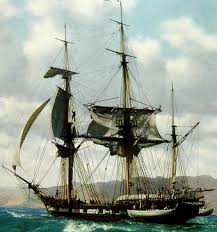
HMS Beagle, on a voyage of discovery
On December 27, 1831, Charles Darwin and H.M.S. Beagle set sail on an around-the-world voyage of discovery that would change all of science, and especially biology, forever.
December 27 1831
After a few delays, H.M.S. Beagle headed out from Plymouth with a crew of 73 under clear skies and a good wind. Darwin became sea-sick almost immediately.
Darwin never fully overcame his seasickness, but he fought it well enough to become the single greatest collector of specimens in history for the British Museum and British science, a distinction that won him election to science societies even before his return from the trip — and cemented his life in science, instead of in the church. Darwin’s discoveries would have revolutionized biology in any case. In analyzing what he had found, a few years later and with the aid of experts at the British Museum, Darwin realized he had disproved much of William Paley’s hypotheses about life and its diversity, and that another, more basic explanation was possible. This led to his discovery of evolution by natural and sexual selection.
Mini-sheet from the Royal Mail in 2009 honoring Darwin’s discoveries in the Galapagos Islands
On December 27, 1968, Apollo 8 splashed down after a successful and heartening trip to orbit the Moon. The three crewmen, Commander Frank Borman, James A. Lovell, Jr., and William A. Anders, had orbited the Moon, a very important milestone in the methodological race to put humans on the Moon (which would be accomplished seven months later). 1968 was a terrible year for the U.S., with the North Korean capture of the U.S.S. Pueblo, assassinations of Rev. Martin Luther King, Jr., and Sen. Robert F. Kennedy during the presidential campaign, riots in dozens of American cities, nasty political conventions with riots at the Democratic Convention in Chicago, a contentious and bitter election making sore the nation’s divide over Vietnam policy, and other problems. On Christmas Eve, Borman, Lovell and Anders broadcast from orbit around the Moon, a triumphant and touching moment for the Apollo Program and Americans around the world. Their safe return on December 27 raised hopes for a better year in 1969.
In 1968, NASA engineers were scrambling to meet President Kennedy’s challenge to land a man on the moon by decade’s end. Because delays with the lunar module were threatening to slow the Apollo program, NASA chose to change mission plans and send the crew of Apollo 8 all the way to the moon without a lunar module.
Exactly 43 years ago, the three astronauts of Apollo 8 became the first humans to orbit another celestial object. As they came around the dark side of the Moon for the third time, Frank Borman, the commander, finally turned their capsule around. And then they saw the Earth.
Borman: Oh my God! Look at that picture over there! Here’s the Earth coming up. Wow, is that pretty.
Anders: Hey, don’t take that, it’s not scheduled.
Borman: (laughing) You got a color film, Jim?
Anders: Hand me that roll of color quick, will you…
One of the resulting photos taken by Anders on a Hasselblad camera became one of the world’s most iconic images.
As Bill Anders recalls it:
I just happened to have one with color film in it and a long lens. All I did was to keep snapping… It’s not a very good photo as photos go, but it’s a special one. It was the first statement of our planet Earth and it was particularly impressive because it’s contrasted against this startling horizon… After all the training and studying we’d done as pilots and engineers to get to the moon safely and get back, [and] as human beings to explore moon orbit, what we really discovered was the planet Earth.
Plan to raise a glass today, December 27, 2012, to Great Beginnings Day for the human race. December 27 is a day we should remember, for these achievements.
Also on December 27:
1927 – “Show Boat” with music by Jerome Kern and libretto by Oscar Hammerstein II, opened at the Ziegfeld Theater in New York City (AP)
1932 – Radio City Music Hall opened for the first time, with a stage that, to me, looks like an old radio (AP)
For “Origin of Species Day,” November 24, the anniversary of the 1859 publication of Charles Darwin’s most famous book, Paul Andersen sent out this Tweet:
Happy Origin of Species Day! Celebrate by learning the story of the comeback stickleback: http://t.co/niMOqARc
Who is Paul Andersen? He’s Montana’s Teacher of the Year (for what year, I don’t know). He teaches science in Bozeman, at Bozeman High.
Plus, he’s produced 224 videos, most of them on science issues. They’re short, they’re informative, and they work. Salman Khan, not yet — but here’s one more piece of the great big puzzle, how do we marry education and technology.
Where does he offer continuing education for teachers on how to produce videos? Why isn’t Texas paying big money to him to get him to do that, to teach Texans how to use YouTube to teach?
Andersen’s on the right path, and he’s running hard. Teachers, are you paying attention?
(By the way, I’d quibble a bit on his history — I think Darwin did a fair deal of experimentation on evolution, breeding pigeons for a decade, among other things. But Andersen’s use of stickleback evolution is very good; the little fishies have been observed to speciate in the wild, and then to duplicate that speciation in captivity, thereby confirming what was observed out in the lakes. Thank you sticklebacks!)
Very quickly this gets into serious territory.
Look, I’m an out of the loop teacher in Dallas, Texas — and for all its money and size and importance, Texas is mostly a cultural and educational backwater. It’s not that there aren’t great people in education here, or no great resources — we are shackled to an ancient political system that puts more value on fealty to not-quite-superordinate ideas than on cutting edge education, or mass educational attainment. There is a powerful anti-intellectual stream in Texas politics that believes a hobbled education system will not threaten the political, social or cultural order. Too many Texans take great solace in that, covertly or overtly.
As a nation, we are engaged in a series of great education experiments, using our children as testing subjects, as guinea pigs. How does video fit into making education work better?
Here we’ve got Paul Andersen and his science videos.
Despite my grousing about his not being in Texas, he is active in national circles where the serious questions get asked about how to use video, and other technologies.
A YouTube Education Summit on October 18 and 19 got Andersen out of Montana, where Andersen ran into C. G. P. Grey, another guy who uses video.
Grey responded with this ode to a “digital Aristotle“:
Links and other information Grey offered:
Some thoughts on teachers, students and the Future of Education.
The book kid me is holding in the video is The Way Things Work. If there’s a bookish child in your life, you should get them a copy: http://goo.gl/QdreH
Also I don’t think that the idea of Digital Aristotle is sci-fi, but if you *do* want to read the sci-fi version, I highly recommend The Diamond Age: http://goo.gl/uvbx6
Game on, ladies and gentlemen. Which one is closer to being right?
There you go, from evolution, to evolution of teaching and education. What’s the selection tool for quality education? Which species of learning will survive to reproduce?
Tomorrow, November 24, 2012, marks the 153rd anniversary of a day that quietly changed all of science, should have changed much of theology, and brought much of the world into the future, though many people don’t know it yet.
It’s a Saturday this year — so let’s be a day early, to get informed and involved the people who don’t check their calendars on the weekends.
Title page, 1859 edition of Darwin’s Origin of Species – image from the University of Sydney via Wikimedia image
How to celebrate? You could read a summary of Ernst Mayr’s shorthand version of Darwin’s theory, and understand it really for the first time (I hope not the first time, but there are a lot of people who really don’t understand what Darwin said — especially among critics of evolution):
Darwin’s theory of evolution is based on key facts and the inferences drawn from them, which biologist Ernst Mayr summarised as follows:[3]
Every species is fertile enough that if all offspring survived to reproduce the population would grow (fact).
Despite periodic fluctuations, populations remain roughly the same size (fact).
Resources such as food are limited and are relatively stable over time (fact).
A struggle for survival ensues (inference).
Individuals in a population vary significantly from one another (fact).
Individuals less suited to the environment are less likely to survive and less likely to reproduce; individuals more suited to the environment are more likely to survive and more likely to reproduce and leave their inheritable traits to future generations, which produces the process of natural selection (inference).
This slowly effected process results in populations changing to adapt to their environments, and ultimately, these variations accumulate over time to form new species (inference).
Charles Darwin’s 1837 sketch, his first diagram of an evolutionary tree from his First Notebook on Transmutation of Species (1837) on view at the the Museum of Natural History in Manhattan. Interpretation of handwriting: “I think case must be that one generation should have as many living as now. To do this and to have as many species in same genus (as is) requires extinction . Thus between A + B the immense gap of relation. C + B the finest gradation. B+D rather greater distinction. Thus genera would be formed. Bearing relation” (next page begins) “to ancient types with several extinct forms.” Wikimedia image
District 15 for the Texas State Board of Education covers 77 counties in Texas’s northern Panhandle. It’s oil (Midland), cotton, Texas prairie and small towns, and lots of schools, and some surprisingly good colleges and universities.
Texas State Board of Education District 15, TFN image – “District Overview District 15 is huge, covering all of northwestern Texas. It is also arguably the most Republican SBOE district, giving more than 74 percent of the vote to Sen. John McCain in the 2008 presidential election and more than 70 percent to Gov. Rick Perry in the 2010 gubernatorial race.”
It’s a district where science plays a big role, and should play a bigger one. The 15th includes those lands in Texas where the Dust Bowl got started, where unwise plowing based on inaccurate readings of climate contributed to one of the greatest man-made natural resources disasters in all of history. It’s the home of Texas Tech University, where members of the chemistry faculty created a wine industry based on the chemistry of grape selection and fermentation, and where geologists learn how to find oil.
This area leads Texas in wind power generation, a considerable factor in the state that leads the nation in wind power generation.
In short, science, engineering and other technical disciplines keep this area economically alive, and vital at times.
Of the two candidates, Democrat Steve Schafersman is a scientist, and a long-time, staunch defender of science education (what we now cutely call “STEM” subjects: Science, Technology, Engineering and Math). If the race were decided by a test in STEM subjects, Schafersman would be the winner. Schafersman lives in Midland.
The GOP candidate in the race is religiously anti-science, Marty Rowley of Amarillo. As a good-ol’-boy, former pastor, he’s got a lot of support from the usual suspects. Rowley’s views on science, technology, engineering and mathematics run contrary to the business and farming interests of his entire district. Do his supporters look to the future?
Do you vote in Midland, Lubbock, Amarillo, Dalhart, Abilene, San Angelo, Dallam County, Tom Greene County, Cooke County or Montague County? You need to vote for Steve Shafersman. Do your children a favor, do your schools a favor, and do your region of Texas a favor, and vote for the guy who works to make education good.
Shafersman is the better-qualified candidate, and probably among the top two or three people with experience making the SBOE work well, in the nation. He deserves the seat, and Texas needs him.
News from the National Center for Science Education — I get e-mail, and it’s probably best to pass it along quickly, unedited, except for links in the text of the article, and the photo of Zack Kopplin, which I added:
VOUCHERS FOR CREATIONISM IN LOUISIANA?
Louisiana is about to spend almost twelve million dollars to fund the teaching of creationism, charges Zack Kopplin, famous for organizing the effort to repeal the so-called Louisiana Science Education Act. In Kopplin’s sights now is a controversial new voucher program in the state that uses public school funds to pay for tuition and certain fees at private schools for students who attend low-performing public schools and whose family income is below 250% of the federal poverty level. When the Board of Elementary and Secondary Education considered a set of accountability guidelines for such private schools at its July 24, 2012, meeting, Kopplin testified that of the roughly 6600 spaces available for students under the program, 1350 will be filled, as the Lafayette Independent Weekly(July 26, 2012) described it, “at private Christian schools that teach creationism and peg evolution as ‘false science.’”
Zack Kopplin, brave teen fighting for good science education in Louisiana
According to the Alexandria Town Talk (July 25, 2012), “A number of the schools on the voucher list teach creationism, a doctrine that holds that God created all life out of nothing, and either don’t mention the theory of evolution or teach that it is false science. State Board of Elementary and Secondary Education [BESE] policy on teaching science requires that public schools teach what is in textbooks but they can supplement with BESE-approved material to promote ‘critical thinking’ on alternatives to evolution.” Superintendent of Education John C. White told the newspaper that BESE had approved the curriculum for all of the schools. “Not teaching evolution could show up in the required state testing for students receiving vouchers, he said, and there could be repercussions ‘if a school shows a fundamental disregard’ for conducting the test.”
Writing earlier in the New Orleans Times-Picayune (July 18, 2012) about Kopplin’s research on the private schools expected to receive new students through the voucher program, columnist James Gill commented, “It is impossible to prepare fully for such a massive reform as going voucher, and some undeserving private schools are bound to receive an OK from harried state officials. But a religious takeover on this scale cannot be accidental. Of the schools on Zack Kopplin’s list, one believes that scientists are ‘sinful men,’ and declares its view ‘on the age of the earth and other issues is that any theory that goes against God’s word is in error.’ Another avers that evolution is ‘extremely damaging to children individually and to society as a whole.’ A third tells students to write an essay explaining how ‘the complexity of a cell shows it must be purposefully designed.’ And so it goes.”
The creationist instructional material used by such schools include textbooks from Bob Jones University Press and A Beka Books — which were described by the University of California system in the ACSI v. Stearns case as “inappropriate for use as primary texts in college preparatory science courses due to their characterizations of religious doctrine as scientific evidence, scientific inaccuracies, failure to encourage critical thinking, and overall un-scientific approach” — and Accelerated Christian Education. A textbook from ACE that argued against evolution on the grounds that the Loch Ness monster not only exists but also is a living plesiosaur (incorrectly described as a dinosaur) understandably attracted the attention of The Scotsman (June 25, 2012) and was widely ridiculed nationally and internationally.
The voucher program is presently under legal challenge from the Louisiana Association of Educators and the Louisiana Federation of Teachers along with a number of local school boards. But the issue of the state’s funding the teaching of creationism is not part of the challenge. Rather, as the New Orleans Times-Picayune (July 10, 2012) explained, “Two key issues are at play in the voucher suit: whether providing private schools with money from the Minimum Foundation Program violates the [Louisiana state] constitution by redirecting those funds from public schools, and whether a last-minute vote setting the new MFP formula in place received enough support in the state House to carry the force of law.” The state will be allowed to implement the voucher program while the challenge works its way through the court system, the newspaper reported.
With all the troubles Louisiana has, with rebuilding from storms, a dysfunctional food distribution system, a dysfunctional health care distribution system, clean up from the Gulf oil spill of 2010, and erosion problems especially in the Gulf bordering parishes, why is Louisiana wasting time and brain power on creationism?
Gee, I think I first posted this more than a year before the Pennsylvania decision. In any case, the subject has come up once again in another forum: Why don’t we teach intelligent design as an “alternative” idea in public school science classes? The answer is, simply, ID is not science. It’s not an alternative hypothesis, it’s a chunk of minority cult religious dogma.
Most bad science claims recirculate year after year, until they are simply educated out of existence in the public mind. We can hope intelligent design falls into that category. But we might worry that modern creationism, begun as a backlash to the anti-Soviet, National Defense Education Act‘s effects on beefing up science teaching in American schools, survives.
We’re talking past each other now over at Right Reason, on a thread that started out lamenting Baylor’s initial decision to deny Dr. Francis Beckwith tenure last year, but quickly changed once news got out that Beckwith’s appeal of the decision was successful.
I noted that Beckwith’s getting tenure denies ID advocates of an argument that Beckwith is being persecuted for his ID views (wholly apart from the fact that there is zero indication his views on this issue had anything to do with his tenure discussions). Of course, I was wrong there — ID advocates have since continued to claim persecution where none exists. Never let the facts get in the way of a creationism rant, is the first rule of creationism.
Discussion has since turned to the legality of teaching intelligent design in a public school science class. This is well settled law — it’s not legal, not so long as there remains no undisproven science to back ID or any other form of creationism.
Background: The Supreme Court affirmed the law in a 1987 case from Louisiana, Edwards v. Aguillard (482 U.S. 578), affirming a district court’s grant of summary judgment against a state law requiring schools to teach creationism whenever evolution was covered in the curriculum. Summary judgment was issued by the district court because the issues were not materially different from those in an earlier case in Arkansas, McLean vs. Arkansas (529 F. Supp. 1255, 1266 (ED Ark. 1982)). There the court held, after trial, that there is no science in creationism that would allow it to be discussed as science in a classroom, and further that creationism is based in scripture and the advocates of creationism have religious reasons only to make such laws. (During depositions, each creationism advocate was asked, under oath, whether they knew of research that supports creationism; each answered “no.” Then they were asked where creationism comes from, and each answered that it comes from scripture. It is often noted how the testimony changes from creationists, when under oath.)
Especially after the Arkansas trial, it was clear that in order to get creationism into the textbooks, creationists would have to hit the laboratories and the field to do some science to back their claims. Oddly, they have staunchly avoided doing any such work, instead claiming victimhood, usually on religious grounds. To the extent ID differs from all other forms of creationism, the applicability of the law to ID was affirmed late last year in the Pennsylvania case, Kitzmiller v. Dover. (Please go read that case!)
In order to question evolution theory, a publisher claiming to be Christian, publishing books to be used in nominally Christian schools that get charter school funds, claims that the Loch Ness Monster is real. Why?
[Loch Ness Monster = dinosaur] + [Alive with humans] = [Falsification of evolution theory]
Like Dave Barry, we could not make this stuff up. It’s too lunatic for fiction.
Here’s the story, from Scotsman.com (not “true Scotsman,” of course) (links added):
Loch Ness monster cited by US schools as evidence that evolution is myth
The Loch Ness monster: Used as evidence that evolution is myth*
By CLAIRE MCKIN
Published on Monday 25 June 2012 14:05
THOUSANDS of American school pupils are to be taught that the Loch Ness monster is real – in an attempt by religious teachers to disprove Charles Darwin’s theory of evolution.
Pupils attending privately-run Christian schools in the southern state of Louisiana will learn from textbooks next year, which claim Scotland’s most famous mythological beast is a living creature.
Thousands of children are to receive publicly-funded vouchers enabling them to attend the schools – which follow a strict fundamentalist curriculum.
The Accelerated Christian Education (ACE) programme teaches controversial religious beliefs, aimed at disproving evolution and proving creationism.
Youngsters will be told that if it can be proved that dinosaurs walked the earth at the same time as man, then Darwinism is fatally flawed.
Critics have slammed the content of the religious course books, labelling them “bizarre” and accusing them of promoting radical religious and political ideas.
One ACE textbook called Biology 1099, Accelerated Christian Education Inc reads: “Are dinosaurs alive today? Scientists are becoming more convinced of their existence.
“Have you heard of the Loch Ness Monster in Scotland? ‘Nessie’ for short has been recorded on sonar from a small submarine, described by eyewitnesses, and photographed by others. Nessie appears to be a plesiosaur.”
Another claim taught is that a Japanese whaling boat once caught a dinosaur.
One former pupil, Jonny Scaramanga, 27, who went through the ACE programme as a child, but now campaigns against Christian fundamentalism, said the Nessie claim was presented as “evidence” that evolution could not have happened.
He added: “The reason for that is they’re saying if Noah’s flood only happened 4,000 years ago, which they believe literally happened, then possibly a sea monster survived.
“If it was millions of years ago then that would be ridiculous. That’s their logic. It’s a common thing among creationists to believe in sea monsters.”
Private religious schools, including the Eternity Christian Academy in Westlake, Louisiana, which follows the ACE curriculum, have already been cleared to receive the state voucher money transferred from public school funding, thanks to a bill pushed through by Republican state governor Bobby Jindal, a Hindu convert to Catholicism.
Boston-based researcher and writer Bruce Wilson, who specialises in the American political religious right, said: “One of these texts from Bob Jones University Press claims that dinosaurs were fire-breathing dragons. It has little to do with science as we currently understand. It’s more like medieval scholasticism.”
Mr Wilson believes that such fundamentalist Christian teaching is going on in at least 13 American states.
He added: “There’s a lot of public funding going to private schools, probably around 200,000 pupils are receiving this education.
“The majority of parents now home schooling their kids are Christian fundamentalists too. I don’t believe they should be publicly funded, I don’t believe the schools who use these texts should be publicly funded.”
And you wonder why kids turn out like they do?
Christians, you may disagree with evolution theory, or Darwin’s findings and the work of 10,000 other scientists, but do you want to perpetrate bald-faced hoaxes to defend your disagreement? Call on the publisher to change the book. Spreading falsehoods is the wrong way to go about getting at the truth.
December 27 is one of those days — many of us are off work, but it’s after Boxing Day, and it’s not yet on to New Year’s Eve or Day. We should have celebrated, maybe.
We should celebrate December 27 as a day of portent: A good embarkation, and a good, safe end to a nation-encouraging trip to almost touch the Moon.
HMS Beagle, on a voyage of discovery
On December 27, 1831, Charles Darwin and H.M.S. Beagle set sail on an around-the-world voyage of discovery that would change all of science, and especially biology, forever.
December 27 1831
After a few delays, H.M.S. Beagle headed out from Plymouth with a crew of 73 under clear skies and a good wind. Darwin became sea-sick almost immediately.
Darwin never fully overcame his seasickness, but he fought it well enough to become the single greatest collector of specimens in history for the British Museum and British science, a distinction that won him election to science societies even before his return from the trip — and cemented his life in science, instead of in the church. Darwin’s discoveries would have revolutionized biology in any case. In analyzing what he had found, a few years later and with the aid of experts at the British Museum, Darwin realized he had disproved much of William Paley’s hypotheses about life and its diversity, and that another, more basic explanation was possible. This led to his discovery of evolution by natural and sexual selection.
Mini-sheet from the Royal Mail in 2009 honoring Darwin's discoveries in the Galapagos Islands
On December 27, 1968, Apollo 8 splashed down after a successful and heartening trip to orbit the Moon. The three crewmen, Commander Frank Borman, James A. Lovell, Jr., and William A. Anders, had orbited the Moon, a very important milestone in the methodological race to put humans on the Moon (which would be accomplished seven months later). 1968 was a terrible year for the U.S., with the North Korean capture of the U.S.S. Pueblo, assassinations of Rev. Martin Luther King, Jr., and Sen. Robert F. Kennedy during the presidential campaign, riots in dozens of American cities, nasty political conventions with riots at the Democratic Convention in Chicago, a contentious and bitter election making sore the nation’s divide over Vietnam policy, and other problems. On Christmas Eve, Borman, Lovell and Anders broadcast from orbit around the Moon, a triumphant and touching moment for the Apollo Program and Americans around the world. Their safe return on December 27 raised hopes for a better year in 1969.
In 1968, NASA engineers were scrambling to meet President Kennedy’s challenge to land a man on the moon by decade’s end. Because delays with the lunar module were threatening to slow the Apollo program, NASA chose to change mission plans and send the crew of Apollo 8 all the way to the moon without a lunar module.
Exactly 43 years ago, the three astronauts of Apollo 8 became the first humans to orbit another celestial object. As they came around the dark side of the Moon for the third time, Frank Borman, the commander, finally turned their capsule around. And then they saw the Earth.
Borman: Oh my God! Look at that picture over there! Here’s the Earth coming up. Wow, is that pretty.
Anders: Hey, don’t take that, it’s not scheduled.
Borman: (laughing) You got a color film, Jim?
Anders: Hand me that roll of color quick, will you…
One of the resulting photos taken by Anders on a Hasselblad camera became one of the world’s most iconic images.
As Bill Anders recalls it:
I just happened to have one with color film in it and a long lens. All I did was to keep snapping… It’s not a very good photo as photos go, but it’s a special one. It was the first statement of our planet Earth and it was particularly impressive because it’s contrasted against this startling horizon… After all the training and studying we’d done as pilots and engineers to get to the moon safely and get back, [and] as human beings to explore moon orbit, what we really discovered was the planet Earth.
Yeah, we missed toasting it on time in 2010. Plan to raise a glass today, December 27, 2011, to Great Beginnings Day for the human race. December 27 is a day we should remember, for these achievements.
Also on December 27:
1927 – “Show Boat” with music by Jerome Kern and libretto by Oscar Hammerstein II, opened at the Ziegfeld Theater in New York City (AP)
1932 – Radio City Music Hall opened for the first time, with a stage that, to me, looks like an old radio (AP)
Lynn Margulis, image from Cambridge Forum Speakers
LYNN MARGULIS DIES
The eminent biologist Lynn Margulis died on November 22, 2011, at the age of 73, according to the University of Massachusetts at Amherst. Born Lynn Alexander in Chicago on March 5, 1938, she enrolled in the University of Chicago at the age of fourteen. She received her A.B. in liberal arts from the University of Chicago in 1957, a joint master’s degree in zoology and genetics from the University of Wisconsin in 1960, and a Ph.D. in genetics from the University of California, Berkeley, in 1963. After a stint as a post-doctoral researcher at Brandeis University, she spent twenty-two years in the Department of Biology at Boston University before moving to the University of Massachusetts at Amherst, where she was Distinguished University Professor. Among her honors and awards were membership in the National Academy of Sciences, the William Procter Prize for Scientific Achievement from Sigma Xi, the Darwin-Wallace Medal from the Linnean Society, and the National Medal of Science. A prolific writer (often in collaboration with her son Dorion Sagan), her books include Origin of Eukaryotic Cells (Yale University Press 1970), Origins of Sex (Yale University Press, 1986), Microcosmos (HarperCollins, 1987), Slanted Truths: Essays on Gaia, Symbiosis, and Evolution (Springer, 1997), Symbiotic Planet (Basic Books, 1998), and Acquiring Genomes (Basic Books, 2002).
Margulis was perhaps most celebrated for her advocacy of the endosymbiotic theory of the origin of organelles, starting with her paper “On the origin of mitosing cells,” published in the Journal of Theoretical Biology in 1967. The endosymbiotic theory is now generally accepted for mitochondria and chloroplasts, if not for all of the organelles that Margulis thought. She was also known for her advocacy of the Gaia hypothesis and symbiogenesis, the idea that speciation is driven largely by symbiosis. Her proclivity for such unconventional evolutionary mechanisms allowed her to be steadily misrepresented by antievolutionists hoping to convince the public that evolution is a theory in crisis. But Margulis firmly rejected creationism, writing, for example, “Anthropocentric writers with a proclivity for the miraculous and a commitment to divine intervention tend to attribute historical appearances like eyes, wings, and speech to ‘irreducible complexity’ (as, for example, Michael Behe does in his book, Darwin’s Black Box) or ‘ingenious design’ (in the tradition of William Paley who used the functional organs of animals as proof for the existence of God). Here we feel no need for supernatural hypotheses. Rather, we insist that today, more than ever, it is the growing scientific understanding of how new traits appear, ones even as complex as the vertebrate eye, that has triumphed” (Acquiring Genomes, p. 202). She was a Supporter of NCSE.
This is a great blow to creationism. Margulis was one of the favorite scientists for quote mining and misquoting among creationism defenders.
It is a greater blow to science and friends of science. All the rest of us will miss the brilliant insights and the questions that forced people to look at life in a new way, often.
Spread the word; friends don't allow friends to repeat history.
While admiring some ground cherries outside my front door, I noticed a number of leaves had been stripped off. Not grazed on by the deer that frequent the area, more like eaten by caterpillars. After a brief search I spotted a hornworm munching away. I didn’t bother killing the hornworm because, after all, the ground cherries are weeds growing amongst the black-eyed susans, and it’s less work for me if they take care of the weeds.
I looked again a few days later, and saw that the hornworm had sprouted numerous white appendages. These are the cocoons of pupating braconid wasps. Braconid wasps are parasitoids that inject their eggs beneath the skin of the host (hornworms are favored by the braconid wasp Contesia congregatus). After feeding on the convenient meal surrounding them, the wasp larvae emerge and spin their coccons, attached to the body of the unfortunate hornworm. In a few days, adult wasps emerge from their cocoons, leaving a dead caterpillar.
I later spotted a second hornworm, which suffered the same fate as the first.
Ewwwwwwww!
Spread the word; friends don't allow friends to repeat history.
Two strings of correspondents in my e-mail date back more than a decade. We met on the old AOL discussion boards, on evolution, and on religious freedom. Occasionally someone in one of those groups will lament the passing of the innocence of those days, and the heated discussions with trolls and reality deniers, and the grand, irreplaceable characters who made last stands denying science to the end, or claiming that Dwight Eisenhower really was Satan in disguise and that America was ruined when he failed to insist Congress open every meeting with prayers, or some other silly folderol.
Or, until that account is unsuspended by the forces supporting Donald Trump: Follow @FillmoreWhite, the account of the Millard Fillmore White House Library
We've been soaking in the Bathtub for several months, long enough that some of the links we've used have gone to the Great Internet in the Sky.
If you find a dead link, please leave a comment to that post, and tell us what link has expired.
Thanks!
Retired teacher of law, economics, history, AP government, psychology and science. Former speechwriter, press guy and legislative aide in U.S. Senate. Former Department of Education. Former airline real estate, telecom towers, Big 6 (that old!) consultant. Lab and field research in air pollution control.
My blog, Millard Fillmore's Bathtub, is a continuing experiment to test how to use blogs to improve and speed up learning processes for students, perhaps by making some of the courses actually interesting. It is a blog for teachers, to see if we can use blogs. It is for people interested in social studies and social studies education, to see if we can learn to get it right. It's a blog for science fans, to promote good science and good science policy. It's a blog for people interested in good government and how to achieve it.
BS in Mass Communication, University of Utah
Graduate study in Rhetoric and Speech Communication, University of Arizona
JD from the National Law Center, George Washington University


 Posted by Ed Darrell










 Millard Fillmore's Bathtub