In 2012, do we know who invented Santa Claus? Who really wrote the “Night Before Christmas?”

December 23, 2012

An encore post and Millard Fillmore’s Bathtub tradition from 2007

Thomas Nast invented Santa Claus? Clement C. Moore didn’t write the famous poem that starts out, “‘Twas the night before Christmas, and all through the house . . . ?”

The murky waters of history from Millard Fillmore’s Bathtub soak even our most cherished ideas and traditions.

But isn’t that part of the fun of history?

Santa Claus delivers to Union soldiers, "Santa Claus in Camp" - Thomas Nast, Harper's Weekly, Jan 3, 1863

In Janaury 1863, Thomas Nast portraye Santa Claus delivered gifts to Union troops in Washington, D.C., wearing a blue, star-spangled coat, just a few days earlier.

Yes, Virginia (and California, too)! Thomas Nast created the image of Santa Claus most of us in the U.S. know today. Perhaps even more significant than his campaign against the graft of Boss Tweed, Nast’s popularization of a fat, jolly elf who delivers good things to people for Christmas makes one of the great stories in commercial illustration. Nast’s cartoons, mostly for the popular news publication Harper’s Weekly, created many of the conventions of modern political cartooning and modeled the way in which an illustrator could campaign for good, with his campaign against the graft of Tammany Hall and Tweed. But Nast’s popular vision of Santa Claus can be said to be the foundation for the modern mercantile flurry around Christmas.

Nast is probably ensconced in a cartoonists’ hall of fame. Perhaps he should be in a business or sales hall of fame, too.  [See also Bill Casselman’s page, “The Man Who Designed Santa Claus.]

Nast’s drawings probably drew some inspiration from the poem, “Account of a Visit from St. Nicholas,” traditionally attributed to Clement C. Moore, a New York City lawyer, published in 1822. The poem is among the earliest to describe the elf dressed in fur, and magically coming down a chimney to leave toys for children; the poem invented the reindeer-pulled sleigh.

Modern analysis suggests the poem was not the work of Moore, and many critics and historians now attribute it to Major Henry Livingston, Jr. (1748-1828) following sleuthing by Vassar College Prof. Don Foster in 2000. Fortunately for us, we do not need to be partisans in such a query to enjoy the poem (a complete copy of which is below the fold).

The Library of Congress still gives Moore the credit. When disputes arise over who wrote about the night before Christmas, is it any wonder more controversial topics produce bigger and louder disputes among historians?

Moore was not known for being a poet. The popular story is that he wrote it on the spur of the moment:

Moore is thought to have composed the tale, now popularly known as “The Night Before Christmas,” on December 24, 1822, while traveling home from Greenwich Village, where he had bought a turkey for his family’s Christmas dinner.

Inspired by the plump, bearded Dutchman who took him by sleigh on his errand through the snow-covered streets of New York City, Moore penned A Visit from St. Nicholas for the amusement of his six children, with whom he shared the poem that evening. His vision of St. Nicholas draws upon Dutch-American and Norwegian traditions of a magical, gift-giving figure who appears at Christmas time, as well as the German legend of a visitor who enters homes through chimneys.

Again from the Library of Congress, we get information that suggests that Moore was a minor celebrity from a well-known family with historical ties that would make a good “connections” exercise in a high school history class, perhaps (”the link from Aaron Burr’s treason to Santa Claus?”): (read more, below the fold)

Clement Moore was born in 1779 into a prominent New York family. His father, Benjamin Moore, president of Columbia University, in his role as Episcopal Bishop of New York participated in the inauguration of George Washington as the nation’s first president. The elder Moore also administered last rites to Alexander Hamilton after he was mortally wounded in a tragic duel with Aaron Burr.

A graduate of Columbia, Clement Moore was a scholar of Hebrew and a professor of Oriental and Greek literature at the General Theological Seminary in Manhattan. [See comment from Pam Bumsted below for more on Moore.] He is said to have been embarrassed by the light-hearted verse, which was made public without his knowledge in December 1823. Moore did not publish it under his name until 1844.

Tonight, American children will be tucked in under their blankets and quilts and read this beloved poem as a last “sugarplum” before slipping into dreamland. Before they drift off, treat them to a message from Santa, recorded by the Thomas Edison Company in 1922.

Santa Claus Hides in Your Phonograph
By Arthur A. Penn, Performed by Harry E. Humphrey.
Edison, 1922.
Coupling date: 6/20/1922. Cutout date: 10/31/1929.
Inventing Entertainment: The Motion Pictures and Sound Recordings of the Edison Companies

Listen to this recording (RealAudio Format)

Listen to this recording (wav Format, 8,471 Kb)

But Henry Livingston was no less noble or historic. He hailed from the Livingstons of the Hudson Valley (one of whose farms is now occupied by Camp Rising Sun of the Louis August Jonas Foundation, a place where I spent four amazing summers teaching swimming and lifesaving). Livingston’s biography at the University of Toronto site offers another path for a connections exercise (”What connects the Declaration of Independence, the American invasion of Canada, the famous poem about a visit from St. Nick, and George W. Bush?”):

Henry Livingston Jr. was born in Poughkeepsie, New York, on Oct. 13, 1748. The Livingston family was one of the important colonial and revolutionary families of New York. The Poughkeepsie branch, descended from Gilbert, the youngest son of Robert Livingston, 1st Lord of Livingston Manor, was not as well off as the more well-known branches, descended from sons Robert and Philip. Two other descendants of Gilbert Livingston, President George Walker Herbert Bush and his son, President-Elect George W. Bush, though, have done their share to bring attention to this line. Henry’s brother, Rev. John Henry Livingston, entered Yale at the age of 12, and was able to unite the Dutch and American branches of the Dutch Reformed Church. At the time of his death, Rev. Livingston was president of Rutgers University. Henry’s father and brother Gilbert were involved in New York politics, and Henry’s granduncle was New York’s first Lt. Governor. But the law was the natural home for many of Henry’s family. His brother-in-law, Judge Jonas Platt, was an unsuccessful candidate for governor, as was his daughter Elizabeth’s husband, U.S. Supreme Court Justice Smith Thompson. Henry’s grandson, Sidney Breese, was Chief Justice of the Illinois Supreme Court.

Known for his encyclopedic knowledge and his love of literature, Henry Livingston was a farmer, surveyor and Justice of the Peace, a judicial position dealing with financially limited criminal and civil cases. One of the first New Yorkers to enlist in the Revolutionary Army in 1775, Major Henry Livingston accompanied his cousin’s husband, General Montgomery, in his campaign up the Hudson River to invade Canada, leaving behind his new wife, Sarah Welles, and their week-old baby, on his Poughkeepsie property, Locust Grove. Baby Catherine was the subject of the first poem currently known by Major Livingston. Following this campaign, Livingston was involved in the War as a Commissioner of Sequestration, appropriating lands owned by British loyalists and selling them for the revolutionary cause. It was in the period following Sarah’s early death in 1783, that Major Livingston published most of his poems and prose, anonymously or under the pseudonym of R. Ten years after the death of Sarah, Henry married Jane Patterson, the daughter of a Dutchess County politician and sister of his next-door neighbor. Between both wives, Henry fathered twelve children. He published his good-natured, often occasional verse from 1787 in many journals, including Political Barometer, Poughkeepsie Journal, and New-York Magazine. His most famous poem, “Account of a Visit from St. Nicholas,” was until 2000 thought to have been the work of Clement Clarke Moore (1779-1863), who published it with his collected poems in 1844. Livingston died Feb. 29, 1828.

More on Henry Livingston and his authorship of the Christmas poem here.
Thomas Nast, Merry Old Santa Claus, Harper's Weekly, Jan 1, 1881

Our views of Santa Claus owe a great deal also to the Coca-Cola advertising campaign. Coca-Cola first noted Santa’s use of the drink in a 1922 campaign to suggest Coke was a year-round drink (100 years after the publication of Livingston’s poem). The company’s on-line archives gives details:

In 1930, artist Fred Mizen painted a department store Santa in a crowd drinking a bottle of Coke. The ad featured the world’s largest soda fountain, which was located in the department store of Famous Barr Co. in St. Louis, Mo. Mizen’s painting was used in print ads that Christmas season, appearing in The Saturday Evening Post in December 1930.

1936 Coca-Cola Santa cardboard store display

  • 1936 Coca-Cola Santa cardboard store display

Archie Lee, the D’Arcy Advertising Agency executive working with The Coca-Cola Company, wanted the next campaign to show a wholesome Santa as both realistic and symbolic. In 1931, The Coca-Cola Company commissioned Michigan-born illustrator Haddon Sundblom to develop advertising images using Santa Claus — showing Santa himself, not a man dressed as Santa, as Mizen’s work had portrayed him.
1942 original oil painting - 'They Remembered Me'

  • 1942 original oil painting – ‘They Remembered Me’

For inspiration, Sundblom turned to Clement Clark Moore’s 1822 poem “A Visit From St. Nicholas” (commonly called “‘Twas the Night Before Christmas”). Moore’s description of St. Nick led to an image of Santa that was warm, friendly, pleasantly plump and human. For the next 33 years, Sundblom painted portraits of Santa that helped to create the modern image of Santa — an interpretation that today lives on in the minds of people of all ages, all over the world.

Santa Claus is a controversial figure. Debates still rage among parents about the wisdom of allowing the elf into the family’s home, and under what conditions. Theologians worry that the celebration of Christmas is diluted by the imagery. Other faiths worry that the secular, cultural impact of Santa Claus damages their own faiths (few other faiths have such a popular figure, and even atheists generally give gifts and participate in Christmas rituals such as putting up a decorated tree).

For over 100 years, Santa Claus has been a popular part of commercial, cultural and religious life in America. Has any other icon endured so long, or so well?

________________________
Below:
From the University of Toronto Library’s Representative Poetry Online

Major Henry Livingston, Jr. (1748-1828)

Account of a Visit from St. Nicholas

1 ‘Twas the night before Christmas, when all thro’ the house,

2 Not a creature was stirring, not even a mouse;

3 The stockings were hung by the chimney with care,

4 In hopes that St. Nicholas soon would be there;

5 The children were nestled all snug in their beds,

6 While visions of sugar plums danc’d in their heads,

7 And Mama in her ‘kerchief, and I in my cap,

8 Had just settled our brains for a long winter’s nap –

9 When out on the lawn there arose such a clatter,

10 I sprang from the bed to see what was the matter.

11 Away to the window I flew like a flash,

12 Tore open the shutters, and threw up the sash.

13 The moon on the breast of the new fallen snow,

14 Gave the lustre of mid-day to objects below;

15 When, what to my wondering eyes should appear,

16 But a miniature sleigh, and eight tiny rein-deer,

17 With a little old driver, so lively and quick,

18 I knew in a moment it must be St. Nick.

19 More rapid than eagles his coursers they came,

20 And he whistled, and shouted, and call’d them by name:

21 “Now! Dasher, now! Dancer, now! Prancer, and Vixen,

22 “On! Comet, on! Cupid, on! Dunder and Blixem;

23 “To the top of the porch! to the top of the wall!

24 “Now dash away! dash away! dash away all!”

25 As dry leaves before the wild hurricane fly,

26 When they meet with an obstacle, mount to the sky;

27 So up to the house-top the coursers they flew,

28 With the sleigh full of Toys — and St. Nicholas too:

29 And then in a twinkling, I heard on the roof

30 The prancing and pawing of each little hoof.

31 As I drew in my head, and was turning around,

32 Down the chimney St. Nicholas came with a bound:

33 He was dress’d all in fur, from his head to his foot,

34 And his clothes were all tarnish’d with ashes and soot;

35 A bundle of toys was flung on his back,

36 And he look’d like a peddler just opening his pack:

37 His eyes — how they twinkled! his dimples how merry,

38 His cheeks were like roses, his nose like a cherry;

39 His droll little mouth was drawn up like a bow.

40 And the beard of his chin was as white as the snow;

41 The stump of a pipe he held tight in his teeth,

42 And the smoke it encircled his head like a wreath.

43 He had a broad face, and a little round belly

44 That shook when he laugh’d, like a bowl full of jelly:

45 He was chubby and plump, a right jolly old elf,

46 And I laugh’d when I saw him in spite of myself;

47 A wink of his eye and a twist of his head

48 Soon gave me to know I had nothing to dread.

49 He spoke not a word, but went straight to his work,

50 And fill’d all the stockings; then turn’d with a jerk,

51 And laying his finger aside of his nose

52 And giving a nod, up the chimney he rose.

53 He sprung to his sleigh, to his team gave a whistle,

54 And away they all flew, like the down of a thistle:

55 But I heard him exclaim, ere he drove out of sight –

56 Happy Christmas to all, and to all a good night.

Online text copyright © 2005, Ian Lancashire for the Department of English, University of Toronto. Published by the Web Development Group, Information Technology Services, University of Toronto Libraries. Be sure to visit this site for more information on this poem, on Maj. Livingston, and on poetry in general.

More:


A water tower named Dwight

January 31, 2012

In all the sturm, drang und angst of the past 10 days, I failed to commemorate the natal day of my brother Dwight.

Water tower in Dwight, Illinois -- fuzzy photo by Ed Darrell at 70 mph

Dwight has always been outstanding in his field. Or, was it, "Out standing in his field?" Water tower in Dwight, Illinois -- fuzzy photo by Ed Darrell at 70 mph

It was a big one for Dwight, too.  Let’s just say he has abandoned that old line about “never trust anyone over 30.”

Actually, the Village of Dwight has an artist’s rendering of the tower, too:

Water Tower village piece, Dwight, Illinois

Water Tower village piece, Dwight, Illinois. It's back ordered at the moment, if you wanted to buy one.

Nice image, don’t you think?

Unlike the water tower in Burley, Idaho, where Dwight misspent his youth, this one is tougher to climb, to spray paint grafitti on it.

Water tower in Burley, Idaho - photo by wogger

Water tower in Burley, Idaho - photo by wogger

I don’t suppose Dwight still does that stuff, though.

Happy birthday, to my brother, a bit late.


Mad Housewife Chardonnay

January 28, 2012

Kathryn isn’t exactly a haus frau, not with all the lawyers she must deal with daily.

Probably more of a comment on her husband.  A good friend offered this gift a while back:

Mad Housewife Chardonnay - IMGP2636 Photo by Ed Darrell, Creative Commons license

Mad Housewife Chardonnay - Photo by Ed Darrell, Creative Commons license

We laughed.  Then we found, in the box, an accompanying chardonnay glass:

Change du Life wine glass - IMGP2637 Photo by Ed Darrell, Creative Commons

Change of Life wine glass

“Hot with complex characteristics.”  Still hot after all these years (that many? really?).

Drinking it poses a conundrum:  A Trophy Wife ™ really should be taken out on an occasion to drink a wine with a name like that, right?  But I’m stingy enough not to want to pay the corkage on a bottle brought in.  In no case should this one be drunk with a dinner she’s slaved over for hours.

Maybe it’s time I hit the kitchen.  Old Bay crab cakes, maybe?  It’s a great wine.


January 17, and auspicious births

January 17, 2012

The First American, Ben Franklin, was born on this day in 1706.  Exactly a century later, Thomas Jefferson’s daughter, Martha, bore James Madison Randolph, the first child born in the White House (fitting that Thomas Jefferson’s grandson would be named after James Madison, no?).  And in 1990, James Darrell was born in Dallas, Texas.

Happy birthday, James!


Smokey’s gone

August 1, 2011

Smokey in May 2009 - glare; photo by Ed Darrell, please attribute IMGP0814

Smokey in better days in 2009, expressing her displeasure at being photographed asleep

Her first night out of the pound I don’t think she slept.  Yowled all night long.  Smokey made one aware of her presence.  It was one of the endearing qualities of one of the smartest, most personable, and grayest cats I’ve ever known.

For 21 years she let us know where she was.  Uncharacteristically, perhaps, she left us quietly Saturday at 5:32 p.m.  Kidney failure.

She fought for life so long as she could.  Last Monday she ate a great breakfast.  Then she stopped eating, cold.  She stopped drinking Tuesday.  We had her into the veterinarian, and blood tests confirmed that her long-time kidney disease had taken hold.  No function showed up.  Other than that, the only outward sign was a little more crankiness (as a cranky cat, she was legendary).  So we made the hard decision, and made an appointment to put her down Thursday.

Thursday afternoon, on her clock, she came to life big time.  She fought going into the carrier and wailed as loudly as ever all the way to the vet’s office.  Another family was struggling with a terminally-ill pet, so there was delay.  Smokey’s wails were disturbing others, so we let her out of the carrier, and she headed right for the door.

Going gently?  “Get out of my way,” she seemed to be saying.  “I’ll go at home, or take somebody else with me.”  At the vet’s office, she’s famous for fighting “procedures,” one of those cats who had to be muzzled on occasion.

We let her have her way, and brought her home.

Two years earlier, she fought a nearly-fatal infection.  Kathryn and I (mostly Kathryn) had to inject her with saline solution twice a day to get her hydrated enough just to hang on.  Her kidney function showed late-term renal disease, then.  The prognosis:  Perhaps two months.  But as soon as she got hydrated, she beat the infection and sprang back to life.

A more self-confident cat I’ve never met.  Cats’ tails go up when they feel good and secure.  For the first 18 years of her life that tail never fell below full sail.  She never met another cat she liked, which created some conflict with the older, gentler rescue cat she joined and the younger, meeker rescue cat who came along later.  Smokey got along with the dogs.  They were bigger, more appropriate for her ego.

She was a cat of many names.

Smokey came from the local animal pound, a hoped-to-be companion for a cat rescued from the side of the road.  She was smoke gray from nose to tail — even her lips and foot pads.  “Smokey” was a natural name, and Kenny suggested it.  James, just one at the time, had some difficulty with the name.  “Bokey” stuck as a nickname, turned to “Pokey” for her habit of yowling to have a door opened, and then pausing, half through the doorway, to ponder several things. Then “Pokes,” and “Poquito,” and “Pokesalot.”

Compared to the longer-haired cats especially, she was sleek.  Finely muscled, she could have been the model for what a good, lean cat should look like.  Each muscle was well exercised.  There was no high place she would not attempt to get to, and no impossible balancing act she would not attempt earning the awe and jealousy of the Wallendas.  “Sleek and gray” was a name she’d answer to — “Fink and gray” when she took to knocking stuff off our dressers to get us up at her preferred rising, at 4:30 or 5:00 every morning.  On weekends, or any day we wanted to sleep late, she’d get on the bed and gently tap a nose until she got a reaction.  Sometimes she’d lick a nose (“kitty kisses”).  Once she bit me.  Once was enough for her — she went back to gentle taps.  Very smart cat.

We resolved to keep the cats indoors, both for their protection and for the protection of the birds who visit the yard.  Within a year Smokey began making runs at the open door.  Astonishingly we avoided a broken or clamped-off tail, or broken ribs.  Finally she made a dash with several yards to build up speed, and by the time she could stop she stood in the middle of the street.  Calmly, she strode back to the curb, tail up, and proceeded to groom herself.  We couldn’t catch her.  After an hour, she yowled to come in.  So she made herself an indoor-outdoor cat.

Of course she had to wear a bell, as lithe and fast as she was she posed a great threat to smaller birds.  But she learned how to shed her collar, and got it down to a record 30 minutes.  Once she figured out we’d put the collar back on when we found it, she took to ditching the collars where they couldn’t be found.

Bird deaths tapered off, fortunately.  We were grateful for her hunting prowess when she made it a personal mission to rid the neighborhood of rats who had tried to move in.  It took her almost a month to get the family of rats under the shed — one by one — but within a summer the neighborhood was safe for squirrels and other more friendly rodents.  Soon after that, she stopped hunting.  The rats never returned.

For the past two summers, blue jays brought their offspring to see Smokey lying in the sun on the patio, teaching them that this was one cat they didn’t need to fear.  After a few months of that, Smokey stopped even glaring at them.  It was almost as if they were visits from old friends, sort of a Blue and Gray reunion after the conflict.

The last year was tough.  Arthritis in her hips slowed her.  We rescued another cat from the pound, and true to form Smokey took an immediate disliking to Luna.  To avoid Luna, Smokey retreated to the back parlor, generally off limits to pets but blocked only by a child gate — which Smokey quickly learned to climb.  As the arthritis affected her more, we put a step stool on one side, a concession she took to immediately.

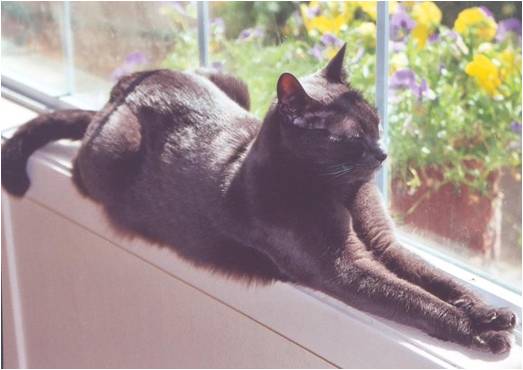
Smokey on the window sill, with sun and pansies

Smokey enjoying the sun from indoors, with pansies. It’s not an easy sill for a cat to balance on — Smokey would balance, and fall asleep.

The affair at the vet’s office Thursday was her last great show of will.  One thinks cats know they are dying.  Smokey would meet death on her terms, thank you very much.  By Friday she was clearly unable to walk or stand well.  Saturday Kathryn sat with her on the dining room floor.  When she wasn’t sleeping, Smokey would meow.  A stroke or two from Kathryn and she’d go back to sleep.  She had refused water until Friday night, but then started taking a little sips from a syringe.

Kathryn ran errands about 4:00 p.m., and I checked that Smokey was sleeping.  About 5:00 she woke up, wanted water, and looked around for Kathryn.  Kathryn returned a few minutes later, and Smokey relaxed, and breathed a last time.

A companion for more than two decades insinuates herself in ways one doesn’t even recognize.  Saturday night I turned off the kitchen lights to head to bed, and instinctively looked into the parlor to say goodnight to Smokey.  Sunday morning I got up to make coffee, and looked to see if Smokey wanted out.  I would have sworn she batted my nose this morning to wake me up, but no cat even close.

Sometime in the next few months I’ll take out a pair of pants or a coat, and notice it’s covered with Smokey’s gray fur.  At some point she used it for a pad, perhaps.  I’ll have to decide whether to clean the thing, or keep it as a reminder of our longtime friend.


Going to the, um, wall, for your grandmother

November 20, 2010

What I really like about this story is that the guy did it for his grandmother, to pull her out of a funk.

From My Modern Met:

SuperHero Grandma, by Sacha Goldberger

Sacha Goldberger's loving portrait of his grandmother, who happens to be a superhero.

A few years ago, French photographer Sacha Goldberger found his 91-year-old Hungarian grandmother Frederika feeling lonely and depressed. To cheer her up, he suggested that they shoot a series of outrageous photographs in unusual costumes, poses, and locations. Grandma reluctantly agreed, but once they got rolling, she couldn’t stop smiling.

Frederika was born in Budapest 20 years before World War II. During the war, at the peril of her own life, she courageously saved the lives of ten people. When asked how, Goldberger told us “she hid the Jewish people she knew, moving them around to different places everyday.” As a survivor of Nazism and Communism, she then immigrated away from Hungary to France, forced by the Communist regime to leave her homeland illegally or face death.

Aside from great strength, Frederika has an incredible sense of humor, one that defies time and misfortune. She is funny and cynical, always mocking the people that she loves.

With the unexpected success of this series, titled “Mamika,” Goldberger created a MySpace page for his grandmother. She now has over 2,200 friends and receives messages like: “You’re the grandmother that I have dreamed of, would you adopt me?” and ” You made my day, I hope to be like you at your age.”

Initially, she did not understand why all these people wrote to congratulate her. Then, little by little, she realized that her story conveyed a message of hope and joy. In all those pictures, she posed with the utmost enthusiasm. Now, after the set, Goldberger shares that his grandmother has never shown even a hint of depression. Perhaps it’s because her story serves some sort of purpose. That through the warm words of newfound friends, she’s reminded of just how lucky she is to be alive.

Several great photos here, at My Modern Met.

Who wouldn’t admire a guy who makes a superhero out of his grandmother?

Mamika, Sacha Goldberger's grandmother

Going to the wall for your grandmother -- Sacha Goldberger photo.

More, and resources:

Tip of the old scrub brush to Jean Detjen.


Cats in Crete and China, and evolution

October 23, 2010

Cretan Cat - photo by Kenny Darrell

A cat Kenny Darrell photographed in Crete -- notice each eye is a different color.

Darwin wondered about the genetic reasons behind white cats being blind deaf (though, of course, he didn’t call it “genetics” then).  Evolution in action:  White cats today usually can see hear.

Kenny found this cat in Crete, and got a good shot of its eyes, each of a different color — though of course, as soon as the focus was set, the cat leaned forward for a pet.

Kenny’s in China right now.  I wonder if China has cats and dogs on the streets like Crete?

Below the fold:  Darwin on white cats.

Read the rest of this entry »


Dan Valentine – My Sister/My Brother, part 1

August 11, 2010

By Dan Valentine

MY SISTER / MY BROTHER – Part 1

One magical, fairy-tale of an evening, back in 1998, my baby sister Valerie—she is eight-years younger than myself—was knighted by Her Majesty Queen Beatrix of the Netherlands.

And I was there!

She is one of the few ballerinas and/or Americans ever to be so honored.

Funny, just a few short years before in Manhattan, after my sister had performed onstage with the great Russian dancer Rudolf Nureyev—yes, that one!—my mom had doused out a cigarette in the Queen’s half-empty cocktail.  At a reception for members of the Dutch community in town (Walter Cronkite was there), my mom, looking around for an ashtray and not finding one nearby, spotted a half-filled drink and plopped her cig in it.  A moment later, the Queen came back, after a brief newspaper interview, to finish her toddy, only to find a, well, you-know-what in it.

But back to little sister’s knighthood.

Earlier that morning, I had attended a ballet class with my sister.  Ballerinas and their male counterparts take class every day of the week to brush up on their technique and such.  They stretch, move to the Barre, and do sequences in the center of the floor for an hour or so.  This is followed by grueling hours of rehearsals for upcoming and/or present performances.  So, anyway, I was standing by the wayside watching a Russian ballerina from the Bolshoi twirl around and around and around.  We made eye contact and she fainted, dead away.  In my dreams, I caught her in my arms.  In reality, she slumped to the floor.  I like to think it was caused by my George Clooney good looks, but it was probably caused by exhaustion.

That day, for a short time, I was the talk of the company.

Her lifemate, Roeland Kerbosch, an award-winning Dutch film director, had informed me a short time beforehand what was to take place that evening.  I remember smoking—of course! as they say in the Netherlands—by the stage door of the Muziektheater in Amsterdam when my sister showed to suit up.  She told me that she was worried about that night’s performance.  Can’t remember why.  All I was thinking was:  Val, this is going to be one of, if not thee greatest night of your life.

Utah-born ballerina Valerie Valentine, Dutch National Ballet

Valerie Valentine, Dutch National Ballet

Later that evening, Valerie—I call her Val, sometimes Vali—was dancing onstage when suddenly everyone but herself stopped in their tracks.  The conductor put down his baton.  The music stopped.  The performance came to a halt.  My sister, in the middle of a pas de deux or whatever, looked around perplexed.  What the heck is going on?

After a moment, the Mayor of Amsterdam walked on stage and bestowed upon her the Order of the Dutch Lion—the highest honor a non-military person can receive in the Netherlands—in recognition for her 25 years of “significant contribution to the art of dance.”

He read from a scroll:  “Admired for her energy and dedication to her work, Valerie Valentine’s beautiful sense of line, strong technique and expressive, magical stage presence have inspired not only choreographers, but photographers and filmmakers as well . . .”

Needless to say, there was a party afterward.  Cocktails, hors d’œuvres, a band, dancing, etc.  I was very happy for my sister, ecstatically so.  But I left the celebration shortly after it began.

I can’t remember feeling sadder.

Sitting at an outside cafe, just a few a blocks away, was my artist brother Jimmy, uninvited (and rightly so; he was literally crazy as hell), doing his best to drink himself to death, an endeavor he would shortly accomplish.

He died four years later, age 48, in Torremolinos, Malaga, Spain . . . on Valentine’s Day.

Add to FacebookAdd to NewsvineAdd to DiggAdd to Del.icio.usAdd to StumbleuponAdd to RedditAdd to BlinklistAdd to TwitterAdd to TechnoratiAdd to Furl


Eleanor Knowles Laney

August 3, 2010

We’re all mourning the recent loss of our Aunt Ellie.  A more formidable foe at Scrabble cannot be imagined.

Eleanor wrote books, edited books, but mainly read books voraciously.   Her love of books is assumed happily by dozens of nieces and nephews, literally.

An appropriate remembrance I have not written — maybe cannot — but there is a good story about her life in the Ogden Standard-Examiner.


Dan Valentine – The Pink Cigarette Lighter, Part 2

July 13, 2010

By Dan Valentine

THE PINK CIGARETTE LIGHTER – Part 2

I was out on the veranda–inhaling my first drag from a cig, slurping my first sip from a cup–when the morning receptionist appeared.

Upon seeing her, I took a look at an imaginary watch on my wrist (my true watch is in my carry-on–the band broke months ago) and said, “You’re late!” I was joking. I didn’t have the slightest idea what time it was. I wrote into the wee hours.

“You, too?” she said. “Nobody lets me be me in this world.” She was half-joking, but all humor has a serious side, or it wouldn’t be funny. No identification.

I guess, she WAS a little late and Gabby, the manager, had gotten on her case. I can relate. She’s gotten on my case more than once, and I’m a guest.

The other night I was outside, having a cigarette, thinking, pacing, when two Mexican gentlemen stopped to inquire if I had any food to spare. “We not eat.” They were homeless and penniless. They had just come from L.A. where they had found little or no work and had returned home across the border. I told them to wait a sec.

I poked my head inside and told Gabby, “There are two gents in need of something to eat.”

She’s a teacher. In her spare time, she teaches a small group, of four or five, creative writing here at the hostel, which she was busy doing at that moment. She couldn’t very well say no in front of her students, so she got up and went to the kitchen and filled two plastic bags full of goods. She may have even taken a well-guarded and cherished jar of strawberry jam out of the locked safe and included it. (I shouldn’t be so judgmental. She probably would have done the good deed on her own, without me or her students here or not.)

She gave the two gentlemen the bags–in return, the two sincerely thanked her and went on their way– and Gabby turned to me and said, “Charming? Yes?”

Si, indeed!

Sunday afternoon–the staff’s day off–she’s about to leave with no one here but me. I asked, “Do you want me to stay around?” You know, just in case someone wanted to check in.

She sad, “No. Leave. Leave forever!”

I had to laugh.

But where was I? Oh, yes. “Nobody lets me be me in this world.” I love that phrase. It says a lot.

I told her so, and she, the morning receptionist, sat to have a chat about this-and-that. Sat-chat-that. Perfect rhymes. Imperfect world.

During our conversation, among many other things–now aware that I was writing a piece on gays and lesbians and those in between–she informed me that three transvestite prostitutes had been found murdered recently and left on the side of the road between here and Rosarito, a small town up the Baja coast–killed by some macho Mexican male or more, she supposed.

One may have very well been wearing pink, I just thought to myself. It doesn’t take much–I know from personal experience–to fuel the fervor in some to kill or hurt another fellow human being.

The Aztecs used to execute homosexuals, and you don’t wanna know the details of how they went about it. Transvestites–whatever their sexual preference–were executed also and, again, you don’t wanna know the gruesome details.

Under Spanish rule “maschismo” was introduced to the Western Hemisphere: Men are men and should act accordingly. Make war not love.

In the mid-’90s, a Mexicana airline pilot had security guards at Guadalajara International Airport escort two San Francisco-bound lesbians off the plane for engaging in immoral behavior. They were seen holding hands.

Two dozen homosexuals were murdered in Mexico during the first-half of that decade, most of them transvestites. And now, years later in 2010, three more can be added to the list.

My fellow Americans, north of the border, I sincerely and humbly apologize. We are not alone, not by a long shot, not that I thought for a moment that we were. Hatred for those who are born different is universal.

Pearl Harbor was the home port of my first ship when serving in the Navy. This was many decades before don’t-ask-don’t-tell–1969 or so. The scuttlebutt on board at one time was that several snipes in Engineering–not just two but several–had been swiftly discharged for gay activities. From first-hand experience, I know you can’t believe everything, or anything, you hear aboard a ship.

To get from the Naval Base to Waikiki Beach, you had to catch a bus that let you off on Hotel Street in Honolulu, where you waited to transfer to another bus. On Hotel Street, at night, you’d see countless prostitutes plying their trade, many with a large pink button–pink! that color again!–that informed those who could read: “I AM A BOY”! It was the law back them.

You might as well have painted a pink bull’s eye on their chests or backs or foreheads or all three. On the bus coming back at night, you’d see them again, on the side of the highway, plying their trade. I’m sure there were many a gay-bashing. Probably a killing or three. Macho guys just wanna have fun.

On the other hand–there’s always a flip side–the large pink warning labels may well have saved a life or three. False advertising can very well get one killed, too.

I believe in education. I believe in magnet schools, comprehensive public schools, high-school level, with different specialized curricula. Reading-writing-and-arithmetic is all fine and dandy, but you gotta teach everyone, as many as you can, how to make a living, how to put bread on the table. The United Kingdom has nearly 3,000 of ‘em, each specializing in a specialized trade. My sister attended one. The London Royal Ballet School.

In Manhattan, I lived just up the block from one. The Fiorella H. LaGuardia High School of Music & Art & Performing Arts. I spoke there once, representing the BMI Musical Theater Workshop. Ving Rhames, Freddie Prinz, Liza Minneli, Dom Deluise are/were all graduates.

But why just the arts? Whether it be plumbing, carpentry, or automotive mechanics, you gotta teach the young how to make a buck, the earlier the better. A magnet school can give the process some intensity and prestige. Just my own personal opinion, but I’m no expert.

My junior year in high school, I came home after my first day at class, and my dad asked what courses I had signed up for. I told him I had signed up for Creative Writing for one. He told me to check out immediately. Take typing. I did, and it has served me well through the years. In the past, I have always been able to get a job typing. Except in Nashville!

I was stationed in Bremerton, Washington, in the Navy for a couple of months. While there I signed up to take a course in shorthand at the local junior college, taking my dad’s advice again. I had to check out. I was the only male and all the women in the class, the professor said, were so well advanced that she was going to skip the first few chapters of the textbook. The women in the class had all taken shorthand in high school.

My dad also told me when I was VERY young to get a part-time job at a Chinese laundry. This was more than 40 years ago. He said Chinese was the future and I could always get a job as a reporter. My dad was a very smart and savvy man. Stupid me, I got a job delivering the Deseret News instead; it might have been bagging groceries at Albertson’s. I can’t remember. I did both at one time or another.

On one of my first days working for Orrin Hatch, he took me aside and told me what the business at hand was all about. “Economics. Economics. Economics.” He might as well have said the whole world, from beginning of time. Maybe he did.

It’s all about the money, sad or not. And you gotta teach people how to make some. I believe countless magnet high schools throughout the nation would be a good start.

Prostitution is the world’s oldest profession, or so it’s said. And I believe it. Those who don’t have a trade often choose the oldest one, whether by choice or by circumstance, for there is always–and always will be–those who will pay for a prostitute’s fast-fix accessibility.

Straight, gay, lesbian, or transgender, many have sexual needs that can’t be met at home by a loved one, if they have a loved one. Some are attracted to transvestites. Some have a desire–it could very well even be sexual–to murder ‘em.

There is a street in Ensenada, I was told by a visitor from San Diego, known by those north of the border and cab drivers here as Tranny Alley. I asked Salsador about it. He’d never head of it. I had to explain to him what the word “tranny” meant. “Tranny” hasn’t entered the Spanish lexicon–as of yet. Where it exactly is, I don’t wanna know. Somewhere in the world–I have no doubt–is a block of ill-repute known as Granny Alley, too. As an aspiring lyricist, I hear a word and automatically match it in my mine with a rhyme. Tranny. Granny. I’d Google it, but I don’t wanna know.

In the Netherlands, and in a few other European countries, prostitution is legal, as it should be. Take it off the side streets and out of the back alleyways–get rid of the pimps!–and supervise the activity. It’s a revenue-maker for city and state. It’s a good idea just disease-, violent-crime-, and you-name-it-wise.

In Amsterdam, it’s even a tourist attraction. Tourists go view a Rembrandt, take in a Van Gogh, taste-test some funny stuff at a Coffee Shop, and visit what is called “The Street of Women” to take a peek at “The Women in the Windows.” Not necessarily in that order. My dad, when he visited, took a stroll down the street and even convinced my mom to tag along. At first, being raised a staunch Presbyterian, she said no-way. “What will people think?” My dad replied, “They’ll simply think a beautiful new girl’s in town.” Ha-ha. My mom thought it over for a moment, pursed her Presbyterian lips, and joined him for a peek. She was a trouper.

I, myself, took my bestest friend for a peek on our first visit there. We walked by a window showcasing a painted woman with a poodle on her lap. “That’s the job I want!” my good friend said. “A job you can take your dog with you to.” She’s very funny. In Houston, she did stand-up comedy for a time–wrote her own material. “How would you come up with the rent?” I asked. “You gotta entertain a customer or two, at the very least. She pondered the proposition for a sec. “Well, that is a problem, isn’t it?”

All the world’s a Catch-22.

My artist brother, Jimmy, who inherited more than a drop of my mom’s Presbyterian blood, was on a first-name basis with a number of prostitutes in Amsterdam. He painted their portraits while they sat in their windows waiting for customer. There was a gallery showing of the paintings called “Women in the Windows.” It received good reviews. Most everything I own is now somewhere in a Houston dump. I kept the few paintings I possessed by my dear departed brother. One or two are of the women in the windows.

My dad often brought copies of police reports home from The Tribune. In his heart of hearts, I think, his dream was to one day write the Great American Novel. One report, I remember, concerned a sex decoy (an undercover cop) and a prospective John. She was standing on the corner of West 2nd South in Salt Lake. It was well-known at one time for prostitutes. Perhaps, still is.

A customer propositioned her. A twelve- or thirteen-year-old boy. He said he wanted to pay for sex with her. She told him, “Kid, go away.” He said, “I’ve been saving up for months.” “Go away,” she said. “You’re going to get yourself in trouble.” He said, “My girl friend won’t have sex with me. The school slut won’t have anything to do with me. And now, you, a prostitute, won’t have sex with me?!” By this time, a patrol car had arrived on the scene. He was taken into custody.

Sad, perhaps, but very human …

Elko, Nevada, last I heard, has legalized prostitution. And, last I heard, there hasn’t been a rape in years. But that I find had to believe.

As a kid, we visited Elko many times. My dad wasn’t too crazy about Las Vegas–he’d spent a short time there homeless after the war–but he loved Elko. We always stayed at the Commercial Hotel downtown. In the lobby was a huge white Polar Bear, stuffed, standing upright on its hind legs, in a glass case. Very sad.

When I was little, kids were allowed in the casino with their folks. I remember standing by my dad as he rolled the dice. When he won, he’d give me a handful of silver dollars. And I remember putting them on my bed in our room upstairs and running my fingers through them time and again. Such joy!

My dad told me to save them. They may be worth something someday. I gave them to a longtime friend of mine, a pawnbroker in Salt Lake, a few years ago to sell. He put them in his safe. When I inquired about my silver dollars some time later, he informed me that they had disappeared. Poof! He didn’t know what happened to them. Hmmmm! I had also given him all the foreign money I had accumulated on my travels to sell. Poof! They had disappeared, too. Hmmmmm!

But back to Elko. On one visit with my folks–I was in my teens at the time–we checked in, unpacked our bags, and went down to the lobby together. After a short while, I told my dad that I was going up to take a short nap. I may have even stretched my arms out to show how tired I was and yawned. Movie-style. He bid me goodnight, and I caught the elevator upward. I stepped out, pushed the Down button, caught the elevator down to the garage. I had a mission: I was going to lose my virginity that evening at a whorehouse across the tracks. I walked down the street, stepped into the nearest house of ill-repute, and looked around. At the end of the bar–waiting for me–was my dad!

Needless to say, by the end of the night, I was still a virgin. But it was one of the most memorable nights in my entire life. At the time, The Tribune’s circulation included much of northern Nevada. The working women there were all readers of his column, and huge fans. That night we visited many, if not all, the houses across the tracks. I didn’t smoke back then, but I pocketed a matchbook from each place we visited–their logos on the covers. They, too, are now in a dump somewhere on the outskirts of Houston.

My dad was ill much of the time in his later years. First, it was shingles. Next, it was anorexia. He was a big man at one time. With anorexia, he lost tens and tens of pounds. He couldn’t get himself to swallow a bite. One time my sister Valerie visited from Amsterdam. She was standing by him at a stop light in front of The Trib, his arms, as always, filled with out-of-town newspapers–a Milwaukee Journal, a Denver Post, etc.–when his pants fell down to his ankles. Very embarrassing. My sister lifted them up and tightened the belt one notch tighter around his thinning-waist.

He couldn’t eat, but he could drink. And at night I would sit with him until the wee hours while he did.

I remember my mom walking into the living room one night and saying, “Dan, you’re drinking too much. I find bottles behind the books on the bookshelves. I find bottles underneath the bed.”

“They were empty, weren’t they?” my dad would inquired.

“Yes.”

“Well, that’s good. I wouldn’t want to waste any good whiskey.”

“Dan, please come to bed.”

“I will, Elaine. Just let me sit here awhile and die a little.” And he’d pour himself another shot of whiskey.

He would sip, and I would listen while he shared plot-idea after plot-idea for movies, novels, short stories, plays, musicals. Titles for songs. I clung on to every word. My goal, up until recently, was to write everyone of ‘em. Song title-wise, I accomplished the task. The hooks of many of the songs I have written through the years were first heard in the wee hours from my dad and jotted down by me to write later.

One idea, for a two-act play, he called “Ballerina Baby!”

LIGHTS UP

Act One – Scene One

Place: London

Father/Husband: No daughter of mine is going to marry a goddamn queer!

Mother/Wife: Sssh! He’ll hear you.

Father/Husband: I don’t care. No daughter of mine is going to marry a goddamn queer!

The plot? Some background: At a very young age, my sister was accepted to learn her chosen craft at the Royal London Ballet School. Foreigners were allowed to take classes and graduate, but they weren’t allowed to continue on and become members of the Royal London Ballet unless they were British citizens. Or married to one.

Hence, the story: The heroine, the daughter, is befriended by a gay fellow dancer who is a British citizen. Maybe he is Indian or even Jamaican. That would make it even more interesting. Upon graduation, he agrees to marry the American so she can join the Royal Ballet as a corps member. Her father is a Texas bigot–there are some–and is firmly against the idea, to say the least. To make a two-act story short, the gay and the bigot become friends, each learning something from the other.

Act Two – Last Scene

The gay lad and the dad are standing together–talking, etc., whatever–when the gay Brit, out of the blue, pinches his the ass of his new father-in-law! Look of dismay on the dad’s face as …

… the curtain falls.

Through the years, every-so-often, I would work on that play. What little I had is now in a Houston dump.

After graduating from the Royal London Ballet, my sister got a job as a member of the Dutch National Ballet. When she first moved to Amsterdam, she had a flat next door to a gay man who made a living working nights as a female impersonator in a drag revue. On the same floor, across from her, was a straight man who took a liking to her and began stalking her.

One night, late, the straight guy tried to force himself on her. The drag queen next door heard her screams for help, came to her aid, and beat the crap out of him.

My mom soon after flew to Amsterdam and moved in with my sister. My dad son after that visited and took the professional drag queen/hero out for a drink or two. After which, the drag queen invited my dad and mom to see a performance. I can see my mom pursing her Presbyterian lips and saying, “But what will people think?” and my dad replaying, “There’ll just think a beautiful new performer is in town.” Ha-ha. I can also see my mom tagging along. She was a trouper.

One last note in closing: I couldn’t help myself. I HAD to Google “Granny Alley”. And, lo and behold, there IS such a block of ill-repute. Of course! It wouldn’t be Planet Earth without one. It’s located in Liverpool.

You learn something every day, whether you want to or not.

We all have a kink or two. I’m just glad mine isn’t trannies or grannies. Perfect rhyme. Imperfect world.


Very large bird

June 30, 2010

DFW Airport - Kenny Darrell leaves for Greece

Kathryn, Kenny, Kenny's grandfather Ken Knowles, under the giant wishbone at DFW Airport

Actually, he’s been in Crete now for two weeks, and he’s deep into training for how to teach.  I’m just slow on getting the posts up.

Kenny left for Greece, despite the lack of visitor facilities on either side of the TSA checkpoints, we all went along for the ride and the farewell, Kathryn, Kathryn’s father Ken Knowles, and I.  Airport art and history displays always fascinate me — there are some great pieces hidden away in U.S. airports.  Sometimes the airlines even spring to pay for the stuff (I wonder how much this thing cost).

A great place for a photo of a family  wishing someone bon voyage. A wishbone, how appropriate.  Was this just a coincidence, or is it a little, pricey arty joke?  “Silver bird.”  Oh.  Right.

It’s metal.  I think it’s the wishbone of a Boeing 767.

Kenny leaves for Greece - detail - IMGP2085

Kenny Darrell and his grandfather, Ken Knowles; DFW Airport, under the giant wishbone -- Kathryn snapping a shot at the right.

Bon voyage, Kenny!

Terry Allen sculpture, Wish, 2005 (DFW Airport)

Terry Allen sculpture, Wish, 2005 (DFW Airport)

More:


Dan Valentine – Moses parts the Red Sea, in Nashville

May 29, 2010

By Dan Valentine

Back to Nashville again and my one-night stand. (Never been fond of one-night stands. Who can stand that long?)

The doors of Operation Stand Down opened up. I had an MCI calling card on me with a few remaining minutes on it, in case an emergency should arise. Standing at a pay phone, I called my sister, Valerie, in France. Told her my predicament.

“Broke!!! Danny, how can you be broke?”

“I only have a few minutes on my card, Val.”

“Homeless! Danny, how did you become homeless!”

“Val, you’re using up my few remaining minutes.”

“Nashville! What are you doing in Nashville?”

(To be fair to my sister, I had said almost the very same things to my brother, Jimmy, when he was in need. If you’ve never been homeless, you don’t have a clue.)

“Money?!” she said. “I don’t have any.”

That was news to me. Last I heard she was a millionaire. Just like I once was. Well, stuff happens, as they say.

“Just $600! For the hostel here. For a month’s stay.”

Well, to make a long, minute-munching call short, she said she’d see what she could do.

Tossing my card in the nearest trash–no remaining minutes left–I made my way to the hostel where I had stayed for a month before going bust. I told Ron, the owner, my plight. Told him my sister was sending money. He offered me board and breakfast in exchange for helping out at the hostel.

That morning I had waffles with Nutella. Most enjoyable, to say the least.

I had a Net 10 cell phone, with minutes on it. Not usable for calls overseas. I phoned an old friend from my New York days. Don’t ask me why.

“Danny!!!” She was happy to hear from me. She is a composer. Very talented. She’s a graduate from the Manhattan School of Music. We were teamed together at the BMI Musical Workshop. We collaborated on what I think are some very good songs. Only one prob: She’s a multiple. Besides her wonderful, talented self, she has some six different, distinct personalities. Each with her/his own, individual name. Of course!

And only one writes music!

One personality acts as protector, one is an elderly woman, one is a little boy, one manages all the others. The last, a very important role–time-consuming!

Not to disturb anyone, I walked from the hostel, cell in hand, to the end of the block, telling her my plight of the last few nights, when suddenly a “crazy black man”, brandishing a baseball bat in his fist, came storming out of the bushes, screaming obscenities and more at me. My talking must have disturbed his sleep–what little sleep a homeless person gets. I could sympathize.

He was in attack mode. I backed away, told my former New York partner what was happening. She could hear him screaming at me. “Gotta go,” I said. “Call you right back.”

He chased me to the edge of the hostel grounds. Like a fool, I screamed, “Help, police! Someone call the police!”

A couple came out of one of the dorms. Saw me. Saw him. Stepped back inside.

Lesson learned: Never shout Police! Shout Fire!

Finally, after what seemed an eternity, the enraged man shouted one or two more remaining things on his mind and walked down the street, out of view, with his bat.

Whew! Close call! I phoned my friend back. And she (the protector, the manager, pick one from a hat) said, “I’m sorry, Danny, but I can’t take the stress!”

She can’t take the stress?!!

“I’m at a very sensitive time in my life.”

So is I!!, to coin a phrase.

“I’d prefer it if you wouldn’t call. Take care, Danny.” Don’t take any wooden nickels.

Click.

A couple of days later I’m walking down a busy street in Nashville, close by Vanderbilt University, when I hear a booming voice in back of me. “Mutherf**kers, clear the way. I’m comin’ through.”

I recognized the voice immediately. It was him! Baseball bat in hand.

He walked by, not knowing me from Adam. Just another white man in a sea of white faces. The enemy. All of us, a major threat. One call on a cell and he could be arrested. For what? Pick a charge out of a white cop’s helmet. Whites are given warnings. I was. Black men are rounded up, locked up, and the key thrown away. It happens! That little bit of knowledge alone can make you crazy.

I watched him walk down the street, head held high, shoulders back, baseball bat in hand. Proud. Bottom of the ninth. Team down four-zip. Bases loaded. Two outs.

Without hesitation, all along the boulevard, couples window-shopping; coeds on their way to class (on their cells, tweeting, of course); businessmen and women scurrying to luncheons; camera-toting tourists, with sites to pose in front; they all cleared a wide, wide path for him.

Moses, baseball bat in hand, parting the Red Sea.

And I like to think: It gave him great joy!


Dan Valentine – He makes me laugh

May 26, 2010

By Dan Valentine

My dad was a big man. Six-two, some two-hundred-and-thirty pounds. He was two-eighty or so at one time.

Once, he went on a public diet, along with other hefty local celebs–a radio deejay or two; a politician or three; John Mooney, the Trib’s sports’ columnist. I think Herman Franks, manager of the old Salt Lake Bees and former New York Giant catcher was one. All wanted to thin down. They called themselves the “Blubber Brigade”. Once a week my dad would report to the reading public their weekly success or failure.

When my mom first fell in love with my dad, friends would say, “But he’s fat.” My mom would answer, “But he makes me laugh.”

HE MAKES ME LAUGH
(c) 2010 by Daniel Valentine

There are men of worldly means,
Earthly goods, and riches,
Who’d have set me up in suites,
Each with household staff.

But my love I chose because
He keeps me in stitches.
He is not a man of wealth,
But HE MAKES ME LAUGH.

There are men of world renown,
Household names with money,
Who’d have handed me blank checks
With their autograph.

But my love I chose because
He’s bust-a-gut funny.
He is not a man of fame,
But HE MAKES ME LAUGH.

Friends wonder why
I’m no taken with the guy.
He’s not much to look at.
Not by half.
Some would even say he’s fat
And ask themselves, “What’s with that?”
Well, HE MAKES ME LAUGH.

There are notables I know
Who are sitting pretty.
Each of whom I said no to.
All must think me daff’.

But my love I chose because
He’s side-splitting witty.
He is far from well-to-do,
But HE MAKES ME LAUGH–
My, how that man can make me laugh!–
And he thinks I’m funny too.

YOU’RE HALFWAY HOME
(c) 2010 by Daniel Valentine

If you can make a woman laugh
In this world of ours gone daff’,
My friend,
YOU’RE HALFWAY HOME.

If you can roll her in the aisle,
Turn concern into a smile,
My friend,
YOU’RE HALFWAY HOME.

Sure, you’d love to wine-and-dine ‘er,
Buy her clothes by some designer,
Send her flowers, bring her candy.
All of which is fine and dandy.
But you’re broke! Not to choke.
Make her laugh. Tell a joke.

If you can make her slap her knee,
Grab her sides, go tee-hee-hee,
My friend,
YOU’RE HALFWAY HOME.

If you can bring tears to her eyes,
Make her laugh until she cries,
My friend,
YOU’RE HALFWAY HOME.

So you’ve none of earthly riches–
Pal, just keep your gal in stitches.
You don’t need a lotta money.
All you gotta be is funny.
Never mind that you’re broke.
Make her laugh. Tell a joke.

If you can make her spill her beer
While she’s grinning ear-to-ear,
My friend,
YOU’RE HALFWAY HOME.

If you can make her roll about,
On the verge of passing out,
My friend,
YOU’RE HALFWAY HOME.

Fill her heart and home with laughter,
Head to toe, floorboard to rafter.
Let the others buy her toddies,
Spend their dough as though their Saudis.
So you’re broke! Not to choke.
Perfect time for a joke.

If you can make her stamp her feet,
‘Fraid ‘a falling off her seat,
My friend,
YOU’RE HALFWAY HOME.

No need to buy a long-stemmed rose.
No box of chocks, no card with poem.
Just make her snort milk from her nose.
Make her laugh
And YOU’RE HALFWAY HOME
To happily-ever-af’.


Dan Valentine – Victor Buono gets into the act

May 25, 2010

By Dan Valentine

Victor Buono and my dad were friends. Drinking buddies, on at least one occasion. He was in Salt Lake, appearing as Falstaff in “Henry IV” at the University of Utah. The year was 1964.

One evening after a performance, they painted the town, as they say. Upon leaving a private club, Buono stepped to the curb for a cab. Upon seeing one, he turned to my dad and said, “What sneaking fellow comes yonder?”

He stepped into the street to flag it down. “Hark! Do you not hear the people cry?”

The cab stopped and he turned to my dad, opening the back passenger door for him. “Enter Troilus.”

A year later he appeared as “Captain Hook” at the Music Valley Music Hall in Bountiful. Believe me, when I say, there has never been a better Captain Hook. Ruta Lee was Peter Pan. He got me an autographed picture of her in her costume. It’s somewhere in a dump in Houston, pigeons pecking away at it. Just one of the many things I had to trash when I became homeless again.

Victor Buono, 1953

Victor Buono, 1953

On the day my sister Valerie started school, late fifties, somewhere thereabouts–she was born in 1955–my dad wrote a column, his best, a “newspaper classic”, to the world.

“World, I bequeath to you today one little girl in a crispy dress with two blue eyes … and a happy laugh that ripples all day long, a batch of light blonde hair that bounces in the sunlight when she runs. I trust you’ll treat her well …”

I Googled it. The results: hit after hit, if that’s the right word. Many minus my dad’s by-line. Some have changed “two blue eyes” to “two brown eyes.”

Many have Victor Buono as the author. He first read the piece on The Joey Bishop Show. When he read it one night as a guest on the The Tonight Show Starring Johnny Carson–I think the year was 1967–the result was countless letters from viewers pleading for a copy.

Buono called my dad. He wanted to make a 45 of it. My dad gave his okay.

It had been read many times on television in the past. Tennessee Ernie Ford read it on his show, Art Linkletter on his, Garry Moore on his.

There is a picture of the 45 on a site called “Victor Buono Fan Page.” No date.

Not much came of it. I don’t even think it got as far as the distribution part.

A copy could very well be in a Houston dump. When I was tossing box after box, I couldn’t look at the contents. It was too painful. There may be a copy in the BYU Achives. That’d be nice.

Victor Buono came to town and visited my dad several times. At the time, we were living up by the University of Utah. Butler Avenue. My folks had bought a sorority house. I’m not kidding. Can’t remember the name of the sorority. They got kicked off campus. The reason: the sorority members couldn’t keep their grades up or the birth control pills down. That was the often-told joke. For months after my folks bought it, frats would walk into the house without ringing, look around disappointed and say, “Where’d all the girls go?”

Three stories, a trillion rooms, one bathroom with rows of stall showers and toilets; a huge dormitory. My folks put a pool in the basement. My dad’s mom lived with us in the Sorority Mother’s quarters (living room, bedroom, kitchen.)

I loved my grandmother. I called her “Mom Mom.” She was my second mother. Her name was Marie. And she was a piece of work. Was she ever! She’d been a Roaring 20s flapper. She loved to party. I mean, she LOVED a party.

Picture Norma Desmond in Sunset Boulevard and that’s my dad’s mother. She wore a turban like Norma Desmond. She sported a long, long cigarette holder like Norma Desmond. She wore dark sunglasses like Norma Desmond When she drank, she WAS Norma Desmond.

I’ll never forget the last time Victor Buono visited. He and my dad and mom would be talking and my grandmother, after a few martinis–no, a lot of martinis–would do her best to change the conversation. “Victor, don’t you think I still look young-young-young?” “Victor, don’t you think I’m beautiful?” Funny/sad. Very embarrassing.

Can’t remember him stopping by after that.


Happy birthday, Kenny

April 1, 2010

You know the story.  April Fools’ babies are always surprises.

Even more than a couple of decades later, they surprise and delight.

We’ll meet for dinner tonight, Kenny, Kathryn, Kenny’s grandfather Ken and I — but it’s a Scout function, and I get a spotlight there.  Is there a better testament to how good a kid is than his giving up his birthday evening for his old man?

He was down from Plano last night, quick pick-up dinner and early gifts, which made him smile.  And that made me smile.

Happy birthday, Kenny.  Many more together, I hope.