TARP saved my nation, and all I got was this bitter, cold tea party

October 5, 2010

Remember TARP, the Toxic Asset Relief Program?

Oh, that’s right — we hate it.  Big hole in the federal budget and all.

Then you should be dancing that it died Sunday night, right?  Yeah, that’s right:  TARP expired.

But, maybe we should be lamenting its passage, and celebrating it.  It ended up costing us almost nothing but the problem of having Tea Party, ignorant ingrates involved in the campaign.  It might even have turned a profit.  In any case, it didn’t leave a big hole in the federal budget, and there is little doubt that it saved us from the Greater Depression.

See the story at NPR:

What do we do with the end of TARP?

And what do we do with the news that TARP will not have cost anything like the $700 billion we thought it would? What if it really cost $50 billion, or less?

What if, in the end, the Toxic Asset Relief Program so controversial at birth and vilified throughout its two years of life turns out to have turned a profit for the government and the taxpayer?

We — most of the news media this is — simply don’t know what to do with this news.

The suggestion that TARP did not blow a hole in the federal budget potentially blows a hole in some other presumptions as well. Economists will argue for years over the necessity of TARP, and the rest of us can argue over the bonuses investment bankers still got (and continue to get).But we won’t argue about whether the government could or should have done more to prevent the collapse of the credit markets and the mass failure of banks in 2008. Because the government did do TARP, and those other things did not happen. We did not go back to 1929 or worse. And, unlovely as it may be, TARP remains the closest thing we have to an explanation for that.

Still, the expiration of the program as Sunday turned to Monday passed largely unremarked. And insofar as the media have noticed the story of TARP’s apparently much-reduced cost, that tale has been anything but ballyhooed.

(For an exception, see the package offered Sunday evening by Guy Raz and the crew at Weekend All Things Considered.)

On the last business day before TARP expired, The New York Times and The Washington Post did report the much-reduced cost figures — mentioning the potential for the program to actually make money for taxpayers in the final accounting.  But the Times put the story in the Business Section, and the Post played it on the Federal Page.

What other “common sense” delusions will misdirect this year’s election vote?

What thanks do we get?  What thanks do we give?


Memorial Day 2010: Fly your flag, study history, honor the dead

May 29, 2010

(Much of this post is encore material, from Memorial Day 2009.)

Please fly your flag this weekend, and especially Monday, to honor those who gave up their lives in defense of the nation and our freedoms.

Memorial Day, traditionally observed on May 30, now observed the last Monday in May, honors fallen veterans of wars. Traditionally, family members visit the cemetery where loved ones are interred and leave flowers on the grave.

Memorial Day honors people who died in defense of the nation.  Armed Forces Day honors those who serve currently, celebrated  the third Saturday in May.  Veterans Day honors the veterans who returned.

On Memorial Day itself, flags on poles or masts should be flown at half-staff from sunrise to noon. At noon, flags should be raised to full-staff position.

When posting a flag at half-staff, the flag should be raised to the full-staff position first, with vigor, then slowly lowered to half-staff; when retiring a flag posted at half-staff, it should be raised to the full staff position first, with vigor, and then be slowly lowered. Some people attach black streamers to stationary flags, though this is not officially recognized by the U.S. Flag Code.

On Memorial Day, 3:00 p.m. local time is designated as the National Moment of Remembrance.

Got another week of school? Here’s a quiz about the history of Memorial Day that might make a warm-up, provided by Carolyn Abell writing in the Tifton (Georgia) Gazette:

1. Memorial Day was first officially proclaimed by a general officer. His name was: A. Robert E. Lee; B. John A. Logan; C. Douglas MacArthur D. George Washington.

2. The first state to officially recognize Memorial Day was A. Virginia; B. Rhode Island; C. New York; D. Georgia.

3. The use of poppies to commemorate Memorial Day started in A. 1870 B. 1915 C. 1948; D. 1967.

4. The original date of Memorial Day was A. May 30; B. July 4; C. May 28; D. Nov 11.

5. Which U.S. Senator has tried repeatedly to pass legislation that would restore the traditional day of Memorial Day observance? A. John McCain B. Ted Kennedy C. Saxby Chambliss D. Daniel Inouye.

The answers, again provided by the Tifton Gazette:

OK, now for the answers. General John Logan, national commander of the Grand Army of the Republic, proclaimed May 30, 1968 as Memorial Day in his General Order Number 11, issued on May 5, 1868. The purpose was to honor the dead from both sides in the War Between the States. Subsequently flowers were placed on the graves of both Union and Confederate soldiers in Arlington National Cemetery on May 30 of that year.

New York was the first state to officially recognize the Memorial Day, in 1873. Southern states, though paying tribute to their dead on separate dates, refused to use May 30 as the official date until after World War I, when the holiday was broadened to honor those who died in any war.

In 1915 a woman named Moina Michael, inspired by the poem, “In Flanders Fields,” (by Canadian Colonel John McRae) began wearing red poppies on Memorial Day to honor our nation’s war dead. The tradition grew and even spread to other countries. In 1922 the VFW became the first veterans’ organization to sell the poppies made by disabled veterans as a national effort to raise funds in support of programs for veterans and their dependents. In 1948 the US Post Office issued a red 3-cent stamp honoring Michael for her role in founding the national poppy movement.

As stated above, May 30 was the original Memorial Day. In 1971, with the passage of the national Holiday Act, Congress changed it so that Memorial Day would be celebrated on the last Monday of May. Some citizens feel that turning it into a “three-day weekend” has devalued the importance and significance of this special holiday. In fact, every time a new Congress has convened since 1989, Senator Daniel Inouye of Hawaii has introduced a bill to the Senate calling for the restoration of May 30th as the day to celebrate Memorial Day.

In his 1999 introductory remarks to the bill, Senator Inouye declared:

“Mr. President, in our effort to accommodate many Americans by making the last Monday in May, Memorial Day, we have lost sight of the significance of this day to our nation. Instead of using Memorial Day as a time to honor and reflect on the sacrifices made by Americans in combat, many Americans use the day as a celebration of the beginning of summer. My bill would restore Memorial Day to May 30 and authorize the flag to fly at half mast on that day.

In addition, this legislation would authorize the President to issue a proclamation designating Memorial Day and Veterans Day as days for prayer and ceremonies honoring American veterans. This legislation would help restore the recognition our veterans deserve for the sacrifices they have made on behalf of our nation.” (from the 1999 U.S. Congressional Record).

Flat at half-staff, U.S.Capitol in background - from Flag Bay

Other sources:

Image of flag and U.S. Capitol from Flags Bay.


Texas standards: Students in the dark about “capitalism”

March 19, 2010

Tony Whitson from Curricublog made the killing observation:

BookTV [C-SPAN] this weekend has Steve Forbes talking about his new book,

“How Capitalism Will Save Us.”


With these new Social Studies TEKS, TX students won’t know what such a
book is about.

Small bit of humor from a truly sad situation.  One of the leaders of the Texas State Soviet of Education defended the evisceration and defenestration of social studies standards saying they didn’t need to listen to liberal college professors.

In economics, the professor was a conservative, well-respected economics professor from Texas A&M University, one of the most conservative state universities in the nation (with a Corps of Cadets numbering in the thousands and tradition deeper than Palo Duro Canyon and broader than the Gulf of Mexico).   Calling these people “liberal” is tantamount to complaining about the communism espoused by Ronald Reagan and Dwight Eisenhower — that is, it demonstrates a divorce from reality and rationality.

In the grand scheme of things it’s not a huge problem, but it’s more than a trifle.  It’s difficult, if not impossible, to fully comprehend market economics in the U.S. without understanding what capitalism is, and how it works.  Teachers will be left to find their own materials to explain “free enterprise” and, if the students ever make it into a real economics course in college, they will discover “free enterprise” is a quaint, political term that is not discussed in serious economics circles.  Texas students will, once again, be pushed to the hindmost by Don McLeroy’s odd views of America and what he doesn’t want Americans to know.

For example, look at the Council for Economic Education — while “capitalism” is not the only word they use for market-based economies, you’ll have a tougher time finding any definition of “free enterprise.”  Or, more telling, look at the Advanced Placement courses, or the International Baccalaureate courses.  AP and IB courses are the most academically rigorous courses offered in American high schools.  The Texas TEKS step away from such rigor, however (while the Texas Education Agency rides Texas schools to add rigor — go figure).  IB courses talk a lot about enterprise, but they don’t censor “capitalism,” nor do they pretend it’s not an important concept.

At the very conservative and very good Library of Economics and Liberty (which every social studies teacher should have bookmarked and should use extensively), a search for “free enterprise” produces 77 entries (today).  “Capitalism” produces almost ten times as much, with more than 750 listings.

Which phrase do you think is more useful in studying American economics, history and politics?

Teachers will deal with it.  It’s one more hurdle to overcome on the path to trying to educate Texas students.  It’s one more roadblock to their learning what they need to keep the freedom in America.

Warren Buffett, Businessweek image

Capitalism - Warren Buffett - BusinessWeek image

Bernie Madoff (photo credit unknown)

Free Enterprise - Bernie Madoff

The real difference?  Literature on capitalism frequently address the issue of moral investments, and the need for some regulation to bolster the Invisible Hand in producing discipline to steer markets from immoral and harmful investments.  The essential history politics economic question of the 20th and 21st centuries is, can economic freedom exist without political freedom, and which one is more crucial to the other?  We know from every period of chaos in history when governments did not function well, but bandits did, that free enterprise can exist without either political freedom or economic freedom.  I think of it like this:

Capitalism

Free Enterprise

Adam Smith Blackbeard the Pirate
Warren Buffett Bernie Madoff
Investing Spending
Building institutions Taking profits
Retail Robbery
Wholesale Extortion
Save for a rainy day debt-equity swap
Antitrust enforcement to keep markets fair Don’t get caught, hope for acquittal
Milton Friedman P. T. Barnum
Ludwig von Mises Charles Ponzi
Friedrich von Hayek Richard Cheney, “deficits  don’t matter”
Paul Krugman Kato Kaelin
Stockholders Victims and suckers

We need free marketeers in the White House

February 23, 2010

Who said this?

We are pro-growth. We are fierce advocates for a thriving, dynamic free market. But we do think that there have to be some rules of the road in place in the financial sector that will create an even playing field and allow businesses to raise capital and consumers to buy products with confidence.

Coming out of this past decade, there has been a sense on the part of a lot of middle-class families that they have been left behind, even when we were expanding. And I talked during the campaign about the need for us to restore a sense of balance to the compact between business, government, and employees all across the country.

If businesses are making record profits but employees are seeing their wages flatline—and in fact, incomes decline over the course of the decade—that puts enormous strains on families. It puts, I think, a dampening effect on consumers who help drive this economy. We are going to be better off if everybody feels like they have got a stake in growth and innovation moving forward. And I think that balance got lost.

Now, making sure that we restore that balance without tipping too far in the other direction in ways that squelch innovation and investment is going to be an important challenge, and one that we take very seriously. But the important message I would have for the business community—and this is something that I emphasize every time I have lunch with CEOs, and we have had a lot of them in here—is we have every interest in you succeeding.

Another big hint below the fold.

Read the rest of this entry »


Social studies train wreck at Texas State Board of Education: Live! A Nation at Risk

January 13, 2010

Steve Schafersman will live blog the hearings on social studies standards before the Texas State Board of Education (SBOE) today, at Evo-Sphere.  Schafersman is president of Texas Citizens for Science, and a long-time activist for better education in Texas on all topics.

Rapid updates or live-blogging should be available at the blog of the Texas Freedom Network, TFN Insider.

It’s Item #6 on the SBOE agenda, with a title that tips off the trouble:

Item #6 — Public Hearing Regarding Proposed Revisions to 19 TAC Chapter 113, Texas Essential Knowledge and Skills for Social Studies, and Chapter 118, Texas Essential Knowledge and Skills for Economics with Emphasis on the Free Enterprise System and Its Benefits.

Schafersman e-mailed an introduction to the meeting:

Some say the Social Studies public testimony by the religious right, liberals, etc., then the SBOE debate, motions to amend, votes, etc. is a bigger circus than adopting the science standards. Judge for yourself. You can watch the entire circus, carnival, and sideshow on the webcast video at http://www.texasadm in.com/cgi- bin/tea.cgi

This is Texas democracy in action, when sullen and tight-lipped State Board members listen to public testifiers for 3 minutes each and profoundly ignore them since they already know what they are going to do. But I, at least, feel better after speaking so I don’t later feel responsible for the crappy amendments, changes, and policies that come out of this horrible Board because I did nothing. The proposed Social Studies standards written by the panels composed of teachers and professors are excellent (when have I heard this before), but the SBOE can’t wait to shamelessly impose their own Religious Right agenda on them.

You’ll recall that SBOE has at every possible turn disregarded the advice of famous and serious historians, respected free-market-advocating economists, geographers and educators on these standards.  Economists, for example, want Texas kids to learn about “capitalism,” since that’s what it’s called by economists and policy makers, and colleges.  SBOE thinks “capitalism” sounds too subversive, and wishes instead to require Texas kids to learn about “free enterprise” instead.

‘A rose by any other name’ you think, until you start thinking of how Texas kids do on standardized tests, college admission exams, and the punchline on the joke, about Texas kids being told not to study capitalism.  No siree, no capitalism in the fictional home of J. R. Ewing, never mind the real-life capitalists like T. Boone Pickens or H. Ross Perot (Jr. and Sr.).

In Dallas, the city prepares to name a street after Cesar Chavez, the great Hispanic union organizer and advocate for working Americans.  In Austin, SBOE works to strike all mentions of Chavez, because they dislike the politics of heroes of our ethnic minorities (soon to be a majority in Texas).  In Washington historians and policy-makers follow the legacy of Thurgood Marshall, the great civil rights attorney and first African-American to sit on the U.S. Supreme Court.  In Austin, SBOE thinks Marshall should be left out of history books.  Many of us suspect he’s anathema to the white right-wing in Austin:  A smart, successful and noble man of color.

Mel and Norma Gabler died years ago, but their history lingers in the halls of education policy in Austin.  It’s Shakespearean.

This is a massive battle.  David Barton worked for 30 years to gut history standards nationally to teach a history of America that never was, and as the official religionist appointee of the right-wing SBOE members, he stands on the brink of accomplishing much of the revisionism he’s advocated.  See the Texas Tribune story on the issue, “Hijacking History.”

Generally we shouldn’t negotiate with terrorists, Ronald Reagan said.  At the SBOE, we’ve put the terrorists in charge of history and economic curricula — if not the terrorist themselves, at least the terrorists’ camels’ noses.  Texas’s process has earned flashing red-light, claxon-sounding repeating of the words of Ronald Reagan’s Commission on Excellence in Education:  If a foreign nation did this to us, we’d consider it an act of war [excerpt below the fold].

Make no mistake about it.  SBOE’s goal is to roll back any of the reforms left from Reagan’s Commission’s work.  Our nation is more at risk from foreign competition than ever before.  SBOE plans to give away a bit more of our future to China, this week.

Our saving grace is the general incompetence of SBOE members to make significant reform in Texas’s wounded schools, reeling from unworkable and damaging requirements under the No Child Left Behind Act and a testing program that severely limits what can be taught in any social studies course other than those bastions of learning left in International Baccalaureate programs and Advanced Placement courses (estimates are that between 5% and 10% of Texas high school students can take one of those good courses).  Whatever silliness, craziness or lies SBOE orders to  be taught, it can’t be taught and tested well.  Inertia preventing change works to save America in this case.

In business, most CEOs at least appreciate the value of having good front-line employees who are the ones who really deliver the service or product and produce the profit of the enterprise (even if they don’t treat those employees so well as the employees deserve).  Education may be the last bastion of flogging the horse that should be pulling the cart instead.  In this case, having well-trained teachers in the classroom is the last hope for Texas, Texas parents and Texas students — and Texas’s economic future and future in liberty.  Teachers are the last defense of freedom in Texas.  Today SBOE will make another assault on the ramparts that protect the teachers in their work.

When will the French fleet arrive to lend aid?  Will it arrive at all?  And if it arrives, will Texas kids know better than to shoot at the ships?

Carol Haynes, who claims to have a doctorate in some discipline, told the board how to rewrite the standards to completely change the history of the civil rights movement in their last hearing on the topic.  According to Haynes, apparently, Dr. Martin Luther King, Jr., was opposed to civil rights and Barry Goldwater was in favor — the Board didn’t offer to correct her revisionism, but instead asked her to go beyond her three minutes in fawning acceptance. This appears to be SBOE’s approval of various Other Universe hypotheses offered by Star Trek, allowing any damned thing at all to be taught as history (except the right stuff).  Haynes is scheduled to testify again (#128), probably very late at night, but perhaps in time for the 10:00 p.m. Texas television news broadcasts.  Oy.

Excerpt from the Report of the Commission on Excellence in Education, A Nation at Risk, below the fold.
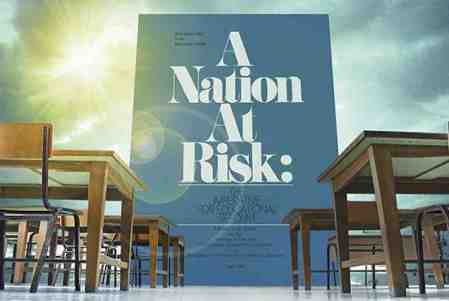
ae_summer2015mehta_opener-1100x736

Cover of A Nation at Risk: The Imperative for Educational Reform, the 1983 report that started the education reform mess. AFT graphic.

Stand up for your nation, it’s children and future; sound the alarm:

Add to FacebookAdd to NewsvineAdd to DiggAdd to Del.icio.usAdd to StumbleuponAdd to RedditAdd to BlinklistAdd to TwitterAdd to TechnoratiAdd to Furl


Read the rest of this entry »


20 years ago, the Berlin Wall fell – reverse domino effect

November 9, 2009

High school sophomores in Texas study world history, and juniors study U.S. history. At 16 and 17 years old, they have difficulty figuring out the fuss over the Berlin Wall. It’s just pictures in their textbook.

The Wall was already three or four years gone when they were born. They don’t remember living with the Soviet Union at all — it’s been Russia to them for their entire lives.

I have some hopes that the celebrations set for this week will aid their understanding, on the 20th anniversary of the breaching and destruction of the wall.

Dominoes set for celebration of the Berlin Wall's destruction.  AP photo by Herbert Knosowski, via Canadian Broadcast System

Caption from CBC: "Dominoes are placed where the Berlin Wall once stood in front of the Brandenburg Gate in the German capital. (Herbert Knosowski/Associated Press)"

An enormous line of giant dominoes is set up along the line where the old wall stood — to be toppled on November 9, the anniversary of the official breaching of the wall.

It’s the “domino theory” in reverse.

About 1,000 plastic foam dominoes will fall to the ground Monday along the route where the Berlin Wall once stood to mark the 20th anniversary of the crumbling of the Cold War barrier.

The 2.3-metre-high blocks, painted by schoolchildren, stretch for 1.5 kilometres in a path near the Brandenburg Gate and the German parliament.

Former Polish leader Lech Walesa, whose pro-democracy movement Solidarity played a key role in ending communism in Eastern Europe, will tip the first domino at 8 p.m. local time.

I made one visit to the wall, late on a night in 1988.  American Airlines explored the possibility of taking over the service authorized from Munich to Berlin.  Soviet and East German rules required passenger flights to stay at a very uncomfortable 10,000 feet.  Pan Am had the route, but Pan Am was in trouble.  We spent a day with Berlin airport authorities and real estate agents trying to figure out how to set up a reservations office and other ground facilities.  European airports tended to force foreign carriers to share gate facilities, which was a problem, and we devoted a lot of time to gathering data for computer lines.

But then, after a smashing dinner of sausage and German-style potatoes in a great, small Berlin pub, we talked our taxi driver into giving us a tour of the wall.  He drove a spot near the Brandenburg gate, and there on a chain link fence keeping westerners from the wall were eight fresh wreaths.  Eight people had died trying to cross from East Berlin to West Berlin in the previous six months.  One wreath for each death.

Just over a year later, the Berlin Wall itself would be gone.

West Berlin acted much like a normal, western European city.  But the wall was there as a constant reminder of the oppression on the other side, a dull fog to constantly dim even the sunniest day.

Old posts on the Berlin Wall here at the bathtub are suddenly popular — usually they get a lot of hits after March when U.S. schools get to the post-World War II era, the Cold War and the Berlin airlift.  I imagine the current popularity has something to do with the anniversary.

I hope somebody has some great video of the dominoes toppling.

Dominoes acerbicly note the irony:  While the U.S. feared nations would fall under communism in a “domino effect,” especially in Southeast Asia (Indochina), communism broke up in a domino effect, as one communist-dominated country after another found freedom near the end of the Cold War.  Why has no one done a serious essay on the domino effect of freedom?

More news and resources:

Famous sign warning visitors leaving West Berlin

A sign of old times, now unneeded

Viral dominoes: Help spread the news:

Add to FacebookAdd to NewsvineAdd to DiggAdd to Del.icio.usAdd to StumbleuponAdd to RedditAdd to BlinklistAdd to TwitterAdd to TechnoratiAdd to Furl


Insurance experts: Get ready for climate change now

July 12, 2009

Climate change denialism is an astounding ball of contradictions and conundrums.

For example, while most denialists claim to be free-market devotees, they pointedly ignore market indications that climate change is real, aggravated by human actions (and inaction), and that humans can do anything about it.

Look at the insurance industry.  I’ve noted often that, here in Texas, we pay higher premiums on home insurance because climate change has produced worse weather, which costs insurance companies a lot.  Insurance company actuaries are paid to predict the future, reliably.  If they fail, insurance companies die quickly.

Weather-related catastrophes, such as wildfires, are posing a serious threat to the insurance industry worldwide. (Photograph source: John McColgan, Bureau of Land Management, Alaska Fire Service.) Caption from Berkeley Lab Research News

Weather-related catastrophes, such as wildfires, are posing a serious threat to the insurance industry worldwide. (Photograph source: John McColgan, Bureau of Land Management, Alaska Fire Service.) Caption from Berkeley Lab Research News

The “market” girds itself to fight climate change that governments are not going to move fast enough to prevent.  This will cost you a lot of money.

A good place to go for information about climate change and how it affects is the Lawrence Berkeley Laboratories, a group that studies the future and is no longer limited (if it ever was) to nuclear future issues.

Insurance in a Climate of Change, The Greening of Insurance in a Warming World, is loaded with information about insurance industry calculations of what the future is, and how insurance companies might and should react to the changes.

How relevant are weather-related natural disasters for insurers, and is there any evidence that the situation is worsening?

Globally, we are seeing about $80 billion/year in weather-related economic losses, of which $20 billion (about a quarter) are insured. This is like a “9/11” every year. Weather-related losses represent about 90% of all natural disaster losses, and the data I just cited do not include an enormous amount of aggregate losses from small-scale or gradual, non-catastrophic events (e.g., lightning, soil subsidence, gradual sea-level rise).

Inflation-adjusted economic losses from catastrophic events rose by 8-fold between the 1960s and 1990s and insured losses by 17-fold. Losses are increasing faster than insurance premiums. The insured share of total losses has increased dramatically in recent decades, and variability is increasing (a key trouble sign for risk-wary insurers). Weather-related catastrophes have clearly visible adverse effects on insurance prices, and availability. Of particular concern are the so-called “emerging markets” (developing countries and economies in transition”, which already have $375 billion per year in insurance premiums (about 12% of the global market at present, but rising). They are significantly more vulnerable to climate change than are industrialized countries. Emerging markets are the center of growth for the industry, yet they are also the center of vulnerability.

Increased exposures are surely influenced—and no doubt heavily in some areas—by rising demographic and socioeconomic exposures. Yet, the rise in losses has outpaced population, economic growth, and insurance penetration. The science of “attribution analysis” is still in primitive stages, and thus we cannot yet quantify the relative roles of global climate change and terrestrial human activities. Some have prematurely jumped to the conclusion [PDF] that demographic trends explain the entire rise in observed losses. In the year 2005, three independent refereed <!– –>scientific articles drew linkages between hurricane trends and climate change.

Denialists claim weather stations are badly-placed, and so we need not worry about climate change since warming can’t accurately be measured — never mind the worldwide rise in temperatures of atmosphere and oceans.   Denialists claim that the greenhouse effect cannot be blamed on carbon dioxide emissions since carbon dioxide is such a small proportion of the gases in the atmosphere, apparently wholly unaware of the greenhouse effect in atmospheric gases, or unaware that only a thin pane of glass makes a greenhouse work.  Denialists claim that polar bears do not decline precipitously, yet, so all wildlife will be unaffected – nevermind the dramatic shifts in migration patterns of birds and migrating mammals, and the dramatic shift in the arrival of spring.  Denialists claim that Boston Harbor has survived 300 years of human development, so all harbors can survive any increase in ocean levels, nevermind the pending disasters of islands sinking out of site and destroying entire nations in the South Pacific, and never mind the drownings in Bengla Desh at every cyclone.

Most denialists rent apaartments or own homes.  Denying the insurance increases will be more difficult, though I fully expect Anthony Watts and Co. will deny that the insurance company actions and studies of global warming are warranted or accurate.

Is there any good news in all of this?

By all means. Insurers need to look no farther than their roots as founders of the original fire departments, early advocates for building codes and fire safety, etc. That is to say that insurers’ history is all about risk management and loss prevention. The same thinking can apply in the case of climate change. Just as insurers fought fire risks through encouraging fire safety, better modeling, and fire suppression, so too can they be part of the climate change solution. This can take many forms, ranging from providing new insurance products (e.g., for carbon trading or energy savings insurance [PDF]), to promoting energy-efficient and renewable technologies [PDF] that also help prevent everyday losses, to engaging in the broader policy discussion on climate change. Insurers can also be part of improving the underlying science of climate change, modeling, and impacts assessment. We maintain an extensive compilation of examples of how leading insurers are stepping into the arena in a constructive manner.

Alas, there is no insurance against the dithering of climate change denialists.

Go, with all thy internet getting, get thee wisdom.


Typewriter of the moment: Alistair Cooke for the BBC

June 19, 2009

Alistair Cookes typewriter, displayed at BBC headquarters, Bush House, in London - Photo by Jeff Zycinski

Alistair Cooke's typewriter, displayed at BBC headquarters, Bush House, in London - Photo by Jeff Zycinski

Alas, our students now are too young to remember Alistair Cooke’s hosting of “Masterpiece Theater” on PBS, and of course, back then the BBC America service — if it existed — was available only to shortwave fanatics or people  who traveled a lot to the British Isles.

Perhaps more than anyone else other than Winston Churchill, and maybe the Beatles, Alistair Cooke tied England and America together tightly in the 20th century.  BBC’s other writers are good to brilliant, but even their obituary for Cooke (March 30, 2004) doesn’t quite do him justice:

For more than half a century, Alistair Cooke’s weekly broadcasts of Letter from America for BBC radio monitored the pulse of life in the United States and relayed its strengths and weaknesses to 50 countries.

His retirement from the show earlier this month after 58 years, due to ill health, brought a flood of tributes for his huge contributing to broadcasting.

Perhaps for Cooke, from Cooke’s broadcasts, we could develop a new variation of the Advanced Placement document-based question:  Broadcast-based questions. Heaven knows his Letter From America provided profound material on American history:

BBCs famous broadcaster Alistair Cooke, painted by June Mendoza (copyright Mendoza - www.junemendoza.co.uk)

BBC's famous broadcaster Alistair Cooke, painted by June Mendoza (copyright Mendoza - http://www.junemendoza.co.uk)


NCSE’s new web design

October 20, 2008

Visited the website for the National Center for Science Education (NCSE) lately?

NCSE redesigned the website — it looks great!

NCSE is the only group in America — which means it may be the only group in the world — that stands for science education so stoutly, especially with regard to the teaching of evolution.

Arrayed against much more munificently funded “ministries” of many stripes, against the oddball but money-rich Discovery Institute, NCSE is the only organization that stands to defend the teaching of the hard science of evolution in America’s schools.

Particularly in times like these, when forces of darkness mass to assault science education, we need NCSE.  Go check out their website.

And, teachers:  Bookmark that site. It’s one of the verifiable, good sites you can point your students to for any research project.  Click on the logo to see.


Frozen North economics: Where supply, demand and distribution are important problems

September 6, 2008

Especially you economics teachers, look at this very carefully:

Six cans of juice, at a store on Baffin Island - photo from Tales from the Arctic

Six cans of juice, at a store on Baffin Island - photo from Tales from the Arctic

How much do you pay for juice at your local market?

“The High Cost of Northern Living” at Arctic Economics points to Tales from the Arctic and “Believe me now?”

How much per ounce?

Kennie (at Tales from the Arctic) features a bunch of unbelievable prices.  Getting goods to towns in the far north of North America, in Canada and Alaska, is a major production.  Transportation and handling kick prices up a bit.

We’ll find out how alert Sarah Palin is when somebody asks her the price of a gallon of milk . . .

More seriously, economics teachers might find some object lessons in these photos, and a good presentation on supply and demand, and the costs of distribution.

Milk at $8.50 a gallon? Even in Canadian currency, that burns.

I wonder:  Do prices like these make economics any easier to teach to high school kids?  Does the urgency of high prices make the subject more relevant?

Tip of the frozen scrub brush to Arctic Economics, of course.


Trafficking workers’ bodies for profit

May 27, 2008

If a guy beats someone to death, it’s murder, right?  And so the nation’s labor laws hold an employer liable for the death of a worker when unsafe working conditions caused the death.

But what if the worker doesn’t die?  What if the worker only loses his arms, or legs, or arms and legs?

No death, no crime, U.S. law says. 

What if the employer poisons the worker with cyanide that eats away the worker’s brain

No death, no crime, U.S. law says.

My colleagues and I were shocked to learn that an employer who breaks the nation’s worker-safety laws can be charged with a crime only if a worker dies. Even then, the crime is a lowly Class B misdemeanor, with a maximum sentence of six months in prison. (About 6,000 workers are killed on the job each year, many in cases where the deaths could have been prevented if their employers followed the law.) Employers who maim their workers face, at worst, a maximum civil penalty of $70,000 for each violation.

Read a plea to change the law, in the New York Times, from David H. Uhlmann, a law professor at the University of Michigan.


Founders online, great interactive site

December 12, 2007

Our friends and benefactors at the Bill of Rights Institute put up a great branch of their site, Founders Online. A grant from the Shelby Cullom Davis Foundation made the project possible.

Bill of Rights Institute logo

Check it out:

John Adams | Samuel Adams | Alexander Hamilton | Patrick Henry
Thomas Jefferson | James Madison | GeorgeMason | Gouverneur Morris
James Otis | Thomas Paine | George Washington | John Witherspoon

This page should be a first stop for your students doing biographies on any of these people, and it should be a test review feature for your classes that they can do on the internet at home, or in class if you’re lucky enough to have access in your classroom.

Good on-line sources are still too rare. This is stuff you can trust to be accurate and appropriate for your students. Send a note of thanks to the Bill of Rights Institute, and send your students to the site.

Just in time for Bill of Rights Day, December 15 . . .


“Evening at the Fed” Dallas registration deadline Nov. 22

November 21, 2007

Dallas-area economics, government and history teachers need to watch the deadline to register for the Dallas Federal Reserve Bank’s “Evening at the Fed,” scheduled for November 29, 2007.

Deadline to register is November 22.

Good dinner, continuing education credits (professional development), a few good ideas for your classroom. See my previous post, here.


Didn’t fool anybody: Liberty Bell

August 23, 2007

Yes, it’s the Liberty Bell, photographed from underneath, with the lights shining through the crack.

I guess it was a lot more obvious than I thought. No one guessed wrong.

This is the bell that resided in the bell tower of the Pennsylvania Statehouse, what we now call Independence Hall. It is the bell that was rung to proclaim the Declaration of Independence in 1776. The bell was cast with several flaws in 1752. It had to be recast shortly after it was delivered, and then cast a third time. It cracked in the early 19th century (legend has it cracking while pealing during the funeral of Chief Justice John Marshall — I won’t vouch for that story). It was last rung in 1846, on the anniversary of George Washington’s birth.

Enshrined in art and legend, the bell appeared on the reverse of the Franklin half-dollars (when was the last time you saw any 50-cent piece in circulation?). Reverse of Franklin half-dollar, showing Liberty Bell - Ask.comIt was put on tour after the Civil War in an effort to get the nation reunited around old symbols (but, considering it was first called “the Liberty Bell” by early abolitionist groups, one might wonder how effective was the tour). When I visited it in the 1990s, the bell rested in its own pavilion about a half-block away from Independence Hall. Renovations of the historic site included construction of a new museum, which required the bell to be moved again.

Preservation and restoration experts wondered whether the bell would well survive the move. So the National Science Foundation (NSF) was called in to study the bell and determine whether it could take the stress of the move. NSF’s press release said the bell passed its “stress test.” The story of the measurement is well told, and may be interesting to students. The writer at NSF put in a lot of the history.

The photo is from the NSF team that did the study; it shows the inside of the bell and part of the “spider” support system that helps hold the bell together and support display.

My probably faulty recollection is that we studied the story of the Liberty Bell each year in grades 1 through 5, which in my case includes schools in the states of Idaho and Utah. My baseline U.S. history tests over the past four years show that about half the students I had, in grades 7, 10, 11 and 12, could not identify the bell or tell why it is revered in U.S. history.

Every reader here gets an “A.”

World War II postal cover featuring Liberty Bell

Other Liberty Bell information:


Berlin Wall’s 46th

August 13, 2007

Today is the 46th anniversary of the beginning of the Berlin Wall. The post I wrote last year on this topic continues to be popular, day in and day out, but especially when high school curricula get to the Cold War, the Berlin Airlift, the 1960s, and the collapse of the Soviet empire, best exemplified by the destruction of the Berlin Wall itself and the reunification of Germany.

Go read my post of last year, “Berlin Wall’s 45th.”

The photograph I used to illustrate that post has become one of the more popular photos of the Berlin Wall on the internet. It is from a small, too-little used collection posted by Corey Hatch at the University of Utah.

Here is another photo from his collection. It comes without caption; from the barbed wire and the uniform and helmet, I would say This is cropped version of a photo of an East German soldier,  Conrad Schumann , assigned to shoot people trying to breach the wall to escape to West Germany, who instead decided to leap to freedom himself, probably at Checkpoint Charlie, one of three gates between East and West Berlin. I regret I have no further credit information on the photo on August 15, 1961.  The photo is by West German photographer Peter Leibing, then working for Contiepress, in Hamburg.

East German soldier leaping barbed wire of the Berlin Wall, to freedom.

German authorities announced the Wall was open for travel between the two entities of divided Germany on November 9, 1989. Jubilant Germans on both sides of the wall tore down sections, poked holes in the concrete barriers, and generally vandalized the wall over the next few weeks. Negotiations then led the way for the Reunification of Germany on October 3, 1990.

Read the rest of this entry »
