A study in geography: The Red River of Texas – film from Texas Parks & Wildlife

December 26, 2011

Seven minutes on the Red River of the southern U.S., the fickle border of Texas and Oklahoma, the river of story and legend.  Good for a map study, good for the fun of it — how much do you really know about the Red River?

George Washington did not cross the Red River; George Washington may not have known the river even existed.  His loss.


7 billion people on Earth?

October 25, 2011

Exponential growth’s potential to rapidly change the numbers of a situation tends to fall out of the thoughts of most people, who don’t see such things occur in daily life.

You should stop and think about this one for a minute:  World population will tip to over 7 billion people soon, maybe in the next week, but most assuredly by next spring.

A very large crowd in a stadium

Seven billion people? Really?  Are the concessions adequate?  The restrooms?

Joel E. Cohen wrote about the event in Sunday’s New York Times:

ONE week from today, the United Nations estimates, the world’s population will reach seven billion. Because censuses are infrequent and incomplete, no one knows the precise date — the Census Bureau puts it somewhere next March — but there can be no doubt that humanity is approaching a milestone.

The first billion people accumulated over a leisurely interval, from the origins of humans hundreds of thousands of years ago to the early 1800s. Adding the second took another 120 or so years. Then, in the last 50 years, humanity more than doubled, surging from three billion in 1959 to four billion in 1974, five billion in 1987 and six billion in 1998. This rate of population increase has no historical precedent.

Can the earth support seven billion now, and the three billion people who are expected to be added by the end of this century? Are the enormous increases in households, cities, material consumption and waste compatible with dignity, health, environmental quality and freedom from poverty?

(Joel E. Cohen, a mathematical biologist and the head of the Laboratory of Populations at Rockefeller University and Columbia University, is the author of “How Many People Can the Earth Support?”)

We’re in for some dramatic shifts in concentrations of people, if not shifts in how we think of the world (thinking is always slower than reality).

While the bulge in younger people, if they are educated, presents a potential “demographic dividend” for countries like Bangladesh and Brazil, the shrinking proportion of working-age people elsewhere may place a strain on governments and lead them to raise retirement ages and to encourage alternative job opportunities for older workers.

Even in the United States, the proportion of the gross domestic product spent on Social Security and Medicare is projected to rise to 14.5 percent in 2050, from 8.4 percent this year.

The Population Reference Bureau said that by 2050, Russia and Japan would be bumped from the 10 most populous countries by Ethiopia and the Democratic Republic of Congo.

I’m not ready, and neither are most other people, I’ll wager.  How about you?

More: 


Channeling Monty Python: “The border between India and Pakistan is closed for the day”

September 7, 2011

BBC map showing location of Wagah and Punjab

BBC map showing location of Wagah and Punjab, divided between Pakistan and India, south of Kashmir

Written accounts cannot possibly do justice to the ceremonies that mark the daily close of business at the border between India and Pakistan.  I had understood it was quite a good show, rivaling the changing of the guard at Buckingham Palace.

But, you don’t expect Monty Python to break out at these affairs, do you? Here’s a video of the ceremony as it was conducted prior to July 2010, I believe, which I found at Wimp.com.  It’s a video clip from BBC Worldwide, narrated by comedian Sanjeev Bhaskar.

Vodpod videos no longer available.

(If that one doesn’t work, try this one — a bit lower quality video):

(Or, here’s a shorter, YouTube version of Baskar’s film.)

Where in the world is this?  It’s in a town and area called Wagah, in Punjab, divided between India and Pakistan since the 1947 independence of those nations (links to Wikipedia left in for your convenience).

Wagah (Punjabi: ਵਾਘਾ, Hindi: वाघा, Urdu: واہگہ) is the only road border crossing between India and Pakistan[1], and lies on the Grand Trunk Road between the cities of Amritsar, India and Lahore, Pakistan. Wagah itself is a village through which the controversial Radcliffe Line was drawn. The village was divided by independence in 1947. Today, the eastern half of the village remains in the Republic of India while the western half is in Pakistan.

While both nations and local residents fully recognize the silliness, it also stands as a symbol of the deep divisions between the two nations.

The Wagah border, often called the “Berlin wall of Asia”,[2] is a ceremonial border on the India–Pakistan Border where each evening there is a retreat ceremony called ‘lowering of the flags’,[3] which has been held since 1959.[4] At that time there is an energetic parade by the Border Security Force (B.S.F) of India and the Pakistan Rangers soldiers. It may appear slightly aggressive and even hostile to foreigners but in fact the paraders are imitating the pride and anger of a Cockerel.[1][5][6] Troops of each country put on a show in their uniforms with their colorful turbans.[7] Border officials from the two countries sometimes walk over to the offices on the other side for day to day affairs. The happenings at this border post have been a barometer of the India-Pakistan relations over the years.[1]

Did someone say “Pythonesque?”

Here’s Michael Palin narrating another view of the ceremony for one of his BBC enterprises, Himalaya with Michael Palin:

Would you be surprised to hear that local people refer to this as “the dance of the roosters?”

Events at this crossing reflect some minor easing of tension between the two nations in the last decade, and in 2010 both nations announced they would tone down the retreat ceremonies. Surely some scholar has analyzed this retreat ceremony and its history, to determine whether it helped ease the tension, or increased the conflict between the two nations.  Could soldiers who participate in such goings-on actually shoot at each other?

Has anyone got a more recent viewing of the ceremony?

How will you explain this to your sophomore world history class?  Is there anything sillier than humans in conflict?

Video via VodPod.

An astonished tip of the old scrub brush to Judith Shields.

More:


Floating over our problems

August 19, 2011

Do you ever dream of flying?

Natsumi Hayashi, a woman in Tokyo, Japan, posts a photo every day of herself, levitating nonchalantly around town and through life.

Great blog, great photos, fun stuff at YowaYowaCamera:

Photo by Natsumi Hayashi, Tokyo - levitating through the day

Natsumi Hayashi of Tokyo flies through the day, and has the photos to prove it at her blog, YowaYowaCamera.

Can you pick out locations from any of those photos?  Is there a good geography exercise in here somewhere?

More: 


Hopewell Rocks and 45-foot tides at the Bay of Fundy

August 4, 2011

Great time-lapse video of the tides at Hopewell Rocks, Bay of Fundy, New Brunswick.

Teachers, can you get a decent geography warm-up with this video?  Every high school kid should know about the Bay of Fundy, one of nature’s greater phenomena.

More: 

Another time-lapse video of the tides at Fundy, taken at Halls Harbour, a different perspective:

5,869
3,340

Timelapse tour of natural wonders of the Southwest U.S. – spectacular!

July 19, 2011

Here’s a video I would like to use as a a warm-up, or prompt to a study of American geography.

Evosia Photography, the hangout of Henry Jun Wah Lee, has a short but spectacular tour of several sites in the American Southwest deserts — Arizona, California, Utah, and Navajoland — timelapse movies, usually shot at night with starry backgrounds.

He has set the photography against the music of a band named Conjure One, an edited version of their recording “Manic Star.”

Certainly there is copyright, at least a Creative Commons license — you should attribute this film to Mr. Lee and the music to Conjure One.

Can you identify these sites?  Can your students?  Can they map out a plan to visit these sites as one exercise?  Can you and your students identify any of the constellations on view? (List of sites, from Mr. Lee, below the fold.)

Have you, or your students, ever visited any of those sites, and gazed at the stars?  Why not?

2,912 looks

Read the rest of this entry »


Kennedy said, in the struggle for freedom, we are all citizens of Berlin (Quote of the moment)

June 26, 2011

49 years ago, on June 26, 1962, in Berlin:

President Kennedy addresses Berlin citizens, 6-26-1962 (photographer unidentified)

President John F. Kennedy addressing a crowd in Berlin, Germany, June 26, 1962 - image from NARA and/or Kennedy Library

From the Smithsonian Magazine site:

June 26, 1963: “Ich bin ein Berliner”

In West Berlin, President John F. Kennedy delivers the famous speech in which he declares, “Ich bin ein Berliner.” Meaning literally “I am a citizen of Berlin,” the statement shows U.S. solidarity with democratic West Berlin, surrounded by communist territory.

View a video of President Kennedy’s speech at American Rhetoric, Top 100 Speeches.

Audio of the famous line, from the National Archives:

Photos and complete audio, at The Sounds of History.com:

Text and transcript, and other materials, from the Kennedy Library and Museum:

Kennedy’s entire speech was good. It was well drafted and well delivered, taking advantage of the dramatic setting and the dramatic moment. John Kennedy well understood how to give a speech, too.

Below is most of the speech, nearly five minutes’ worth, from a YouTube file — another indication that schools need to open up their filters to allow at least some of the best YouTube material through:

Transcript, from the JFK Library:

I am proud to come to this city as the guest of your distinguished Mayor, who has symbolized throughout the world the fighting spirit of West Berlin. And I am proud to visit the Federal Republic with your distinguished Chancellor who for so many years has committed Germany to democracy and freedom and progress, and to come here in the company of my fellow American, General Clay, who has been in this city during its great moments of crisis and will come again if ever needed.

Two thousand years ago the proudest boast was “civis Romanus sum.” Today, in the world of freedom, the proudest boast is “Ich bin ein Berliner.”

I appreciate my interpreter translating my German!

There are many people in the world who really don’t understand, or say they don’t, what is the great issue between the free world and the Communist world. Let them come to Berlin. There are some who say that communism is the wave of the future. Let them come to Berlin. And there are some who say in Europe and elsewhere we can work with the Communists. Let them come to Berlin. And there are even a few who say that it is true that communism is an evil system, but it permits us to make economic progress. Lass’ sie nach Berlin kommen. Let them come to Berlin.

Freedom has many difficulties and democracy is not perfect, but we have never had to put a wall up to keep our people in, to prevent them from leaving us. I want to say, on behalf of my countrymen, who live many miles away on the other side of the Atlantic, who are far distant from you, that they take the greatest pride that they have been able to share with you, even from a distance, the story of the last 18 years. I know of no town, no city, that has been besieged for 18 years that still lives with the vitality and the force, and the hope and the determination of the city of West Berlin. While the wall is the most obvious and vivid demonstration of the failures of the Communist system, for all the world to see, we take no satisfaction in it, for it is, as your Mayor has said, an offense not only against history but an offense against humanity, separating families, dividing husbands and wives and brothers and sisters, and dividing a people who wish to be joined together.

What is true of this city is true of Germany–real, lasting peace in Europe can never be assured as long as one German out of four is denied the elementary right of free men, and that is to make a free choice. In 18 years of peace and good faith, this generation of Germans has earned the right to be free, including the right to unite their families and their nation in lasting peace, with good will to all people. You live in a defended island of freedom, but your life is part of the main. So let me ask you as I close, to lift your eyes beyond the dangers of today, to the hopes of tomorrow, beyond the freedom merely of this city of Berlin, or your country of Germany, to the advance of freedom everywhere, beyond the wall to the day of peace with justice, beyond yourselves and ourselves to all mankind.

Freedom is indivisible, and when one man is enslaved, all are not free. When all are free, then we can look forward to that day when this city will be joined as one and this country and this great Continent of Europe in a peaceful and hopeful globe. When that day finally comes, as it will, the people of West Berlin can take sober satisfaction in the fact that they were in the front lines for almost two decades.

All free men, wherever they may live, are citizens of Berlin, and, therefore, as a free man, I take pride in the words “Ich bin ein Berliner.”

You may also want to note these posts:


Battle of Bunker Hill, June 17, 1775

June 17, 2011

Barely two months after the Battle of Lexington and the Battle of Concord (April 19, 1775), British regulars attacked American colonists holding high ground near Boston, at Bunker and Breed’s Hills.  The Library of Congress carries a suitable-for-the-classroom description of the events, with links to resources:

Battle of Bunker Hill
Battle of Bunker Hill,
E. Percy Moran, artist,
copyright 1909.
Prints & Photographs Online Catalog

On June 17, 1775, American troops displayed their mettle in the Battle of Bunker Hill during the siege of Boston, inflicting casualties on nearly half of the British troops dispatched to secure Breed’s Hill (where most of the fighting occurred).

Map showing the action at Bunkers-Hill
A plan of the action at Bunkers-Hill, on the 17th. of June, 1775…,
By Sir Thomas Hyde-Page, 1775.
Map Collections

Approximately 2,100 British troops under the command of General Thomas Gage stormed Breed’s Hill, where colonial soldiers were encamped. In their fourth charge up the hillside, the British took the hill from the rebels, who had run out of ammunition. After suffering more than 1,000 casualties during their attacks on Breed’s Hill, the British halted their assaults on rebel strongholds in Boston. The last rebels left on the hill evaded capture by the British thanks to the heroic efforts of Peter Salem, an African-American soldier who mortally wounded the British commanding officer who led the last charge.

When George Washington assumed command of colonial forces two weeks later, he garnered ammunition for Boston troops and secured Dorchester Heights and Bunker Hill.

Several speeches in the American Memory collection African American Perspectives: Pamphlets from the Daniel A. P. Murray Collection, 1818-1907, contain references to Peter Salem, the former slave and hero of the Battle of Bunker Hill:

Mr. Everett has described Peter Salem, a black man, and once a slave, as having been among the most prominent and meritorious characters at the battle of Bunker’s Hill. Indeed, the historical painting of that scene, by Col. Trumbull, an eyewitness, done in 1785, gives Peter Salem , with other black patriots, a conspicuous place. One of the latter is thus commemorated:

“To the Honorable General Court of the Massachusetts Bay: The subscribers beg leave to report to your Honorable House (which we do in justice to the character of so brave a man), that, under our own observation, we declare that a negro man, called Salem Poor, of Col. Frye’s regiment, Capt. Ames’ company, in the late battle at Charlestown, behaved like an experienced officer, as well as an excellent soldier. To set forth particulars of his conduct would be tedious. We would beg leave to say, in the person of this said negro, centres a brave and gallant soldier. The reward due to so great and distinguished a character, we submit to the Congress.”
Cambridge, Dec. 5, 1755.

“A Reading on Slavery, from the Early Presidents.”
Opinions of the Early Presidents, and of the Fathers of the Republic, upon Slavery and upon Negroes as Men and Soldiers.
Prepared for the Celebration of Washington’s Birthday at Lyceum Hall, Salem, February 22, 1863.
African American Perspectives: Pamphlets from the Daniel A. P. Murray Collection, 1818-1907

Learn more about the Battle of Bunker Hill in American Memory:

Spirit of '76
Spirit of ’76, American Mutoscope and Biograph Company, 1905.
The American Variety Stage: Vaudeville and Popular Entertainment, 1870-1920


Canada? It’s in North America? What?

March 27, 2011

And in other news that didn’t make most U.S. local newspapers today, the government of Canada fell yesterday.

Canada government falls, Politically-Illustrated

"The Conservative government in Canada was toppled on Friday after a vote of no-confidence passed in the parliament by 156 to 145." Cartoon at Politically Illustrated by Cam Cardow

You know:  Canada.  That nation north of North Dakota, the one that keeps Alaska stuck to the North American Continent.  Remember?   It’s got about 20% of the world’s fresh water.  Those guys who helped us whip Hitler on D-Day.

Oh, c’mon.  Google the place, will you?  It’s the nation where, when you go there, ‘those bastards with the drug problem south of the border’ is the United States.

No, no, it’s probably not important.  We buy a lot of our oil from Canada.  Canada is our biggest trading partner.  They buy a lot of the goods that we still produce here.

And the conservative government there, under a parliamentary system that kids in the U.S. are never tested on in Texas, lost a vote of confidence Friday, in Ottawa.

Ottawa?  It’s the capital of Canada.  No, Montreal isn’t even the capital of Quebec.

Oh, come on! Quebec.  Quebec! It’s the province of Canada with all the French speakers. Yeah, Quebec City is the capital of Quebec.

Ottawa’s in Ontario.  No, Ottawa is the capital of the whole nation, Canada.  Ontario’s capital is Toronto.

Lone Ranger?  No, Toronto has nothing to do with the Lone Ranger.  It’s the biggest city in Canada.

Anyway, to get back to the topic, Canada’s government failed.  Conservatives lost a vote because of ethics issues.

Ethics issues, conservatives.  No news there.  No wonder it wasn’t covered better.

Elections in May. You’d know this, if you read the blogs of the Natural Resources Defense Council.

As if anyone cared.

Hey, get this:  Ontario alone has more than 250,000 lakes, natural lakes.  In a good, very wet year, Texas has two, maybe three natural lakes.

You could look it up.

No, NATO won’t intervene.  Canada is part of NATO.

More seriously:

Energy- and environment-interested people should take note. Canada is our largest source of imported oil at about 2 million barrels a day — more than Mexico and Saudi Arabia imports combined — and we share two ocean coasts with the nation.  See what Susan Casey-Lefkowitz said at her blog:

Hopefully, whoever takes over next in Canada will be a bigger proponent of clean energy and fighting climate change than the Harper government has been. The Harper government has been a vocal proponent of tar sands oil expansion – pushing this dirty fuel in the United States and in Europe. In fact, the Harper government has been instrumental in undermining clean energy efforts at home and abroad all to promote the tar sands oil industry. A fresh approach in Canada gives the country a chance to get back to its green roots and to listen to its provincial governments such as Ontario, Quebec, Manitoba and British Columbia who have been developing innovative ways to promote clean energy and fight climate change. A fresh approach also provides an opportunity to lessen Canada’s dependence on the oil and gas sector and its heavy control over the Canadian dollar leading many to fear “Dutch disease.”

Clean energy and fighting climate change are critical issues now and in the coming decades. Hopefully, Canada can step forward as a leader on both in the future.

We can overlook the abuse of the word “hopefully” to extract important information, I think.  Did your local paper cover this story today?

More, resources:


What’s the radiation level right now?

March 19, 2011

Concerned about radiation from Japan?

It’s highly improbable that dangerous levels of radiation would drift more than a few miles from the damaged nuclear power plants in Japan, but maybe seeing some actual readings might convince people there’s not much to worry about — other than our sympathy for Japan, the Japanese people and especially those workers who have stayed on the site of the power plant to work to secure the reactors so they do not become hazards to the population at large.  Those workers may be exposed to significant, harmful radiation, and they deserve all the thanks you can give them.

Below is a map of the contiguous 48 states of the U.S., showing live readings from about a dozen sampling sites across the nation.  The map should update about every minute (if it doesn’t, and  you want to see updates, click through to the Radiation Network site).

Normal background levels are about 25 to 75; a low-level warning might be given if readings are sustained at 100.  These numbers are Counts Per Minute (CPM), a very crude measure from a Geiger counter showing how many radioactive particles or rays hit the sensor in a minute.  It does not distinguish alpha, beta or gamma, and it may be dependent on the design of the Geiger counter, especially the size of the sensor — differently designed machines give different readings even right next to each other.

So it’s a crude count, but it’s a map of counts.

Radiation Network map of radiation in the U.S.  Read legend, use with caution

Radiation Network map of radiation in the U.S. Read legend, use with caution. Click map to go to Radiation Network site.

Here is legend information for the map:
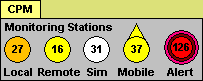
Legend for Radiation Network map

Sampling station symbols, Radiation Network

Nuclear site, calculated by the Radiation Network

At left is a symbol used on the map to mark “nuclear sites” by the Radiation Network.  Note that a nuclear “site” is not necessarily a nuclear power station.  For example, there are nuclear sites designated near Moab, Utah; there are a couple of ore refining facilities or tailing ponds there, but no nuclear power station.  The map shows a nuclear site in the Texas Panhandle.  There is no nuclear power station there.

Instructions on how to read the map, from RadNet:

How to Read the Map:

Referring to the Map Legend at the bottom left corner of the map, locate Monitoring Stations around the country that are contributing radiation data to this map as you read this, and watch the numbers on those monitoring stations update as frequently as every minute (your browser will automatically refresh).  The numbers represent radiation Counts per Minute, abbreviated CPM, and under normal conditions, quantify the level of background radiation, i.e. environmental radiation from outer space as well as from the earth’s crust and air.  Depending on your location within the US, your elevation or altitude, and your model of Geiger counter, this background radiation level might average anywhere from 5 to 60 CPM, and while background radiation levels are random, it would be unusual for those levels to exceed 100 CPM.  Thus, the “Alert Level” for the National Radiation Map is 100 CPM, so if you see any Monitoring Stations with CPM value above 100, further indicated by an Alert symbol over those stations, it probably means that some radioactive source above and beyond background radiation is responsible.

Notice the Time and Date Stamp at the bottom center of the Map.  That is Arizona Time, from where we service the Network, and your indication of how recently the Radiation Levels have been updated to the Map.

(Please note: Any White circles on the map represent Monitoring Stations that are running Simulations, instead of using a real Geiger counter, so any Alert levels that may occur over those stations are to be ignored since they represent only momentary testing.)

Remember, “alert level” is sustained count above 100. But again, be alert that this is only counts per minute, and may be difficult to translate to an accurate radiation reading.

The Radiation Network is an all volunteer operation, no government funding or other involvement.  In fact, the network is seeking volunteers to get a Geiger counter and hook it up to the internet to provide even more real-time readings.  See “How to Participate in the Nationwide Radiation Network.”

If you’re a denier of global warming/climate change, you should use your usual denial tool, claiming that because radiation at background levels is “normal,” no level of radiation can be harmful.  In fact, if you’d make that claim and volunteer to go staff the crews trying to cool the reactors, the entire world would salute you.

Should you be concerned? MIT’s Technology Review explains that the levels of radiation at the plant site itself are quite low, though higher than normal (article by Courtney Humphries).  The article also explains that radiation levels rapidly drop the farther from the plant one is; while we may be able to detect increases in radiation attributable to the radiation from Fukushima site, it is highly unlikely that radiation will exceed safety standards:

In terms of potential health dangers from radiation from the Fukushima Daiichi Nuclear Power Station, “the people who are in the most immediate danger from acute and severe radiation doses are those people who are on site at the moment and who are desperately trying to keep the reactors under control,” says Jacqueline Williams, a radiation oncologist at the University of Rochester Medical Center.

Moving away from the immediate vicinity of the plant, radiation levels drop very rapidly. James Thrall, radiologist-in-chief at Massachusetts General Hospital, says that radiation levels are inversely proportional to the square of the distance from the source: The level at two miles from the source are one-quarter what they are at one mile, and “at 10 miles away, it’s almost an infinitesimal fraction,” he says. Individual exposure also varies widely depending on whether a person is outside or indoors, or shielded with protective clothing. Japanese authorities have evacuated the population living within a 20-kilometer radius of the plant, and have warned those living within 30 kilometers to stay indoors. Some experts say that people living beyond this range have no cause for concern at this time. “This has nothing to do with the general population,” McBride says.

The trickier question is whether lower doses of radiation—well below the threshold of acute illness—could lead to long-term health consequences for those in that area. Thrall says that epidemiological studies on survivors of nuclear attacks on Japan have found that those receiving 50 millisieverts or more had a slightly elevated cancer risk—about 5 percent higher than expected—and that risk seemed to rise with higher exposures. But scientists still vigorously debate whether that risk can be extrapolated down to even lower exposures.

After the nuclear disaster at Chernobyl, the population experienced a surge in thyroid cancers in children. However, scientists found that the culprit was not radiation in the air but radioactive contamination of the ground, which eventually found its way into cow’s milk. Thrall points out that in Japan, this is highly unlikely because the authorities are carefully monitoring the water and food supplies and keeping the public informed, which did not happen at Chernobyl.

More, resources:


Then and now: Big Cottonwood Canyon, Utah – 1869 and 2006

March 18, 2011

Photographer Timothy H. O’Sullivan toured the western territories — not yet states — for either the U.S. Army Corps of Engineers or the U.S. Geological Survey, around 1868 and 1869.  Color photography hadn’t been perfected.  His plates were black and white only.

He had been one of the photographers who captured parts of the Civil War on film, with particularly poignant photos of the battlefield at Gettysburg, Pennsylvania, within hours after the battle ended on July 4, 1863.

O’Sullivan’s photos appear in the collection at the Library of Congress, and at the George Eastman House (Eastman was the founder of Kodak, as you know).

O’Sullivan’s photos show the mineral and mining operations of Nevada, Utah and Idaho, and Arizona and New Mexico, so far that I’ve found.  Particularly in the mountains, the places he photographed can be tracked down today.

In this post we compare O’Sullivan’s photo up what he called “Great Cottonwood Canon of the Wahsatch,” what is today one of the beautiful canyons leading out of Salt Lake City, Big Cottonwood, in the Wasatch Front.  O’Sullivan took a shot up the canyon, then very much unroaded, at an enormous block of granite that came to be known as Storm Mountain.

In 1869:

"Great Cottonwood Canyon, Wahsatch Mountains," 1869 photo by Timothy H. O'Sullivan - USGS photo from Eastman collection

"Great Cottonwood Canyon, Wahsatch Mountains," 1869 photo by Timothy H. O'Sullivan - USGS photo from Eastman collection

Rich Legg of Salt Lake City captured the same mountain in 2006, and graciously consented to let us use it here for comparison.  This is Storm Mountain, now:

From LeggNet:

Big Cottonwood Canyon, Utah, 2006 - photo by Rich Legg, copyright and rights reserved

Big Cottonwood Canyon, Utah, 2006 - photo by Rich Legg, copyright and rights reserved; image here by express permission

Note from LeggNet blog: This recent capture was made in Big Cottonwood Canyon just outside of Salt Lake City. The striking shadows along with the jagged ridges create a dramatic lighting effect.

Legg’s camera and film allowed a quicker shot, I’ll wager (if he used film at all — it may be an electronic image).

The granite didn’t change much.  Storm Mountain is literally a fraction of a mile outside the city limits of Salt Lake City.  A photo the other way would show dramatic change.  A photo of Storm Mountain, which consists chiefly of naked granite, appears almost unchanged in over a century.  It’s difficult even to find places where the vegetation has changed.

In the past 20 years we have seen comparisons of America’s and the world’s glaciers, from photos through the late 19th and 20th centuries, compared to photos of today.  The archives of landscape photos held by groups like the George Eastman House offer opportunities for historians and land managers and policy makers to compare American lands from more than a century ago, to those same lands today.  Much of those older photo archives are available on line, at least for searching.  Will scholars make methodical use of these resources?


7 Billion: Are you typical? Year-long Nat Geo special reports

March 13, 2011

7 Billion: Are you typical?

Vodpod videos no longer available.

7 Billion: Are you typical? Year-long Nat Geo s…, posted with vodpod

I could see a bell-ringer in there somewhere.  Who do you think ought to see this thing?  What classes in public schools should see it, for what purpose?

I hope the year-long series lives up to the video.  I hope there are a lot more videos to go along with it.  As a piece of persuasive rhetoric, it does make a decent case for subscribing to National Geographic for a year.  How’s that for rhetorical criticism?


Latitude and Longitude in two minutes

March 3, 2011

Teachers, can you use a video that covers latitude and longitude in just over two minutes?

A good idea, generally, from Matt Rosenberg (a better idea without “autoplay”) — a few more videos at Ask.com Geography.

[Editor’s note:  I’ve put the video below the fold because I can’t find an easy way to turn off the autoplay command.  My apologies to anyone bothered by the problem.]

Read the rest of this entry »


England? Britain? United Kingdom? Everything explained

February 4, 2011

Is it England, Britain or UK?  The explanation:

Tip of the old scrub brush to Joe Carter at First Things.


Stunning photo: What happened here, 795 years ago?

December 5, 2010

Runnymede, Magna Carta Isle, photo by Wyrdlight, Antony McCallum, 2008 (Wikimedia)

What event critical to western history and the development of the democratic republic in the U.S. happened here in 1215?

A teacher might use some of these photos explaining the steps to the Constitution, in English law and the heritage of U.S. laws.  Other than the Magna Carta, all the events of Runnymede get overlooked in American studies of history. Antony McCallum, working under the name Wyrdlight, took these stunning shots of this historic meadow.  (He photographs stuff for studies of history, it appears.)

Maybe it’s a geography story.

View of Runnymede Meadow from Engham Village -- Wyrdlight photo through Wikimedia

View of Runnymede Meadow from Engham Village -- Wyrdlight photo through Wikimedia

Several monuments to different events of the past millennium populate the site.  The American Bar Association dedicated a memorial to the Magna Carta there — a small thing open to the air, but with a beautiful ceiling that is probably worth the trip to see it once you get to England.

Wikipedia explains briefly, with a note that the ABA plans to meet there again in 2015, the 800th anniversary of the Great Charter:

Magna Carta Memorial


The Magna Carta Memorial & view towards the ‘medes’


Engraved stone recalling the 1985 ABA visit

Situated in a grassed enclosure on the lower slopes of Cooper’s Hill, this memorial is of a domed classical style, containing a pillar of English granite on which is inscribed “To commemorate Magna Carta, symbol of Freedom Under Law”. The memorial was created by the American Bar Association to a design by Sir Edward Maufe R.A., and was unveiled on 18 July 1957 at a ceremony attended by American and English lawyers.[5]

Since 1957 representatives of the ABA have visited and rededicated the Memorial renewing pledges to the Great Charter. In 1971 and 1985 commemorative stones were placed on the Memorial plinth. In July 2000 the ABA came:

to celebrate Magna Carta, foundation of the rule of law for ages past and for the new millennium.

In 2007 on its 50th anniversary the ABA again visited Runnymede and during the convention installed as President Charles Rhyne who devised Law Day which seeks in the USA an annual reaffirmation of faith in the forces of law for peace.

The ABA will be meeting at Runnymede in 2015 on the 800th anniversary of the sealing of the original charter.

The Magna Carta Memorial is administered by the Magna Carta Trust, which is chaired by the Master of the Rolls.[10]

In 2008, flood lights were installed to light the memorial at night, but due to vandalism they now lie smashed.

I’ll wager the lights get fixed before 2015.

Detail of ceiling of the Magna Carta Memorial, Runnymede - Wikimedia image

Detail of ceiling of the Magna Carta Memorial detailing play of light, and star pattern, Runnymede - Wikimedia image

More, resources:
