Becalmed in the Dallas Doldrums of the internet

February 16, 2010

Sorry about that.

Near the end of storm recovery in Dallas, on Sunday, our power went out.  Still out.

Well, at least partially.  I’ll leave it to the electricians, but we’ve lost all big power, 220-volts, to major appliances including the furnace and water heater, and half of our other house circuits, including the one that runs the DSL modem.

Posting will be slight while I shiver and curse and harangue Oncor Energy.


Another warming contrarian who can’t/won’t shoot straight

February 12, 2010

Joanne Nova is, I gather, a former television personality in Australia now blogging away against science and the study of climate change at JoNova.  Here’s how far off the track she is:  She’s been sucked in by Monckton,  as some great scientist and hero — he whose biggest achievements are to call scientists “bedwetters” and attack the reputations of famous dead women (what is it about Monckton and dead women?).

Her latest post is a hoot. She’s claiming that the case for global warming is coming apart.  She illustrates it with this PhotoShop™ masterpiece (note the “JoNova” in the lower lefthand corner, and note it well):

JoNova's PhotoShop of Glen Canyon Dam for an article on wildly inaccurate claims about climate change; original photo copyright by Wild Nature Images.

JoNova defaces photo of Glen Canyon Dam. Original photo copyright by Wild Nature Images.

Glen Canyon Dam poses problems for serious advocates of environnmental protection for many reasons, not the least being the death of Glen Canyon.  This dam represents one of the greatest losses of the environmental movement.  That’s not why Nova chose the photos, I’m sure — I’d be surprised if she could find Glen Canyon on a map, and I’m all but certain she’s clueless about the controversy about the dam (don’t even wonder whether she’s ever read Ed Abbey).

Regardless where one stands on the issues around Glen Canyon Dam, one cannot look at this photo without seeing the white stripe from the water behind the dam, running about 50 feet up the canyon walls.

Check out the original, copyrighted photo here, at WildNatureImages.com (and maybe buy a copy — it’s a great photo of the dam, Lake Powell and the area; no bluer sky anywhere).  I presume that, even with the huge “JoNova” on it, Nova will allow free duplication of her original work; but why didn’t she credit the guy who took the photo (Ron Niebrugge) and the people who put it on the internet for her (WildNatureImages.com)?  Update:  Nova is giving credit, now.

The original, without comment, is at once more beautiful, more awe-striking, and more accurate a portrayal of the effects of climate than Nova’s doctored version:

Glen Canyon Dam - photo by Ron Niebrugge, at WildNatureImages.com

Glen Canyon Dam, photo by Ron Niebrugge, at WildNatureImages.com. Displayed here with express written permission.

See, climate change is thought to be one of the culprits for that white line. Glen Canyon Dam is in straits right now, as is the Colorado River Compact that created the legal justification for constructing the dam, because precipitation in the mountains where the Colorado River is born has fallen dramatically in the past couple of decades — and Lake Powell has shrunk to a vestige of its former self, of its planned extent, of the extent hoped for in cooler times.

Lake Powell's drop, circa 2008, photo by Marco Ammannati via National Parks Traveler

Lake Powell's drop, circa 2008, photo by Marco Ammannati via National Parks Traveler. Caption from National Parks Traveler: "At Glen Canyon National Recreation Area, years of drought, possibly an indicator of climate change, have revealed Lake Powell's bathtub walls. Spring runoff, however, could soon make those bathtub walls vanish."

JoNova uses a photograph showing the harms of climate change, to claim that climate change does not occur.

Is this the stupidest anti-climate change statement ever made?

Offer your candidates for dumber or stupider claims below.  It’s time we started counting and cataloging.

More:


Just in case you thought any climate contrarian remains sane . . .

February 2, 2010

Which of these would be accurate in showing the insanity, but not so sharp as to raise the hackles of the climate contrarians?

  • “Contrarians think Antarctic unworthy of protection”
  • “Denialists criticize efforts to keep Antarctic clean”
  • “Climate change critics’ brains have left the building”

Read these stories, and tell me.

The Intergovernmental Panel on Climate Change (IPCC) noted the delicate condition of the Antarctic with regard to its two main industries, fishing and tourism.  IPCC AR4 noted that the tourism industry takes steps to protect Antarctic environments made more vulnerable by melting.  (Footnote here; actual flyer here, assessment document here in Microsoft Word .doc format)

Contrarians come unglued, here at ClimateQuotes.com, and here at Air Vent.

It’s clear that the contrarians don’t have much experience in heavy documentation.  If you follow the links they provide, you quickly get to the paper provided by the tourist industry noting their precautions to prevent contamination, provided to meet a request by scientists from the Australian team, and based on information well vetted to the point that it includes substantial excerpts from what appears to be a peer-reviewed journal on the types of solutions suitable for decontaminating foreign boots in the Antarctic (Polar Record, vol. 41, no. 216, Jan. 2005, p. 39-45; it is actually the official journal of the Scott Polar Research Institute at Cambridge, UK).  There is astounding and commendable attention to detail, much more than the contrarians can grok, it appears.

More troubling to the Boy Scout in me is the contrarians’ contempt for what is, really, Leave No Trace Camping carried to an Antarctic tourist stop.  This is part of the environment protection credo of the Boy Scouts and Girl Scouts, and it is sound policy that everyone should be teaching their children.

What is wrong with that?  Why do the contrarians mock wise policies?  Why do they make false claims against what amounts to good Scouting?

Leave No Trace logo

Contratians disapprove of the ethics of environmental stewardship?

One implicit complaint is that the footnote does not provide evidence of damage from climate change, in the Antarctic.  It’s clear that the critics have not followed the footnote path to see why the boot cleaning poster and directive were issued, nor to see what is the research or official government action that prompted the tourist companies to implement the procedure.

It appears in a section of the IPCC reports on effects of warming on industries in affected areas.  Only two industries are noted in the Antarctic, fishing and tourism.  After establishing the increased chance of problem organisms, including micro-organisms, showing up in Arctic and Antarctic areas as the areas warm, and after noting two plagues that killed penguins recently, from micro-organisms, the IPCC paper notes that concern to prevent such tragedies have so far required only boot decontamination, and it offers a link to the flyer provided by an Antarctic tour operators group.

Got that?  To show that the tour operators are affected, IPCC cited the flyer put out by the tour operators showing how and why they were changing their operations.  It’s a minor, almost trivial point.

At no point did IPCC’s report claim this procedure as evidence of warming, or the effects of warming.  So the claims of the contrarians and denialists are completely off base, as they’d recognize except for their own shouting for the lynching of science to proceed.

Criticism of IPCC for noting the good stewardship techniques used in the Antarctic comprises more political smear than scientific enlightenment, by a huge factor.  Voodoo science from the contrarians begets voodoo criticism.

Contrarians lack wisdom in posing this complaint of theirs.  This is one more point IPCC got right, factually and ethically.  IPCC should be commended for that.

Wall of Shame (update added on February 7)

Outlets that cite the boot reference, falsely or stupidly, as some sort of flaw in the IPCC report, and thereby demonstrate malevolent intentions, and not scientific (“malice” for you Times v. Sullivan fans):


MSM understand dangers of warming

February 1, 2010

Editorial in the St. Louis Post-Dispatch, another of America’s great legacy of great newspapers:

The decade that ended in 2009 was the warmest on record, NASA reported earlier this month. It displaced the decade of the 1990s as the warmest ever. The 1990s displaced the 1980s.

Last year was the second-warmest since 1880, when modern temperature measurements began. The warmest year on record was 2005. All of the 10 warmest years on record have occurred since 1998. Perhaps you’re starting to see a pattern.

Tip of the old scrub brush to Open Mind, who also notes that the last decade was the warmest ever.


Wattsupgate: Denialists claim all knowledge is wrong

January 31, 2010

It really is that bad.  Climate science denialists now attack any information simply for not being what they want it to be.  Lysenko’s Ghost smiles broadly.

Anthony Watts is just the most prominent of the bloggers making hoax charges of error and worse in the fourth report from the Intergovernmental Panel on Climate Change (IPCC), because of a footnote that cites a rock climbing magazine.

Here’s the trouble for Watts:  There is no indication that the citation is in error in any way.  Watts’s move is more fitting of King George III’s campaign against Ben Franklin’s lightning rods, the prosecution of John Peter Zenger, the pre-World War II campaign against Einstein’s work because he was born a Jew, or the hoary old Red Channels campaign against Texas history told by John Henry Faulk.  It’s as bad as the Texas State Board of Education’s attack on Brown Bear, Brown Bear, What Do You See? Watts’ and others’ complaint is simply that Climbing magazine’s story on the worldwide retreat of glaciers suitable for climbing is not published in a juried science journal.

In other words, they indict the science, not because it’s wrong — they have no evidence to counter it — but because it’s too American Patriot correct Jewish left Texan mistakenly thought to be political well-known, too accessible, (small “d”) democratically-reported.

And of course, any comment that points that out at Watts’s blog goes into long-term “moderation,” keeping it from the light of day in the best tradition of the Crown’s defense of Gov. Cosby’s misadministration of New York (see “John Peter Zenger”).  Watts said in a quote that should have been attributed to the Daily Telegraph:

The IPCC’s remit is to provide an authoritative assessment of scientific evidence on climate change.

In its most recent report, it stated that observed reductions in mountain ice in the Andes, Alps and Africa was being caused by global warming, citing two papers as the source of the information.

However, it can be revealed that one of the sources quoted was a feature article published in a popular magazine for climbers which was based on anecdotal evidence from mountaineers about the changes they were witnessing on the mountainsides around them.

The other was a dissertation written by a geography student, studying for the equivalent of a master’s degree, at the University of Berne in Switzerland that quoted interviews with mountain guides in the Alps.

The revelations, uncovered by The Sunday Telegraph, have raised fresh questions about the quality of the information contained in the report, which was published in 2007.

It comes after officials for the panel were forced earlier this month to retract inaccurate claims in the IPCC’s report about the melting of Himalayan glaciers.

By those standards, Watts’s own readers should eschew his blog — it’s not peer reviewed science by any stretch, and Watts isn’t an established authority in climate science (he’s not even working for an advanced degree).  Consistency isn’t a virtue or concern among climate change denialists.  Watt’s entire modus operandi is much more anecdotal than the story in Climbing, which was written by a physicist/climber who studies climate change in the world’s mountains.

And did you notice?  They’re whining about research done by a scientist in pursuit of a degree, complaining about the second citation.  That’s the exaclty kind of research that they claim the magazine article is not.  Their complaint is, it appears, that a scientist in pursuit of education is not the right “kind” of person to do climate research. It’s the chilling sort of bigotry that we spent so much time in the 20th century fighting against.  In the 21st century, though, it appears one can still get away with demonizing knowledge, education and research, part of the campaign to indict “elitism,” the same sort of elitism aspired to by America’s founders.  Too much of the criticism against scientists involved in documenting global warming is the cheap bigotry the critics claim to find in science, falsely claimed in my view.

Topsy-turvy.

And the glaciers?  Yeah, the evidence tends to show they are in trouble.  Those Himalayan glaciers?  The IPCC report was accurate in everything except the speed at which the glaciers decline — they should be with us for another three centuries, not just 50 years, if we can reduce warming back to 1990s levels (oddly, denialists rarely deal with the facts of accelerating warming, preferring to point to a local snowstorm as a rebuttal of all knowledge about climate).

Oh, and the research?  The author of the story in Climbing magazine is Mark Bowen.  Dr. Bowen’s Ph.D. is in physics from MIT. He’s a climber, and he researches climate change on the world’s highest mountains.  His 2005 book, Thin Ice, focused tightly on what we can learn about climate from the world’s highest mountains.   Bowen is the expert Anthony Watts would like to be.

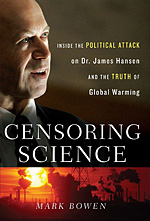
Cover of Mark Bowen's book defending climate science, "Censoring Science."

Cover of Mark Bowen’s book defending climate science, “Censoring Science.”

Bowen’s newest book:  Censoring Science:  Inside the political attack on James Hansen and the truth of global warming. Watts doesn’t want anyone to read that book.  It is easy to imagine Watt’s s attack is, he hopes, pre-emptive, against Bowen’s book.

I’ll wager Watts hasn’t read the article in Climbing, and didn’t know who Bowen was when he launched his attack, though.  The denials of bias coming out of the denialists’ camp will be interesting to watch.

Let the denialists roll out the rope far enough, they’ll inevitably hang themselves.

More:

Do something for freedom: Spread the news

Add to FacebookAdd to NewsvineAdd to DiggAdd to Del.icio.usAdd to StumbleuponAdd to RedditAdd to BlinklistAdd to TwitterAdd to TechnoratiAdd to Furl


No climate change denialists will apply

January 28, 2010

Australia is looking for a scientist to head up the next round of Australia’s reports to the Intergovernmental Panel on Climate Change (IPCC).

But who would want a job that pays nothing and brings a great deal of grief?  Crikey notes that scientists, especially Australian scientists, get slandered and libeled daily by climate change denialists.  Not to mention the death threats.

That fat pay the denialists keep claiming comes to the scientists, and urges them to misreport the data?

The only remuneration IPCC scientists get – as a quick check of last week’s ad would have made clear — is travel costs and living expenses while they are at IPCC meetings.  The IPCC work is on top of their day jobs as academics and researchers.

That’s right, ladies and gentleman:  Climate Denialist Extraordinaire Christopher Monckton profits from his obnoxious and error-filled lectures more than the guys who do the heavy lifting.

You know that denialists won’t apply to do the job.  Most of us suspect they don’t have the courage of their convictions to do it, but there’s another problem:  Very few of them are qualified.  They don’t do science.

Bookmark the story. Remind the denialists of it from time to time.

IPCC art, on AR5 process

(New year’s greetings from the IPCC.)


Astounding manipulation of data — from the climate denialists

January 26, 2010

Especially since they purloined the e-mails from the Hadley Climate Research Unit (CRU), climate change denialists get bolder and bolder about making wilder and wilder statements of disinformation.

For example, our old friend Anthony Watts now makes criminal charges in his headlines, that scientists altered data to reflect the opposite of what their research found and then lied about it — but read the story, about Himalayan glaciers.  Watts quotes a story with a bad headline from The Daily Mail, in which a scientist tells how important scientisits consider the situation in the Himalayas, with glacier decline. There is no confession of any wrongdowing, but Watt’s headlines it “Scientist admits IPCC usied fake data to influence policy makers.”  There’s no confession.  Were it so wildly inaccurate, wouldn’t Watts post the science that rebuts the IPCC claim?

Anyway, Dale Husband takes a harder look at some of the denialist claims.  Nils-Axel Morner claims that, contrary to all measures and the actual submersion of islands, sea level rises do not occur.  Morner testified to that point to the British government in 2005, according to Dale Husband.

Can you detect the “trick” Morner used to deny sea level rise in his graph?

Morner's "data trick" to show no sea level rise, 2005

Morner's "data trick" to show no sea level rise, 2005

Morner’s work is the basis of Anthony Watts’ and Christopher Monckton’s claims that the Maldives are not sinking, and probably the “science” basis for almost all claims that the oceans do not rise.  You gotta follow the footnotes.

The intellectual execution, drawing and quartering of Morner’s claims is worth a read, at Dale Husband’s Intellectual Rants.

Good heavens.  Is Morner really the intellectual basis of this part of the denialists’ denial?  This isn’t an area I’ve followed closely.  My experience is that if Monckton cites him, he’s probably wrong.  But Morner is the major author on sea levels in the denialist compilation of what they claim is not crank science.

Maybe the denialists should just take up yoga.  If you stand on your head to look at the charts, they all look different, and the charts showing the temperature rising aren’t quite so scary.


Where’s that global cooling the denialists promised?

January 20, 2010

Forgetting that the planet has seasons, climate denialists for months have been hoo-hooing  about snowfalls and cold weather.  Some of the more serious propagandists among them claim that the Earth is now in a cooling cycle, and that temperatures have been falling since the record hot year of 1998.

Really?

Head on over to Open Mind, and take a look at the facts.

NASA GISS [Goddard Institute for Space Studies] has released the estimated monthly temperature for December 2009, which closes out the year 2009, which closes out the decade of the 2000s. The result: 2005 is still the hottest calendar year, 2009 is the 2nd-hottest year ever, although it’s really in a statistical tie with 1998, 2002, 2003, 2006, and 2007.

They’ve confused weather with climate.  They’ve failed to keep score.  Perhaps they’ve spent wasted their time hacking e-mails instead of measuring climate.

RealClimate carries the news in a post by some of NASA’s top scientists, including James Hansen:

The past year, 2009, tied as the second warmest year in the 130 years of global instrumental temperature records, in the surface temperature analysis of the NASA Goddard Institute for Space Studies (GISS). The Southern Hemisphere set a record as the warmest year for that half of the world. Global mean temperature, as shown in Figure 1a, was 0.57°C (1.0°F) warmer than climatology (the 1951-1980 base period). Southern Hemisphere mean temperature, as shown in Figure 1b, was 0.49°C (0.88°F) warmer than in the period of climatology.

How will the critics treat this news?  And, what were they doing during the past decade when all those warm days rolled into weeks, rolled into months and years, and finally, to the warmest decade ever?

Global land  temperature mean for the decade ending 2009, plus hemispheric comparisons

Caption from RealClimate: Figure 1. (a) GISS analysis of global surface temperature change. Green vertical bar is estimated 95 percent confidence range (two standard deviations) for annual temperature change. (b) Hemispheric temperature change in GISS analysis. (Base period is 1951-1980. This base period is fixed consistently in GISS temperature analysis papers. . . Base period 1961-1990 is used for comparison with published HadCRUT analyses in Figures 3 and 4.)

Heat things up a bit, and spread the alarm:

Add to FacebookAdd to NewsvineAdd to DiggAdd to Del.icio.usAdd to StumbleuponAdd to RedditAdd to BlinklistAdd to TwitterAdd to TechnoratiAdd to Furl


Monckton’s profiteering: Climate denialists rake in the money

January 19, 2010

Bizarre as it may seem, the imagined profiteering of environmentalists has becoma favorite complaint of global warming deniers.  Ignoring the fact that he’s on the board of Apple Computers and a very savvy investor, and ignoring the facts of his donation of proceeds he gets from lectures, deniers claim Al Gore has gotten rich off of warning people about global warming.

They even complain when researchers get grants to study the stuff, as if the researchers were buying Maseratis and taking vacations to the Caribbean on the money.

How could they think that?

Might it be because the deniers really are pulling in high dollar, luxury fees to campaign against the science?  Christopher Monckton, warming denialist extraordinaire, is touring Australia.  Comes this little slip of public relations:

During this tour, Lord Monckton will be chaperoned by wealthy mining consultant and geologist Professor Ian Plimer. Lord Monckton will also be getting a fee of $20,000 and all his travel and accommodation – somewhere in the region of $100,000 – will be paid for.

Who might be paying for Monckton’s tour?* China?  India?  We don’t know, but following Monckton’s lead, we might hope that the western intelligence agencies are investigating Monckton to see just what he’s up to.

$120,000 to make up political smears that damage national policies and science?  Mencken would be ashamed.

More:

_____________

* It’s a paraphrase of Monckton, who evilly worried about funding for climate research and ill-funded environmental groups, “Goodness knows where they get it from!  Foreign governments, possibly!  I don’t know!  I haven’t looked.  But it’s certainly an alarming question:  Are the environmental movements being backed by China or India so they won’t have to compete with us for natural resources because we will have shut our industry down.  It’s a question that the security services, I hope, are looking at, because it certainly worries me.”

Annals of Global Warming: Bering Strait, choke point and butterfly effect

January 17, 2010

From the National Science Foundation, we get more stuff that students in high school ought to learn, stuff which would give the conservatives on the Texas State Board of Education full-fledged conniptions, stuff that just doesn’t fit into Texas’s Teach-To-The-Test™ education standards.

Reading the press release brings home two points to me.  First, for the sake of Texas social studies standards, this story tells the physical effects of “choke points.”  The Bering Strait limited human migration to populate the America’s, meeting the definition of choke point favored by Texas Essential Knowledge and Skills (TEKS), and this story sheds light on that issue.  But it also points out that choke points affect more than just humans.  This was a key finding of the President’s Commission on Americans Outdoors that led to a recommendation that we create green corridors favorable for animal migration.  In the Bering Strait, it’s migration of ice and cold and warm water that get choked off — and that, too, affects human history.  Second, this may enlighten students to the butterfly effect noted in the science we call chaos, where a small physical perturbation in one area can have enormous consequences later, and far away, in the dynamic systems that keep our planet alive.  (Yeah, the Bering Strait is bigger than a butterfly.  I know.)

Press Release 10-003

Global Ice Age Climate Patterns Influenced by Bering Strait

Small geographic feature has large impacts on climate

Ice pouring through the Bering Strait, from the Arctic to Pacific Ocean - NASA photo via NSF

Ice is shown choking the Bering Strait in recent times; the ice moves from the strait south to the Bering Sea. Credit: NASA

January 10, 2010

In a vivid example of how a small geographic feature may have far-reaching impacts on climate, new research shows that water levels in the Bering Strait helped drive global climate patterns during ice age episodes dating back more than 100,000 years.

The international study, led by scientists at the National Center for Atmospheric Research (NCAR) in Boulder, Colo., found that the repeated opening and closing of the narrow strait due to fluctuating sea levels affected currents that transported heat and salinity in the Atlantic and Pacific Oceans.

As a result, summer temperatures in parts of North America and Greenland oscillated between comparatively warm and cold phases, causing ice sheets to alternate between expansion and retreat and affecting sea levels worldwide.

While the findings do not directly bear on current global warming, according to Steve Nelson, National Science Foundation (NSF) program director for NCAR, they highlight the complexity of Earth’s climate system and the fact that seemingly insignificant changes can lead to dramatic tipping points for climate patterns, especially in and around the Arctic.

“The global climate is sensitive to impacts that may seem minor,” says NCAR scientist Aixue Hu, the project’s lead scientist. “Even small processes, if they are in the right location, can amplify changes in climate around the world.”

The research results are published this week in the journal Nature Geoscience.

Funded by NSF and the U.S. Department of Energy, the scientists used the latest generation of supercomputers to study past climate at a level of detail that would have been impossible just a few years ago.

Hu and his colleagues set out to solve a key mystery of the last glacial period: Why, starting about 116,000 years ago, did northern ice sheets repeatedly advance and retreat for about the next 70,000 years? The enormous ice sheets held so much water that sea levels rose and dropped by as much as about 100 feet (30 meters) during these intervals.

In other cases, scientists have associated such major oscillations in climate with fluctuations in Earth’s orbit around the Sun. But in the time period the research team looked at, the orbital pattern did not correspond with the geologic movement of the ice sheets and associated sea level changes.

The researchers considered an alternative possibility: that changes in the Bering Strait, the main gateway in the Northern Hemisphere between the Atlantic and Pacific Oceans, might have affected ocean currents across much of the globe.

Although small–the strait is currently about 50 miles (80 kilometers) wide between Russia and the westernmost islands of Alaska–it allows water to circulate from the relatively fresh north Pacific to the saltier north Atlantic via the Arctic Ocean. This flow is instrumental to regulating the strength of a current known as the meridional overturning circulation, a key driver of heat from the tropics to the poles.

Using the NCAR-based Community Climate System Model, a powerful computer tool for studying worldwide climate, the researchers compared the responses of ice age climate to conditions in the Bering Strait.

They ran the model on new supercomputers at NCAR and the Department of Energy’s Oak Ridge National Laboratory, enabling them to focus on smaller-scale geographic features that, until recently, could not be captured in long-term simulations of global climate.

The simulations accounted for the changes in sea level, revealing a recurring pattern–each time playing out over several thousand years–in which the reopening and closing of the strait had a far-reaching impact on ocean currents and ice sheets.

As the climate cooled because of changes in Earth’s orbit, northern ice sheets expanded. This caused sea levels to drop worldwide, forming a land bridge from Asia to North America and nearly closing the Bering Strait.

With the flow of comparatively fresh water from the Pacific to the Atlantic choked off, the Atlantic grew more saline. The saltier and heavier water led to an intensification of the Atlantic’s meridional overturning circulation, a current of rising and sinking water that, like a conveyor belt, pumps warmer water northward from the tropics.

This circulation warmed Greenland and parts of North America by about 3 degrees Fahrenheit (1.5 degrees Celsius)–enough to reverse the advance of ice sheets in those regions and reduce their height by almost 400 feet (112 meters) every thousand years. Although the Pacific cooled by an equivalent amount, it did not have vast ice sheets that could be affected by the change in climate.

Over thousands of years, the Greenland and North American ice sheets melted enough to raise sea levels and reopen the Bering Strait.

The new inflow of fresher water from the Pacific weakened the meridional overturning circulation, allowing North America and Greenland to cool over time. The ice sheets resumed their advance, sea levels dropped, the Bering Strait again mostly closed, and the entire cycle was repeated.

The combination of the ocean circulation and the size of the ice sheets–which exerted a cooling effect by reflecting sunlight back into space–affected climate throughout the world.

The computer simulations showed that North America and Eurasia warmed significantly during the times when the Bering Strait was open, with the tropical and subtropical Indian and Pacific Oceans, as well as Antarctica, warming slightly.

The pattern was finally broken about 34,000 years ago, the point in Earth’s 95,000-year orbital cycle at which the planet was so far from the Sun at certain times of year that the ice sheets continued to grow even when the Bering Strait closed.

When the orbital cycle brought Earth closer to the Sun in the northern winter, the ice sheets retreated sufficiently about 10,000 years ago to reopen the strait. This helped lead to a relatively stable climate, nurturing the rise of civilization.

“This kind of study is critical for teasing out the nuances of our climate system,” says NCAR scientist Gerald Meehl, a co-author of the paper. “If we can improve our understanding of the forces that affected climate in the past, we can better anticipate how our climate may change in the future.”

In addition to NCAR, the study team included researchers from the National Center for Scientific Research (CNRS) in France, University of Colorado in Boulder, Catholic University of Louvain in Belgium, Australian National University and Harvard University.

-NSF-
Download the high-resolution JPG version of the image [of ice flowing through the Bering Strait, above]. (1.4 MB)

Bering Strait, NASA photo via National Science Foundation

The Bering Strait separates the U.S. and Russia by only 90 kilometers. Credit: NASA

Download the high-resolution JPG version of the image. (570 KB)

Currents move warm and cold water across the Arctic Ocean - UCAR map

Altered currents once produced ocean warming (right, dark red) that melted ice sheets. Credit: UCAR

Download the high-resolution JPG version of the image. (680 KB)

Media Contacts
Cheryl Dybas, NSF (703) 292-7734 cdybas@nsf.gov
David Hosansky, NCAR/UCAR (303) 497-8611 hosansky@ucar.edu

The National Science Foundation (NSF) is an independent federal agency that supports fundamental research and education across all fields of science and engineering. In fiscal year (FY) 2009, its budget is $9.5 billion, which includes $3.0 billion provided through the American Recovery and Reinvestment Act. NSF funds reach all 50 states through grants to over 1,900 universities and institutions. Each year, NSF receives about 44,400 competitive requests for funding, and makes over 11,500 new funding awards. NSF also awards over $400 million in professional and service contracts yearly.

Get News Updates by Email

Useful NSF Web Sites:
NSF Home Page: http://www.nsf.gov
NSF News: http://www.nsf.gov/news/
For the News Media: http://www.nsf.gov/news/newsroom.jsp
Science and Engineering Statistics: http://www.nsf.gov/statistics/
Awards Searches: http://www.nsf.gov/awardsearch/

Bookmark those sites, teachers.

More:


Annals of Global Warming: Research isn’t the road to riches

January 13, 2010

A popular theme among climate denialists claims that researchers are getting rich off of contracts to do research into global warming, and so they skew their data in order to make sure they can get future contracts.

This notion demonstrates an alarming lack of information about how research grants from government and other sources work.  Climate researchers aren’t buying big fancy homes and fast cars.  They aren’t getting rich off what little research money comes their way — that money goes into research.

Here’s one way to tell:  Canadian researchers into the changing conditions in the Arctic can’t get <i>to</i> the Arctic to do their work.  Were they getting rich off of grants, this would not happen.

Stories in Nature this week, and most of the stuff is available to the public, free:

J. England photo - Helicoptering research gear to researchers in the Canadian Arctic - Nature Magazine

J. ENGLANDGetting people and supplies into remote Arctic field sites requires expensive air support. - Nature photo

  • Canadian Arctic researchers left out in the cold

    The Arctic is one of the fastest-changing landscapes in the world: its glaciers, sea ice and animals are being radically affected by climate change, and the melting environment could in turn have huge impacts on rising temperatures. It is imperative that scientists continue to monitor these conditions. Yet Canadian scientists are finding it increasingly difficult to get out in the field to do their work, says John England in an Opinion piece. This is discussed further in an Editorial and with the author in the Nature Podcast, all free in Nature this week.

    Credit: J. England

Canada needs a polar policyJ. ENGLAND

Getting people and supplies into remote Arctic field sites requires expensive air support.


Annals of Global Warming: Black soot and glaciers in Tibet

January 5, 2010

Another in a series on the history of global warming; this comes from the Earth Observatory at NASA (visit that site — the image is more stunning, larger):

tibet_geos5_2009269

Black Soot and the Survival of Tibetan Glaciers

Posted December 15, 2009
Black Soot and the Survival of Tibetan Glaciers

Color bar for Black Soot and the Survival of Tibetan Glaciers
download large image (677 KB, JPEG) acquired September 26, 2009
download large animation image (9 MB, M4V) acquired August 1, 2009 – November 9, 2009

On the Tibetan Plateau, temperatures are rising and glaciers are melting faster than climate scientists would expect based on global warming alone. A recent study of ice cores from five Tibetan glaciers by NASA and Chinese scientists confirmed the likely culprit: rapid increases in black soot concentrations since the 1990s, mostly from air pollution sources over Asia, especially the Indian subcontinent. Soot-darkened snow and glaciers absorb sunlight, which hastens melting, adding to the impact of global warming.

NASA climate scientists combine satellite and ground-based observations of soot and other particles in the air with weather and air chemistry models to study how the atmosphere moves pollution from one place to another. This image is from a computer simulation of the spread of black soot (“black carbon” to climate scientists) over the Tibetan Plateau from August through November 2009. It shows black carbon aerosol optical thickness on September 26, 2009. (Aerosol optical thickness is scale that describes how much pollution was in the air based on how much of the incoming sunlight the particles absorbed.) Places where the air was thick with soot are white, while lower concentrations are transparent purple.

The highest concentrations of black soot are in the right-hand side of the image, over the densely populated coastal plain of China. But high concentrations occur over India, as well, and the black soot spreads across the southern arc of the Tibetan Plateau, which is defined by the towering peaks of the Himalaya Mountains. (Note: Topography has been exaggerated to highlight features that influence air movement). The animation shows how the black carbon pollution from India often circulates at high concentrations for several days against the base of the Himalaya, periodically “sloshing” over the rim of the mountains and spilling northward over the plateau, before being carried away over the Bay of Bengal or the Arabian Sea.

Writing about the implications of the study for the Goddard Institute for Space Studies Website, NASA climate scientist and study co-author James Hansen said, “[C]ontinued, ‘business-as-usual’ emissions of greenhouse gases and black soot will result in the loss of most Himalayan glaciers this century, with devastating effects on fresh water supplies in dry seasons. The black soot arises especially from diesel engines, coal use without effective scrubbers, and biomass burning, including cook stoves. Reduction of black soot via cleaner energies would have other benefits for human health and agricultural productivity. However, survival of the glaciers also requires halting global warming, which depends upon stabilizing and reducing greenhouse gases, especially carbon dioxide.”

NASA image by Gregory Shirah, Goddard Scientific Visualization Studio, based on model simulations from the Goddard Earth Observing System Model, Version 5 (GEOS-5). Caption by Rebecca Lindsey.


Annals of Global Warming: Warming in the middle troposphere, cooling in the lower stratosphere, 1995-2007

January 2, 2010

This is a post out of history, from the good people at NASA’s Earth Observatory, on July 6, 2007.  For those of who are not climate scientists or particularly advanced in our acumen in dealing with the large datasets and complex mathematics of global warming, this Earth Observatory Image of the Day may improve understanding.

Atmospheric Temperature Trends, 1979-2005

Posted July 6, 2007

Atmospheric Temperature Trends, 1979-2005

Climate models predict that the build up of greenhouse gases should warm the lower layer of the atmosphere, called the troposphere, and cool the layer above it, the stratosphere. Greenhouse gases accumulate in the troposphere where they absorb energy radiated from the Earth and re-emit energy back to the surface. Because the gases trap heat in the lower parts of the atmosphere, the stratosphere cools down. This pattern of warming in the lower atmosphere and cooling in the stratosphere is a hallmark of greenhouse gas warming in global climate models.

These images show temperature trends in two thick layers of the atmosphere as measured by a series of satellite-based instruments between January 1979 and December 2005. The top image shows temperatures in the middle troposphere, centered around 5 kilometers above the surface. The lower image shows temperatures in the lower stratosphere, centered around 18 kilometers above the surface. Oranges and yellows dominate the troposphere image, indicating that the air nearest the Earth’s surface warmed during the period. The stratosphere image is dominated by blues and greens, indicating cooling.

Globally, the troposphere warmed, and the stratosphere cooled during this period. Local trends varied. The greatest tropospheric warming was in the Arctic, where warming is amplified as snow and ice melt. The Antarctic, on the other hand, showed cooling. Some researchers have explained the localized cooling as a side effect of the ozone hole on atmospheric circulation over Antarctica. Loss of ozone cools the stratosphere, a change which intensifies the vortex of winds that encircle the continent. The stronger vortex isolates the air over the continent, cooling the stratosphere even further. At different times of the year, the unusually cold air dips down from the stratosphere and into the troposphere.

The cooling trend in the stratosphere was probably not solely due to greenhouse gas warming at lower altitudes; loss of ozone also cools the stratosphere. In the stratosphere, two warm spots over Antarctica and the Arctic appear to defy the overall cooling trend. One explanation for these warm spots is that polar stratospheric temperatures can fluctuate widely. The poles, especially the Arctic, experience periodic events known as sudden stratospheric warmings, during which the vortex of winds that circles the poles breaks down. When this happens, the stratosphere can warm several tens of degrees Celsius in a few days. Although these events are more common in the Arctic, a significant sudden stratospheric warming also occurred in the Antarctic stratosphere in 2002 and may help explain the apparent warming trend. Whether the localized warming trend is significant is still uncertain.

The measurements were taken by Microwave Sounding Units and Advanced Microwave Sounding Units flying on a series of National Oceanic and Atmospheric Administration (NOAA) weather satellites. The instruments record microwave energy emitted from oxygen molecules in the atmosphere. Warmer molecules release more energy than cooler molecules, so scientists can measure the temperature of the atmosphere by recording the amount of microwave energy being emitted. Early analyses of these measurements showed little or no warming in the troposphere, where models predicted that warming should be occurring. For a time, these measurements caused some people to question the validity of global climate models and greenhouse gas warming. Scientists discovered, however, that the satellites carrying the microwave instruments had drifted in their orbits over time, so that more recent measurements were taken at a different time of day than older measurements. Once scientists accounted for this bias and other differences between the individual instruments, the measurements showed a warming trend in the troposphere, consistent with surface observations of rising global temperature.

Re-analysis of the satellite measurements answered one of the frequently asked questions about global warming: why didn’t the early satellite data show warming in the lower layer of the atmosphere? To read more on this topic, see Global Warming Questions & Answers, which addresses this and other common questions about global warming.

    Further reading

  • Global Warming Questions & Answers on the Earth Observatory.
  • Global Warming, a fact sheet published on the Earth Observatory.
  • Fu, Q., Johanson, C.M., Warren, S.G., Seidel, D.J. (2004, May 6). Contribution of stratospheric cooling to satellite-inferred tropospheric temperature trends. Nature, 429, 55-58.
  • Johanson, C.M., Fu, Q. (2007 June). Antarctic atmospheric temperature trend patterns from satellite observations. Geophysical Research Letters, 34, L12703.
  • Karl, T. R., Hassol, S. J., Miller, C. D., and Murray, W. L., editors. (2006). Temperature Trends in the Lower Atmosphere: Steps for Understanding and Reconciling Differences. A Report by the Climate Change Science Program and the Subcommittee on Global Change Research, Washington, DC. Accessed June 8, 2007.
  • Ramaswamy, V., Schwarzkopf, M.D., Randel, W.J., Santer, B.D., Soden, B.J., Stenchikov, G.L. (2006, Feb 24). Anthropogenic and natural influences in the evolution of lower stratospheric cooling. Science, 311, 1138-1141.
  • Remote Sensing Systems. (2007, June 12). Description of MSU and AMSU Data Products. Accessed July 5, 2007.

NASA image created by Jesse Allen, using data provided courtesy of Remote Sensing Systems. Caption information courtesy Carl Mears, Remote Sensing Systems, and Paul Newman and Joel Susskind NASA Goddard Space Flight Center.

Spread the historic word:

Add to FacebookAdd to NewsvineAdd to DiggAdd to Del.icio.usAdd to StumbleuponAdd to RedditAdd to BlinklistAdd to TwitterAdd to TechnoratiAdd to Furl


Chinese government behind “climategate” hacking?

January 1, 2010

Conspiracy fans — a category which appears to include almost all climate change denialists — won’t like the news from Planet Green’s “Planet 100.”  This little news show claims evidence that China was the source of the hacking of the University of East Anglia’s climate related e-mails.

Why won’t the denialists like it?  They won’t like it because it makes sense:  Who stood to profit from embarrassing scientists just before the Copenhagen meetings?  China, who wished to avoid any binding agreements, would gain simply by sowing confusion.

Evidence is pretty thin, but for the first time since the hacked e-mails were published, there’s a plausible motive.   Also, the source is also not wholly pristine or reputable in science stuff — the Daily Mail of London, which specializes in gossipy tabloid news.  Watch that space.

P.S.  — Don’t miss the squid invasion story in the same newscast.

Resources:


Global warming politics: ‘Blame the teachers first’

December 29, 2009

Note to teachers: They hate you out there global warming denial land.

Watt’s Up denizens ramble in a state of confusion about how the planet can be warming while local records fall in cold weather.  [Note to Anthony Watts:  Have you explained to your readers that seasons are not governed by CO2 levels, but instead by the tilt of the Earth?]

How to clear up the confusion? Blame it on the teachers.  No kidding.  Here’s the comment from “r”:

r (08:12:32) : [about 62 comments down]

Forget the main stream media. The real roots of this movement, strangely enough, are in grade school and collage teachers.

College teachers are out of touch with the real world. They live in the insulated bubble of academia. They go to school for so long, all they know is school. They never get any experience in the real world of any industry. Therefore, they preach the socialist agenda because it sounds good on paper. The young people they teach do not protest because they don’t know any better yet. Their parents continue to give money to these colleges because they have no idea what their children are actually learning.

Grade school teachers despite having increased course work on classroom management are not required to take many classes in science. They cannot teach science because they don’t understand it themselves. Global warming was introduced to my children through Scholastic Magazine given out at school. The magazine is used as part of the curriculum. The teachers never questioned it. The children were frightened by it and peer pressure keeps anyone from dissenting. The parents are learning about global warming from their children as in 1984.

In fact it is harder for me to protest the fraud of global warming at my own school than it is to protest in the media. I run the risk of alienating myself and my children at school.

If anybody would like to send my schools a note telling them to stop teaching the global warming fraud with reasons why, I would be grateful.

Here are the principal’s emails: Vince.DiGrandi@WappingersSchools.org
Tom.Stella@wappingersschools.org

Perhaps I can do the same for someone else.

Thanks in advance.

Here’s what I recommend:  Send an e-mail to the two people listed above, and congratulate them for offering real science to their students.  Tell them you’ve heard that there is a national campaign to stop them from teaching good science, and that you support them and hope the campaign fails.

Anyone who lies to his kids about science, about the environmental issues we face, about life in general, will indeed alienate themselves from their children, if the children are lucky.  “r” wishes his kids to be taught voodoo science.  Shame on him.

I wonder what “r” thinks of his own teachers.