December 20, 2007
Mike Thomas at Rhetoric & Rhythm wonders if the deck was stacked against science: The review team sent to evaluate the science education offerings at the Institute for Creation Research does not look like a fair cross-section of educators, had no science representation, and had an odd surplus of creationism connections, he learned from reading the San Antonio Express-News:
What happened is that a delegation of so-called experts made a formal site visit to the ICS in Dallas and gave them a glowing report which led to a unanimous vote of affermation from the accreditation committee. Now the issue will go to the full committee in January.
But who were these “experts” that evaluated the ICS? The E-N reports thusly:
The trio consisted of two scholars at Texas A&M University-Commerce, reference librarian David Rankin and educational leadership professor Lee “Rusty” Waller, and Gloria White, managing director of the Dana Research Center for Mathematics and Science Education at the University of Texas at Austin.
A reference librarian and an education leadership professor? Where are the scientists?? Oh, and here is the kicker. The educational leadership prof is also a Baptist minister.
And the third person, Gloria White, is a graduate of Abilene Christian University, a private religious school in West Texas.
It certainly sounds like the deck was stacked in favor of the fundamentalist crowd.
I’m still wondering why the legal evaluation does not include a question about whether it would be legal to do what ICR trains people to do. Public schools hiring people with graduate degrees in creationism should probably ask for indemnity from ICR against the inevitable lawsuit that comes when they teach what ICR trains them to teach.
The audacity of this plan takes one’s breath away, doesn’t it?
Spread the word; friends don't allow friends to repeat history.
 Leave a Comment » |
  Creationism, Government, Higher education, Religion, Science, Texas | Tagged: creationism controversy, Politics, Religion, Science |
  Permalink
 Posted by Ed Darrell
December 20, 2007
It was DDT that nearly did in the peregrine falcon, not habitat destruction, not hunters, not egg collectors.
Dr. [Tom] Cade, who said he had been fascinated by falcons from childhood and who did his Ph.D. dissertation on the peregrine and gyrafalcon in Alaska, recalled that at first the peregrine’s plight was mistakenly attributed to overdevelopment, molestation by falconers, collection of its brown speckled eggs by admirers and wanton killing by people who simply did not like falcons. But at a conference at the University of Wisconsin in 1965, experts realized that the crash of falcons was a worldwide problem, and, as Rachel Carson suggested in ”The Silent Spring,” DDT was probably the main culprit.
DDT is an organochloride compound that breaks down into DDE, a highly persistent chemical that is stored in the fat of animals that consume it, especially predators like peregrines that are at the top of the food chain. DDE interferes with the deposition of calcium in the shells of the birds’ eggs, leaving them too fragile to survive incubation by females weighing two or three pounds.
Remarkable story of the dedication of one ornithologist, a successful program to revive an endangered species, and serendipity with a happy ending, in an often-overlooked article by science writer Jane Brody at the New York Times, February 15, 2000.
Junk science advocates claim that DDT did no serious damage to birds; the story of the peregrine falcon indicates that DDT was the major culprit in a worldwide decline of raptors. (This is direct refutation of claims by Steven Milloy and the late Gordon Edwards.)
Apart from the rebuttal points, Brody’s story tells how scientists work, how they make mistakes and recover, and how luck plays a huge role in some endeavors.
Peregrine falcons were delisted from the endangered species list in 2000, due largely to the success of Tom Cade’s captive breeding program, coupled with a decline in DDT in the wild after DDT use was restricted.
Spread the word; friends don't allow friends to repeat history.
1 Comment | Accuracy, DDT, Environmental protection, Government, History, Junk science, Rachel Carson, Science | Tagged: DDT, environment, Environmental protection, Junk science, Science | Permalink
Posted by Ed Darrell
December 19, 2007
Texas’s creationism controversy continues, today with new articles in The San Antonio Express and The New York Times.
Melissa Ludwig’s article in the San Antonio paper gets right to the problem, that the Institute for Creation Research proposes to train educators to do what the law says they cannot do:
Science teachers are not allowed to teach creationism alongside evolution in Texas public schools, the courts have ruled. But that’s exactly what the Dallas-based Institute for Creation Research wants them to do. The institute is seeking state approval to grant online master’s degrees in science education to prepare teachers to “understand the universe within the integrating framework of Biblical creationism,” according to the school’s mission statement.
Last week, an advisory council made up of university educators voted to recommend the program for approval by the Texas Higher Education Coordinating Board in January, sparking an outcry among science advocates who have fended off repeated attempts by religious groups to insert creationism into Texas science classrooms.
“It’s just the latest trick,” said James Bower, a neurobiologist at the University of Texas at San Antonio who has publicly debated creationists. “They have no interest in teaching science. They are hostile to science and fundamentally have a religious objective.”
The 43-page site visit report by the Texas Higher Education Coordinating Board (THECB) is available for download in .pdf form at the San Antonio Express site (and thanks to the Express for making this available!). This report provides details that regulators should check carefully, such as the library for ICR is in California and unavailable to students. Up-to-date science articles are unavailable to these graduate students, it appears from the report. In science, journal articles provide the most recent research, and often the most interesting work. Graduate students would be expected to rely heavily on such sources for much of their work.
In the Times, the focus is on just getting the facts out. Perhaps understandably, some officials did not want to talk to the Times:
The state’s commissioner of higher education, Raymund A. Paredes, said late Monday that he was aware of the institute’s opposition to evolution but was withholding judgment until the Texas Higher Education Coordinating Board meets Jan. 24 to rule on the recommendation, made last Friday, by the board’s certification advisory council.
Henry Morris III, the chief executive of the Institute for Creation Research, said Tuesday that the proposed curriculum, taught in California, used faculty and textbooks “from all the top schools” along with, he said, the “value added” of challenges to standard teachings of evolution.
“Where the difference is, we provide both sides of the story,” Mr. Morris said. On its Web site, the institute declares, “All things in the universe were created and made by God in the six literal days of the creation week” and says it “equips believers with evidences of the Bible’s accuracy and authority through scientific research, educational programs, and media presentations, all conducted within a thoroughly biblical framework.”
Notable is the absence of consultation with the science community in Texas. Texas officials avoid meeting with scientists, as if they know what the scientists will tell them about programs to offer creationism.
The report to the THECB includes a section on legal compliance. ICR has required building occupancy permits and no obvious OSHA citations, the report says.
The legality of teaching creationism gets no mention. It’s not legal, of course. Generally, a program to train people must not train them to violate a state’s laws, or federal laws. If no one asks that question, the answer that it’s not legal won’t get made.
Spread the word; friends don't allow friends to repeat history.
2 Comments | Creationism, Education, First Amendment, Government, Politics, Religion | Tagged: Creationism, Education, Government, Politics, Religion | Permalink
Posted by Ed Darrell
December 6, 2007
McBlogger has an interesting, Texas-based take on the scandals at the Texas Education Agency: It’s a hallmark of Republicans in Texas government.
In other words, other agencies are similarly screwed up, and the common thread is Republican appointees out of their depth and unaware of it.
(Do short posts make this place start to look like Instapundit? Looks only — check the substance.)
Tip of the old scrub brush to Bluedaze.
Spread the word; friends don't allow friends to repeat history.
Leave a Comment » | Creationism, Evolution, Government, Intelligent Design, Rampant stupidity, Religion, Science, Separation of church and state, Texas | Tagged: Education, Politics, Religion, scandal, Science, Texas Education Agency | Permalink
Posted by Ed Darrell
November 21, 2007
Dallas-area economics, government and history teachers need to watch the deadline to register for the Dallas Federal Reserve Bank’s “Evening at the Fed,” scheduled for November 29, 2007.
Deadline to register is November 22.
Good dinner, continuing education credits (professional development), a few good ideas for your classroom. See my previous post, here.
Spread the word; friends don't allow friends to repeat history.
Leave a Comment » | Federal Reserve Bank, Freedom - Economic, Geography - Economic, Government, History, Lesson plans, Teaching | Tagged: Economics, Education, Federal Reserve, professional development | Permalink
Posted by Ed Darrell
November 10, 2007

Nobel-winner economist Joseph Stiglitz is in Ethiopia. His comments on the value and the problems of economic development in order to fight poverty could provide important background or discussion material for your economics unit on international economics, international trade, and world financing systems.
Spread the word; friends don't allow friends to repeat history.
2 Comments | Bell Ringers, Economics, Geography - Economic, Geography - Physical, Government, Poverty, Warm-up exercises | Tagged: Africa, economic development, Ethiopia | Permalink
Posted by Ed Darrell
November 8, 2007
Kathy Dopp’s project keeps turning up reasons to watch out for electronic voting machines, and other tampering with elections.
Below the fold I copy a recent e-mail from Dopp’s group. If true, the allegations here paint a sad picture of the U.S. as a nation plunging to third-world status in important areas, such as democratic elections.
I wish it were different, but for myself, I have little confidence that either the 2000 or 2004 election was straight up. Was it crooked enough to skew results? Let me know what you think in comments.
Dopp’s e-mail follows: Read the rest of this entry »
Spread the word; friends don't allow friends to repeat history.
Leave a Comment » | Civil Rights, Elections, Government, Law, Lessons of history, Voting Rights Act | Tagged: 2004, Constitution, Elections, fraud, Ohio, Voting Rights Act | Permalink
Posted by Ed Darrell
November 7, 2007
Have you Texas, New Mexico and Louisiana economics teachers registered for Evening at the Fed?
Evening at the Fed
Dinner and Discussion for High School Teachers
Dallas, November 29, 2007
Houston, December 4, 2007
San Antonio, December 11, 2007
El Paso, December 13, 2007
Financial Markets: Innovations and Challenges
The 2007 Evening at the Fed series will feature Jeffery Gunther, assistant vice president and senior economist in the Dallas Fed’s Financial Industry Studies Department. Gunther will speak on factors leading up to the recent financial market turmoil, in particular the role of nontraditional financial instruments. He will address such questions as:
- Are financial innovations, such as hedge funds, forever changing the financial landscape?
- What happened in the U.S. sub prime real estate market?
- What does the consumer need to understand about nontraditional financial instruments?
- What impact do these new financial instruments have on the US economy?
Join us at a location convenient for you. The fee to attend is $15, which includes dinner and materials. Space is limited and the registration fee must be received by the cut-off date.
This would probably be a good session for government and U.S. history teachers, too.
Registration details after the fold.
Read the rest of this entry »
Spread the word; friends don't allow friends to repeat history.
2 Comments | Economics, Education, Federal Reserve Bank, Free market economics, Government, History, Personal finance | Tagged: Dallas Fed, Economics, Education, Government, Teachers | Permalink
Posted by Ed Darrell
November 5, 2007
A few weeks ago I looked all over to find an image of the engraving of the edge of the new U.S. “presidential dollar” coins.
Now, of course, I don’t need it — so I found a marvelous illustration at the U.S. Mint site (yes, I checked there earlier).
FYI, and use:

Spread the word; friends don't allow friends to repeat history.
1 Comment | Art, Economics, Government | Tagged: , edge engraving, edge incusions, U.S. dollar coin | Permalink
Posted by Ed Darrell
October 26, 2007
Congress seriously considers changes in mining laws in the U.S. — the General Mining Act of 1872 is 135 years old with no serious changes since its passage. President Ulysses S Grant signed the law.
The law affected much of the development of the U.S. west of the Mississippi River, but this issue is generally ignored. The New York Times editorial page endorses the change process in an editorial today.
Originally enacted to encourage economic development in the West, the law gives precedence above all other land uses to mining for hard-rock minerals like gold, uranium and copper. It requires no royalties from companies that mine on public lands and contains no environmental safeguards. It has left a sad legacy of abandoned mines, poisoned streams and damaged landscapes throughout the West.
Now, at last, there is real hope for reform. Representative Nick Rahall, a West Virginia Democrat who has been trying to modernize this law for two decades, has persuaded the Natural Resources Committee to approve a major rewrite.
The law is a major study in economics, government intervention and free markets. It would make a good topic for warm-ups or government intervention lesson plans in high school economics classes.
Spread the word; friends don't allow friends to repeat history.
1 Comment | Economics, Environmental protection, Government, History, Law, Politics | Tagged: 1872 Mining Act, Economics, Environmental protection, Mining, Politics | Permalink
Posted by Ed Darrell
October 17, 2007
Every Member of Congress needs someone to read the Federal Register daily, the Congressional Record each day, and the Constitution regularly.
The Federal Register records agency actions, many of them quite obscure, but all of the agency actions that affect a member’s state or district. Sometimes an agency will try to sneak something past a member, and sometimes they’ll simply fail to notify the member of something that really deserves a lot of attention. The Congressional Record does the same thing for Congress. It’s a difficult read, but someone who knows it well can tell when conditions are ripe to get action on some measure.
Al Kamen at The Washington Post gives an object lesson on why knowledge of the Constitution is important. In this case, Senate Majority Leader Harry Reid’s Constitution experts invoked the clause that prevents a president from making recess appointments.
This may be inside baseball to most people. Kamen’s story demonstrates why a party will elect someone like Reid as their leader. He may not be as suave and funny as Jack Kennedy on camera, but he knows where the buttons are that open and close the automatic doors of power.
The detente the two sides reached over the Senate’s August break — which saw the Senate approve dozens of nominees in exchange for a no-recess-appointment pledge — is over.
That deal was reached in part because Senate Majority Leader Harry Reid (D-Nev.) dusted off an old weapon — the pro forma session — which would mean theoretically that the Senate would never be in recess. When both sides negotiate anew, that weapon looms large.
Turns out the pro forma session originally had nothing to do with recess appointments. It comes from Article I, Section 5 of the Constitution, which says neither the House nor Senate may be out for more than three days while the other body is in session, without the consent of that other body.
But neither chamber wanted to seek “permission” from the other one for anything. Bad form and all that.
Did you know what was in Article I, Section 5?
Perhaps more important, this was covered by the much-maligned-in-blogdom “Main Stream Media” (MSM). Can you find a blogger who broke this story before Kamen? I’ll wager you can’t.
Spread the word; friends don't allow friends to repeat history.
Leave a Comment » | Government, Law, U.S. Constitution, U.S. Senate | Tagged: Constitution, hardball politics, recess appointments, Sen. Harry Reid, Senate procedure | Permalink
Posted by Ed Darrell
September 30, 2007
 Trial simulations put students into the middle of tough topics in government, economics and history — or can do, depending on how well the simulations work. In the middle of the fight is a great place to learn.
Scholastic.com features a series of lesson plans suitable for government and civics. Looking for Constitution Day lesson plans I stumbled into a trial-by-jury simulation, with the mock trial script all prepared for you, for grades 5 through 8.
It looks to me to be a good way to study the jury system (see Amendments 6 and 7 of the Constitution). The lesson plans and materials were designed, and their dissemination supported by the American Board of Trial Advocates. Yes, that’s a group with a view; no, the bias doesn’t show up in the classroom materials, really.
Here’s a graphic on amending the Constitution, from the same site. This could be reproduced for student journals, printed for small posters, or, check with your high school drafting classes to see whether they won’t print this out for you in a poster size, in color. Scholastic.com features nine graphic pages like that one.
Trial by jury provides the foundation for some of our greatest drama: On television with Perry Mason, Matlock, Law & Order, Boston Legal, or L.A. Law; on the stage with Inherit the Wind and Ayn Rand’s The Night of January 16th; in opera with Gilbert and Sullivan’s Trial by Jury (okay, in operetta). This is the sort of thing students enjoy, and probably will remember.
How and why to show up for jury duty is one of the most important understandings our students can take away.

Spread the word; friends don't allow friends to repeat history.
Leave a Comment » | 6th Amendment, 7th Amendment, Bill of Rights, Government, Jurisprudence, Justice, Law, Lesson plans, U.S. Constitution | Tagged: 6th Amendment, Bill of Rights, Constitution, Lesson plans, Trial by jury | Permalink
Posted by Ed Darrell
September 25, 2007
Don’t forget about the victims of Katrina who still need help. But add to your worries the more than 50,000 families in Texas whose homes were seriously damaged by Hurricane Rita who have had no inkling of help, now two years after the storm.

Gov. Rick Perry declared the state disaster; Pres. George Bush declared the national distaster — but only about 1% of the money allocated has been spent, and Texans are hurting.
FrecklesCassie, the author of the blog Political Teen Tidbits, makes the case for action here: “Hurricane Damage isn’t the Only Problem .”
Drop a letter to Rick Perry; drop a letter to George Bush. Tell them to get off their duffs and do something. That’s what they get the big hair and make the big bucks for.
Copy Cassie’s post and send it to your best friends in e-mail; put up a blog post and link to Cassie’s post.
Where are Sens. Kay Bailey Hutchison and John Cornyn when Texas needs them? Cornyn is up for election next year, and he’s not all over this?
Looks to me like the Democrats could pick up a U.S. Senate seat in Texas, too. Texas wouldn’t be ignored like this if Phil Gramm and George Bush were still alive . . .
Spread the word; friends don't allow friends to repeat history.
2 Comments | Disasters, Government, Politics, Texas | Tagged: government inaction, Hurricane Rita, Texas disasters | Permalink
Posted by Ed Darrell
September 17, 2007
Editor’s note: Dr. Vincent Resh of the University of California at Berkeley addressed the distinguished, long-lived Commonwealth Club of San Francisco on August 22, 2007. Below is a column by Resh which appeared in the San Francisco Chronicle a few days before the speech, covering much of the same material.
Resh tells the story of a public health victory in Africa against a disease called river blindness. People victimized are made blind by a parasitic worm which lives in the victim’s eyes. I relate it here because Resh tells how the victory is achieved without resorting to the use of destructive DDT, which had been proposed. Note carefully what Resh says about DDT. This is one more chunk of evidence against the broadcast use of DDT, a story in support of the ban on DDT imposed in the U.S. since 1972. Rachel Carson was right.
_____________________
- Vincent H. Resh has been a professor of entomology at UC Berkeley since 1975. He was the senior environmental adviser for the onchocerciasis control program.
River blindness ‘curse’ lifted
Vincent H. Resh
Sunday, August 19, 2007
Insect-transmitted diseases typically come to our attention through local news reports of the threat of West Nile virus or of dengue fever in our neighborhoods. The works of the Gates Foundation have made us more aware of malaria, the mosquito-transmitted disease that kills well more than a million people each year. But there are scores of insect-transmitted diseases that affect humans, and the insects responsible for many of them live in water.
 Click on thumbnail image for a chart showing the life cycle of river blindness — from the Carter Center, by Alberto Cuadra
DDT and its descendents were initially effective in controlling the water-dwelling vectors of human diseases. However, the effects of these insecticides on environmental health also had significant, indirect effects on human health. The fish in rivers, which are the main protein source for humans in most developing countries, were drastically reduced by these poisons.
Read the rest of this entry »
Spread the word; friends don't allow friends to repeat history.
Leave a Comment » | DDT, Geography - Physical, Government, Public health, Rachel Carson | Tagged: Blackfly, DDT, geography, Government, ivermectin, Onchocerciasis, Rachel Carson, River Blindness, Vincent H. Resh | Permalink
Posted by Ed Darrell
September 14, 2007
Imagine the United States government had an agency that was staffed with experts who were respected by scientists and policy makers of all political stripes.
Imagine this agency did studies on serious issues that would affect the nation in the future, and recommend policies that would allow our nation to take advantage of technology to promote human welfare and our economy, and that would allow our nation to resolve issues that threaten our health, domestic welfare and national security.
Imagine that, because the agency had such strong support and credibility, policy makers would enact recommendations the agency made.
Imagine!?! No, all you need to do is remember the Office of Technology Assessment (OTA), an arm of Congress that provided powerful information, insight and recommendations on technology policies for about two decades, from about 1974 to 1995.
Now, think about how useful it would be to have such an agency back, to advise our nation on climate change, emergency preparedness, weapons of mass destruction in the post-Soviet era, malaria eradication policies, internet safety and security, and other key issues.
It’s time to bring back the OTA.
Mark Hoofnagle at the Denialism Blog started sounding the conch:
The fact of the matter is that our government is currently operating without any real scientific analysis of policy. Any member can introduce whatever set of facts they want, by employing some crank think tank to cherry-pick the scientific literature to suit any ideological agenda. This is truly should be a non-partisan issue. Everybody should want the government to be operating from one set of facts, ideally facts investigated by an independent body within the congress that is fiercely non-partisan, to set the bounds of legitimate debate. Everybody should want policy and policy debates to be based upon sound scientific ground. Everybody should want evidence-based government.
Go read what he said. Check in with P. Z. Myers’ view. See what John Wilkins says. Hoofnagle lists actions you can take, today, to get the ball rolling.
In the meantime, wander over to the Princeton University site where the OTA’s reports are now archived (I understand the government was going to take it offline, sort of a latter-day burning of the library at Alexandria). Noodle around and look at the report titles. Notice that, though the agency was killed dead by 1995, the agency had reports on climate change. Notice that the agency was a decade or two ahead in urging policies to encourage the internet. Look at the other issues the agency dealt with, look at the legislation that resulted — and you’ll lament with me that we don’t have the agency around today, when the issues are tougher, the technology more difficult to understand, and politics more driven by rumor than fact.
Killing the OTA was the Pearl Harbor of the present war on science. It’s time we started to fight back, to take back the scientific Pacific — our nation’s future is no less in peril now from the war on science, than it was then from hostile nations.
Resources:
Spread the word; friends don't allow friends to repeat history.
6 Comments | Accuracy, Government, History, Politics, Reason, Science, Technology, U.S. House of Representatives, U.S. Senate | Permalink
Posted by Ed Darrell

 Click on thumbnail image for a chart showing the life cycle of river blindness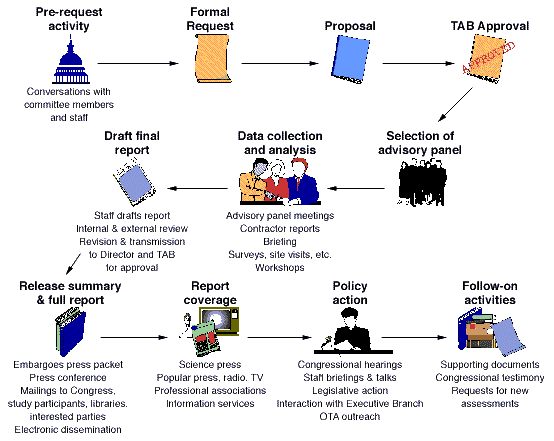




 Millard Fillmore's Bathtub