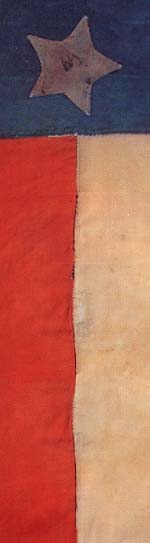
The Order of the Arrow, the camping honor society within U.S. Boy Scouting, takes much of its Indian Heritage from a tribe of the Delaware group, the Lenni Lenape. The last speaker of the Lenni Lenape language died in Oklahoma a couple of years ago; it’s good to see more efforts to record the rest of the heritage before it, too, slips away.
Spread the word; friends don't allow friends to repeat history.
Those who cannot remember the past are condemned to repeat it.
George Santayana (The Life of Reason, vol. 1: Reason in Common Sense)
Last year a seventh grade kid approached me about a problem he had with the Texas history text. He pointed to a photograph of a Ku Klux Klansman, pointy-hood and all. It was a photo probably from the 1920s, in no way flattering to the Klansman, and it accompanied a couple of paragraphs explaining the resurrection of the Klan in that era. The book explained what some did to fight the Klan (not enough, but that’s a topic for another time).
“That’s racist, Mister!”
I asked him why he thought the photograph was racist.
“That’s a Klansman! They killed people!”
Yes, it’s a Klansman, and yes, Klansmen killed people unjustly. That’s part of history, a part of history we need to remember to prevent it from happening again. I explained that the photo did not endorse the Klan in any way, and that section of the book actually spoke against their actions.
“You’re a racist, Mister! That picture is racist and should be cut out!”
Our conversation had taken an inexplicable (to me) turn, away from the content of the photo or the book, into uncharted realms of inanity.
“Why don’t you take your complaint to the principal, and tell your parents about it,” I said. “I think this is a conversation you and I should have with your parents present.”
Of course, the student did nothing I asked. Within a week I had a handful of other students complaining about the picture. Some of those conversations were better, but not much. Students had a difficult time understanding how reading about racism was not practicing racism. Learning about the mistakes of the past in order to avoid them, was the same as making the mistakes, the students argued.
This occurred shortly after several parents in another Texas school district had complained about the use of The Adventures of Huckleberry Finn because it contains a slang term for “negro” now considered particularly offensive when used by whites. The complaining parents were black. Never mind that this great American novel’s point is that racism is wrong, slavery an abomination to a just God, and that Jim is much greater a man than those who held him captive in slavery.
I worry that too many people lack enough education in history to make rational decisions about what should be considered “good to read” and what should genuinely be kept out of curricula.
Case in point: A janitor and student at Indiana University-Purdue University at Indianapolis (IUPUI) was investigated for creating a “hostile work environment,” and one of his offenses appears to have been his reading of a history of a defeat of the Ku Klux Klan in South Bend, Indiana. It is unclear from details we have, but it appears complainants could not tell the difference between reading the history of a Klan defeat, and reading a book promoting the Klan.
Should we worry? I’d like your opinions, and experiences if you have any; details of the Indianapolis case below the fold.
The Texas Declaration of Independence was produced, literally, overnight. Its urgency was paramount, because while it was being prepared, the Alamo in San Antonio was under seige by Santa Anna’s army of Mexico.
Immediately upon the assemblage of the Convention of 1836 on March 1, a committee of five of its delegates was appointed to draft the document. The committee, consisting of George C. Childress, Edward Conrad, James Gaines, Bailey Hardeman, and Collin McKinney, prepared the declaration in record time. It was briefly reviewed, then adopted by the delegates of the convention the following day.
As seen from the transcription, the document parallels somewhat that of the United States, signed almost sixty years earlier. It contains statements on the function and responsibility of government, followed by a list of grievances. Finally, it concludes by declaring Texas a free and independent republic.
Prior to statewide testing, this used to be a key part of 7th grade and other curricula in social studies.
There must be a celebration somewhere in Texas today, but I can’t find it.
Step 1:
Visit Washington-on-the-Brazos, where the Texas Independence Convention signed the Republic into being. It’s now a state park with state-of-the-art interactive exhibits open year round, with plenty of rousing events during the week of March 2.
Step 4:
Throw a Happy Birthday Texas party. Suggest that guests come dressed as cowboys or Alamo freedom fighters; serve cowboy camp grub and Tex-Mex goodies, play songs about Texas and tell Texas jokes.
I can easily see a time when a student with a computer terminal gets an assignment to look at some of the activitiesavailable at a site like America by Air, with on-line quizzes as the student progresses through the exhibits.
How far away are we? Two questions: Does your school provide an internet-linked computer for each student? Do you have the software or technical support to give an on-line assignment and track results?
Teaching stays stuck in the 19th century, learning opportunities fly through the 21st.
Spread the word; friends don't allow friends to repeat history.
The 13th U.S. president was central to Kia’s upcoming “Unheard of President’s Day Sale,” honoring, in tongue-in-cheek fashion, the first commander in chief to have running water in the White House. The punchline of new TV ads promoting the sale is a soap-on-a-rope bust of President Fillmore; the automaker handed out the same soaps to reporters at its media dinner last week during the Chicago Auto Show.
New chairman not amused
But Byung Mo Ahn was not amused. The South Korea-born executive, who returned to Kia’s Irvine, Calif., headquarters nine days ago in the newly created position of chairman and group CEO of Kia Motors America and Kia Motors Manufacturing Georgia (the automotive plant currently under construction in West Point, Ga.), doesn’t like the current brand of humor in Kia’s ads, according to executives close to the matter. One of those executives said Mr. Ahn prefers to show the cars and trucks as serious contenders with good quality.
The offending ad:
Personally, I thought the offense of repeating the historical error about Fillmore and White House bathtubs was excusable for the courage to use Fillmore to advertise anything. You have to tip your back scrubbing brush to a company who thinks Americans have enough smarts to recognize historical humor, and who is brave enough to act on it.
(I wouldn’t exactly kill for one, but it sure would be nice to have one of those Millard Fillmore Soap-on-a-Rope thingies, for the Millard Fillmore’s Bathtub National Archives, of course. With my teacher’s salary, I ain’t paying the big bucks on eBay for one, either. I’m sure the Smithsonian Institution, and the Buffalo and Erie County Historical Society would love to have examples, too.)
Raymond Jacobs died of natural causes at the age of 82 last week, his daughter told the Associated Press
Jacobs said he was present at the first flag raising, captured by a photographer for Leatherneck magazine. A later flag-raising, to put up a larger flag, was photographed by Joe Rosenthal, who won a Pulitzer Prize for the photo.
He is said to have returned to his unit by the time a more famous Associated Press photograph of a second flag-raising was taken later the same day.
Jacobs later fought in the Korean conflict in 1951 before retiring as a sergeant. He went on to work as a reporter, anchor and news director in local television in Oakland.
Eyewitnesses to the two World Wars dwindle in numbers. Historians and friends should be certain to capture their stories before they are gone.
Japan renamed the island Iwo To, its name prior to the war.
Spread the word; friends don't allow friends to repeat history.
Especially in black and white, the photo is not so macabre as to shock. Pyle looks peaceful, asleep, as Richard Pyle wrote. The value is historical. It’s a reminder that reporters, too, put themselves in harm’s way, to inform Americans about the world, providing the information our democratic republic needs to function well.
Remember to vote in your state’s primary elections this year. Deserve their heroism.
In that momentous, often terrible year of 1968, February 1 found the offensive in full swing by the National Liberation Front forces (NFL, or Viet Cong) across South Vietnam. The “General Uprising” kicked off on January 30, the beginning of Tet, the Vietnamese new year celebration (Tet is based on the Chinese lunisolar calendar, shifting from year to year; in 2008 the first day of Tet is February 7). News was just beginning to hit the U.S., in the days before videotape from the field and easy satellite uplinks.
On February 1, 1968, Associated Press photographer Eddie Adams accompanied a South Vietnamese police team trying to clear part of Saigon (now Ho Chi Minh City) of Viet Cong; Adams put his camera up to aim as police chief General Nguyễn Ngọc Loan put a gun to the head of a man suspected of being part of the NFL, Nguyễn Văn Lém. Adams clicked the shutter coincidentally as the police chief fired the gun, killing the suspect.
The photo ruined the life of Gen. Nguyễn. Adams wrote in Time Magazine:
The general killed the Viet Cong; I killed the general with my camera. Still photographs are the most powerful weapon in the world. People believe them; but photographs do lie, even without manipulation. They are only half-truths.
What the photograph didn’t say was, ‘What would you do if you were the general at that time and place on that hot day, and you caught the so-called bad guy after he blew away one, two or three American people?’
Via Wikipedia and BBC. Wikipedia caption: Nguyen Ngoc Loan executes Viet Cong Captain Nguyen Van Lem: February 1, 1968. This Associated Press photograph, “General Nguyen Ngoc Loan executing a Viet Cong prisoner in Saigon,” won a 1969Pulitzer prize for its photographer Eddie Adams. Film also exists of this event, but owing to the more graphic nature of the film, the photograph is more widely known.
Spread the word; friends don't allow friends to repeat history.
SMU has about an hour of tape of a speech Dr. King delivered at SMU in 1966. While the speech is not particularly noteworthy, it’s a good example of King’s rhetoric of the time. You can put it on your iPod.
It’s a real period piece — King in a southern, formerly segregated town, so soon after the Voting Rights Act. Real history, real people. Very interesting.
SMU has activities running all week long. Things change in 40 years.
(Check out the socks and ties of the men on stage — and where are the women?)
Photos from SMU, from the archives of the campus newspaper, The SMU Campus.
Spread the word; friends don't allow friends to repeat history.
LYNDON JOHNSON: It’s all of us, who must overcome the crippling legacy of bigotry and injustice. And we shall overcome.
BILL MOYERS: As he finished, Congress stood and thunderous applause shook the chamber. Johnson would soon sign into law the Voting Rights Act of 1965 and black people were no longer second class citizens. Martin Luther King had marched and preached and witnessed for this day. Countless ordinary people had put their bodies on the line for it, been berated, bullied and beaten, only to rise, organize and struggle on, against the dogs and guns, the bias and burning crosses. Take nothing from them; their courage is their legacy. But take nothing from the president who once had seen the light but dimly, as through a dark glass — and now did the right thing. Lyndon Johnson threw the full weight of his office on the side of justice. Of course the movement had come first, watered by the blood of so many, championed bravely now by the preacher turned prophet who would himself soon be martyred. But there is no inevitability to history, someone has to seize and turn it. With these words at the right moment — “we shall overcome” — Lyndon Johnson transcended race and color, and history, too — reminding us that a president matters, and so do we.
Po’pay was a leader of the revolt against oppressive Spanish rule over New Mexico’s native inhabitants between 1675 and 1681, a century before the American Revolution.
In 1997, the New Mexico Legislature selected Po’pay as the subject of the state’s second statue for the National Statuary Hall Collection and created the New Mexico Statuary Hall Commission, whose members were appointed by Governor Gary Johnson. Four sculptors were selected to create maquettes, and Cliff Fragua was awarded the commission in December 1999. It will be the seventh statue of a Native American in the collection; the others are King Kamehameha I, Will Rogers (who had Cherokee ancestors), Sakakawea, Sequoyah, Washakie, and Sarah Winnemucca.
The seven-foot-high statue was carved from pink Tennessee marble (making it the only colored marble statue in the collection) and stands on a three-foot-high pedestal comprised of a steel frame clad in black granite. It is the first marble statue contributed to the collection since that of South Dakota’s Joseph Ward, which was given in 1963; the other statues given since that time have been bronze. Its acceptance marked the first time at which every state in the Union has been represented by two statues in the collection. In addition, Po’pay is historically the first person represented in the collection to be born on what would become American soil.
No image or written description of Po’pay is known to exist. Sculptor Cliff Fragua describes the statue thus:
In my rendition, he holds in his hands items that will determine the future existence of the Pueblo people. The knotted cord in his left hand was used to determine when the Revolt would begin. As to how many knots were used is debatable, but I feel that it must have taken many days to plan and notify most of the Pueblos. The bear fetish in his right hand symbolizes the center of the Pueblo world, the Pueblo religion. The pot behind him symbolizes the Pueblo culture, and the deerskin he wears is a humble symbol of his status as a provider. The necklace that he wears is a constant reminder of where life began, and his clothing consists of a loin cloth and moccasins in Pueblo fashion. His hair is cut in Pueblo tradition and bound in a chongo. On his back are the scars that remain from the whipping he received for his participation and faith in the Pueblo ceremonies and religion.
Fragua, an Indian from Jemez Pueblo, studied sculpture in Italy, California, and New Mexico; he created his first stone sculpture in 1974.
Sarah Winnemucca
[facsimile of her signature, “Sarah Winnemucca Hopkins”]
1844–1891
Nevada
Defender of Human rights
Educator
Author of first book by a Native woman
Each state may have two statues in the collection.
My work on the Senate staff often required that I walk the Capitol, especially between the Senate and House Press Galleries. I often lamented that it was not available or accessible to students. This collection of statues is one of the better unsung galleries of history in Washington, D.C. It is heavily influenced by politics and current fashion. Selections illustrate how state legislatures try to make their state’s reputation, and can be very quirky. For example, Pennsylvania’s statues include Robert Fulton, an inventor of the steamboat, and John Peter Gabriel Muhlenberg — but not Ben Franklin or William Penn. Why? There could be a paper done on the politics of the choices of each of the 50 states.
I’ve often recommended students diagram the Preamble to the Constitution, to better understand the source of authority in our government (“We, the People”).
Betsy (I have no surname) sent me a link to this:
Preamble to the Constitution as your English teacher wishes you would have diagrammed it.
Sentence diagram of the Preamble to the Constitution. GIF version
We the People of the United States, in Order to form a more perfect Union, establish Justice, insure domestic Tranquility, provide for the common defence, promote the general Welfare, and secure the Blessings of Liberty to ourselves and our Posterity, do ordain and establish this Constitution for the United States of America.
Thomas Nast invented Santa Claus?Clement C. Moore didn’t write the famous poem that starts out, “‘Twas the night before Christmas, and all through the house . . . ?”
The murky waters of history from Millard Fillmore’s Bathtub soak even our most cherished ideas and traditions.
But isn’t that part of the fun of history?
Below: Thomas Nast’s first published drawing featuring Santa Claus; for Harper’s Weekly, “A Journal of Civilization,” January 3, 1863 Nast portrayed the elf distributing packages to Union troops: “Santa Claus in camp.” Nast (1840-1904) was 23 when he drew this image.
Yes, Virginia (and California, too)! Thomas Nast created the image of Santa Claus most of us in the U.S. know today. Perhaps even more significant than his campaign against the graft of Boss Tweed, Nast’s popularization of a fat, jolly elf who delivers good things to people for Christmas makes one of the great stories in commercial illustration. Nast’s cartoons, mostly for the popular news publication Harper’s Weekly, created many of the conventions of modern political cartooning and modeled the way in which an illustrator could campaign for good, with his campaign against the graft of Tammany Hall and Tweed. But Nast’s popular vision of Santa Claus can be said to be the foundation for the modern mercantile flurry around Christmas.
Nast’s drawings probably drew some inspiration from the poem, “Account of a Visit from St. Nicholas,” traditionally attributed to Clement C. Moore, a New York City lawyer, published in 1822. The poem is among the earliest to describe the elf dressed in fur, and magically coming down a chimney to leave toys for children; the poem invented the reindeer-pulled sleigh.
Modern analysis suggests the poem was not the work of Moore, and many critics and historians now attribute it to Major Henry Livingston, Jr. (1748-1828) following sleuthing by Vassar College Prof. Don Foster in 2000. Fortunately for us, we do not need to be partisans in such a query to enjoy the poem (a complete copy of which is below the fold).
The Library of Congress still gives Moore the credit. When disputes arise over who wrote about the night before Christmas, is it any wonder more controversial topics produce bigger and louder disputes among historians?
Moore is thought to have composed the tale, now popularly known as “The Night Before Christmas,” on December 24, 1822, while traveling home from Greenwich Village, where he had bought a turkey for his family’s Christmas dinner.
Inspired by the plump, bearded Dutchman who took him by sleigh on his errand through the snow-covered streets of New York City, Moore penned A Visit from St. Nicholas for the amusement of his six children, with whom he shared the poem that evening. His vision of St. Nicholas draws upon Dutch-American and Norwegian traditions of a magical, gift-giving figure who appears at Christmas time, as well as the German legend of a visitor who enters homes through chimneys.
Again from the Library of Congress, we get information that suggests that Moore was a minor celebrity from a well-known family with historical ties that would make a good “connections” exercise in a high school history class, perhaps (“the link from Aaron Burr’s treason to Santa Claus?”): (read more, below the fold)
Washington had been thought to be in a position to take over the government and declare himself king, if he chose. Instead, at some cost to himself he personally put down a rebellion of the officers of the army who proposed a coup d’etat against the Continental Congress, angered that they had not been paid. Washington quietly asked that the men act honorably and not sully the great victory they had won against Britain. Then Washington reviewed the army, wrapped up affairs, journeyed to Annapolis to resign, and returned to his farm and holdings at Mount Vernon, Virginia.
Because Washington could have turned into a tyrant, it is reported that King George III of England, upon hearing the news of Washington’s resignation, refused to believe it. If the report were true, George is reported to have said, Washington was the greatest man who ever lived.
Washington’s resignation set precedent: Civilian government controlled the military; Americans served, then went back to their private lives and private business; Americans would act nobly, sometimes when least expected.
Or, until that account is unsuspended by the forces supporting Donald Trump: Follow @FillmoreWhite, the account of the Millard Fillmore White House Library
We've been soaking in the Bathtub for several months, long enough that some of the links we've used have gone to the Great Internet in the Sky.
If you find a dead link, please leave a comment to that post, and tell us what link has expired.
Thanks!
Retired teacher of law, economics, history, AP government, psychology and science. Former speechwriter, press guy and legislative aide in U.S. Senate. Former Department of Education. Former airline real estate, telecom towers, Big 6 (that old!) consultant. Lab and field research in air pollution control.
My blog, Millard Fillmore's Bathtub, is a continuing experiment to test how to use blogs to improve and speed up learning processes for students, perhaps by making some of the courses actually interesting. It is a blog for teachers, to see if we can use blogs. It is for people interested in social studies and social studies education, to see if we can learn to get it right. It's a blog for science fans, to promote good science and good science policy. It's a blog for people interested in good government and how to achieve it.
BS in Mass Communication, University of Utah
Graduate study in Rhetoric and Speech Communication, University of Arizona
JD from the National Law Center, George Washington University


 Posted by Ed Darrell





 Millard Fillmore's Bathtub