One hundred and fifty National Geographic Society employees march in the Preparedness Parade on Flag Day, June 14, in 1916. With WWI underway in Europe and increasing tensions along the Mexican border, President Woodrow Wilson marched alongside 60,000 participants in the parade, just one event of many around the country intended to rededicate the American people to the ideals of the nation.
Not only the anniversary of the day the flag was adopted by Congress, Flag Day is also the anniversary of President Dwight Eisenhower’s controversial addition of the words “under God” to the Pledge of Allegiance in 1954.
(Text adapted from “:Culture: Allegiance to the Pledge?” June 2006, National Geographic magazine)
The first presidential declaration of Flag Day was 1916, by President Woodrow Wilson. Wilson won re-election the following November with his pledge to keep America out of World War I, but by April of 1917 he would ask for a declaration of war after Germany resumed torpedoing of U.S. ships. The photo shows an America dedicated to peace but closer to war than anyone imagined. Because the suffragettes supported Wilson so strongly, he returned the favor, supporting an amendment to the Constitution to grant women a Constitutional right to vote. The amendment passed Congress with Wilson’s support and was ratified by the states.
The flags of 1916 should have carried 48 stars. New Mexico and Arizona were the 47th and 48th states, Arizona joining the union in 1913. No new states would be added until Alaska and Hawaii in 1959. That 46-year period marked the longest time the U.S. had gone without adding states, until today. No new states have been added since Hawaii, more than 49 years ago. (U.S. history students: Have ever heard of an essay, “Manifest destiny fulfilled?”)
150 employees of the National Geographic Society marched, and as the proud CEO of any organization, Society founder Gilbert H. Grosvenor wanted a photo of his organization’s contribution to the parade. Notice that Grosvenor himself is the photographer.
I wonder if Woodrow Wilson took any photos that day, and where they might be hidden.
Since 1916, when President Woodrow Wilson issued a presidential proclamation establishing a national Flag Day on June 14, Americans have commemorated the adoption of the Stars and Stripes by celebrating June 14 as Flag Day. Prior to 1916, many localities and a few states had been celebrating the day for years. Congressional legislation designating that date as the national Flag Day was signed into law by President Harry Truman in 1949; the legislation also called upon the president to issue a flag day proclamation every year.
According to legend, in 1776, George Washington commissioned Philadelphia seamstress Betsy Ross to create a flag for the new nation. Scholars debate this legend, but agree that Mrs. Ross most likely knew Washington and sewed flags. To date, there have been twenty-seven official versions of the flag, but the arrangement of the stars varied according to the flag-makers’ preferences until 1912 when President Taft standardized the then-new flag’s forty-eight stars into six rows of eight. The forty-nine-star flag (1959-60), as well as the fifty-star flag, also have standardized star patterns. The current version of the flag dates to July 4, 1960, after Hawaii became the fiftieth state on August 21, 1959.
Fly your flag with pride today.
Elmhurst Flag Day 1939, DuPage County Centennial - Posters From the WPA
Hoisting the flag at Guantanamo, Cuba, June 12, 1898. Edward H. Hart, photographer. Image from the American Memory Collection at the Library of Congress
Oh, it’s important in retrospect, no?
On June 10, 1898, U.S. Marines landed at Guantánamo Bay. For the next month, American troops fought a land war in Cuba that resulted in the end of Spanish colonial rule in the Western Hemisphere. Cuban rebels had gained the sympathy of the American public while the explosion and sinking of the U.S.S. Maine, widely blamed on the Spanish despite the absence of conclusive evidence, further boosted American nationalistic fervor.
On June 12, the area was secured and the flag posted.
He held many jobs, cowboy, police commissioner, governor, military leader, president — but he regarded his profession as “writer.”
Theodore Roosevelt‘s typewriter, a Remington, from his house at Sagamore Hill, New York:
Theodore Roosevelt’s typewriter from his home at Sagamore Hill, New York – Fish and Wildlife Service photo, National Digital Image Library (public domain)
Update, March 16, 2012: There are two versions of the same photo above, if we’re lucky. The designator at the National Digital Library has changed at least twice, leaving this post high and dry. There is another, slightly lower quality version of the photo above. You’re not seeing double, you’re seeing operational redundancy.
New logo and slogan for the Texas Historical Commission
A lot of photos from the sites the Historical Commission operates, news of special events, and links to the Commission’s sites’ websites. As yet there are not any substantive historical analyses.
Before we move past remembrances of D-Day, let’s take a moment to think about and memorialize the soldiers who fought there, so many of whom died there.
From the National Guard's feature, This Day in National Guard History: "Circular written by General Dwight D. Eisenhower explaining the importance of the Normandy invasion on winning the war. These were distributed to every member of the attacking force the night prior to the D-Day landings. Sergeant J. Robert "Bob" Slaughter, a Guard member of Virginia's Company D, 116th Infantry, passed his copy around among the members of Company D to get their signatures (front and back) as they waited to load aboard the landing craft that would take them to Omaha Beach. By nightfall of June 6, about half of these men were dead or wounded. Courtesy John R. Slaughter"
Normandy, France — The Allied invasion of France, commonly known as “D-Day” begins as Guardsmen from the 29th Infantry Division (DC, MD, VA) storm onto what will forever after be known as “bloody Omaha” Beach. The lead element, Virginia’s 116th Infantry, suffers nearly 80% casualties but gains the foothold needed for the invasion to succeed. The 116’s artillery support, the 111th Field Artillery Battalion, also from Virginia, loses all 12 of its guns in high surf trying to get on the beach. Its men take up arms from the dead and fight as infantrymen. Engineer support came from the District of Columbia’s 121st Engineer Battalion. Despite high loses too, its men succeed in blowing holes in several obstacles clearing paths for the men to get inland off the beach. In the early afternoon, Maryland’s 115th Infantry lands behind the 116th and moves through its shattered remnants to start the movement in off the beach. Supporting the invasion was the largest air fleet known to history. Among the units flying missions were the Guards’ 107th (MI) and 109th (MN) Tactical Reconnaissance Squadrons The Normandy campaign lasted until the end of July with four Guard infantry divisions; the 28th (PA), 29th, 30th (NC, SC, TN) and the 35th (KS, MO, NE) taking part along with dozens of non-divisional units all earning the “Normandy” streamer.
Great idea. Really. There’s a lot of campaign stuff left over. Rather than dump it, they’re selling it cheap.
Image from the Obama campaign site, June 2009
Government and politics teachers can stock up on the stuff to decorate the room. AP Government teacher Mrs. Richie, at Duncanville High School had a collection of bumperstickers that went back 30 years before she retired (where did that collection go?)
Over at Republican National Headquarters, they’re having a sale on politicians, I hear. Entire Congressional committee minorities, cheap. Izzat so? Not really. Really?
Spread the word; friends don't allow friends to repeat history.
Senate Majority Leader Mike Mansfield, oil on canvas painting by Aaron Shikler, 1978 - Wikimedia image
Beginning in March 1974 I had the great pleasure and high honor of interning with the Secretary of the Senate, Francis R. Valeo. Valeo served because of his close relationship with the Majority Leader, Mike Mansfield, and working in Valeo’s office put one on the Mansfield team. In an era before serious security with magnetometers in Washington’s public buildings — we didn’t even have photo identification cards then — Mike Mansfield’s signature on my staff card got me anywhere I wanted to go in Washington, including the White House.
People who knew Mansfield held him in very high regard. I often tell people he was the best politician to work for, but in reality, he’s probably the best leader I ever worked with in any enterprise. He respected every senator as a representative of the people of one of the 50 states, and that respect was returned.
In his office one afternoon he met with the a couple of members of the Joint Chiefs of Staff, the big bigwigs from the Pentagon. Mansfield was a former sailor, marine and soldier — he had served in the Navy, Army and Marines. He lied about his age the first time. He had served in China and the Philippines, producing a life-long interest and deep expertise in U.S. affairs in the Pacific and Far East.
But this was 1974. Mansfield had turned against supporting corrupt Vietnamese politicians early in the U.S. involvement in Vietnam. Originally a supporter of Nixon’s policies, by 1974 his opposition to the war was the chief part of their relationship. Still the military guys loved him. An Army Colonel accompanying the group was anxious to explain to the young intern part of the mystique.
“You should see Mansfield in the formal meetings. Everybody is always introduced, and their full rank is laid on the table. ‘General Muckamuck. West Point ’33, Columbia Law. Admiral Bigship. General Soandso, who recently got his third star.'”
“And then they get to Mansfield. He’s the Senate Majority Leader. And he introduces himself as ‘Mike Mansfield, Private First Class.'”
I asked Mansfield about it later. He smiled, and said he might have done that a time or two. He said that the big brass in the military need to remember as every senator does that they work for the American people. Rank doesn’t make you right, he said.
Looking up a minor fact on Mansfield this morning I ran into this statement, which I’d never heard [quoting now from Wikipedia]:
This gentleman went from snuffy to national and international prominence. And when he died in 2001, he was rightly buried in Arlington. If you want to visit his grave, don’t look for him near the “Kennedy Eternal Flame”, where so many politicians are laid to rest. Look for a small, common marker shared by the majority of our heroes. Look for the marker that says “Michael J. Mansfield, Pfc. U.S. Marine Corps.”
Remarks by Col. James Michael Lowe, USMC, October 20, 2004.
The burial plot of Senator and Mrs. Mansfield can be found in section 2, marker 49-69F of Arlington National Cemetery.
For the sake of accuracy, I would like to know the occasion of Col. Lowe’s remarks, and who Col. Lowe is. The link at Wikipedia is dead. Does anyone know?
Member list of the U.S. House of Representatives, with notations by Samuel Morse on vote of February 23, 1843
By 1842, funding from the U.S. Congress was essential if the now-impoverished Morse was to be able to build and prove his telegraph system. On February 23, 1843, his bill for appropriated funding passed in the House of Representatives by a slim majority of 89 to 83 (with 70 not voting), but obviously every vote was crucial. This annotated member list of the twenty-six states may have been used by Morse before, during, or after the vote. The symbol “O” is thought to indicate an assenting vote, “-” a dissenting vote, and “>” no vote.
Spread the word; friends don't allow friends to repeat history.
Maj. Gen. John A. Logan, Grand Army of the Republic (Union Army), inventor of Memorial Day; Library of Congress photo, Brady National Photographic Art Gallery, between 1860 and 1865
In 1868, Commander in Chief John A. Logan of the Grand Army of the Republic issued General Order Number 11 designating May 30 as a memorial day “for the purpose of strewing with flowers or otherwise decorating the graves of comrades who died in defense of their country during the late rebellion, and whose bodies now lie in almost every city, village, and hamlet churchyard in the land.”
The first national celebration of the holiday took place May 30, 1868, at Arlington National Cemetery, where both Confederate and Union soldiers were buried. Originally known as Decoration Day, at the turn of the century it was designated as Memorial Day. In many American towns, the day is celebrated with a parade.
Southern women decorated the graves of soldiers even before the Civil War’s end. Records show that by 1865, Mississippi, Virginia, and South Carolina all had precedents for Memorial Day. Songs in the Duke University collection Historic American Sheet Music, 1850-1920 include hymns published in the South such as these two from 1867: “Kneel Where Our Loves are Sleeping,” dedicated to “The Ladies of the South Who are Decorating the Graves of the Confederate Dead ” and “Memorial Flowers,” dedicated “To the Memory of Our Dead Heroes.”
Spread the word; friends don't allow friends to repeat history.
In a drawer in a file box in the U.S. Patent Office in Washington, D.C., is a study in black ink on white paper, lines that resemble those images most of us have of the first Wright Bros. flyer, usually dubbed “Kittyhawk” after the place it first took to the air.
Drawing 1 from patent granted to Orville Wright for a flying machine
The patent was issued on May 22, 1906, to Orville Wright, Patent No. 821393, for a “flying machine.”
It makes more sense if you turn the drawing on its side.
Wright Bros. flying machine, from patent drawing
Why did it take three years to get the patent issued?
[Google Video version is not showing or playing for reasons I don’t know; fortunately the National Archives (NARA) has uploaded a version to YouTube]
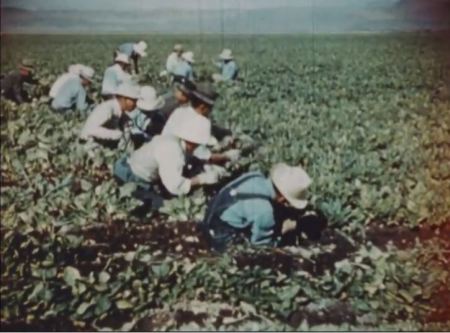
“A Challenge to Democracy,” by the War Relocation Board. This film defends the relocation of 100,000 Japanese Americans during World War II.
Japanese-descended American citizens harvesting crops they grew during internment during World War II. Screen capture from “Challege to Democracy.”
“These people are not under suspicion,” the narrator says. “They are not prisoners, they are not internees. They are merely dislocated people, the unwounded casualties of war.”
CREDIT: Mauldin, Bill, artist. “Another such victory and I am undone” Copyright 1962, Field Enterprises, Inc. Prints and Photographs Division of the Library of Congress.
Spread the word; friends don't allow friends to repeat history.
But this day was different because a second year graduate student, Stanley Lloyd Miller, was speaking, and the room was full because the word had spread that something important was to be presented. In addition to the famous scientists and less famous but equally high-powered scientists was an undergraduate, Carl Sagan attending his first chemistry seminar. The topic was the synthesis of important biological compounds, using conditions thought to have existed on the primitive Earth.
Miller reported that by sending repeated electric sparks through a sealed flask containing a mixture of methane, ammonia, hydrogen, and water vapor, he had made some of the amino acids found in proteins. Perhaps, he suggested, this was how organic compounds were made on the ancient Earth before life existed.
While Miller was confident of his results, the rows of famous faces in his audience were, to say the least, intimidating. He was bombarded with questions. Were the analyses done correctly? Could there have been contamination? After the event, Miller thought that the questions had been constructive, but since the results were hard to believe, they had simply wanted to ensure that he had not made some mistake. However, Carl Sagan thought that Miller’s inquisitors seemed to be picky and did not appreciate the significance of the experiment. Even the relevance of Miller’s results to the origin of life were questioned. When someone asked Miller how he could really be sure this kind of process actually took place on the primitive Earth, Nobel Laureate Harold Urey, Miller’s research advisor, immediately interrupted, replying, “If God did not do it this way, then he missed a good bet.” The seminar ended amid the laughter, and the attendees filed out with some making complimentary remarks to Miller. Miller changed clothes, went back to the lab and started a paper chromatography run.
The events leading up to this dramatic seminar began two years earlier in October, 1951 when Urey presented the Chemistry Department seminar on the origin of the Solar system. In addition to the usual high powered scientists, the audience had contained the then first year graduate student, Stanley Miller.
Read “Prebiotic Soup—Revisiting the Miller Experiment” by Jeffrey Bada and Antonio Lazcano published in Science300 (2003) 745-726 in full text or as a PDF.
This is an abridged version of the Stanley Miller’s 70th Birthday published in Origins of Life and Evolution of the Biosphere30: 107-112, 2000 by Jeffrey Bada and Antonio Lazcano and The Spark of Life – Darwin and the Primeval Soup by Christopher Wills and Jeffrey Bada, Perseus Books, 2000.
More than 50 years ago scientists demonstrated that basic chemicals of life, thought previously by some to be too complex to arise naturally, could occur in nature spontaneously. Much of the misunderstanding and crank science behind creationism is devoted to hiding these facts.
Lift a glass to Stanley Miller and his experiment today, a toast to learning, a toast to the truth.
Table of contents for latest Origins of Life, a journal of ISSOL (there are more experiments reported in one issue of this nearing-40-years journal than there are in all of intelligent design/creationism — and this is not even in the realm of evolution theory yet)
About 75,000 images, most very high quality, for classroom use. Images are sorted into categories that should align with all state standards and any textbook series — at the California State Universities, World Images Kiosk. There are a lot of images from ancient cultures, a lot of images from pre-Renaissance times, and a rich panorama of other images.
Or, until that account is unsuspended by the forces supporting Donald Trump: Follow @FillmoreWhite, the account of the Millard Fillmore White House Library
We've been soaking in the Bathtub for several months, long enough that some of the links we've used have gone to the Great Internet in the Sky.
If you find a dead link, please leave a comment to that post, and tell us what link has expired.
Thanks!
Retired teacher of law, economics, history, AP government, psychology and science. Former speechwriter, press guy and legislative aide in U.S. Senate. Former Department of Education. Former airline real estate, telecom towers, Big 6 (that old!) consultant. Lab and field research in air pollution control.
My blog, Millard Fillmore's Bathtub, is a continuing experiment to test how to use blogs to improve and speed up learning processes for students, perhaps by making some of the courses actually interesting. It is a blog for teachers, to see if we can use blogs. It is for people interested in social studies and social studies education, to see if we can learn to get it right. It's a blog for science fans, to promote good science and good science policy. It's a blog for people interested in good government and how to achieve it.
BS in Mass Communication, University of Utah
Graduate study in Rhetoric and Speech Communication, University of Arizona
JD from the National Law Center, George Washington University


 Posted by Ed Darrell







 Millard Fillmore's Bathtub

