War on malaria: Wall Street Journal and bloggers side with malaria

May 24, 2009

It’s spring.  Each of the past four years, spring has been the time that the anti-Rachel Carson, anti-environmental protection, anti-environmentalist, pro-DDT groups throttle up their campaigns to impugn Carson and environmentalists, and argue that all we need to do is poison Africa to make the world safe from malaria.

Here’s where Col. Renault joins us from Casablanca to say “Round up the usual suspects.”  It’s spring 2009.  Henry I. Miller of the Hoover Institution could be along any moment to say we need DDT to fight West Nile Virus, though DDT is not the pesticide of choice even among pesticide professionals.

The Wall Street Journal has become a favorite venue for these poison-the-Earthers as it has left rational policy decisions behind, at least in the editorial and op-ed pages. Steven Milloy’s got a book out slandering environmentalists, Green Hell, and a new blog to promote the book.  No doubt someone will trot out Gordon Edwards’ Lyndon-Larouche-tainted claims against Rachel Carson, though none of them check out.

Right on cue:  “Malaria, Politics and DDT – The U.N. bows to the anti-insecticide lobby” from the Wall Street Journal! It appeared in the Saturday edition, May 23.

Sure enough, Green Hell blog picks it up repeating the old canard about how a day without DDT is like a day of genocide. You can’t teach a stupid dog new tricks, you know.  In a post title that drips with calumny, Milloy says “Greens re-boot African genocide.”  They have no case; smears must do the work.

Let’s dissect the WSJ piece, eh?

In 2006, after 25 years and 50 million preventable deaths, the World Health Organization reversed course and endorsed widespread use of the insecticide DDT to combat malaria. So much for that. Earlier this month, the U.N. agency quietly reverted to promoting less effective methods for attacking the disease. The result is a victory for politics over public health, and millions of the world’s poor will suffer as a result.

So much error in so little space!  The error-to-word ratio may be a new land speed record.

Were there 2 million deaths per year from malaria, we could say malaria killed 50 million people in the last 25 years.  But for many, or most of the past 35 years, the death rate has hovered around 1 million, sometimes lower.  That’s still too high for those of us who think malaria should be beaten, but it’s not 2 million a year.  WSJ exaggerates the death figures — what else do they exaggerate?  If they have a case, why do they need to exaggerate?

WHO never abandoned DDT for specific usesThere was no policy for WHO to reverse in 2006.  WHO made it clear that they would continue to use DDT where appropriate, and where local governments would allow.  WSJ, new to the business of caring about Africans afflicted by malaria, doesn’t know the history.

DDT’s effectiveness against malaria-carrying mosquitoes began to wane by 1950.  By the mid-1960s, many populations of mosquitoes had developed resistance and even immunity to DDT.  That was why the World Health Organization (WHO) abandoned its campaign to eradicate malaria.  Overuse of DDT, especially in agriculture, led to rapid evolution of resistance among mosquitoes.  Without a weapon that worked as DDT had worked before resistance, the campaign could not succeed.

The Journal is simply wrong when it says only less-effective methods are left. DDT’s greatly reduced effectiveness is part of the reason; but research over the past five years, in tests run broadly in several African nations, shows that bednets reduce malaria infections by between 50% and 85%.  That is much more effective than DDT in broadcast spraying.

One of the things WSJ fails to mention — maybe they don’t know, there is much demonstration of ignorance in the editorial — is that DDT is not used in broadcast spraying to fight malaria.  Such campaigns proved disastrous because they killed off the predators of mosquitoes more effectively than they killed the mosquitoes, and because they often produced harmful results in other ways.  Along some African rivers, the spraying campaigns killed off a lot of fish local people used for food.  The dangers of DDT have been demonstrated in Africa.

WHO had championed a campaign in the late 1950s and 1960s to eradicate malaria.  The strategy was to use DDT to knock down local mosquito populations for six months or a year, and in that time treat humans infected with the malaria parasites so that, when the mosquitoes came back, there would be no pool of malaria infection among humans from which to draw malaria to spread.

Alas, the overuse of DDT caused mosquitoes to develop resistance before the malaria-fighters could get into the field in some places and get the health care components of the campaign to work.

Because of the worldwide resistance to DDT among insects, DDT cannot be counted on as a panacea against malaria in any case.  While it was never the panacea, never the sole tool to beat the disease, its role has been dramatically reduced by the rise of resistance to the chemical.

The U.N. now plans to advocate for drastic reductions in the use of DDT, which kills or repels the mosquitoes that spread malaria. The aim “is to achieve a 30% cut in the application of DDT worldwide by 2014 and its total phase-out by the early 2020s, if not sooner,” said WHO and the U.N. Environment Program in a statement on May 6.

Citing a five-year pilot program that reduced malaria cases in Mexico and South America by distributing antimalaria chloroquine pills to uninfected people, U.N. officials are ready to push for a “zero DDT world.” Sounds nice, except for the facts. It’s true that chloroquine has proven effective when used therapeutically, as in Brazil. But it’s also true that scientists have questioned the safety of the drug as an oral prophylactic because it is toxic and has been shown to cause heart problems.

Where was the Wall Street Journal when these studies were proposed, when they were run, and when they were reported?  WHO and health care agencies in affected countries carefully worked to find non-DDT solutions to malaria.  All programs to fight malaria require good health care systems, to diagnose malaria in victims, accurately as to the form of parasite affecting the victim, and to treat the disease to restore health to the victim and remove that person from the pool of people from whom mosquitoes can draw new malaria to infect others.  The results are in.  The treatment works.  Now comes WSJ to pose questions that have already been answered?  They are too late, and wrong.

Most malarial deaths occur in sub-Saharan Africa, where chloroquine once worked but started failing in the 1970s as the parasite developed resistance.

Fascinating.  In discussions with the pro-DDTers, resistance of mosquitoes to DDT is generally denied.  But here the WSJ cites similar resistance by the parasite.  Remember, dear reader, that the DDTers are selective in their use of evidence.

Even if the drugs were still effective in Africa, they’re expensive and thus impractical for one of the world’s poorest regions. That’s not an argument against chloroquine, bed nets or other interventions. But it is an argument for continuing to make DDT spraying a key part of any effort to eradicate malaria, which kills about a million people — mainly children — every year. Nearly all of this spraying is done indoors, by the way, to block mosquito nesting at night. It is not sprayed willy-nilly in jungle habitat.

DDT is more expensive than bednets.  DDT is used now only for indoor residual spraying (IRS).  Hut walls are treated with DDT to kill or repel mosquitoes after they have already bitten a victim; this prevents the spread of some parasites, at least in the bodies of the mosquitoes killed.  IRS requires some expensive work, however.  First, analysis of the mosquitoes must be done to be sure DDT is effective; annd second, a professional or highly-trained person must apply the stuff.  DDT applications have to be repeated about every six months.  They cost about $12.00 each time.  IRS may decrease malaria infection by as much as 35% (I’m being liberal).

In contrast, bednets decrease malaria infection by 50% to 85%.  They cost about $10.00 for the expensive ones, and they last five years.  In tests and in practice in Africa over the past five years, bednets have proven to be a necessary and very effective method to fight malaria.  Bednets work without DDT (there are alternative chemicals available for IRS); DDT can’t work without bednets.

There is strong opposition to use of DDT even for IRS, in Uganda, for example, where cotton and tobacco farmers have sued to stop the use.  In other areas, local people still fear fish kills.  DDT is controversial because of local opposition to it, not because of any environmental group’s action.

And the net result is that DDT is not the cheapest nor most effective method to fight malaria.  It is an increasingly expensive, controversial, and decreasingly effective tool.

But here is the bottom line:  Unless malaria is wiped out in human hosts, there will always be mosquitoes ready to spread the disease from one infected human to a dozen uninfected humans.  The key to eliminating malaria is not killing every mosquito on Earth, as quixotic a goal as that may be; the key is to develop methods of curing humans quickly and well and interrupting the life cycle of the parasite.  Drugs are expensive?  DDT cannot substitute for drugs, regardless how cheap it is.

WHO is not saying that DDT shouldn’t be used. But by revoking its stamp of approval, it sends a clear message to donors and afflicted countries that it prefers more politically correct interventions, even if they don’t work as well. In recent years, countries like Uganda, Tanzania and Zambia have started or expanded DDT spraying, often with the help of outside aid groups. But these governments are also eager to remain in the U.N.’s good graces, and donors typically are less interested in funding interventions that WHO discourages.

These campaigns have provided little success against malaria — nothing on the scale of success of bednets.

Oddly, one of the greatest roadblocks to the use of DDT in Africa since 2000 was the Bush administration, which refused to allow any U.S. dollars for the purchase of DDT or treatment.  There are foggy signs the Bush policies eased in 2008.  But again, it may simply be that the opportunity to use DDT is gone.  It’s time to move on to fight malaria, and quit tilting at the DDT windmill.

“Sadly, WHO’s about-face has nothing to do with science or health and everything to do with bending to the will of well-placed environmentalists,” says Roger Bate of Africa Fighting Malaria. “Bed net manufacturers and sellers of less-effective insecticides also don’t benefit when DDT is employed and therefore oppose it, often behind the scenes.”

Roger Bate acts as a shill for malaria over recent years.  Despite the name of his organization, he stands opposed to any effective means of fighting malaria, and he always stands for poisoning Africa.  His claims here are directly contradicted by the results of campaigns run by the Bill and Melinda Gates Foundation, a group which has dedicated its time and an astounding amount of money to beating malaria.  Bill Gates has no axe to grind on the issue — the foundation encourages bednets and medical care, and is relatively silent about DDT.  The Foundation’s work has saved more lives in the past three years than Roger Bate has in more than a decade of promoting DDT.  The Gates Foundation clearly is more credible.

All other serious experts tend to agree with the Gates Foundation path as well.

It’s no coincidence that WHO officials were joined by the head of the U.N. Environment Program to announce the new policy. There’s no evidence that spraying DDT in the amounts necessary to kill dangerous mosquitoes imperils crops, animals or human health. But that didn’t stop green groups like the Pesticide Action Network from urging the public to celebrate World Malaria Day last month by telling “the U.S. to protect children and families from malaria without spraying pesticides like DDT inside people’s homes.”

Pesticide Action Network is probably the only so-called green organization as crazy against DDT as Roger Bate is crazy for DDT.   Ignore what they say.  Pay attention to what’s really going on. (See comments on PAN.)  DDT is dangerous — PAN, for any inaccuracies they may have, are more accurate than the pro-p0ison side.

The National Academy of Sciences did a serious study of DDT in the late 1970s, and in a publication on the future of such chemicals in 1980, NAS said that while DDT was at one time a near-miracle working chemical, it is more dangerous than its benefits justify, and it needs to be eliminated from use.  The entire world has been working to protect people from dangerous man-made chemicals.  The Persistent Organic Pesticides Treaty of 2001 (POPs) calls for an end to use of dangerous chemicals, and singles out a dozen of the most dangerous. DDT is among the dozen most dangerous.  POPs includes a waiver to allow DDT use for fighting disease, so even it does not ban the stuff.  History shows that DDT decreases in effectiveness, and we discover new dangers from the stuff almost every year.  Since we have effective alternatives, and since DDT use has been hamstrung by litigation in Africa and ineffectiveness in the field, now is a great opportunity to end DDT use with very little harmful effect.

“We must take a position based on the science and the data,” said WHO’s malaria chief, Arata Kochi, in 2006. “One of the best tools we have against malaria is indoor residual spraying. Of the dozen or so insecticides WHO has approved as safe for house spraying, the most effective is DDT.” Mr. Kochi was right then, even if other WHO officials are now bowing to pressure to pretend otherwise.

Kochi was right to call for IRS then — and since we now have effective alternatives to DDT to use in IRS, WHO is right again to call for a reduction in DDT use in 2009.  We must take a position based on the science and the data, after all.

DDT is less effective than alternatives, and more expensive.  DDT is a killer once released in the wild.  DDT is unnecessarily controversial where it might do the most good, and therefore even less effective than it might be.  How can the Wall Street Journal come to any different conclusion, if they’re looking at the economics and science?  Who would have suspected political string-pulling at WSJ?

Rachel Carson was right.  47 years after Silent Spring is not too soon to eliminate DDT use.

___________

Here’s one indicator of the silly and bizarre exaggerations pro-DDT people tend to use:  This guy claims DDT had eliminated polio. In an otherwise over-the-top claim that Rachel Carson is a mass murderer — a claim that is false in all respects — the author goes even farther, claiming DDT effectiveness as a pharmaceutical against a disease like polio where there is no record for DDT’s ever having been used.

____________

Even more flight from reality: Climate Change Fraud blog, a site that appears to be a haven for anti-science, reprinted the WSJ editorial and added a bogus history introduction.  And another addition to the Wall of Shame:  Black and Right.


May 22, 1906: Patent to Wright Bros. for “flying machine”

May 23, 2009

In a drawer in a file box in the U.S. Patent Office in Washington, D.C., is a study in black ink on white paper, lines that resemble those images most of us have of the first Wright Bros. flyer, usually dubbed “Kittyhawk” after the place it first took to the air.

Drawing 1 from patent granted to Orville Wright for a flying machine

Drawing 1 from patent granted to Orville Wright for a flying machine

The patent was issued on May 22, 1906, to Orville Wright, Patent No. 821393, for a “flying machine.”

It makes more sense if you turn the drawing on its side.

Wright Bros. flying machine, from patent drawing

Wright Bros. flying machine, from patent drawing

Why did it take three years to get the patent issued?

Below the fold, the rest of the patent.

Read the rest of this entry »


Cy? Si! Mel Blanc and Jack Benny

May 22, 2009

One of my favorite comedy routines from the Master of Voices, Mel Blanc, and his accomplice Jack Benny:

We were talking about this old routine today, and sure enough, we could find it on YouTube.

In 1974, they repeated it for old times’ sake, on the Tonight Show with Johnny Carson:

Note:  May 22 is the anniversary of the last time Johnny Carson hosted the Tonight Show, in 1992. George Bush the elder was president then; the Soviet Union had been out of existence only five months.  Osama bin Laden was a little-known, former ally of the U.S. in the Russo-Afghanistan war.  E-mail was just coming on, cell-phones were rare and expensive, as well as analog, wireless broadband hadn’t been invented.  Apple was still making computers far, far behind the IBM-compatible PCs — new chips like the 486 promised a revolution in computing.  A lifetime ago.

Why is this post tagged “animation?”  You remember, don’t you? Blanc was the guy who did almost every voice in the Warner Bros. cartoons from the classic era.  Bugs Bunny, Daffy Duck, Foghorn Leghorn . . . as someone noted, remarkable to think Yosemite Sam and Tweety Bird are the same guy.

Update, 2014:  Mel Blanc’s birthday was May 30, as Richard Daybell reminded us; sweet, short tribute to Blanc at ‘Tis Pity He’s a Writer.


Evolution 2009, in Kearney, Nebraska

May 20, 2009

Evolution 2009 kicks off Wednesday, September 2, 2009 at the University of Nebraska atKearney.

In honor of Darwin’s birth bicentennial and the sesquicentennial of his most famous work, the program is dedicated to evolution in different fields of biology.

High school instructors can get in for $75.  World class scientists like Jack Horner, Brad Davidson, Shannon Williamson and Randy Moore will present — along with world class evolution and legal evidence expert, Nick Matzke.

The main hotel will be the Ramada Inn in Kearney, where I spent a cold, snowy night in November 1979 after a kindly truck driver from Consolidated Freightways rescued me from certain hypothermia a few miles out of town, where my car had spun into nearly six feet of snow.

Now, can I find some excuse to get to the conference?

I predict:  For the 21st consecutive year since the field of intelligent design was proposed, there will be no new research supporting intelligent design, even in the poster sessions.  This is a science conference, and intelligent design supporters will quietly boycott the entire affair.


Vintage film on Japanese internment during World War II

May 20, 2009

[Google Video version is not showing or playing for reasons I don’t know; fortunately the National Archives (NARA) has uploaded a version to YouTube]

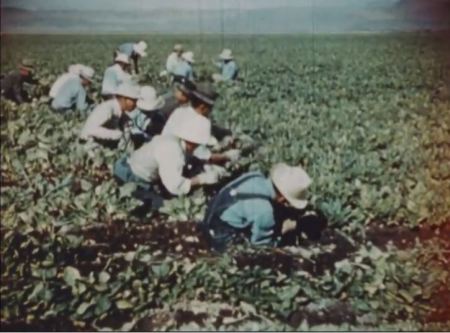
“A Challenge to Democracy,” by the War Relocation Board.  This film defends the relocation of 100,000 Japanese Americans during World War II.

Japanese-descended American citizens harvesting crops they grew during internment during World War II. Screen capture from "Challege to Democracy."

Japanese-descended American citizens harvesting crops they grew during internment during World War II. Screen capture from “Challege to Democracy.”

“These people are not under suspicion,” the narrator says.  “They are not prisoners, they are not internees.  They are merely dislocated people, the unwounded casualties of war.”

According to the Internet Archive, the film is a 1944 production.  That site has the film available for download in several formats.  The film is collected in the Prelinger Archives.  On my computer, some of the Internet Archive versions offer  better quality than the Google Video version above.

I originally found the film at a school site in Washington, Mr. Talmadge’s Wikispace site, apparently for his classes in the history of the State of Washington.  That site has a very useful series of links to good sites on the internet for information about the Japanese internment.  There are several other topics noted there, too, including the Chinese Exclusion Act, the Whitman Massacre in Oregon, and the Nez Perce Retreat.  I’d love to see Mr. Talmadge’s plan for the year.

What do your students do to display their work on the internet?


Bell Ringer: Bermuda Triangle, Area 51, Marfa, and other cool mysteries

May 17, 2009

If a day goes by that I don’t get a question about one of these sites, it’s a very slow day.

Those questions tell me something else:  Students have genuine interests in geography, and in mysteries.  Students will pay attention to lesson plans that include one or more of these sites in them, especially if you refer to the mystery.

How about just a geography search:  How close is the closest site to you?  Can students visit these sites on their summer vacations?  What airport is closest for tourists?  What arrangements need to be made to visit the place?

Wired.com provides the video — your students have the questions.  Can you provide the answers, or lead them to the answers?  How about listing your answers in comments?

Answers, or more information:


Desperation in AGW denial ranks?

May 17, 2009

One might hope it is a sign of desperation, and not just one more ratcheting up on the dishonesty scale.

Anthony Watts has a post that looks at Boston Harbor, a post borrowed from a sleepy blog called Climate Sanity, by Tom Moriarty.  Watts, a leader among denialists, notes the warnings about sea level rising, and then offers maps of Boston as evidence everyone is safe.

The maps show the shoreline expanding around the peninsula where the main part of Boston sits.

Consequently, the authors claim, rising sea levels won’t do damage anyone should worry about.

Changes in Boston Harbor, from the denialist blog Climate Sanity

Changes in Boston Harbor, animation from the denialist blog Climate Sanity

It’s an odd sort of claim.  Anyone with any knowledge of the growth of harbor cities will look at the maps and notice the extension of lands from fill. Watts and Moriarty do not specifically claim that ocean levels have no effect, though some reading the headlines alone may get that idea.  They argue that humans will respond to negate the bad effects of climate change. 

That’s not what the maps show at all. The maps show that, in the absence of wetlands protection, people will use fill to expand commercial opportunities at a busy harbor.  That is true whether the fill requires the destruction of local landmarks, or whether the fill arrives accidentally from other major natural events.

The climate change denialists’ claims make an argument based in deception.  Harbor areas are always better fortified against sea and weather changes than other areas.  Boston Harbor is a comparatively small area, when contrasted with the Atlantic coastline of North America.

Do they know they’re just pulling our leg?  Or is this one more sign of the desperation denialists get over the realization the facts are against them?

At root the argument fails, and fails offensively: Watts and company argue that climate change and rising sea levels are not a problem, if we have enough concrete and fill to expand land close to the water and harden seawalls.  We also would need a lot of commercial development to make it cost effective to fill in the threatened lands.  That sort of development will involve only a very small area of any nation’s coastline.

Of course, that sort of hardening of sites is exactly what the wetlands protection under Section 404 of the Clean Water Act aimed to slow or stop, and it is part of the cause of trouble in the Mississippi Delta and other places unhardened, where the effects of hardening ports are pushed.

Watts also fails to account for the more serious immediate issues:  It’s not permanent inundation that we need to worry about with ports, but rather, the effects of stronger storms with higher sea levels.  The U.S. Environmental Protection Agency has been on that issue for years.  Boston Harbor is an example of a place that we need to protect from effects of climate change, at great expense, in order to preserve the filling done in the past and the development on that filled-in land that once was sea.

For examples, consult the white paper from EPA in July 2008, “Planning for Climate Change Impacts at U.S. Ports.  From the very first lines, you can begin to see why the denialists’s claims don’t wash:

Over the coming decades, climate change is likely to cause sea levels to rise, lake levels to drop, more frequent and severe storms, and increases in extreme high temperatures. These effects can have mild to severe impacts on port infrastructure and operations, depending on their geographical setting and design. Ports are critical to the trade and transportation networks of the United States. Specifically, ports handle 78% of all U.S. foreign trade by weight and 44% by value.1 The United States’ ports also represent billions of dollars in capital improvements and new investments. While the risk that climate change poses to ports is unclear, what is clear is that ports need to better understand climate change, how it may impact them, and what they can do to ensure reliable services for their customers.

Stakes are too high for analysis so shallow as simple map overlays.  In reality many factors mean that ports and harbors are threatened from many different problems arising from climate change.  The EPA white paper lists specifics.

Changes in water level:

The most immediate concern related to rising sea levels is the need to raise the level of infrastructure to prevent flooding. Ports will need to consider anticipated sea levels when building new infrastructure. In cases where current infrastructure may not be high enough for its useful lifespan, ports will need to increase infrastructure heights.

Higher sea levels may threaten ports’ environmental mitigation projects. Also, many ports have contaminated or potentially contaminated industrial land on their premises.17 Higher water levels may require new containment methods to prevent leeching of contaminants.

Many climate models predict that climate change will cause water levels to drop in the Great Lakes and the Mississippi River Basin, which would make shipping there more difficult. When lake levels decreased from 1997-2001, ships in the Great Lakes were forced to carry less cargo. Future decreases in water level would again require cargo restrictions or perhaps the redesign of vessels. Either one would increase the cost of shipping on interior waterways. Decreased depths could be mitigated by increased dredging, but at a financial and environmental cost.

Storm events and precipitation:

Globally, extreme precipitation events are expected to become more frequent, and severe storms are expected to become more intense. Stronger wave action and higher storm surges, especially when coupled with higher sea levels, are the primary threat to ports. These impacts can damage bridges, wharfs, and piers, terminal buildings, ships, and cargo. Harbor infrastructure may need to be raised or reinforced to withstand these impacts.

In addition to contributing to storm surge, wind can also have its own damaging impacts. High winds particularly threaten unreinforced terminal structures. For example, Hurricane Katrina tore roofs and doors off warehouses at the Port of New Orleans. One possible response to these threats is to change design standards for terminals, cranes, lighting systems, and other infrastructure to incorporate the risk of stronger storms.

Higher temperatures:

Higher incidences of extreme high temperatures could also affect some auxiliary port infrastructure. For example, paved surfaces may deteriorate more quickly in hotter conditions. Cranes and warehouses made of metal may require design changes to withstand higher temperatures. Higher temperatures may also require more energy for cooling of goods stored at ports.

Higher temperatures could impact the human and natural environments associated with ports as well. Many employees at ports work primarily outdoors. Operational changes may be required to protect workers from extreme heat. Warmer temperatures may also increase the risk of transferring invasive species from region to region on cargo vessels.

For ports in northern states, including Alaska, higher temperatures could provide some benefits. Operating conditions may improve as ice accumulation on port infrastructure decreases. Shipping seasons would lengthen as more ports and waterways become ice free for more of the year. These effects could increase volume and reduce costs for northern shipping.

Indirect impacts, including insurance:

Ports are also likely to face changes in insurance coverage and possible higher insurance premiums because of climate change. The insurance industry is one of the leading commercial sectors expressing concern about and exploring adaptive responses to climate change. Several large companies that provide business insurance services are incorporating risk from climate change into insurance offerings. Strategies include shifting a greater share of risk onto customers and providing technical support and pricing incentives for customers to reduce their exposure to climate-related risks.

Denialist arguments frequently come with unintended irony.  Part of Boston Harbor was filled in by a the New England hurricane of 1938.  Castle Island, one of the areas the animation highlights as being filled out, ostensibly by humans, is connected to the mainland now as a testament, a warning of the potential for nature to change the place quickly, contrary to the plans of humans.  One day in 1938 a hurricane converted the place from an island to a peninsula.  Is this really the best the denialists have to persuade us that we shouldn’t be concerned about the power of nature now?

Climate warming is real.  The effects of warming are real and quite problematic already.  Filling in wetlands around busy harbors, even just to raise elevation, is not a viable solution to the problems, regardless their cause.

Resources:


Kerouac played fantasy baseball – four decades early

May 17, 2009

Who knew?

Three of Jack Kerouac’s fantasy baseball team cards, circa 1953-56. New York Public Library, Berg Collection, Jack Kerouac Archive

Three of Jack Kerouac’s fantasy baseball team cards, circa 1953-56. New York Public Library, Berg Collection, Jack Kerouac Archive

Kerouac fans, and anyone who participates in a rotisserie league sport, and anyone who just wants a moment of merriment, should read this New York Times story:

Almost all his life Jack Kerouac had a hobby that even close friends and fellow Beats like Allen Ginsberg and William S. Burroughs never knew about. He obsessively played a fantasy baseball game of his own invention, charting the exploits of made-up players like Wino Love, Warby Pepper, Heinie Twiett, Phegus Cody and Zagg Parker, who toiled on imaginary teams named either for cars (the Pittsburgh Plymouths and New York Chevvies, for example) or for colors (the Boston Grays and Cincinnati Blacks).

At least one more book Kerouac had inside, unwritten.  Now we just see the outline of what could have been a superb, and funny, work of fiction, in a book by New York Public Library curator Isaac Gewirtz.  The Kerouac items are in the Berg Collection at the Library.

No historian could make this stuff up.


Cartoons: Bill Mauldin on DDT

May 16, 2009

Bill Mauldin rose to fame drawing cartoons from the fronts during World War II, first as a soldier, and then as the cartoonist for Stars and Stripes.  He won the Pulitzer Prize for cartooning in 1945.  After the war he continued to be a major force in American culture, eventually cartooning for the St. Louis Post-Dispatch and quickly winning a second Pulitzer, and then with the Chicago Sun-Times, with drawings syndicated to other newspapers around the world.

In 1962 Mauldin turned his pen to DDT and the controversy created in part by Rachel Carson’s best-selling book Silent Spring.

CREDIT: Mauldin, Bill, artist. Another such victory and I am undone Copyright 1962, Field Enterprises, Inc. Prints and Photographs Division of the Library of Congress.

CREDIT: Mauldin, Bill, artist. “Another such victory and I am undone” Copyright 1962, Field Enterprises, Inc. Prints and Photographs Division of the Library of Congress.


History: May 15, 1963, President’s council vindicates Rachel Carson, warns of pesticide dangers

May 15, 2009

President John F. Kennedy’s Science Advisory Council (PSAC) studied Rachel Carson’s best-selling book, Silent Spring, checking it for scientific accuracy.  Kennedy read the book himself, but sought expert advice before doing anything.  Meanwhile, DDT manufacturers bankrolled an extensive public relations campaign claiming DDT was safe, and suggesting Carson was less than a careful writer and scientist.

On May 15, 1963, PSAC reported:  Carson was right. Pesticides were being misused, even abused, and some pesticides like DDT presented significant threats to the environment.  “The Use of Pesticides” recommended increased government scrutiny of the safety and efficacy of pesticides, and vindicated Carson’s reporting of science findings.

Library of Congress described the event and its import in America’s Library, “Meet Amazing Americans”:

The Consequences of Silent Spring

Reading Carson’s book changed many people’s ideas about the environment and inspired some to take action. People wrote to their representatives in congress and asked them to do something about the misuse of pesticides. When several senators created a committee to research environmental dangers, they asked Carson to speak to them about pesticides. Carson recommended that the government regulate and reduce pesticide use, and that it ban the most toxic pesticides. She said that a citizen of the United States had the right “to be secure in his own home against the intrusion of poisons applied by other persons.”

President Kennedy understood the importance of Carson’s book. He asked his Science Advisory Committee to research Carson’s claims in Silent Spring. In 1963 the Committee released a report called “The Uses of Pesticides.” It supported Silent Spring. Environmental activists continued to push the government to regulate pesticides. Changes in federal law in 1964 required companies to prove that something did not cause harm before they could sell it. In 1972, activists pushed for and won a ban on DDT, the pesticide that started Carson’s research for Silent Spring. And in 1970 the Environmental Protection Agency (EPA) was created “in response to the growing public demand for cleaner water, air and land.” Who knows what the world would be like today if Rachel Carson had not written Silent Spring?

 
Some radicals argue that Rachel Carson’s legacy is tarnished, that she was in error about DDT, and somehow that translates into many deaths as a result of malaria, as if DDT worked against malaria parasites themselves.  With such a strong propaganda campaign of disinformation plaguing us today, we do well to pause and remember that Carson’s work was subjected to intense, careful scrutiny by scientists from the start.  Carson’s reporting was accurate, and her legacy of environmental protection and saving lives should be celebrated.

Teaching Resource: Role play simulation, “Advisory Committee on Pesticides 1963,” (see especially the list of historic and scientific resources available for study and for the simulation, from Douglas Allchin).

Rachel Carson in the ocean in Florida, 1955 - photo, R. G. Schmidt, USFWS

Rachel Carson in the ocean in Florida, 1955 – photo, R. G. Schmidt, USFWS

Updates, January 2013:

More, from 2013:

Save


History: May 15, 1953 and the mysteries of life’s beginnings

May 15, 2009

May 15, 1953, saw the publication in Science of Stanley Miller’s dramatic experiment showing that essential chemicals of life rise spontaneously.

The late Prof. Stanley Miller.  ISSOL photo

The late Prof. Stanley Miller. ISSOL photo

As usual, the real history is better and much more serendipitous than anyone could imagine in a fictional account; here’s an account from the International Astrobiology Society (ISSOL), from their 2003 celebration of the 50th anniversary of Miller’s paper’s publication:

The University of Chicago Chemistry Department seminars were held on Mondays in Kent Hall, an old building where the floors creaked and there was a smell of dust and mildew. Only the most distinguished scientists were invited to speak at this seminar, many had Nobel prizes or were to receive one, and the list included Franck, Urey, Calvin, Seaborg, Eigen, Libby and Taube.

But this day was different because a second year graduate student, Stanley Lloyd Miller, was speaking, and the room was full because the word had spread that something important was to be presented. In addition to the famous scientists and less famous but equally high-powered scientists was an undergraduate, Carl Sagan attending his first chemistry seminar. The topic was the synthesis of important biological compounds, using conditions thought to have existed on the primitive Earth.

Miller reported that by sending repeated electric sparks through a sealed flask containing a mixture of methane, ammonia, hydrogen, and water vapor, he had made some of the amino acids found in proteins. Perhaps, he suggested, this was how organic compounds were made on the ancient Earth before life existed.

While Miller was confident of his results, the rows of famous faces in his audience were, to say the least, intimidating. He was bombarded with questions. Were the analyses done correctly? Could there have been contamination? After the event, Miller thought that the questions had been constructive, but since the results were hard to believe, they had simply wanted to ensure that he had not made some mistake. However, Carl Sagan thought that Miller’s inquisitors seemed to be picky and did not appreciate the significance of the experiment. Even the relevance of Miller’s results to the origin of life were questioned. When someone asked Miller how he could really be sure this kind of process actually took place on the primitive Earth, Nobel Laureate Harold Urey, Miller’s research advisor, immediately interrupted, replying, “If God did not do it this way, then he missed a good bet.” The seminar ended amid the laughter, and the attendees filed out with some making complimentary remarks to Miller. Miller changed clothes, went back to the lab and started a paper chromatography run.

The events leading up to this dramatic seminar began two years earlier in October, 1951 when Urey presented the Chemistry Department seminar on the origin of the Solar system. In addition to the usual high powered scientists, the audience had contained the then first year graduate student, Stanley Miller.

Read “Prebiotic Soup—Revisiting the Miller Experiment” by Jeffrey Bada and Antonio Lazcano published in Science300 (2003) 745-726 in full text or as a PDF.

This is an abridged version of the Stanley Miller’s 70th Birthday published in Origins of Life and Evolution of the Biosphere 30: 107-112, 2000 by Jeffrey Bada and Antonio Lazcano and The Spark of Life – Darwin and the Primeval Soup by Christopher Wills and Jeffrey Bada, Perseus Books, 2000.

More than 50 years ago scientists demonstrated that basic chemicals of life, thought previously by some to be too complex to arise naturally, could occur in nature spontaneously. Much of the misunderstanding and crank science behind creationism is devoted to hiding these facts.

Lift a glass to Stanley Miller and his experiment today, a toast to learning, a toast to the truth.

More Resources:


Climate Denial Crock of the Week: Ocean levels

May 10, 2009

Blue Ollie carried a YouTube video that got me to look at Peter Sinclair’s marvelous series of amateur videos, “Climate Denial Crock of the Week.” Sinclair posts under the handle GreenMan at YouTube.

Here’s the Climate Denial Crock of the Week video on ocean levels, and the denial that they are rising — in line with my post a few hours ago about peoples in the South Pacific and in Alaska losing their homes to climate change:

Pat Frank’s work keeps reminding us that, in science, it’s often difficult to establish a clear, indisputable proximate cause.  Something is going on in Newtok, Alaska, and in the Carteret Islands, Papua New Guinea.  Those things should not be ignored, and cannot be ignored safely for long.

(Teachers:  Note most of these videos are around 5 minutes in length — more than suitable for classroom use, perhaps even as a bell ringer.  Notice also that, if you don’t know how to make these videos, as I don’t, you’re behind the curve.)


What if we changed the climate and no one paid attention?

May 10, 2009

Rush Limbaugh, Pete DuPont, Michael Savage, the Discovery Institute and other great exponents of reality denial (generally, but not always, without drugs) will continue to rail at James Hansen’s science chops, but the universe goes on in the Real World™Global warming, climate change, takes a severe toll on inhabitants of this planet.

It’s a tribute to the propaganda value of Anthony Watts that this milestone earned so little note:  Residents of Carteret Island, Papua New Guinea, began their move to higher ground last week. The rising ocean is reclaiming their land; seasonal high tides make agriculture impossible.

Who noticed?

You can read about the refugees in The Solomon Times.  You can read about it in the Papua New Guinea Post -Courier. You can’t read it about it much of anywhere else.  The revolution is not televised, it’s not even in print.

Meanwhile, in Alaska, without serious action by the world to enact some sort of program out of the Kyoto meetings to combat climate change by nations united, indigenous peoples are meeting to figure out what they can do without government help.  The place of their meeting carries a message:

The summit is taking place about 500 miles from the Alaskan village of Newtok, where intensifying river flow and melting permafrost are forcing 320 residents to resettle on a higher site some 9 miles away in a new consequence of climate change, known as climigration.

Newtok is the first official Arctic casualty of climate change. A U.S. Army Corps of Engineers study indicates 26 other Alaskan villages are in immediate danger, with an additional 60 considered under threat in the next decade, Cochran said.

Here’s how the warming denialists’ diary entries should run:

“Climate change chased the Carteret Islanders out of their homes, but I wasn’t concerned because I am not a Carteret Islander, and probably couldn’t find the place on a map.”

Further reading:

http://alphainventions.com/rss


Lusitania – sunk 94 years ago today

May 7, 2009

We’re talking about the sinking of the Lusitania, and the role that incident played in getting the U.S. into World War I.

Coincidence:  Look at the date today.

Enlistment poster, after the sinking of the Lusitania

Enlistment poster, after the sinking of the Lusitania

94 years ago today.  U-20 sank the Lusitania, champion of the Cunard Line, on May 7, 1915.

World War I appears to have been a heyday for propaganda posters.  Google up “Lusitania +poster” and you can find a wealth of recruiting posters and just plain propaganda posters.  If only we had the time, there are a couple of lesson plans waiting in that search.

Note:  Details on the poster: Artist, Fred Spear, 1915; “Enlist,” published by Sackett & Wilhelms Corp.

Other resources:

  • All Lusitania, all the time:  Lusitania blog

  • True, but did Einstein say it?

    May 6, 2009

    Poster by Ricardo Levins Morales. Updated March 2015 - click image to purchase a copy of the poster from Mr. Morales.

    Poster by Ricardo Levins Morales. Updated March 2015 – click image to purchase a copy of the poster from Mr. Morales.

    Nice poster, great thought — you can’t measure everything about a student with a test, nor with a battery of tests.  Texas testing in core areas finished up last week, Advanced Placement and International Baccalaureate testing runs this week.

    Not everything that can be counted, counts, and not everything that counts can be counted.
    – Albert Einstein

    I especially thought of this quote one day last week while reading the questions to a kid with Downs syndrome who, as best I could measure from just watching reactions working problems, has a great flair for mathematics, and again when I discovered a geographic genius in the special education group.  (My classes say universally the tests were easy — and for some reason I find that terrifying.)

    Did Einstein say it? I found the poster at Learning is More Than a Score; it can be purchased from the Northland Poster Collective.  Neither suggests where we might verify that Albert actually said it, though Bob Murphy at More Than a Score said he understands it may have been on the wall in Einstein’s office.  The artist is Ricardo Levins Morales (see more at Ricardo Levins Morales Galleries).

    Readers, can you help?  Did Einstein say that?  When and where?

    Update March 2015:  Quote Investigator urges that we attribute the quote to William Bruce Cameron, in a 1963 book.