Hudson’s Half Moon

November 25, 2008

New Yorkers, Vermonters and Candadians continue to celebrate 400 years since Hudson and Champlain, and 200 years since Robert Fulton brought steam power to the Hudson’s commercial ways.

Tugster: A Waterblog features some nice shots, and a couple of stunning shots, of the reconstruction of Henry Hudson’s ship, Half Moon.  Great stuff for presentations, and he likes to share.

Tugster is an outstanding repository of images of tugboats, ships and other things related to the commerce of Greater New York Harbor, and boats on the water generally.  Tugster’s collection of images should be regular source material for teachers of history, economics, geography and government.

A Waterblog

Stern of Half Moon, Henry Hudson's ship; from Tugster: A Waterblog

Notice how the figurehead frightens even the trees to blazing red.

A Waterblog

Bowsprite of Henry Hudson's Half Moon, via Tugster: A Waterblog

Tugster tells us that Henry Hudson himself is blogging, channeling across 400 years — perhaps tired of duckpins with his crew in the Adirondacks (hello, Rip van Winkel!).  Can your students correspond with Henry Hudson?

Resources:


Good Interred With Their Bones Dept.: Michael Crichton

November 24, 2008

https://i.ytimg.com/vi/9qtgQXtrl4Q/hqdefault.jpg

Author Michael Crichton railing against environmental protection and science he politically disagreed with, at the Smithsonian Institution, about the same time as his Commonwealth Club presentation.

One of my news grabbers found an article on environmentalism and religion at a Live Journal site, an answer to a speech by Michael Crichton on environmentalism as religion.  Crichton’s speech was delivered in 2003 to the Commonwealth Club in San Francisco, a venerable old institution for giving a soap box to doers and thinkers. [Note, April 2015: If that link doesn’t work, find Crichton’s speech here.]

Crichton’s speech started out with promise:

I have been asked to talk about what I consider the most important challenge facing mankind, and I have a fundamental answer. The greatest challenge facing mankind is the challenge of distinguishing reality from fantasy, truth from propaganda. Perceiving the truth has always been a challenge to mankind, but in the information age (or as I think of it, the disinformation age) it takes on a special urgency and importance.

We must daily decide whether the threats we face are real, whether the solutions we are offered will do any good, whether the problems we’re told exist are in fact real problems, or non-problems. Every one of us has a sense of the world, and we all know that this sense is in part given to us by what other people and society tell us; in part generated by our emotional state, which we project outward; and in part by our genuine perceptions of reality. In short, our struggle to determine what is true is the struggle to decide which of our perceptions are genuine, and which are false because they are handed down, or sold to us, or generated by our own hopes and fears.

As an example of this challenge, I want to talk today about environmentalism.

The promise was short-lived.

Crichton described his learnings from studying anthropology, including an observation that religions always arise, and cannot be stamped out.  From there he makes an astounding leap, to claim that environmentalism is religion.  From that failed leap, the speech rapidly deteriorates.  He adopts tenets of American Christian and political fundamentalism, rapidly following up with a disavowal of fundamentalism, as if to try to hide what he’s done, or deny it, at least for himself:

So I can tell you some facts. I know you haven’t read any of what I am about to tell you in the newspaper, because newspapers literally don’t report them. I can tell you that DDT is not a carcinogen and did not cause birds to die and should never have been banned. I can tell you that the people who banned it knew that it wasn’t carcinogenic and banned it anyway. I can tell you that the DDT ban has caused the deaths of tens of millions of poor people, mostly children, whose deaths are directly attributable to a callous, technologically advanced western society that promoted the new cause of environmentalism by pushing a fantasy about a pesticide, and thus irrevocably harmed the third world. Banning DDT is one of the most disgraceful episodes in the twentieth century history of America. We knew better, and we did it anyway, and we let people around the world die and didn’t give a damn.

I can tell you that second hand smoke is not a health hazard to anyone and never was, and the EPA has always known it. I can tell you that the evidence for global warming is far weaker than its proponents would ever admit. I can tell you the percentage the US land area that is taken by urbanization, including cities and roads, is 5%. I can tell you that the Sahara desert is shrinking, and the total ice of Antarctica is increasing. I can tell you that a blue-ribbon panel in Science magazine concluded that there is no known technology that will enable us to halt the rise of carbon dioxide in the 21st century. Not wind, not solar, not even nuclear. The panel concluded a totally new technology-like nuclear fusion-was necessary, otherwise nothing could be done and in the meantime all efforts would be a waste of time. They said that when the UN IPCC reports stated alternative technologies existed that could control greenhouse gases, the UN was wrong.

I can, with a lot of time, give you the factual basis for these views, and I can cite the appropriate journal articles not in whacko magazines, but in the most prestigious science journals, such as Science and Nature. But such references probably won’t impact more than a handful of you, because the beliefs of a religion are not dependent on facts, but rather are matters of faith. Unshakeable belief.

From the promising start of claiming we must be skeptical and carefully sort out what is true from what is not true, he rapidly plunges from the stratosphere into the depths of the ocean of misinformation.  Count the errors:

  1. Newspapers have been regular carriers of claims that restrictions on DDT are unnecessary.  You won’t find such claims in science journals, in fact — they appear almost without exception in newspapers.  Crichton is wrong about where you’d learn that DDT is harmless.  You can’t learn it from people who know.
  2. DDT is a “probable human carcinogen” listed by every cancer-fighting agency on Earth.  Fortunately for humans, it appears to be weakly carcinogenic.  Recent studies indicate it’s devious in its carcinogenicity, too — it gives cancers not to the people who were exposed, but to their children.  Research into this path is only about a decade old.  Recent studies confirm carcinogenicity in humans.  Carcinogenicity in almost every other animal exposed has been long known.  It is highly unlikely that a compound known to cause cancer in every mammal tested, would not be carcinogenic in humans.  Again, you can’t learn this stuff in science journals.  You’ll have to learn it as dogma from cranks and crackpots.
  3. DDT’s links to the deaths of young birds is rock solid.  The links were clear by 1962, and no study has been done since 1962 to question those conclusions.  In fact, more than 1,000 studies have been done on the links, and published in peer-review journals.  Each one supports Rachel Carson’s conclusions that DDT is deadly to young birds.  The mechanisms are now known by which DDT causes eggshell-thinning, which increases the chick mortality.  Recovery of the bald eagle, osprey, and brown pelican correlate exactly with the decline of DDT in the tissues of the birds.  No scientist who has studied the matter doubts that DDT kills birds.
  4. DDT was banned because it disrupts eco-systems.  In the wild, it is uncontrollable.  Yes, it kills pests.  But it also kills all the pest predators, too.  The pests use reproduction as a survival tool, and outreproduce predators, and even DDT.  An application of DDT, then, kills off the predators that protect an ecosystem from the pests, and the pests come roaring back, unchecked by nature.  The poison is magnified as it rises through the food chain (trophic levels, if you want the science term).  By the time an eagle or predator fish eats, it gets a crippling dose of the stuff.  By the mid-1960s, insects and arachnid pests around the world had begun to show resistance and even immunity to DDT (bedbugs demonstrated resistance by 1950; some are completely immune to DDT; almost all mosquitoes now carry multiple copies of a gene which allows mosquitoes to digest DDT as a nutrient, doing no harm).  The restrictions on DDT had nothing to do with human cancers, but everything to do with saving crops and forests, and the wildlife that lives there.  Crichton pulls an old bait-and-switch when he claims regulators knew DDT “wasn’t carcinogenic and banned it anyway.”  The regulators knew it might be a weak carcinogen, but they did not know it spreads through the environment and lasts almost forever, contaminating even human breast milk for at least six decades after application.  But this was not their concern.  The dangers of carcinogenicity were on top of the concerns about agriculture and forests and prairies.  Regulators acted to save the world we live in, and noted that such action also produced a minor reduction in cancer risk.
  5. DDT use in Africa never reached the nations where most malaria victims die today, at least not by 1972.  The ban on spraying DDT on cotton has nothing to do with malaria rates today, except that contrary to Crichton’s claim, it was the DDT use that aided malaria, not its cessation.  So for Crichton to claim that stopping the use of DDT on U.S. cotton crops led to a rise in malaria in Africa is a stretch of evidence way, way beyond any logical link.  Chaos theory only jokingly suggests the butterfly’s fluttering in Beijing last month affects weather in New York this month.  Boll weevils in the U.S. don’t carry malaria anyway, let alone fly to Africa to infect children there.
  6. Crichton dogmatically insists smoke is not a health hazard to non-smokers.  You won’t find much research to back his claim.  It’s another claim he makes religiously, on belief, not on evidence.  He can tell us second-hand smoke is not dangerous, but he can’t back the claim with evidence.  (Dangers of second-hand smoke have been well known since the 1970s; when Orrin Hatch got the law passed to switch to four, rotating warnings on cigarette packages, the debate was whether to include a fifth warning of second-hand smoke.)
  7. Urbanization figures cited by Crichton are low, and do not consider the damage done by urbanization to non-urban lands.  Low?  In one study, planners looked at Tippecanoe County, Indiana.  Recently, urban land use there rose from 8% to 12% — starting from a baseline larger than Crichton allows.  Crichton might argue that counties in North Dakota lose people, but the pollution and erosion from the urbanization in West LaFayette, Indiana, cannot be offset by relatively stable rural areas 600 miles away (I’m plucking a figure out of my hat), in a completely different watershed, in a completely different airshed, in a completely different climate, in a different economy.  Any soldier  or farmer can tell you that concentrating activities of people in a smaller area multiplies the impacts.  If you have 40 cows roaming over 6 acres, you don’t need to worry so much about where they leave their pies, or the concentration of ammonia in their urine.  If you put those same 40 cows in one small pen, however, you’ve just created a runoff problem, and health problems for the cows and the people who handle them.  Wholly apart from the numbers games, the facts show that urbanization increases the need for green and wild space for the people who move into the citiesTwo different presidential commissions reporting 25 years apart noted the needs, and the needs are only more fierce now (the link is to an article by Charles Jordan, who was one of the commissioners on the President’s Commission on Americans Outdoors which reported in 1987, the second of the two studies referred to — see Jordan’s article for full details).
  8. If the Sahara is shrinking, that doesn’t help much.  South of the Sahara, in Niger, an area the size of Luxembourg is lost to desertification every year.  Deserts are advancing in Arizona, California, China (both the Gobi and the Taklamakan), and across the rest of Central Asia to Africa.  If the Sahara is shrinking, that’s probably good.  It’s not enough to suggest that desertification is not a problem, even in North Africa.  Ultimately, it’s not how much land is affected, but rather it is the effects themselves, and how they affect humans.  Desertification — which is defined by international agencies as the degradation of land — affects 16.5 million people in Europe alone.  According to the UN, desertification threatens the lives and livlihoods of about out of every six people on Earth — 1.2 billion people total.  How does the Sahara’s shrinking help them?  Is Crichton just pulling another bait-and-switch?
  9. The total ice on Antarctica is increasing because the waters around the icy continent are warming — “lake effect” increases snowfall when increased evaporation from warmer waters is carried by the air over land.  The rather dramatic increases in ice pack on parts of Antarctica are stark testimony to the ill effects of global warming.
  10. If Crichton is right, and no existing technology will allow us to reduce carbon emissions, then we need to hit the panic button, not the snooze button.

Those are just the factual errors in two paragraphs.  Environmentalism as religion?  Maybe that would be a good idea, if the religion honored accuracy and truth telling, rather than fictional accounts of what is going on on Dear Old Planet Earth.

I enjoyed Michael Crichton’s writing, and I hope his stories inspire kids to work at a life in science.  But, as with Caesar, as Antony noted, the bad stuff people do lives on past them.  Let’s change that for Crichton – kill the bad stuff, keep the good stuff.

The evil that men do lives after them;
The good is oft interred with their bones.

William Shakespeare
Julius Caesar, Act III, Scene 2

Update, April 4, 2013:  American Elephants, a blog that isn’t about elephants, isn’t about their conservation, and in my view, isn’t much about America, either, fell victim to Crichton’s errors, all these months later. Plenty of time to get the story right since 2008, but American Elephants couldn’t do it.  American Elephants is too often an example of the Dunning Kruger effect, alas.

Other sites that still get it wrong, five and six years later:


Typewriter of the moment: Poet Edgar Guest

November 21, 2008

Poet and columnist Edgar Guest, in Detroit, 1939; photo for Life Magazine by Bernard Hoffman

Poet and columnist Edgar Guest, in Detroit, 1939; photo for Life Magazine by Bernard Hoffman

Archives of Life Magazine have been opened and made available for purchase, on Google, by Time-Warner.  The archives contain nice surprises like this photograph of popular poet Edgar Guest, at his typewriter in Detroit, in 1939. (You may browse the archives on Google by searching for a topic, and inserting into your search line, “source:life.”)

Guest published his first poem in the Detroit Free Press in 1898.  Between then and his death in 1959, he wrote and published more than 11,000 poems, syndicated to hundreds of newspapers.

Tip of the old scrub brush to Pseudo-Polymath.


Texas used to be full of ’em

November 20, 2008

Best of Texas features a tribute to Doug Tinker, “Lookout, Ann Richards, Another Texas Giant is Headed Your Way.”

I hadn’t heard the news (did you even bother to tell us, Dallas Morning News?).  If you’re not steeped in Tejaniana — or Texana, if you prefer — you may not have known about Doug Tinker.

He was the sort of guy who was the best of Texas.  Just telling the truth about him sounds like you’re telling a whopper – but it’s so satisfying to be able to tell such stories and know they’re the truth, too.

Best of Texas had a better vantage point than I had from here in the Bathtub — so read the story there (artfully dotted with links so you can check it out if you don’t think a human being could live that large).  And think:  Where would we be without good friends like Best of Texas, to tell the history worth the listening — and more, where would we be without good people like Doug Tinker, to make the history worth the telling?

Sometimes, people tell history so somebody will repeat it.  Then they tip their champagne bottle with the straw in it to the clouds and say, “Take that! George Santayana!”

The Ghost of Santayana laughs, too.

More:


Think about this: It’s World Philosophy Day

November 20, 2008

David Bain has the five baddest philosophy questions, with a couple of attempted answers, at the BBC’s site.  Bain is a lecturer in philosophy at the University of Glasgow.

How hard does one have to think to get a full professorship at Glasgow?  Ponder that.


Pulitzer-winner Doris Kearns Goodwin in Arlington, Texas – TONIGHT

November 19, 2008

If I didn’t have two other competing meetings, one which is rather life-or-death, I’d love to on my way to Arlington, Texas, and the University of Texas at Arlington, right now.

Tickets are free to hear Doris Kearns Goodwin, the eminent historian, lively lecturer, and author late of Team of Rivals, which must surely be one of the more enlightening and surprising biographies of Abraham Lincoln.

When the senator from the Land of Lincoln, Barack Obama meets with John McCain to smoke the peace pipe, and seems to be on the verge of inviting his chief rival, Hillary Clinton, into his cabinet, Goodwin’s lecture cannot be more timely.

And, probably, fun.

DR. DORIS KEARNS GOODWIN

Admission is free, but tickets are required. Go to www.utatickets.com for your free tickets.

Dr. Doris Kearns Goodwin (MOVED TO TEXAS HALL)

Pulitzer Prize-winning author and historian

November 19, 2008 · 8:00 pm · Texas Hall

Dr. Doris Kearns Goodwin

A recap of the presidential election and discussion of her book Team of Rivals: The Political Genius of Abraham Lincoln

Here’s a link to maps of UTA’s campus; you can get closer directions to Texas Hall there.


Geography lesson: New York City

November 19, 2008

Bookmark this site, geography teachers:  Farm School is going to New York City for the “American Thanksgiving” holiday.  Check out the long list of rich resources.

Any student or teacher doing a project on modern New York City should send a note of Thanksgiving to Farm School, eh?


Evolution, other science on trial – today, in Austin, Texas

November 19, 2008

The Texas State Board of Education (SBOE) hearings on proposals for new science standards kick off today — and will probably run long into the night.

You can probably still sneak comments in.  You can listen to the hearings in streaming audio, live.  You can read the live blog reports from Texas Citizens for Science (TCS) President Steve Schafersman.

Texas science teacher Joe Lapp (a member of TCS) will give the board some good advice — will they listen?

Lapp will say:

My name is Joe Lapp, but I go by Spider Joe. I teach children about spiders, about the biology and physics of a spider’s world. My mission is to stoke passion for science in children and to empower children to think like scientists. I like to think that I’m launching these children into productive future careers as scientists, and indirectly, through them, contributing to solving some of mankind’s most serious challenges.

I’m watching what is going on here in the State Board of Education. You’re vying over what to teach about science and about evolution in particular. Some of you say, “teach the weaknesses with evolution.” Some of you say, “the ‘weaknesses’ are phony, don’t teach them.” You argue over whether science includes the supernatural or is restricted to just natural phenomena.

I ask you, how many of you grew up to be scientists? How many of you make a living teaching science to children? In a world full of people who dedicate their lives to science or science education, how many of you on the board are one of these specialized experts?

I’m suggesting that you recognize that you yourselves don’t have the answers.

We all come to the table with preferences and biases, but we’re talking about our children’s education and their future lives. When a scientist approaches a question, she may have a preferred answer, one that might win her the Nobel prize. When Pons and Fleischmann performed their cold fusion experiment, they wanted to see more energy output than input. Their bias blinded them to the truth, and rather than winning the Nobel Prize they became laughing stocks. If a scientist wants to know the truth, she must design an experiment that might show her desired outcome wrong; she must delegate her answer to the outcome of an experiment that ignores her biases.

The State Board of Education has a choice. One option is to play politics with our children’s future and vote your bias, regardless of the truth. The other option is to delegate your answer to the outcome of an experiment that ignores your biases, so that the answer better reflects the truth.

Fortunately for you, you have already performed the experiment. You delegated answers to your questions about science and evolution to experts in science and science education. They answered in the form of your September TEKS drafts. I urge you not to suffer the embarrassing fate of Pons and Fleischmann and to accept your experimental results. I suspect that politics introduced biases into the November drafts. Don’t fudge your results.

Please show your respect for children and science by making this a scientific decision and not a political one. Launch children into science by example. Envision children growing up to create new biofuels, cure cancers, eliminate AIDS, end malnutrition, reverse global warming, and save our wondrous natural resources for future generations.

Science is our children’s future.

Resources:


Young Dallas orator meets Oprah

November 18, 2008

Dalton Sherman, the fifth grader from Dallas’s Charles Rice Learning Center, accepted an invitation to speak to a national audience through Oprah Winfrey’s television program, yesterday.

It was much the same speech he gave to Dallas teachers in August, edited for a broader audience.  Did you see it?  What did you think?

Did we mention earlier that his mother is a teacher in Dallas Independent School District?

Texas A&M sent a recruiting letter — he’s just seven years from graduation.  He said he thinks he can be the next Obama.  So that begins.  Good.


Obama went to the White House, and all you got was . . .

November 17, 2008

Oh, wait.  He’s still interested in recruiting your help.

Change you can count on.  Change you can believe in.  Change we need.

What sort of thing did that campaign unleash?  We’re still learning.


Public Lands insanity

November 16, 2008

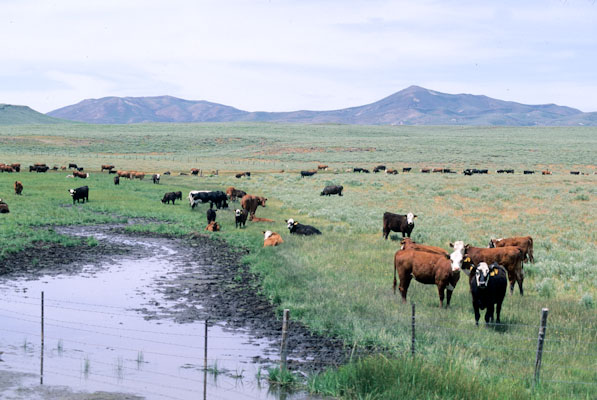
Remember when Strange Maps “discovered” that so much of the 13 western states is owned by the Federal Government?  On the one hand, it was nice to see people paying attention to public lands in the west.

Public lands in a western state, with grazing cattle. Wild Earth Guardians image.

Public lands in a western state, with grazing cattle. Wild Earth Guardians image.

Public lands.  Photo from the Montana Wildlife Federation

Public lands. Photo from the Montana Wildlife Federation

At the Bathtub, we remarked on the history of the issue with a map that showed where the publicly-owned lands really are (the Strange Maps version only showed a dot in the middle of each state proportionate to the federal land held in the state.)  On the other hand, it was an open invitation for know-nothings and know-littles to jump in with silly ideas.  Remarkably, the post remained free of such folderol — until just recently.

None of these sites gives any serious thought to the idea.  None provides a scintilla of an iota of analysis to indicate it would be a good idea.

As one of the the principal spokesmen for the Sagebrush Rebellion in the early days, I want it known that I’ve thought these issues through, and argued them through, and followed the documentation for 30 years (Holy frijole!  I’m old!).  Issues with public lands revolve around stewardship.  Bad stewardship is not improved by a change in ownership.  Ownership change has all too often only led to worse stewardship.  Selling off the public lands is a generally stupid idea.

Certain local circumstances change the nature of a tiny handful of such deals — but not often, not in many places, and not enough to make a significant contribution to retiring any debt the federal government owns.

On the other hand, incomes from these lands typically runs a few multiples of the costs of managing them.  The Reagan administration discovered the lands were a great source of money to offset losses in other places, and for that reason (I suspect) never really got on the Sagebrush Rebellion band wagon — or, maybe Reagan’s higher officials just didn’t get it.

It’s troubling that such a flurry of stupidity strikes now, during a transition of presidents. This is how stupid ideas get traction, like kudzu on a cotton farm, while no one is paying deep attention.  Let’s put this idea back into its coffin with a sagebrush stake in its heart.

Bottom line:  Keep public lands in federal trust.  The Sagebrush Rebellion is over.  The sagebrush won.

_____________

Speaking of presidential transitions, who should be Secretary of Interior?  Stay tuned.

More:

Update 2014: The original GSA map showing percentages of federal holdings in each state (including Indian Reservations as federal holdings), as published in Strange Maps when it was still active.

Update 2014: The original GSA map showing percentages of federal holdings in each state (including Indian Reservations as federal holdings), as published in Strange Maps when it was still active.


Happy birthday, Walter Cronkite (a bit late)

November 12, 2008

Missed this one.  But contrary to what most of my journalism profs said, I think news is news so long as people don’t know it.

Walter Cronkite - undated photo via Mediabistro

Walter Cronkite - undated photo via Mediabistro

Walter Cronkite turned 92 on election day, November 4.

Astounding.  He’s still active in news, though heaven knows CBS doesn’t use him as they should (where was he on election night?).

I’ve been interested to see the prominence he gets, now, in history accounts of the Vietnam war.  At the same time, it’s painful that we have students whose parents didn’t grow up with Cronkite on the air.  They’re a generation removed from knowing what they missed.

My one brief Cronkite story:  Late one afternoon I was preparing for a hearing at the Senate Labor Committee for the next morning, preparations that had been slowed by a fair deal of breaking news around Reagan’s Labor Secretary Raymond Donovan, whose potential links to crime organizations had been hidden from the committee during his nomination hearings (Donovan was acquitted of wrongdoing in a later trial).  Chaos might be the best way to describe the events, especially in the news area.   A lot of misinformation was passed around, about what were the position and concerns of Labor Committee Chairman, Sen. Orrin Hatch (my boss), what was the position of the White House, what was the evidence and what wasn’t the evidence on Donovan, etc.

I turned on the television to catch Cronkite’s broadcast.  About five minutes in, the phone rang.  It was Rita Braver, then a CBS producer, and she really gave me the third degree about some minor point on the Donovan story — a minor point, but one that had been reported incorrectly by others (I forget now what the issue was).  I had known Braver, chiefly on the phone, for some time.  I found her extremely careful with the facts, which was comfortable considering where she sat in CBS’s ranks; the stuff she worked on was on the evening news regularly.  We talked for a few minutes, and then rather abruptly she yelled “Hang on!”  and put me on hold.  The newscast I was watching went to a commercial break, and as sometimes happened, the camera pulled away, and Cronkite on the air reached for the telephone on his desk.  The commercial came on simultaneously with the voice on the phone:  “This is Walter Cronkite.  Mr. Darrell, I have a question about this report I’m holding.  I think Rita has spoken with you about it.”  We talked about the issue for just about a minute, he thanked me.  As the show came out of the break, Cronkite read the news about Ray Donovan that day, with Hatch’s views.  He got it right, of course.

Do most people realize how intensely most news operations work to get even the small stuff right?

It was really odd watching Cronkite reach for the phone, and then hear him on my phone.

Other Cronkite news:


Tonight! Science educators, go see Barbara Forrest at SMU!

November 11, 2008

Reminder:  Dr. Barbara Forrest, the noted science historian whose testimony was key to the decision in the Dover, Pennsylvania, evolution trial, is speaking at 6:00 p.m. at SMU tonight, November 11, 2008.

If you’re in Dallas, go.

Also, I got word today that Texas teachers can pick up CEU credits for this event, sponsored by the science and philosophy departments at SMU together with the Texas Freedom Network. Check in at the registration table.

Forrest’s presentation will serve as a warning to Texas: “Why Texans Shouldn’t Let Creationists Mess with Science Education.”

The event is at the Hughes-Trigg Student Center, in the Hughes-Trigg Theatre (map with free parking shown) — more details at the Texas Freedom Network site.

Hope to see you there.


Honor veterans, fly your flag today

November 11, 2008

Fly your flag today for Veterans Day, 2008.

Veterans Day poster, 2008 - from the U.S. Department of Veterans Affairs

Veterans Day poster, 2008 - from the U.S. Department of Veterans Affairs

See these resoures:

Google changed its logo to honor veterans, again:

Click here for Google's sources on Veterans Day 2008

Click here for Google's 2008 sources


Faith and Freedom speaker series: Barbara Forrest at SMU, November 11

November 10, 2008

Update:  Teachers may sign up to get CEU credits for this event.  Check in at the sign-in desk before the event — certificates will be mailed from SMU later.

It will be one more meeting of scientists that Texas State Board of Education Chairman Dr. Don McLeroy will miss, though he should be there, were he diligent about his public duties.

Dr. Barbara Forrest, one of the world’s foremost experts on “intelligent design” and other creationist attempts to undermine the teaching of evolution, will speak in the Faith and Freedom Speaker Series at Southern Methodist University (SMU) in Dallas.   Her evening presentation will serve as a warning to Texas: “Why Texans Shouldn’t Let Creationists Mess with Science Education.”

Dr. Forrest’s presentation is at 6:00 p.m., in the Hughes-Trigg Student Center in the Hughes-Trigg Theatre, at SMU’s Campus. The Faith and Freedom Speaker Series is sponsored by the Texas Freedom Network’s (TFN) education fund.  Joining TFN are SMU’s Annette Caldwell Simmons School of Education and Human Development, Center for Teaching Excellence, Department of Anthropology, Department of Biological Sciences, and Department of Philosophy.

Hughes-Trigg is at 3140 Dyer Street, on SMU’s campus (maps and directions available here).

Seating is limited for the lecture; TFN urges reservations be made here.

Dr. Forrest being interviewed by PBSs NOVA crew, in 2007.  Southeastern Louisiana University photo.

Dr. Forrest being interviewed by PBS's NOVA crew, in 2007. Southeastern Louisiana University photo.

From TFN:

Dr. Barbara Forrest
is Professor of Philosophy at Southeastern Louisiana University. She is the co-author with Paul R. Gross of Creationism’s Trojan Horse: The Wedge of Intelligent Design (2004; 2007), which details the political and religious aims of the intelligent design creationist movement.  She served as an expert witness in the first legal case involving intelligent design, Kitzmiller et al. v. Dover Area School District. She is a member of the Board of Directors for the National Center for Science Education and Americans United for Separation of Church and State. Widely recognized as a leading expert on intelligent design, she has appeared on Larry King Live, ABC’s Nightline, and numerous other television and radio programs.

Also see: