Internet-fueled antagonists of global warming reports probably grow weary of the constant drizzle of reports and stories confirming the bare, consensus conclusion that rising temperatures, globally, are contributed to significantly by human-provided air pollution.
So, can you blame them when they trumpet that a major organization like the American Physical Society reverses its stand on global warming, and publishes a paper by a fellow usually considered a hoax and tinfoil hat favorite, Lord Monckton?
Well, yes, you can blame them. That’s not at all what happened. It turns out that a division of APS simply opened a discussion on global warming, and in doing that, they published Monckton’s piece for discussion.
With this issue of Physics & Society, we kick off a debate concerning one of the main conclusions of the International Panel on Climate Change (IPCC), the UN body which, together with Al Gore, recently won the Nobel Prize for its work concerning climate change research. There is a considerable presence within the scientific community of people who do not agree with the IPCC conclusion that anthropogenic CO2 emissions are very probably likely to be primarily responsible for the global warming that has occurred since the Industrial Revolution. Since the correctness or fallacy of that conclusion has immense implications for public policy and for the future of the biosphere, we thought it appropriate to present a debate within the pages of P&S concerning that conclusion. This editor (JJM) invited several people to contribute articles that were either pro or con. Christopher Monckton responded with this issue’s article that argues against the correctness of the IPCC conclusion, and a pair from Cal Poly San Luis Obispo, David Hafemeister and Peter Schwartz, responded with this issue’s article in favor of the IPCC conclusion. We, the editors of P&S, invite reasoned rebuttals from the authors as well as further contributions from the physics community. Please contact me (jjmarque@sbcglobal.net) if you wish to jump into this fray with comments or articles that are scientific in nature. However, we will not publish articles that are political or polemical in nature. Stick to the science! (JJM)
The following article has not undergone any scientific peer review. Its conclusions are in disagreement with the overwhelming opinion of the world scientific community. The Council of the American Physical Society disagrees with this article’s conclusions.
1. GOOD LORD! GLOBAL WARMING DENIERS VANDALIZE APS.
Science is open. If better information becomes available scientists rewrite the textbooks with scarcely a backward glance. The Forum on Physics and Society of the APS exists to help us examine all the information on issues such as global climate change. There are physicists who think we don’t have warming right, I know one myself. It is therefore entirely appropriate for the Forum to conduct a debate on the pages of its newsletter. A couple of highly-respected physicists ably argued the warming side. Good start. However, on the denier’s side was Christopher Monckton, 3rd Viscount Monckton of Brenchley, who inherited his father’s peerage in 2006. Lord Monckton is not a scientist, his degree is in journalism and he’s a reporter for the Evening Standard, an English tabloid. Whatever it is that Viscounts do, he may do very well, but he doesn’t know squat about physics and his journalism suffers from it. Worse, somebody fed the media the line that Monckton’s rubbish meant the APS had changed its position on warming; of course it has not. Few media outlets took the story seriously.
How desperate are the anti-Gore-ites? They are desperate enough they’ll turn off their bovine excrement detectors, and claim Monckton’s goofy stuff is a new position for APS, without bothering to check the facts.
The American Physical Society reaffirms the following position on climate change, adopted by its governing body, the APS Council, on November 18, 2007:
“Emissions of greenhouse gases from human activities are changing the atmosphere in ways that affect the Earth’s climate.”
An article at odds with this statement recently appeared in an online newsletter of the APS Forum on Physics and Society, one of 39 units of APS. The header of this newsletter carries the statement that “Opinions expressed are those of the authors alone and do not necessarily reflect the views of the APS or of the Forum.” This newsletter is not a journal of the APS and it is not peer reviewed.
A serious case against the conclusions of human causation for global warming, by Pat Frank, published in Skeptic’s online site, “A Climate of Belief.” Dr. Frank is a careful and generally rigorous thinker, a physicist with no axes to grind against anyone involved, who has made a good case that we cannot conclude human causation; in discussions I’ve had with Dr. Frank, he’s limited his criticisms to the science. I’m more of an effects guy myself — but this is the one article that keeps me hoping for more, better evidence (while we make plans to reduce emissions, of course — whether warming is human caused or not, we need cleaner air).
Spread the word; friends don't allow friends to repeat history.
A photography studio in Fort Worth where Butch Cassidy and the Sundance Kid had their picture taken, with the Hole in the Wall Gang — made famous in George Roy Hill’s movie, “Butch Cassidy and the Sundance Kid” starring Paul Newman and Robert Redford (with the brilliant script by William Goldman)
World’s 2nd longest burning light bulb, Fort Worth, Texas, Stockyards Museum
The world’s second-longest burning light bulb, still going after more than a century, at the Stockyards Museum (take that you CFLs!)
Texas history teachers might want to note these sites — field trips! Extra credit! (The entire article is preserved below the fold, in the event of the folding of McClatchy Newspapers, or the paper’s deleting the story from their archives.)
NPR’s series, “Road Trip: Songs to Drive By,” featured five classical and jazz tunes about specific places in the U.S., some from larger works, in the June 10 program. Each of these works should be featured in U.S. history classes, at least. They represent music forms and tunes students should be familiar with.
At this time of year, you have to get up around 4 a.m. to experience the full effect of sunrise over the Grand Canyon. When Ferde Grofé saw it as a young musician on the road, he was so bowled over that he sat down and wrote “Sunrise,” the first movement of what turned into his “Grand Canyon Suite.” Grofé had something interesting in common with Aaron Copland — both of them were New York City natives who became famous for composing music about the American West. The best-known movement of Grofé’s Grand Canyon Suite, “On the Trail,” is a different kind of road trip: The loping gait of the music describes the ride down to the bottom of the Canyon on the back of a mule.
“Cattle” & “The Homesteader”
Artist: Angel Gil-Ordóñez
Album: Virgil Thompson: The Plow that Broke the Plains; The River
Song: The Plow That Broke the Plains, film score
Nothing brings home how vast this country is quite like driving across the Great Plains, an area that was devastated during the Great Depression. In the middle of the Depression, the U.S. Department of Agriculture put out a half-hour documentary about the dust bowl called “The Plow That Broke the Plains” — the first government film produced for commercial release. Director Pare Lorentz shot footage in Montana, Wyoming, Colorado, Texas, and Kansas, and he got a suitable composer to write the score for the film: Virgil Thomson, who was born in Kansas City, Mo.
A Breeze from Alabama, march & ragtime two-step for piano
Artist: Dick Hyman
Album: Joplin:Piano Works
Song: A Breeze from Alabama
No one’s exactly sure where Scott Joplin was born. It was probably in northeast Texas, but Texas wasn’t a state back then. After Joplin became a pianist, he started traveling, mostly around the Midwest, as far north as Chicago — and eventually even to New York. “A Breeze from Alabama” is one of Joplin’s quieter rags. You can practically smell the camellias.
“Putnam’s Camp”
Artist: Various
Album: The Orchestral Music of Charles Ives: World Premieres and First Editions
Song: Orchestral Set No. 1: Three Places in New England, for orchestra, S. 7 (K. 1A5)
Charles Ives was the quintessential New Englander, growing up in Danbury, Conn., in the late 1800s, when Danbury was the hat-making capitol of the country. In this piece, Ives paints three unique musical portraits of a spot in Connecticut, and two in neighboring Massachusetts. The middle portrait, “Putnam’s Camp, Redding,” describes a Fourth of July picnic in Redding, Conn., where General Israel Putnam and his men made camp during the American Revolution — and where Ives had a summer home. It’s full of raucous quotations, including Ives’ own “Country Band March” and his “Overture and March 1776.”
On the Town–“Times Square”
Artist: Leonard Bernstein
Album: Bernstein: Serenade after Plato’s Symposium; Fancy Free; On the Town Dance Episodes
Song: On the Town: “Times Square”
Leonard Bernstein may have been born in New England, but it didn’t take him long to move to New York. No one epitomized the energy of the City — or captured it in his music — more than he did. Bernstein’s ballet Fancy Free, about three sailors on shore leave in New York, became the Broadway Musical On the Town. If New York is the pulse of the East Coast, then Times Square is the pulse of New York, and you can hear all the madness of midtown Manhattan in “Times Square,” the last of Bernstein’s Three Dance Episodes from On the Town.
Spread the word; friends don't allow friends to repeat history.
Dan Bates served on the staff at Camp Maple Dell for at least the part of one summer when I was on junior staff there, in Utah’s Payson Canyon (1969? 1970?). Maple Dell is a Boy Scout camp operated by the Utah National Parks Council, B.S.A.
I remember Dan because he was one of those overachieving guys who had earned every possible merit badge — 121 at the time, if I recall correctly. By comparison, there are 21 merit badges necessary to earn Eagle Scout (which Dan is, also).
It didn’t go to his head at all. Dan was a great guy, from Heber, Utah, a small town up Provo Canyon in one of the world’s most beautiful valleys. Heber used to be separated from much of Utah by snow every year, but the roads are kept clear these days.
Once I asked Dan what possessed him to get every merit badge, and without pausing long, he said, “What else do you do in Heber in the winter?” It was a flip answer unexpected from the usually more sober Bates.
I think about Dan this time of year when the news stories start appearing about a new Scout, somewhere, who has earned every merit badge. One of the common themes of these stories: Has anyone else ever done it?
Eagle Scout Travis Cochran, California, holder of every merit badge
If Don Townsend was a betting man he’d put money on the fact that Travis Cochran is the only Boy Scout to have earned every merit badge and the Bronze and Silver Hornaday Medals.
Cochran, 18, of Cedarpines Park, earned 122 merit badges during his scouting career. Twenty-one merit badges must be earned to reach the rank of Eagle Scout.
There is a qualification in this story — Cochran also earned the Bronze and Silver Hornaday Conservation Medals — but you see the drift.
Alas, there is no central location for information about such achievements that I have ever found. Tracking the achievements of Boy Scouts, like the tremendous accomplishments of Scouts Dan Bates and Travis Cochran, generally falls to the local unit. Sometimes a local Boy Scout Council will have some information, but usually not.
History sneaks away so often because no one bothers to invite it to stick around.
Do you know of other Boy Scouts who earned every possible merit badge? We had one such Scout in the Circle 10 Council (Dallas) last year. How many others sneaked by without the hoopla they deserve?
Dan Bates, where are you these days?
Update, August 2009: Dan Bates has been found!
Dan wrote in from Mesa, Arizona, and the Grand Canyon Council — see his note in comments, below. Turns out I remembered it incorrectly — he had 100 merit badges, but not all of them. His brother got them all. Glad for the correction. Happier to have found Mr. Bates.
Reality once again demonstrates that hoaxes can’t keep up. Truth is either stranger than fiction, or just better.
You just can’t make this stuff up:
The Utah Supreme Court today threw out the manslaughter conviction of Erik Kurtis Low, who killed a Park City man after the victim gave him a “wedgie.”
Low, now 40, claimed in his 2005 trial he was defending himself when he shot 38-year-old Michael Jon Hirschey following a night of drinking, drug use and horseplay.
Ah, the old drinking, drug use and horseplay excuse.
The Utah Supreme Court said the trial court erred in instructing the jury on possible sentences, giving the jury too many ways to find the man guilty. The conviction was tossed out. Prosecutors cannot retry on the old charges, but new charges are possible.
Watch that space. Accurate history is always better than the hoax stuff.
Flags may be flown sun-up to sun-down. The U.S. flag should be run up the pole quickly, and be left to fly unfettered in the breeze. The flag may be left flying after sundown, if it is lighted.
Battery died in the camera — photos sometime later this week, after I charge the batteries, and if I can get back to a place to post (how wired is Southern Utah?).
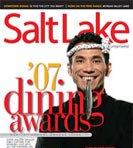
But with all the great food we’ve eaten in Salt Lake City today, it’s worth noting that we go the best sushi in the U.S. at Takashi, on Market Street. Two hours of sumptuous, eye-opening dining.
First day of the trip and we get a U.S. best. What a great start!
Spread the word; friends don't allow friends to repeat history.
Again at Café Philos, the anti-Darwin fifth columnists do their best to continue distortions of history, in this case, in high irony, claiming NOT to defend John Freshwater.
Not in defense of Freshwater’s walking over the Constitution and zapping burns on students in the shape of a cross? Why bother to go after Darwin? No explanation is necessary. It’s like the story of the frog and the scorpion. Creationists are like scorpions. It’s in their nature. (I believe it is a corruption of human nature that creationism visits on those who allow the demon in.) (“Paging Bobby Jindal! Creationist Demon Possession in the Louisiana Governor’s Mansion; what? You’re already there? When’s the exorcism this time?”)
In a cartoon, Darwin bans “Laissez faire,” a shorthand for “Social Darwinism,” and eugenics from his house. Unknown cartoonist, from a short essay on Northwestern University’s discussion book, The Reluctant Mr. Darwin, by David Quammen.
Here’s the exchange. If you find it boring, my apologies. I do weary at the prospect of having to do this again, and again. On the crashed hard-drive of my first laptop, I have files now 15 years old discussing this same silly claim. I’m posting here for the record, for my easy reference, with hope that someday it will not be necessary to post this stuff at all. You may need some of these links some day, and here they are, below the fold.
[2008] Today’s the 52nd anniversary of a horrendous accident in the air over the Grand Canyon. Two airliners collided, and 128 people died.
In 1956 there was no national radar system. When commercial flights left airports, often the only contact they had with any form of air traffic control was when the pilots radioed in for weather information, or for landing instructions. Especially there was no system to avoid collisions. As this 2006 story in the Deseret News (Salt Lake City) relates, the modern air traffic control system was spurred mightily by this tragedy.
About 9 a.m. Saturday, June 30, [1956], the TWA flight bound for Kansas City, Mo., and the United flight bound for Chicago left Los Angeles International Airport within three minutes of each other. The TWA flight, carrying 70 people, filed a flight plan to cruise at 19,000 feet. The United flight, with 58 people on board, planned to cruise at 21,000 feet.
About 20 minutes into the flight, TWA pilot Capt. Jack Gandy requested permission to climb to 21,000 feet. An air traffic controller in Salt Lake City turned down Gandy’s request. Then Gandy asked to fly “1,000 on top,” meaning at least a thousand feet above the clouds, which that morning were billowing as high as 30,000 feet. That request was granted.
By the time both planes were over the Grand Canyon, the pilots were flying in and out of the clouds, on visual flight rules and off their prescribed flight plans, apparently typical in those days as pilots veered off course to play tour guide.
No one knows exactly what happened.
It was the last big accident before instigation of the “black box,” so investigators had to piece together details from debris on the ground.
They decided that the left wing and propeller of the United plane hit the center fin of the TWA’s tail and cut through the fuselage, sending Flight 2 nose-first into the canyon, two miles south of the juncture of the Colorado and Little Colorado rivers. The United DC- 7, which had lost most of its left wing, began spiraling down. Capt. Robert Shirley radioed Salt Lake City a garbled message that controllers understood only after they slowed down the recording: “Salt Lake, ah, 718 . . . we are going in.” Flight 718 smashed into a cliff on Chuar Butte.
I’m thinking of the crash today for two reasons. I’m off for a tour of canyons, including both rims of the Grand Canyon, in the next two weeks. The last time I was there was 1986, with the President’s Commission on Americans Outdoors. We flew in on a Twin Otter, coming up from Phoenix, over the Roosevelt Dam, up over the Mogollon Rim, over the Glen Canyon Recreation area and stopping it Page. From Page to Grand Canyon, we took full advantage of the huge windows in the Otter — seeing first hand the sights that the controversial tourist flights were designed to reveal. Safety was a key concern, and we talked about it constantly with the pilots.
A few weeks later, on June 18, 1986, that DeHavilland Twin Otter collided with a Bell Jet Ranger helicopter over the Canyon. 25 people died in that crash.
I have flown over the Canyon a dozen times since then — no longer will airliners dip down to give passengers a better view, not least because airliners cruise tens of thousands of feet higher now than they did then. I think of those airplane accidents every time I see the Canyon.
We’re driving in. We’ll spend a day and a half on the South Rim, and another couple of nights on the North Rim. We’re taking our time on the ground. But if we had time, and we could afford it, I’d love to get up in an airplane or helicopter to see the Canyon from the air again.
One might begin to think Louisiana really is cursed. Katrina, Rita, other political troubles — and then they elect the bright, young reformer as governor, and he turns out to be a voodoo history and voodoo science practitioner — heck, maybe he practices just plain old voodoo.
All this comes at a time when it may have saved John McCain from making a mistake that would make George McGovern’s selection of Tom Eagleton look like wisdom of the ages (when news came out that Eagleton had undergone convulsive shock therapy for depression, he was replaced on the ticket by Sargent Shriver, but not after much damage had been done to the credibility and viability of the McGovern campaign — why Nixon thought it necessary to sponsor burglary to defeat this ticket is one of the mysteries of the ages of Shakespearian tragedy come to life in in American politics).
Mind you, I like and respect McGovern, and I found working with Tom Eagleton on the Senate Labor Committee a great joy.
Spread the word; friends don't allow friends to repeat history.
Or, until that account is unsuspended by the forces supporting Donald Trump: Follow @FillmoreWhite, the account of the Millard Fillmore White House Library
We've been soaking in the Bathtub for several months, long enough that some of the links we've used have gone to the Great Internet in the Sky.
If you find a dead link, please leave a comment to that post, and tell us what link has expired.
Thanks!
Retired teacher of law, economics, history, AP government, psychology and science. Former speechwriter, press guy and legislative aide in U.S. Senate. Former Department of Education. Former airline real estate, telecom towers, Big 6 (that old!) consultant. Lab and field research in air pollution control.
My blog, Millard Fillmore's Bathtub, is a continuing experiment to test how to use blogs to improve and speed up learning processes for students, perhaps by making some of the courses actually interesting. It is a blog for teachers, to see if we can use blogs. It is for people interested in social studies and social studies education, to see if we can learn to get it right. It's a blog for science fans, to promote good science and good science policy. It's a blog for people interested in good government and how to achieve it.
BS in Mass Communication, University of Utah
Graduate study in Rhetoric and Speech Communication, University of Arizona
JD from the National Law Center, George Washington University


 Posted by Ed Darrell







 Millard Fillmore's Bathtub
