Yee Haw! The first Fiesta de Tejas! is on the web! 2007 Wildflower edition

April 2, 2007

Bluebonnet from Ft. Worth Army Corps of Engineers

No apologies, but thanks to Bob Wills, of course, whose holler that the “Texas Playboys are on the air!” should be an inspiration to everybody. Bob Wills and the Texas Playboys at Casa Mana, California, 1943

Just what in the world is Fiesta de Tejas!? This is the inaugural — and we hope, not last — edition of a monthly collection of weblog postings about Texas history, Texas geography, Texana and other things Texas. We’re finding our way as we go, much as pioneers got to Texas first, and only then began to realize that they didn’t know exactly where they were, and that they didn’t know exactly what they had.

This is a carnival of Texas blogs. Texas is big, vigorous, and in need of exploration on the World Wide Web. My hope is to bring together sources on Texas history, politics, economics, arts, geography and sciences, in a place that promotes the general dissemination of knowledge about the state. My hope is that teachers of 7th grade Texas history will find a lot here to supplement and improve their teaching of the course, that teachers of history and geography in other places will also find material to enrich their own teaching about Texas, that students will find information to make their projects and papers into rewarding explorations of Texas’ unique persona.

I dubbed it a fiesta, because “carnival” seems too commonplace a term for a place where people can buy macaroni in the shape of the state. I used the older form of the word, “Tejas,” both to reflect the historical focus, and to avoid confusion and copyright issues with established things called Fiesta of Texas. “Tejas” is the original, probably Caddoan word meaning “friend” that Spanish explorers misunderstood to mean the name of the people and the place, and whose spelling quickly metamorphosed into Texas with an “x.”

Texas is the second largest state in the United States, physically (next to Alaska) and in population (next to California). Texas occupies a unique place in U.S. history and lore, and it deserves its own history carnival.

Getting this one off the ground has not been a cakewalk, however, not by any stretch. Inspired by other state historians’ efforts, particularly those of Georgia (thank you, David), I have been unhappily surprised by a dearth of self-nominated entries by Texas historians. I am hopeful this is a momentary hiccough, and that Texas historians will step across this particularly line in the sand to expose their unique writings about their unique state. (And thank you, too, Clio Bluestocking, and ElementaryHistoryTeacher, whose contributions are noted below.)

Still, there is plenty to see. So let’s get to it.

The bluebonnets bloom along Interstate Highway 20, which stretches across Texas from Louisiana to an intersection with Interstate 10 a hundred miles or so east of El Paso. They probably started blooming two weeks ago farther south, but this is the season of Texas wildflowers, which will run in full glory well into June in most of the state. The photo at the top of this post shows bluebonnets (Lupinis texensis) from Ft. Worth, in an Army Corps of Engineers tract. More photos of Texas wildflowers come to us from an Austin gardener who blogs about “Hill Country Wildflowers” at Digging. The drought hampered blooms in 2006; rains in 2007 helped much of the state’s wildflowers, though we’re still underwatered.

Texas wildflowers used to be mowed down by highway maintenance crews. First Lady Ladybird Johnson took on a campaign to protect and promote wildflowers during her husband’s presidency, however, and now Texas and many other states actively promote wildflowers. Texas A&M University and other institutions support and promote wildflower planting, and the Ladybird Johnson Wildflower Center resides near Austin, leading research and promotion of wildflowers worldwide.

North Dakota poet Mark Phillips writes about that West Texas plague, tumbleweeds (Salsola kali), in his poem, “Rootless!”. I defy you to say this isn’t Texas. [I also defy you to make that link work to get to that poem; here, try this link.]

Spring stirs the wild animals of Texas, too — including skunks. The Nature Writers of Texas tell us about skunk romance.

Hey, where’s the history? Start here: Georgians are so fired up not to be outdone by a Texas history carnival, that they even swipe Texas history to blog about! Elementaryhistoryteacher explains Georgia’s contributions to the Texas Revolution, at Georgia On My Mind. See her exposition of “A Few Good Men.” And then note her follow-up, explaining one more Texas debt to Georgia, “A Georgian Gave the Lone Star to Texas.”

“Honoring Texas History Is Nothing To Be Ashamed Of,” at DallasBlog — a contribution from Texas’ 27th Land Commissioner, Jerry Patterson. Don’t stop there — go to Patterson’s agency’s site, and notice the dozens of historic Texas maps available for sale — at least one specific to your Texas town or county: General Land Office (GLO) maps.

Texas is proud of being big, different, and Texas. Millard Fillmore’s Bathtub earlier discussed the Texas Pledge to the Texas flag — mainly a political blog, A Capitol Annex warns us all, “Don’t Mess With the Texas Pledge.” Texas homeschooler Sprittibee informs us of “Six Flags and Texas snobbery.

Word didn’t get out to some of us of the educator persuasion, but March was Texas History Month. Abilene Reporter-News columnist Glenn Dromgoole gave quick reviews of recent books about Texas history.

The Top Shelf, a blog by a Texas school district’s director of library services, gives a substantial list of on-line Texas history resources selected by Michelle Davidson Ungarait at the Texas Education Agency, in “March is Texas History Month.”

Mug Shots features a coffee mug created for Texas’ sesquicentennial in 1986, featuring historic comic strips relating Texas history. Whew! A lot of commemorating there — one post of several commemorating Texas History Month. Texas Sesquicentennial Mug, from Mug Shots

This is Texas Music says farewell to the band Cooder Graw, who called it quits early this year. It’s a short post, with doorways to a lot more about music. Texas music is an enormous topic, much bigger than most people appreciate. Just how deep? Consider this tribute piece, and alert to a new CD from, Texas musician Joe Ely, from Nikkeiview, by Gil Asakawa. Texas’ diversity in influences, perspectives and admirers fairly drips from that one.

While Texas officially celebrates diversity in music, in other arts, and in business, diversity is not greatly celebrated in all corners of Texas, nor is it accurate that diversity was always celebrated. Texas history recounts many cases where disputes were chiefly between people of different ethnic or racial groups. How should that history be handled in classrooms, in boardrooms, and in government? An interview with an author raises that question, and offers resources for study, at the History News Network, in an article by Rick Schenkman:

Elliot Jaspin, a winner of the Pulitzer Prize (1979), is the author of the just-published book, Buried in the Bitter Waters: The Hidden History of Racial Cleansing in America (Basic Books), the March HNN Book of the Month.

Serious thought is given also to the divide between religious and secular in America, using our Hollywood view of Texas as a jumping off point and traipsing through the misconceptions about the trial of John T. Scopes (who lived much of his post-trial life as a petroleum geologist in Houston, Texas), at Adventus, “Return to Never Was.”

Another Texas-flavored mug from Mug Shots.

History is politics, and politics is history, in some parts of Texas all of the time, and in all of Texas part of the time. Do you remember the Digger Barnes character in the old “Dallas” television series? He was fiction. The fictional Digger Barnes can hold no candle to the real Ben Barnes, however, and the political blog, Burnt Orange Report, carried a two-part series (Part I, Part II) explaining the importance of Barnes and covering much of his history, starting in February. Another Texas political blog, Rick Perry vs. the World, interviewed Barnes — part I, here.

Kay Bell at Don’t Mess With Taxes reprints a letter from Bum Phillips about what it means to be from Texas, and in Texas. [Catch the subtle pun on a common Texas slogan? I didn’t, at first . . .)

Texas is rich in science and natural history. Monkeys In the News notes the recent description of ancient primates, near Laredo. (Thanks to Dear Kitty for that one.)

Texas is rich in food, too. Hey, I have to get one of my own posts in here, don’t I? 2007 is the 100th anniversary of the founding of the dairy processor in Brenham, Texas, that produces Bluebell Ice Cream, among the best ice creams in the world. You can read it here, “Blue Bell Ice Cream, a tastier part of Texas History.”

If you don’t want ice cream? As Davy Crockett told Tennessee, you may just go to hell — I’m going to Texas. Any fan of ice cream would say the same.A mug from the Bob Bullock Museum, with a famous Davy Crockett quote.

A parting shot, from Mug Shots.

The gates are open for submissions to the next Fiesta de Tejas! scheduled for May 2, 2007. You may e-mail entries to me at edarrell AT sbcglobal DOT net, or take advantage of the Blog Carnival listing, which will create a back-up copy of your entry for us. We need a logo, something appropriate to Texas. Also, if you would like to host a future session of the Fiesta, please drop me a note. These things work better with different eyes and ears working on them from time to time.

If you found something of value here, let me know in comments. And then, spread the word that the carnival is up and running. Yeeeeee haaawwww!


Last call for Texas history carnival, Fiesta de Tejas!

March 31, 2007

Today’s the last day to nominate your post, or another’s post, for the inaugural (and we hope not last) Fiesta de Tejas! blog carnival of Texas history and other things Texan.

Texas relief map from geology.comSend the good stuff! You can send it through the Blog Carnival entry site for Fiesta de Tejas! (which is a good idea, since it saves copies), found here, or send it to me directly at edarrell AT sbcglobal DOT net.

Map image: Texas relief map from Geology.com


Olio/Olla podrida/Mulligan stew/Stone soup

March 26, 2007

Here are some of the posts I’ve been thinking about over the past couple of days:

Iraq and VietnamWritings by Hudson has been reading about LBJ and Vietnam.  Santayana’s ghost appreciates the exercise.

Camels in the Outback, camels in the dogfood:  Would you believe a million camels are feral in the Australian Outback?  And now, with a drought, it’s a problem.  The Coffee House alerts us.

What if everybody in your organization came to you for help? The Drawing Room tells us why you’d be wise to work for such a thing.

U.S. soldiers protest the warNo, not the current war — African American soldiers protest the Filipino conflict.  Forgotten soldiers, forgotten war — you’d do well to reacquaint yourself with this chapter of U.S. history at Vox ex Machina.

Leaks about the incident that got us into the warNo, not yet the Iraq war (see how you jump to conclusions?).  POTUS reflects on LBJ and the Gulf of Tonkin Resolution, and the leaks and lack of intelligence that may have gotten us into a quagmire.

Earthquakes in Tornado Alley:  Tennessee Guy points to an article that wonders about the New Madrid Fault, and whether it is tensing up for “the Big One” to shake West Tennessee (and the rest of the Midwest), or it is going to sleep for a millennium.

Science and racismA collection of Darwin’s writings that touch on race and slavery, for your bookmark file.

Cool school librariesWe’re not talking about air conditioning.


Quote stumbled upon: Clarence Day, on descendants of apes

March 24, 2007

Clarence Day, from NNDB

What fairy story, what tale from the Arabian Nights of the jinns, is a hundredth part as wonderful as this true fairy story of simians! It is so much more heartening, too, than the tales we invent. A universe capable of giving birth to many such accidents is — blind or not — a good world to live in, a promising universe. . . . We once thought we lived on God’s footstool; it may be a throne.

Clarence Day (1874-1935), This Simian World (1920), XIX

More from that chapter, below the fold

Read the rest of this entry »


This Day in Mythstory

March 24, 2007

This site will challenge your hoax detectors — just enough facts to ring true, enough humor to make the parodies appealing and likely to be repeated as fact.  This Day in Mythstory is written by Chris Regan, a humor writer formerly with “The Daily Show with Jon Stewart.”

When the professionals hoax up history, at least they do it in good faith.

(This site is probably funnier if you know which parts are accurate, and which are not.  Basically, the historical events cited are real, though the reasons given are suspect.  Each of these pieces might make a good warm-up to get students discussing what is accurate, and what is humor.)


Lenten Carnivals?

March 23, 2007

Euclid, from the School of Athens (Holy See)

Mardi Gras marks the end of merriment for Christians who spend Lent thinking about atoning for past sins, in preparation for Easter. Mardi Gras ends with the arrival of Ash Wednesday. So, why are we talking carnivals?

Learning carnivals can be as onerous as Lent, right?

We hope not, actually. Yes, it’s Lent, but weblog carnivals continue, and those carnivals are to our advantage, entertainment and betterment.

The Education Wonks host the 111th Carnival of Education. One post in that carnival deserves special mention: Friends of Dave.org complains that education reform simply is not happening, but it’s not because we don’t know what to do. We know how to improve schools and educational outcomes, Dave argues, and first on his list is “high quality teachers and staff.”

It’s a marvelous summary of education reform studies over the past 40 years. And almost sidles into the real problems: We lack the will to pay the money to get the job done. You may disagree with my conclusion, but I challenge you to pick anything other than a nit in Dave’s post, and I challenge you to identify a better, quicker, and cheaper solution.

And, let me take this moment to plug the upcoming carnival of Texas history and all things Texas, Fiesta de Tejas! If you blog for history, or for Texas, please pass the plug along to your readers, and invite them to submit entries. We publish on April 2.

Image:  Euclid, from “The School of Athens”


Tuskegee Airmen medal ceremony set for March 29

March 23, 2007

Tuskegee Airmen in Europe, Library of Congress photo

Congress voted to award the Congressional Gold Medal of Honor to the Tuskegee Airmen as a group. The ceremony is set for Washington, D.C., in the Capitol Rotunda, for March 29, 2007.

This is another great story of Americans, otherwise held down in their daily life, who rise to meet a monstrous challenge. They not only met the challenge but achieved a degree of triumph beyond what anyone had hoped. The story is a natural segue to the post World War II civil rights movement, and it fits nicely into studies of the war or studies of civil rights. News items around the time of the ceremony should update the history of the Tuskegee Airmen and provide good photos for classroom presentations.

“It’s sort of an open validation of the Tuskegee Airmen, that we fought stereotypes, overcame them and prevailed,” said Roscoe Brown, an 85-year-old Riverdale, N.Y., resident who graduated from the Tuskegee program in 1944. “This is the ultimate when your nation recognizes you.”

The gold medal, equivalent to the Presidential Medal of Freedom, is awarded to individuals or groups for singular acts of exceptional service and for lifetime achievement. The Tuskegee fliers will join a distinguished group of recipients that includes George Washington, Winston Churchill, Rosa Parks, the Wright brothers and former Secretary of State Colin Powell.

Rep. Charles Rangel, D-N.Y., and Sen. Carl Levin, D-Mich., introduced identical bills in the House of Representatives and the Senate in 2005 to give the airmen the congressional medal. The Senate bill passed in October 2005 and the House followed in February 2006. President Bush signed the bill into law last April.

It is also a story of racism and bureaucratic bungling delaying appropriate recognition to heroes for 60 years.

Lee Archer, 87, of New Rochelle, is America’s first black flying ace.

“It shows the country is trying to right an old wrong,” Archer said. “I never thought we would get it, but we would have done it without any recognition … . My family is very excited. I am, too.”

Of the 994 black aviators who got their training at the Tuskegee Institute in Alabama beginning in 1942, fewer than 385 are still alive. On March 4, Edgar L. Bolden, 85, who trained at Tuskegee and flew P-47s, died in Portland, Ore.

More information:

Tip of the old scrub brush to Resist Racism.


Quote of the moment: W. C. Lowdermilk, soil erosion

March 20, 2007

Soil erosion in Virginia, photo by W. C. Lowdermilk

Soil erosion in Virginia, photo by W. C. Lowdermilk “Figure 15. — A formerly productive field in Virginia that has been cut to pieces by gully erosion. About 50 million acres of good farm land in the United States have been ruined for further practical cultivation by similar types of erosion.”


From Conquest of the Land through 7,000 Years, by W. C. Lowdermilk, its first director, a soil conservation publication of the U.S. Soil Conservation Service, first issued in about 1939:

When in Palestine in 1939, I pondered the problems of the use of the land through the ages. I wondered if Moses, when he was inspired to deliver the Ten Commandments to the Israelites in the Desert to establish man’s relationship to his Creator and his fellow men — if Moses had foreseen what was to become of the Promised Land after 3,000 years and what was to become of hundreds of millions of acres of once good lands such as I have seen in China, Korea, North Africa, the Near East, and in our own fair land of America — if Moses had foreseen what suicidal agriculture would do to the land of the holy earth — might not have been inspired to deliver another Commandment to establish man’s relation to the earth and to complete man’s trinity of responsibilities to his Creator, to his fellow men, and to the holy earth.

When invited to broadcast a talk on soil conservation in Jerusalem in June 1939, I gave for the first time what has been called an “Eleventh Commandment,” as follows: Thou shalt inherit the Holy Earth as a faithful steward, conserving its resources and productivity from generation to generation. Thou shalt safeguard thy fields from soil erosion, thy living waters from drying up, thy forests from desolation, and protect thy hills from overgrazing by thy herds, that thy descendants may have abundance forever. If any shall fail in this stewardship of the land, thy fruitful fields shall become sterile stony ground and wasting gullies, and thy descendants shall decrease and live in poverty or perish from off the face of the earth.


Texana & History Carnival

March 17, 2007

Chili pepper night light

Fiesta Texana!

Okay, Texas history fans: It’s time we got our stuff together for a Texas history carnival[Update:  The inaugural Fiesta de Tejas! is here, at the Bathtub, on April 2.]

Except, this being Texas, just calling it a “carnival” probably won’t cut it. It needs to be a fiesta.

Our friend and colleague David Parker over at Another History Blog mentions the Georgia History Carnival today (the carnival itself is at Provocative Church). If Georgia, with its dull, almost-landlocked, not-found-by-Europeans-until-the-17th-century and having-only-peaches-instead-of-peppers history can do it, Texas should be able to do it better.

Heck, we could almost do a carnival on Texas-shaped cooking gear and foods.

Texas-shaped grill from Texas Correctional Industries

Texas-shaped grill from Texas Correctional Industries.

Texas-shaped Bubba Burgers

Texas-shaped Bubba Burgers.

Nobody makes Georgia-shaped burgers. And contrary to popular belief, Wendy’s burgers are not really shaped like Colorado, or Wyoming.

So, what do you think? Should we have an internet carnival of Texas history and things Texan? If you think it’s a good idea, leave a comment saying so. If you have something to contribute, send it along to Fiesta Texana!, e-mail me at edarrell[AT]sbcglobal.net. Let’s see what happens.

(Chili pepper nightlight from Katsu Designs.)

Update: Okay, we’re registered as Fiesta de Tejas at the Blog Carnival. We’re off and rolling, accepting entries. Send in your best!

(We could also use a logo — something with an armadillo, or a pepper, or a cowboy hat, sideoats grama grass, or surprise us! No pay, of course — just glory.)


Quote of the Moment: Nikita Khruschev, whose side is history on?

March 15, 2007

About the capitalist states, it doesn’t depend on you whether or not we exist. If you don’t like us, don’t accept our invitations, and don’t invite us to come and see you. Whether you like it or not, history is on our side. We will bury you.*

Nikita Sergeyevich Khruschev (1894-1971); reported statement at a reception for Wladyslaw Gomulka at the Polish Embassy, Moscow, November 18, 1956

Khruschev enjoys a hot dog in Iowa, 1959

Soviet Premier Nikita Khruschev enjoying a hot dog in Des Moines, Iowa, during his 1959 tour of the U.S. (Photo from American Meat Institute, National Hot Dog & Sausage Council, http://www.hot-dog.org)

* The exact phrasing of the last line is debatable. As Bartlett’s Familiar Quotations, 16th Edition has it, “Neither the original nor the translation of the last two sentences appeared in either Pravda or the New York Times, which carried the rest of the text. Another possible translation of the last sentence is: We shall be present at your funeral, i.e., we shall outlive you; but the above is the familiar version.”


Historic carnival season

March 15, 2007

Kurt Nordstrom photo of Texas State Fair

Early Modern Notes hosts the 50th History Carnival. Early Modern Notes was the inaugural host for the carnival, back in 2005. A lot of history under the bridge since then.

Posts at the Carnival include a small handful of tributes to the late Arthur Schlesinger, Jr., whose death should remind us how valuable can be the contributions of historians who get the ear of policy makers. The Carnival also features posts useful to teachers, on grading and plagiarism.

The host sprinkled “Bonus links” throughout the Carnival, including this link to the 21st Teaching Carnival at the Salt Box, which I had missed earlier this month.  Good ideas, nice presentation — you could learn something if you dropped by.


Strong hints that “Texas Chainsaw Massacre” is fiction

March 14, 2007

The DVD release of the Texas Chainsaw Massacre’s latest cinema episode is probably driving the traffic to the post I did a while ago noting that the movies are not based on any Texas incidents (see “Based on a true story, except . . .). The original movie, in 1974, was billed as “based on a true story.” “The film which you are about to see is an account of the tragedy which befell a group of five youths, in particular Sally Hardesty and her invalid brother, Franklin,” the Narrator says opening the film.

The latest enfilmations apparently carry the same claim (I say apparently because I have never seen any of them through, and only a few snippets on television of any of them — I go by what I hear and see from others).

We have the testimony of the author of the original screenplay that it is fiction, loosely based on a famous case in Wisconsin which was also, very loosely, the basis for Alfred Hitchcock’s Psycho and the later, more horrifying Silence of the Lambs. Other internet sites say it’s fiction, such as Snopes.com (a favorite and very good hoax and error debunking site).

Still, the kids ask.

Why not turn this into a geography and/or history exercise? Read the rest of this entry »


Quote of the Moment: Teddy Roosevelt on beating depression

March 14, 2007

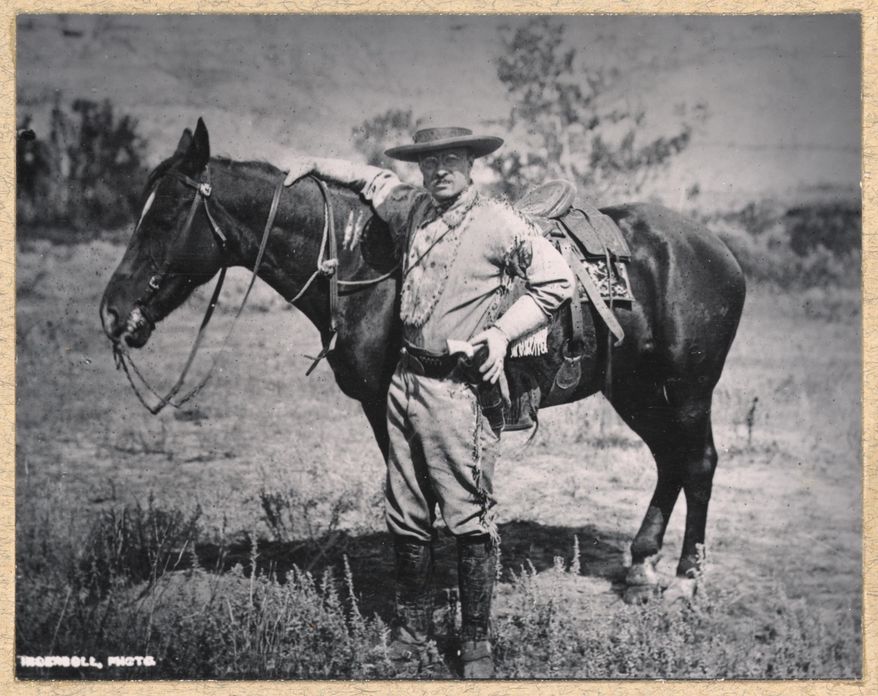
After the same-day deaths in 1884 of his beloved wife Alice, in childbirth, and his mother, who lived with the family, Teddy Roosevelt went into a depression. To beat the depression, he moved to South Dakota and became a cowboy, a very good cowboy.

TR with horse, in the Dakotas

Black care rarely sits behind a rider whose pace is fast enough.

— Attributed to Teddy Roosevelt by David McCullough, on the frontispiece for McCullough’s biography of Roosevelt, Mornings on Horseback (Simon & Schuster, 1981).

Save


Quote of the Moment: Charles Darwin, noble monkey ancestors

March 13, 2007

Charles Darwin, image from Deviant Art; Artwork : www.davidrevoy.com

Charles Darwin, image from Deviant Art; Artwork : http://www.davidrevoy.com

For my own part I would as soon be descended from that heroic little monkey, who braved his dreaded enemy in order to save the life of his keeper, or from that old baboon, who, descending from the mountains, carried away in triumph his young comrade from a crowd of astonished dogs — as from a savage who delights to torture his enemies, offers up bloody sacrifices, practices infanticide without remorse, treats his wives like slaves, knows no decency, and is haunted by the grossest superstitions.

– Charles R. Darwin,
The Descent of Man,
1871, ch. 6


Teacher and student history resources, from the Feds

March 13, 2007

Federal Resources for Educational Excellence (FREE) is a great idea. Federal agencies are loaded with information useful to teachers and students, formerly available in print if one could find the appropriate phone number or get lucky with a mail sweepstakes. Now a lot of the information is compiled specifically for education, and the U.S. Department of Education has compiled a user-congenial site to help educators find the stuff.

FREE image from home page

Under “U.S. History and Topics” you may find a good deal of support for most social studies disciplines. The Women’s History Month focus highlights two topics from the Library of Congress and two from the National Endowment for the Humanities.   Read the rest of this entry »