Berlin Wall in the U.S., the FDR Library

March 31, 2014

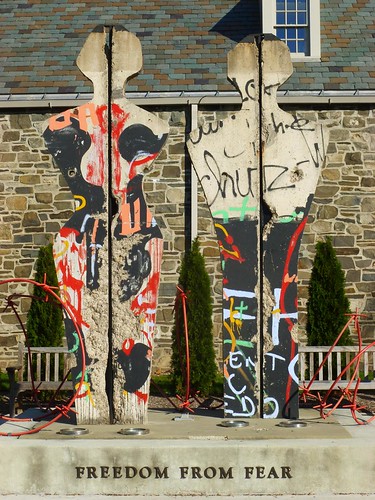
"Freedom from Fear," sculpture made from cutouts of sections of the Berlin Wall, photo by gwenvasil, FDR Home & Presidential Library Hyde Park, NY, October 20, 2013.

“Freedom from Fear,” sculpture made from cutouts of sections of the Berlin Wall, photo by gwenvasil, FDR Home & Presidential Library Hyde Park, NY, October 20, 2013.

Interesting, perhaps somewhat silly sculpture, found on the grounds of the Roosevelt Family estate in Hyde Park, New York, near the FDR Library and Museum.

Unless and until one knows the rest of the story.

  • These rather free form human forms, covered in what looks like graffiti, were cut from sections of the Berlin Wall, after the collapse of East Germany.
  • This is close to the bust of FDR’s ally in war for peace, Winston Churchill.  Appropriate, because,
  • Sculpture was created by Churchill’s granddaughter, Edwina Sandys.
  • Actually, these  sculptures were arranged together in a suite, in an area now known as Freedom Court
    • “In 2007, a new dimension was added to this hallowed ground by the construction of the Freedom Court. In honor of the friendship between the two legendary leaders, Edwina was instrumental in commissioning a bronze bust of Winston Churchill by sculptor Oscar Nemon, to be placed opposite one of FDR already in existence. The two sculptures flank the entrance to the court so that now and forever the two old wartime allies will be able to look at each other in a dynamic ‘outdoor room’ made of trees and shrubs.”Edwina’s ‘BreakFree’ now stands center stage in the Freedom Court, bearing witness to the ideals these great statesmen stood for, and bringing all three sculptures together in a magical web of connectedness.”
  • Segments of the Berlin Wall from which these cutouts came now stand in Fulton, Missouri, at the National Churchill Museum — the cutout figures were christened “BreakFree” by Edwina Sandys; the wall, from which they came, is called “BreakThrough.”

A few parts of the Berlin Wall are displayed across the U.S.  At Fulton, Missouri, are eight segments, made into liberating art by Edwina Sandys; at Hyde Park, New York, the cutouts from those segments form another artwork dedicated to freedom.  Other pieces of the wall and one of the guard towers, can be seen at the Newseum in Washington, D.C.

Nice touch to borrow the phrase from FDR’s “Four Freedoms” speech for the pedestal.

I found this photo from a Tweet from the FDR Library earlier today, alerting people to the collection of photos at the Flickr site of gwenvasil.  Follow the links, you’ll find other photos worth serious pondering.

More:


Quote of the moment: Education is knowing what you know, and what you don’t

March 31, 2014

Commenter Robert Lopresti mentioned a book assembled at the Library of Congress, to assist Members of Congress in creating speeches on important issues, with accurate quotes in accurate context: Respectfully Quoted: A Dictionary of Quotations.

One might wonder if anyone in Congress even knows the book exists.

You can buy the book, at Amazon, or from the Library of Congress Gift Shop, and Bartleby has it online (public domain already?).

My first use of the online version, I looked for education, and found this from William Feather (1889-1981), describing  just what “an education” is:

An education isn’t how much you have committed to memory, or even how much you know. It’s being able to differentiate between what you do know and what you don’t. It’s knowing where to go to find out what you need to know; and it’s knowing how to use the information you get.

When and where did Feather say that?  Things get murky — according to the list at the Library of Congress:

Publisher and writer William Feather, photo by William Feather III

Publisher and writer William Feather, photo by William Feather III. Can we trust a bon mot attributed to such a jovial and scholarly looking fellow?

Attributed to WILLIAM FEATHER.—August Kerber, Quotable Quotes on Education, p. 17 (1968). Unverified.

An honest assessment that we don’t know for certain that Feather said exactly that. This book could be a valuable resource!

Who the heck was William Feather?

William A. Feather (August 25, 1889 – January 7, 1981) was an American publisher and author, based in Cleveland, Ohio.

Born in Jamestown, New York, Feather relocated with his family to Cleveland in 1903. After earning a degree from Western Reserve University in 1910, he began working as a reporter for the Cleveland Press. In 1916, he established the William Feather Magazine.[1] In addition to writing for and publishing that magazine, and writing for other magazines as H.L. Mencken‘s The American Mercury, he ran a successful printing business, and wrote several books.[2]

Feather’s definition appeals to me.  Educated people know where to find the facts they need, and they know when it’s important to search for those facts, rather than stand on ignorance.

Compare it with the Hubbard/Rogers advice, that it’s what we know “that ain’t so” that gets us into trouble.

How could any test, ever test for that?


What exactly did Thomas Edison say about the theory of relativity?

March 29, 2014

Need some scholarly help here.  I worry that what I want isn’t available in print, and perhaps not at all on the internet.

Thomas Edison at 80, in 1927

Thomas Edison at 80, in 1927; from Edison After 40: Edison’s career coincided with the widespread use of photography. During his lifetime he sat several times for professional portrait photographers. In addition, most of the time there was a photographer at the laboratory, recording the historic course of events.

Remember the old “Garry Moore Show?”  In the farming and  not-quite-suburban towns where I spent my first 18 years, Garry  Moore was a popular guy.  Today he might be remembered as the variety show host who pushed to get Carol Burnett on television, and helped her early career.  In his own right, he was a television staple — MC for daytime quiz shows, night-time quiz shows, and a couple of variety programs that entertained those of us living in what was then the greater American community, but is today too often mislabeled as “fly-over land.”

Garry Moore, Carol Burnett, and Durward Kirby, in a publicity still photo from 1961's

Garry Moore, Carol Burnett, and Durward Kirby, in a publicity still photo from 1961’s “Garry Moore Show.” Wikipedia

In one of his variety programs (probably called “The Garry Moore Show”) he featured a weekly pirouette through history using old photos and old films, “That Wonderful, Wonderful Year.”  In that time before home VCRs, historical films were difficult and expensive to come by (some still are).  These vignette and skit views into history were often unique.  Hey, it was an entertainment show.

(That’s a long set-up.)

One of those history romps featured a film interview with Thomas Edison, in his 80s.  I recall it was on the event of Edison’s 86th birthday, but don’t hold me to that — especially since he didn’t live to 86 (1847-1931; this is a demonstration of the faults of memory, especially mine).

The interviewer asked Edison, the inventor and practical applicator of chemistry and physics, what he thought of new science, specifically, Albert Einstein’s theory of relativity.  Edison’s answer was direct, honest and startling — so much so that I wrote it down on a long-lost notepad.

‘I don’t think anything of Einstein’s theory of relativity,’ Edison said, ‘because I don’t understand it.’

Can you help me track down exactly what Edison said about relativity, and where and when?


Celebrate Thomas Jefferson’s birthday at Monticello, April 11

March 27, 2014

Thomas Jefferson was born April 13, 1743, in Shadwell, Virginia.

The good people who operate Monticello, Jefferson’s glorious home in Virginia, will kick off a weekend of celebration on April 11, the Friday before Sunday, April 13, 2014.

Want to join in the celebration in Jefferson’s home?

U.S. Army's Old Guard Fife and Drum Corps

Come Celebrate Jefferson’s Birthday!

Friday, April 11
At Monticello

Monticello will mark the 271st anniversary of Thomas Jefferson’s birth with a celebration and ceremonies on the West Lawn. Held in conjunction with Founder’s Day at the University of Virginia, the event will feature remarks by James H. Webb, Jr., former U.S. Senator from Virginia and the 2014 recipient of the Thomas Jefferson Foundation Medal in Citizen Leadership, and the presentation of wreaths honoring Jefferson by local, state, and national organizations. 10 a.m., free and open to the public. (Admission required for house tours.)

Jefferson MedalOther Events
You may also be interested in related events being held at the University of Virginia as part of Founder’s Day:

April 10

  • 12:30 p.m. Thomas Jefferson Foundation Medalist in Citizen Leadership The Frank Batten School of Leadership and Public Policy will host a talk by James H. Webb, Jr., former U.S. Senator (D-Va.) and Secretary of the Navy, decorated Vietnam veteran and successful author, journalist and filmmaker, in Garrett Hall.

April 11

  • 10:00 a.m. Thomas Jefferson Foundation Medalist in Law: A public talk will be held in the Caplin Pavilion featuring Kenneth R. Feinberg, an attorney who has administered the compensation funds for victims of the Sept. 11 terrorist attacks, the BP oil spill in the Gulf of Mexico, the 2007 shootings at Virginia Tech and the Boston Marathon bombings.
  • 3:30 p.m. Thomas Jefferson Foundation Medalist in Architecture
    The School of Architecture will host a public talk by Toyo Ito, a Tokyo-based architect who combines conceptual innovation with superbly executed buildings, as in his masterpiece, the Sendai Mediatheque, which reimagines what a public museum and library should be in the digital age, in Old Cabell Hall Auditorium.

Learn more about all Founder’s Day events


April is National Poetry Month 2014 — are you ready?

March 27, 2014

If you ask me, we don’t have enough poetry in our lives.

In bygone times, newspapers carried poems almost daily.  Magazines carried poems in every issue, but today you find fewer poems published in fewer magazines — can you name the periodical publication in which you last saw a poem that caught your eye, or heart?

National Poetry Month poster for 2006

National Poetry Month poster for 2006. Click image for a larger, more inspirational view.

Rhyme and meter power their way into our minds.  Teachers who use poetry find lessons stick longer with students.

Shouldn’t we use a lot more?

Since 1996, several groups including the Academy of American Poets have celebrated National Poetry Month in April.  There are posters,and of course April is a month with several poems to its creditPaul Revere’s Ride, The Concord Hymn, To a Lady with a Guitar, An April Day, The Waste Land, and several poems just about April as a month.

It’s a good time to beef up our poetry tool boxes, if we are managers of organizations, or teachers, or parents, or human.

Poetry lovers gave thought to how to do that, and there are many good recommendations out there.  For example, from Poetry.org, 30 activities for National Poetry Month 2014:

30 Ways to Celebrate

Celebrate Poem in Your Pocket Day
The idea is simple: select a poem you love, carry it with you, then share it with co-workers, family, and friends.
Read a book of poetry
“Poetry is a response to the daily necessity of getting the world right.”
Memorize a poem
“Getting a poem or prose passage truly ‘by heart’ implies getting it by mind and memory and understanding and delight.”
Revisit a poem
“America is a country of second acts, so today, why not brush the dust off these classics and give them a fresh read?”
Put poetry in an unexpected place
“Books should be brought to the doorstep like electricity, or like milk in England: they should be considered utilities.”
Bring a poem to your place of worship
“We define poetry as the unofficial view of being, and bringing the art of language in contact with your spiritual practices can deepen both.”
Attend a poetry reading
“Readings have been occurring for decades around the world in universities, bookstores, cafes, corner pubs, and coffeehouses.”
Play Exquisite Corpse
“Each participant is unaware of what the others have written, thus producing a surprising—sometimes absurd—yet often beautiful poem.”
Read a poem at an open mic
“It’s a great way to meet other writers in your area and find out about your local writing community.”
Support literary organizations
“Many national and local literary organizations offer programs that reach out to the general public to broaden the recognition of poets and their work.”
Listen on your commute
“Often, hearing an author read their own work can clarify questions surrounding their work’s tone.”
Subscribe to a literary magazine
“Full of surprising and challenging poetry, short fiction, interviews, and reviews, literary journals are at the forefront of contemporary poetry.”
Start a notebook on Poets.org
“Poets.org lets users build their own personal portable online commonplace book out of the materials on our site.”
Put a poem in a letter
“It’s always a treat to get a letter, but finding a poem in the envelope makes the experience extra special.”
Watch a poetry movie
“What better time than National Poetry Month to gather some friends, watch a poetry-related movie, and perhaps discuss some of the poet’s work after the film?”

.

Take a poem out to lunch
Adding a poem to lunch puts some poetry in your day and gives you something great to read while you eat.”
Put a poem on the pavement
“Go one step beyond hopscotch squares and write a poem in chalk on your sidewalk.”
Recite a poem to family and friends
“You can use holidays or birthdays as an opportunity to celebrate with a poem that is dear to you, or one that reminds you of the season.”
Organize a poetry reading
“When looking for a venue, consider your local library, coffee shop, bookstore, art gallery, bar or performance space.”
Promote public support for poetry
“Every year, Congress decides how much money will be given to the National Endowment for the Arts to be distributed all across America.”
Start a poetry reading group
“Select books that would engage discussion and not intimidate the reader new to poetry.”
Read interviews and literary criticism
“Reading reviews can also be a helpful exercise and lend direction to your future reading.”
Buy a book of poems for your library
“Many libraries have undergone or are facing severe cuts in funding. These cuts are often made manifest on library shelves.”
Start a commonplace book
“Since the Renaissance, devoted readers have been copying their favorite poems and quotations into notebooks to form their own personal anthologies called commonplace books.”
Integrate poetry with technology
“Many email programs allow you to create personalized signatures that are automatically added to the end of every email you send.”
Ask the Post Office for more poet stamps
“To be eligible, suggested poets must have been deceased for at least ten years and must be American or of American descent.”
Sign up for a poetry class or workshop
“Colleges and arts centers often make individual courses in literature and writing available to the general public.”
Subscribe to our free newsletter
“Short and to the point, the Poets.org Update, our electronic newsletter, will keep you informed on Academy news and events.”
Write a letter to a poet
“Let the poets who you are reading know that you appreciate their work by sending them a letter.”
Visit a poetry landmark
“Visiting physical spaces associated with a favorite writer is a memorable way to pay homage to their life and work.”

How will you use National Poetry Month in your classroom, teachers?  And by “teachers, ” I mean you, math teachers, social studies teachers, phys ed teachers, biology and chemistry teachers.  You don’t use poetry?  No wonder America lags in those subjects . . .

What’s do you remember about your teachers’ use of poetry in learning?

What’s your favorite poem?

More:


The Gospel About Millard Fillmore – a Unitarian paean to our 13th president

March 26, 2014

This sermon was delivered at the First Unitarian Universalist Society of San Francisco, by the Rev. John Robinson, on September 18, 2005.

Choir practice at First Unitarian Universalist Church of San Francisco.

Choir practice at First Unitarian Universalist Church of San Francisco.

That church used to keep this text in its sermon archives, but I recently discovered that archive had gone away.  I was happy to find I could get a historic version of the page, from which I got this text below.

I offer this here for scholars of the history of the presidency, and for scholars and fans of Millard Fillmore.  Oh, and to update the link in my list of sources on Millard Fillmore.

The Gospel About Millard Fillmore

This sermon began many years ago, over 30. Elliot Richardson had been invited to speak at the Annual Meeting of our Association of Free churches. He was then the martyred hero who had resigned as Attorney General of these United States rather than obey Richard Nixon’s order to fire Archibald Cox as Special Watergate Prosecutor. He was a Unitarian from an old Unitarian family.

Not all Unitarians were happy to have him as speaker. There was much agitation about the choice. Protesters tried to interrupt his speech, but were finally prevailed upon to let him make it.

In the question and answer period that followed, one of the dissenters demanded to know how Elliot Richardson, when Nixon’s Secretary of Defense, could have authorized the infamous December bombings of Hanoi and Haiphong.

Elliot Richardson pointed out to the questioner that he had not been appointed to Secretary of Defense until after the bombings, indeed until after the Vietnam Truce had been declared. He could have stopped there. Gotten off, as so many of us are apt to do, looking good. But he did not. He told the truth. He continued saying: “But, I think the decision to bomb was right.” It was the sort of candor that impresses.

Later that evening a young minister, this was years ago, was on a hotel elevator on to which Elliot Richardson stepped, unsuspectingly. Emboldened by spirits if not spirit. The young minister thanked Mr. Richardson for his speech and apologized for the rude behavior of some self-righteous Unitarians who treat those others of this tradition with whom they disagree so intolerantly. And then, as an illustration he launched into an impromptu sermon on Millard Fillmore. Ever polite, Elliot Richardson said he would like to see a full text. The young minister sent it to him, at the Court of St. James, where Mr. Richardson was at the time United States Ambassador to Great Britain. The Ambassador sent back a letter thanking the young minister for his sermon, saying that he had enjoyed it immensely. As a not so young minister, I still treasure that letter. Here for you this morning is the text of that sermon.

History has been unkind to Millard Fillmore, often referred to as “Millard Who?”. Forgetting that he was 13th president of the United States. One of the few accomplishments for which he is given credit is installing the first bath tub in the White House. There is serious doubt about that.

One historian said of Fillmore: “He came to the Presidency by the only road available to a man of limited ability, the death of his predecessor.” He was accused of being both pro-slavery and abolitionist. It was said he did “not have courage” “but was just inflexible.” They accused him of having “no position except equivocation,” that he was “without personal earnest conviction, personal force, or capacity for strong personal leadership.” His general rating as a president has been, until recently, below average, way below. He is judged bad or poor in his religiousness by those who judge such things. He was rejected by the religious community of which he was a member. He was a Unitarian.

There are three reasons to tell the story of Millard Fillmore: First, he illustrates the on-going tension in our free religious community, between the prophetic and the practical – the privilege of moral purity and the necessity to make real world decisions. Second, he illustrates well how difficult it is to judge our contemporaries. And third, to help restore Millard Fillmore to his rightful place in history.

The list of reasons for Fillmore’s lack of fame or infamy is long. His presidency was very short, only 2 years 236 days. His presidency is greatly overshadowed by the momentous events of the Civil War, eight years later. He was not liked by either the abolitionist historians or those historians who were apologists for the south. His association with the Know-Nothings tarnished his memory. And perhaps most important, the principal source of information about him came from the writings of his arch rival and enemy, the New York political boss Thurlow Weed, who called Fillmore derisively, “That incorruptible man from Buffalo.” Weed was very corruptible.

Millard Fillmore was born in a log cabin January 1, 1800, in upstate New York on his father’s poor, unproductive, isolated, farm. Millard was his mother’s maiden name. His education was sparse, no more than three months a year. He said that in the nine months working on his father’s farm, he forgot more than he learned the other three months. But his ambitious father apprenticed Millard to a cloth cutter, and then later got him a job in a law office. Millard’s Education was mostly self-learning, though by 20 he had a position as a schoolteacher. And then he became a lawyer. At 26 he married Abigail Powers who had taught him as he tried to catch up on his education. At 28 he was elected to the New York State Assembly.

At age 31 he joined a group of like-minded citizens in Buffalo New York where he now made his home. These were the founding and charter members of the First Unitarian Church of Buffalo New York.

Millard fought many good fights in the New York State Assembly. He fought for repeal of a law that required anyone testifying in court to swear that they believed in God and the hereafter. He pushed for an end to imprisonment for debt, and bankruptcy laws to protect small business interests. He fought for separation of church and state.

Millard was a party switcher right from the beginning. He was elected to the assembly as a National Republican, the party of Jefferson. Then He was elected as an Anti-Mason, a party he had helped to form. The Anti-Masons held that the Masonic Order with its lodges, secret rites and oaths, loyalties to something other than the Constitution, constituted an invisible Empire, a dangerous intrusion in a democracy. He wanted to get Masons out of government.

Fillmore was elected to Congress as a National Republican in 1832. His first term saw the formation of the Whig Party, an event he supported, as he wanted to see a party of National Union.

Unfortunately for those who look for titillation in sermons there were no publish rumors of moral turpitude. He served but one term in Congress, (perhaps an early supporter of term limits) and then went home to Buffalo and devoted himself to cultural and intellectual enrichment of Buffalo. (I know, you may think that an oxymoron.) He supported good causes like free public education and free public libraries.

In 1836 he was again elected to the House of Representatives. There he was made chair of the powerful House Ways and Means Committee. He also was chair of a Select Committee charged with investigation of election fraud in New Jersey (yes, I know, no change there). Incredibly Fillmore’s committee found 5 congressmen of his own party guilty, threw them out of congress, and thus handed control of The House to the opposition party! (IMAGINE!)

In 1842 he again left Congress, this time as a prominent Whig. The next year Horace Greely, editor of the NEW YORK TRIBUNE (also an alleged Unitarian), urged Fillmore’s candidacy for Vice-President. (Years later Fillmore repaid the favor by getting Greely out of debtors’ prison in Paris.)

1844 was not the year for Millard to get the nomination. He was held to be anti-slave and anti-Southern. He opposed the annexation of Texas as an attempt to swell slavery forces.

Later Millard opposed the Mexican War, which he believed would spread slavery and weaken the North’s industrial economy.

1848 was the year when Fillmore was tapped as the Whigs vice-presidential candidate. He balanced the ticket, with General Zachary Taylor, a Southerner, and slave owner, who was a hero of the Mexican War (ironically). Taylor ran on a rough and ready image. Leading abolitionists bolted the party, particularly New Englanders, notably the leading Unitarian, Charles Francis Adams.

The Taylor-Fillmore ticket had no platform because whatever was said would alienate part of the country. Abe Lincoln supported this ticket. On November 7, they won.

On July 9, 1850, rough and ready Zachary Taylor died from illness. Fillmore became President, the third President to be Unitarian. (In October of that same year this church was founded.) Within a month Fillmore had aroused the ire of the North by signing the Compromise of 1850. He did it, knowing that he had ruined any hope he had to run for the Presidency on his own. He also earned the animosity of many Unitarians.

The Compromise of 1850 preserved the balance between the North and South that dated from the Missouri Compromise and earlier. By it: California was admitted as a free state; New Mexico and Utah became Territories with no restriction on slavery; Texas was paid 10 million dollars to accept the Texas-New Mexico boundaries; slavery was to be decided by the people of Texas. The balance of concessions was further kept by prohibiting the slave trade in Washington, D.C. but continuing the right (better said the wrong) of slave ownership in the capital. The provision that enraged the abolitionists most was the strengthening of the fugitive slave laws. It empowered federal agents to enforce the act. The Whig Party split over Fillmore’s signing of the law.

Ralph Waldo Emerson (Unitarian) said of the fugitive slave law, “I will not obey it, by God.” Theodore Parker (author of the opening words this morning), a Boston Unitarian minister, led an armed band of vigilantes that confronted slave hunters up from the South; intimidated them into leaving; and saved a slave couple who had escaped to Boston. Parker had acted in direct defiance of the Fugitive Slave Law. With loaded pistol and sword ready on his writing desk Unitarian Parker wrote the Unitarian President, Fillmore, telling what he had done and challenging Fillmore to enforce his “damned law.”

History has judged Fillmore harshly for that one law – a Unitarian President perpetuating slavery – the scandal! Why did he do it? Talk of secession! Remember the times. Even before Taylor’s inauguration, Virginia had passed legislation that threatened secession if the federal government interfered with “Southern Institutions”. John C. Calhoun (also a Unitarian and charter member of the Unitarian Church in Washington D.C.) and other Southern leaders were making ominous warnings. Tension between the States in the House of Representatives kept them from selecting a Speaker for over three weeks. By the time Fillmore took office, the South was ringing with calls for secession, not only if slavery were interfered with but if its expansion were checked.

Fillmore’s predecessor, Taylor, a Southerner, a slave owner and war hero, might have held the country together had he lived to veto the compromise of 1850 as he had said he would. Fillmore knew he could not hold the Union if he vetoed it. He set one goal, to preserve the Union and the Constitution. To give up the great compromise forged in 1787-1788 would, he knew, lead to the rupture of the Union. He thought the North was at that time not yet strong enough to win a civil war. Modern historians agree.

By the end of October 1850, Fillmore had angered abolitionists by sending federal troops to assist U.S. Marshal’s in the arrest of fugitive slaves. His determination for the compromise was also felt in the South. He sent reinforcements for Charleston, South Carolina where Southerners, angry over the North’s resistance to the fugitive slave laws, were threatening to seize federal property.

Fillmore has been most severely criticized for not fighting slavery with determination. However, there is another side. John F. Kennedy in Profiles of Courage chose to profile Daniel Webster. Webster was also a Whig and a Unitarian. Kennedy praises Webster for his courage in supporting The Compromise of 1850 with its Fugitive Slave Law. Fillmore had presided as Vice-President over the debates on the Compromise. He had heard Webster’s famous speech that cost Webster the support of his Massachusetts constituents. Emerson said of Webster at this time “The word ‘liberty’ in the mouth of Mr. Webster sounds like the word ‘love’ in the mouth of a courtesan.”

Webster and Fillmore thought slavery would die a natural death in the industrial revolution (Why invest capital in slave ownership when an Irishman could be rented for next to nothing in wages.) They saw the tension, not so much as slave vs. free, as agriculture vs. industry.

Webster was but one vote for the bill. Fillmore alone shouldered the final responsibility to veto or sign the bill. Fillmore bore the blame for the Compromise of 1850. Do not forget that Lincoln, the Great Emancipator, said that if he could preserve the Union by keeping slavery, he would.

When the Compromise of 1850 fell apart, the Civil War began. The Whigs were terribly weakened by abolitionist outrage.

Perhaps Fillmore’s next most far-reaching act was to send Commodore Perry to Japan. But Fillmore was done. The Whigs were done.

In the election of 1852 Fillmore and Webster fought over the nomination for President at the next Whig Convention, for 47 ballots to a deadlock. In the end, a man neither of them could support was nominated and lost the election. A saddened Fillmore attended, with his wife, the cold rainy inauguration of Franklin Pierce. Three weeks later Fillmore’s wife died of pneumonia contracted that inauguration day. Fillmore’s 22 year old daughter died the year after he left office.

After he had stepped down from office, the Officers of the American Unitarian Association invited Millard Fillmore to preside over the Annual Meeting. But abolitionists refused to allow him to be seated after he got there. They would have no part of this man who would not follow their conscience. One hopes that this free religion might be gentler today but I am not sure. After the Civil War, Fillmore stung by their action resigned from the Buffalo Church when its minister and his friend died.

By 1856 the Whig party had disintegrated. The lines grew harder: Democrats to the South, Republicans to the North. Millard Fillmore wanted a party for the Union. He then made the second mistake for which he has been charged harshly. He offered himself to the American Party, the Know-Nothings, anti-foreign and anti-Catholic, as candidate — a devil of a thing for a free religionist to do. He hoped to gather there the remnants of the Whigs. He then went off to Europe on a 12-month vacation.

Ironically he was on foreign soil, after just completing an audience with the Pope when he was notified that he had received the Know-Nothing’s nomination for President. He was chosen because he was the only person of stature that they could get.

But many Know-Nothings were unhappy with him and bolted the party. Fillmore is not known to have ever expressed any anti-Catholic sentiments. This though he had lost a bid for Governor of New York because Catholics were angry that his militancy for separation of church and state made him oppose state funding they sought for various Catholic institutions.

Fillmore expressed no support for the Know-Nothing goal of removing all Catholics from office alleging they would be loyal to the Pope rather than the U.S.A. He did, however, believe that foreigners should be fully Americanized in their views before becoming citizens. He was also concerned that immigrants, who joined our diplomatic service, were sent to the countries from which they had come. He thought it a potential conflict of interest.

In 1856, he ran for President as the American Party candidate with a Southern slaveholder as his running mate. They emphasized in the campaign regional compromise and preservation of the Union. They carried only the State of Maryland. However they also were the spoilers that kept the Republicans from winning and thus put the Civil war off four more years. It is important remember that the changes happening in this nation, at this time, were more dramatic and far reaching in many ways than the computer revolution in our own. These were the years of the industrial revolution. The dramatic growth of railroads and factories, was changing the North for a subsistence farm economy to market agriculture and industrial growth. These changes radically altered the balance between North and South, increasing the might of the North disproportionately.

It is difficult to know whether Millard was in any sense a believer in Know-Nothingism, or if he knew of the violence in which some of its members engaged, or if he merely compromised himself to win his objective of continued Union of the States. He wouldn’t be the first prejudice Unitarian. He was not a radical Abolitionist. He said, however, that he thought the fugitive slave law odious but constitutional.

Slavery was a despicable practice. There is no apology for it. It is easy to condemn compromisers. But it is harder to make the difficult decisions that the real world demands. If it had not been for the courage of Fillmore the Civil war would have come sooner. And if the South had succeeded in becoming independent, how long and how entrenched by bitterness would slavery have lasted? Until today? And if cooler heads had prevailed, compromise succeeded, would slavery possibly have collapsed anyway without the blood shed and bitterness engendered by that fratricidal war?

The tension between the ideal and the real, the promise and what is practical, between moral purity and the sin of every day life, is very real. It is a tension that we humans are both burdened and blessed with. I leave you to struggle with these hard dilemmas. You do each time you vote. I believe that we are at our best when we walk with each other talk with each other, even in our differences, rather than separating.

Millard Fillmore lived out the balance of his days quietly in private life. He supported Lincoln, met Lincoln in Buffalo when Lincoln was on his way from Illinois to his First Inaugural. He took Lincoln to services at the First Unitarian Church of Buffalo. He thought that the Republicans had provoked the Civil War but gave it his support at rallies. He thought Lincoln too harsh – he strongly supported Andrew Johnson’s efforts at conciliation.

Fillmore was no Saint if you look for moral purity, nor was he our most brilliant President. He refused an Honorary Degree from Oxford, because he had no earned degree of any kind. He said he was “not entitled to it.” (Give him high marks on humility). But he was more than most have given him credit for. He risked and lost his reputation to keep the vision of a United States, even as others risked much to purify that vision. In looking up Eliot Richardson on the Internet, I find that he is listed as an Episcopalian/Anglican. Perhaps he too felt the sting of our righteousness at the General Assembly.

May we, O God, be people who understand that the course of truth and good is never so easy, and that the tread of evil runs through each of us, most surely when we are convinced of our own righteousness.

Amen and Amen.

Mostly accurate, so far as I can tell.  No, I haven’t figured out how you cite this under MLA standards.


Nene, once again more than just a crossword answer

March 26, 2014

Caption:  USFWS Refuge System ‏@USFWSRefuges -   Nene hatchings on Jas Campbell #Refuge are 1st in Hawaii in centuries http://bit.ly/1jBxFrT  pic.twitter.com/PK2l9PVa3v

Caption: USFWS Refuge System ‏@USFWSRefuges – Nene hatchings on James Campbell National Wildlife Refuge are first in [Oahu] Hawaii in centuries http://bit.ly/1jBxFrT pic.twitter.com/PK2l9PVa3v (this photo taken on Kaui, at the Kilauea Point National Wildlife Refuge). Photograph by Brenda Zaun/USFWS/Flickr Creative Commons

These great looking geese, known as Nene,  are thought to have descended from Canada geese blown off course; once they were common on many of the Hawaiian Islands, but by 1952 there were only 30 left.

Bones found on Oahu show they once thrived there.  A few birds — blown off course again, or looking for more territory? — moved to Oahu a few months ago, and have raised young.  Scientists are watching to see how it works out.

With short name featuring only two different letters, “Nene” is a popular crossword answer, and clue.  Some ornithologists half-joke that the familiarity among crossword enthusiasts was a huge aid in getting aid for the wild populations of the bird, and in getting the Endangered Species Act passed into law.

More:


Smoking out the bogus: Martin Porter’s “Four Principles of a Quotation”

March 25, 2014

Commenter SBH put me on to this interesting set of principles from a mathematician, on bogus quotes, and how to determine that they are bogus, and most important, how to avoid creating a bogus quote by stripping context or altering the text.

‘After all, a study I once read said something like 86% of all statistics cited in speeches are made up on the spot.’*

I looked up Martin Porter.  What are his principles of quotations?  Who is he, and why should we listen to him?

Mathematician Martin Porter, in the 21st century.

Mathematician Martin Porter, in the 21st century. Self portrait.

Turns out he’s a mathematician who works in algorithms to study language, and a founder of Grapeshot.  Along the way, he grew intrigued with trying to source a very famous quotation attributed to Edmund Burke (confess, you don’t really know enough about Burke to describe who he was, or why that quote might not be his, right? See Porter’s last principle).

Porter wrote an interesting essay about the experience, and about the wide abuse of the real Burke quote and what he’d learned.

At the end of the essay, he posed principles for quotations, two involving how we might hold the necessary skepticism that helps smoke out quotes that are bogus for one reason or another.

The other two, I confess, sometimes are difficult to follow.  One of my favorite statements from George Santayana, in the upper right corner of this blog, stands out of context (he wasn’t writing about history, really), nor have I read the entire book.  Porter proposes very high standards indeed: It’s not enough that the quote be accurately phrased and attributed appropriately to its creator; Porter wants the quote to be used in a similar context.  In his essay on the Burke quote, he notes Burke was talking of factions, but when Ronald Reagan used it, even getting the phrasing right, Reagan used it to talk about arming nations.  Porter suggests such a usage can lead us awry.

Edmund Burke (1729-1797), Irish statesman, author, orator, political theorist and philosopher, who, after moving to England, served for many years in the House of Commons of Great Britain as a member of the Whig party. No, not the same Whig Party that produced Millard Fillmore in America.

Edmund Burke (1729-1797), Irish statesman, author, orator, political theorist and philosopher, who, after moving to England, served for many years in the House of Commons of Great Britain as a member of the Whig party. No, not the same Whig Party that produced Millard Fillmore in America.

Porter is right, of course.

2014 is a federal election year.  Here in Texas we also have municipal elections in May — a lot of opportunities, to vote, a lot of campaigning, and a in that campaigning a stunning wealth of opportunities for people to misattribute quotes, or to invent whole new inappropriate contexts, twists, and diversions to accurate understanding.

We should heed Martin Porter better, perhaps.

Martin Porter’s four Principles for Quotations:

I therefore formulate and offer to the world the following Principles for Quotations, two for quoters and two for readers, which, if universally followed, would make an immense improvement to the reliability of the information available on the world wide web.

Principle 1 (for readers)
Whenever you see a quotation given with an author but no source assume that it is probably bogus.
Principle 2 (for readers)
Whenever you see a quotation given with a full source assume that it is probably being misused, unless you find good evidence that the quoter has read it in the source.
Principle 3 (for quoters)
Whenever you make a quotation, give the exact source.
Principle 4 (for quoters)
Only quote from works that you have read.

* You knew that one was bogus. Right?

More:

Save

Save


2001 press release from NIAID, mosquito genome sequencing project: “DDT was once a powerful tool”

March 24, 2014

Caption from Vanderbilt University: Figure 1. Anopheles freeborni mosquito taking a blood meal. Image reproduced from the Centers for Disease Control http://www.cdc.gov/malaria/about/biology/mosquitoes/, CDC, public domain.

Caption from Vanderbilt University: Figure 1. Anopheles freeborni mosquito taking a blood meal. Image reproduced from the Centers for Disease Control http://www.cdc.gov/malaria/about/biology/mosquitoes/, CDC, public domain.

Press release from the NIH National Institute of Allergy and Infectious Diseases (NIAID):

Anopheles gambiae Genome Sequencing Project

March 5, 2001


Statement of Anthony S. Fauci, M.D.
Director, National Institute of Allergy and Infectious Diseases


Today, a global network of researchers announced that they are collaborating in sequencing the genome of Anopheles gambiae, the mosquito responsible for most cases of malaria in Africa. The National Institute of Allergy and Infectious Diseases (NIAID) applauds the efforts of the network and their goal of obtaining sequence data by the end of the year.

This information, together with the knowledge gained from the sequences of malaria parasites and the human genome, will provide researchers with a wealth of genomic data necessary for understanding this complex disease. (See the communiqueExternal Web Site Policy.)

The need for a multifaceted commitment to fight malaria and develop new and improved treatments, diagnostics and vaccines has never been greater. According to the World Health Organization, an estimated 300 to 500 million cases of malaria occur annually; in 1999, an estimated 1.1 million deaths were attributed to malaria, most of which occurred in children under the age of 5. Malaria is a public health threat in more than 90 countries, where 40 percent of the world’s population lives. Because of the enormity of this problem, NIAID has made malaria research a central focus of our scientific portfolio and supports a comprehensive research program, which includes basic, field-based and clinical research.

Malaria is caused by a single-celled parasite that is spread to humans by mosquitoes. The control of malaria continues to be a challenge because of the dual problems of increased rates of insecticide resistance in mosquitoes and increased rates of drug resistance in the malaria parasites. Reducing disease transmission by mosquito control has been a mainstay of regional and global malaria control programs. The insecticide DDT was once a powerful tool in global efforts to eradicate malaria. With the development of DDT-resistant mosquitoes, new tools are needed to control this disease. An improved understanding of the basic biology of mosquitoes and their genomes will contribute to our ability to understand and monitor insecticide resistance, develop new insecticides, and ultimately help control the malaria pandemic.

NIAID conducts and supports research—at NIH, throughout the United States, and worldwide—to study the causes of infectious and immune-mediated diseases, and to develop better means of preventing, diagnosing and treating these illnesses. News releases, fact sheets and other NIAID-related materials are available on the NIAID Web site at www.niaid.nih.gov.

About the National Institutes of Health (NIH): NIH, the nation’s medical research agency, includes 27 Institutes and Centers and is a component of the U.S. Department of Health and Human Services. NIH is the primary federal agency conducting and supporting basic, clinical, and translational medical research, and is investigating the causes, treatments, and cures for both common and rare diseases. For more information about NIH and its programs, visit www.nih.gov.

NIH…Turning Discovery Into Health ®

Some points to ponder, 13 years later:

  1. Dr. Fauci notes that DDT was, at one time, a powerful tool to fight malaria — but no longer.  DDT resistant mosquitoes means new tools must be found to replace DDT.
  2. Fauci makes no mention of a shortage of DDT for any reason.  It appears from the press release that DDT’s widespread use is compromised only by its decreasing effectiveness, not by any ban from any governmental entity.
  3. In 1999, 15 years ago now, about 1.1 million people died from malaria annually; estimates cited here are that 300 million to 500 million people actually got a bout of malaria through the year.  This compares with 2012 figures of fewer than 700,000 dead, and fewer than 250 million infections.
  4. Fauci said that, if malaria is to be defeated, it must be attacked on multiple fronts.  Spraying insects alone is not enough, increasing medical care alone is not enough — no single action provides a panacea.


A sermon remembering Millard Fillmore’s second wife

March 18, 2014

This was delivered in January.  My search engines found it just a couple days ago, a story about a sermon featuring Millard Fillmore and his second wife, Caroline.

Interesting.  From the Newnan Times-Herald in the suburbs of Atlanta, Georgia:

Almost forgotten president focus at service

Millard Fillmore's second wife, Caroline, and Fillmore's official White House portrait.


Millard Fillmore was president for a few difficult years a decade before the Civil War split the nation into.

He is almost forgotten by most Americans today. When remembered, Fillmore is often the punchline of a joke — he is often erroneously remembered as the first president to have a bathtub in the White House.

Fillmore and his wife, Caroline, however, were points of beginning for a recent sermon at Allen-Lee Memorial United Methodist Church in Lone Oak. Winston Skinner, a member of the church and a staff member at The Newnan Times-Herald who has a great love for history, brought the message.

Skinner was a pastor for more than 24 years and often used events from history as touchstones for sermons and special services. Chad Hill, Allen-Lee’s pastor, asked Skinner to preach on Jan. 12.

“This sermon idea had been rolling around in my head,” Skinner said.

Skinner, who lives in Newnan, has been interested in presidents and first ladies since he was in elementary school. “I had been reading about Caroline Fillmore, who married the former president in 1858. Upon reflection, I saw several points that ‘will preach’ in her life story,” he said.

“The Fillmores were a religious couple. Their home was known as one of clean language and living. She was Baptist. He Unitarian. When the former president had died in 1874, ministers from three different faiths preached at his funeral,” Skinner noted in his sermon.

Caroline McIntosh “was the wife of a former president, but she had never lived in the White House, never experienced the power and burden of the presidency,” Skinner preached.

“In Caroline Fillmore’s story, we find glimpses of our own. We were not there to see Jesus speak to a multitude on the hillside. We did not taste the fish and bread multiplied from a little boy’s lunch. We did not hear the noises as Lazarus, dead three days, rose from his tomb in Bethany and walked into the sunlight,” Skinner said.

“We did not experience any of that, but we who believe know the one who worked those great miracles. We know Jesus intimately. He lives in our hearts. He accompanies us each moment of our lives,” he added.

The hymns used for the service were from Ira Sankey’s Gospel Hymns, published in the 1870s. A copy of the popular hymnal was among Caroline Fillmore’s belongings offered at auction last year.

Shelia Simpson sang “Sweet Hour of Prayer” during the service.

Church members invited visitors on Jan. 12, days after Millard Fillmore’s 214th birthday. A special effort was made to contact members descendants of Coweta County’s pioneer Carmichael family who may be distantly related to Caroline Fillmore.

After the service, a display of some of Skinner’s presidential memorabilia was displayed in the church fellowship hall. There were miniature figures of presidents, coins, stamps and items autographed by four presidents’ wives — Frances Cleveland, Mary Harrison, Rosalynn Carter and Barbara Bush.

I hope there’s an electronic copy of that sermon, and I hope I can get one.


Honoring James Madison, the go-to guy, on his birthday

March 16, 2014

James Madison, the fourth President of the United States, and the Father of the Constitution, was born March 16, 1751, in the Tidewater area of Virginia.

Is it sinful that we do not celebrate his birthday with a federal holiday, fireworks, picnics and speeches and concerts?

Maybe you could fly your flag to day.  If the neighbors ask why, tell them you’re flying it for freedom on James Madison’s birthday.  They’ll say, “Oh,” and run off to Google Madison.  You will have struck a blow for the education that undergirds democracy.

A few years ago I was asked to talk about freedom to a group of freedom lovers in North Texas.  I chose to speak about James Madison’s remarkable, and too-often unremarked-upon life. Later, when I started this blog, I posted it here, with an introduction.  All of that is below, in honor of the birth of James Madison.

Did you know that Madison is the shortest man ever to have been president?  His stature is measured in freedom, not in feet and inches.

(Originally a post on July 31, 2006)

James Madison, 1783, by Charles Wilson Peale.  Library of Congress collection

James Madison, 1783, miniature by Charles Wilson Peale. Madison would have been 32. Library of Congress collection

I don’t blame students when they tell me they “hate history.”  Heaven knows, they probably have been boringly taught boring stuff.

For example, history classes study the founding of the United States. Especially under the topical restrictions imposed by standardized testing, many kids will get a short-form version of history that leaves out some of the most interesting stuff.

Who could like that?

Worse, that sort of stuff does damage to the history and the people who made it, too.

James Madison gets short shrift in the current canon, in my opinion. Madison was the fourth president, sure, and many textbooks note his role in the convention at Philadelphia that wrote the Constitution in 1787. But I think Madison’s larger career, especially his advocacy for freedom from 1776 to his death, is overlooked.

Madison was the “essential man” in the founding of the nation, in many ways. He was able to collaborate with people as few others could, in order to get things done, including his work with George Mason on the Virginia Bill of Rights, with George Washington on the Constitution and national government structure, Thomas Jefferson on the structure and preservation of freedom, Alexander Hamilton on the Constitution and national bank, and James Monroe on continuing the American Revolution.

We need to look harder at the methods and philosophy, and life, of James Madison. This is an opinion I’ve held for a long time. Below the fold I reproduce a “sermon” I delivered to the North Texas Church of Freethought in November 2001.

James Madison White House portrait, John Vanderlyn, 1816

James Madison’s official White House portrait, by John Vanderlyn in 1816; in the White House collection

I have left this exactly as it was delivered, though I would change a few things today, especially emphasizing more the key role George Washington played in pushing Madison to get the Constitution — a view I came to courtesy of the Bill of Rights Insitute and their outstanding, week-long seminar, Shaping the Constitution: A View from Mount Vernon 1783-1789. The Bill of Rights Institute provides outstanding training for teachers, and this particular session, at Washington’s home at Mount Vernon, Virginia, is well worth the time (check with the Institute to see whether it will be offered next year — and apply!). I am especially grateful to have had the opportunity to discuss these times and issues with outstanding scholars like Dr. Gordon Lloyd of Pepperdine University, Dr. Adam Tate of Morrow College, and Dr. Stuart Leibiger of LaSalle University, during my stay at Mount Vernon.

James Madison by Gilbert Stuart c. 1821

James Madison, portrait by Gilbert Stuart c. 1821; National Portrait Gallery

My presentation to the skeptics of North Texas centered around the theme of what a skeptic might give thanks for at Thanksgiving. (It is available on the web — a misspelling of my name in the program carried over to the web, which has provided me a source of amusement for several years.)

Here is the presentation:

Being Thankful For Religious Liberty

As Presented at the November, 2001 Sunday Service of The North Texas Church of Freethought

Historians rethink the past at least every generation, mining history for new insights or, at least, a new book. About the founders of this nation there has been a good deal of rethinking lately. David McCullough reminds us that John Adams really was a good guy, and that we shouldn’t think of him simply as the Federalist foil to Thomas Jefferson’s more democratic view of the world. Jefferson himself is greatly scrutinized, and perhaps out of favor — “American Sphinx,” Joseph Ellis calls him. The science of DNA testing shows that perhaps Jefferson had more to be quiet about than even he confessed in his journals. While Jefferson himself questioned his own weakness in his not freeing his slaves in his lifetime, historians and fans of Jefferson’s great writings wrestle with the likelihood of his relationship with one of his own slaves (the old Sally Hemings stories came back, and DNA indicates her children were fathered by a member of the Jefferson clan; some critics argue that Jefferson was a hypocrite, but that was Jefferson’s own criticism of himself; defenders point out that the affair most likely was consensual, but could not be openly acknowledged in Virginia at that time). Hamilton’s gift to America was a financial system capable of carrying a noble nation to great achievement, we are told – don’t think of him simply as the fellow Aaron Burr killed in a duel. Washington is recast as one of the earliest guerrilla fighters, and in one book as a typical gentleman who couldn’t control his expenses. Franklin becomes in recent books the “First American,” the model after which we are all made, somehow.

Of the major figures of these founding eras, James Madison is left out of the rethinking, at least for now. There has been no major biography of Madison for a decade or more, not since Ralph Ketcham’s book for the University of Virginia press. Madison has a role in Joseph Ellis’s Founding Brothers, but he shares his spotlight with Hamilton and Jefferson. I think this is an oversight. As we enter into the first Thanksgiving season of the 21st century, we would do well to take a look back at Madison’s life. Madison gives us a model of reason, and more important, a model of action coupled to reason. America’s founding is often depicted as a time of great thunder — if not the thunder of the lightning Ben Franklin experimented with, an experiment he parlayed into worldwide respect for Americans, it is the thunder of the pronouncements of Thomas Jefferson in the Declaration of Independence, or of George Washington, just generally thundering through history.

The use of a bolt of lightning as a symbol for this group is inspired, I think. I’m a great fan of Mark Twain, and when I see that bolt of electricity depicted I think of Twain’s observation:

“Thunder is good; thunder is impressive. But it is lightning that does the work.”

Thunder at the founding is impressive; where was the lightning?

I’d like to point out two themes that run through Madison’s life, or rather, two activities that we find him in time and again. Madison’s life was marked by periods of reflection, followed by action as a result of that reflection.

We don’t know a lot about Madison’s youth. He was the oldest son of a wealthy Virginia planter, growing up in the Orange County area of Tidewater Virginia. We know he was boarded out for schooling with good teachers – usually clergymen, but occasionally to someone with expertise in a particular subject – and we know that he won admission to Princeton to study under the Rev. John Witherspoon, a recent Presbyterian transplant from across the Atlantic. Madison broke with tradition a bit in attending an American rather than an English school. And after completing his course of study he remained at Princeton for another year to study theology directly under Witherspoon, with an eye toward becoming a preacher.

Witherspoon is often held up as an example of how religion influenced the founders, but he was much more of a rationalist than some would have us believe. He persuaded the young Madison that a career in law and politics would be a great service to the people of Virginia and America, and might be a higher calling. After a year of this reflection, Madison returned to Virginia and won election to local government.

In his role as a county official Madison traveled the area. He inspected the works of government, including the jails. He was surprised to find in jail in Virginia people accused of — gasp! — practicing adult baptism. In fact Baptists and Presbyterians were jailed on occasion, because the Anglican church was the state church of Virginia, and their practicing their faith was against the common law. This troubled Madison greatly, and it directed an important part of his work for the rest of his life. In January of 1774, Madison wrote about it to another prominent Virginian, William Bradford:

“Poverty and Luxury prevail among all sorts: Pride ignorance and Knavery among the Priesthood and Vice and Wickedness among the Laity. This is bad enough. But it is not the worst I have to tell you. That diabolical Hell conceived principle of persecution rages among some and to their eternal infamy the Clergy can furnish their Quota of Imps for such business. This vexes me the most of any thing whatever. There are at this time in the adjacent County not less than 5 or 6 well meaning men in close Gaol for publishing their religious Sentiments which in the main are very orthodox. I have neither patience to hear talk or think of any thing relative to this matter, for I have squabbled and scolded abused and ridiculed so long about it, to so little purpose that I am without common patience. So I leave you to pity me and pray for Liberty of Conscience to revive among us.”

By April, Madison’s views on the matter had been boiled down to the essences, and he wrote Bradford again more bluntly:

“Religious bondage shackles and debilitates the mind and unfits it for every noble enterprise.”

Madison must have done a fine job at his county duties, whatever they were, because in 1776 when Virginia was organizing its government to survive hostilities with England, Madison was elected to the legislative body.

Madison was 25, and still raw in Virginia politics. He was appointed to the committee headed by George Mason to review the laws and charter of the colony. Another who would serve on this committee when he was back from Philadelphia was Thomas Jefferson. George Mason was already a giant in Virginia politics, and by the time Madison got to Williamsburg, Mason had already completed much of the work on a bill of rights to undergird the new Virginia government. Madison noted that freedom of religion was not among the rights enumerated in Mason’s version — but it was too late, Mason said. The work was done.

Madison quietly went to work on Mason, in committee, over dinner, during social occasions — noting the great injustice of jailing people solely because of their beliefs, and urging to Mason that it did Virginia no good to keep these fathers from providing for their families.

Mason ultimately agreed to accept the amendment.

The pattern was set.

Perhaps a better example of this reflection and action cycle occurred nearly a decade later. By 1785 the war was over, independence was won, but the business of government continued. While serving as governor of Virginia, Thomas Jefferson had drafted about 150 proposals for laws, really a blueprint for a free government. About half of these proposals had been passed into law. By 1785, Jefferson was away from Virginia, representing the Confederation of colonies in Paris. Jefferson had provided several laws to disestablish religion in Virginia, and to separate out the functions of church and state. With Jefferson gone, however, his old nemesis Patrick Henry sought to roll back some of that work. Henry proposed to bring back state support for the clergy, for the stated purpose of promoting education. (Yes, this is the same battle we fight today for church and state separation.) After Jefferson’s troubled term as governor, Virginia turned again to Henry – Henry ultimately served six terms as governor. His proposal was set for a quick approval in the Virginia assembly. It was late in the term, and everyone wanted to get home.

Henry was, of course, a thundering orator of great note. Madison was a small man with a nervous speaking style, but a man who knew the issues better than anyone else in almost any room he could be in. Madison came up with an interesting proposal. Picking the religion for the state was serious stuff, he said. A state doesn’t want to pick the wrong religion, and get stuck with the wrong god, surely – and such weighty matters deserve widespread support and discussion, Madison said. His motion to delay Henry’s bill until the next session, in order to let the public know and approve, was agreed to handily.

You probably know the rest of this story. With a year for the state to reflect on the idea, Madison wrote up a petition on the issue, which he called a “Memorial and Remonstrance.” In the petition he laid out 15 reasons why separation of church and state was a superior form of government, concluding that in the previous 1,500 years, every marriage of church and state produced a lazy and corrupt church, and despotic government. Madison’s petition circulated everywhere, and away from Patrick Henry’s thundering orations, the people of Virginia chose Madison’s cool reason.

When the legislature reconvened in 1786, it rejected Henry’s proposal. But Madison’s petition had been so persuasive, the legislature also brought up a proposal Thomas Jefferson had made six years earlier, and passed into law the Virginia Statue for Religious Freedom.

This was a great victory for Madison, and for Virginia. He celebrated by convening a convention to settle disputes between Virginia and Maryland about navigation on the Chesapeake Bay. Having reflected on the nature of this issue — a dispute between colonies — Madison had sought advice from others having the same problems, such as New York and New Jersey. In that effort he got the support of a New Yorker working on the same problems, Alexander Hamilton. In the course of these discussions Madison thought it clear that the difficulty lay with the form of government that bound the colonies together under the Articles of Confederation. Hamilton agreed, and they got their respective states and conferences to agree to meet in Philadelphia in 1787 to try to fix those problems. [Since I first wrote this, I’ve learned that it was George Washington’s desire to get a federal government, to facilitate the settling of the Ohio River Valley where Washington had several thousands of acres to sell, that prompted him to push Madison into the Annapolis Convention, and who made the introduction between Madison and Washington’s old aide and friend, Alexander Hamilton; Madison’s work with Washington runs much deeper than I orignally saw.]

James Madison, 1792 portrait by Charles Wilson Peale, Gilcrease Museum, Tulsa

James Madison, 1792 portrait by Charles Wilson Peale, Gilcrease Museum, Tulsa

Amending the Articles of Confederation was a doomed effort, many thought. The colonies would go their separate ways, no longer bound by the need to hang together against the Parliament of England. Perhaps George Washington could have got a council together to propose a new system, but Washington had stayed out of these debates. Washington’s model for action was the Roman general Cincinnatus, who went from his plow to lead the Romans to victory, then returned to his farm, and finding his plow where he had left it, took it up again.

Madison invited Washington, and persuaded Washington to attend. Washington was elected president of the convention, and in retrospect that election guaranteed that whatever the convention produced, the colonies would pay attention to it.

You know that history, too. The convention quickly decided the Articles of Confederation were beyond repair. Instead, they wrote a new charter for a new form of government. The charter was based in part on Jefferson’s Virginia Plan, with lots of modifications. Because the Constitution resembles so much the blueprint that Jefferson had written, and because Jefferson was a great founder, many Americans believe Jefferson was a guiding light at that Philadelphia convention. It’s often good to reflect that Jefferson was in Paris the entire time. While America remembers the thunder of Washington’s presiding, Franklin’s timely contributions and Jefferson’s ideas, it was Madison who did the heavy lifting, who got Washington and Franklin to attend the meeting Madison had set up, and got Jefferson’s ideas presented and explained.

It was Madison who decided, in late August of 1787, that the convention could not hang together long enough to create a bill of rights, and instead got approval for the basic framework of the U.S. government. In Virginia a few months later, while Patrick Henry thundered against what he described as a power grab by a new government, it was Madison who assembled the coalitions that got the Constitution ratified by the Virginia ratifying convention. And when even Jefferson complained that a constitution was dangerous without a bill of rights, it was Madison who first calmed Jefferson, then promised that one of the first actions of the new government would be a bill of rights. He delivered on that promise as a Member of the House of Representatives in 1789.

It is difficult to appreciate just how deeply insinuated into the creation of America was James Madison. In big ways and small, he made America work. He took the lofty ideas of Jefferson, and made them into laws that are still on the books, unamended and unedited, more than 200 years later.

When the ratification battle was won, when Madison had won election to the House over Patrick Henry’s strong objection, partly by befriending the man Henry had picked to defeat Madison, James Monroe, Madison could have savored the moment and been assured a place in history.

James Madison in 1804, by Gilbert Stuart

James Madison in 1804, by Gilbert Stuart. Colonial Williamsburg Foundation, Williamsburg, Virginia. Gift of Mrs. George S. Robbins

That’s not what a lightning bolt does. Journeying to New York for the opening of the First Congress and the inauguration of Washington as president, Madison stopped off at Mount Vernon to visit with Washington, apparently at Washington’s request. In what was a few hours, really, Madison wrote Washington’s inaugural address. While there at Mount Vernon, Madison stumbled into a discussion by several others on their way to New York, wondering what high honorific to apply to the new president. “Excellency” was winning out over “Your highness,” until Washington turned to Madison for an opinion. Madison said the president should be called, simply, “Mr. President.” We still do.

Once in New York, Madison saw to the organizing of the Congress, then to the organizing of the inauguration. And upon hearing Washington’s inauguration address — which Madison had ghosted, remember — Congress appointed Madison to write the official Congressional response.

Years later, in Washington, Madison engineered the candidacy of Thomas Jefferson for president, and after Jefferson was elected, Madison had the dubious honor as Secretary of State of lending his name to the Supreme Court case that established the Supreme Court as the arbiter of what is Constitutional under our scheme of government, in Marbury v. Madison.

Wherever there was action needed to make this government work, it seemed, there was James Madison providing the spark.

James Madison was the lightning behind the thunder of the founding of America. We should be grateful that he lived when he did, where he did, for we all share the fruits of the freedoms he worked to obtain. And in this Thanksgiving season, let us look for appropriate ways to honor his work.

James Madison circa 1829-1839, portrait by Chester Harding.  National Portrait Gallery

James Madison, 1829, portrait by Chester Harding. National Portrait Gallery. “In 1829, Madison came out of retirement to attend a convention for revising Virginia’s constitution. While there, he posed for this portrait by the Massachusetts painter Chester Harding.”

The Madisonian model of thoughtful reflection leading to action is one that is solidly established in psychological research. It is the model for leadership taught in business schools and military academies.

I would compare religious liberty to a mighty oak tree, under which we might seek shade on a hot summer day, from which we might draw wood for our fires to warm us in winter, or lumber to build great and strong buildings. That big oak we enjoy began its life long before ours. We enjoy its shade because someone earlier planted the seed. We enjoy our freedoms today because of men like James Madison.

How do we give thanks? As we pass around the turkey to our family, our friends, we would do well to reflect on the freedoms we enjoy, and how we got them.

Finally, remembering that someone had to plant those seeds, we need to ask: What seeds must we plant now for those who will come after us? We can demonstrate our being grateful for the actions of those who came before us by giving to those who come after us, something more to be grateful for. A life like Madison’s is a rarity. Improving on the freedoms he gave us might be difficult. Preserving those freedoms seems to me a solemn duty, however. Speaking out to defend those freedoms is an almost-tangible way to thank James Madison, and as fate would have it, there is plenty of material to speak out about. A postcard to your senators and representative giving your reasoned views on the re- introduction of the Istook Amendment might be timely now – with America’s attention turned overseas for a moment, people have adopted Patrick Henry’s tactic of trying to undo religious freedom during the distraction. I have had a lot of fun, and done some good I hope, in our local school system by asking our sons’ science and biology teachers what they plan to teach about evolution. Whatever they nervously answer — and they always nervously answer that question — I tell them that I want them to cover the topic fully and completely, and if they have any opposition to that I would be pleased to lend my name to a suit demanding it be done. We might take a moment of reflection to ponder our views about a proposed Texas “moment of silence” bill to be introduced, and then let our state representatives have our thoughts on the issue.

Do you need inspiration? Turn to James Madison’s writings. In laying out his 15-point defense of religious freedom in 1785, Madison wrote that separation of church and state is essential to our form of government:

“The preservation of a free Government requires not merely, that the metes and bounds which separate each department of power be invariably maintained; but more especially that neither of them be suffered to overleap the great Barrier which defends the rights of the people.”

How can we express our gratitude for such a foundation for religious liberty? Let loose a few lightning bolts, in remembrance of Madison.

Copyright © 2001 and 2006 by Ed Darrell. You may reproduce with attribution. Links added in May 2013.

More:


Happy birthday, Albert Einstein! 135 years, today

March 14, 2014

How many ways can we say happy birthday to a great scientist born on Pi Day?  So, an encore post.

E=mcc - logo from AIP

E=energy; m=mass; c=speed of light

Happy Einstein Day! to us.  Albert’s been dead since 1955 — sadly for us.  Our celebrations now are more for our own satisfaction and curiosity, and to honor the great man — he’s beyond caring.

Almost fitting that he was born on π Day, no? I mean, is there an E=mc² Day?

Albert Einstein was born on March 14, 1879, in Ulm, Germany, to Hermann and Pauline Einstein. 26 years later, three days after his birthday, he sent off the paper on the photo-electric effect; that paper would win him the Nobel Prize in Physics in another five years, in 1921. In that same year of 1905, he published three other papers, solving the mystery of Brownian motion, describing what became known as the Special Theory of Relativity and solving the mystery of why measurements of the light did not show any effects of motion as Maxwell had predicted, and a final paper that noted a particle emitting light energy loses mass. This final paper amused Einstein because it seemed so ludicrous in its logical extension that energy and matter are really the same stuff at some fundamental point, as expressed in the equation demonstrating an enormous amount of energy stored in atoms, E=mc².

Albert Einstein as a younger man - Nobel Foundation image

Albert Einstein as a younger man – Nobel Foundation image

Any one of the papers would have been a career-capper for any physicist. Einstein dashed them off in just a few months, forever changing the fields of physics. And, you noticed: Einstein did not win a Nobel for the Special Theory of Relativity, nor for E=mc². He won it for the photo electric effect. Irony in history.

106 years later Einstein’s work affects us every day. Relativity theory at some level I don’t understand makes possible the use Global Positioning Systems (GPS), which revolutionized navigation and mundane things like land surveying and microwave dish placement. Development of nuclear power both gives us hope for an energy-rich future, and gives us fear of nuclear war. Sometimes, even the hope of the energy rich future gives us fear, as we watch and hope nuclear engineers can control the piles in nuclear power plants damaged by earthquakes and tsunami in Japan.

English: Albert Einstein on a 1966 US stamp

Albert Einstein on a 1966 US stamp (Photo credit: Wikipedia)

If Albert Einstein was a genius at physics, he was more dedicated to pacifism. He resigned his German citizenship to avoid military conscription. His pacifism made the German Nazis nervous; Einstein fled Germany in the 1930s, eventually settling in the United States. In the U.S., he was persuaded by Leo Szilard to write to President Franklin Roosevelt to suggest the U.S. start a program to develop an atomic weapon, because Germany most certainly was doing exactly that. But while urging FDR to keep up with the Germans, Einstein refused to participate in the program himself, sticking to his pacifist views. Others could, and would, design and build atomic bombs. (Maybe it’s a virus among nuclear physicists — several of those working on the Manhattan Project were pacifists, and had great difficulty reconciling the idea that the weapon they worked on to beat Germany, was deployed on Japan, which did not have a nuclear weapons program.)

English: USSR stamp dedicated to Albert Einste...

Everybody wanted to claim, and honor Einstein; USSR issued this stamp dedicated to Albert Einstein Русский: Почтовая марка СССР, посвящённая Альберту Эйнштейну (Photo credit: Wikipedia)

Einstein was a not-great father, and probably not a terribly faithful husband at first — though he did think to give his first wife, in the divorce settlement, a share of a Nobel Prize should he win it. Einstein was a good violinist, a competent sailor, an incompetent dresser, and a great character. His sister suffered a paralyzing stroke. For many months Albert spent hours a day reading to her the newspapers and books of the day, convinced that though mute and appearing unconscious, she would benefit from hearing the words. He said he did not hold to orthodox religions, but could there be a greater show of faith in human spirit?

Einstein in 1950, five years before his death

Einstein in 1950, five years before his death

When people hear clever sayings, but forget to whom the bon mots should be attributed, Einstein is one of about five candidates to whom all sorts of things are attributed, though he never said them. (Others include Lincoln, Jefferson, Mark Twain and Will Rogers). Einstein is the only scientist in that group. So, for example, we can be quite sure Einstein never claimed that compound interest was the best idea of the 20th century. This phenomenon is symbolic of the high regard people have for the man, even though so few understand what his work was, or meant.

A most interesting man. A most important body of work. He deserves more study and regard than he gets.

More, Resources:


It’s π (pi) Day, 2014!

March 14, 2014

One might wonder when a good sociologist will write that book about how our vexing and depressing times push people to extreme measures, dwelling on one particular manifestation:  The invention of new celebrations on the calendar.

In my lifetime Halloween grew from one short dress-up night with candy for kids, to a major commercially-exploited festival, from an interesting social event to a religiously-fraught night of bacchanalia with a weeks-long buildup.  Cinco de Mayo grew into a festival of all things Mexican, though very few people can explain what the day commemorates, even among our Mexican neighbors.  (No, it’s not Mexico’s Independence Day.)

St. Patrick’s Day grew in stature, and Guinness products now are freely available in almost every state.  Bastille Day gets a celebration even in Oak Cliff, Texas.  I’ve pushed Hubble Day, and Feynman Day; this weekend I’ll encourage people to celebrate James Madison’s birthday — and in January, I encourage the commemoration of Millard Fillmore’s birthday.

It could be a fun book, if not intellectually deep.

It will explain why, on Einstein’s birthday, March 14, we celebrate the number π (pi).

That book has not been written down, yet.  So we’re left simply to celebrate.

Down in Austin, at SXSW, some performance artist used the sky as his canvas on π Day Eve; The Austin American-Statesman captured it:

Caption from the Austin American-Statesman: Austin American-Statesman  Tomorrow is pi day, aka March 14, aka 3.14 - which is why mathematical pi was spelled out in a circle over Austin today (Friday isn't supposed to be as good of a day for skywriting)

Caption from the Austin American-Statesman: Austin American-Statesman Tomorrow is pi day, aka March 14, aka 3.14 – which is why mathematical pi was spelled out in a circle over Austin today (Friday isn’t supposed to be as good of a day for skywriting)

Read more about San Francisco-based artist ISHKY’s project on MyStatesman: http://atxne.ws/1cWLF1e

Photo by Austin Humphreys / Austin American-Statesman — with Joseph Lawrence Cantu.

There’s too much good stuff, on Einstein and on pi, for one post.

Happy pi Day!

Here’s to Albert Einstein, wherever you are!

More:

A photo at Life in a Pecan Guild caught a much more informative photograph of the Austin skywriting:

Each letter, and digits (yes, they printed pi in the Sky!) was formed by five airplanes flying in formation.  Wow. Just wow. Photo at Life in a Pecan Guild.

Each letter, and digit (yes, they printed pi in the Sky!) was formed by five airplanes flying in formation. Wow. Just wow. Photo at Life in a Pecan Guild. (Go there for more photos.)

There will be some great photos of that Austin skywriting, I predict.  Will you point them out to us, in comments?


Nathan Bigelow on Woodrow Wilson, TODAY (March 5), at Austin College

March 5, 2014

Too late for most of us, but history teachers near Sherman, Texas, ought to zip out as soon as school is out this afternoon, and head over to Austin College.

From North Texas e-News:

Nathan Bigelow, Professor of Political Science at Austin College in Sherman, Texas; Bigelow will present

Nathan Bigelow, Professor of Political Science at Austin College in Sherman, Texas; Bigelow will present “The Evolving Political Thought of Professor [Woodrow] Wilson,” March 5, 2014.

Bigelow to share insight on political evolution of Woodrow Wilson

SHERMAN, TEXAS — Nathan Bigelow, Austin College associate professor of political science and chair of the Department of Political Science, will present “The Evolving Political Thought of Professor Wilson” on March 5 at 4:30 p.m. in Wright Campus Center, Room 231. A 4 p.m. reception in nearby Johnson Gallery precedes his presentation, which highlights his recent sabbatical study. The event, free and open to the public, is hosted by the Johnson Center for Faculty Development and Excellence in Teaching.

Bigelow said his talk will focus on the bookends of Woodrow Wilson’s academic career: Congressional Government (1880), in which he made a broad critique of the American constitutional system, and Constitutional Government (1908), written just before he left academia for a career in politics, in which he reassessed many of his original positions. “I contend that his evolving thought can be traced to changes in the political environment during this time – specifically, increased party discipline and invigorated presidential leadership,” Bigelow said.” I will use newly available quantitative measures of this time period to help support my argument.”

The Robert and Joyce Johnson Center for Faculty Development and Excellence in Teaching, is directed by Bernice Melvin, Margaret Root Brown Chair of Foreign Languages and Literatures and professor of French. Within the mission of the center is the encouragement of ‘bold exploration of intellectual frontiers” and “fostering lively intellectual dialogue within and across academic disciplines.”

Austin College is a leading national independent liberal arts college located north of Dallas in Sherman, Texas. Founded in 1849, making it the oldest institution of higher education in Texas operating under original charter and name, the college is related by covenant to the Presbyterian Church (USA). Recognized nationally for academic excellence in the areas of international education, pre-professional training, and leadership studies, Austin College is one of 40 schools profiled in Loren Pope’s influential book Colleges That Change Lives.

Texas history and social studies teachers have been working to bolster teaching of the Progressive Era, Imperialism, and important figures of those times including Woodrow Wilson, after testing indicated Texas students are too often unfamiliar with the times and events.  Sherman area history teachers are lucky to have this close by.

I’ve been unable to discover whether professional education credit will be offered.


Can dog whistle politics keep the GOP in power, or is America too smart to stay enthralled?

March 2, 2014

Especially if, by some grotesque misunderstanding, you don’t think you’re in the 47% Mitt Romney wrote off as undeserving of a vote and a life, you ought to listen to Ian Haney López describe what’s going on in GOP and conservative politics.

From Bill Moyers.

Transcript here.

Cover of Ian Haney Lopez's Dog Whistle Politics, How coded racial appeals reinvented racism and wrecked the middle class; Oxford Books

Cover of Ian Haney Lopez’s Dog Whistle Politics, How coded racial appeals reinvented racism and wrecked the middle class; Oxford Books

Moyers’s website describes this interview:

Ian Haney López on the Dog Whistle Politics of Race

February 28, 2014

What do Cadillac-driving “welfare queens,” a “food stamp president” and the “lazy, dependent and entitled” 47 percent tell us about post-racial America? They’re all examples of a type of coded racism that this week’s guest, Ian Haney López, writes about in his new book, Dog Whistle Politics.

Haney López is an expert in how racism has evolved in America since the civil rights era. Over the past 50 years, politicians have mastered the use of dog whistles – code words that turn Americans against each other while turning the country over to plutocrats. This political tactic, says Haney López, is “the dark magic” by which middle-class voters have been seduced to vote against their own economic interests.

“It comes out of a desire to win votes. And in that sense… It’s racism as a strategy. It’s cold, it’s calculating, it’s considered,” Haney López tells Bill, “it’s the decision to achieve one’s own ends, here winning votes, by stirring racial animosity.”

Ian Haney López, a professor of law at the University of California, Berkeley, is a senior fellow at the policy analysis and advocacy group, Demos.

Producer: Candace White. Segment Producer: Robert Booth. Editor: Sikay Tang.

Does revealing the existence of dog whistles help kill the cheap trick?  My fear is that those who hear the whistle clearly understand that they are responding to a racist call, and that is why they respond.  Exposing the racism, or exposing the subtle use of racism, only makes the politicians who use the whistle more appealing to those voter segments, and those policies more appealing to those voters (though they would not admit it).

If you think dog whistles don’t exist, consider the hot controversies surrounding education spending, vouchers to kill public schools, immigration reform needed to boost our economy, or health care reform.  Consider also the birther movement.

After hearing Mr. Haney López’s interview, what do you think?

More: