Arab Spring spreads to Europe?

January 16, 2012

English: Emil Boc speaking.

Romanian Prime Minister Emil Boc - Image via Wikipedia

Eric Koenig wondered, and wrote:

On December 17, 1989, Romanian security forces fired into a crowd in the city of Timişoara. Scarcely a week later, the Romanian revolution was over and Nicolae Ceaușescu and his wife had been toppled and tried and summarily executed. Now thousands of people are protesting in Romania and calling for the ouster of their President (who has been in some political hot water himself, being “suspended” briefly and narrowly escaping impeachment in 2007, during his first term) and many of the protests started in the same city.

Is history repeating itself?  Stay tuned …

http://www.dailystar.com.lb/News/International/2012/Jan-15/159949-romania-protests-spread-despite-health-bill-withdrawal.ashx#axzz1je7ndQhJ

http://www.bbc.co.uk/news/world-europe-16570860

The story isn’t being followed by many US newspapers. Yet.

I think it’s not quite so simple, nor a repeat of 22 years ago.  Romanians protest austerity cuts to their government-paid health plans, according to BBC:

Romanian Prime Minister Emil Boc has called for dialogue and an end to violence after four days of protests against austerity cuts.

Dozens of people were hurt on Sunday, as demonstrators and riot police clashed for a second day running in the capital Bucharest.

The rallies began in support of an official who quit in protest against health care reforms.

But they have grown into a broader hostility towards government policies.

The alliance of opposition parties has called for early elections.

I think the economic grievances are not of the same kind as those in Africa and Arabia, nor are they so deep as the extreme discontent with Ceaușescu’s communist government 22 years ago.

But, who can tell what’s really going on?  We have to depend on reports from Lebanese newspapers, and rewrites of those stories from the Associated Press?

Government change poses astonishing opportunities in the past year, especially these home-grown, nationalist liberation movements.  New resources, cut back from a century ago, leave us without eyes and ears on the ground in too many foreign capitals.

English: Grave of the former dictator Nicolae ...

Bucharest grave of former Romanian dictator Nicolae Ceaușescu - Image via Wikipedia

Why aren’t we hearing more about the Romanian crisis in U.S. news media?  Well, there’s the war in Afghanistan, the ending war in Iraq, and trouble in Nigeria.  Then there is the South Carolina circus.   For all I know, American Idol is in the news today, too.

It’s not like either you are, or I am, Marie, the Queen of Roumania, right?  What could go wrong that might affect us?

Watch.  U.S. papers will pick up the story in small snippets over the next week or so.

Could you find Romania on an unlabeled map?

Map of Romania, from GreenwichMeanTime.com

Map of Romania, from GreenwichMeanTime.com

Location map of Romania, GreenwhichMeanTime.com

Location map of Romania, GreenwhichMeanTime.com


Bill Moyers: Democracy and plutocracy don’t mix

December 4, 2011

The really good news is that Bill Moyers will be back in January, with “Bill Moyers and Company.”

Details at Bill Moyers.com, where you can see this vintage critique of current politics (even though it’s a year and a half old).

Bill Moyers Essay: Plutocracy and Democracy Don’t Mix from BillMoyers.com on Vimeo.

Moyers broadcast this in his farewell performance on Bill Moyer’s Journal, April 30, 2010

Text of his remarks below the fold.

Read the rest of this entry »


Typewriter of the moment: Walter Cronkite

October 9, 2011

Walter Cronkite at his office typewriter:

Walter Cronkite at his typewriter, in his office

Walter Cronkite at his typewriter, in his office - from The Typewriter blog

Pipe rack to his left, on the shelf above; full set of the Encyclopedia Britannica to his right (probably a 1960s set); A lot of books, some dealing with space exploration, among his favorite topics; models of the X-15 and early versions of the Space Shuttle; award from the Boy Scouts to his right, where he can see it easily.

When was this photo taken?  1970s?  Earlier?  Maybe someone who follows Dixie Cups could date the cup to Cronkite’s left.

This is probably the same office, redecorated, and stripped down to move – and with a different typewriter (a Smith-Corona electric?):

Walter Cronkite in his office just before his final newscast, 1981; SF Chronicle "file photo"

Caption from the San Francisco Chronicle website: "In this March 6, 1981 file photo, Walter Cronkite talks on the phone at his office, prior to his final newscast as CBS anchorman in New York City. Behind him is a framed Mickey Mouse cartoon and his Emmy award. Famed CBS News anchor Walter Cronkite, known as the 'most trusted man in America' has died, Friday, July 17, 2009. He was 92."


Hoaxsters frustrated: Alert called off at Nebraska nuclear power plant

July 15, 2011

Sometimes time and events just catch up to the hoaxsters.

In Nebraska, on Wednesday July 14, the Cooper nuclear generating station of the Nebraska Public Power District (NPPD) ended it’s “notification of unusual event” as floodwaters of the Missouri River retreated from the site.

Walkways for flood at Fort Calhoun Nuclear Station, 2011

Publicity photo from Omaha Public Power District

According to the Associate Press report, the alert for the nuclear power plant at Fort Calhoun remains in effect.  Fort Calhoun is upriver from Cooper, and lower in elevation in relation to the Missouri River.  Fort Calhoun also was offline and in cold shutdown when the alert was posted, because it had been in a refueling operation.  Fort Calhoun is operated by Omaha Public Power district (OPPD).

NRC Chairman tours Fort Calhoun Nuclear Generating Station

Publicity photo from OPPD

No damage was done to the reactor at either site.  Operations continued at Cooper.

Rumors of a serious incident aroused conspiracy nuts when a hoax report out of Pakistan claimed the Russian nuclear agency had said the Fort Calhoun plant was in meltdown.

NRC chair tours Fort Calhoun NGS in Nebraska, 2011

No meltdown. Photo from OPPD

How with the hoaxsters spin it now?

More, resources:

Earlier at Millard Fillmore’s Bathtub:


Troops who fought in two wars now protect public against Missouri River flood and nuclear accident

July 10, 2011

Hoax claims died down a bit across the blogosphere, but the Missouri River still floods, and the two Nebraska nuclear power plants on the Missouri still face threats from the flood.

Comes news via the Omaha World-Herald that members of Nebraska’s and Iowa’s Air National Guard — many of them veterans of Iraq or Afghanistan — patrol the levees, helping protect against floods.  Among points of special concern are the nuclear power plants at Fort Calhoun and Cooper.

The military helicopter’s black shadow dances on an engorged Missouri River as the aircraft slowly loops the flood-encircled Fort Calhoun Nuclear Station — the same left-leaning turns the pilot navigated two days prior.

Warrant Officer Boe Searight, 32, with the Nebraska Air National Guard wants the infrared camera mounted under the chopper to record similar flood scenes for levee experts on the ground to compare.

He and his colleague Chief Warrant Officer 2 Eric Schriner also are looking for new signs of trouble for the flooded plant.

“Keep daily eyes on it and see if anything changes,” says Schriner, 31.

Far below, on mosquito-infested riverbanks, two-person crews with the Nebraska National Guard and Iowa National Guard patrol the Omaha and Council Bluffs levees in mud-caked boots.

Members of the Guard are the front-line levee watchers in an operation that clearly has high stakes: Levees protect about 40,000 people from homelessness in the neighboring river cities — as well as the region’s key airport.

The levee watchers are out there right now — three shifts a day, all week, searching for gopher holes, chasing away sightseers who could fall from the levees, and checking for signs of water seepage.

More than 130 men and women with the Nebraska Army and Air National Guard work each day for flood duty, along with 120 from the Iowa Army and Air National Guard.

The idea is to spot trouble early. Levees don’t always give notice before they rupture, but more often than not they do.

If trouble is spotted, steps can be taken to shore up or boost a weakened levee.

Good to know.  Still no nuclear incident along the lines of the hoax report from the Pakistani outlet alleged to be based on a report from a Russian agency — which is also good news — but no cause for abatement of overall concern.

Sometimes safety preparations work.  Kudos to the Air National Guards, to the Nuclear Regulatory Agency, and to the companies who own  the power plants.  May their work continue to pay off in no nuclear incidents.

Idaho Samizdat noted earlier that the bizarre conspiracy theories haven’t borne out as accurate or true in the least:

The flooding situation in Nebraska has been the subject of bizarre conspiracy theories originating in Russia and Pakistan alleging that a meltdown has occurred at Ft. Calhoun and that the government is covering it up.

One U.S. web site, Business Insider, ran with the story as legitimate and set off a huge round of copy cat reports on the Internet.

Reports of a U.S. news blackout are also part of the conspiracy theory even though Nebraska papers such as the Omaha World-Herald and the New York Times have run major stories on measures by the two reactor sites to prevent the flood waters from reaching important infrastructure such as switch yards


Ben Stein in a nutshell (appropriately)

July 8, 2011

Ben Stein is too easy to kick around anymore.  His views on politics, science, and general public policy have inflated so much above the troposphere that he really cannot speak about life on the ground at all.  The movie mockumentary “Expelled!” provided the early signs of pundit dementia.

Graphic for Ben Stein's American Spectator column

Graphic for Ben Stein's American Spectator column: Even in the art, Stein's out of it; his column is titled, "Nation's Pulse," but the graphic shows Uncle Sam hooked up to a machine measuring everything but his pulse. Even Sam's genitals get wired, but the nurse isn't counting heartbeats, nor does it appear any other monitor is.

At the same time, he’s a friend of dogs.  One of his tributes to his old dog literally brought tears to my eyes, and reminded me much of the old saying that heaven has no room for those who don’t like dogs.  That also raised the horrible vision of spending eternity in a heaven with dog-lovers who also happen to be political idiots.

Stein won’t kick dogs, but he’ll kick scientists, and poor people, and anyone in the middle class.  Maybe heavens don’t take people solely on the basis of their affection for dogs.

I digress.

At the remains of the American Spectator — a once-great, nearly revolutionary and smart journal of conservatism slipped on the slime to twitchy, bumper-sticker politics — Stein’s every-issue column turned to his vacation in an exclusive and expensive home in Sandpoint, Idaho, his distaste for undeveloped land and and outright fear of wilderness, friends, and the birth of his granddaughter, nicknamed Coco:

I feel so worried about Coco, She is only a tiny infant with eyes barely open. What do I want Coco to know? To do her best. To love her parents. To forgive. To be a lot more prudent about money than I am. To be grateful for this, our America, the best place in the universe. To turn her will and her life over to God and turn to Him for help in every situation.

But I wish my parents and Alex’s parents were here to help. And I wish my sister lived closer so she could help. And that Mr Nixon were still alive to give the leaders of this nation some clue about how to lead a nation. I am excited about Coco, but I am scared.

Right emotions, wrong thoughts.  We need Lyndon Johnson, with a concern for eliminating poverty among the aged (something he did!), not Richard Nixon.  With the possible exception of his trip to China, nothing Nixon did couldn’t have been done better by Johnson with another four years, or Humphrey, had we had the sense.

But that’s Stein.  He’s human on the family front, full of emotion, loving dogs, getting a cold treat for his ill wife, worrying about the future his granddaughter faces, especially from his privileged palace in Sandpoint, a nice nearly-wild area unfortunately become home of right-wing militias, Aryan-loving neo-Nazis and Keystone Kops-style militias — then switching to his brain-driven mode from emotion-driven, and doing everything he can to make sure anyone who lacks a few million dollars in the bank courtesy of the Old Man will be unable to rise above the fears.  Stein luckily led a charmed life, dependent on the kindness of family, friends and strangers, and he cannot understand why others don’t do the same.  Stein’s solutions stand magnificently out of reason:  Out of work?  Take a tax cut.  Need money to go to college?  Your father needs a tax cut, if he’s rich.  Health care tough to find because you can’t pay for it?  Tax cuts for the owner of the company you wish to work for.  And stop your arguing for more practical or workable solutions whining.

Stein stands in such sharp contrast to the Nepali prince Siddhartha, whose views of real life led him to forsake his princely heritage and seek spiritual enlightenment.  One hopes for a Stein-like character with the conscience of Siddhartha, but the practicality of Ross Perot who once noted that what America really needs is a political leader who will fill some potholes, and then, instead of holding a press conference about it, fill some more potholes.

Ben Stein’s road of life has been stripped of most potholes.  It’s so smooth, he can’t understand why everyone doesn’t drive that way, going to fancy school’s on Dad’s big money, hobnobbing with Republicans at the country club and occasionally taking the opportunities they toss your way.  Wouldn’t such a life be divine?


Hoaxed Nebraska nuclear plant crisis update

June 24, 2011

Help me out, Dear Reader:  Here is the English language site of the Russian Federal Atomic Energy Agency (FAEE), the press site.  Can you find any statement at this site relating to the power plants in Nebraska along the flooding Missouri River?

Fires in Japan after tsunami -- not a nuclear power station

What some reports appear to paint as the Nebraska nuclear generating stations (However, please note: In this photo, no nuclear power plants appear)

Cooper nuclear generation station in 1993 floods

What you really see: Cooper Nuclear Generating Station in Nebraska -- still there (from a 1993 photo)

I have found no mention of any U.S. incident.   This suggests the Pakistani news report of a Russian agency report of disaster is hoax, too.

Claims of a crisis in Nebraska are hoaxes,  I think.  The Russian agency from which the report is claimed to have come, does not show such a report.

This is more evidence that the whole flap is a hoax.

True to form, several birther and other conspiracy paranoiac sites claim that these plants in Nebraska are gone, in flames, or leaking water that nearly glows.

Can’t Sarah Palin point her bus to Nebraska and let her press entourage get the real story?


Nuclear power plant incident in Nebraska?

June 19, 2011

A Pakistani newspaper, The Nation, should not be confused with the U.S. magazine of the same name, as I originally did.

Late Friday The Nation questioned an alleged news blackout around an incident at the Fort Calhoun nuclear power plant outside of Omaha, Nebraska:

A shocking report prepared by Russia’s Federal Atomic Energy Agency (FAAE) on information provided to them by the International Atomic Energy Agency (IAEA) states that the Obama regime has ordered a “total and complete” news blackout relating to any information regarding the near catastrophic meltdown of the Fort Calhoun Nuclear Power Plant located in Nebraska.

According to this report, the Fort Calhoun Nuclear Plant suffered a “catastrophic loss of cooling” to one of its idle spent fuel rod pools on 7 June after this plant was deluged with water caused by the historic flooding of the Missouri River which resulted in a fire causing the Federal Aviation Agency (FAA) to issue a “no-fly ban” over the area.

Located about 20 minutes outside downtown Omaha, the largest city in Nebraska, the Fort Calhoun Nuclear Plant is owned by Omaha Public Power District (OPPD) who on their website denies their plant is at a “Level 4” emergency by stating: “This terminology is not accurate, and is not how emergencies at nuclear power plants are classified.”

So, we have some questions to deal with:

  1. Is there a serious incident at the Fort Calhoun facility?
  2. Has anyone ordered a news blackout, and if so, why?
  3. Is it likely that a Pakistani newspaper relying on Russian sources can better report on a nuclear power plant in Nebraska than, say, the local Omaha newspaper?

As much as we might like to give The Nation a chance at being accurate, how likely is it that a U.S. president could order a complete revocation of emergency safety plans for a nuclear facility, when, by law and regulation, those plans are designed to protect the public?  The story smells bad from the start, just on government processes in the U.S.

The Nation, Fort Calhoun, Nebraska, nuclear power plant

This is the photograph used by The Nation to illustrate its online article claiming a meltdown at the Fort Calhoun nuclear power station in Nebraska. It shows a flooded nuclear power station, Fort Calhoun we might assume. Is it? Does the photograph show any problem besides the flooding?

The Russian report is too strong, probably.  First, there’s no news blackout, as evidenced by local reporting.  Second, our American “be-too-conservative-by-a-factor-of-ten” safety standards make piffles sound like major problems.  The story’s being filtered through a Pakistani newspaper should give us further pause in taking things at face value.

According to the local Nebraska newspaper, the Omaha World-Herald, the Fort Calhoun facility powered down on April 9 for refueling.  Because of the pending floods, it was not yet refired up.  A powered-down reactor is unlikely to melt down.

O W-H, Nebraska’s largest and most venerated newspaper, reports on a second problem at a second nuclear plant.  Reports on the second “incident” give a clear view into just how careful U.S. plants are usually operated:

Cooper Nuclear Station near Brownville, Neb., declared a “Notification of Unusual Event” about 4 a.m. Sunday when the Missouri River there reached a height of 42.5 feet.

The declaration, which has been anticipated by the power plant’s operators, was made as part of safety and emergency preparedness plan the station follows when flooding conditions are in effect.

The plan’s procedures dictate when the Missouri River’s water level reaches 42.5 feet, or greater than 899 feet above sea level, a notification of unusual event is declared. If the river’s level increases to 45.5 feet or 902 feet above sea level, plant operators are instructed take the station offline as a safety measure.

An earlier story at the O W-H dealt specifically with issues at Fort Calhoun, and the flooding — again suggesting there is little danger from that facility.

FORT CALHOUN, Neb. — Despite the stunning sight of the Fort Calhoun nuclear reactor surrounded by water and the weeks of flooding that lie ahead, the plant is in a safe cold shutdown and can remain so indefinitely, the reactor’s owners and federal regulators say.

“We think they’ve taken adequate steps to protect the plant and to assure continued safety,” Victor Dricks, spokesman for the Nuclear Regulatory Commission, said Thursday.

Tim Burke, vice president at Omaha Public Power District, said the plant’s flood barriers are being built to a level that will protect against rain and the release of record amounts of water from upstream dams on the Missouri River.

“We don’t see any concerns around the Fort Calhoun Nuclear Station,” Burke said at a briefing in Omaha Mayor Jim Suttle’s office.

The nuclear plant, 20 miles north of Omaha, was shut down April 9 for refueling. It has not been restarted because of the imminent flooding.

Who do we believe, a Russian report issued more than 6,000 miles from Nebraska, reported in a newspaper in Pakistan, or the local reporters on the beat?

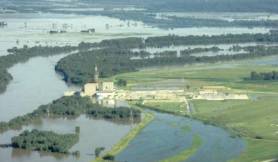
Fort Calhoun nuclear generating plant, flooded by the Missouri River, on June 17, 2011 - Photo by Matt Miller, Omaha  World-Herald

Photo caption from the Omaha World-Herald: "The Fort Calhoun Nuclear Station from the air Thursday. OPPD was putting the finishing touches on federally ordered flood-defense improvements before flooding began. MATT MILLER/THE WORLD-HERALD"

More, other resources:

UPDATE, June 20, 2011:  Let’s call it a hoax

I don’t think I’m going too far out on a limb to call the claims of a serious accident, emergency and potential disaster at the Fort Calhoun site, a hoax.  The Russian report — if it exists — may not have been intended as a hoax, but coupled with filtering through the credulous and gullible foreign press (we’re looking at you, Pakistan’s The Nation), it has risen to hoax level, to be debunked.  Sure, you should be concerned about safety and security at Fort Calhoun and Cooper — but you should be concerned about safety and security at every nuclear power plant around the world, all the time.  This may be a good time for you to reread John McPhee’s brilliant Curve of Binding Energy.  It’s dated — Ted Taylor died October 28, 2004  (was his autobiography ever published?) — but still accurate and informative, plus, any excuse to read any work of McPhee is a great one.


Salt Lake Tribune obit for journalist Ernie Ford

June 4, 2011

The Salt Lake Tribune carried an obituary for my old journalism professor Ernie Ford today.

Small world:  Good words about Ernie came from an official at KSL-Television, Con Psarras, Vice President for Editorials and Special Projects.  Con is former news director at KSL, the job that many said Ernie was perfect for, but  could never have because he wasn’t in with the owners of the station.  Con is also a former colleague of mine from the University of Utah debate squad (he was a much better debater than I)*.

Con Psarras, KSL’s vice president of editorials and special projects, remembered Ford as “a one-of-a-kind character.”

“He was inspirational to a lot of people,” said Psarras, KSL’s former news director. “He was a real journalist who cared about all those fundamental things that make journalists good at what they do. He was a stickler for detail. If you got something wrong, it was not a pleasant experience. Someone said they earned their first layer of thick skin from Ernie Ford.”

Stickler for detail, sure.  Ford was a great copy editor, and as a managing editor he worried about getting things right, for the readers’ sake in addition to avoiding libel suits.  But I didn’t find it unpleasant to get those fact challenges from Ford.  He knew where the weak spots of a story were likely to be, and he asked the questions that exposed those weaknesses to the writer.  I enjoyed that banter and process — which prevented mistakes from getting into print. (There weren’t idiots as editors of the Chronicle — accuracy, shoe leather and decent writing lived in that paper, often.)

Where are schools of journalism these days?  I was shocked that Texas A&M dropped its journalism program a few years back.  The best intern I ever had came out of A&M’s program.  Liz Newlin wrote concisely and well, and she could smell the heart of a news story, and put it into the lead so you’d have to follow the arteries deeper into the thing to see what happened.  Newlin could have been another Ernie Ford — but she married a guy named Taylor (you figure out the married name), went to law school and became a water law expert in Tucson.

Who trains good journalists by the score in good journalism practices anymore?  Who would want to go into such a field, with newspapers coming down around those left in the newsrooms, and with every fourth yahoo with an internet connection blogging away? [Yeah, me too.]

_____________

*  We got a couple of good reporters out of that debate squad.  Good training for a reporter, I think.  Steve Christensen signed up with UPI back when it was still a noble outfit; I don’t know where he is these days.  Tim Weiler reported for several years in and around Salt Lake.   Carolyn Young, one of  our graduate assistants back in the Early Later Than You Think Holocene reported for KSL’s rival, KUTV, but she headed out to Oregon.  Of course, none of them were journalism majors.  Go figure.


Quiet giant of Utah journalism, Ernie Ford

June 2, 2011

Sometimes the news comes slow.

Jake Sorenson at the Daily Utah Chronicle sent out a notice that Ernie Ford died last night.  Cardiac issues.  He was 70, after all — young by today’s standards, and not yet used up.

Ford was adjunct faculty and adviser to the Chronicle when I wrote there, and took classes from him.  Ford and Roy Gibson were veterans of Utah journalism who could offer a couple of chapters of a textbook they never wrote on how to write well, and how to write good news stories — with just their markups, questions and corrections in the margins of the news story one had to meet deadline on.

Gibson died several years ago.

More than once I regretted that I had to send the copy, with Ford’s comments, off to “typesetting” in the backshop, knowing I’d never see it again.  We didn’t have a photocopier to just make another copy.

Details to come, Jake said.  We’re losing more than just old, established newspapers.  We’re losing the men and women who made the news, news, and made the news readable, and understandable.

Ford made his reputation at KSL Television News and the Salt Lake TribuneHere’s a 1989 story on his leaving KSL to move to a Dallas station.  Sometime after that he moved on to run the Society of Professional Journalists, in Indiana.  Details on Ford’s life and death to follow, but probably no film at 11:00.

When enough of the big trees fall, you can’t call it a forest any more, you know?

_______________

DePauw University put out a release on Ernie Ford:

Former Prof. Ernie Ford Passes Away at Age 70

98198

Veteran reporter, editor and journalism professor Ernie Ford died June 1 in Greencastle, Indiana

June 2, 2011, Greencastle, Ind. —  Ernest J. “Ernie” Ford Jr., a respected journalist and former member of the DePauw University faculty, passed away yesterday. He was 70 years old.

Ford was born on June 7, 1940, in Salt Lake City, and earned bachelor’s and master’s degrees in journalism from the University of Utah. After a lengthy career in print and broadcast journalism, Ford came to Greencastle in the spring of 1992 when he was named executive director of the Society for Professional Journalists (SPJ). The organization, which was founded by student journalists at DePauw University as Sigma Delta Chi (SDX) in 1909, is the nation’s most broad-based journalism organization. SPJ had its national headquarters in Greencastle in the 1990s. 98200

“Ernie Ford was selected because of his strong management experience in broadcast and print journalism,” said Georgiana Vines, assistant managing editor of the Knoxville News Sentinel and chair of the search committee, when Ford’s appointment was announced.

Ford had served as SPJ’s national president during 1991-92 before taking a paid post with the organization. He became a member of SPJ’s national board of directors in 1984, when he was elected Region 9 director, and served as chair of the Ethics Committee, Publication Committee, and the Legal Defense Fund.

98201

Photo, l-r: Ford and David Bohmer '69, director of the Pulliam Center for Contemporary Media Center and Media Fellows Program, with former The DePauw editors Eric Aasen '02 and Andrew Tangel '03 in October 2010

A regular lecturer to students in journalism classes and members of the DePauw Media Fellows program, Ford served as a part-time instructor in University Studies during the 2001-02 academic year. Ernie Ford and his wife, Linda, who survives, are also known to a generation of DePauw students as owners of the Fine Print Bookstore, which they operated on Greencastle’s square for 15 years.

He also served as an adjunct instructor at the University of Utah, Brigham Young University and Utah State University.

“Ernie was a great teacher who helped his students understand the media industry and journalism,” recalls Andrew Tangel, a 2003 DePauw graduate and former editor of The DePauw who now a reporter at New Jersey’s Bergen Record. “A former investigative reporter himself, he seemed to relish asking tough questions at public meetings on campus and in town. He passed along tips to student journalists and encouraged them to be aggressive, hard-nosed reporters.”

Before coming to Indiana, Ford’s journalism career which included stints as managing editor of KSL-TV in Salt Lake City, assistant news director of KDFW-TV in Dallas, assistant city editor of the Salt Lake Tribune, wire editor of the Idaho Post-Register in Idaho Falls, and general assignment reporter for the Deseret News in Salt Lake City. He collected numerous journalism awards, including a 1980 Sigma Delta Chi award for broadcast public service, regional Emmys, the Eudora Welty Award and the DuPont Award. A strong advocate for the First Amendment and the rights of journalists, Ford testified before Congress in support of the Freedom of Information Act and organized a a petition drive that led move the U.S. Supreme Court to permit still cameras in the 47517courtroom.

In 2006, Ford was inducted into the Hall of Fame of the Daily Utah Chronicle, the University of Utah’s student newspaper, where he cuts his reporting teeth as an undergraduate and later served as faculty adviser.

Ford served on the boards of the Putnam County Humane Society, Great Lakes Booksellers Association, served of president of Main Street Greencastle, and was a longtime supporter of the Putnam County Playhouse.

A celebration of Ernie Ford’s life will be held at 2 p.m. Sunday at the Putnam County Playhouse, 715 South County Road 100 East, Greencastle.

An obituary is accessible at the website of Greencastle’s Banner-Graphic.


Terrible plunge of BBC News

May 28, 2011

BBC Radio News logo

BBC Radio News logo

3:30 p.m. Central Daylight Time.  In Barcelona, Spain, London’s Wembley Stadium, Manchester United and Barcelona(Spain) tangle for the Champions’ League trophy.

BBC News?  This is the order of the stories:

  • In Afghanistan, the national police chief was murdered by a suicide bomber
  • In Egypt, Hosni Mubarak was fined $90 million for interfering with business by cutting phones and internet
  • Yemen’s got trouble
  • Palestinian independence got support from the Arab League, meeting in Doha, Qatr
  • U.S. President Obama ended his tour of Europe in Poland, with a pledge of friendship
  • In Moscow, Russian, gay rights demonstrators were attacked by a mob led by people who said they are members of the Russian Orthodox Church
  • Barcelona leads Manchester, 3 to 1, with minutes to play

I’m not usually one to complain, but doesn’t it appear BBC News has its priorities wrong in this order of stories?


Businessweek’s great covers – “Don’t play chicken with the debt ceiling”

May 21, 2011

BusinessWeek cover, April 18-24, 2011 - Don't play chicken with debt ceiling

BusinessWeek cover, April 18-24, 2011 - Don't play chicken with debt ceiling; chicken image by Jan Hamus/Alamy

Not every one of the Bloomberg Businessweek covers has been a hit, but a lot of them are — vastly more entertaining since Bloomberg took over the old workhorse magazine.

This one packs a political punch along with visual excitement.

And it’s right.  Do any Republicans pay attention to the finance and business worlds anymore?

Articles inside are informative, too — see Peter Coy’s article, and  did you see the article on the debt ceiling issue and the views of past Treasury secretaries?

Hey!  Republicans!  Stop playing chicken with the nation’s credit, will you?

Graphic - dangerous game on debt ceiling -- Businessweek

Businessweek graphic from April 18-24, 2011 issue - click for larger view at Businessweek site; chicken image by Jan Hamus/Alamy


Do you read about politics on line? Help with this research (it’s free!)

May 14, 2011

Texas Liberal asks help for a friend doing research:

I’ve been requested to ask my readers to consider taking part in a survey of uses and users of online sources of political information being conducted by researcher Tom Johnson.

Research, in dictionary - Oklahoma State U

Image from Oklahoma State University

Mr. Johnson is a senior scholar at the University of Texas School of Journalism.

Mr. Johnson says that most of the people responding have been conservatives. This is fine as far as that goes, but they’d like to balance it out so the survey is more representative of the full electorate.

The survey should take between about 15 – 20 minutes to complete.

You might also wish to consider passing along the link to the survey on Facebook or Twitter.

Thank you.

Don’t hope that your assisting with Dr. Johnson’s research will improve the writing or accuracy of anything you get on line, though.  It’s research, not miracle working.


Alan Alda speaks about the future of science communication, for NSF

March 28, 2011

After the long-running, ever popular television series M*A*S*H ended, star Alan Alda got roped into hosting a science program on public television for Scientific American. Alda discovered he really likes science.  He discovered he has a flair for talking about science, too.

With the constant discussion among scientists about how to overcome the War on Science, and especially how to combat the fruit loops, crank scientists, junk science purveyors and others who muddy the waters of understanding science, I thought this interview at a National Science Foundation function was interesting:

Vodpod videos no longer available.

Alan Alda speaks about the future of science co…, posted with vodpod

Caption from NSF:

Alan Alda, award winning actor and Visiting Professor with the Center for Communicating Science, talks about his experiences with communicating science to the general public. Looking to close the gap between the scientific community and the public, Mr. Alda discusses what needs to be improved, and how science can be better understood.

Credit: National Science Foundation

Can Alda really do anything about saving science communication, rescuing it from the propaganda machines?


Why conservative talk makes more money than liberal talk: No thinking (is it true?)

January 15, 2011

Some say the success of conservative radio can be traced to 1987 when the Reagan administration put an end to the Fairness Doctrine, making it easier for broadcasters to be one-sided. Others cite the Telecommunications Act of 1996, which led to mega-chains of stations and the widespread duplication of successful formats – including conservative talk radio – which gradually took over the stronger radio outlets in most markets.

Peter Funt, of Candid Camera

Peter Funt, of Candid Camera

But such arguments really overlook the simpler truths of the matter: conservative broadcasters serve an audience that is often angry and easily stirred, that wants to be reinforced more than challenged, and that doesn’t always feel compelled to slavishly adhere to the facts of a matter.

More importantly, conservative broadcasters across the dial are vastly more entertaining than their liberal counterparts. Limbaugh and Beck are polished performers, with enough shtick in the tank to keep truckers engrossed over the long haul, or to rouse tired shift workers on the drive to and from home. Indeed, the daring diatribe of the right is so compelling that it often seems as if the most dedicated listeners of conservative broadcasters are their progressive competitors.

Peter Funt of Candid Camera, at the Cagle Post (Cagle Cartoons)