Chess games of the rich and famous: Marcel Duchamp

July 6, 2010

Duchamp playing chess

Sculptor and conceptual artist Marcel Duchamp playing chess. Unknown photographer, via Concepts into Virtualities

Marcel Duchamp, according to Andrew Stafford:

Marcel Duchamp (1887-1968), the painter and mixed media artist, was associated with Cubism, Dadaism and Surrealism, though he avoided any alliances. Duchamp’s work is characterized by its humor, the variety and unconventionality of its media, and its incessant probing of the boundaries of art. His legacy includes the insight that art can be about ideas instead of worldly things, a revolutionary notion that would resonate with later generations of artists.

Also, he liked to play chess.

Marcel Duchamp with chess set designed by his friend, Max Ernst

Marcel Duchamp with chess set designed by his friend, Max Ernst

The photograph at left comes from ChessMate.com:

. . . Marcel Duchamp, enjoying a chess set designed and presented to him by fellow artist, Max Ernst.

To say that Duchamp was an avid chess player would be an understatement. He played at approximately expert to master strength, and it is well known that he had — during the later part of his formidable career as a visual artist — given up the pursuit of art in favor of chess.

Here is an interesting quote about art and chess that is attributed to Marcel Duchamp:

“I am still a victim of chess. It has all the beauty of art — and much more. It cannot be commercialized. Chess is much purer than art in its social position.”

You will also want to see:

  • “Half-naked Thursday:  Eve Babitz with Marcel Duchamp,” at You Can Hire An Artist.   Is it safe for work or school?  The photo shows Duchamp in a gallery filled with his works at in 1963, playing chess with Eve Babitz, who is nude.   (The museum is identified as the “Pasadena Art Museum,” which would be the Pasadena Museum of Art of California See the explanation from Kathleen Benton in comments; I think it more likely that the museum is the Norton Simon Museum, also in Pasadena, but showing much more modern art and European art. (The Pasadena Art Museum is wonderful, by the way — an outstanding place to spend an afternoon; the Norton Simon is one you must see in your lifetime.)
  • “Not Wanting to Say Anything About Marcel,” by John Cage, at the Norton Simon Museum in Pasadena.

Newseum’s interactive map of today’s headlines

June 2, 2010

This is cool.

Pam Harlow, an old friend from American Airlines, and a map and travel buff, e-mailed me with a link to the Newseum’s interactive headline map.  I can’t get a good screen shot to show you — so you gotta go to their site and see it for yourself.

When it comes up in your browser, it features a map of the continental 48 states, with dots marking major daily newspapers across the nation.  Put your pointer on any of those dots and you see the front page of the newspaper for today from that city.

Using the buttons at the top of the map, you can check newspapers on every continent except Antarctica.

How can I use this in class?

Update:  Here’s a screen shot of the Newseum feature:

Newseum's interactive front-page feature - showing the front page of the Idaho Statesman-Journal of Pocatello, Idaho, on December 15, 2013

Newseum’s interactive front-page feature –  on December 15, 2013


Computer-aided study of the Venus de Milo

February 27, 2010

Oh, sure, it’s on the web more as advertising for Konica/Minolta.  But it’s still cool.

Close-up of arm of Venus de Milo - Wikimedia image

So-called “Venus de Milo” (Aphrodite from Melos), detail of the upper block: join surface of the right upper arm, with mortise; attachment holes, which probably bore a metal armlet; strut hole above the navel, now covered with plaster. Parian marble, ca. 130-100 BC? Found in Melos in 1820. Wikimedia image

Konica/Minolta scanned the Venus de Milo in great detail, and they have put up a Flash multimedia piece exploring the creation of the piece, techniques of sculptors of the time, and, most interesting to most of us, just what the piece was supposed to look like with her arms.

If your school district is nipple intolerant, don’t send your kids there.  If you have AP World History, your kids might benefit from seeing Konica/Minolta’s comments and study — you can check it all out in less than ten minutes.


Millard Fillmore’s birthday, January 7 – How will you celebrate in 2010?

December 30, 2009

In honor of Millard Fillmore’s birthday on January 7, I’ll post a collection of images of Fillmore and his administration that I’ve come across over the past year.  Though photography was invented in 1837, and though Fillmore was thought to be a handsome man, not many images of our 13th president survive on the internet.  For that matter, there is not a lot of good biographical information, either.

Many of these images come from the Library of Congress’s collections.

Millard Fillmore, Library of Congress Prints and Photographs Collection - Duval image

Millard Fillmore, undated lithograph, Library of Congress

The Library of Congress has one copy of a print of this image.  A note with the image says “Duval,” but little is known about it otherwise, at least to the Library of Congress.  No date is given.  Judging from the color of his hair, I think this may be an image done for his unsuccessful 1856 campaign.

Only a tiny handful of images of Fillmore show up regularly — this is not one of them.  I wonder whether my posting it here will have any effect in spreading its popularity.

Fillmore will perhaps always remain enigmatic, out of step with his own times in many ways, and forced to the edges of history by other events and people more in the mainstream.  Fillmore was born January 7, 1800, 24 days after the death of George Washington (d. December 14, 1799), and lived through the administration of Abraham Lincoln, and the Civil War.  Fillmore had some things in common with both of those great presidents, but no real dealings except for his opposition to Lincoln.

History uneasily deals with such men, who refuse to be put into pigeon holes.

Resources:


Typewriter of the moment: Santa Claus, Indiana’s Post Office

December 27, 2009

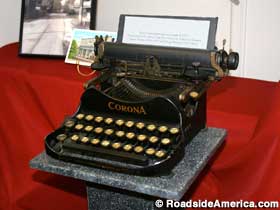
maybe a little late for Christmas:  Here’s the typewriter used to answer letters to Santa Claus, at the U.S. Post Office of Santa Claus, Indiana:

Typewriter used to answer letters to Santa Claus, from the U.S. Post Office in Santa Claus, Indiana - Roadside America photo

Typewriter used to answer letters to Santa Claus, from the U.S. Post Office in Santa Claus, Indiana - Roadside America photo

For 30 years, kids letters to Santa Claus were answered, with the responses typed on this Corona at the Post Office.  The machine rests on display at the Santa Claus Museum in Kris Kringle Plaza in Santa Claus, Indiana, about 40 miles east northeast from Evansville (south of Interstate 64).

Answers to letters to Santa Claus are answered from the museum today.

You can see the typewriter; Roadside America’s website says the museum is open 9:00 a.m. to 5:00 p.m. daily — but you may want to call ahead to confirm:

Santa Claus Museum

Address:
41 N. Kringle Place, Santa Claus, IN
Directions:
On the north side of Hwy 162/Christmas Blvd just west of Holiday World. In Kringle Plaza. Look for the Holiday Foods and the Post Office.
Admission:
Donations.
Hours:
9 am-5 pm daily. (Call to verify)
Phone:
812-937-2687

Spread Santa’s cheer!

Add to FacebookAdd to NewsvineAdd to DiggAdd to Del.icio.usAdd to StumbleuponAdd to RedditAdd to BlinklistAdd to TwitterAdd to TechnoratiAdd to Furl


Newspaper history: “Yes, Virginia,” the most popular editorial ever vouches for Santa Claus

December 20, 2009

“Papa says, ‘If you see it in the Sun, it’s so.'”

Do we stand as witnesses to the end of newspapers in America?

It’s been a grand history.  Newspapering gave us great leaders like Benjamin Franklin.  Newspapering gave us wars, like the Spanish-American War.  Newspapering gave us Charlie Brown, Ann Landers, the Yellow Kid, Jim Murray, Red Smith, Thomas Nast (and Santa Claus), the Federalist Papers, and coupons to save money on laundry soap.

It’s been a curious history, too.  An 1897 editorial vouching for Santa Claus rates as the most popular editorial of all time, according to the Newseum in Washington, D.C.

Francis Pharcellus Church, New York Sun writer who wrote "Yes Virginia, there is a Santa Claus" - Newseum

The man who saved Christmas, at least for Virginia O'Hanlon: Francis Pharcellus Church - Newseum image

In autumn, 1897, 8-year-old Virginia O’Hanlon of 115 West 59th Street in New York, wrote to the New York Sun with this simple question:

“Please tell me the truth; is there a Santa Claus?”

In the age of Yellow Journalism, the fiercely competitive Sun‘s editors turned the letter to Francis Pharcellus.  He responded to little Virginia on September 21, 1897:

“Yes, Virginia, there is a Santa Claus.”

Church’s brother, William Conant Church, owned and published the newspaper.  Both had followed their father into the news business.  They co-founded The Army-Navy Journal in 1863, and went on to a series of journalistic collaborations.  Francis was 58 years old when he answered Virginia’s letter. (He died at age 67, in 1906.)

The New York Sun held down the conservative corner in New York journalism at the time, versus the New York Times and the New York Herald-Tribune.  But it also had an interesting history, to a blogger intrigued by hoaxes.  In 1835 the paper published a series of six newspaper stories falsely attributed to Sir John Herschel, a well-known astronomer, claiming to describe a civilization on the Moon — the Great Moon Hoax.  The discovery was credited to a new, very powerful telescope.

In 1844 the paper published a hoax written by Edgar Allen Poe, the Balloon Hoax.  Under a pseudonym, Poe wrote that a gas balloon had crossed the Atlantic in three days.

The Sun also featured outstanding reporting.  A 1947 and 1948  series about crime on the docks of New York City won a Pulitzer Prize for writer Malcolm Johnson.  That series inspired Elia Kazan’s 1954 movie On the Waterfront starring Marlon Brando, Rod Steiger, Eva Marie Saint, Karl Malden and Lee J. Cobb.

The New York Sun ceased publication in 1950.

For all of its history, the Sun and the Churches are most remembered for that defense of belief in Santa Claus.
Virginia O’Hanlon grew up, graduated from Hunter College, got a masters at Columbia, and earned a Ph.D. from Fordham.  She taught in the New York City Public School system, from which she retired in 1959.  She died in 1971.

Birth of tradition

Columbia University was Church’s alma mater, as well as O’Hanlon’s.  Her letter and his response get a reading each year at the Yule Log Ceremony at Columbia College, along with the poem “A Visit from St. Nicholas.”  Animated, live-acting, and other television productions have been mounted in 1974, 1991, and 2009.


Is there a Santa Claus?  Did Church write a credible defense? The text of the letter and answer, below the fold.

Add to FacebookAdd to NewsvineAdd to DiggAdd to Del.icio.usAdd to StumbleuponAdd to RedditAdd to BlinklistAdd to TwitterAdd to TechnoratiAdd to Furl

Read the rest of this entry »


Texas State Dinosaur an affront to creationists

October 22, 2009

Texas has a new State Dinosaur.

Scientists are working to make a good model of the beast for the Fort Worth Museum of Science and History, as reported in the October 6 Fort Worth Star-Telegram (often referred to locally as the “Startle-gram,” but still one of America’s good-to-great newspapers).  David Casstevens reported:

The official state dinosaur would look big even inside Cowboys Stadium.

The creature stood 15 feet tall at the shoulders.

Sixty feet long, head to tail, it weighed 20 tons or more.

Sadly, despite being native to Texas, the species lived and died without ever tasting brisket.

“It was a herbivore,” paleontologist Dale Winkler said.

The quadrupedal sauropod — sort of a giant prehistoric giraffe — was the state’s first vegetarian.

Winkler, an SMU professor, stood with several other men around a workbench inside a building west of Azle, arms folded, their eyes studiously fixed on a rare and wondrous object, the skull that once contained the very small brain of Paluxysaurus jonesi.

They are members of a team that is meticulously reconstructing the dinosaur’s framework.

An articulated skeleton of the beast, which roamed this part of the country more than 100 million years ago, will become the centerpiece of DinoLabs, a dinosaur exhibit at the new $80 million Fort Worth Museum of Science and History, which opens Nov. 20.

Texas is the ample belly of the nation’s Bible Belt, don’t you know.  Creationists could not let such science endeavors proceed without their version of a blessing, provided in this case by a letter to the editor by a local guy named Richard Hollerman:

Unwarranted assumptions

David Casstevens’ Oct. 6 story tells of work to restore a dinosaur, Paluxysaurus jonesi, that will soon have its place in the Fort Worth Museum of Science and History. (See: “Dinosaur skeleton to lead exhibit”)

Thousands of professing Christians, including scientists with advanced degrees, deny basic elements of his account and views held by unbelieving paleontologists. (1) Consistent Christians believe God created dinosaurs relatively recently — about 6,000 years ago — whereas skeptical scientists assert they lived 100 million years ago. (2) Christians contend that dinosaurs were created as dinosaurs instead of evolving from prehistoric life that spontaneously sprang from nonlife 3 billion years ago. (3) Consistent Christians believe that dinosaurs became extinct after the worldwide Noaic flood 4,500 years ago.

We totally reject the unfounded assertion that this dinosaur “roamed this part of the country more than 100 million years ago” — as the reporter asserts. The discerning reader can verify this by consulting the Institute for Creation Research ( www.icr.org), Answers in Genesis ( www.answersingenesis.org), Apologetics Press ( www.apologeticspress.org) and others showing the fallacy of the evolution model and reasonableness of recent creation, along with the creation and extinction of dinosaurs.

I encourage the Star-Telegram to report these findings in a way that harmonizes with established facts instead of blindly accepting unfounded assertions by unbelieving paleontologists.

— Richard Hollerman, Richland Hills

You should be impressed that so many other local residents have differing views.  The newspaper published several letters in response to Hollerman, on October 17:

Good science vs. non-science

After reading Richard Hollerman’s Oct. 14 letter, “Unwarranted assumptions,” I gather that he believes that only atheist scientists think that dinosaur fossils are millions of years old.

That is incorrect. The vast majority of scientists, regardless of religious beliefs, think that the evidence is overwhelming that dinosaur fossils are millions of years old. If he needs some examples of scientists who are Christian, specifically evangelical Christians, I would point out Mary Schweitzer, Keith Miller, Francis Collins, Richard G. Colling and Stephen J. Godfrey, who are biologists and paleontologists and are also evangelical Christians. Were it not for space limitations I could list thousands more.

This is not about belief vs. disbelief. It is about good science vs. non-science.

— Bill Robinson, Arlington

Hollerman and “thousands of professing Christians” have declared that their religious beliefs trump science, and they have a constitutional right to their notions. On top of that, they also have their churches, family units, private schools, home schooling, colleges that teach pseudo-science and the amazing Creation Museums in which Noah built a third tier on the “ark” to keep dinosaurs at a respectful distance. Fine.

Those of us who do not share the beliefs of “thousands” ask only that you use the aforementioned resources to educate your young, accustom yourselves to the thought of life in a Third World country and leave the rest of us alone!

— Jackie Bell, River Oaks

According to creationists, science is correct about the following:

Chemistry, computer science, mathematics, engineering, sociology, systems science, psychology, medicine, nuclear science, agronomy, astronomy, nanotechnology, acoustics, biophysics, condensed matter physics, electronics, fluid dynamics, geophysics, plasma physics, vehicle dynamics, solar astronomy, meteorology, limnology, soil science, toxicology, marine biology, parasitology, anatomy, biochemistry, structural biology, entomology, cetology, phylogeny, algebra, calculus, cartography, geopolitics, criminology, agriculture, language engineering, pathology, pediatrics, nutrition, physical therapy and dermatology.

But for some reason, according to creationists, science is wrong about evolution. How is that even possible?

— Mark Stevens, Fort Worth

Millions of professing Christians, including intelligent people from all religions and all walks of life, view the basic elements of paleontology as reasonable and logical. (1) Bones found in the different layers of soil show a chronological time line extending much further than 6,000 years ago. (2) Evolution is an observable, rational concept that is ongoing even in today’s “educated” world. (3) Claims that dinosaurs became extinct in a worldwide flood 4,500 years ago are laughable.

Uneducated Christians contend that dinosaurs became extinct in the Noaic flood, yet if you read the Bible it says Noah took two of every animal into the ark to preserve the different species. Did he overlook dinosaurs? Were they deemed unfit to survive by God?

Being raised as a Southern Baptist, I was taught that God guided evolution to fit His plan. Even the most devout Christians in my church had enough intelligence to see the facts that were right before their eyes. I encourage Star-Telegram readers to open their minds and their eyes to prevent the corruption of future generations and find a way to harmonize their beliefs with established facts instead of blindly accepting unfounded fantasies from uneducated Christians.

— Terry Brennan, Haltom City

I sat in total amazement after reading Hollerman’s letter disagreeing with the history of the Paluxysaurusjonesi. To cite Genesis as a historical reference is almost laughable, except for the fact that there are people who honestly believe the Adam and Eve story of creation. To believe that humans lived in this form, only with less clothing, millions of years ago is incredulous to say the least.

I give thanks that there is a science that disproves these myths. Why can’t these folks see the divine spirit in the creation and evolution of life forms on our planet, rather than actually believing what is in the Bible literally? I find it exciting that there are higher forms of being, and that new knowledge is being revealed every moment of every day.

— Betsy Stell, Arlington

I don’t know whom Hollerman was referring to in his letter when he wrote about “Consistent Christians.” I guess he means “fundamentalists” since they’re the only ones who believe in Bronze Age myths rather than modern science. Or perhaps he means people who believe the pseudo-science in the silly, anti-evolution Christian fundamentalist Web sites he cited.

The truth, of course, is that every scientific discipline from archeology to zoology contributes to the vast body of knowledge and huge amount of evidence supporting evolution. Thanks, Star-Telegram, for publishing facts and not allegorical stories written by Middle Eastern tribesmen thousands of years ago.

— Terry McDonald, Grapevine

I was impressed by the Star-Telegram’s reporting on the restoration of the fossil Paluxysaurus jonesi by the Fort Worth Museum of Science and History. The article gave the facts and some feel-good information about the people involved in the reconstruction of the dino fossil.

However, Hollerman’s letter would be a joke if it weren’t for the fact that so many people really do think that the Earth is only 6,000 years old and will deny the fact that the Earth is about 4.5 billion years old. It has been proven by scientific method.

Creationists have a distorted view because the one book that they use (written 2,000 years ago by primitives) disagrees with the science that proves the existence of natural history. The age of this fossil is not unfounded but rests on the work of many thousands of scientists over a couple of hundred years in scores of different scientific disciples. The scientific method that is used to vet new and existing research is a crucible that is used to sort facts from fallacy and has been used to debunk fake, false and misleading science for a couple of hundred years.

We would still be living in caves without the scientific and technological advances that we enjoy today. I applaud the Star-Telegram for its fair and unbiased science reporting. Keep it up.

— Charlie Rodriguez, Arlington

Meanwhile, e-mails between members of Texas Citizens for Science chase another interesting facet:  Where in Texas is there enough Jurassic rock to support such a find?

Oh, those scientists!

More information:

Tip of the old scrub brush to Annette Carlisle, a member of Texas Citizens for Science.

Cast away a note in a bottle, in the Paluxy River:


Add to FacebookAdd to NewsvineAdd to DiggAdd to Del.icio.usAdd to StumbleuponAdd to RedditAdd to BlinklistAdd to TwitterAdd to TechnoratiAdd to Furl


Typewriter of the moment: Alan Lomax, folk music historian, 1942

October 18, 2009

Alan Lomax at the typewriter, 1942 - Library of Congress photo

Alan Lomax at the typewriter, 1942, using the "hunt and peck method" of typing - Library of Congress photo

Who was Alan Lomax?  Have you really never heard of him before?

Lomax collected folk music, on wire recorders, on tape recorders, in written form, and any other way he could, on farms, at festivals, in jails, at concerts, in churches, on street corners — anywhere people make music.  He did it his entire life.  He collected music in the United States, across the Caribbean, in Britain, Scotland, Ireland, Spain and Italy.

Alan Lomax, Woody Guthrie, Lillie Mae Ledford and an obscured Sonny Terry, New York, 1944 (Library of Congress Collection - photographer unknown)

Alan Lomax, Woody Guthrie, Lillie Mae Ledford and an obscured Sonny Terry, New York, 1944 (Library of Congress Collection - photographer unknown)

Almost all of that collection is in the Library of Congress’s unsurpassed American Folklife collection, from which dozens of recordings have been issued.

Born in 1915, Alan Lomax began collecting folk music for the Library of Congress with his father [John Lomax] at the age of 18. He continued his whole life in the pursuit of recording traditional cultures, believing that all cultures should be recorded and presented to the public. His life’s work, represented by seventy years’ worth of documentation, will now be housed under one roof at the Library, a place for which the Lomax family has always had strong connections and great affection.

Were that all, it would be an outstanding record of accomplishment.  Lomax was much more central to the folk revivals in the both England and the U.S. in the 1950s and 19602, though, and in truth it seemed he had a hand in everything dealing with folk music in the English-speaking world and then some.  Carl Sagan used Lomax as a consultant to help choose the music to be placed on the disc sent into space with the exploring satellite Voyager, “the Voyager Golden Record.”

Have you listened to and loved Aaron Copland’s “Rodeo,” and the famous passage, “Hoedown?”  How about Miles Davis, with the Gil Evans-produced “Sketches of Spain?”  [Thank you, Avis Ortner.]  Then you know the work of Alan Lomax, as Wikipedia explains:

  • The famous “Hoedown” in Aaron Copland‘s 1942 ballet Rodeo was taken note for note from Ruth Crawford Seeger‘s piano transcription of the square-dance tune, “Bonypart” (“Bonaparte’s Retreat”), taken from a recording of W. M. Stepp’s fiddle version, originally recorded in Appalachia for the Library of Congress by Alan and Elizabeth Lomax in 1937. Seeger’s transcription was published in Our Singing Country (1941) by John A. and Alan Lomax and Ruth Crawford Seeger.
  • Miles Davis‘s 1959 Sketches of Spain album adapts the melodies “Alborada de vigo” and “Saeta” from Alan Lomax’s Columbia World Library album Spain.

Lomax died in 2002.

Other resources:


“To Hear Your Banjo Play” featuring Pete Seeger, written and produced by Alan Lomax.
Trailer for the PBS P.O.V. film, “The Song Hunter,” by Rogier Kappers

Vodpod videos no longer available.

more about “POV – Lomax the Songhunter | PBS“, posted with vodpod

Sing out!

Add to FacebookAdd to NewsvineAdd to DiggAdd to Del.icio.usAdd to StumbleuponAdd to RedditAdd to BlinklistAdd to TwitterAdd to TechnoratiAdd to Furl


Museum of North Texas History: 100 years of Scouting

October 3, 2009

Wondering what to do while you’re in Wichita Falls, Texas?

Through March 2010, you can view a display commemorating Scouting’s 100th anniversary in the United States, featuring nearly 100 years of Scouting history in Wichita Falls.

Stephanie Wood, assistant curator of the exhibit “Boy Scouts of America: 100 Years,” hangs Boy Scout uniforms at the Museum of North Texas History.  Photo by Photos by Marissa Millender/Times Record News

Stephanie Wood, assistant curator of the exhibit “Boy Scouts of America: 100 Years,” hangs Boy Scout uniforms at the Museum of North Texas History. Photo by Photos by Marissa Millender/Times Record News

Again showing the value of local “mainstream” media, the Wichita Falls Times-Record News featured a story on the exhibit on September 14, “Scouting through the ages.”

History teaches us if you learn from the past, you’ll be better prepared for the future. But being prepared is a quality also embraced by another organization — the Boy Scouts of America.

And so it seemed fitting that when the Boy Scouts reached their 100th anniversary this year, the Northwest Texas Council would commemorate the event at the Museum of North Texas History.

The downtown museum will open its latest exhibit, “Boy Scouts of America: 100 Years,” with a preview dinner at 6 p.m. Thursday at the dowtown museum, 720 Indiana, though more than 400 visitors got a sneak peek of the display Saturday during the Wichita Falls Museum Coalition’s Stroll ‘N’ Roll Museum Day.

The $40 preview dinner will include a viewing of the exhibit and a talk by Jim Hughes, George Adams and Darrell Kirkland.

Hughes, the Boy Scouts Chartered Organization Representative at Floral Heights United Methodist Church, has been involved in Scouting for about seven decades. A lot of his Scouting memorabilia peppers the exhibit, such as his Order of the Arrow badges and Boy Scout, Cub Scout and Explorer awards.

One of the most valuable pieces of memorabilia in the display, he said, is a flag hand-sewn by Scouts in 1913.

“Boys didn’t have money back then and had to make their own flag,” Hughes said.

Another impressive contribution to the exhibit is Bill McClure’s Eagle badge. McClure received his Eagle rank — the highest rank that can be achieved in the organization — in 1921. He was the first Eagle in the Wichita Falls Council to do so. He earned 21 merit badges and would eventually become a journalist for the Times Record News and sold advertising for KWFT before his death in 1982.

Hughes said what he treasures most among his scouting collection over the years is his own Eagle badge.

The exhibit, curated by Betsy O’Connor with Stephanie Wood as assistant curator, also includes a Pinewood Derby track on which visitors can race wooden cars, along with a display of a tent and camp fire.

Visitors will see Boy Scout, Cub Scout and Webelos uniforms on display, as well, such as the 1930s-era uniform of Billy Sims, the 1961 outfit of Tim Hunter and the 1998 uniform of Cory Wood, along with the “brag vest” of Cole Watson.

One area features information about Philmont Scout Ranch, a 137,493-acre ranch in the mountains of northeastern New Mexico in the Sangre de Christo Range of the Rockies, donated by Oklahoma oilman Waite Phillips.

Posters in the exhibit show various ropes and knots Scouts learn to tie, and things Scouts can do in nature conservation.

From left, Betsy O’Connor, curator, and Stephanie Wood, assistant curator, set up a camping display in the “Boy Scouts of America: 100 Years” exhibit at the Museum of North Texas History.  Photos by Marissa Millender/Times Record News

From left, Betsy O’Connor, curator, and Stephanie Wood, assistant curator, set up a camping display in the “Boy Scouts of America: 100 Years” exhibit at the Museum of North Texas History. Photos by Marissa Millender/Times Record News

Other items to look for: Carl Watson’s walking stick, an Order of the Arrow Native American headdress and Eagle Claw necklace and photographs of local scouts.

The Boy Scouts of America was incorporated on Feb. 8, 1910, by William D. Boyce and others. It was modeled after an organization in Great Britain founded by Lord Baden-Powell.

In 1911, Dr. J.L. McKee, pastor of First Presbyterian Church, organized the first troop in Wichita Falls with 27 members before the troop disbanded after McKee left town. But two years later, four more troops were organized. The Wichita Falls Council became the Northwest Texas Council in 1937.

All three of Jim Hughes’ sons, like their father, earned the rank of Eagle Scout. So has one of his grandsons. Another grandson is a Cub Scout who is continuing the tradition of Scouting in the Hughes family.

“I got so much out of it,” Hughes said. “I wanted to have my kids have the same experience.”

Following the exhibit’s opening, “Boy Scouts of America” can be viewed through March 2010.

Do museums in your area have Scouting exhibits planned, or already up?  Let us know in comments.

Share this post with others:

Add to FacebookAdd to NewsvineAdd to DiggAdd to Del.icio.usAdd to StumbleuponAdd to RedditAdd to BlinklistAdd to TwitterAdd to TechnoratiAdd to Furl


Let’s go to the zoo . . . kitchen

September 28, 2009

Kate closed down Radula, and moved all her blogging to Adventures of a Free Range Urban Primate.

Did you ever wonder what it’s like to work in the kitchen of a zoo?  Kate has the lowdown.

From Urban Primate:  Just to see the scope of whats stored there, in one hand Allyson is holding meatballs. In the other, whole frozen birds . . . complete with feathers.

From Urban Primate: "Just to see the scope of what's stored there, in one hand Allyson is holding meatballs. In the other, whole frozen birds . . . complete with feathers."

The photos from that post alone would make a good PowerPoint for some biology class, or a discussion of animals in an elementary class.


100 Tall Texans

July 2, 2009

The exhibit left the George H. W. Bush Presidential Library in March 2007 — but the good folks who run the library left an on-line version.  It’s a gallery of 100 photographic portraits of important Texans.  Click on the photo, you get a short biography of each person.

Red Adair, pioneer in putting out oil field fires - Image from George H. W. Bush Presidential Library

Red Adair, pioneer in putting out oil field fires - Image from George H. W. Bush Presidential Library

Red Adair holds the first spot on the list, and ZZ Top occupies the last (the list is alphabetical).  The list is eclectic, and useful.  The list focuses on the 20th century, leaving out the usual Texas luminaries Austin, Houston and de Zavala, and that’s good.  This is a great list for junior high Texas history students to use, for learning Texas history, or for selecting the “famous Texan” who will be the subject of their biography project.

A handful of these people are commonly reported on in classrooms.  Most are not, however. You’ll learn more about Texas folklore and Texas’s Mexican heritage in music from these short biographies than you can learn in many Texas history courses.   Adair to ZZ Top, including John Henry Faulk, John Nance Garner, Walter Cronkite, Bobby Layne, Janis Joplin, Scott Joplin, Michael DeBakey, George Foreman, Lydia Mendoza, Sam “Lightnin'” Hopkins, Hector Garcia, and Bessie Coleman, and 86 others.  All the major Texas industries are represented, and all parts of Texas.  If a student knew all of these people, the student would have a heck of a bunch of Texas knowledge.

Bessie Coleman, worlds first licensed black pilot - image from the George H. W. Bush Presidential Library

Bessie Coleman, world's first licensed black pilot - image from the George H. W. Bush Presidential Library

Use this exhibit to broaden your knowledge of Texas history, or to invent new teaching points.  A savvy teacher could use these to create 100 bell ringers, I suspect — and do a lot more.

It would be great if the library were to publish a poster featuring the 100 portraits.  Anybody in College Station listening?

How do you use this exhibit in your classroom?


Bathtub reading on a warm June Sunday

June 7, 2009

I thought everybody does serious reading in the bathtub, no?

The Boneyard at Davis-Monthan Air Force Base near Tucson, Arizona; the Pima Air & Space Museum now offers bus tours of the 309th Maintenance and Regeneration Groups collection of scrapped and very historic airplanes

The Boneyard at Davis-Monthan Air Force Base near Tucson, Arizona; the Pima Air & Space Museum now offers bus tours of the 309th Maintenance and Regeneration Group's collection of scrapped and very historic airplanes

Can’t soak all day.


D-Day: 65 years ago today

June 6, 2009

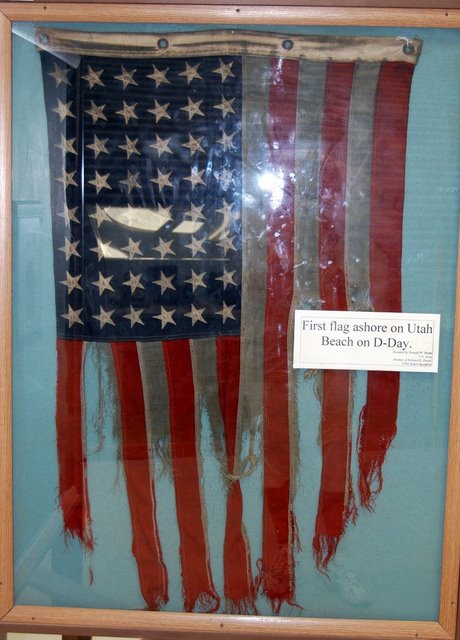
First Flag on Utah Beach, June 6, 1944

First U.S. flag on Utah Beach, Normandy, D-Day, June 6, 1944; Pima Air Museum, Tucson, Arizona

This mostly an encore post.  A reader sent an e-mail with a question:  Does U.S. law suggest the flying of the U.S. flag on the anniversary of D-Day?

Today is the 65th anniversary of the Invasion of Normandy in World War II, a date generally called D-DayNo, you don’t have to fly your flag. This is not one of the days designated by Congress for flag-flying.

But you may, and probably, you should fly your flag.  If you have any D-Day veterans in your town, they will be grateful, as will their spouses, children, widows and survivors. A 22-year-old soldier on the beach in 1944 would be 87 today, if alive.  These men and their memories of history fade increasingly fast.  Put your flag up.  You may be surprised at the reaction.

If you do run into a D-Day veteran, ask him about it.  Keep a record of what he says.

First Wave at Omaha:  The Ordeal of the Blue and the Gray by Ken Riley:  Behind them was a great invasion armada and the powerful sinews of war. But in the first wave of assault troops of the 29th (Blue and Gray) Infantry Division, it was four rifle companies landing on a hostile shore at H-hour, D-Day -- 6:30 a.m., on June 6, 1944. The long-awaited liberation of France was underway. After long months in England, National Guardsmen from Virginia, Maryland and the District of Columbia found themselves in the vanguard of the Allied attack. In those early hours on the fire-swept beach the 116th Infantry Combat Team, the old Stonewall Brigade of Virginia, clawed its way through Les Moulins draw toward its objective, Vierville-sur-Mer. It was during the movement from Les Moulins that the battered but gallant 2d Battalion broke loose from the beach, clambered over the embankment, and a small party, led by the battalion commander, fought its way to a farmhouse which became its first Command post in France. The 116th suffered more than 800 casualties this day -- a day which will long be remembered as the beginning of the Allies Great Crusade to rekindle the lamp of liberty and freedom on the continent of Europe.  Image from National Guard Heritage series, from which the caption was borrowed.

"First Wave at Omaha: The Ordeal of the Blue and the Gray" by Ken Riley: Behind them was a great invasion armada and the powerful sinews of war. But in the first wave of assault troops of the 29th (Blue and Gray) Infantry Division, it was four rifle companies landing on a hostile shore at H-hour, D-Day -- 6:30 a.m., on June 6, 1944. The long-awaited liberation of France was underway. After long months in England, National Guardsmen from Virginia, Maryland and the District of Columbia found themselves in the vanguard of the Allied attack. In those early hours on the fire-swept beach the 116th Infantry Combat Team, the old Stonewall Brigade of Virginia, clawed its way through Les Moulins draw toward its objective, Vierville-sur-Mer. It was during the movement from Les Moulins that the battered but gallant 2d Battalion broke loose from the beach, clambered over the embankment, and a small party, led by the battalion commander, fought its way to a farmhouse which became its first Command post in France. The 116th suffered more than 800 casualties this day -- a day which will long be remembered as the beginning of the Allies' "Great Crusade" to rekindle the lamp of liberty and freedom on the continent of Europe. Image from National Guard Heritage series, from which the caption was borrowed.


Gone but not forgotten: George W. Bush Librarium

April 9, 2009

From the same people who brought us Goodnight Bush,  some of the attractions at the theme park that is planned for the campus of Southern Methodist University; or attractions that might be planned, if the litigation ever ends.

In a more serious vein:


Texas Independence Day, March 2

March 2, 2009

The place to be today is Washington-on-the-Brazos State Historical Site, looking back 173 years.

Here on March 2 of that year [1836], 59 delegates signed the six-page document that declared the Republic of Texas free and independent of Mexico.

As related in the Dallas Morning News, it was a fretful time in Texas.

The convention delegates actually gathered on March 1, 1836, a month after they were elected and sent to Washington, a growing town on the Brazos River less than 100 miles northwest of what now is Houston.

The convention within weeks would adopt a constitution amid a swift series of events. While they were meeting, Travis and his men were killed at the Alamo. And just over another month later, Gen. Sam Houston’s army would defeat the Mexicans in the famous Battle of San Jacinto.

And, just in time for this year’s celebration, researchers announced they have recovered a document lost from the Texas State Archives for a century, the order for copies of the Texas Declaration to be copied and printed.  Jim Bevill found the scrap of paper placed haphazardly in a file now housed at Southern Methodist University (SMU).

Michael Paulsen Chronicle  Author Jim Bevill found the order issued on March 2, 1836, for the first copies of the Texas Declaration of Independence in a collection donated to the Southern Methodist University library. The order had long been missing from the state archives

Author Jim Bevill found the order issued on March 2, 1836, for the first copies of the Texas Declaration of Independence in a collection donated to the Southern Methodist University library. The order had long been missing from the state archives. Photo by Michael Paulsen, Houston Chronicle

Bevill was doing research for his upcoming book, The Paper Republic, a history of the Republic of Texas from the viewpoint of economics rather than the usual military perspective.

The new Texas government was desperately short of money. Investors in New Orleans refused to give the fledgling country a loan until Texas officially declared independence from Mexico.

The document Bevill found was an order sent to San Felipe to have printers make five handwritten copies and 1,000 printed copies of the declaration.

Hope you have a good Texas Independence Day.  We have grades due.

See also:

Resources: