None of my news readers pulled it up, either last August and September, when U.S. Rep. Jason Altmire, D-Penn., got the bill through Congress and signed into law by President Bush, nor a couple of weeks ago when the action occurred.
Rep. Altmire conducted a petition campaign in Pennsylvania, and used the lever of popular, bipartisan support to pry the bill loose from U.S. Sen. Tom Coburn’s hold in the Senate. Coburn is a Republican from Oklahoma, a physician, and an ardent advocate of spraying DDT. He had placed a hold on the bill in committee, stopping all action under the Senate’s rules of profound deference to members.
The swell of popular support made clear by Altmire’s campaign appears to have persuaded Sen. Coburn to allow the bill to move. The bill passed the Senate by unanimous consent on August 3, 2007, and got President Bush’s signature on August 9. These sorts of honorary bills generally are not targeted for political points. That Coburn allowed the bill through suggests a good deal of maturation as a senator on Coburn’s part.
Below the fold, Rep. Altmire’s press releases on the bill’s passing the Senate, and on President Bush’s signing the bill.
Chevy has launched a test fleet of hydrogen-powered fuel cell Equinox SUVs. This fleet hit the streets of New York City, Washington, D.C., and Southern California.
“Project Driveway” is the first large-scale market test of fuel cell vehicles with real drivers in the real world. Why? Because hydrogen fuel cells use zero gasoline and produce zero emissions. They’re a sustainable technology for a better environment. And they ultimately reduce our dependence on petroleum. Equinox Fuel Cell is an electric vehicle powered by the GM fourth-generation fuel cell system, our most advanced fuel cell propulsion system to date. The electric motor traction system will provide the vehicle with instantaneous torque, smooth acceleration, and quiet performance.
The Equinox Fuel Cell will go nearly 150 miles per fill-up, and reach a top speed of 100 mph. Green Car Journal has given the Chevy Equinox Fuel Cell its Green Car Vision Award. The Equinox Fuel Cell won the award over several nominees, including the Honda FCX Clarity and Toyota Prius Plug-In.
It took 20 years longer than it should have to get hybrid fueled vehicles on the road; hydrogen power lags at least as far back. To those of us who long ago gave up hoping the Detroit Big 3 might see the light on hydrogen in any form, the news GM has a fleet of fuel-cells in pre-Beta testing is most interesting. We remember GM’s last foray into electric cars. Hopes do not rise, at least not great hopes, and not high.
It’s been 31 years since Roger Billings drove a hydrogen-powered internal combustion car in Jimmy Carter’s inaugural parade. Hope abides, but not forever. Feathers cannot sustain hope that long, Emily.
Fuel cells provide significant advantages, though. The need for something like fuel cells should drive a market to make the things work. [More about fuel cells, hydrogen, and Roger Billings, below the fold.]
War in the Congo is not about liberty, it’s not really about the politics of a nation, at least, not a nation as any book defines it. At this point, the conflict is over who controls deposits of ores, some fo them rare, from which today’s modern technological devices are manufactured. The world needs to worry about blood diamonds, but also blood cell phones, blood iPods and blood computers.
Seriously, when does “never again” begin?
Spread the word; friends don't allow friends to repeat history.
The symposium is set for Saturday, April 12, 2008, at McCord Auditorium in SMU’s Dallas Hall, 8:30 a.m. to 5:00 p.m. Teachers and community college professors may earn up to 7 hours CEU credits. Registration is available on-line. The $20.00 fee includes a luncheon; conference-only registration is an amazingly inexpensive $5.00.
Conference organizers are looking at a second wave of energy resource development in the Four Corners region, especially, following on earlier development of uranium ore extraction, and coal-fired power generation.
The symposium and the resulting book of essays will provide an historical context for energy development on Native American lands and put forth ideas that may guide future public policy formation. Collectively, the presentations will make the case that the American Southwest is particularly well-suited for exploring how people have transformed the region’s resources into fuel supplies for human consumption. Not only do Native Americans possess a large percentage of the region’s total acreage, but on their lands reside much of the nation’s oil, coal, and uranium resources. Regional weather patterns have also enabled native people to take advantage of solar and wind power as effective sources of energy. Although presentations will document histories of resource extraction and energy development as episodes of exploitation, paternalism, and dependency, others will show how energy development in particular has enabled many Indians to break from these patterns and facilitated their social, economic, and political empowerment.
My second job out of high school, and through much of my undergraduate days, took me to Farmington, New Mexico, and far around the area for the Air Pollution Laboratory at the University of Utah’s Engineering Experiment Station, to measure air quality and effects of air pollution resulting from the Four Corners Power Plant, as the San Juan Generating Station was under construction.
I’m planning to attend the symposium.
Especially after last Saturday’s sessions for history teachers at SMU (the Stanton Sharp Symposium), I highly recommend these programs for their ability to charge up high school teachers to better classroom work. This is history, and economics, at its best, looking to improve public policy and help people.
Planned presentations are listed below the fold, copying the information from the website for the symposium.
TP&W produces a weekly program on the lands it manages, recreation and other issues dealing with land and environmental protection in Texas. The weekly programs come packed full of information and great photography — wise Texas history and geography teachers will see whether their local PBS station carries this program and tape it regularly.
Several times in the past five years TP&W produced special programs on Texas water resources. This one was produced in 2007:
Texas, the State of Springs: This hour-long documentary, narrated by Walter Cronkite, examines the alarming decline of Texas’ natural springs and addresses the current issues that directly impact spring flow and what can be done to save these vital resources.
Texas the State of Springs, initially aired on PBS stations across Texas on Thursday, February 15, 2007.
You may purchase a DVD copy of the documentary — and of two previous editions, one narrated by Cronkite and an earlier one narrated by Ray Benson of Asleep at the Wheel. They are available for $12.00 each, a bargain. Copyright expressly encourages use of these productions in classrooms.
Every middle school and high school in Texas should have a copy of these programs in their libraries. Perhaps your PTA would donate the $36.00 to put all three of them there?
On March 14, 2008, Alma College, in Alma, Mich., is hosting a conference examining what is known about the impact of DDT on human health and the environment.
The conference will bring together a number of national and international experts to frame and lead discussions of current knowledge of DDT. Attendees will engage with experts to plan what research or other projects are needed to address questions about the impact of DDT and other persistent organic pollutants (POPs).
The conference is jointly sponsored by the Center for Responsible Leadership at Alma College, the Ohio Valley Chapter of the Society for Environmental Toxicology and Chemistry, and the Pine River Superfund Task Force, a U.S. Environmental Protection Agency (EPA) community advisory group (CAG) for Superfund sites in the Pine River watershed in Michigan.
Why Alma College?
For a number of years students and faculty at Alma have helped support the work of the Pine River Task Force. The Superfund sites in the watershed of the Pine River resulted from the massive dumping of byproducts from production of DDT and a fire retardant based upon polybrominated biphenyls (PBBs) by Velsicol Chemical Company. In addition to general dumping of wastes, Velsicol was responsible in 1973 for one of the worst food contamination mistakes in history, when PBB was erroneously mixed with animal feed and remained undetected for a year.
While highly contaminated for decades, the Pine River watershed has been fortunate to be the location of Alma College, with a long tradition of community involvement, and also the home of a number of people with remarkable expertise. One of the long time members of the CAG was the late Eugene Kenaga (1917-2007), for whom the conference is named.
Eugene Kenaga
During World War II, Dr. Kenaga served as an officer in a malariology unit in the Pacific Theater, using DDT. For forty-two years he was a research scientists with the Dow Chemical Company, for many years in charge of their entomological research. In 1968 he served on a three-member blue ribbon pesticide advisory panel (for Michigan Governor George Romney) that restricted use of DDT in the state. After the formation of EPA, he served on a variety of EPA advisory panels. He was also one of the founders of the International Society of Environmental Toxicology and Chemistry (SETAC).
And:
Recently, the College, SETAC, and Task Force have become aware of an international campaign that questions the national and international restrictions on the use of DDT. Knowledge of this campaign led to the decision to bring together international experts and concerned citizens to discuss what is known and needs to be known about the impacts on human health and the environment arising from exposure to DDT and the other POPs.
Serious scholars, academic rigor, real scientists, real science, government agencies charged with protecting human health and environmental quality, the Center for Responsible — will any of the DDT advocates have the backbone to show? They don’t appear to fit any of those categories.
Eugene Kenaga International DDT Conference on Environment and Health
March 14, 2008
Alma College, Alma, Mich.
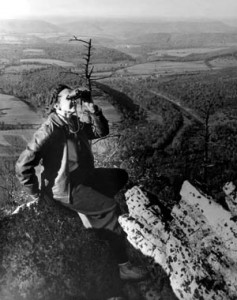
A record number of bald eagles soared past Hawk Mountain in Berks County this fall, continuing a comeback that began with the banning of DDT in 1972. Then, 18 eagles were counted during the typical migration. The count this fall: 230. – Don Sapatkin
Caption from PennLive.com blog: Visitors and staff gather on the South Lookout at Hawk Mountain Sanctuary, near Kempton, Berks County. (HAWK MOUNTAIN SANCTUARY PHOTO) (Photo substituted here for previous photo noted below, which has gone missing in DatedLinksLand)
The white area at upper center is the “River of Rocks”. According to http://www.hawkmountain.org, this formation is a mile-long boulder field, up to 40 feet deep, which was deposited 10,000-12,000 years ago (the end of the last Ice Age), when glaciers stopped 40-50 miles to the north of this location. Repeated freezing and thawing cracked boulders from the ridgetop that gradually slid to their current position.
Spread the word; friends don't allow friends to repeat history.
The site offers a lot. E-mail updates on issues, cheap DVDs of the movie ($10.00 each for the first 10, $9.00 each for the next 10 . . . you may want to get a copy for each social studies classroom), background stories to the movie, story of Annie Leonard, background sheets, lists of organizations working on the issues and reading lists and more. I found no lesson plans, but you can surely cobble one together for an hour class, with 20 minutes taken up by the film. Plus you can download the movie, for free.
Go noodle around the site: There are lots of possibilities for student projects, student discussions, in-class exercises, homework, and fun.
This movie details, quickly and with good humor, the economics of recycling, the economics of waste disposal, and the economics of production. This provides a great gateway to talk about civics and government, and how to make things happen like garbage collection and recycling; a gateway to talk about economics, especially the various flows of money and goods; a gateway to talk about geography and how we have used our land and rivers to bury and carry waste; and how we use natural resources generally.
This would also be a good video for Boy Scout merit badge classes for the Citizenship in the Community and Citizenship in the Nation badges.
Contrasted with most of the industrial grade video I’ve seen for economics classes, this is fantastic. It’s better than any of the sometimes ambitious, but ultimately dull productions from the Federal Reserve Banks (are you listening, Richard Fisher? Hire Will Brehm’s group). (No offense, Osgood — yours is the best of that lot.)
Sen. Tom Coburn, R-Okla., probably has political objections to the movie, claiming it leans left, which indicates it’s in the mainstream. If you’re using any other supplemental material in your classes, this just balances it out.
Screen capture from the film, “Story of Stuff”
Spread the word; friends don't allow friends to repeat history.
Cover of August 2008 Emerging Infectious Diseases from the CDC, featuring: Jan Steen (c. 1625–1679). Beware of Luxury (c. 1665). Oil on canvas 105 cm x 145 cm. Kunsthistorisches Museum, Vienna, Austria
Weighing risks against benefits for DDT spraying is very difficult. Anti-environmentalists and junk science purveyors claim millions of deaths from DDT’s not being sprayed.
They never tell us about the kids DDT could kill.
When we combine data from North America on preterm delivery or duration of lactation and DDE with African data on DDT spraying and the effect of preterm birth or lactation duration on infant deaths, we estimate an increase in infant deaths that is of the same order of magnitude as that from eliminating infant malaria. Therefore, the side effects of DDT spraying might reduce or abolish its benefit from the control of malaria in infants, even if such spraying prevents all infant deaths from malaria.
* * * * *
The prohibition of DDT use for malaria control was probably not the sole cause of increasing malaria burden in sub-Saharan Africa (40), and thus DDT will probably not be the sole cure for the malaria epidemic there. Insecticide-treated bed nets, widely used in African households to prevent mosquito bites, are effective (41,42). Synthetic pyrethroid insecticides, cheaper than DDT, are available (43,44). Where DDT is used, all infant deaths, plus birth weights and the duration of lactation, should be counted. Some thought could also be given to a formal trial, since the risk and benefit calculations apply to individual dwellings, and an effective alternative, namely bed nets, is available. (Chen A, Rogan WJ. Nonmalarial infant deaths and DDT use for malaria control. Emerg Infect Dis [serial online] 2003 Aug. Available from: URL: http://www.ncbi.nlm.nih.gov/pmc/articles/PMC3020610/)
Go read it — the issue of spraying or not is complex, and this study talks only about infant deaths (there may be greater life saving among older children and adults that would make the infant deaths a trade off policy makers would consider, for example). It’s a study from the Centers for Disease Control, part of a continuing series of technical publications from CDC titled Emerging Infectious Diseases. This series tracks much of the work done to fight malaria world wide.
This is valuable information. It shows the issue is much more complex that just “spray or don’t spray.” It’s also information that JunkScience.com hopes you will not pursue. It’s real information, and it refutes the junk science claims from that site.
A more clear image from Wikimedia Commons of Jan Steen’s painting, “Beware of Luxury.” Click on cover of journal at top of post for a discussion of this painting and how it relates to infectious diseases.
Spread the word; friends don't allow friends to repeat history.
Suddenly the shoreline north of Sydney were transformed into the Cappuccino Coast.
Foam swallowed an entire beach and half the nearby buildings, including the local lifeguards’ centre, in a freak display of nature at Yamba in New South Wales.
One minute a group of teenage surfers were waiting to catch a wave, the next they were swallowed up in a giant bubble bath. The foam was so light that they could puff it out of their hands and watch it float away.
Perhaps a good geography warm-up: Where are these pictures from? What is the phenomenon shown in the photos? Why might it be unusual for these people to be swimming in the ocean in August?
Yellowstone National Park is just a cool place. If you’re not using it for anything in your geography and U.S. history courses, you’re missing out.
Here’s a ten-minute video that the producers hope you’ll show far and wide to encourage television stations to pick up the series. It’s a ten-minute pilot for “Travelers’ Tales,” featuring outdoor writer Tim Cahill, a founder of Outside magazine, and photographer Tom Murphy.
Here are some of the points you might use in class:
Yellowstone in winter, especially the wildlife, like bison, elk and coyotes (all shown), and wolves (not shown)
Volcanic geology — Yellowstone is the world’s largest caldera, after all
Diversity of landforms in the U.S., or in the world. More than half the hot water features on the planet are in Yellowstone
Travel and adventure
What makes good writing (travel writing in this case)
Western geography
Development of the west, especially after the Lewis and Clark Expedition
The video features a lot of snow, elk, bison and coyotes, hot springs flowing into a river making swimming in January feasible, Mammoth Hot Springs and the travertine pools, and the cold northern desert of sagebrush and juniper.
Questions you might consider to turn this into a warm-up exercise (bell ringer):
Geography, not answered in the video (map or internet exercise):
Yellowstone National Park covers parts of which three states?
Yellowstone National Park is mostly located in which state?
What is the most famous feature of Yellowstone National Park?
Ashfall Beds State Park features ancient mammals killed by an eruption in the Yellowstone Caldera. Where is Ashfall Beds State Park?
Thomas Moran played a key role in getting Congress to designate Yellowstone as a park. What did he do to help convince Congress to act?
Geography, answered in the video:
What year was Yellowstone designated a National Park by Congress?
What sort of volcanic feature is the entire Yellowstone area?
The Yellowstone Caldera explodes catastrophically about every 600,000 years, according to some geologists. How long has it been since the last such catastrophic explosion?
The wags say there are two seasons in Yellowstone, ______ and winter.
What is a “hot pot?”
Spread the word; friends don't allow friends to repeat history.
Events in Congo trouble at so many levels. Reports in The New York Times and other places document unspeakable violence: 27,000 sexual assaults in South Kivu Province in 2006, just a fraction of the total number across the nation of 66 million people. The assaults are brutal. Women assaulted are often left so badly injured internally, they may never heal.
Map of Congo, highlighting province of Bukavu where violence against women is epidemic, from New York Times
Genocide you say? Many assaults appear to be spillover from the Hutu-Tutsi conflict in next-door Rwanda. But assaults by husbands on wives also are epidemic. Result of civil war? Then how to explain the “Rasta” gang, dreadlocked fugitives who live in the forest, wear tracksuits and Los Angeles Lakers jerseys, and who commit unspeakable crimes against women and children? What nation are they from, and against whom do they fight, if anyone — and for what?
The facts cry out for action:
Nightly rapes of women and girls. The violence appears to be a problem across the nation.
Huge chunks of Congo have no effective government to even contend against the violence.
Killers with experience in genocide in their native Rwanda moved into Congo; they live by kidnapping women for ransom. The women are assaulted while held captive. Sometimes husbands do not take back their wives.
The oldest rape victim recorded by one Congo physician is 75; the youngest, 3.
Surely intervention by an international group would help, no? However
Congo hosts the largest single peacekeeping mission of the United Nations right now, with 17,000 troops. Congo is a big nation, bordered by nine other nations. How many troops would it take to secure the entire nation, or the entire border? No one knows.
2006 saw an election that was supposed to remake history, end the violence and start Congo on the road to recovery; but was the $500 million it cost enough to change Congo’s history of a string of bad governments?
International attention focuses on other crises: Iraq, Afghanistan, Sudan and Darfur, Iran, Korea, Chechnya, Turkey and the Kurds, Palestine and Israel. Congo, constantly roiling since the 1960s, is way down the list of world concerns, no matter how bad the violence.
Americans looking for a quick resolution to the situation in Iraq might do well to study Congo. At Congo’s independence in the 1960s, there was hope of prosperity and greater peace. Foreign intervention, including meddling from the U.S., regional civil wars, bad government and long international neglect, ate up the hope. Achieving what a nation could be is difficult, when so many forces align to prevent it from being anything other than a violent backwater. Pandora’s box resists attempts to shut it. Quick resolution is unlikely.
So the violence in Congo continues.In this world, when is the “never” in “never again?”
How many other such cases fall outside our textbooks, and off the state tests?
A UK High Court judge has rejected a lawsuit by political activist Stuart Dimmock to ban the showing of Al Gore’s An Inconvenient Truth in British schools. Justice Burton agreed that
“Al Gore’s presentation of the causes and likely effects of climate change in the film was broadly accurate.”
There were nine points where Burton decided that AIT differed from the IPCC and that this should be addressed in the Guidance Notes for teachers to be sent out with the movie.
Unfortunately a gaggle of useless journalists have misreported this decision as one that AIT contained nine scientific errors.
Got that? The British Court said Gore is right.
I’ll bet I’ve seen that case cited a half dozen times today, with claims that Gore’s film is generally wrong.
Tim’s detail on the case, and the nine allegations of “error” (scare quotes from the judge in the original opinion) should be read by anyone following the climate change debates. I doubt that any Gore critics will read, nor, just to be nasty, that many of them can.
This is another political hoax in the making. Bad reporting, caused largely because the news of the case hit as the announcement of Gore’s Nobel Prize win crossed the news wires, makes Gore a target for the denialist and right-wing spin machines. Though their charges are inaccurate, they will make the charges, and repeat them endlessly. Buckle up — it’s going to be a bumpy night.
Spread the word; friends don't allow friends to repeat history.
Missed it? Well, it was at the dinner hour, 06:16:42 PM (CDT). You may have thought it was Bubba’s great sauce for the barbecue, or the raspberry in the iced tea.
In terms of destruction, the earthquake was hardly significant.
Emergency responders said they knew of only one report of damage: A teapot fell off of a woman’s stove.
In California, people probably wouldn’t have even noticed the tremor. But this earthquake happened in the Lone Star State and left Brazos Valley residents baffled.
“You just don’t expect your house to shake,” said Burleson County resident Karen Bolt. She was in her trailer home cleaning dishes when the temblor began.
35 km (20 miles) W of Bryan, Texas
65 km (40 miles) ENE of Taylor, Texas
110 km (70 miles) ENE of AUSTIN, Texas
170 km (105 miles) NW of Houston, Texas
In terms of magnitude and damage, this is the largest earthquake known to have occurred in Texas. The most severe damage was reported at Valentine, where all buildings except wood-frame houses were damaged severely and all brick chimneys toppled or were damaged. The schoolhouse, which consisted of one section of concrete blocks and another section of bricks, was damaged so badly that it had to be rebuilt. Small cracks formed in the schoolhouse yard. Some walls collapsed in adobe buildings, and ceilings and partitions were damaged in wood-frame structures. Some concrete and brick walls were cracked severely. One low wall, reinforced with concrete, was broken and thrown down. Tombstones in a local cemetery were rotated. Damage to property was reported from widely scattered points in Brewster, Jeff Davis, Culberson, and Presidio Counties. Landslides occurred in the Van Horn Mountaiins, southwest of Lobo; in the Chisos Mountains, in the area of Big Bend; and farther northwest, near Pilares and Porvenir. Landslides also occurred in the Guadalupe Mountains, near Carlsbad, New Mexico, and slides of rock and dirt were reported near Picacho, New Mexico. Well water and springs were muddied throughout the area. Also felt in parts of Oklahoma, New Mexico, and in Chihauhua and Coahuila, Mexico.
Texas history courses could make some use of these data, for map reading exercises, and for general geography about the state. Click on the map below, the isoseismal map of the 1931 Valentine, Texas quake, and geography teachers will begin to dream of warm-up exercises right away.
Or, until that account is unsuspended by the forces supporting Donald Trump: Follow @FillmoreWhite, the account of the Millard Fillmore White House Library
We've been soaking in the Bathtub for several months, long enough that some of the links we've used have gone to the Great Internet in the Sky.
If you find a dead link, please leave a comment to that post, and tell us what link has expired.
Thanks!
Retired teacher of law, economics, history, AP government, psychology and science. Former speechwriter, press guy and legislative aide in U.S. Senate. Former Department of Education. Former airline real estate, telecom towers, Big 6 (that old!) consultant. Lab and field research in air pollution control.
My blog, Millard Fillmore's Bathtub, is a continuing experiment to test how to use blogs to improve and speed up learning processes for students, perhaps by making some of the courses actually interesting. It is a blog for teachers, to see if we can use blogs. It is for people interested in social studies and social studies education, to see if we can learn to get it right. It's a blog for science fans, to promote good science and good science policy. It's a blog for people interested in good government and how to achieve it.
BS in Mass Communication, University of Utah
Graduate study in Rhetoric and Speech Communication, University of Arizona
JD from the National Law Center, George Washington University


 Posted by Ed Darrell




 Map of Congo, highlighting province of Bukavu where violence against women is epidemic,





 Millard Fillmore's Bathtub
