If you’re interested in science research, check it out. Some of the posts are terribly technical — I don’t understand them, so I’ll have to get one of our sons to explain it to me — but you can catch the drift of what’s going on. Tommaso also offers a few photos of the Albuquerque area and Sandia Peak, worth the click alone.
It’s a good model of what some of us should do more of (yeah, this is self-flagellation).
We get Charlie Rose’s program late here — generally after midnight. I’m up to my ears with charitable organization duties (“Just Say No!”), work where I came in midstream, family health issues, and other typical aggravations of trying live a well-examined life.
I caught most of an hour discussion on science in America, featuring Sir Paul Nurse, president of Rockefeller University and Nobel laureate, Bruce Alberts, editor of Science, Shirley Ann Jackson, president of Rensselaer Polytechnic Institute, Harold Varmus, Nobel winner and president of Memorial Sloan-Kettering Cancer Center, and Lisa Randall, the Harvard nuclear physicist (string theory).
It was a great policy discussion. It had great humor, and great wisdom. And at the end, Rose thanked Nurse and others for helping him put on a 13-part seminar on science policy.
Thirteen parts? And I caught just the last few minutes of #13?
There is the Charlie Rose archives! Here’s the show I caught, “The Imperative of Science.” Great discussion. Scary — Lisa Randall notes that the action in physics has moved to CERN, in Europe, and the search for the Higgs Boson. Varmus and Nurse talk about restrictions in funding that bite at our ability to keep the world lead in education and science. Educators, especially in science, should watch.
Are we kicking away our ability to lead in technology, health care, and other vital economic areas? One cannot help but wonder in listening to these people discuss the difficulty of getting support for critical research during the Bush administration. They each stressed the hope that the next president will be one literate in science.
Episode 1: The Brain — Exploring the human brain from psychoanalysis to cutting edge research.
Episode 2: The Human Genome — Exploring the contributions that have been made to science through the discovering and mapping of human DNA.
Episode 3: Longevity — An in-depth discussion of longevity and aging from the latest research on calorie restriction, anti-aging drugs, genetic manipulation to the social and economic implications of an increase in human life span. (Longevity News Release)
Episode 4: Cancer — A discussion of the latest advances in cancer, from the genetics to cancer prevention, early detection, diagnosis, treatment and management of care. (Cancer News Release)
Episode 5: Stem Cells — A roundtable discussion on the latest advances in embryonic and adult stem cell research, their implications, and potential to change the way medicine is practiced.
Episode 6: Obesity — An informative dialogue on the growing obesity epidemic, its impact on overall health and the latest research to help understand, treat and prevent obesity. (Obesity News Release)
Episode 7: HIV/AIDS — A panel of leading experts addresses current treatment and prevention strategies, and new medical breakthroughs being used in the fight against HIV/AIDS. (HIV/AIDS News Release)
Episode 8: Pandemics — An exploration of factors that could create a global pandemic and how the science and public health leaders are addressing the crisis. (Pandemics News Release)
Episode 9: Heart Disease — A panel of experts explores the biology and genetics of cardiovascular disease, prevention and treatment, the development of medical, surgical and interventional therapies and steps individuals can take toward a heart-healthy lifestyle. (Heart Disease News Release)
Episode 10: Global Health — A roundtable discussion on initiatives aimed at fighting infectious diseases, protecting women and children, and strengthening global public health systems. (Global Health News Release)
No kidding. Our Italian physicist friend Dorigo passed along the note on his blog, Quantum Diaries Survivor. George Gliba at NASA (gliba@milkyway.gsfc.nasa.gov) hopes someone was watching Bootës at about 6:10 UT (which would be about 1:10 a.m. Central Daylight Time (CDT), if I’m calculating that correctly).
Gliba said:
Last night the NASA SWIFT spacecraft saw the most extrinsically luminous Gamma-ray Burst ever known. Some ground based telescopes recorded the visual optical afterglow to be 5th magnitude!
Here’s your chance to make science history: If you may have seen the thing, or better, if you have a videotape of the incident (which may have lasted a few minutes), scientists would sure love to see it.
Most gamma ray bursts occur when massive stars run out of nuclear fuel. Their cores collapse to form black holes or neutron stars, releasing an intense burst of high-energy gamma rays and ejecting particle jets that rip through space at nearly the speed of light like turbocharged cosmic blowtorches. When the jets plow into surrounding interstellar clouds, they heat the gas, often generating bright afterglows. Gamma ray bursts are the most luminous explosions in the universe since the big bang.
“This burst was a whopper,” said Swift principal investigator Neil Gehrels of NASA’s Goddard Space Flight Center in Greenbelt, Md. “It blows away every gamma ray burst we’ve seen so far.”
Calculations show this one was 7 billion light years away. Cool!
I believe this is an excerpt from a NOVA tribute to Feynman, which has never been available commercially so far as I have found. Anybody know how to get a copy of the video?
Among other things, the piece included comments from some of Feynman’s closest friends, and it detailed their fascination with a tiny republic then inside of the Soviet Union, Tannu Tuva, which Feynman had determined to be the most obscure and difficult nation on Earth to travel to — and so, of course, he wanted to go. The place is known today as Tuva.
No denying the man his orange juice.
Spread the word; friends don't allow friends to repeat history.
For a successful technology, reality must take precedence over public relations, for nature cannot be fooled.
Richard Feynman, in the Rogers Commission Report on the Space Shuttle Challenger Accident, appendix (1986)
Photo: Richard Feynman, at a hearing of the Rogers Commission, demonstrates with a glass of ice water and a piece of O-ring material, how cold makes the O-rings inflexible; photo credit unknown
Spread the word; friends don't allow friends to repeat history.
In 1924, he announced the discovery of a Cepheid, or variable star, in the Andromeda Nebulae. Since the work of Henrietta Leavitt had made it possible to calculate the distance to Cepheids, he calculated that this Cepheid was much further away than anyone had thought and that therefore the nebulae was not a gaseous cloud inside our galaxy, like so many nebulae, but in fact, a galaxy of stars just like the Milky Way. Only much further away. Until now, people believed that the only thing existing outside the Milky Way were the Magellanic Clouds. The Universe was much bigger than had been previously presumed.
Later Hubble noted that the universe demonstrates a “red-shift phenomenon.” The universe is expanding. This led to the idea of an initial expansion event, and the theory eventually known as Big Bang.
Hubble’s life offered several surprises, and firsts:
Hubble was a tall, elegant, athletic, man who at age 30 had an undergraduate degree in astronomy and mathematics, a legal degree as a Rhodes scholar, followed by a PhD in astronomy. He was an attorney in Kentucky (joined its bar in 1913), and had served in WWI, rising to the rank of major. He was bored with law and decided to go back to his studies in astronomy.
In 1919 he began to work at Mt. Wilson Observatory in California, where he would work for the rest of his life. . . .
Hubble wanted to classify the galaxies according to their content, distance, shape, and brightness patterns, and in his observations he made another momentous discovery: By observing redshifts in the light wavelengths emitted by the galaxies, he saw that galaxies were moving away from each other at a rate constant to the distance between them (Hubble’s Law). The further away they were, the faster they receded. This led to the calculation of the point where the expansion began, and confirmation of the big bang theory. Hubble calculated it to be about 2 billion years ago, but more recent estimates have revised that to 20 billion years ago.
An active anti-fascist, Hubble wanted to joined the armed forces again during World War II, but was convinced he could contribute more as a scientist on the homefront. When the 200-inch telescope was completed on Mt. Palomar, Hubble was given the honor of first use. He died in 1953.
“Equipped with his five senses, man explores the universe around him and calls the adventure Science.”
Update, December 31: CBS’s Sunday Morning has an “Almanac” feature weekly; Hubble was featured on December 30. Unfortunately CBS has not posted the video. However, I did find a description of Hubble’s work on YouTube — in true, irritating internet fashion, stripped of citations. The video is below. If you know details — who made the video, where good copies might be available — please note it in comments.
[*]Newton’s giants:Nicolaus Copernicus, Giordano Bruno, Johannes Kepler, René Descartes.Bartlett’s 16th Edition phrases the letter to Hooke a little differently:“If I have seen further than (you and Descartes) it is by standing upon the shoulders of Giants.” Others attribute the quote much earlier; it was a saying of the times, it appears, and this is one of the most famous uses of it.
Spread the word; friends don't allow friends to repeat history.
Remember the State of the Union pledge to put science front and center in building the nation’s economy?
That was then, this is now: Fermilab is cutting projects due to reduced federal funding. The U.S. is ceding pre-eminence in particle physics to CERN in Europe, or anyone else who will simply spend the money.
It is clear that the US congress does not believe pure research in subatomic physics something useful for the Nation. Let’s face it: we lived through sixty years of good funding on the standing wave of nuclear weapons research, but we do not seem to manage to fool anybody anymore: no more deadly tools from muons and neutrinos. So, no dough. Sad, but true. I only hope that Europe will be smarter and that particle research at CERN will continue as strong as it has been recently shown to be.
Regret to start your weekend on down notes; science does best if syncopation is not limited, however. Get out there and play.
Spread the word; friends don't allow friends to repeat history.
Texas is the nation’s second largest state. The institute will provide another source for Texas kids to get career training.
The Nuclear Power Institute will help train staff needed to operate new reactors and generating plants. It will also revamp curriculum for junior high, high school and college students who are interested in pursuing careers in the field, according to officials with Texas A&M Engineering.
The institute was established in a joint effort by the Dwight Look College of Engineering and the Texas Engineering Experiment Station (TEES). The Look College is one of the largest engineering colleges in the nation, with nearly 9,000 students and 12 departments.
“The Texas A&M University System is uniquely configured with the ideal combination of education, research and service agencies and universities to lead this effort,” Vice Chancellor and Dean of Engineering Kem Bennett said in a statement released last week. “The institute will make a significant impact upon the work force and economy of the state and nation.”
The Texas A&M University System Board of Regents signed off on the formal creation of the Nuclear Power Institute earlier this month.
There is a high degree of irony in this announcement at this time. While Texas A&M looks to the future with nuclear power, the state weighs whether to allow a Dallas religious school to train teachers that management of nuclear power is based on flawed theory. A&M will train people to manage nuclear power; the Institute for Creation Research (ICR) wants to train high school teachers to teach Texas’s high school kids that nuclear power is mysterious and cannot work.
Does Texas contradict itself? Walt Whitman might have asked. Texas is large. It contains multitudes.
But should it contain a school that teaches much of basic science is just wrong?
It might be nice if a higher percentage of the multitudes had the reasoning power to see what’s wrong with this picture, and why the question is important.
This may be too subtle for people unfamiliar with atomic theory to realize the full impact. Zeno at Halfway There explains the wacky part of ICR’s misunderstanding, or wishful thinking about atomic theory. Simply put, ICR claims to have discovered that God interferes with nuclear reactions, making it difficult to predict that a nuclear reactor won’t suddenly increase its output by ten times, cooking the nuclear power plant and a couple of nearby towns in the doing.
Texas A&M is working to prepare people to live in the late 21st and 22nd centuries. ICR is fighting to take us back to the 16th or 17th century.
If ICR is successful, from what pool will A&M draw its candidates for nuclear engineering and nuclear power management? Against its will, Texas A&M could become one of the largest graduate institutions for all of India and China.
Cartoon by Steve Benson of the Arizona Republic, 2004; via Panda’s Thumb
It’s scary to think people can be granted a degree in lying to innocent children, and that it would be counted as a factor in favor of their teaching, instead of as a problem to be overcome like a bad background report.
But ICR was granting degrees in California. They hope to expand their sales in Texas, closer to the Bible Belt’s buckle.
How will the state’s serious higher education institutions respond? What should Texas education officials do? It’s a difficult question, really. Generally states allow any institution that gets accreditation to grant degrees. ICR was denied accreditation in California, but set up a separate accrediting company for Bible colleges and religiously affiliated schools. When the U.S. Department of Education authorized that accrediting association as acceptable for Pell Grant and Stafford Grant purposes, California’s ability to stop the madness was limited. Texas allows degrees for colleges that teach chiropractic medicine, and there are probably several other degree granting programs that would raise eyebrows of rational people, were they better known.
“It just seems odd to license an organization to offer a degree in science when they’re not teaching science,” Mr. [Dan] Quinn [of the Texas Freedom Network] said.
“What we’re seeing here is another example of how Texas is becoming the central state in efforts by creationists to undermine science education, especially the teaching of evolution.”
A group of educators and officials from the state Coordinating Board visited the campus in November and met with faculty members. The group found that the institute offered a standard science education curriculum that would prepare them to take state licensure exams, said Glenda Barron, an associate commissioner of the board.
Dr. Barron said the program was held to the same standards that any other college would have to meet.
“The master’s in science education, we see those frequently,” she said. “What’s different – and what’s got everybody’s attention – is the name of the institution.”
No, it’s not the name of the institution that worries us — it’s their history of defending buncombe, hoaxes and falsehoods as science, detracting from the education of science in a major way.
Science education in the U.S. is under assault. ICR is asking Texas to surrender the nation’s future and accept the ICR’s white flag of ignorance as the state’s own. It is unclear to me whether the state may refuse to do that, though it would be the moral thing to do to refuse.
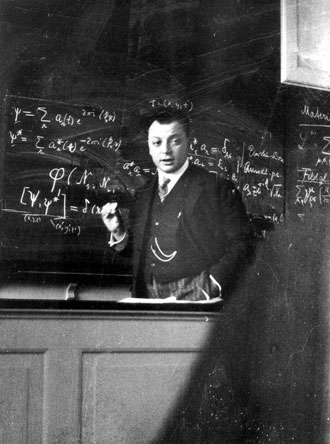
— Wolfgang Pauli (1900-1958), as quoted by R. Peierls
Peierls (1960) writes of Pauli, “… a friend showed him the paper of a young physicist which he suspected was not of great value but on which he wanted Pauli’s views. Pauli remarked sadly ‘That’s not right. It’s not even wrong'”. (Peierls R (1960). “Wolfgang Ernst Pauli, 1900-1958”. Biographical memoirs of fellows of the Royal Society5: 174-92. Royal Society (Great Britain))
Pauli won the Nobel Prize in Physics in 1945: “At this stage of the development of atomic theory, Wolfgang Pauli made a decisive contribution through his discovery in 1925 of a new law of Nature, the exclusion principle or Pauli principle. The 1945 Nobel Prize in Physics has been awarded to Pauli for this discovery.”
Spread the word; friends don't allow friends to repeat history.
In 2003 Physics Nobel Winner Steven Weinberg made a stunning presentation to the Texas State Board of Education on why evolution needs to be in biology texts.
This is a great post-World War II, Cold War story of technology that should pique interest in the time and the events for many students. For a 90 minute class, a solid lesson plan could be developed around the science and technology of the flight (yes, even in history — this is key stuff in the development of economics, too). The physics of sound, a brief history of flight and aircraft, the reasons for post-war development of such technologies, the political situation: There are a dozen hooks to get into the topic. Fair use would cover showing a clip from “The Right Stuff” about the flight, and there are some dramatic clips there. (The movie is 3 hours and 13 minutes; great stuff in a format too long for classroom use. Is there any possibility your kids would read the Tom Wolfe book?)
When will someone – the Air Force? NASA? an aircraft company? — put together a DVD with authorized film clips from the newsreels and the movie, and suggested warm ups and quiz questions?
Back in the bad old days one of my elementary school teachers did an entire morning on the speed of sound, aircraft engineering, and the history of faster-than-sound flight. I learned the accurate way to measure the distance to lightning by counting seconds to the thunder (it’s about a mile for every 5 seconds, not a mile for every second, as our school-yard lore had it).
Image at right: Brig. Gen. Charles E. Yeager today, with image of Bell X-1; U.S. Air Force image
This program, to fly at the speed of sound, at what is now Edwards Air Force Base changed the way science of flight is done in the U.S. Yeager led the group of Air Force pilots who proved that military pilots could do the testing of aircraft; the project proved the value of conducting research with experimental aircraft on military time. The methods developed for testing, evaluating, redesigning and retesting are still used today. The drive for safety for the pilots also grew out of these early efforts at supersonic flight.
Yeager’s flight came when technology was cool, not just for the virtual reality role playing games (RPGs), which were still decades in the future, but because it was new, interesting, and it opened a world of possibilities. We all wanted to fly airplanes, especially small, fast airplanes. Read the rest of this entry »
Spread the word; friends don't allow friends to repeat history.
The Nobel Committees are working overtime to frustrate my predictions this year.
Two Europeans won the Nobel Prize in Physics. Albert Fert, Unité Mixte de Physique CNRS/THALES, Université Paris-Sud, Orsay, France, and Peter Grünberg, Forschungszentrum Jülich, Germany, won for the discovery of “giant magnetoresistance.”
It’s called one of the first real applications of nanotechnology. Here’s an explanation from IBM’s website, of how the discovery affects new hard drive technologies. This is the basic technology for the working of your hard drive.
Score so far this year: Five awards, one person schooled in the U.S, by Quaker schools, not public schools. My predictions that the awards go to U.S. citizens schooled in the public schools are not doing well, so far this year. Is the trend over already?
Spread the word; friends don't allow friends to repeat history.
One of my elementary teachers used to make a big deal of the Nobel Prizes every year. We’d get the newspaper clips on the prizes, calculate how much they were worth, and discuss what the people did to win them.
Several years ago I started offering grade boosts to economics students who could predict the winner of the Nobel Memorial Prize in Economics. One year I actually had to pay up, after another teacher discovered a Nobel handicapping site, and one student got very, very lucky. What other uses can you find?
I especially remember the prize to Penzias and Wilson in Physics in 1978, because it meant we didn’t have to study Steady State any longer (and I’d always found that description confusing). Steady State was still in some books, more than a decade after their discovery of Big Bang.
Announcements of the 2007 Nobel Prizes and The Sveriges Riksbank Prize in Economic Sciences in Memory of Alfred Nobel will be held on the following dates:
Physiology or Medicine – Monday, October 8, 11:30 a.m. CET (at the earliest)
Physics – Tuesday, October 9, 11:45 a.m. CET (at the earliest)
Chemistry – Wednesday, October 10, 11:45 a.m. CET (at the earliest)
Literature – Thursday, October 11, 1:00 p.m. CET (at the earliest)
Peace – Friday, October 12, 11:00 a.m. CET
Economics – Monday, October 15, 1:00 p.m. CET (at the earliest)
While working in education policy years back I noticed that Nobel winners come disproportionately from the U.S., and disproportionately from the public schools. Watching such trends tends to be a practice of journals outside the U.S., however, such as the Times of India:
Americans tend to dominate the science prizes and last year they made a clean sweep, taking the medicine, physics, chemistry and economics awards. Read the rest of this entry »
Spread the word; friends don't allow friends to repeat history.
Or, until that account is unsuspended by the forces supporting Donald Trump: Follow @FillmoreWhite, the account of the Millard Fillmore White House Library
We've been soaking in the Bathtub for several months, long enough that some of the links we've used have gone to the Great Internet in the Sky.
If you find a dead link, please leave a comment to that post, and tell us what link has expired.
Thanks!
Retired teacher of law, economics, history, AP government, psychology and science. Former speechwriter, press guy and legislative aide in U.S. Senate. Former Department of Education. Former airline real estate, telecom towers, Big 6 (that old!) consultant. Lab and field research in air pollution control.
My blog, Millard Fillmore's Bathtub, is a continuing experiment to test how to use blogs to improve and speed up learning processes for students, perhaps by making some of the courses actually interesting. It is a blog for teachers, to see if we can use blogs. It is for people interested in social studies and social studies education, to see if we can learn to get it right. It's a blog for science fans, to promote good science and good science policy. It's a blog for people interested in good government and how to achieve it.
BS in Mass Communication, University of Utah
Graduate study in Rhetoric and Speech Communication, University of Arizona
JD from the National Law Center, George Washington University


 Posted by Ed Darrell







 Millard Fillmore's Bathtub