Texas Gov. Abbott sides with cancer, brags about it

October 23, 2015

I get e-mail from Texas Gov. Greg Abbott, and all too often it leaves me shaking my head in disgust.

This one came today. I suppose one needs to understand that the e-mail is intended to mislead the recipients about what Gov. Abbott is doing.

In the War on Cancer, Abbott has sided with cancer. As Attorney General in the later stages of the wilting administration of the beleaguered Rick Perry, Abbott refused to investigate a Texas Constitutionally-established, billion-dollar fund to support cancer research whose administration then-Gov. Perry had turned over to old political friends.

Tens of millions of dollars of taxpayer money went into black holes of bank accounts of Perry’s political supporters.

Abbott should have recused himself from any investigation by his office, because under the laws setting up the research fund, he was on the board.  Any investigation would need to answer the question about what Abbott had done to be sure the funds were spent as the law intended.

Conflicts of interest don’t bother Greg Abbott, though, so long as the conflicts work in favor of his friends, and political donors.

Fortunately for Texas, there is another, separate office to investigate public wrongdoing in state agencies, the Public Integrity Unit of the Travis County District Attorney’s office. That office indicted one of the cancer agency’s officials (he was convicted of misappropriating $11 million in public funds), and promised to indict more.

This so angered Perry he stepped all over the Texas Constitution to bring down the Travis County DA — and that earned Perry his own indictment after an investigation by a GOP-led task force.  Oh, yeah, there were other shenanigans by Perry that he might have wanted to cover up; but the cancer research abuse already sent one Perry buddy to jail.

You get the idea. Cancer research is political in Texas, and probably not all that serious a concern to GOP elected officials. Cancer is something poor people get. Republicans have health insurance.

For years, Planned Parenthood clinics in Texas and the rest of the nation offered free cancer screenings and checkups to women who otherwise could not get them for lack of money. These services have nothing to do with abortion, but a lot to do with obstetrical and gynecological care poor women cannot get otherwise.

Well, now Greg Abbott has ordered funding for those health care services to stop.

Read Abbott’s fund-raising letter — yes, he wants me (and you) to donate to his unholy campaign against women’s health care — and pay particular attention to how he avoids any mention of what kinds of services this funding cut-off will kill. He wants you to think he’s fighting abortion.

Which might be oddly and rarely true, if his denial of cancer screenings enables cancer to kill a woman who might have later gotten an abortion, or destroy her ability to conceive at all.

See the letter, sent with the subject, “Another win against Planned Parenthood”:

___________________________________

Friend,

Abbott cuts funding for cancer fightAbbott cuts funding for cancer fight disclaimer_______________________________________

So there you have it. Greg Abbott wants you to send him money, because he’s stopped poor women in Texas from getting cancer screenings.

Because, abortion, liberty, guns, and probably, illegal immigrants.

And, because he can get away with it.

How stupid must a Texas politician be to think promoting cancer will help any of those problems? How conniving must one be to try to hoodwink Texans into sending him money, neglecting to mention it’s money to support cutting medical care to women who need it?

How stupid must Texas voters be, if they don’t see through this corrupt ruse?

More:


September 29, 1936: FDR warned Republicans would try to take away Social Security

September 29, 2015

How can this still be true, 79 years later to the day?

FDR warned us in 1936, that Republicans would try to gut federal programs that help people and make America great. It’s as if we have a haunting by Santayana‘s Ghost, on Social Security, unemployment insurance, job training, job creation and budget deficits:

Update: Shorter excerpt of speech, leaving out the parts I really wanted; the video originally featured is not available. Rats.

Our friend SBH pointed us to the text of the speech.  FDR addressed the New York State Democratic Convention, in Syracuse, on September 29, 1936  (Can you imagine — does any state have such thing still —  state party conventions so late in the year, today?).  He found it at UC-Santa Barbara‘s American Presidency Project website.  Here’s the text of the excerpt above, plus a little:

In New York and in Washington, Government which has rendered more than lip service to our Constitutional Democracy has done a work for the protection and preservation of our institutions that could not have been accomplished by repression and force.

Let me warn you and let me warn the Nation against the smooth evasion which says, “Of course we believe all these things; we believe in social security; we believe in work for the unemployed; we believe in saving homes. Cross our hearts and hope to die, we believe in all these things; but we do not like the way the present Administration is doing them. Just turn them over to us. We will do all of them — we will do more of them, we will do them better; and, most important of all, the doing of them will not cost anybody anything.”

But, my friends, these evaders are banking too heavily on the shortness of our memories. No one will forget that they had their golden opportunity—twelve long years of it.

Remember, too, that the first essential of doing a job well is to want to see the job done. Make no mistake about this: the Republican leadership today is not against the way we have done the job. The Republican leadership is against the job’s being done.

Read more at the American Presidency Project: Franklin D. Roosevelt: Address at the Democratic State Convention, Syracuse, N.Y. http://www.presidency.ucsb.edu/ws/index.php?pid=15142&st=Roosevelt&st1#ixzz1T2VHx1tx

More:

Social Security Poster: old man

Social Security Poster: old man (Photo from the Social Security Board, via Wikipedia)

Yes, this is mostly an encore post. Fighting ignorance requires patience.

Yes, this is mostly an encore post. Fighting ignorance requires patience.


Ed Brayton, Dispatches from the Culture Wars, moving to Patheos

August 12, 2015

Our old friend Ed Brayton, high priest and chief bottle washer at Dispatches from the Culture Wars through all these years — as a solo blog, at the late, Seed Magazine Science Blogs, and then for the past few years at FreeThought Blogs — is pulling back from his administrative work at FtB. He’s also moving Dispatches to Patheos.

Masthead for Ed Brayton's Dispatches from the Culture Wars

Masthead for Ed Brayton’s Dispatches from the Culture Wars

There’s been angst. Brayton established FtB and is known as the owner of the network; it’ll take a committee to try to replace him there.

The most famous photograph of the Paparazzi-eluding Ed Brayton. From his Twitter pate, @edbrayton.

The most famous photograph of the Paparazzi-eluding Ed Brayton. From his Twitter page, @edbrayton.

Ed’s been a good friend to Millard Fillmore’s Bathtub over the years, encouraging and making key starter suggestions (along with P. Z. Myers of Pharyngula).  More important, Brayton’s been a staunch defender of thinking issues through. He’s stood up firmly for religious freedom, academic freedom and good science, among a bunch of other issues over the years.

Change your bookmarks to get the freshest stuff. As he does live in Michigan and knows Michigan politics, he’s probably the go to guy for straight dope on the Courser scandals, for example.

Good luck, wish you well, Ed.

Good luck FreethoughtBlogs, too.


Key part of Burwell decision: “Congress passed the Affordable Care Act to improve health insurance markets”

June 25, 2015

U.S. Supreme Court hearing oral arguments in King v. Burwell.  The decision issued on June 25, 2015. Image from Newsworks (who is the artist?)

U.S. Supreme Court hearing oral arguments in King v. Burwell. The decision issued on June 25, 2015. Image from Newsworks. [Continued search for credit information on this image turned up this caption; artist is Dana Verkouteren of Associated Press] “This courtroom artist rendering shows Michael Carvin, lead attorney for the petitioners, right, speaking before the Supreme Court in March. King v. Burwell, a major test of the Affordable Care Act, could halt health care premium subsidies in all the states where the federal government runs the insurance marketplaces. (AP Photo/Dana Verkouteren)

In all the rending of garments and gnashing of teeth about the Supreme Court’s decision in the Burwell case today, you’d be lucky to learn what the Court actually said.

Here are the key paragraphs of the majority’s decision (links added here), as written by Chief Justice John Roberts:

Reliance on context and structure in statutory interpretation is a “subtle business, calling for great wariness lest what professes to be mere rendering becomes creation and attempted interpretation of legislation becomes legislation itself.” Palmer v. Massachusetts, 308 U. S. 79, 83 (1939). For the reasons we have given, however, such reliance is appropriate in this case, and leads us to conclude that Section 36B allows tax credits for insurance purchased on any Exchange created under the Act. Those credits are necessary for the Federal Exchanges to function like their State Exchange counterparts, and to avoid the type of calamitous result that Congress plainly meant to avoid.

*    *    *

In a democracy, the power to make the law rests with those chosen by the people. Our role is more confined—“to say what the law is.” Marbury v. Madison, 1 Cranch 137, 177 (1803). That is easier in some cases than in others. But in every case we must respect the role of the Legislature, and take care not to undo what it has done. A fair reading of legislation demands a fair understanding of the legislative plan.

Congress passed the Affordable Care Act to improve health insurance markets, not to destroy them. If at all possible, we must interpret the Act in a way that is consistent with the former, and avoids the latter. Section 36B can fairly be read consistent with what we see as Congress’s plan, and that is the reading we adopt.

The judgment of the United States Court of Appeals for the Fourth Circuit is

Affirmed.

Go read the rest of the 47 pages (in the .pdf from the Supreme Court), if you wish to be well-informed.  The case probably isn’t at all what’s being reported in most venues.


How do Texas’s voter ID laws hurt Texas voters? This film shows how

April 30, 2015

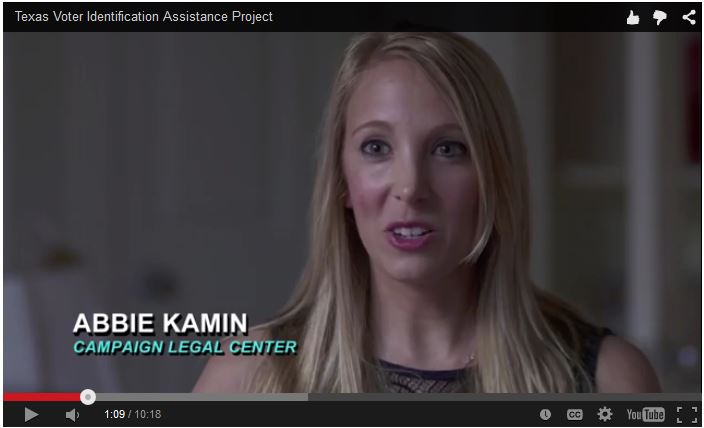
Abbie Kamin, a Houston lawyer assisting Texas voters keep their right to vote, explains how Texas's voter ID laws hurt Texans, and damage democracy in the U.S.

Abbie Kamin, a Houston lawyer assisting Texas voters keep their right to vote, explains how Texas’s voter ID laws hurt Texans, and damage democracy in the U.S.

Video you won’t see at 11.

From the Texas Voter Identification Assistance Project, at the Campaign Legal Center.

Description:
Published on Apr 24, 2015

Under Texas’ new restrictive photo/voter ID law, more than 600,000 Texans now lack sufficient identification to vote in elections, with little to no help from the State of Texas to resolve the problems. The Texas Voter Identification Assistance Project, coordinated by the Campaign Legal Center, a nonpartisan nonprofit, provided assistance to Texas voters who wished to vote but lacked the newly required identification, and thus were disenfranchised.

At the Campaign Legal Center’s site, there’s a press release on the video, released to correspond with arguments on voter identification issues at the Fifth Circuit Court of Appeals.

CLC FILM RELEASE: On Day of Fifth Circuit Oral Argument, Meet Victims of Texas Voter Photo ID Law

CLC Staff

Apr 28, 2015

Today, the Campaign Legal Center released a short film focusing on three lifelong voters disenfranchised by Texas’ voter photo ID law (SB 14), the most restrictive and burdensome voter ID law in the nation.  The ten-minute film produced by Firelight Media traces the efforts of the Campaign Legal Center’s Voter ID Project to assist registered voters to overcome the many hurdles erected by the new law in order to obtain the photo IDs required by SB 14.

Today in Veasey v. Abbott, oral arguments will be heard in a challenge to that law, in the U.S. Court of Appeals for the Fifth Circuit in New Orleans.  Attorneys at the Campaign Legal Center serve as co-counsel for plaintiffs Congressman Marc Veasey, LULAC, and a group of Texas voters.

Following a two-week trial last fall, U.S. District Court Judge Nelva Gonzales Ramos enjoined SB 14, finding that it was as an unconstitutional burden on the right to vote as well as an unconstitutional poll tax, had “an impermissible discriminatory effect against Hispanics and African-Americans, and was imposed with an unconstitutional discriminatory purpose.”  The state defendants immediately appealed Judge Ramos’ decision. In mid-October, the Fifth Circuit Court of Appeals stayed that decision solely to avoid confusion in the November 2014 elections, and the U.S. Supreme Court subsequently refused to vacate the Fifth Circuit’s stay.

The film released today traces the plight of three Texans who were victims of the Texas voter photo ID law and the massive effort required of many voters to exercise their right to vote under the new law.

“These longtime voters were had their voting rights violated because of SB 14 which the District Court found to be unconstitutional and in violation of the Voting Rights Act,” said J. Gerald Hebert, Executive Director of The Campaign Legal Center.  “The plight of these victims, who suffered a violation of their voting rights through no fault of their own, mirrors the evidence that prompted Judge Ramos to strike down Texas’ intentionally discriminatory, modern-day poll tax.”

The first challenge (Veasey v. Perry) to the Texas photo ID law was filed by the Campaign Legal Center and others in the summer of 2013 claiming that SB 14 violates the 1st, 14th, 15th and 24th Amendments to the Constitution, as well as Section 2 of the Voting Rights Act.  Several additional challenges were then brought against the Texas law (including one by the United States).  All of the cases were consolidated in the Southern District of Texas in Corpus Christi.

In addition to overseeing the Voter ID Project, the Campaign Legal Center is part of the legal team representing the Veasey-LULAC plaintiffs that includes Chad Dunn and K. Scott Brazil (Brazil & Dunn), Neil G. Baron, David Richards (Richards, Rodriguez & Skeith), Armand Derfner (Derfner & Altman), and Luis Roberto Vera, Jr. (LULAC).

To read the Legal Center’s Fifth Circuit brief, click here.

To read the District Court decision striking down the Voter ID law, click here.

Tip of Millard’s old scrub brush to Michael Li.


No, Earth Day does not celebrate Lenin, who was anti-environmentalist – 2015 debunking of the annual Earth Day/Lenin hoax

April 20, 2015

This is mostly an encore post, repeated each year on April 22 and Earth Day — sad that it needs repeating; anti-environmentalists don’t appear to learn much, year to year.  (Yes, some of the links may be dated; if you find one not working, please let me know in comments.)

You could write it off to pareidolia, once.

Like faces in clouds, some people claimed to see a link. The first Earth Day, on April 22, 1970, coincided with Lenin’s birthday. There was no link — Earth Day was scheduled for a spring Wednesday, when the greatest number of college students would be on campus.

Link to permanent Earth Day site, at EarthDay.org

Link to permanent Earth Day site, at EarthDay.org

Now, years later, with almost-annual repeats of the claim from the braying right wing, it’s just a cruel hoax.  It’s as much a hoax on the ill-informed of the right, as anyone else. Many of them believe it.

No, there’s no link between Earth Day and the birthday of V. I. Lenin:

One surefire way to tell an Earth Day post is done by an Earth Day denialist: They’ll note that the first Earth Day, on April 22, 1970, was an anniversary of the birth of Lenin.

Coincidentally, yes, Lenin was born on April 22 (new style calendar; it was April 10 on the calendar when he was born — one might accurately note that Lenin’s mother always said he was born on April 10).

It’s a hoax. There is no meaning to the first Earth Day’s falling on Lenin’s birthday — Lenin was not prescient enough to plan his birthday to fall in the middle of Earth Week, a hundred years before Earth Week was even planned.

About.com explains why the idea of a link between Earth Day and Lenin is silly:

Does Earth Day Promote Communism?
Earth Day 1970 was initially conceived as a teach-in, modeled on the teach-ins used successfully by Vietnam War protesters to spread their message and generate support on U.S. college campuses. It is generally believed that April 22 was chosen for Earth Day because it was a Wednesday that fell between spring break and final exams—a day when a majority of college students would be able to participate.

U.S. Sen. Gaylord Nelson, the guy who dreamed up the nationwide teach-in that became Earth Day, once tried to put the whole “Earth Day as communist plot” idea into perspective.

“On any given day, a lot of both good and bad people were born,” Nelson said. “A person many consider the world’s first environmentalist, Saint Francis of Assisi, was born on April 22. So was Queen Isabella. More importantly, so was my Aunt Tillie.”

April 22 is also the birthday of J. Sterling Morton, the Nebraska newspaper editor who founded Arbor Day (a national holiday devoted to planting trees) on April 22, 1872, when Lenin was still in diapers. Maybe April 22 was chosen to honor Morton and nobody knew. Maybe environmentalists were trying to send a subliminal message to the national subconscious that would transform people into tree-planting zombies. One birthday “plot” seems just about as likely as the other. What’s the chance that one person in a thousand could tell you when either of these guys were born.

My guess is that only a few really wacko conservatives know that April 22 is Lenin’s birthday (was it ever celebrated in the Soviet Union?). No one else bothers to think about it, or say anything about it, nor especially, to celebrate it.

Certainly, the Soviet Union never celebrated Earth Day. Nor was Lenin any great friend of the environment.  He stood instead with the oil-drillers-without-clean-up, with the strip-miners-without-reclamation, with the dirty-smokestack guys.  You’d think someone with a bit of logic and a rudimentary knowledge of history could put that together.

Gaylord Nelson, Living Green image

Inventor of Earth Day teach-ins, former Wisconsin Governor and U.S. Senator Gaylord Nelson

The REAL founder of Earth Day, Wisconsin’s U.S. Sen. Gaylord Nelson, usually recognized as the founder and father of Earth Day, told how and why the organizers came to pick April 22:

Senator Nelson chose the date in order to maximize participation on college campuses for what he conceived as an “environmental teach-in.” He determined the week of April 19–25 was the best bet; it did not fall during exams or spring breaks, did not conflict with religious holidays such as Easter or Passover, and was late enough in spring to have decent weather. More students were likely to be in class, and there would be less competition with other mid-week events—so he chose Wednesday, April 22.

In his own words, Nelson spoke of what he was trying to do:

After President Kennedy’s [conservation] tour, I still hoped for some idea that would thrust the environment into the political mainstream. Six years would pass before the idea that became Earth Day occurred to me while on a conservation speaking tour out West in the summer of 1969. At the time, anti-Vietnam War demonstrations, called “teach-ins,” had spread to college campuses all across the nation. Suddenly, the idea occurred to me – why not organize a huge grassroots protest over what was happening to our environment?

I was satisfied that if we could tap into the environmental concerns of the general public and infuse the student anti-war energy into the environmental cause, we could generate a demonstration that would force this issue onto the political agenda. It was a big gamble, but worth a try.

At a conference in Seattle in September 1969, I announced that in the spring of 1970 there would be a nationwide grassroots demonstration on behalf of the environment and invited everyone to participate. The wire services carried the story from coast to coast. The response was electric. It took off like gangbusters. Telegrams, letters, and telephone inquiries poured in from all across the country. The American people finally had a forum to express its concern about what was happening to the land, rivers, lakes, and air – and they did so with spectacular exuberance. For the next four months, two members of my Senate staff, Linda Billings and John Heritage, managed Earth Day affairs out of my Senate office.

Five months before Earth Day, on Sunday, November 30, 1969, The New York Times carried a lengthy article by Gladwin Hill reporting on the astonishing proliferation of environmental events:

“Rising concern about the environmental crisis is sweeping the nation’s campuses with an intensity that may be on its way to eclipsing student discontent over the war in Vietnam…a national day of observance of environmental problems…is being planned for next spring…when a nationwide environmental ‘teach-in’…coordinated from the office of Senator Gaylord Nelson is planned….”

Nelson, a veteran of the U.S. armed services (Okinawa campaign), flag-waving ex-governor of Wisconsin (Sen. Joe McCarthy’s home state, but also the home of Aldo Leopold and birthplace of John Muir), was working to raise America’s consciousness and conscience about environmental issues.

Lenin on the environment? Think of the Aral Sea disaster, the horrible pollution from Soviet mines and mills, and the dreadful record of the Soviet Union on protecting any resource. Lenin believed in exploiting resources and leaving the spoils to rot in the sun, not conservation; in practice there was no environmental protection, but instead a war on nature, in the Soviet Union.

So, why are all these conservative denialists claiming, against history and politics, that Lenin’s birthday has anything to do with Earth Day?

Can you say “propaganda?” Can you say “political smear?”

2015 Resources and Good News:

2014 Resources and Good News:

2013 Resources and Good News:

Good information for 2012:

Good information from 2011:

Good information from 2010:

2014’s Wall of Shame:

2013 Wall of Shame:

Wall of Lenin’s Birthday Propaganda Shame from 2012:

Wall of Lenin’s Birthday Propaganda Shame from 2011:

Wall of Lenin’s Birthday Propaganda Shame from 2010:

Spread the word. Have you found someone spreading the hoax, claiming Earth Day honors Lenin instead? Give us the link in comments.


Encore: Campaigning Obama visited the Dubliner on St. Patrick’s Day, 2012

March 17, 2015

(This is a slightly-edited encore post, for St. Patrick’s Day — I like the Corrigan Brothers’ droll tune.)

I’d forgotten about the birthers’ greatest nightmare — Obama’s got Irish blood in him!

Democratic Underground features a series of photos of President Obama with an Irish cousin at one of my favorite old haunts in Washington, the Dubliner.

President Barack Obama drinks a Guinness with his ancestral cousin from Moneygall Ireland Henry Healy, center, and the owner of the pub in Moneygall Ireland, Ollie Hayes, right, at The Dubliner Restaurant and Pub and Restaurant on St. Patrick's Day, Saturday, March 17, 2012, in Washington (Official White House Photo by Pete Souza)

President Barack Obama drinks a Guinness with his ancestral cousin from Moneygall Ireland Henry Healy, center, and the owner of the pub in Moneygall Ireland, Ollie Hayes, right, at The Dubliner Restaurant and Pub and Restaurant on St. Patrick’s Day, Saturday, March 17, 2012, in Washington (Official White House Photo by Pete Souza)

Many great memories of the Dubliner, including its own great business success.

In 1974, when I interned at the Senate, the Dubliner was just a small bar on the first floor of the Commodore Hotel.  Rocky Johnson of Sen. Mike Gravel‘s office, one of my roommates, introduced me to Guinness.  The Dubliner was the most reliable source in D.C. at the time.  The bartender was a guy named Paddy.  It was never crowded — and they had good fish and chips with a fine, imported malt vinegar. I wasn’t exactly a regular, but I made several a lot of visits.

Ironically, for my summer job later that year with the Louis August Jonas Foundation, we had a trip to D.C. planned with about 16 “boys from abroad” and the designated hotel was the Commodore — it was cheap and met our needs, being close to the Capitol.  I was asked to chaperone, and happily went.   So Freddy Jonas, the great benefactor of the foundation and Camp Rising Sun, and I could sneak down to the Dubliner for a nightcap after the boys were asleep.  Michael Greene, the foundation’s executive director at the time, warned me that Freddy would always ask if you wanted a second drink, but Freddy would not take one himself — and so, of course, neither should staffers.

One night while Freddy and I were capping off the evening we ran into a friend from my interning, Avis Ortner, a former rodeo barrel rider who had starred in a Kodak commercial series, and who worked in a Washington law firm.  She and Freddy struck it off very nicely.  I was surprised at how much Freddy knew about horses, and the questions he had about rodeo riding.  At some point in the evening he asked me if I were going to have a second drink, and of course I declined.  “Well, you only live once.  Avis and I are having a second one, and you should join us.”  People who knew Freddy well still don’t believe me when I tell them the story.  But it’s true.  It’s the magic of the Dubliner.  [Is Avis still cleaning up at bridge in D.C.? [Yes!]]

I was back in D.C. in 1975, again with the Jonas Foundation bunch, and again at the Commodore.  The Dubliner had a successful year, and had taken over the small cafe/dining room next door to bar.

In 1976 I visited again, and after a very successful year the Dubliner kicked out the gift shop of the hotel and opened a second bar there.  It was crowded on weekends.

In 1979 I moved to D.C.  Within a couple of years the Dubliner bought out the Commodore.  You couldn’t get a seat at the bar most nights.  St. Patrick’s Day 1980 the line wrapped around the block, and though the place never had a great or large stage, the live act was the Clancy Brothers with Tommy Makem, if I recall correctly.

Reconstruction and massive redecorating made the hotel into a great stop, and a sometimes pricey room.  Eventually the bar company sold the hotel, but kept the location for the bar.  After Kathryn and I got married, we’d walk over to the Dubliner for lunch at least a couple of times a month, and the fish and chips at the Dubliner got better.  I may have done in half the cod from the Grand Banks all by myself.

We’ve been in Texas now since 1987.  I miss the Dubliner.  Have been able to make it back only a couple of times.  Obama’s lucky he could get in, on St. Patrick’s Day.  I hope he appreciates his luck.

Yes, this is mostly an encore post.  Fighting ignorance requires patience.

Yes, this is mostly an encore post. Fighting ignorance requires patience.


Close one: Turns out Obama’s not the antichrist

February 16, 2015

In case you were worried:

http://twitter.com/TheFix/status/567111784184938496

That appeared in the Lexington Dispatch, in Lexington, North Carolina.  Wish they had that paper at my newsstand.

Read the rest of this entry »


God blessed February 12, 1809, with Darwin and Lincoln

February 12, 2015

Is it an unprecedented coincidence?  206 years ago today, just minutes (probably hours) apart according to unconfirmed accounts, Abraham Lincoln was born in a rude log cabin on Nolin Creek, in Kentucky, and Charles Darwin was born into a wealthy family at the family home  in Shrewsbury, England.

Gutzon Borglums 1908 bust of Abraham Lincoln in the Crypt of the U.S. Capitol - AOC photo

Gutzon Borglum’s 1908 bust of Abraham Lincoln in the Crypt of the U.S. Capitol – Architect of the Capitol photo

Lincoln would become one of our most endeared presidents, though endearment would come after his assassination.  Lincoln’s bust rides the crest of Mt. Rushmore (next to two slaveholders), with George Washington, the Father of His Country, Thomas Jefferson, the author of the Declaration of Independence, and Theodore Roosevelt, the man who made the modern presidency, and the only man ever to have won both a Congressional Medal of Honor and a Nobel Prize, the only president to have won the Medal of Honor.  In his effort to keep the Union together, Lincoln freed the slaves of the states in rebellion during the civil war, becoming an icon to freedom and human rights for all history.  Upon his death the entire nation mourned; his funeral procession from Washington, D.C., to his tomb in Springfield, Illinois, stopped twelve times along the way for full funeral services.  Lying in state in the Illinois House of Representatives, beneath a two-times lifesize portrait of George Washington, a banner proclaimed, “Washington the Father, Lincoln the Savior.”

Charles Darwin statue, Natural History Museum, London - NHM photo

Charles Darwin statue, Natural History Museum, London – NHM photo

Darwin would become one of the greatest scientists of all time.  He would be credited with discovering the theory of evolution by natural and sexual selection.  His meticulous footnoting and careful observations formed the data for ground-breaking papers in geology (the creation of coral atolls), zoology (barnacles, and the expression of emotions in animals and man), botany (climbing vines and insectivorous plants), ecology (worms and leaf mould), and travel (the voyage of H.M.S. Beagle).  At his death he was honored with a state funeral, attended by the great scientists and statesmen of London in his day.  Hymns were specially written for the occasion.  Darwin is interred in Westminster Abbey near Sir Isaac Newton, England’s other great scientist, who knocked God out of the heavens.

Lincoln would be known as the man who saved the Union of the United States and set the standard for civil and human rights, vindicating the religious beliefs of many and challenging the beliefs of many more.  Darwin’s theory would become one of the greatest ideas of western civilization, changing forever all the sciences, and especially agriculture, animal husbandry, and the rest of biology, while also provoking crises in religious sects.

Lincoln, the politician known for freeing the slaves, also was the first U.S. president to formally consult with scientists, calling on the National Science Foundation (whose creation he oversaw) to advise his administration.  Darwin, the scientist, advocated that his family put the weight of its fortune behind the effort to abolish slavery in the British Empire.  Each held an interest in the other’s disciplines.

Both men were catapulted to fame in 1858. Lincoln’s notoriety came from a series of debates on the nation’s dealing with slavery, in his losing campaign against Stephen A. Douglas to represent Illinois in the U.S. Senate.  On the fame of that campaign, he won the nomination to the presidency of the fledgling Republican Party in 1860.  Darwin was spurred to publicly reveal his ideas about the power of natural and sexual selection as the force behind evolution, in a paper co-authored by Alfred Russel Wallace, presented to the Linnean Society in London on July 1, 1858.   On the strength of that paper, barely noticed at the time, Darwin published his most famous work, On the Origin of Species, in November 1859.

The two men might have got along well, but they never met.

What unusual coincidences.

Go celebrate human rights, good science, and the stories about these men.

A school kid could do much worse than to study the history of these two great men.  We study them far too little, it seems to me.

Resources:

Charles Darwin:

Abraham Lincoln:

More:

Anybody know what hour of the day either of these men was born?

Yes, you may fly your flag today for Lincoln’s birthday, according to the Flag Code; the official holiday, Washington’s Birthday, is next Monday, February 16th — and yes, it’s usually called “President’s Day” by merchants and calendar makers. You want to fly your flag for Charles Darwin? Darwin never set foot in North America, remained a loyal subject of Her Majesty, Queen Victoria, to the end of his days. But go ahead. Who would know?

Yes, this is mostly an encore post.  Fighting ignorance requires patience.

Yes, this is mostly an encore post. Fighting ignorance requires patience.


Who wrote “A Day in the Life of Joe Republican?”

January 30, 2015

As it came to me. Similar to a module we used to use in Orrin Hatch speeches back in the Pleistocene (probably would have gotten him voted out if he used the old module now, let alone this one).

Why do these essays usually come with no author, or “author unknown?”  I’ve tracked it down to Crooks and Liars and a recitation by Thom Hartmann, who attributes it to a guy named John Gray in Cincinnati, in 2004. Is that right?

A Day In the Life of Joe Republican

Joe gets up at 6 a.m. and fills his coffeepot with water to prepare his morning coffee. The water is clean and good because some tree-hugging liberal fought for minimum water-quality standards. With his first swallow of water, he takes his daily medication. His medications are safe to take because some stupid commie liberal fought to ensure their safety and that they work as advertised.

All but $10 of his medications are paid for by his employer’s medical plan because some liberal union workers fought their employers for paid medical insurance – now Joe gets it too.

He prepares his morning breakfast, bacon and eggs. Joe’s bacon is safe to eat because some girly-man liberal fought for laws to regulate the meat packing industry.

In the morning shower, Joe reaches for his shampoo. His bottle is properly labeled with each ingredient and its amount in the total contents because some crybaby liberal fought for his right to know what he was putting on his body and how much it contained.Joe dresses, walks outside and takes a deep breath. The air he breathes is clean because some environmentalist wacko liberal fought for the laws to stop industries from polluting our air.

He walks on the government-provided sidewalk to subway station for his government-subsidized ride to work. It saves him considerable money in parking and transportation fees because some fancy-pants liberal fought for affordable public transportation, which gives everyone the opportunity to be a contributor.

Joe begins his work day. He has a good job with excellent pay, medical benefits, retirement, paid holidays and vacation because some lazy liberal union members fought and died for these working standards. Joe’s employer pays these standards because Joe’s employer doesn’t want his employees to call the union.

Hal Coffman in the New York American, 1912. Via Superitch

Hal Coffman in the New York American, 1912. Via Superitch

If Joe is hurt on the job or becomes unemployed, he’ll get a worker compensation or unemployment check because some stupid liberal didn’t think he should lose his home because of his temporary misfortune.

It is noontime and Joe needs to make a bank deposit so he can pay some bills. Joe’s deposit is federally insured by the FDIC [FSLIC] because some godless liberal wanted to protect Joe’s money from unscrupulous bankers who ruined the banking system before the Great Depression.

Joe has to pay his Fannie Mae-underwritten mortgage and his below-market federal student loan because some elitist liberal decided that Joe and the government would be better off if he was educated and earned more money over his lifetime. Joe also forgets that in addition to his federally subsidized student loans, he attended a state funded university.

Joe is home from work. He plans to visit his father this evening at his farm home in the country. He gets in his car for the drive. His car is among the safest in the world because some America-hating liberal fought for car safety standards to go along with the tax-payer funded roads.

He arrives at his boyhood home. His was the third generation to live in the house financed by Farmers Home Administration because bankers didn’t want to make rural loans.

The house didn’t have electricity until some big-government liberal stuck his nose where it didn’t belong and demanded rural electrification.

He is happy to see his father, who is now retired. His father lives on Social Security and a union pension because some wine-drinking, cheese-eating liberal made sure he could take care of himself so Joe wouldn’t have to.

Joe gets back in his car for the ride home, and turns on a radio talk show. The radio host keeps saying that liberals are bad and conservatives are good. He doesn’t mention that the beloved Republicans have fought against every protection and benefit Joe enjoys throughout his day. Joe agrees: “We don’t need those big-government liberals ruining our lives! After all, I’m a self-made man who believes everyone should take care of themselves, just like I have.”

Thom Hartmann recites:


Je suis Charlie!

January 8, 2015

If you follow my Tweets, or if you watch what I post on Facebook, you may have noticed I frequently credit editorial cartoonists with telling the truth.  Cartoonists fill a critical need.  I admire their work.

That’s not strong enough.  I find that political cartoons offer truths, in quickly grokable form, that would remain hidden in news and commentary otherwise.

Perhaps more importantly, cartoons lampoon those who desperately, bitterly need lampooning.

Why is that important?  Lampooning exposes crazy behaviors in our leaders, behaviors that if unchecked might lead a group to disaster.  Or a community.  Or a nation.  Or a planet.

Ancient sayings, properly and improperly attributed to various sources, over a period of 500 to 1,000 years point to the importance of lampooning in correcting actions of leaders and governments.  This version comes from a Sophocles play, Antigone (620-3):

For cunningly of old
was the celebrated saying revealed:
evil sometimes seems good
to a man whose mind
a god leads to destruction.

Lampooning helps, illustrating perhaps with laughter where the problem lies, though it also suggests that the chief perpetrators and promulgators of the craziness may be immune from such insights, whether through laughter or any other method.

If those lampooned genuinely cannot see the humor, a greater problem is exposed.  That’s the point. Expose the madness, lay it bare for all to see.  Sane people will work to help the insane, and avoid leading others into that madness.  Lampooning provides us a great tool to avoid disasters, if we would only look. Laughter is optional, if the message gets through.

Even insane leaders and groups understand this at some level. Mark Twain (Samuel Clemens) wrote about the value of ridicule of majestic error in his Notebook:

No god and no religion can survive ridicule. No church, no nobility, no royalty or other fraud, can face ridicule in a fair field and live.*

We got a sharp and painful reminder of these facts yesterday, when a group of gunmen, stung by ridicule from a French satire magazine, stormed that magazine’s offices and brutally gunned down a score of people, a dozen of whom died.  Their form of religious struggle appears insane to sane people, and when that is pointed out to them, they behave with more intense insanity.

To these gunman, whose existence alone is a blasphemous assault on the idea of peaceful religion, ridicule in publication was too much to take.  Rather than answer with other cartoons or parody, or serious thought in print, they attempted to change the playing field’s fairness.

In doing they exposed their critics as accurate and true. Those already crazed by the gods probably have no sense of irony left, either.

This morning comes the word that Charlie Hebdo will publish next week as scheduled.  Instead of the usual run of 113,000 copies, the first run will be more than a million, to meet greater demand. Stricken down by gunmen, Charlie Hebdo rises phoenix-like, with strength multiplied by more than ten.

We mourn the cartoonists and editors lost.  They are martyrs in the cause of freedom and peace, and especially in the “jihad” they engage in for freedom of expression, something that we know now is not a uniquely American virtue or necessity.

Throughout history memorable phrases heralded periods of great change, when people took a stand against tyranny and violence, and stood for freedom and peace.

I am Spartacus.

Here I stand.  I can do no other.”

“Union!”

“. . . the only thing we have to fear is fear itself.”

” . . . Freedom of speech and expression . . . Freedom of every person to worship God in his own way . . . Freedom from Want . . . Freedom from Fear. . .”

Ich bin ein Berliner.

We Shall Overcome

I Am A Man.”

And now, “Je suis Charlie!”

Beyond Charlie Hebdo, the world’s cartoonists and editorialists storm traditional and electronic media with support for the cartoonists.  Here below are some examples, in no particular order.  What other cartoons or commentary have you seen that we all should see?

Andy Marlette, cartoonist for the Pensacola News-Journal borrowed the saying from the sticker that Woody Guthrie used on his guitar, “This Machine Kills Fascists”:

Andy Marlette of the Pensacola News-Journal, borrowing from Woody Guthrie's guitar

Andy Marlette of the Pensacola News-Journal, borrowing from Woody Guthrie’s guitar

Pete Seeger borrowed Woody’s line, and painted on the drum head of his banjo, “This Machine Surrounds Hate and Forces It to Surrender.” Marlette also penned a piece for USA Today.

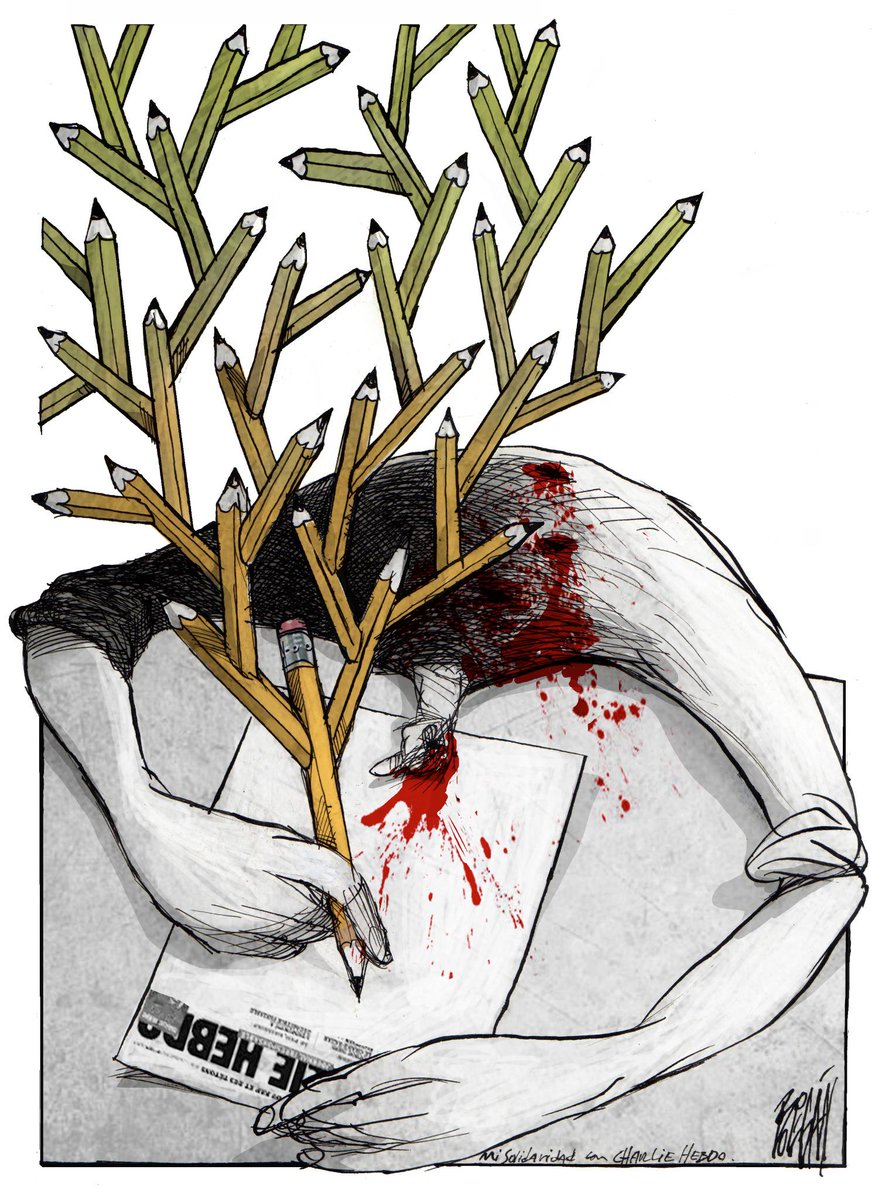
Cuban Angel Boligan (@AngelBoligan):

Cuban-born cartoonist Angel Boligan, on Charlie Hebdo

Cuban-born cartoonist Angel Boligan, on Charlie Hebdo

Nate Beeler in the Columbus Dispatch:

Nate Beeler's cartoon on Charlie Hebdo, for the Columbus Dispatch

Nate Beeler’s cartoon on Charlie Hebdo, for the Columbus Dispatch

Pat Bagley in the Salt Lake Tribune:

Pat Bagley, Salt Lake Tribune

Pat Bagley, Salt Lake Tribune

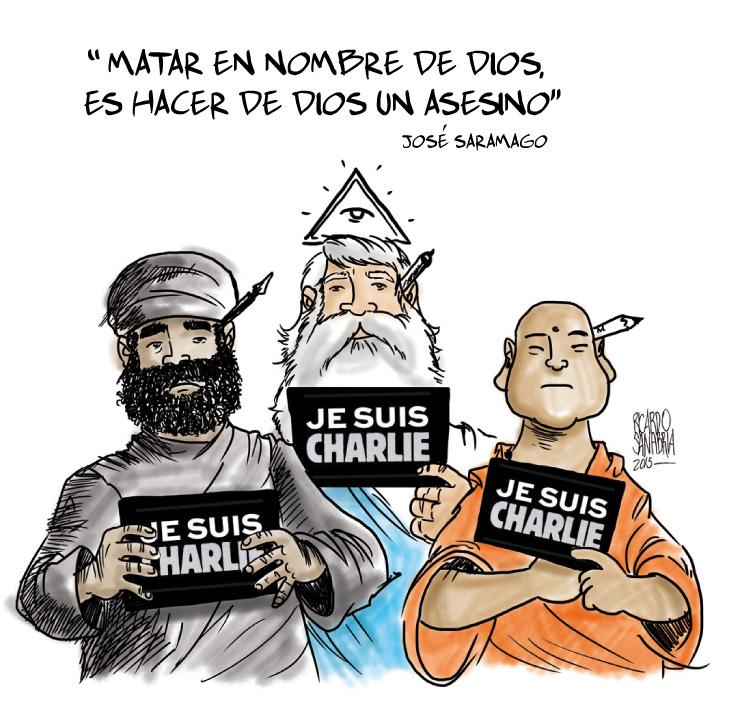
Ricardo Sanabria in Venezuela:

Ricardo Sanabria, Venezuela

Ricardo Sanabria, Venezuela

Manjool, an Indian cartoonist:

“Last message from #CharlieHebdo cartoonists to their killers. My #cartoon “

Clay Bennett at the Chattanooga, Tennessee newspapers:

Clay Bennett's cartoon on the tragedy at Charlie Hebdo

Clay Bennett’s cartoon on the tragedy at Charlie Hebdo

NOT by Banksy, but by Lucille Clerc:

Cartoon by Lucille Clerc

Cartoon circulated as by Banksy, but really by graphic designer Lucille Clerc

John Cole, Scranton Times-Tribune:

@AnnePhutto said:  Je suis Charlie...my 12 year old daughter's favorite cartoon in response to the tragedy.  Cartoon by John Cole, Scranton News-Tribune

@AnnePhutto said: Je suis Charlie…my 12 year old daughter’s favorite cartoon in response to the tragedy. Cartoon by John Cole, Scranton Times-Tribune

Charlie Hebdo dead?  I don’t think so.

______________

*  Twain also warned against taking ridicule too far, and spoke on the difficulty of knowing, if you’re the butt of the ridicule:

  • Sense of ridicule is bitterer than death & more feared. — men commit suicide daily to escape it.
    Mark Twain’s Notebooks and Journals, Vol. 3, p. 346.
  • There is no character, howsoever good and fine, but it can be destroyed by ridicule, howsoever poor and witless. Observe the ass, for instance: his character is about perfect, he is the choicest spirit among all the humbler animals, yet see what ridicule has brought him to. Instead of feeling complimented when we are called an ass, we are left in doubt.
    Pudd’nhead Wilson

More:


Quote of the moment, for politics at the end of 2014: Ebenezer Scrooge, “darkness is cheap”

December 23, 2014

Roberto Innocenti, Scrooge on a dark staircase

Ebenezer Scrooge, up a dark staircase; “Darkness was cheap, and Scrooge liked it.” Illustration by Roberto Innocenti, via Pinterest.

Quote of the moment (an encore post for the season, with a bit of context thrown in later):

Darkness is cheap, and Scrooge liked it.

– Charles Dickens, A Christmas Carol, Stave 1

I think of that line of Dickens’s often when  I read of the celebrations of calumny that pass as discourse in Republican politics these days. Although, with the 2008 renewing of Limbaugh’s contract, it may no longer be true that his particular brand of darkness is cheap.

Cheap or not, darkness remains dark.

John Leach, Scrooge meets Ignorance and Want

Scrooge meets Ignorance and Want, the products of his stinginess (drawing by John Leech, 1809-1870)


Drawing by John Leech (1809-1870), to illustrate Charles Dickens’ A Christmas Carol. Work in the public domain (available at WikiSource).

Here is the sentence Dickens put before the quote, to add a little context; Scrooge was climbing a very large, very dark staircase.

Half-a-dozen gas-lamps out of the street wouldn’t have lighted the entry too well, so you may suppose that it was pretty dark with Scrooge’s dip.

Up Scrooge went, not caring a button for that. Darkness is cheap, and Scrooge liked it.

Speaking of darkness, a longer excerpt from Dickens’s story:

‘Forgive me if I am not justified in what I ask,’ said Scrooge, looking intently at the Spirit’s robe, ‘but I see something strange, and not belonging to yourself, protruding from your skirts. Is it a foot or a claw?’

‘It might be a claw, for the flesh there is upon it,’ was the Spirit’s sorrowful reply. ‘Look here.’

From the foldings of its robe, it brought two children; wretched, abject, frightful, hideous, miserable. They knelt down at its feet, and clung upon the outside of its garment.

‘Oh, Man! look here. Look, look, down here!’ exclaimed the Ghost.

They were a boy and girl. Yellow, meagre, ragged, scowling, wolfish; but prostrate, too, in their humility. Where graceful youth should have filled their features out, and touched them with its freshest tints, a stale and shrivelled hand, like that of age, had pinched, and twisted them, and pulled them into shreds. Where angels might have sat enthroned, devils lurked, and glared out menacing. No change, no degradation, no perversion of humanity, in any grade, through all the mysteries of wonderful creation, has monsters half so horrible and dread.

Scrooge started back, appalled. Having them shown to him in this way, he tried to say they were fine children, but the words choked themselves, rather than be parties to a lie of such enormous magnitude.

‘Spirit! are they yours?’ Scrooge could say no more.

‘They are Man’s,’ said the Spirit, looking down upon them. ‘And they cling to me, appealing from their fathers. This boy is Ignorance. This girl is Want. Beware them both, and all of their degree, but most of all beware this boy, for on his brow I see that written which is Doom, unless the writing be erased. Deny it!’ cried the Spirit, stretching out its hand towards the city. ‘Slander those who tell it ye! Admit it for your factious purposes, and make it worse. And bide the end!’

‘Have they no refuge or resource?’ cried Scrooge.

‘Are there no prisons?’ said the Spirit, turning on him for the last time with his own words. ‘Are there no workhouses?’ The bell struck twelve.

Scrooge looked about him for the Ghost, and saw it not. As the last stroke ceased to vibrate, he remembered the prediction of old Jacob Marley, and lifting up his eyes, beheld a solemn Phantom, draped and hooded, coming, like a mist along the ground, towards him.

A Christmas Carol, Stave 3

Christmas is a festival to celebrate light, what many Christians call “the light of the world?” If so, let us work to stamp out the darkness which the unrepentant Scrooge so dearly loved.

Darkness may be cheap, but it is not good.  Light a candle, and run into the darkness, spreading light. We need more light.

More:


Post-election kissing and making up

December 21, 2014

Someone, now I forget who, sent me this little ditty in the wake of Barack Obama’s election victory in 2012.

The election is over,
The talking is done.

From CarStickers.com

From CarStickers.com

Your party lost.
My party won.

So let us be friends,
Let arguments pass.
I’ll hug your elephant,
If you kiss my ass.

I wondered who wrote it.  My handwritten note says whoever sent it to me said they got it off the internet.

Who needs plagiarism with the WorldWide Web? The usual tendencies to attribute witty or snarky sayings to famous people, and to strip actual authorship, get huge boosts from the internet. Mark Twain said a good lie could get around the Earth seven times before truth gets its boots on — with the internet, the lies, falsehoods and lack-of-appropriate attribution pieces fly at the speed of electronic interchange, near the speed of light but for the copper in the wires.

Here, a couple of years later, it could come into use again. Have I learned any more about who wrote it? Not really.  I looked, and didn’t find an authoritative version with an author’s name attached, which looks to be final.

From Etsy and ThinkOutLoudApparel.

From Etsy and ThinkOutLoudApparel.

This version claims to come from 1972, and the re-election of Richard Nixon:

The election is over, the results are now known,
The will of the people has clearly been shown.

Let’s all get together and show by our deeds,
That we will give Dick all the help that he needs.

Let bygones by bygones and all bitterness pass,
I’ll hug your elephant if you kiss my ass.

Still no author; from 2004:

The election is over, the results are now known.
The will of the people has clearly been shown.
We should show by our thoughts and our words and our deeds
That unity is just what our country now needs.
Let’s all get together. Let bitterness pass.
I’ll hug your elephant.
You kiss my ass.

We might assume it’s been around at least since Nixon’s second election then. I’ll wager it goes back farther into the recesses of history.

But does anyone know for sure? It’s been around long enough to have made the leap to bumperstickers, and other political paraphernalia.

Help us out in comments, if you have information.
[Update December 2020]

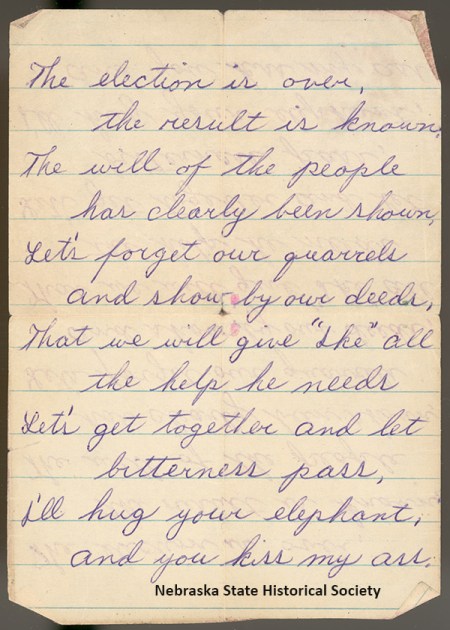
Handwritten note suggesting the poem comes no later than 1956; sadly, note comes from the wallet of a murder victim. History Nebraska blog

Handwritten note suggesting the poem comes no later than 1956; sadly, note comes from the wallet of a murder victim. History Nebraska blog

From Kaboodle.com

From Kaboodle.com

[Editor’s note: What was the image from Kaboodle.com, that is now no longer available there? December 2020]


Election Day 2014: Fly your flag, and VOTE!

November 4, 2014

Saint Louis Art Museum, St. Louis, Missouri George Caleb Bingham (American, 1811–1879). The County Election, 1852. Oil on canvas. 38 x 52 in. (96.5 x 132.1 cm). Gift of Bank of America.

The County Election, 1852. Saint Louis Art Museum, St. Louis, Missouri George Caleb Bingham (American, 1811–1879).  Oil on canvas. 38 x 52 in. (96.5 x 132.1 cm). Gift of Bank of America.

Every polling place should be flying the U.S. flag today.  You may fly yours, too.  In any case, if you have not voted already, go vote today as if our future depends upon it, as if our nation expects every voter to do her or his duty.

Today the nation and world listen to the most humble of citizens.  Speak up, at the ballot box.

Did you notice?  In George Caleb Bingham’s picture, there are no U.S. flags.  You may fly yours anyway.

The whole world is watching.

More:

Yes, this is an encore post.

Yes, this is an encore post. I really like Bingham’s painting.


Leigh Bailey in Texas House District 108

October 31, 2014

Not my district, but if it were, I’d vote for Leigh Bailey.

The Trailblazers Blog at the Dallas Morning News described the race:

Meyer, a Republican, and Bailey, a Democrat, are competing for an open seat in House District 108. The district covers the Park Cities, Preston Hollow and central Dallas. Meyer is the heavy favorite in the GOP stronghold, but Bailey is trying to win independent voters and newcomers to Uptown, Downtown Dallas and East Dallas.

Candidates for Texas House, District 108, Republican Morgan Meyer on the left, and Democrat Leigh Bailey on the right.  Dallas Morning News photos

Candidates for Texas House, District 108, Republican Morgan Meyer on the left, and Democrat Leigh Bailey on the right. Dallas Morning News photos

In my conversations with both candidates, Republican Morgan Meyer seemed distant, stiff, and unwilling to say anything that wasn’t approved by Corporate HQ (whose? I don’t know).

Bailey took time to talk, about life in Dallas, how to make it better, what an uphill fight she has.  Dallas schools, and what it might take to make people see the improvements already there, and how to support teachers and students . . .

In short, Bailey is much more human, and for my money, much more attuned to the needs of Texas, Texas families, and making things work in Austin.

When you vote Tuesday, Dallasites, if you’re in District 108, vote for Leigh Bailey.