Wes Elsberry at Austringer does a bit of design on the side. Here’s his latest:

Tip of the old scrub brush to P. Z. Myers at Pharyngula.
Wes Elsberry at Austringer does a bit of design on the side. Here’s his latest:
Tip of the old scrub brush to P. Z. Myers at Pharyngula.
 Leave a Comment » |
  Creationism, Intelligent Design, Politics | Tagged: Bumper sticker, intelligent design flunked |
  Permalink
 Posted by Ed Darrell
The Neural Gourmet sends greetings:
Tangled Up In Blue Guy brings us the fortnight’s best grumpy liberal blogging for this 49th edition of Carnival of the Liberals. Join us October 24th for our
anger management seminarCarnival of the Liberals #50 at That Is So Queer.
Go see what people who actually claim to be liberal think and blog about. It’s one of those places where people actually discuss Myanmar/Burma as if it mattered, and as if they have hope for the future.

Who’d have thought such things concerned liberals? (Hey, if you didn’t think liberals worry about such things, you really need to take a look at COTL49.)
Leave a Comment » | Geography - Political, Politics, Weblogs | Permalink
Posted by Ed Darrell
It doesn’t matter what your politics are — Rob Reiner’s got a great little film here on effective presentations (the one at the campaign site is better quality than the one on YouTube). He’s pushing for Hillary Clinton for President. What he says applies to anything — selling Girl Scout cookies, selling Boy Scout popcorn, raising money to fight breast cancer, recruiting people to your organization, talking about the hero’s quest in Beowulf for your English 3 class, making a case for more computers for your classroom, whatever.
“She’d rather do laundry than talk to you.” That’s an acid test. If your audience would rather do laundry, you need to listen to Rob Reiner.
[Gee, I hope the Clinton campaign leaves that video up for a long time . . .]
1 Comment | Campaigns, Politics, Presentations, Presidents, Student projects | Permalink
Posted by Ed Darrell
Let’s put an end to the silly “Christian nation” notion once and for all. Can we?
I am a hopeful person. Of course, I realize that it is highly unlikely we would ever be able to disabuse people of the Christian nation myth.
Okay — then let’s at least lay some facts on the table.

First, some background. John McCain, U.S. Senator from Arizona and candidate for U.S. president, granted an exclusive interview to a reporter from Belief.net. Read excerpts here.
In the interview McCain falls into the Christian nation trap:
Q: A recent poll found that 55 percent of Americans believe the U.S. Constitution establishes a Christian nation. What do you think?
A: I would probably have to say yes, that the Constitution established the United States of America as a Christian nation. But I say that in the broadest sense. The lady that holds her lamp beside the golden door doesn’t say, “I only welcome Christians.” We welcome the poor, the tired, the huddled masses. But when they come here they know that they are in a nation founded on Christian principles.
Second, David Kuo properly, but gingerly, takes on McCain′s argument (hooray for Belief.net).
Then, third, Rod Dreher (the Crunchy Con from the Dallas Morning News) agrees with McCain, mostly.
McCain’s blithe endorsement of this myth, based in error and continued as a political drive to shutting down democratic processes. McCain may be starting to understand some of the difficulties with this issue. His remarks are a week old, at least, and there’s been a wire story a day since then. Will it make him lean more toward taking my advice?
Below the fold, I post a few observations on why we should just forget the entire, foolish claim. Read the rest of this entry »
48 Comments | 6th Amendment, Bogus history, Books, First Amendment, Politics, Religion, Religious Freedom, Separation of church and state | Tagged: Christian nation, Christian Nation Hoax, hoax, John McCain, Law, Politics, Religion, Separation of church and state, Supreme Court | Permalink
Posted by Ed Darrell
Information on DDT is scattered clouds of information, lately. Some of these really should get more comment — but time is quite short for me right now.
Here’s the news:
One more study on DDT and breast cancer. Stop the presses on this one. It’s a good study, and it shows a link. Effect Measure at the Seed Stables has a good post on it. One of the key differences here is that this study looked for childhood exposure. Exposure of children to DDT seems to be more damaging than exposure to adults. This should be especially worrying considering DDT’s daughter products and their ability to mimic estrogen in the wild.
Bill Moyers’ program on PBS looked at the recent campaign against Rachel Carson, and found the campaign ethically challenged. Moyers takes a more in-depth and gentle view of Carson, from a perspective from the arts. Solid information, interesting view.
All Africa.com had a news report on the current anti-malaria campaign in Malawi: “Rescuing children from malaria.” Real news — it doesn’t call for broadcast spraying of DDT. (Surprised?) In fact, it attacks the colleagues of the Rachel Carson critics, the tobacco companies.
A recent think piece out of the always-informative Christian Science Monitor: “Bring back DDT? Think again.”
Perhaps a minor blip: Plaintiffs ask damages against chemical companies and others because the DDT dumped next door has decreased the value of their properties. An Alabama appeals court ruled that plaintiffs may call in experts to testify that DDT dumping decreases property value. (Maybe Roger Bate would like to buy the property at market value? All that DDT would mean no mosquitoes forever, right?)
And from the lost-but-now-found archives, a story that demonstrates subtly the bias that Rachel Carson critics have — Roger Bate defending tobacco companies in a 1996 Wall Street Journal opinion piece. Perhaps one should not be surprised that people who defend tobacco against health regulators and health care education could turn around and argue for DDT and against Rachel Carson.
4 Comments | DDT, Environmental protection, History, Malaria, Politics, Public health, Rachel Carson, Science, War on Science | Tagged: DDT, Environmental protection, Junk science, Malaria | Permalink
Posted by Ed Darrell
Sec. of Education Margaret Spellings defends the Bush administration’s “No Child Left Behind” Act (NCLB) because, she says, it helps with accountability. It’s all about testing to make sure education takes, don’t you know.
Unless the test might show that Spellings and Bush haven’t done what they promised to do. Then the tests are off.
Bug Girl has the story: The U.S. has pulled out of the international testing for math and science, claiming budget restrictions. Surely the Bush administration did not fail to budget for their big test showing. Is that the real reason? Or do they fear that the test comparisons will show that NCLB has not worked?
Good discussion in the comments, too, about sequencing of math and science courses.
Leave a Comment » | Education assessment, Education quality, No Child Left Behind Act, Politics, Texas | Tagged: , NCLB | Permalink
Posted by Ed Darrell
Don’t forget about the victims of Katrina who still need help. But add to your worries the more than 50,000 families in Texas whose homes were seriously damaged by Hurricane Rita who have had no inkling of help, now two years after the storm.
Gov. Rick Perry declared the state disaster; Pres. George Bush declared the national distaster — but only about 1% of the money allocated has been spent, and Texans are hurting.
FrecklesCassie, the author of the blog Political Teen Tidbits, makes the case for action here: “Hurricane Damage isn’t the Only Problem .”
Drop a letter to Rick Perry; drop a letter to George Bush. Tell them to get off their duffs and do something. That’s what they get the big hair and make the big bucks for.
Copy Cassie’s post and send it to your best friends in e-mail; put up a blog post and link to Cassie’s post.
Where are Sens. Kay Bailey Hutchison and John Cornyn when Texas needs them? Cornyn is up for election next year, and he’s not all over this?
Looks to me like the Democrats could pick up a U.S. Senate seat in Texas, too. Texas wouldn’t be ignored like this if Phil Gramm and George Bush were still alive . . .
2 Comments | Disasters, Government, Politics, Texas | Tagged: government inaction, Hurricane Rita, Texas disasters | Permalink
Posted by Ed Darrell
From the Utah History Encyclopedia on-line, we get a solid if brief description of the highlights of public education in Utah.
Here are the roots of the deep opposition to vouchers in Utah. Several times Utah communities started their own private schools, only to turn them over to public entities, especially after 1890. Utahns regard public schools as their own. Voucher advocates seem unable to notice that an assault on the public schools is an assault on Utah communities, for that reason.
Plus, as The Deseret Morning News reported Sunday, Utah’s schools often achieve excellence. Utah parents don’t like the idea of taking money away from successful schools their kids attend to fund untested, unregulated private schools.
2 Comments | Education, Education quality, Education success, History, Politics, School vouchers | Tagged: Education, School vouchers, Utah voucher referendum | Permalink
Posted by Ed Darrell
Reality of elections: It’s more than issues. Voter turnout, and voter habits and biases, affect the outcome. The good news is that the habits and biases in this case work against vouchers.
Hoover Institute fellow Terry Moe’s evaluation of the general feeling of voters toward vouchers is golden, and should be framed by anyone working the issue — about a dozen paragraphs into the article.
Leave a Comment » | Education, Education quality, Education spending, Politics, School vouchers | Tagged: November election, School vouchers, Terry Moe, Utah referendum | Permalink
Posted by Ed Darrell
Little Miss Attila explains the politics of DDT, how the hysteria is driven by a lobbying group.
Good history, if you’re new to the issue.
Leave a Comment » | DDT, Politics, War on Science | Tagged: DDT, environment, Politics | Permalink
Posted by Ed Darrell
It looks a lot like inside baseball. It’s conducted away from classrooms, while teachers struggle to deliver science to students in crowded classrooms without adequate textbooks, without adequate science labs and without adequate time. The perpetrators hew to Otto von Bismark’s claim that the public shouldn’t see their laws or sausages being made.
Since Bismark, in the U.S. we have food safety laws to protect our sausage. In Texas, the political scheming in the State Board of Education (SBOE) continues to spoil science education.
Science standards for Texas Essential Knowledge and Skills (TEKS) — the Texas state science education standards — are being rewritten by the Texas Education Agency, under direction of the SBOE. While procedures have been consistent over the past 15 years or so, and the state legislature reined in SBOE from political shenanigans in textbook selection, SBOE members are fighting back to get the right to skew science standards. For weeks the selection of committees to review specific standards have been held up so members of the SBOE can stack the committees to put their political views in.
Board members are insisting on stacking the review committees now, weeks after the deadline for members to nominate qualified teachers and experts to review the standards. This is the gateway to the path of bad standards through which we earlier watched other school boards frolic — Cobb County, Georgia, Dover, Pennsylvania, and the State of Ohio. Taxpayers in Cobb County and Dover paid the price when courts correctly noted that the changes proposed violated the religious freedom clauses of the state constitutions and the First Amendment. Ohio’s board backed down when a new governor cleaned house, and when it became clear that their position would lose in court.
Simply gutting the standards, however, may not rise to the standard of illegal religious influence. Keeping kids in the dark may not violate federal or state law. It’s immoral, but would the Texas State Board stick to that side of morality? Many observers doubt it, given the track record of recent years striking important health information from texts that might save a few lives, and the legislature’s pro-cancer legislation this year.
Some observers have provided detailed reports that to many of us look like simple foot dragging. In the past week it has become more clear that the foot dragging is really political positioning.
If anyone was lulled to sleep by the Dallas Morning News article a few weeks ago which touted board members’ claims they would not advocate putting intelligent design into the biology curriculum, the greater fears now seem to be coming true: Board members did NOT say they would stand for good science, or that they would not try to cut evolution, Big Bang, astronomy, geology, accurate medicine and health, and paleontology out of curricula. The Corpus Christi Caller-Times warned:
Board chairman Don McLeroy, though indicating that he won’t support the teaching of intelligent design, says he would like to see more inclusion in textbooks of what he called weaknesses in the evolutionary theory, a sentiment expressed by many of the predominantly Republican 15-member board.
This only sounds like another version of a common tactic by religious pressure groups that seek to create a controversy about evolution that only exists in their opposition. That nicely covers their ultimate goal of converting classrooms into pulpits for religious teachings.
Texas schoolchildren will be the losers if the teaching of science, or health, or history — all subjects that have been the target of pressure groups — is based on something other than the best known and most widely accepted bodies of knowledge. In a pluralistic nation with many creeds and religions, letting personal faith become the guiding force for the public school curriculum invites creation of a battleground.
Texans should watch the State Board of Education in the months to come.
Just over a month ago one of the chief theorists behind Big Bang theory died in Austin, Ralph Alpher. His death went largely unnoticed. In 2003, with the Nobel Prize winning-physicist Ilya Prigogine of the University of Texas not yet cool in the grave, charlatans felt free to misrepresent his work on thermodynamics, saying he had “proved” that evolution could not occur. In fact, his prize-winning work showed that on a planet like Earth, evolution is a virtual certainty. Prigogine, Alpher: A greater tragedy is brewing: Will Big Bang survive the hatchets of anti-science forces on the SBOE? Many hard theories of science are unpopular with religious fanatics in Texas. Those fanatics are over-represented on the SBOE.
Don’t just watch. Write to your board member, to the TEA director, to the governor, to the legislature. One way to keep “no child left behind” is by holding all children back. Texas and America cannot afford such Taliban-like enforcement of ignorance.
5 Comments | Bogus history, Politics, Science, Science and faith, State school boards, Texas, Texas Lege, Textbook Selection, Voodoo history, Voodoo science | Permalink
Posted by Ed Darrell
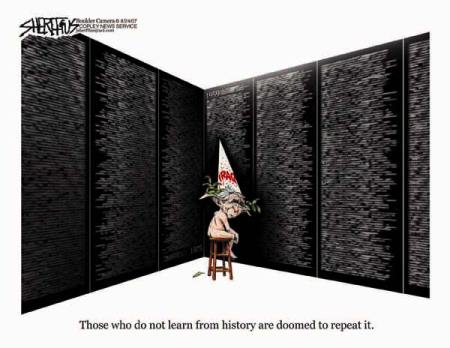
Sherffius in the Boulder Daily Camera, August 2007 - copyright Sherffius
Sherffius, in the Boulder (Colorado) Daily Camera
The deadline for cartoonists to enter the Ranan Lurie Prize competition at the United Nations is October 1. The winning cartoon from 2006, from Argentinian cartoonist Alfredo Sabat, is one of the most popular images in Google’s image search for “cartoon.”
Images pack a punch. If a pen is mightier than a sword, a cartoonist’s pencil and ink drawing can be more powerful than a cannon.
While we wait for the winners of the Lurie competition, we can look around to see other great cartoonists’ work. Earlier I tried to call attention to the work of John Sherffius at the Boulder (Colorado) Daily Camera. Since then, he’s won the James Aronson Social Justice Award for Graphics for the body of his work. The power of his drawings should be clear from the cartoon above.
Do you have a favorite cartoonist, especially one from a smaller newspaper who has not yet received the kudos she or he is due? Tell us about it in comments — and give links, if you can.
And share the word with others:


4 Comments | Cartoons, History, History images, Newspapers, Political cartoons, Politics | Permalink
Posted by Ed Darrell

Dr. J. D. Williams, the founding director of the Robert H. Hinckley Institute of Politics at the University of Utah, died at his home in Salt Lake City on September 4.
Links to news articles are provided from the Hinckley Institute’s website.
The Hinckley Institute provides powerful education, usually in the form of on-the-knife-edge training, in practical politics, the kind of politics that can change things. Utah enjoys the benefits of many active people in politics who learned how to make things work better through a Hinckley Institute internship.
Dr. Williams led the Institute for its first ten years, from 1965 to 1975. He was an active Democrat, but the Institute trained people of all parties, and he enjoyed good working relations with politicians of all stripes. His personal interventions pushed many elected officials and other good citizens off to a good start.
I served two internships with the Utah House of Representatives, and got the benefit of Williams’ and Bae Gardner’s personal attention when they copied my application for a Washington intership with the National Wildlife Federation, and submitted it to the Secretary of the U.S. Senate, too. I lost out on the NWF internship to woman I knew who had a tenth of a point better GPA in biology than I did. But I got the internship in the office of Frank Valeo, who worked closely with his friend, Sen. Mike Mansfield of Montana, the Majority Leader.
It was a grand time in Washington in that spring of 1974, as Richard Nixon’s Watergate escapades were unfolding in the House Judiciary Committee, as the U.S. faced the first oil embargo from OPEC, as the peace in Vietnam was unraveling, and as a variety of other issues simmered across the nation.
Later I had the benefit of several great interns from the Hinckley Institute to help me out.
Robert H. Hinckley’s idea of practical political training was a great one. The Institute could easily have sunk into mediocrity, as just a clearing house for cheap labor for bad politicians. Under Dr. Williams’ leadership, instead it became a force for good political action, a focal point for ethical public officials.
It was a sad week for Democrats generally, in Utah. Former Gov. Calvin L. Rampton died today. He was 93.
2 Comments | Education, Leadership, Politics | Permalink
Posted by Ed Darrell
Erwin Chemerinsky has agreed, again, to take the post of dean at the new law school at the University of California at Irvine.
Leaping off a bit from what Brian Leiter said earlier, that deans really don’t have any academic freedom of their own, we should note that being dean occupies more than every waking moment of a person’s life. There are few who can do the dean’s job and continue their previous scholarship output at the same high level. Anyone who might have been concerned about Chemerinsky’s politics can take some solace in the fact that he will certainly have to cut back on his studies and writing at least a little, in order to do his duties.
UC-Irvine’s school will open with very high expectations. If Chemerinsky does half the job as dean that he is capable of doing, the entering class will carry with it some jealousy, or at least some wistfulness, from a lot of attorneys who will wish they could have had the experience.
If egos as big as those involved in this affair can shake hands and patch over a serious disagreement, there is hope for mankind.
Leave a Comment » | Academic freedom, College, Law, Leadership, Politics | Permalink
Posted by Ed Darrell
Utah’s voucher referendum vote is just over six weeks away. From here in Dallas, it appears the anti-voucher forces are leading.
Why do I say that without looking at a single poll? The pro-voucher forces have gone dirty, by Utah political standards: They’re pushing an opinion piece that says God and the Mormon pioneers favor vouchers, according to an AP report via KSL.com (radio and television).
It the occasionally peculiar language of Utah politics, it’s a desperate move, intentionally below the belt, in hopes of crippling the opposition so a win by default must be declared, even over the foul.
A conservative think tank is distributing a lengthy essay on the history of education in Utah that implies that if Mormons don’t vote in favor of the state’s school voucher law that they could face cultural extinction.
The “conservative think tank” is the Sutherland Institute (SI), which would be a far-right wing group in most other places. SI published a 40-page brief in favor of the Utah voucher plan, and its director, Paul Mero, is on the road in Utah speaking before every Rotary Club, Chamber of Commerce and gathering of checkers players he can find. An excerpt appears at their website, and this appears to be the subject of the current controversy.
Education is one of the key values of the Latter-day Saints Church (LDS or Mormon). “Knowledge is the glory of God,” reads one inscription on a gate leading to the church’s flagship school in Provo, Brigham Young University (BYU). Schools were always among the first things built in new Mormon settlements. The University of Utah — originally the University of Deseret — is the oldest public university west of the Missouri, founded in 1850. Mormons take pride in their getting of education, and in the education establishments they’ve created.
Mero’s argument is that the Mormons were forced to give up their private schools for public schools in the anti-polygamy controversies leading up to Utah statehood in 1896. This is a weak hook upon which to hang the voucher campaign. He’s trying to appeal to Mormons who worry about government interference in religion.
The foundations of his argument do not hold up well. “[LDS] Church spokesman Mark N. Tuttle issued a two-sentence response to the essay, saying the church hasn’t taken a position on school vouchers,” the AP article notes.
Utah’s voucher program is the standard vampire voucher structure, taking money away from public schools in favor of private and sectarian schools, and not putting any new money into public schooling. When the Utah legislature passed the program, public opposition was so strong that a petition to put in on the ballot as a referendum captured a record number of signatures in a record period of time.
More to come, certainly.
6 Comments | Education, Education reform, Education spending, History, Politics, School vouchers | Permalink
Posted by Ed Darrell
You are currently browsing the archives for the Politics category.


Ed Darrell on Texas's Colorado River


Come on in, the water's fine. Come often: Cleanliness is next to godliness.


 Millard Fillmore's Bathtub
