Great benefits to America from having MORE immigrants – 5 key points from the Dallas Fed

April 19, 2014

Did you know?

Interesting fact sheet from the Dallas Branch of the Federal Reserve Bank system.

All material below this point is directly quoted from the .pdf fact sheet; it is here in text format to aid in indexing, and quoting.

Immigration Get the Facts header

An Economic Overview

As U.S. immigration reform moves forward in 2013, a variety of facts and figures continue to be presented around immigrants and their current and potential contributions to the U.S. economy. This fact sheet—the first in our series on immigrants and the economy—provides key data points on why immigrants are vital to the U.S. economy and why comprehensive immigration reform is necessary for future U.S. competitiveness.

Five Reasons
Why the U.S. Economy Needs Immigrants
FACTS

1.  Immigrants are more likely to be entrepreneurial and to start new businesses, which, in turn, create jobs for U.S.-born workers.

  • Immigrants started 28 percent of all new U.S. businesses in 2011, employing 1 in 10 U.S. workers. 1
  • Immigrants represent 18 percent of small business owners in the U.S.—exceeding their share of the overall population (13 percent)—and are more likely than those born in the U.S. to start a small business. Immigrant-owned small businesses employed an estimated 4.7 million people and generated an estimated $776 billion in receipts in 2007. More small business owners are from Mexico than any other country.2
  • Over the past two decades, immigrants made up 30 percent of the growth in small business creation.3
  • Immigrants founded 18 percent of 2010 Fortune 500 companies, creating jobs for 3.6 million people. When including immigrants and their children, the number of Fortune 500 companies with immigrant roots jumps to 40 percent, employing more than 10 million people.4

2.  Both high-skilled and low-skilled immigrant labor creates additional jobs across the U.S. economy.  Immigration FRSB Population box

  • With immigration reform, newly authorized immigrant workers would produce enough new consumer spending to support 750,000 to 900,000 jobs.5
  • Every additional foreign-born student who graduates in science, technology, engineering, or mathematics (STEM) and remains in the U.S. creates an estimated 2.62 American jobs.
  • Every low-skilled, non-agricultural, temporary worker who comes to the U.S. to fill a job that may otherwise be left open creates an average of 4.64 U.S. jobs. 6  These low-skilled jobs are the necessary backbone to support higher-skilled positions.
  • Passage of the DREAM Act would add $329 billion to the U.S. economy and create 1.4 million new jobs by 2030.7

3.  Immigrants boost tax revenue, enlarge the taxpayer base and help to keep down the price of goods.  Immigration FRSB DYK box1

  • On average, immigrants, including the undocumented, pay nearly $1,800 more in taxes than they receive in benefits.8
  • Households headed by undocumented immigrants paid $11.2 billion in state and local taxes in 2010. That included $1.2 billion in personal income taxes, $1.6 billion in property taxes and $8.4 billion in sales taxes.9
  • Immigrants lower the price of products used by highly educated consumers by 0.4 percent of GDP and for less-educated consumers by 0.3 percent.10

4.  As baby boomers retire, immigrants will increasingly be critical for continued economic growth and for ensuring a steady flow of new workers.  Immigration FRSB DYK box2

  • Without immigrants, the U.S. will not have enough new workers to support retirees. Seventy years ago, there were 150 workers for every 20 seniors; 10 years ago, there were 100 workers per 20 seniors.  By 2050, there will be only 56 workers for every 20 seniors. The U.S. needs new taxpayers to help fund Social Security and Medicare and new workers to fill retirees’ positions and provide health care services.11
  • Current levels of immigration will temper the aging of the U.S. population over the next two decades, slowing the increase in the old-age dependency ratio by more than one-quarter.12
  • Nearly 65 percent of Latino immigrants in California who stayed more than 30 years are homeowners, making them a critical pool to buy homes as baby boomers downsize.13

5.  The majority of immigrants in the U.S. today are from Latin America, representing a huge potential economic opportunity due to the region’s burgeoning economic standing.

  • Immigrants are a vital link with their home countries and offer new prospects for the U.S. to capitalize on Latin America’s economic expansion, which saw 3 percent growth in 2012—double the 1.5 percent growth in the United States. In addition, 11 of the 20 U.S. free-trade agreements in force are with Latin American countries. Immigrant-owned small businesses have a unique opportunity to connect to the global marketplace.
  • Over 7 percent of immigrant firms export their goods and services, whereas just over 4 percent of non-immigrant firms export.14
  • Mexico boasts the second largest economy in Latin America and grew at a rate of 4.0 percent in 2012, with a projected 3.5 percent growth in 2013.15  With 29 percent of all immigrants and 58 percent of undocumented immigrants coming from Mexico,16 this demographic represents a human gateway to one of Latin America’s fastest-growing economies.

This fact sheet is a product of the AS/COA Hispanic Integration and Immigration Initiative, which advances the integration of immigrants and promotes positive dialogue around the economic contributions of immigrants and Latinos overall across the United States. It was produced by Jason Marczak, AS/COA Director of Policy, in collaboration with Leani García. For more information, visit AS/COA Online at:  http://www.as-coa.org.  For media inquiries or to speak with an expert on this topic, please contact Adriana LaRotta in our communications office at:   alarotta@as-coa.org

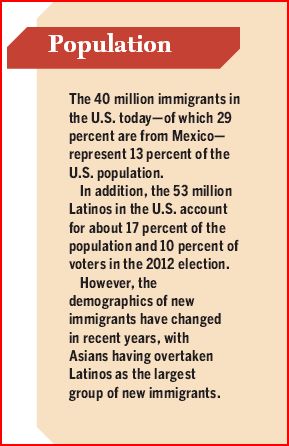
Population:  The 40 million immigrants in the U.S. today—of which 29 percent are from Mexico— represent 13 percent of the U.S. population.

In addition, the 53 million Latinos in the U.S. account for about 17 percent of the population and 10 percent of voters in the 2012 election.

However, the demographics of new immigrants have changed in recent years, with Asians having overtaken Latinos as the largest group of new immigrants.

Did you know?
Google, Procter & Gamble, Kraft, Colgate Palmolive, Pfizer, and eBay are among companies with immigrant founders.

Did you know?
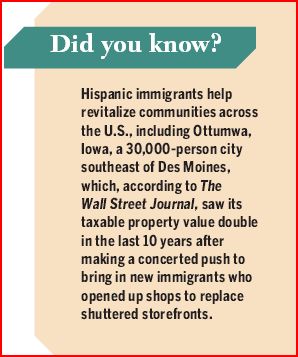
Hispanic immigrants help revitalize communities across the U.S., including Ottumwa, Iowa, a 30,000-person city southeast of Des Moines, which, according to The Wall Street Journal, saw its taxable property value double in the last 10 years after making a concerted push to bring in new immigrants who opened up shops to replace shuttered storefronts.

Endnotes

1.  Robert H. Fairlie, “Open for Business: How Immigrants are Driving Small Business Creation in the United States,” Partnership for a New American Economy, August 2011. http://www.renewoureconomy.org/sites/all/themes/pnae/openforbusiness.pdf

2.  Fiscal Policy Institute, “Immigrant Small Business Owners: A Significant and Growing Part of the Economy,” June 2012. http://fiscalpolicy.org/immigrant-small-business-owners-FPI-20120614.pdf

3.  Ibid.

4.  Partnership for a New American Economy, “The ‘New American’ Fortune 500,” June 2011.  http://www.renewoureconomy.org/sites/all/themes/pnae/img/new-american-fortune-500-june-2011.pdf

5.  Raúl Hinojosa-Ojeda, “Raising the Floor for American Workers: The Economic Benefits of Comprehensive Immigration Reform,” Center for American Progress, January 2010.

6.  Madeline Zavodny, “Immigration and American Jobs,” American Enterprise Institute for Public Policy Research and the Partnership for a New American Economy, December 2011. http://www.renewoureconomy.org/sites/all/themes/pnae/img/NAE_Im-AmerJobs.pdf

7.  Juan Carlos Guzmán and Raúl C. Jara, “The Economic Benefits of Passing the Dream Act,” Center for American Progress and Partnership for a New American Economy, October 2012.  http://www.americanprogress.org/issues/immigration/report/2012/09/30/39567/the-economic-benefits-of-passing-the-dream-act/

8.  James P. Smith & Barry Edmonston, eds., The New Americans: Economic, Demographic, and Fiscal Effects of Immigration (Washington, DC: National Research Council, National Academy of Sciences Press, 1997), 220, 353.

9.  Immigration Policy Center, “Unauthorized Immigrants Pay Taxes, Too,” April 2011.  http://www.immigrationpolicy.org/just-facts/unauthorized-immigrants-pay-taxes-too

10.  Patricia Cortes, “The Effect of Low-Skilled Immigration on US Prices: Evidence from CPI Data,” 381-422.

11.  Immigration Policy Center, “The Future of a Generation: How New Americans Will Help Suppport Retiring Baby Boomers,” February 2012. http://www.immigrationpolicy.org/just-facts/future-generation-how-new-americans-will-help-support-retiring-baby-boomers

12.  Ibid.

13.  Dowell Myers, Immigrants and Boomers: Forging a New Social Contract for America (New York: Russell Sage Foundation, 2007).

14.  Robert H. Fairlie, “Immigrant Entrepreneurs and Small Business Owners, and their Access to Financial Capital,” Small Business Administration, May 2012.

15.  The World Bank, “Mexico Overview,” 2013. http://www.worldbank.org/en/country/mexico/overview

16.  Pew Hispanic Center, “A Nation of Immigrants: A Portrait of the 40 Million, Including 11 Million Unauthorized,” January 2013. http://www.pewhispanic.org/files/2013/01/statistical_portrait_final_jan_29.pdf

More: 


Insta-Millard: Nevada’s Constitution doesn’t favor Cliven Bundy

April 15, 2014

It’s a relic of the Civil War and Congress’s intention to strengthen the Union when Nevada became a state in 1864, but there it is, in Section 2 of the Nevada Constitution, making a mockery of Cliven Bundy’s claim to owe allegiance to Nevada and its Constitution, but not to the U.S.:

Sec: 2.  Purpose of government; paramount allegiance to United States.  All political power is inherent in the people[.] Government is instituted for the protection, security and benefit of the people; and they have the right to alter or reform the same whenever the public good may require it. But the Paramount Allegiance of every citizen is due to the Federal Government in the exercise of all its Constitutional powers as the same have been or may be defined by the Supreme Court of the United States; and no power exists in the people of this or any other State of the Federal Union to dissolve their connection therewith or perform any act tending to impair[,] subvert, or resist the Supreme Authority of the government of the United States. The Constitution of the United States confers full power on the Federal Government to maintain and Perpetuate its existance [existence], and whensoever any portion of the States, or people thereof attempt to secede from the Federal Union, or forcibly resist the Execution of its laws, the Federal Government may, by warrant of the Constitution, employ armed force in compelling obedience to its Authority.

Sheesh!

Here’s the essay quiz, students:  The standoff between the Bureau of Land Management cowboys — each of whom swore an oath to uphold and defend the Constitution of the U.S., in contrast to Mr. Bundy who claims to owe no allegiance to the U.S. — and the armed mob who threatened to kill those same employees of our U.S. government:  Did Nevadans  (or Idahoans) violate any part of Section 2 of the Nevada Constitution?  Which clauses?

I used to say “the Sagebrush Rebellion is over; sagebrush won.”  Even the sagebrush are losing this one.

From The Atlantic:  Eric Parker, who lives in central Idaho, aims his weapon from a bridge as protesters gather by the Bureau of Land Management's base camp in Bunkerville, Nevada. (Jim Urquhart/Reuters)

From The Atlantic: Eric Parker, who lives in central Idaho, aims his weapon from a bridge as protesters gather by the Bureau of Land Management’s base camp in Bunkerville, Nevada. (Jim Urquhart/Reuters)  (See also Article III, Section 3 of the U.S. Constitution, with regard to Mr. Parker’s actions here.)

More: 


Insta-Millard: Bundy Ranch issue history

April 14, 2014

It’s an oversimplification, but not an oversimplification that leads to inaccuracy.

I say “oversimplification” because President Reagan did not impose grazing fees for the first time, but instead set rates at the time.  U.S. grazing fees grew out of the 1934 Taylor Grazing Act, which included among other noble purposes the saving of unoccupied public lands from erosion, to prevent them from contributing to a national Dust Bowl.  The Bureau of Land Management (BLM) manages about 245 million acres of land in the U.S., highly concentrated in 13 western states (about 86% of Nevada is public lands of one sort or another).  Of those lands, about 155 million acres are open to grazing.  BLM is part of the U.S. Department of Interior.  Reagan’s Executive Order came when the law authorizing grazing fees had expired, and Congress was at an impasse in passing a new one, partly over a Reagan Administration proposal to raise grazing fees to market value, a multiple of fees then (and now) in effect.

Sagebrush Rebellion catches Tea Party Stupid disease, it seems to me.  If the virus hasn’t been cured since 1993, what are the odds Mr. Bundy will sit still for a cure now?

More to come?

More:

Mad City Quanta, a Nebraska on-line comic, on grazing fees issues in 2012.

Mad City Quanta, a Nebraska on-line comic, on grazing fees issues in 2012. To update it, substitute “Bundy” for “Fischer” on the tie of the steer on the left.


“Years of Living Dangerously” – April 13 premiere of climate change information series

April 11, 2014

Will it work this time?  Can it recharge the effort Al Gore started?

Monte Best of Plainview, Texas, explains to Don Cheadle how the Texas drought caused the Cargill Company to close its meat packing plant in the city.

Monte Best of Plainview, Texas, explains to Don Cheadle how the Texas drought caused the Cargill Company to close its meat packing plant in the city. “Act of God,” many local people say.

Here’s the trailer:

The avid promotional explanation:

Published on Mar 14, 2014

Don’t miss the documentary series premiere of Years of Living Dangerously, Sunday, April 13th at 10PM ET/PT.

Subscribe to the Years of Living Dangerously channel for more clips:
http://s.sho.com/YearsYouTube

Official site: http://www.sho.com/yearsoflivingdange…
The Years Project: http://yearsoflivingdangerously.com/
Follow: https://twitter.com/YEARSofLIVING
Like: https://www.facebook.com/YearsOfLiving
Watch on Showtime Anytime: http://s.sho.com/1hoirn4
Don’t Have Showtime? Order Now: http://s.sho.com/P0DCVU

It’s the biggest story of our time. Hollywood’s brightest stars and today’s most respected journalists explore the issues of climate change and bring you intimate accounts of triumph and tragedy. YEARS OF LIVING DANGEROUSLY takes you directly to the heart of the matter in this awe-inspiring and cinematic documentary series event from Executive Producers James Cameron, Jerry Weintraub and Arnold Schwarzenegger.

More: 


Joseph Keppler’s cartoon on why we need the 17th Amendment

April 4, 2014

[Welcome, University of Houston students reading here for History 1306, American History after 1877. Please leave a comment on whether you find this entry useful, and other questions you may have.]

This is the cartoon:

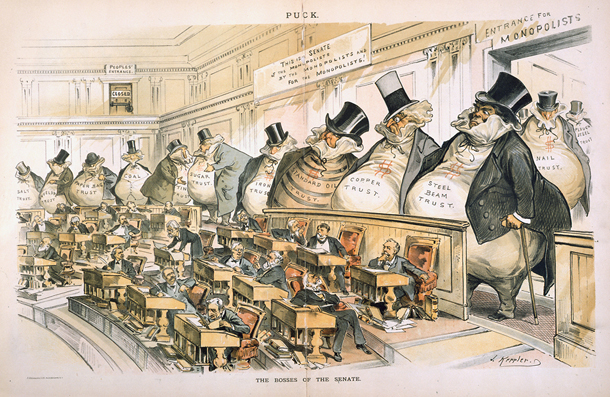
“The Bosses of the Senate,” by J. Ottmann Lith. Co. after Joseph Keppler Puck Lithograph, colored, 1889-01-23 From the collection of the U.S. Senate

One of my old high school classmates, Shaun McCausland, ran for the U.S. Senate in Utah in 2012, on the Constitution Party ticket.  Nice kid, I felt an obligation to pay attention to what he was trying to do, even with his running against my old boss, Orrin Hatch.

I was surprised to find in his campaign materials he e-mailed me, a call for the repeal of the 17th Amendment.

What?  That’s the amendment that gives us direct election of U.S. senators, instead of letting the state legislatures select them.   Why repeal?

Shaun sent along an explanation, from Constitution Party materials, as I recall, claiming that the 17th Amendment was a “power grab” by industry and other oligarchist groups, to take power from the states.  It was a move towards corruption, the material explained.

Seriously?  People think that today?

History takes a different view.

Prior to the 17th Amendment, state legislatures selected the U.S. senators.  Big corporate interests — the monopolists — figured this out in spades, and proceeded to buy state legislatures, thereby getting the right to name their friends to the U.S. Senate, in the perfect picture of a corrupt bargain (the charge originally aimed at the supposed deal between John Quincy Adams and Daniel Webster Henry Clay, in which it was alleged Webster Clay got the House of Representatives to name Adams president, and Webster Clay was in turn appointed Secretary of State, the president-in-waiting post of that day).

Look at the cartoon.  You’ll see the fat “bosses” sitting around the back of the senate chamber labeled, “Copper Trust,” “Steel Trust,” “Oil Trust,” and so on.

Consider Montana, Utah and Arizona.  In each of those states, huge copper mines were among the leading businesses.  The domes of the Arizona and Utah capitol buildings are capped with copper, in honor of the leading role the ore and mineral played in early state history.

Who got elected to the state legislatures in those states?  Copper company-approved and -supported candidates won.

So, who was elected to the U.S. Senate, by the state legislatures?  Copper company-approved senators.

In 1913, when Arizona joined the union, one could make a case that copper controlled at least 6 senators out of 96.

And so it was for other trusts, in other states — or a mixture of trusts in some states. Think of the trusts of the time — the copper trust, the steel trust, the steel beam trust, the nail trust, the coal trust, and many others.

The rich guys ruled.

While this system technically violated no laws in those campaign-contribution-limit-free days, it clearly affected legislation.  The Progressive Movement arose as a grassroots movement, from farmers and laborers, from downtrodden immigrants, from the prairies, mines and mills.  When enough people got involved, they could out vote the trusts in a few things — but it still took more than a quarter century to change the election process for the U.S. Senate, to keep the corruption out.

Politics of the times from 1900 to 1920 were complex, and can be oversimplified easily.  Running that risk, let us note that by the time Woodrow Wilson took over the White House, reformers were maneuvering to fix problems in lots of areas, sometimes with great overreaches like the 18th Amendment and Prohibition, but also with long-needed reforms, and reforms headed in the right direction but not strongly or fast enough, like the creation of the Federal Reserve.

The 17th Amendment was intended to get corruption out of the U.S. Senate, especially the senator selection process.  Instead of leaving the selection in the hands of corporation-captive state legislatures, the 17th Amendment expanded democracy, making the selection of U.S. senators a choice of the people of the state, at the ballot box.

Keppler’s cartoon, originally published in Punch Magazine, tells the story in one panel.  It shows the U.S. Senate — very astute historians may be able to pick out and identify particular senators — with the chief door labeled “Monopolists’ Entrance.”  Coming through the door, and lining the back of the Senate, are the “Bosses of the Senate,” moneybags with legs, or in one case an oil barrel with legs, and with the name of the trust written across the front of their nattily-dressed girths.

The senators turn to their bosses, awaiting instruction.

Inscribed on the wall at the back of the chamber is a twisted rendition of Lincoln’s stirring description of the government intended by the Constitution:  “This is the Senate of the Monopolists by the Monopolists and for the Monopolists!” (Compare Keppler’s cartoon drawings of the U.S. Senate Chamber with photographs and drawings, if you can find them.)

There is a door to the galleries of the Senate, labeled “The Peoples’ Entrance.”  It is barred, bolted and nailed shut, keeping out the American people.

Keppler’s cartoon was published January 23, 1889.  Earlier reform attempts failed, in 1828, 1829 and 1855. Progressives including William Jennings Bryan, George Frisbie Hoar and Elihu Root pushed for reform in the 1890s.  By 1910, some 31 states had passed resolutions asking for reform; some of them initiated direct primary elections, though that didn’t generally affect the selections by the legislatures.  Partly to avoid a states-led convention to amend the Constitution, which could easily run rogue, critics feared, Congress took up the issue.  Congress passed the amendment, submitting it to the states on May 13, 1912.  By April 18, 1913, three-fourths of the states had ratified the proposal, and it was declared the 17th Amendment.  Ironically, by that time Bryan had assumed the office of Secretary of State, and it fell to him to proclaim the amendment adopted on May 31, 2013.

The fat cats lost.

Please remember that.

More:

Another cartoon, by Spencer, for the Omaha (Nebraska) World, poking fun at the time required to get the 17th Amendment; from the U.S. National Archives, collected by Robert C. Byrd, Senate Majority Leader:

Cartoon portraying the time needed to pass the 17th Amendment allowing the direct election of U.S. senators By Spencer, for the Omaha World Herald, 1912 Reproduced from Robert C. Byrd, The Senate, 1789­1989

Cartoon portraying the time needed to pass the 17th Amendment allowing the direct election of U.S. senators By Spencer, for the Omaha World Herald, 1912 Reproduced from Robert C. Byrd, The Senate, 1789­1989

Nota Bene: Oh, to have a good copy editor. Clay, not Webster. How many years, how many thousand readers, before anyone read it as it was, and not as we expected it to be?

Save

Save


Yogi Berra and ObamaCare

April 2, 2014

Cartoon from Tom Toles at the Washington Post, April 2, 2014:

“ObamaCare: Nobody goes there. It’s too crowded.” Tom Toles in the Washington Post, April 2, 2014.

Why you need to know a little history to get good jokes:

Yogi Berra is famous for his sayings, some of which sound foolish at first, but which generally pack a lot of wisdom or sharp observation.

Berra grew up in St. Louis, which has many famous restaurants.  On some occasion, someone suggested the group should go eat at Ruggeri’s, and Yogi’s reply became famous:

On why he no longer went to Ruggeri’s, a St. Louis restaurant: “Nobody goes there anymore. It’s too crowded.”


Still have questions on Obamacare? Here’s the answer site (and a poll)

March 22, 2014

Here.  NPR is our most trusted news organization, and it has answers to specific questions and a collection of great stories on the entire law.

Is that a coincidence, or did they plan it that way?

Your Questions About The Affordable Care Act

By Danny DeBelius, Christopher Groskopf, Jessica Pupovac, Matt Stiles, Christopher Swope and Julie Rovner

NPR’s guide to the dozens of common questions about the new health care law known as Obamacare. Did we miss something? Send us your questions, and read our latest news stories on the issue.

Questions on the Affordable Care Act? Answers all over. Click the picture to go to the New York Daily News FAQ on the law, and how it affects you.

Questions on the Affordable Care Act? Answers all over. Click the picture to go to the New York Daily News FAQ on the law, and how it affects you.

Wait a minute, you say: “I want answers to questions, not just news stories.”

Yeah, they know:

Find Answers To Common Questions

What are the basics of the law?

Am I eligible?

How do I enroll?

How do the exchanges work?

Get the picture?  Click over there and start learning.

Then, when you’ve changed yoru health care plan (if you change it), come back here and answer this poll.  It should go without saying that you can answer the poll now if you’re not going to change.  Please answer only once.

The Millard Fillmore’s Bathtub Poll – Affordable Care Act


Can dog whistle politics keep the GOP in power, or is America too smart to stay enthralled?

March 2, 2014

Especially if, by some grotesque misunderstanding, you don’t think you’re in the 47% Mitt Romney wrote off as undeserving of a vote and a life, you ought to listen to Ian Haney López describe what’s going on in GOP and conservative politics.

From Bill Moyers.

Transcript here.

Cover of Ian Haney Lopez's Dog Whistle Politics, How coded racial appeals reinvented racism and wrecked the middle class; Oxford Books

Cover of Ian Haney Lopez’s Dog Whistle Politics, How coded racial appeals reinvented racism and wrecked the middle class; Oxford Books

Moyers’s website describes this interview:

Ian Haney López on the Dog Whistle Politics of Race

February 28, 2014

What do Cadillac-driving “welfare queens,” a “food stamp president” and the “lazy, dependent and entitled” 47 percent tell us about post-racial America? They’re all examples of a type of coded racism that this week’s guest, Ian Haney López, writes about in his new book, Dog Whistle Politics.

Haney López is an expert in how racism has evolved in America since the civil rights era. Over the past 50 years, politicians have mastered the use of dog whistles – code words that turn Americans against each other while turning the country over to plutocrats. This political tactic, says Haney López, is “the dark magic” by which middle-class voters have been seduced to vote against their own economic interests.

“It comes out of a desire to win votes. And in that sense… It’s racism as a strategy. It’s cold, it’s calculating, it’s considered,” Haney López tells Bill, “it’s the decision to achieve one’s own ends, here winning votes, by stirring racial animosity.”

Ian Haney López, a professor of law at the University of California, Berkeley, is a senior fellow at the policy analysis and advocacy group, Demos.

Producer: Candace White. Segment Producer: Robert Booth. Editor: Sikay Tang.

Does revealing the existence of dog whistles help kill the cheap trick?  My fear is that those who hear the whistle clearly understand that they are responding to a racist call, and that is why they respond.  Exposing the racism, or exposing the subtle use of racism, only makes the politicians who use the whistle more appealing to those voter segments, and those policies more appealing to those voters (though they would not admit it).

If you think dog whistles don’t exist, consider the hot controversies surrounding education spending, vouchers to kill public schools, immigration reform needed to boost our economy, or health care reform.  Consider also the birther movement.

After hearing Mr. Haney López’s interview, what do you think?

More: 


North Korea: A hole in the fabric of the 21st century

February 25, 2014

Here’s a photograph of one of the greatest, and longest-running tragedies of our time.

No, that’s not a stretch of water in the red circle.  That’s North Korea, at night, blacked out by a lack of electrical lights.

Tweetpic from the Washington Post: North Korea looks like a sea of misery in this photo from space http://wapo.st/1c1B84q  via @KnowMoreWP pic.twitter.com/nB3g8fa63Q

Tweetpic from the Washington Post: North Korea looks like a sea of misery in this photo from space http://wapo.st/1c1B84q via @KnowMoreWP pic.twitter.com/nB3g8fa63Q

It’s a photo from the International Space Station taken in January.

The KnowMore blog from the Post describes the tragedy, and points to even more disturbing stories:

North Korea appears as nothing more than a shadow in the above photograph, taken at night aboard the International Space Station last month. South Korea’s eastern coastline is indistinguishable from the demilitarized zone along the border with the North, as though the Sea of Japan flowed into the Yellow Sea and Pyongyang were an island in a strait separating South Korea from China.

North Korea’s interior is nearly invisible from orbit at night, just as what happens inside the country on a day-to-day basis is largely invisible to the outside world. U.N. investigators managed to shine a little light into North Korea’s darkest corners last month.  [Click here to get to the U.N. report]

I’ve used similar photos in class.  It’s a powerful exercise.  North Korea is as dark as undeveloped and largely unpopulated areas of the Congo River Basin, the Australian Outback, the Arabian Peninsula’s “Empty Quarter,” and almost as dark as Antarctica.

No doubt stargazing is good in some of those dark spots in North Korea.  This is one case where the absence of light pollution does NOT indicate good planning, but instead an amazing paucity of rational development.


Carbon dioxide(CO²) emissions since 1820, Rosling visualization

February 23, 2014

Monthly average atmospheric carbon dioxide concentration at Mauna Loa Observatory, Hawaii (CDIAC)

Monthly average atmospheric carbon dioxide concentration at Mauna Loa Observatory, Hawaii (CDIAC)

Gee, while we’re exploring Hans Rosling‘s and Gapminder’s videos at Vimeo, let’s take a look at the animated chart showing CO² emissions since 1820.

Anything we can learn there?

What did we learn?

  • CO² emissions from humans rose a lot after the start of the industrial revolution
  • When nations industrialize, CO² output rises dramatically (But, what’s with Brunei? Flaring of oil wells?)

What else?

More:

Use this quiz to introduce subjects such as global health, the effects of HIV, population growth and carbon dioxide emissions, or as starting point to discuss what development is. What do the indicators in these quizzes say about the world?

Gapminder quiz on global development: “About the Quiz/Teacher’s guide Use this quiz to introduce subjects such as global health, the effects of HIV, population growth and carbon dioxide emissions, or as starting point to discuss what development is. What do the indicators in these quizzes say about the world?”


February 18, 1885: Twain’s novel Huck Finn, published in the U.S.

February 18, 2014

Today is the 129th anniversary of the U.S. publication of Mark Twain’s Adventures of Huckleberry Finn, another installment in the novelization with great embellishment of the childhood of Samuel Clemens in Hannibal, Missouri, before the Civil War.  Earlier installments included The Adventures of Tom Sawyer.  

Cover and binding of the first edition of Mark Twain's The Adventures of Huckleberry Finn. Wikipedia image

Cover and binding of the first edition of Mark Twain’s The Adventures of Huckleberry Finn. Mark Twain was the pen name of Samuel L. Clemens. Wikipedia image

It is THE great American novel. It is the novel in which America faces its coming-of-age, in the metaphysical ramblings of a 13-year-old boy in the dark, on a raft in the Mississippi River, with an escaped slave who is a good friend, and has saved his life. Huck Finn confronts reality: Should he do what the preachers say to do, or should he do the moral thing instead?

America, most of it, grew up with that realization, coming even as it did, a generation after the Emancipation Proclamation.

In a good school, one probably unaffected by the damage done to learning by George Bush’s “No Child Left Behind Act,” nor more recent purges of quality in the classroom such as “value-added teaching,” “Racing to the Top,” or Common Core State Standards or the folderol conservative backlash against education in general, Tom Sawyer is often a child’s introduction to Twain, and to book-length literature.

In my youth, Tom Sawyer was so popular with teachers, and reading aloud by teachers was considered such a great idea, I think I heard the book three times. I know Mrs. Eva Hedberg, in my third grade class in Burley, Idaho, read parts of it.  My recollection is that Mrs. Elizabeth Driggs and Mr. Herbert Gilbert both read it to us, in fourth and fifth grade, in Pleasant Grove, Utah.  (There were other books; I think I heard five of the Laura Ingalls Wilder books between those three teachers.  Reading was golden to them. Mrs. Hedberg even gave me credit for reading encyclopedia, cover to cover, with each letter of the alphabet counted as a book. Our World Book volume for the letter S had disappeared; I’ve never been good at snakes.)

Twain once remarked that he didn’t think a youth could read the Bible and ever draw a clean, fresh breath of air again.  Tom Sawyer can similarly haunt the life of a person, though generally to higher moral standards.

I had hoped they’d continue to The Adventures of Huckleberry Finn.  When they didn’t, I borrowed it from the Pleasant Grove Junior High Library and read it through.  I read it in the middle of the modern civil rights struggle, between 1963’s horrors and the Voting Rights Act of 1965, just as our Vietnam tragedy was really ramping up.

Wait. I remember Mr. Gilbert being stopped by a question on Huck’s father, Pap. This was in Deep Mormonia, in Utah County. Pap drank a bit. Well, that’s not accurate. Pap drank to excess, often. Most of my fellow students had no knowledge of the drinking of alcohol. Their parents didn’t drink, not in front of the children if they did, since imbibing alcohol was a violation of the LDS Church’s Word of Wisdom, a commandment that they treat their bodies as temples, not as amusement parks.  That bodily purity rule put alcohol, tobacco and caffeine off-limits. Most of the parents simply didn’t drink. It would have put sugar off-limits, too, had there been enough sugar to abuse as late-20th century America did. Also, there was the issue of the LDS Church having significant holdings in the U & I Sugar Company (Utah and Idaho), which made sugar from beets, and blessed the church with a significant stream of income, from the Coca-Cola bottlers alone. But I digress.

Maybe we did hear some of Huck Finn.  I didn’t hear all of it — mumps, or something.  And I checked it out on my own later.

One line jumped out at me from the start.  It is a powerful lesson in government and democracy.

In the course of the novel, Huck falls in with a couple of crooks, the Duke and the King.  They make their swindles in land deals on lands to which they don’t have title.

In Chapter XXVI (26), Huck accompanies the two swindlers to an orphanage of sorts.  The duke and the king decide to sell the orphanage, and leave town before their purchasers discover the sales are frauds.  Early on in their hustings they collect a bag of gold. Then Huck sits down to dinner with one of the girls at the place, and he meets a few others who all treat him rather kindly, and in the course of an hour or two he begins to have second thoughts, fearing for the fate of the orphans.

Meanwhile with investments coming in so fast, the duke and the king ponder leaving town earlier than planned, with at least the bag of gold, fearing they might be discovered.   In the course of their conversation, overheard by Huck hiding in the room, the king works to convince the duke that most of the town’s people remain bamboozled:

Well, the king he talked him blind; so at last he give in, and said all right, but said he believed it was blamed foolishness to stay, and that doctor hanging over them.  But the king says:

“Cuss the doctor!  What do we k’yer for him?  Hain’t we got all the fools in town on our side?  And ain’t that a big enough majority in any town?”

Savor that one, and let it sink in for a bit. “Hain’t we got all the fools in town on our side? And ain’t that a big enough majority in any town?”

James Madison and Thomas Jefferson trafficked in democratic institutions at a metaphysical level, understanding men were no angels, as Madison put it, but with a bit of education a people should be able to rule themselves as well as, or better than, a tiny elite, even if that elite were educated.  But they understood at the wholesale political level that a check was necessary on the people; in 1822 Madison defended free public education in a letter:

A popular Government, without popular information, or the means of acquiring it, is but a Prologue to a Farce or a Tragedy; or perhaps both.  Knowledge will forever govern ignorance.  And a people who mean to be their own governours, must arm themselves with the power which knowledge gives.

In Huck Finn, just over a half-century later, Twain was writing about applied politics, the theory, not the hypothesis, on a retail level.  Without education for the masses, the group who cynically bamboozles for money or power wins once they’ve got every fool in town on their side.

We have a political system that is more subject to corruption due to lack of education than lack of money.

To an honest politician, this is a huge burden.  You won the election?  You got the vote of every fool in town?  Then it’s up to you to act wisely, despite their foolishness.  Robert Redford’s character in “The Candidate” pulls an upset win in a U.S. Senate race — the film closes with the candidate, rather scared, sitting down with the party-provided campaign advisor, and asking in all earnestness:  “What do we do now?”

Happy anniversary, Huck Finn.  Perhaps we should fly the flag today in honor of the publication of the book.  We would fly it a bit nervously, perhaps.

Illustration by E. W. Kemble,  from The Adventures of Huckleberry Finn

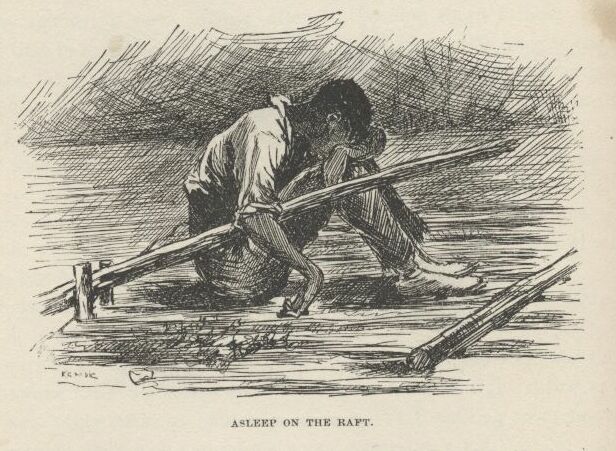
“Asleep on the raft” — Illustration by E. W. Kemble, from The Adventures of Huckleberry Finn

Twain himself hired E. W. Kemble to illustrate the first edition.

Save


Lincoln and Darwin, born hours apart, February 12, 1809

February 12, 2014

Is it an unprecedented coincidence?  205 years ago today, just minutes apart according to unconfirmed accounts, Abraham Lincoln was born in a rude log cabin on Nolin Creek, in Kentucky, and Charles Darwin was born into a wealthy family at the family home  in Shrewsbury, England.

Gutzon Borglums 1908 bust of Abraham Lincoln in the Crypt of the U.S. Capitol - AOC photo

Gutzon Borglum’s 1908 bust of Abraham Lincoln in the Crypt of the U.S. Capitol – Architect of the Capitol photo

Lincoln would become one of our most endeared presidents, though endearment would come after his assassination.  Lincoln’s bust rides the crest of Mt. Rushmore (next to two slaveholders), with George Washington, the Father of His Country, Thomas Jefferson, the author of the Declaration of Independence, and Theodore Roosevelt, the man who made the modern presidency, and the only man ever to have won both a Congressional Medal of Honor and a Nobel Prize, the only president to have won the Medal of Honor.  In his effort to keep the Union together, Lincoln freed the slaves of the states in rebellion during the civil war, becoming an icon to freedom and human rights for all history.  Upon his death the entire nation mourned; his funeral procession from Washington, D.C., to his tomb in Springfield, Illinois, stopped twelve times along the way for full funeral services.  Lying in state in the Illinois House of Representatives, beneath a two-times lifesize portrait of George Washington, a banner proclaimed, “Washington the Father, Lincoln the Savior.”

Charles Darwin statue, Natural History Museum, London - NHM photo

Charles Darwin statue, Natural History Museum, London – NHM photo

Darwin would become one of the greatest scientists of all time.  He would be credited with discovering the theory of evolution by natural and sexual selection.  His meticulous footnoting and careful observations formed the data for ground-breaking papers in geology (the creation of coral atolls), zoology (barnacles, and the expression of emotions in animals and man), botany (climbing vines and insectivorous plants), ecology (worms and leaf mould), and travel (the voyage of H.M.S. Beagle).  At his death he was honored with a state funeral, attended by the great scientists and statesmen of London in his day.  Hymns were specially written for the occasion.  Darwin is interred in Westminster Abbey near Sir Isaac Newton, England’s other great scientist, who knocked God out of the heavens.

Lincoln would be known as the man who saved the Union of the United States and set the standard for civil and human rights, vindicating the religious beliefs of many and challenging the beliefs of many more.  Darwin’s theory would become one of the greatest ideas of western civilization, changing forever all the sciences, and especially agriculture, animal husbandry, and the rest of biology, while also provoking crises in religious sects.

Lincoln, the politician known for freeing the slaves, also was the first U.S. president to formally consult with scientists, calling on the National Science Foundation (whose creation he oversaw) to advise his administration.  Darwin, the scientist, advocated that his family put the weight of its fortune behind the effort to abolish slavery in the British Empire.  Each held an interest in the other’s disciplines.

Both men were catapulted to fame in 1858. Lincoln’s notoriety came from a series of debates on the nation’s dealing with slavery, in his losing campaign against Stephen A. Douglas to represent Illinois in the U.S. Senate.  On the fame of that campaign, he won the nomination to the presidency of the fledgling Republican Party in 1860.  Darwin was spurred to publicly reveal his ideas about the power of natural and sexual selection as the force behind evolution, in a paper co-authored by Alfred Russel Wallace, presented to the Linnean Society in London on July 1, 1858.   On the strength of that paper, barely noticed at the time, Darwin published his most famous work, On the Origin of Species, in November 1859.

The two men might have got along well, but they never met.

What unusual coincidences.

Go celebrate human rights, good science, and the stories about these men.

A school kid could do much worse than to study the history of these two great men.  In fact, we study them far too little, it seems to me.

Resources:

Charles Darwin:

Abraham Lincoln:

More:

Anybody know what hour of the day either of these men was born?

This is mostly an encore post.

Yes, you may fly your flag today for Lincoln’s birthday; the official holiday, Washington’s Birthday, is next Monday, February 17th — and yes, it’s usually called “President’s Day” by merchants and calendar makers.


Pat Bagley: Corporate slavery, or “Misreporting the ACA”

February 7, 2014

Congressional Budget Office (CBO) figures show as many as 2 million Americans might quit jobs they don’t like, and go chase their dreams, because now they can get health insurance under the Affordable Care Act (ObamaCare).

Conservatives, and more than a few news organizations, misreported the study to say, as they claim, that the ACA will require the firings of 2 million people.

You can read the CBO report here, and draw your own inferences (make them reasonable, please); but Pat Bagley, the master cartoonist at the Salt Lake Tribune, put it in picture form.  Several panels in this cartoon, each telling no fewer than a thousand words.

Pat Bagley's cartoon from the Salt Lake Tribune, on reports that the ACA would enable workers to quit jobs they keep solely to keep health care benefits.

Pat Bagley’s cartoon from the Salt Lake Tribune, on reports that the ACA would enable workers to quit jobs they keep solely to keep health care benefits.

This is why the GOP doesn’t like ACA, you know. It really does give average citizens some choice.  Freedom to choose NOT to feed the profit-gouging machines of the friends of the GOP threatens the GOP much more than did Americans drinking coffee instead of tea, in 1773.

Bagley’s cartoon is more than picture-perfect. It’s truthful.


Would we let terrorists poison our water, if they promised jobs?

February 4, 2014

Great, potent question.

What do you think?

And, where did that photo come from?

Protester in West Virginia:  "Would we let terrorists poison our water supply, if they said it created jobs?"  Photographer unidentified; so is protester.

Protester in West Virginia: “Would we let terrorists poison our water supply, if they said it created jobs?” Photographer unidentified; so is protester.

Keep your eye on West Virginia.

Here’s why:  Do you know what factories may lie upstream from your drinking water, and do you know how they are regulated?  Is the regulation done well?

More:


President Barack Obama’s State of the Union 2014 – full transcript

January 29, 2014

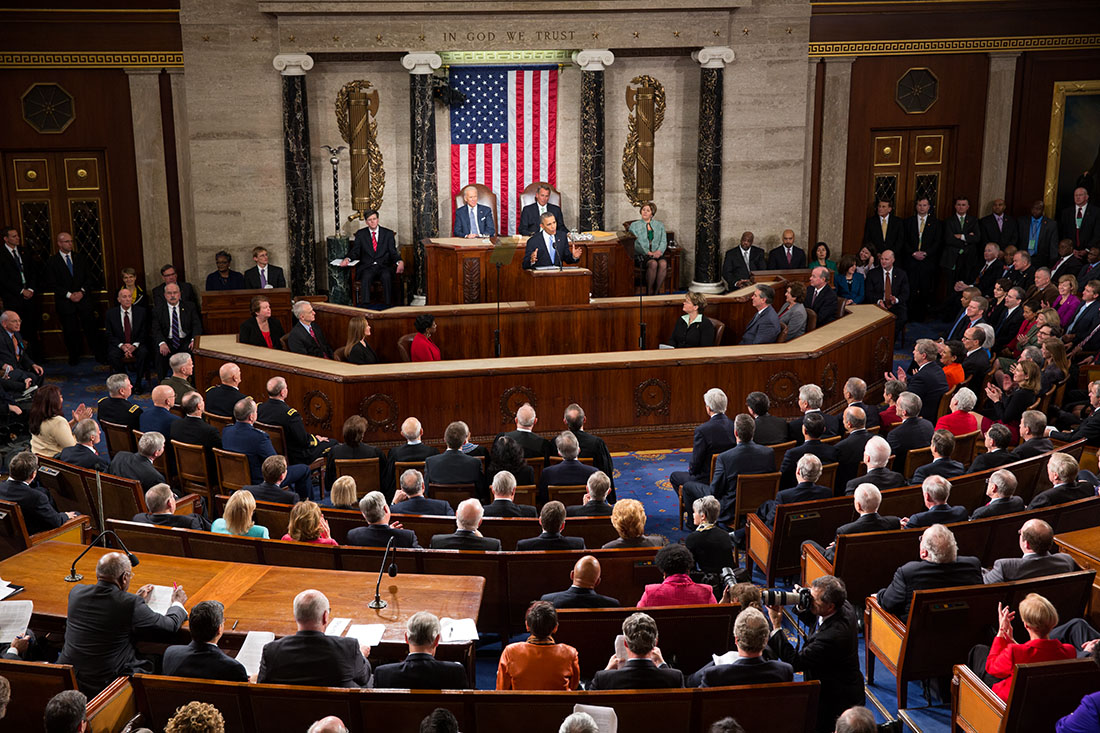
Obama and Washington wait for the State of the Union -  White House caption: President Barack Obama reviews his speech one last time while waiting in a room at the U.S. Capitol prior to delivering the State of the Union address in the House Chamber in Washington, D.C., Jan. 28, 2014. (Official White House Photo by Pete Souza)
Obama and Washington wait for the State of the Union – White House caption: President Barack Obama reviews his speech one last time while waiting in a room at the U.S. Capitol prior to delivering the State of the Union address in the House Chamber in Washington, D.C., Jan. 28, 2014. (Official White House Photo by Pete Souza)

From the Federal News Service, via Washington Post:

Published: January 28

President Obama delivered his 2014 State of the Union address on Jan. 28, 2014, at the U.S. Capitol in Washington. Transcript courtesy of Federal News Service.

PRESIDENT OBAMA: Thank you. (Applause.) Thank you so much. Thank you. Thank you. (Applause.) Thank you so much.

Mr. Speaker, Mr. Vice President, members of Congress, my fellow Americans, today in America, a teacher spent extra time with a student who needed it and did her part to lift America’s graduation rate to its highest levels in more than three decades.

White House caption:  President Barack Obama delivers the State of the Union address in the House Chamber at the U.S. Capitol in Washington, D.C., Jan. 28, 2014. (Official White House Photo by Amanda Lucidon)
White House caption: President Barack Obama delivers the State of the Union address in the House Chamber at the U.S. Capitol in Washington, D.C., Jan. 28, 2014. (Official White House Photo by Amanda Lucidon)

An entrepreneur flipped on the lights in her tech startup and did her part to add to the more than 8 million new jobs our businesses have created over the past four years. (Applause.)

An autoworker fine-tuned some of the best, most fuel-efficient cars in the world and did his part to help America wean itself off foreign oil.

A farmer prepared for the spring after the strongest five-year stretch of farm exports in our history.

A rural doctor gave a young child the first prescription to treat asthma that his mother could afford. (Applause.) A man took the bus home from the graveyard shift, bone-tired but dreaming big dreams for his son. And in tight-knit communities all across America, fathers and mothers will tuck in their kids, put an arm around their spouse, remember fallen comrades and give thanks for being home from a war that after twelve long years is finally coming to an end. (Applause.)

Tonight this chamber speaks with one voice to the people we represent: It is you, our citizens, who make the state of our union strong. (Applause.)

And here are the results of your efforts: the lowest unemployment rate in over five years; a rebounding housing market — (applause) — a manufacturing sector that’s adding jobs for the first time since the 1990s — (applause) — more oil produced — more oil produced at home than we buy from the rest of the world, the first time that’s happened in nearly twenty years — (applause) — our deficits cut by more than half; and for the first time — (applause) — for the first time in over a decade, business leaders around the world have declared that China is no longer the world’s number one place to invest; America is.

(Cheers, applause.) That’s why I believe this can be a breakthrough year for America. After five years of grit and determined effort, the United States is better-positioned for the 21st century than any other nation on Earth.

The question for everyone in this chamber, running through every decision we make this year, is whether we are going to help or hinder this progress. For several years now, this town has been consumed by a rancorous argument over the proper size of the federal government. It’s an important debate — one that dates back to our very founding. But when that debate prevents us from carrying out even the most basic functions of our democracy — when our differences shut down government or threaten the full faith and credit of the United States — then we are not doing right by the American people. (Cheers, applause.)

Now, as president, I’m committed to making Washington work better, and rebuilding the trust of the people who sent us here. And I believe most of you are, too. Last month, thanks to the work of Democrats and Republicans,Congress finally produced a budget that undoes some of last year’s severe cuts to priorities like education. Nobody got everything they wanted, and we can still do more to invest in this country’s future while bringing down our deficit in a balanced way.

But the budget compromise should leave us freer to focus on creating new jobs, not creating new crises.

[Complete Enhanced Video Transcript]

And in the coming months — (applause) — in the coming months, let’s see where else we can make progress together. Let’s make this a year of action. That’s what most Americans want, for all of us in this chamber to focus on their lives, their hopes, their aspirations. And what I believe unites the people of this nation, regardless of race or region or party, young or old, rich or poor, is the simple, profound belief in opportunity for all, the notion that if you work hard and take responsibility, you can get ahead in America. (Applause.)

Now, let’s face it: That belief has suffered some serious blows. Over more than three decades, even before the Great Recession hit, massive shifts in technology and global competition had eliminated a lot of good, middle-class jobs, and weakened the economic foundations that families depend on.

Today, after four years of economic growth, corporate profits and stock prices have rarely been higher, and those at the top have never done better. But average wages have barely budged. Inequality has deepened. Upward mobility has stalled. The cold, hard fact is that even in the midst of recovery, too many Americans are working more than ever just to get by; let alone to get ahead. And too many still aren’t working at all.

So our job is to reverse these trends.

It won’t happen right away, and we won’t agree on everything.

But what I offer tonight is a set of concrete, practical proposals to speed up growth, strengthen the middle class and build new ladders of opportunity into the middle class. Some require congressional action, and I’m eager to work with all of you. But America does not stand still, and neither will I. (Applause.) So wherever and whenever I can take steps without legislation to expand opportunity for more American families, that’s what I’m going to do. (Cheers, applause.)

As usual, our first lady sets a good example. Michelle’s — (applause) — well. (Chuckles.) (Cheers, applause.) Yeah. Michelle’s Let’s Move! partnership with schools, businesses, local leaders has helped bring down childhood obesity rates for the first time in thirty years, and that’s an achievement — (applause) — that will improve lives and reduce health care costs for decades to come. The Joining Forces alliance that Michelle and Jill Biden launched has already encouraged employers to hire or train nearly 400,000 veterans and military spouses. (Applause.)

Taking a page from that playbook, the White House just organized a College Opportunity Summit, where already 150 universities, businesses, nonprofits have made concrete commitments to reduce inequality in access to higher education and to help every hardworking kid go to college and succeed when they get to campus.

And across the country — (applause) — we’re partnering with mayors, governors and state legislatures on issues from homelessness to marriage equality.

The point is, there are millions of Americans outside Washington who are tired of stale political arguments and are moving this country forward. They believe, and I believe, that here in America, our success should depend not on accident of birth but the strength of our work ethic and the scope of our dreams. That’s what drew our forebears here. It’s how the daughter of a factory worker is CEO of America’s largest automaker — (applause) — how the son of a barkeeper is speaker of the House — (cheers, applause) — how the son of a single mom can be president of the greatest nation on Earth. (Cheers, applause.)

Now — (sustained cheers and applause) — opportunity is who we are. And the defining project of our generation must be to restore that promise.

We know where to start. The best measure of opportunity is access to a good job. With the economy picking up speed, companies say they intend to hire more people this year.

And over half of big manufacturers say they’re thinking of insourcing jobs from abroad. (Applause.)

So let’s make that decision easier for more companies. Both Democrats and Republicans have argued that our tax code is riddled with wasteful, complicated loopholes that punish businesses investing here, and reward companies that keep profits abroad. Let’s flip that equation. Let’s work together to close those loopholes, end those incentives to ship jobs overseas, and lower tax rates for businesses that create jobs right here at home. (Cheers, applause.)

Moreover, we can take the money we save from this transition to tax reform to create jobs rebuilding our roads, upgrading our ports, unclogging our commutes — because in today’s global economy, first- class jobs gravitate to first-class infrastructure. We’ll need Congress to protect more than 3 million jobs by finishing transportation and waterways bills this summer. (Cheers, applause.) That can happen.

But — but I’ll act on my own to slash bureaucracy and streamline the permitting process for key projects, so we can get more construction workers on the job as fast as possible. (Applause.)

We also have the chance, right now, to beat other countries in the race for the next wave of high-tech manufacturing jobs. And my administration’s launched two hubs for high-tech manufacturing in Raleigh, North Carolina, and Youngstown, Ohio, where we’ve connected businesses to research universities that can help America lead the world in advanced technologies.

Tonight, I’m announcing we’ll launch six more this year. Bipartisan bills in both houses could double the number of these hubs and the jobs they create. So, get those bills to my desk and put more Americans back to work. (Applause.)

Let’s do more to help the entrepreneurs and small business owners who create most new jobs in America. Over the past five years, my administration has made more loans to small business owners than any other. And when 98 percent of our exporters are small businesses, new trade partnerships with Europe and the Asia-Pacific will help them create even more jobs. We need to work together on tools like bipartisan trade promotion authority to protect our workers, protect our environment and open new markets to new goods stamped “Made in the USA.” (Applause.)

Listen, China and Europe aren’t standing on the sidelines; and neither — neither should we. We know that the nation that goes all-in on innovation today will own the global economy tomorrow. This is an edge America cannot surrender. Federally-funded research helped lead to the ideas and inventions behind Google and smartphones. And that’s why Congress should undo the damage done by last year’s cuts to basic research so we can unleash the next great American discovery. (Cheers, applause.)

There are entire industries to be built based on vaccines that stay ahead of drug-resistant bacteria or paper-thin material that’s stronger than steel. And let’s pass a patent reform bill that allows our businesses to stay focused on innovation, not costly and needless litigation. (Applause.)

Now, one of the biggest factors in bringing more jobs back is our commitment to American energy. The “all the above” energy strategy I announced a few years ago is working, and today America is closer to energy independence than we have been in decades. (Applause.)

One of the reasons why is natural gas. If extracted safely, it’s the bridge fuel that can power our economy with less of the carbon pollution that causes climate change. (Applause.) Businesses plan to invest almost a hundred billion dollars in new factories that use natural gas. I’ll cut red tape to help states get those factories built and put folks to work, and this Congress can help by putting people to work building fueling stations that shift more cars and trucks from foreign oil to American natural gas. (Applause.)

Meanwhile, my administration will keep working with the industry to sustain production and jobs growth while strengthening protection of our air, our water, our communities. And while we’re at it, I’ll use my authority to protect more of our pristine federal lands for future generations. (Applause.)

Now, it’s not just oil and natural gas production that’s booming; we’re becoming a global leader in solar too.

Every four minutes another American home or business goes solar, every panel pounded into place by a worker whose job can’t be outsourced. Let’s continue that progress with a smarter tax policy that stops giving $4 billion a year to fossil fuel industries that don’t need it so we can invest more in fuels of the future that do. (Cheers, applause.)

And even as we’ve increased energy production, we’ve partnered with businesses, builders and local communities to reduce the energy we consume. When we rescued our automakers, for example, we worked with them to set higher fuel efficiency standards for our cars. In the coming months I’ll build on that success by setting new standards for our trucks so we can keep driving down oil imports and what we pay at the pump.

And taken together, our energy policy is creating jobs and leading to a cleaner, safer planet. Over the past eight years the United States has reduced our total carbon pollution more than any other nation on Earth. (Applause.)

But we have to act with more urgency because a changing climate is already harming western communities struggling with drought and coastal cities dealing with floods. That’s why I directed my administration to work with states, utilities and others to set new standards on the amount of carbon pollution our power plants are allowed to dump into the air.

The shift — (applause) — the shift to a cleaner energy economy won’t happen overnight, and it will require some tough choices along the way.

But the debate is settled. Climate change is a fact. (Applause.) And when our children’s children look us in the eye and ask if we did all we could to leave them a safer, more stable world, with new sources of energy, I want us to be able to say yes, we did. (Cheers, applause.)

Finally, if we’re serious about economic growth, it is time to heed the call of business leaders, labor leaders, faith leaders, law enforcement — and fix our broken immigration system. (Cheers, applause.) Republicans and Democrats in the Senate have acted, and I know that members of both parties in the House want to do the same. Independent economists say immigration reform will grow our economy and shrink our deficits by almost $1 trillion in the next two decades. And for good reason: When people come here to fulfill their dreams — to study, invent, contribute to our culture — they make our country a more attractive place for businesses to locate and create jobs for everybody. So let’s get immigration reform done this year. (Cheers, applause.) Let’s get it done. It’s time.

The ideas I’ve outlined so far can speed up growth and create more jobs. But in this rapidly-changing economy, we have to make sure that every American has the skills to fill those jobs.

The good news is, we know how to do it. Two years ago, as the auto industry came roaring back, Andra Rush opened up a manufacturing firm in Detroit. She knew that Ford needed parts for the best-selling truck in America, and she knew how to make those parts. She just needed the workforce. So she dialed up what we call an American Job Center; places where folks can walk in to get the help or training they need to find a new job, or a better job. She was flooded with new workers, and today, Detroit Manufacturing Systems has more than 700 employees. And what Andra and her employees experienced is how it should be for every employer and every job seeker.

So tonight, I’ve asked Vice President Biden to lead an across- the-board reform of America’s training programs to make sure they have one mission: train Americans with the skills employers need, and match them to good jobs that need to be filled right now. (Cheers, applause.) That means more on-the-job training, and more apprenticeships that set a young worker on an upward trajectory for life. It means connecting companies to community colleges that can help design training to fill their specific needs. And if Congress wants to help, you can concentrate funding on proven programs that connect more ready-to-work Americans with ready-to-be-filled jobs.

I’m also convinced we can help Americans return to the workforce faster by reforming unemployment insurance so that it’s more effective in today’s economy. But first, this Congress needs to restore the unemployment insurance you just let expire for 1.6 million people. (Cheers, applause.)

Let me tell you why.

Misty DeMars is a mother of two young boys. She’d been steadily employed since she was a teenager, put herself through college. She’d never collected unemployment benefits, but she’s been paying taxes.

In May, she and her husband used their life savings to buy their first home. A week later, budget cuts claimed the job she loved. Last month, when their unemployment insurance was cut off, she sat down and wrote me a letter, the kind I get every day. “We are the face of the unemployment crisis,” she wrote. “I’m not dependent on the government. Our country depends on people like us who build careers, contribute to society, care about our neighbors. I am confident that in time I will find a job, I will pay my taxes, and we will raise our children in their own home in the community we love. Please give us this chance.”

Congress, give these hardworking, responsible Americans that chance. (Cheers, applause.) Give them that chance. Give them the chance. They need our help right now, but more important, this country needs them in the game. That’s why I’ve been asking CEOs to give more long-term unemployed workers a fair shot at new jobs, a new chance to support their families. And in fact, this week many will come to the White House to make that commitment real.

Tonight I ask every business leader in America to join us and do the same because we are stronger when America fields a full team. (Applause.)

Of course, it’s not enough to train today’s workforce. We also have to prepare tomorrow’s workforce, by guaranteeing every child access to a world-class education. (Applause.)

Estiven Rodriguez couldn’t speak a word of English when he moved to New York City at age 9. But last month, thanks to the support of great teachers and an innovative tutoring program, he led a march of his classmates through a crowd of cheering parents and neighbors from their high school to the post office, where they mailed off their college applications. And this son of a factory worker just found out he’s going to college this fall. (Applause.)

Five years ago we set out to change the odds for all our kids. We worked with lenders to reform student loans, and today more young people are earning college degrees than ever before. Race to the Top, with the help of governors from both parties, has helped states raise expectations and performance. Teachers and principals in schools from Tennessee to Washington, D.C., are making big strides in preparing students with the skills for the new economy — problem solving, critical thinking, science, technology, engineering, math.

Now, some of this change is hard.

It requires everything from more challenging curriculums and more demanding parents to better support for teachers and new ways to measure how well our kids think, not how well they can fill in a bubble on a test. But it is worth it — and it is working.

The problem is we’re still not reaching enough kids, and we’re not reaching them in time, and that has to change.

Research shows that one of the best investments we can make in a child’s life is high-quality early education. (Applause.) Last year, I asked this Congress to help states make high-quality pre-K available to every 4-year-old. And as a parent as well as a president, I repeat that request tonight.

But in the meantime, 30 states have raised pre-k funding on their own. They know we can’t wait. So just as we worked with states to reform our schools, this year we’ll invest in new partnerships with states and communities across the country in a race to the top for our youngest children. And as Congress decides what it’s going to do, I’m going to pull together a coalition of elected officials, business leaders, and philanthropists willing to help more kids access the high-quality pre-K that they need. (Applause.) It is right for America. We need to get this done.

Last year, I also pledged to connect 99 percent of our students to high-speed broadband over the next four years. Tonight I can announce that with the support of the FCC and companies like Apple, Microsoft, Sprint, and Verizon, we’ve got a down payment to start connecting more than 15,000 schools and 20 million students over the next two years, without adding a dime to the deficit. (Cheers, applause.)

We’re working to redesign high schools and partner them with colleges and employers that offer the real-world education and hands-on training that can lead directly to a job and career. We’re shaking up our system of higher education to give parents more information and colleges more incentives to offer better value, so that no middle- class kid is priced out of a college education. We’re offering millions the opportunity to cap their monthly student loan payments to 10 percent of their income, and I want to work with Congress to see how we can help even more Americans who feel trapped by student loan debt. (Applause.)

And I’m reaching out to some of America’s leading foundations and corporations on a new initiative to help more young men of color facing especially tough odds stay on track and reach their full potential.

The bottom line is, Michelle and I want every child to have the same chance this country gave us. But we know our opportunity agenda won’t be complete, and too many young people entering the workforce today will see the American Dream as an empty promise, unless we also do more to make sure our economy honors the dignity of work, and hard work pays off for every single American.

You know, today, women make up about half our workforce, but they still make 77 cents for every dollar a man earns. That is wrong, and in 2014, it’s an embarrassment.

Women deserve equal pay for equal work. (Cheers, applause.)

You know, she deserves to have a baby without sacrificing her job. (Cheers, applause.) A mother deserves a day off to care for a sick child or sick parent without running into hardship. (Applause.) And you know what, a father does too. It is time to do away with workplace policies that belong in a “Mad Men” episode. (Laughter, cheers, applause.) This year let’s all come together, Congress, the White House, businesses from Wall Street to Main Street, to give every woman the opportunity she deserves, because I believe when women succeed, America succeeds. (Cheers, applause.)

Now, women hold a majority of lower-wage jobs, but they’re not the only ones stifled by stagnant wages. Americans understand that some people will earn more money than others, and we don’t resent those who, by virtue of their efforts, achieve incredible success. That’s what America’s all about. But Americans overwhelmingly agree that no one who works full-time should ever have to raise a family in poverty. (Applause.)

In the year since I asked this Congress to raise the minimum wage, five states have passed laws to raise theirs.

Many businesses have done it on their own. Nick Chute is here today with his boss, John Soranno. John’s an owner of Punch Pizza in Minneapolis, and Nick helps make the dough. (Laughter.) Only now he makes more of it. (Laughter.) John just gave his employees a raise to 10 bucks an hour, and that’s a decision that has eased their financial stress and boosted their morale.

Tonight I ask more of America’s business leaders to follow John’s lead. Do what you can to raise your employees’ wages. (Applause.) It’s good for the economy; it’s good for America. (Sustained applause.)

To every mayor, governor, state legislator in America, I say, you don’t have to wait for Congress to act; Americans will support you if you take this on. And as a chief executive, I intend to lead by example. Profitable corporations like Costco see higher wages as the smart way to boost productivity and reduce turnover. We should too. In the coming weeks I will issue an executive order requiring federal contractors to pay their federally-funded employees a fair wage of at least $10.10 an hour because if you cook — (cheers, applause) — our troops’ meals or wash their dishes, you should not have to live in poverty. (Sustained applause.)

Of course, to reach millions more, Congress does need to get on board.

Today the federal minimum wage is worth about twenty percent less than it was when Ronald Reagan first stood here. And Tom Harkin and George Miller have a bill to fix that by lifting the minimum wage to $10.10. It’s easy to remember: 10.10. This will help families. It will give businesses customers with more money to spend. It does not involve any new bureaucratic program. So join the rest of the country. Say yes. Give America a raise. (Cheers, applause.) Give ’em a raise.

There are other steps we can take to help families make ends meet, and few are more effective at reducing inequality and helping families pull themselves up through hard work than the Earned Income Tax Credit. Right now, it helps about half of all parents at some point. Think about that. It helps about half of all parents in America at some point in their lives.

But I agree with Republicans like Senator Rubio that it doesn’t do enough for single workers who don’t have kids. So let’s work together to strengthen the credit, reward work, help more Americans get ahead.

Let’s do more to help Americans save for retirement. Today most workers don’t have a pension. A Social Security check often isn’t enough on its own. And while the stock market has doubled over the last five years, that doesn’t help folks who don’t have 401(k)s. That’s why tomorrow I will direct the Treasury to create a new way for working Americans to start their own retirement savings: MyRA. It’s a — it’s a new savings bond that encourages folks to build a nest egg.

MyRA guarantees a decent return with no risk of losing what you put in. And if this Congress wants to help, work with me to fix an upside-down tax code that gives big tax breaks to help the wealthy save, but does little or nothing for middle-class Americans, offer every American access to an automatic IRA on the job, so they can save at work just like everybody in this chamber can.

And since the most important investment many families make is their home, send me legislation that protects taxpayers from footing the bill for a housing crisis ever again, and keeps the dream of homeownership alive for future generations. (Applause.)

One last point on financial security. For decades, few things exposed hard-working families to economic hardship more than a broken health care system. And in case you haven’t heard, we’re in the process of fixing that. (Scattered laughter, applause.)

Now — a pre-existing condition used to mean that someone like Amanda Shelley, a physician’s assistant and single mom from Arizona, couldn’t get health insurance. But on January 1st, she got covered. (Applause.) On January 3rd, she felt a sharp pain. On January 6th, she had emergency surgery. Just one week earlier, Amanda said, that surgery would’ve meant bankruptcy. That’s what health insurance reform is all about, the peace of mind that if misfortune strikes, you don’t have to lose everything.

Already, because of the Affordable Care Act, more than 3 million Americans under age 26 have gained coverage under their parents’ plans. (Applause.)

More than 9 million Americans have signed up for private health insurance or Medicaid coverage — 9 million. (Applause.)

And here’s another number: zero. Because of this law, no American, none, zero, can ever again be dropped or denied coverage for a pre-existing condition like asthma or back pain or cancer. (Cheers, applause.) No woman can ever be charged more just because she’s a woman. (Cheers, applause.) And we did all this while adding years to Medicare’s finances, keeping Medicare premiums flat and lowering prescription costs for millions of seniors.

Now, I do not expect to convince my Republican friends on the merits of this law. (Laughter.) (Chuckles.) (Laughter.) But I know that the American people are not interested in refighting old battles. So again, if you have specific plans to cut costs, cover more people, increase choice, tell America what you’d do differently. Let’s see if the numbers add up. (Applause.) But let’s not have another 40- something votes to repeal a law that’s already helping millions of Americans like Amanda.

(Cheers, applause.) The first 40 were plenty. We all owe it to the American people to say what we’re for, not just what we’re against.

And if you want to know the real impact this law is having, just talk to Governor Steve Beshear of Kentucky, who’s here tonight. Now, Kentucky’s not the most liberal part of the country. That’s not where I got my highest vote totals. (Laughter.) But he’s like a man possessed when it comes to covering his commonwealth’s families. They’re our neighbors and our friends, he said. They’re people we shop and go to church with — farmers out on the tractor, grocery clerks. They’re people who go to work every morning praying they don’t get sick. No one deserves to live that way.

Steve’s right. That’s why tonight I ask every American who knows someone without health insurance to help them get covered by March 31st. Help them get covered. (Applause.) Moms, get on your kids to sign up. Kids, call your mom and walk her through the application. It’ll give her some peace of mind, and plus, she’ll appreciate hearing from you. (Laughter.)

After all, that — that’s the spirit that has always moved this nation forward.

It’s the spirit of citizenship, the recognition that through hard work and responsibility, we can pursue our individual dreams, but still come together as one American family to make sure the next generation can pursue its dreams as well.

Citizenship means standing up for everyone’s right to vote. (Applause.) Last year, part of the Voting Rights Act was weakened, but conservative Republicans and liberal Democrats are working together to strengthen it. And the bipartisan commission I appointed, chaired by my campaign lawyer and Governor Romney’s campaign lawyer, came together and have offered reforms so that no one has to wait more than a half hour to vote. Let’s support these efforts. It should be the power of our vote, not the size of our bank account, that drives our democracy. (Cheers, applause.)

Citizenship means standing up for the lives that gun violence steals from us each day. I have seen the courage of parents, students, pastors, and police officers all over this country who say “we are not afraid,” and I intend to keep trying, with or without Congress, to help stop more tragedies from visiting innocent Americans in our movie theaters and our shopping malls, or schools like Sandy Hook. (Applause.)

Citizenship demands a sense of common purpose; participation in the hard work of self-government; an obligation to serve to our communities.

And I know this chamber agrees that few Americans give more to their country than our diplomats and the men and women of the United States armed forces. (Extended applause.) Thank you.

Tonight, because of the extraordinary troops and civilians who risk and lay down their lives to keep us free, the United States is more secure. When I took office, nearly 180,000 Americans were serving in Iraq and Afghanistan. Today, all our troops are out of Iraq. More than 60,000 of our troops have already come home from Afghanistan. With Afghan forces now in the lead for their own security, our troops have moved to a support role. Together with our allies, we will complete our mission there by the end of this year, and America’s longest war will finally be over. (Applause.)

After 2014, we will support a unified Afghanistan as it takes responsibility for its own future.

If the Afghan government signs a security agreement that we have negotiated, a small force of Americans could remain in Afghanistan with NATO allies to carry out two narrow missions: training and assisting Afghan forces and counterterrorism operations to pursue any remnants of al-Qaida. For while our relationship with Afghanistan will change, one thing will not: our resolve that terrorists do not launch attacks against our country. (Applause.)

The fact is that danger remains. While we’ve put al-Qaida’s core leadership on a path to defeat, the threat has evolved as al-Qaida affiliates and other extremists take root in different parts of the world. In Yemen, Somalia, Iraq, Mali, we have to keep working with partners to disrupt and disable these networks. In Syria, we’ll support the opposition that rejects the agenda of terrorist networks. Here at home, we’ll keep strengthening our defenses and combat new threats like cyberattacks. And as we reform our defense budget, we have to keep faith with our men and women in uniform and invest in the capabilities they need to succeed in future missions. (Applause.)

We have to remain vigilant.

But I strongly believe our leadership and our security cannot depend on our outstanding military alone. As commander in chief, I have used force when needed to protect the American people, and I will never hesitate to do so as long as I hold this office. But I will not send our troops into harm’s way unless it is truly necessary, nor will I allow our sons and daughters to be mired in open-ended conflicts. We must fight the battles — (applause) — that need to be fought, not those that terrorists prefer from us — large-scale deployments that drain our strength and may ultimately feed extremism.

So even as we actively and aggressively pursue terrorist networks, through more targeted efforts and by building the capacity of our foreign partners, America must move off a permanent war footing. (Applause.) That’s why I’ve imposed prudent limits on the use of drones, for we will not be safer if people abroad believe we strike within their countries without regard for the consequence.

That’s why, working with this Congress, I will reform our surveillance programs because the vital work of our intelligence community depends on public confidence, here and abroad, that privacy of ordinary people is not being violated. (Applause.) And with the Afghan war ending, this needs to be the year Congress lifts the remaining restrictions on detainee transfers and we close the prison at Guantanamo Bay — (applause) — because we counter terrorism not just through intelligence and military action but by remaining true to our constitutional ideals and setting an example for the rest of the world.

You see, in a world of complex threats, our security, our leadership depends on all elements of our power — including strong and principled diplomacy. American diplomacy has rallied more than 50 countries to prevent nuclear materials from falling into the wrong hands, and allowed us to reduce our own reliance on Cold War stockpiles.

American diplomacy, backed by the threat of force, is why Syria’s chemical weapons are being eliminated. (Applause.) And we will continue to work with the international community to usher in the future the Syrian people deserve — a future free of dictatorship, terror and fear.

As we speak, American diplomacy is supporting Israelis and Palestinians as they engage in the difficult but necessary talks to end the conflict there; to achieve dignity and an independent state for Palestinians, and lasting peace and security for the state of Israel — a Jewish state that knows America will always be at their side. (Applause.)

And it is American diplomacy, backed by pressure, that has halted the progress of Iran’s nuclear program — and rolled back parts of that program — for the very first time in a decade. As we gather here tonight, Iran has begun to eliminate its stockpile of higher levels of enriched uranium.

It’s not installing advanced centrifuges. Unprecedented inspections help the world verify every day that Iran is not building a bomb. And with our allies and partners, we’re engaged in negotiations to see if we can peacefully achieve a goal we all share: preventing Iran from obtaining a nuclear weapon. (Applause.)

These negotiations will be difficult; they may not succeed. We are clear-eyed about Iran’s support for terrorist organizations like Hezbollah, which threaten our allies; and we’re clear about the mistrust between our nations, mistrust that cannot be wished away. But these negotiations don’t rely on trust; any long-term deal we agree to must be based on verifiable action that convinces us and the international community that Iran is not building a nuclear bomb. If John F. Kennedy and Ronald Reagan could negotiate with the Soviet Union, then surely a strong and confident America can negotiate with less powerful adversaries today. (Applause.)

The sanctions that we put in place helped make this opportunity possible. But let me be clear: if this Congress sends me a new sanctions bill now that threatens to derail these talks, I will veto it. (Applause.) For the sake of our national security, we must give diplomacy a chance to succeed.

(Applause.) If Iran’s leaders do not seize this opportunity, then I will be the first to call for more sanctions and stand ready to exercise all options to make sure Iran does not build a nuclear weapon. But if Iran’s leaders do seize the chance — and we’ll know soon enough — then Iran could take an important step to rejoin the community of nations, and we will have resolved one of the leading security challenges of our time without the risks of war.

And finally, let’s remember that our leadership is defined not just by our defense against threats but by the enormous opportunities to do good and promote understanding around the globe, to forge greater cooperation, to expand new markets, to free people from fear and want. And no one is better positioned to take advantage of those opportunities than America.

Our alliance with Europe remains the strongest the world has ever known. From Tunisia to Burma, we’re supporting those who are willing to do the hard work of building democracy. In Ukraine, we stand for the principle that all people have the right to express themselves freely and peacefully and to have a say in their country’s future. Across Africa, we’re bringing together businesses and governments to double access to electricity and help end extreme poverty. In the Americas, we’re building new ties of commerce, but we’re also expanding cultural and educational exchanges among young people.

And we will continue to focus on the Asia-Pacific, where we support our allies, shape a future of greater security and prosperity and extend a hand to those devastated by disaster, as we did in the Philippines, when our Marines and civilians rushed to aid those battered by a typhoon, and were greeted with words like, “We will never forget your kindness” and “God bless America.”

We do these things because they help promote our long-term security. And we do them because we believe in the inherent dignity and equality of every human being, regardless of race or religion, creed or sexual orientation. And next week the world will see one expression of that commitment when Team USA marches the red, white and blue into the Olympic stadium and brings home the gold. (Cheers, applause.)

My fellow Americans, no other country in the world does what we do. On every issue, the world turns to us, not simply because of the size of our economy or our military might but because of the ideals we stand for and the burdens we bear to advance them.

No one knows this better than those who serve in uniform. As this time of war draws to a close, a new generation of heroes returns to civilian life. We’ll keep slashing that backlog so our veterans receive the benefits they’ve earned and our wounded warriors receive the health care — including the mental health care — that they need. (Applause.) We’ll keep working to help all our veterans translate their skills and leadership into jobs here at home, and we will all continue to join forces to honor and support our remarkable military families.

Let me tell you about one of those families I’ve come to know.

I first met Cory Remsburg, a proud Army Ranger, at Omaha Beach on the 65th anniversary of D-Day. Along with some of his fellow Rangers, he walked me through the program, the ceremony. He was a strong, impressive young man, had an easy manner. He was sharp as a tack. And we joked around, and took pictures, and I told him to stay in touch.

A few months later, on his 10th deployment, Cory was nearly killed by a massive roadside bomb in Afghanistan. His comrades found him in a canal, face down, underwater, shrapnel in his brain.

For months, he lay in a coma. And the next time I met him, in the hospital, he couldn’t speak; he could barely move. Over the years, he’s endured dozens of surgeries and procedures, hours of grueling rehab every day.

Even now, Cory is still blind in one eye. He still struggles on his left side. But slowly, steadily, with the support of caregivers like his dad Craig, and the community around him, Cory has grown stronger. Day by day, he’s learned to speak again and stand again and walk again, and he’s working toward the day when he can serve his country again.

“My recovery has not been easy,” he says. “Nothing in life that’s worth anything is easy.”

Cory is here tonight. And like the Army he loves, like the America he serves, Sergeant First Class Cory Remsburg never gives up, and he does not quit. (Cheers, applause.) Cory. (Extended cheers and applause.)

My fellow Americans — my fellow Americans, men and women like Cory remind us that America has never come easy. Our freedom, our democracy, has never been easy. Sometimes we stumble; we make mistakes; we get frustrated or discouraged.

But for more than two hundred years, we have put those things aside and placed our collective shoulder to the wheel of progress: to create and build and expand the possibilities of individual achievement; to free other nations from tyranny and fear; to promote justice and fairness and equality under the law, so that the words set to paper by our founders are made real for every citizen.

The America we want for our kids — a rising America where honest work is plentiful and communities are strong; where prosperity is widely shared and opportunity for all lets us go as far as our dreams and toil will take us — none of it is easy. But if we work together; if we summon what is best in us, the way Cory summoned what is best in him, with our feet planted firmly in today but our eyes cast towards tomorrow, I know it’s within our reach.

Believe it.

God bless you, and God bless the United States of America. (Cheers, applause.)