DFH were right

March 19, 2009

Some guy who goes by Joeyess seems to be the one who put this together — wrote the song?  Performed?

Call it sequencing.  Students often ask — at least once a week — whether I was a hippie.  They figure that’s a possibility since I don’t like much of the rock of the ’80s, and they don’t know much history of the ’50s and ’60s.  They don’t believe me when I tell them I thought college was a better idea.  They look confused when I tell them I was a plainclothes hippie.

Noodling around the radio dial the other day, I wondered how an antiwar movement could work with ClearChannel running so much of the radio formats, and none of the formats being exactly friendly to the slightest political commentary.

So, take a look. Tell us what you think in comments.

Political folk music in the Internet Age, Pete Seeger channeled through Lawrence Lessig (profanity in lyric makes it NSFW, NSFC, alas):

Tip of the old scrub brush to Pharyngula.


69 years ago, diplomacy failed

September 3, 2008

There were other good things to note on Labor Day 2008, and schools were out anyway.

Remember that September 1, 1939, Adolf Hitler’s soldiers crossed into Poland, claiming that Poland had somehow threatened Germany’s security.

And so began World War II in Europe.  Read about it in the coverage from the New York Times, then.

Front page of the New York Times, Sept. 1, 1939

Front page of the New York Times, Sept. 1, 1939

Europeans have not forgotten.  So we might understand why Europe gets jumpy when a big nation’s army rolls across the borders of a smaller nation, claiming the smaller nation provoked them.


Rick Warren and George Washington

August 17, 2008

At American Creation, Tom Van Dyke looks at the questions paster Rick Warren asked Sen. John McCain and Sen. Barack Obama, with an eye to history.

George Washington probably would have flunked the test, had he been on the dais yesterday, Van Dyke notes.

Santayana’s Ghost shifts nervously.

Washington Bible - image from the Masonic Library and Museum

"Washington Bible" - image from the Masonic Library and Museum


No one believes it. Is it so?

August 9, 2008

One of the great mysteries of history is how an entire nation of people can follow a leader into tragedy — a stupid war, economic morass, cultural suicide, genocide, or other tragedy — without appearing to notice they were going against their national values, against reason, against morality.

I wonder if part of the answer can be found by studying the way our brains perceive things, in particular, the way our brains force us to see things that are not so.

Some things are just so unbelievable, our brains tell us we’re seeing something different, something more believable. Here are two examples, the Charlie Chaplin mask illusion, and the Einstein mask illusion.

Chaplin — you know it’s concave, but the nose sticks out every time:

Einstein — is Big Brother really watching you? What do your eyes say?

Here’s a nasty little kicker: Even when most people know that it’s an illusion, they can’t perceive the illusion-in-action; as Paul Simon wrote, “Still a man sees what he wants to see and he disregards the rest.” See Stephen Fry’s discussion about the illusion from BBC2:

Historical applications

  • CIA chief William Colby was involved in Operation Phoenix during the Vietnam War. When investigations revealed that the operation involved torture, many people refused to believe the U.S. would be involved in torture (good!). And even after he admitted to Congressional committees that he had personally authorized the torture, people had difficulty believing it. David Wise wrote an article about Operation Phoenix for the New York Times Magazine, July 1, 1973: “Not one of Colby’s friends or neighbors, or even his critics on the Hill, would, in their wildest imagination, conceive of Bill Colby attaching electric wires to a man’s genitals and personally turning the crank. “Not Bill Colby… He’s a Princeton man.'”
  • “[T]he Russians are finished. They have nothing left to throw against us,” a confident Adolf Hitler told Gen. Franz Halder in July 1941. Russia mired down the German army, making the phrase “the Eastern Front” a dreaded death sentence in German commands. In the end, it was the Soviet Army that first got to Berlin, and captured Hitler’s command bunker where der Führer had committed suicide a short time before. Adding to the historic irony, twice over: First, Stalin refused to believe his intelligence service reports that the Nazis were massing on the border of Russia, just two years after the Molotov-Ribbentrop Pact, which pledged neither nation would invade the other. Second, Hitler’s generals had studied Napoleon’s invasion of Russia in 1812, working to avoid all the mistakes Napoleon made. So sure were the Nazis of their superiority to Napoleon in every way, they invaded Russia on the anniversary of Napoleon’s invasion, June 22, 1941. Great shades of Santayana’s Ghost!
  • Bush administration historians will wonder why Bush was able to do what he did, in the Iraq war and other situations foreign and domestic, with even members of his own party who saw him close up believing he’d do something different. See this story by Ron Susskind, “Faith, Certainty and the Presidency of George Bush,” New York Times Magazine, October 17, 2004.
  • The Gulf of Tonkin Resolution, based on an incident in the Gulf of Tonkin near Vietnam.  (See also documents from the National Security Agency archives.)
  • Weapons of Mass Destruction in Iraq.

Richard Feynman discussed at length how scientists know their experimental results are accurate, and how to keep science honest. He pointed out that most of the time, errors creep in at the start, and some people just refuse to believe they exist. It is easiest to fool ourselves, Feynman said — and so a good scientist understands that, and protects against self-deception. If only other disciplines could adopt that philosophy, strategy and tactics!

Faith can get us through troubled times, but often gets us into troubled times in the first place.

Do you have other examples of self-delusion by illusionary means?

Tip of the old scrub brush to Vous Pensez.


Irony: Celebrate Solzhenitsyn, not his ideas

August 5, 2008

In the old, old movie, from the H. G. Wells story, “Things to Come,” the forces of scientific good (led by Raymond Massey) use a gas to knock out warring parties, to stop the shooting, and to give the good guys a chance to disarm disputants and set things right.

1936 movie poster for Things to Come - WikiMedia image

1936 movie poster for "Things to Come" - WikiMedia image

That was fictional. The “Gas of Peace” doesn’t exist.

The sniping will continue about P. Z. Myers’ complaint that some Catholics grossly over reacted when they threatened death to a fellow who didn’t swallow his wafer at communion, and then kept the wafer (not a hostage — the wafer has been returned), and a lot of the sniping will come from Rod Dreher at the Dallas Morning News.

Did anyone else note the irony of Dreher’s comments commending the ideas of the late Alexander Solzhenitsyn, who campaigned his entire life against authoritative oppression of freedom and enforcement of ideas against all good and common sense, while at the same time railing against Myers’ similar campaign?

Santayana’s Ghost needs to do more active haunting. We can’t excuse tyranny from a church, nor tyranny from any government in the United States of America, either. Freedom typically works better when the freedom to offend is greater than the privilege of being free from being offended. Why doesn’t Dreher see that?

More resources:


Legacy of 1968: USS Pueblo still shadows North Korean relations

June 29, 2008

It’s clear that U.S. relations with North Korea (the Peoples Republic of Korea, or PRK) still suffer from institutional memories of the USS Pueblo incident. For both sides the Pueblo incident remains a sore point from 1968, a very trying year for the U.S. anyway.

PRK was scheduled to detail its nuclear activities in a report last Thursday when I started pondering this issue — part of the continuing negotiations to close down nuclear weapons production in PRK. PRK hoped to get off the U.S. list of “terrorist nations.

Al Jazeera featured this story, below, in September 2007. In addition to footage of the Pueblo, still illegally held by PRK, and used as tourist site and propaganda opportunity, the piece explores the effects of the incident on more recent events, the negotiations to de-nuclearize the Korean Peninsula.

And now we know the rest of the story. PRK delivered the report; Bush announced the nation would be taken off the list of supporters of terrorism.  (Report below from CBS News)

PRK destroyed the cooling towers to their offensive reactor.

And now we’re right back where we were in 1995. Eight years of Bush’s work pushed us backwards 13 years.  Partial compliance by PRK, but the bomb-building project is on hold.

Nuclear non-proliferation mades some strides this last week. Still I can’t help the feeling that January 21, 2009, cannot arrive quickly enough.

Remember the Pueblo veterans. The Pueblo Affair still dogs relations between the U.S. and the PRK, through no fault of the crew of the Pueblo who endured a year of brutal captivity, and then seem to have been forgotten by the nation they served so well.


Torturing children, the Constitution, and a teacher’s duty to protect children

June 23, 2008

This is the device Ohio teacher John Freshwater was using to shock students and brand them with crosses: A BD-10A high-frequency generator tester for leak detection, from Electro-Technic Products, Inc.:

   BD10ASV  OUTPUT: 10,000-50,000 volts at frequency of approx. 1/2 megahertz. Power 230 V, with a momentary ON/OFF switch

BD-10A high frequency generator tester leak detector, from Electro-Technic Products.  “BD10ASV OUTPUT: 10,000-50,000 volts at frequency of approx. 1/2 megahertz. Power 230 V, with a momentary ON/OFF switch”

As described at the company’s website:

  • Model BD-10A is the standard tester
  • Model BD-10AS features a momentary ON/OFF switch
  • OUTPUT: 10,000-50,000 volts at frequency of approx. 1/2 megahertz

The company also offers a line of instruments for teaching science — notably absent from that part of the catalog is this shocking device (literally).

Generally, this tester should not produce serious injury, even when misapplied. Standard middle school lab safety rules would suggest that it should never be used to “test” a human for leaks. Such voltages are designed to produce sparks. Sparks do not always behave as one expects, or hopes. High voltages may make cool looking sparks, but the effects of high voltage jolts differ from person to person. It may be harmful.

“We have instructions to warn people that it’s not a toy,” said Cuzelis, who owns Electro-Technic Products in Chicago. “If this device is directed for seconds (on the skin), that’s a clear misuse of the product.”

Cuzelis said he is not aware of anyone seriously hurt with the device and said that his company has never been sued for injuries.

What sort of lab safety rules did Freshwater have for other experiments?

If you discovered your child’s science teacher had this device, designed to produce high-voltage sparks to highlight holes in rubber and plastic liners of tanks, would you be concerned? If you know what should go on in a science class, you’d know there is probably little use for such a device in a classroom. It’s been described as a Tesla coil.

Tesla coils of extremely small voltages can be safe. They should be safe. But one occasionally finds a safety warning, such as this generalized note at Wikipedia:

Even lower power vacuum tube or solid state Tesla Coils can deliver RF currents that are capable of causing temporary internal tissue, nerve, or joint damage through Joule heating. In addition, an RF arc can carbonize flesh, causing a painful and dangerous bone-deep RF burn that may take months to heal. Because of these risks, knowledgeable experimenters avoid contact with streamers from all but the smallest systems. Professionals usually use other means of protection such as a Faraday cage or a chain mail suit to prevent dangerous currents from entering their body.

Freshwater was using a solid state Tesla coil, if I understand the news articles correctly. Knowing that these sparks can cause deep tissue and bone damage in extreme cases, I suspect that I would not allow students to experience shocks as a normal course of a science classroom, especially from an industrial device not designed with multiple safety escapes built in.

Freshwater had been zapping students for years.

Here is a classic photo of what a Tesla coil does, a much larger coil than that used by John Freshwater, and a photo not from any classroom; from Mega Volt:

Tesla coil in action, from Mike Tedesco

Tesla coil in action, from Mike Tedesco

There is nothing in the Ohio science standards to suggest regular use of a Tesla coil in contact with students performs any educational function.

I offer this background to suggest that the normal classroom procedures designed to ensure the safety of students were not well enforced in Freshwater’s classrooms, nor was there adequate attention paid to the material that should have been taught in the class.

The teacher, John Freshwater, has been dismissed by his local school board. Freshwater supporters argue that this is a case of religious discrimination, because Freshwater kept a Bible on his desk.

Among the complaints are that he burned crosses onto the arms of students with the high-voltage leak detector shown above. This gives an entirely new and ironic meaning to the phrase “cross to bear.”

Cafe Philos wrote the most succinct summary of the case I have found, “The Firing of John Freshwater.” Discussion at that site has been robust. Paul Sunstone included photos of one of the students’ arms showing injuries from the schocks. He also included links to news stories that will bring you up to date.

Amazingly, this misuse of an electrical device may not be the most controversial point. While you and I may think this physical abuse goes beyond the pale, Freshwater has defenders who claim he was just trying to instill Biblical morality in the kids, as if that would excuse any of these actions. Over at Cafe Philos, I’ve been trying to explain just why it is that Freshwater does not have a First Amendment right to teach religion in his science class. There is another commenter with the handle “Atheist” who acts for all the world like a sock puppet for anti-First Amendment forces, i.e., not exactly defending a rational atheist position.

Below the fold I reproduce one of my answers to questions Atheist posed. More resources at the end.

Read the rest of this entry »


Not Bobby Jindal: The Parable of the Idiot Candidate

June 16, 2008

Bobby Jindal’s experience at exorcisms and rejection of the Catholic Church’s position on teaching creationism are getting some attention. He is young and makes an appearance of governmental competence (though, New Orleans is still a mess and he’s had several months to start making things happen that aren’t happening). But on science issues, the man is without sense, without reason.

In response to a post at Pharyngula, someone commented:

No, no no…. we WANT McCain to pick Jindal.

Because Jindal claims to have performed an exorcism.

http://www.time-blog.com/swampland/2008/06/jindals_exorcism.html

PleaseohpleaseohpleaseohPLEASE pick Jindal!!!!!!

Let me tell you a story. This looks like a parable, and after a fashion, it is.  It is also history.  You can look it up.  Call it a parable from Santayana’s Ghost.

Once upon a time, back in the Cretaceous (okay, 1976), when Utah was still split among Democrats and Republicans, especially for national offices like senator and representative, there was a great congressman in Utah’s first district (which you might call the “cursed First,” because it has had its share of misfortunes, like Enid Greene, and Douglas Stringfellow; except that at the time, it was the 2nd. No, I’m not about to explain). Rep. Alan Howe was a smart, well-connected Democrat, and a very good first-term Congressman. He’d won election in 1974 when Wayne Owens vacated the seat to run for the U.S. Senate unsuccessfully against Jake Garn.* In 1976, Howe was considered unbeatable.

Howe’s brother was president of the Utah State Senate. Howe was a friend of outgoing Gov. Calvin Rampton. As a former director of the Four Corners Commission, he had a good bead on water, energy, agricultural, industrial and environmental issues in the entire state. He was rising rapidly up the ladder in Democratic leadership. Republicans who might have made a run looked at Howe’s war chest of campaign contributions, his record and sterling reputation, and sat out the race.

At that time the state’s parties held their conventions in June. Under Utah’s system, all candidates for an office would appeal to the delegates of the state convention, and if one candidate got 50% plus 1 of the delegates to vote for her or him, there would be no primary. If no candidate got a majority, the top two would face off in a primary in September, and the winner would go to the general election in November.

Utah’s Republicans had five people file for the office, all of them unknowns, all of them considered appropriate to fill the ballot out for a losing election. The five were so undistinguished, and so undistinguishable, that the race was close between all of them. An insurance salesman named Dan Marriott (no relation to the J. W. Marriotts) scraped enough delegate votes to stand against a proctologist in the primary election. Both candidates were unfamiliar with national politics and national issues. It would be one gaffe after another up to the primary.

But that’s not the story. I was a part-time reporter for KUTV, helping Lucky Severson (later of NBC) and a great documentary unit in coverage of all things political in the state. Since there was no great race on the Democratic side, I got the short straw and a good chance to cover the local Democratic convention. It was uneventful enough I didn’t even get a stand-up out of it.

Alan Howe’s campaign was loaded with people I knew from college. They invited me to a post-convention party which was, unfortunately, a fund-raiser. Consulting with the assignment desk, we figured that since the invitation came as a comp ticket, and not as an invitation to cover the thing, it was a freebie that was unacceptable under the station’s gift policies. I could go on my own, we determined, but I’d have to pay for the ticket myself. I didn’t have the change.

So I didn’t get even a stand-up. And I didn’t get to go to the party with the Congressman.

About 2:00 a.m. the assignment desk called, asking hopefully whether I’d gone to the fundraiser after all. When I said “no,” the guy yelled “Damn!”

“Look,” I said. “We discussed this — it’s against the station’s policies.”

“Yeah, but a good story isn’t. We just got a tip from the County Jail that Howe was picked up for soliciting a prostitute.”

Utah, then, was much more provincial than it is now. Still, there are few places outside of Louisiana where soliciting sex for hire is not a death knell in an election campaign.

Alan Howe had just handed his congressional seat to a Republican to be named later.

Dan Marriott and the proctologist, J. Preston Hughes fought a gaffe-filled campaign all the way to the primary. Hughes avoided using all the great campaign slogans a proctologist could use fairly and accurately, indicating a great lack of a sense of humor (“Send Hughes to Washington — he’s made a career out of cutting up a–holes to make life better!”) Marriott beat Hughes, 56,000 votes to 25,500 votes roughly.

The campaign for the general election was a groaner. Utah Democrats tried to get Howe to resign the election, but he refused, even after he was convicted. Howe refused to debate Marriott, appearing to hope that Marriott wouldn’t get any publicity. A Democrat ran a write-in campaign, further sapping Howe’s hopes.

Television debates were set up, but Howe refused to appear. These turned into painful interviews of Dan Marriott, who had no real good ideas about what he was getting into, it appeared. In one public television “debate,” open to voters to call in questions, when the host, Rod Decker then of the Deseret News went to the phones, not even crickets chirped. Decker ended up asking questions himself, though he hadn’t prepared to do that. In one exchange seared into my memory, Decker asked Marriott what committees he might like to be on in Congress, since it was all but absolutely certain he’d win the election and be able to stay out of the way of speeding buses and trains. Marriott explained that he’d been on a few committees in his local PTA, and they didn’t seem to get anything done, so he hoped he wouldn’t get any committee assignments.

Utah, so dependent on largesse from the Interior Committees and Agriculture Committees, issued a collective groan.

Utah got stuck with a candidate no one wanted, and had to send him to the House of Representatives.

Do not ever — EVER! — hope the other party will nominate an idiot against your candidate. Even the good candidates are idiot enough to blow an election. But sure as the other side nominates an idiot that even other idiots can see unable to do the job, something will happen to push that nominated idiot into the position.

There is a good history of surprise office-holders rising to the occasion. Teddy Roosevelt was nominated for the Vice Presidency largely to get him out of New York politics, where his mere presence threatened to clean up some of the corruption. New Yorkers thought he’d never recover from serving as Vice President. You know the rest of the story, of course, how President William McKinley showed up in Buffalo to shake hands, how Leon Czolgosz got in line and shot McKinley fatally.

Dan Marriott with large rubber gloves

Even Utah got lucky. Dan Marriott had enough sense to learn a bit about Congress. He lucked into a seat on the House Interior Committee, and in a Democratic Congress, with everyone ignoring him, he sneaked through a bill to clean up radioactive mill tailings in Salt Lake County. Managing to avoid major embarrassments, he went on to serve four terms. Utah swatted him down when he stood for election as governor in 1984.

Photo at left: Dan Marriott, on right, with large rubber gloves. Dan Marriott Photograph Collection at the J. Willard Marriott Library, University of Utah.

Events can intervene. Good candidates get tripped up — think Ed Muskie defending his wife’s honor in New Hampshire, but with a few tears, before tears were acceptable. Think all those Republicans who avoided the nastiness of the campaign against Nixon in 1968, since Robert Kennedy would easily outdistance Nixon. Sen. Paul Wellstone was a lock in a close race in Minnesota in 2002, until an airplane crash changed the race — as happened to Mel Carnahan in Missouri in 2000, and to Dick Obenshain in Virginia in 1978. Or think of former Speaker of the House Tom Foley of Washington, who simply lost his seat when an unexpected change of mind of the voters of Washington got him, in 1994, when the Newt Gingrich Contract On America was executed.

Every vote counts, until it’s dismissed or uncounted. Every race is important. Pray that each party puts up the best available people, and that the best of them win.

Remember: Do not ever — EVER! — hope the other party will nominate an idiot against your candidate. Even the good candidates are idiot enough to blow an election. But sure as the other side nominates an idiot that even other idiots can see is unable to do the job, something will happen to push that nominated idiot into the position.

________

* Shortly after his election in 1974 I interviewed Jake Garn with a panel for KUED-TV. I asked Garn what he would bring to the Senate, a good, softball question. He went on at length about his viewpoint as a former mayor, noting that no one else in the Senate had that experience. I named five or six former mayors in the Senate, and I asked him what was the difference. “I won’t become federalized like they did,” he said. I thought of that quote often as he orbited the Earth. Glad he didn’t fall victim to the siren song of federalization.


Ghost of Joe McCarthy: LGF/Malkin assault on Rachael Ray

May 26, 2008

WARNING: Satirical material ahead.

At long last, Sen. McCarthy Little Green Footballs, have you no decency?

One wonders just how much mob activity these guys can provoke before somebody — perhaps someone at LGF, and Michelle Malkin’s blog — wakes up and stands up to stop the madness.

Rachael Ray wore a black and white patterned scarf at a shoot for a Dunkin’ Donuts ad. As a Blood to a blue bandana or a Crip to a red one, LGF pulled out their rhetorical guns and started firing. ‘Aren’t those the colors of Yassir Arafat’s group, Al Fatah?’ LGF wonders.

You couldn’t make up this kind of craziness if it didn’t exist. Well, almost couldn’t make it up.

I expect that, next, Little Green Footballs will hear that some radio stations are suppressing the news about the invasion of Martians.

Next week: Little Green cake pans filmed flying across LGF’s yard, and LGF leads a new dig at the old quarry in Piltdown. How long before Nebraska Man shows up in the credits to Michelle Malkin’s blog, and they start rooting for the Cardiff Giant during the Hall of Fame Game in Cooperstown? Is it true that Michelle Malkin has an interview with Judge Crater set up for later this week?

Barnum’s ghost is tired.

What Michelle Malkin and LGF claimed to see:

British woman wearing Palestinian kaffiyah

What everyone else saw:

Rachael Ray advertises for Dunkin' Donuts

Dunkin’ Donuts pulled the ad rather than risk offending anyone. The scarf had a paisley design, a company spokesman told LGF — and no one disputes that.

Does anyone else see the irony of Little Green Footballs complaining about this and inciting a mob? What will they do when they realize that green was Mohammed’s favorite color, and is almost an official color of Islam?

And when the truth comes out, will it be that LGF was mainstreaming terrorism to sell Little Green Footballs — like mob action against a donut shop — occasionally outing one of their friends or some innocent person to avoid suspicion themselves?

Santayana was right. What do you know about Herb Philbrick’s dip into communism double agentry, in I Led Three Lives? What do you remember about Robespierre and the Summer of Terror? What do you remember about Stalin’s installation of terror in the Soviet Union?

Why aren’t Malkin and LGF going after Rev. Moon, or some real threat to something — whooping cough, measles, something really dangerous?

Whose side is Little Green Footballs on, anyway?

Islamic religious flag of Turkey

Tip of the old scrub brush to Dispatches from the Culture Wars.

Other Resources:

Update: Greater, sadder irony: Rachael Ray’s site today featured a nice tribute to our troops, with recipes.


Olympic history FAIL!, or great PhotoShop

May 11, 2008

Ed Brayton found it.

Olympic torch relay protestor with really dumb sign

Do you think the sign maker was jesting? Or do you think the sign maker genuinely didn’t know? (See: 1936 Olympics in Berlin)

While we wait to see whether someone will confess to PhotoShopping this picture, we teachers might consider using this photo as a hook for a lesson on the differences between the rising totalitarian state of Nazi Germany in 1936, and the rising, increasingly economically free state of the People’s Democratic Republic of China today.

One more lesson plan for this year — it’s reusable next fall, with the added bonus then that by then you’ll have the headlines of the actual Olympics to add to the discussion.

Update: The photo is said to have been was taken by Rowan Benum at a California site (see Mr. Benum’s comment). Since it’s all the rage on conservative sites, where the history ignorance is condemned but the conservative bloggers can’t quite bring themselves to endorse the Communist Chinese, I strongly suspect wondered about a PhotoShop origin. The torch was run through San Francisco; there are few palms in San Francisco (Californians: Can you identify the location?).

Update 5-13-2008: The photographer kindly dropped by comments to note the authenticity of the photo. I agree, the Tibetan prayer flags suggest authenticity; would a hoaxer think of such details?

Discussion questions for the classroom:

Students should look at the photo, and read coverage of the torch relay, such as CNN’s story about the San Francisco relay where Mr. Benum took the photo. Students should have access to information about the International Olympic Committee and its organization, especially the tradition of Olympic Truce. The Charter of the Olympics is probably too long for practical classroom use, but Paragraph 2 can be copied for the students, or perhaps the full page of the “Fundamental Principles of Olympism”:

“Olympism is a philosophy of life, exalting and combining in a balanced whole the qualities of body, will and mind. Blending sport with culture and education, Olympism seeks to create a way of life based on the joy found in effort, the educational value of good example and respect for universal fundamental ethical principles.”
Olympic Charter, Fundamental principles, paragraph 2

There is a wealth of information for classroom use at the website of the IOC. If you’re particularly adventurous, or deep into this topic, check out the podcasts of Olympic history from amateur historian Eli Hunt.

Students should also have some information about Tibet, and the Dalai Lama and Tibet’s government in exile, about the history of Tibet and China’s actions since World War II. Students should have some history of the 1936 Olympics, and they should be familiar with the stories of Jesse Owens’ accomplishments there and his return to a segregated U.S. You may want to provide an article about the U.S. protest of the 1980 Olympics in Moscow, and the Soviet protest of the 1984 Olympics in Los Angeles, and other Cold War moments of Olympic tension.

  1. Since the International Olympics Committee (IOC) is an avowedly non-political international agency, is it fair or rational to protest the siting of an Olympics on political grounds?
  2. What do the protesters ask the IOC to do? What do the protesters ask others to do?
  3. Under international law, what are the rights and duties of the Peoples Republic of China (PRC)?
  4. Did the IOC ask anything of the government of the Peoples Republic of China of a political nature? Would such requests be fair, or rational?
  5. Other international organizations function in other nations where governments do not have good records on human rights, such as the Red Cross/Red Crescent, Scouting, UNICEF, and others (can you add to this list?). What considerations must such organizations give to local politics where human rights are at issue?
  6. Compare and contrast the issues surrounding the Beijing Olympics with issues surrounding the Myanmar relief efforts after Cyclone Nargis (2008).
  7. Look at other protests involving the Olympics, especially in 1980 and 1984. Did those protests achieve what the protesters had hoped? Does the success or failure of past protests augur well for current protests?
  8. The creator of the protest sign in the photograph appears to have not known about the 1936 Olympics, which were hosted in Berlin, then under the control of the Nazi government of Germany. The Olympics were sited in Berlin prior to the rise of the Nazi government. Does the protester’s ignorance of history affect the message of the sign? Does it reflect well on the cause the protester advocates?
  9. What other famous or notorious examples of ignorance of history can you find?
  10. Do you ever get embarrassed for the people captured in Jay Leno’s “Jaywalking” segments?
  11. Georges Santayana (1863-1952) famously said, “Those who cannot remember the past are condemned to repeat it.” Do you find that statement to be true? Does this affect the course of history? (Students may want to explore the history of invasions of Russia by Napoleon and Hitler, or the history of invasions of Afghanistan by Britain, the Soviet Union, and the U.S.)

Call for help: Real story behind the Holocaust?

May 4, 2008

Historians, help me out here. I’ve recently become aware that many creationists have swallowed as accurate Richard Weikart’s book making Darwin complicit in the Nazi Holocaust of World War II.

I have always dismissed Weikart. His claims fly in the face of history recorded by too many reputable and trustworthy hands. Others aren’t concerned with what history really shows, or are simply ignorant of history (candidates for Jay Leno’s “Jaywalking” segment). I am working to assemble what I hope will be a short piece showing the error of Weikart’s claims.

It seems to me there are many holes in the history case Weikart tries to make. And the history case needs to be nailed down, accurately.

Scientists already have responded. The American Academy for the Advancement of Science complains that the scientific inaccuracies in the film muddy the waters between science and religion unfairly and unnecessarily (see video here). The Jewish Anti-Defamation League has complained about the unholy Holocaust claims. Movie reviewers have not been kind to the film, with reviews like the New York Times:

One of the sleaziest documentaries to arrive in a very long time, “Expelled: No Intelligence Allowed” is a conspiracy-theory rant masquerading as investigative inquiry.

Still there are creationists, and other people of faith out there, who grant credence to Weikart’s claims. So we need a clear rebuttal to Weikart’s claims, from the history viewpoint.

The National Center for Science Education has a brief that touches on these arguments; what other sources do you recommend on these specific claims listed below?

Weikart makes six claims (I’ve borrowed here from an article he wrote for American Spectator):

1. Darwin argued that humans were not qualitatively different from animals. The leading Darwinist in Germany, Ernst Haeckel, attacked the “anthropocentric” view that humans are unique and special.

That seems directly contrary to the view of Darwin presented in the better biographies. I don’t recall Darwin ever arguing this point at all. Is Weikart imagining this?

2. Darwin denied that humans had an immaterial soul. He and other Darwinists believed that all aspects of the human psyche, including reason, morality, aesthetics, and even religion, originated through completely natural processes.

Darwin never denied the existence of human souls. While Darwin made rather brilliant arguments for how morality could arise through evolution, going so far as to say that morality is necessary for the survival of a social species such as humans, at no point in his arguing for the natural processes does he deny or disavow the supernatural. Descent of Man will offer Darwin’s work on the rise of morals and art — what other sources would you recommend?

3. Darwin and other Darwinists recognized that if morality was the product of mindless evolution, then there is no objective, fixed morality and thus no objective human rights. Darwin stated in his Autobiography that one “can have for his rule of life, as far as I can see, only to follow those impulses and instincts which are the strongest or which seem to him the best ones.”

Notes from Evil Bender, Creationist quotemining of Darwin: moral relativism edition, has already called out the gross error in Weikart’s claim here — this is quite contrary to what Darwin actually argued and said. But again, there should be a few other sources to rebut Weikart’s claim. Which do you recommend?

4. Since evolution requires variation, Darwin and other early Darwinists believed in human inequality. Haeckel emphasized inequality to such as extent that he even classified human races as twelve distinct species and claimed that the lowest humans were closer to primates than to the highest humans.

Actually, Darwin was a potent advocate of legal equality, for example in his advocacy and support for ending slavery. Weikart’s claim here completely steps away from reality. I admit to not being overly familiar with Haeckel’s work, partly because Haeckel doesn’t represent Darwin, partly because I have just never found the guy’s work particularly interesting or useful. What sources and arguments do you recommend here?

5. Darwin and most Darwinists believe that humans are locked in an ineluctable struggle for existence. Darwin claimed in The Descent of Man that because of this struggle, “[a]t some future period, not very distant as measured by centuries, the civilised races of man will almost certainly exterminate and replace throughout the world the savage races.”

That’s a complete distortion of what Darwin wrote, of course — the NCSE site has a short rebuttal. Darwin was writing of the clash between colonists and natives, largely between Europeans and aboriginals, or between Europeans with guns and aboriginals without them. Key case in point: The Tasmanian “Wars,” which led to the almost complete extinction of native Tasmanians, a sad circumstance Darwin saw on his voyage. Got other sources you recommend?

6. Darwinism overturned the Judeo-Christian view of death as an enemy, construing it instead as a beneficial engine of progress. Darwin remarked in The Origin of Species, “Thus, from the war of nature, from famine and death, the most exalted object which we are capable of conceiving, namely, the production of the higher animals, directly follows.”

This claim is so full of hooey I’m not sure where to start. What do you think? Can you imagine how quickly Darwin would have gotten his shotgun out for some fool who suggests, like Weikart does here, that Darwin was not grieved by the death of Annie? Are you outraged at the butchering of the last paragraph from Origin of Species?

There are a lot of Christians who should know better who have been misled by this claptrap. Will you help me make a brief against Weikart’s claims?

Comments are open. Please chime in.


Return to normalcy

March 14, 2008

For at least one hour this past week, the Bathtub got more than 11,000 hits. Who could have foreseen that a post about an ancient piece of pseudo-animation would catch the fancy of so many? I gather that the word “animation” played a key role in the enormous popularity of the post.

In two days the Bathtub got more than 100,000 hits; that’s big blog territory, about where WordPress phones and suggests it’s time to move to a paid format. The first day was chiefly driven by Reddit; the second day by Digg. At this point traffic is coming from about five different flagging services.

I wish other, more serious posts would merit such attention. In the real world, People magazine sells a lot more than Time, and a lot more than Natural History, and those magazines throw away an equivalent of the entire press run of The Journal of the Air Pollution Control Association just because of a crease in one page. Content quality bears no correlation to total circulation. But that’s my judgment; who can say that my judgment is better than the crowd’s? Santayana’s Ghost is a more amicable companion, but Galton’s Ghost haunts us, too.

So, some observations:

1. Archaeologists and anthropologists need to flack their finds better. The animated .gif was created in 2004 as best I can determine. I picked up the story from a tiny note in a monthly archaeology newsletter Kris Hirst’s blog at from Ask.com, which picked the story up from a note on a piece of controversy about the bowl (regarding whether it was the Assyrian Tree of Life depicted or not). The bowl was found, depending on the source, in the 1970s or 1980s (surely someone knows which date would be correct).

In other words, this “news” has been kicking around for a quarter to a third of a century. What other magnificent archaeological finds would people find fascinating, if they only knew about them?

This is a constant problem. News gatekeepers — editors — generally do a good job, but the volume of news means many things people would find intriguing, get overlooked. Some day I’ll write up my experiences as a press secretary, telling how editors would repeatedly reject tips as “not news,” then run the items months later when the item came in through a different source, or a different route. (“She came in through the bathroom window,” the Beatles sang, and every press secretary understands why; the door and the grand staircase were occupied.)

The problem is compounded by the internet and computers. Most people who looked at the post did not start out the day wondering what had happened recently in archaeological digs in Iran. News reader filters for our “interests” may shut out things we really would be interested to see. I called it “animation,” and 100,000 people crowded to see. There’s nothing like an old fashioned newspaper to pique our interest in odd items we were not looking for at all, on pages where we read other stuff we were looking for.

2. We all need to marry the cyber world to the real world. I still know precious little about the artifact in question. Where can I find information on it? I don’t have access to archaeology journals. Without knowing exactly where to look on the internet, we are all at a loss as to where to turn. What museum is this piece in, if any? (If it’s not in a museum, Iran or its owners could auction it off at a pretty good price right now, I’ll bet.) Who were the Italians who found it? Where can we find the papers describing it? What about the 11-minute film mentioned in the press releases — where is that film, how can we see it? Those people who hold this information appear not to be plumbed into the tubes of the internets, or the spigots are turned off. There is an information vacuum here, and good, real information is difficult to find to fill it.

3. Most of us know precious little about the world; the internet is often limited in the help it can offer to cure our ignorance. Several commenters seemed to have some knowledge about Iran’s archaeological heritage. Most of us had never heard of the Burnt City, most of us still couldn’t find it on a map, and most of us don’t know where to go to get the next chunk of fascinating information. The internet is a great institution, but in these matters, it’s still hit or miss for people who really want to know. We’re missing the boat on using computers and the internet as education tools.

Readers: What else have we learned from this experience?


Can we keep up with the Russians Indians, Chinese, Europeans, Japanese, Saudis?

December 29, 2007

Sputnik’s launch by the Soviet Union just over 50 years ago prompted a review of American science, foreign policy, technology and industry. It also prompted a review of the foundations of those practices — education.

Over the next four years, with the leadership of the National Science Foundation, Americans revamped education in each locality, beefing up academic standards, adding new arts classes, new science classes, new humanities classes especially in history and geography (1957-58 was the International Geophysical Year) and bringing up to date course curricula and textbooks, especially in sciences.

On the wave of those higher standards, higher expectations and updated information, America entered an era of achievement in science and technology whose benefits we continue to enjoy today.

We were in the worst of the Cold War in 1957. We had an enemy that, though not really formal in a declared war sense, was well known: The Soviet Union and “godless communism.” Some of the activities our nation engaged in were silly — adding “under God” to the Pledge of Allegiance smoked out no atheists or communists, but did produce renewed harassment of Jehovah’s Witnesses and anyone else opposed to such oaths — and some of the activities were destructive — Sen. Joseph McCarthy’s excessive and ultimately phony zeal in exposing communists led to detractive hearings, misplaced fears of fellow citizens and serious political discussion, and violations of Americans’ civil rights that finally prompted even conservative Republicans to censure his action. The challenges were real. As Winston Churchill pointed out, the Soviet Union had drawn an “Iron Curtain” across eastern Europe. They had maintained a large army, gained leadership in military aviation capabilities, stolen our atomic and H-bomb secrets, and on October 4, 1957, beaten the U.S. into space with a successful launch of an artificial satellite. The roots of destruction of the Soviet Empire were sown much earlier, but they had barely rooted by this time, and no one in 1957 could see that the U.S. would ultimately triumph in the Cold War.

That was important. Because though the seeds of the destruction of Soviet communism were germinating, to grow, they would need nourishment from the actions of the U.S. over the next 30 years.

Sen. John F. Kennedy and Counsel Robert F. Kennedy, McClellan Committee hearing, 1957

Sen. John F. Kennedy and Counsel Robert F. Kennedy, McClellan Committee hearing, 1957; photo by Douglas Jones for LOOK Magazine, in Library of Congress collections

Photo from the Kennedy Library: “PX 65-105:185 Hearing of the Select Committee to Investigate Improper Activities in Labor-Management Relations (“McClellan Commitee”). Chief Counsel Robert F. Kennedy and Senator John F. Kennedy question a witness, May, 1957. Washington, D. C., United States Capitol. Photograph by Douglas Jones for LOOK Magazine, in the Library of Congress, Prints and Photographs Division, LOOK Magazine Collection.”

Fourteen days after the Soviet Union orbited Sputnik, a young veteran of World War II, Massachusetts Sen. John F. Kennedy, spoke at the University of Florida. Read the rest of this entry »


How do we know what we know?

December 10, 2007

Especially in science — how do we know what we know?

A charitable trust in Britain called Sense About Science makes a start on explaining peer review, the process scientists use in science journals to referee what is accurate and what is not.

The site looks legitimate, though I’m no great judge of British scientists (see the board of trustees and advisors).

The site has several sets of debunking material, debunking things like “alternative” treatments for malaria, plus an 8-page pamphlet on how peer review works.

See especially these publications (available in downloadable .pdf):

The booklets are available free, but I’ll wager they were intended for British consumption — I’m not sure they’d mail them across the Atlantic.

It’s worth a look. See any problems with using that pamphlet in a classroom? I am very interested if you find a problem with any of the materials there.


Quote of the moment: Bohr on predictions, creationists on the death of evolution theory

November 21, 2007

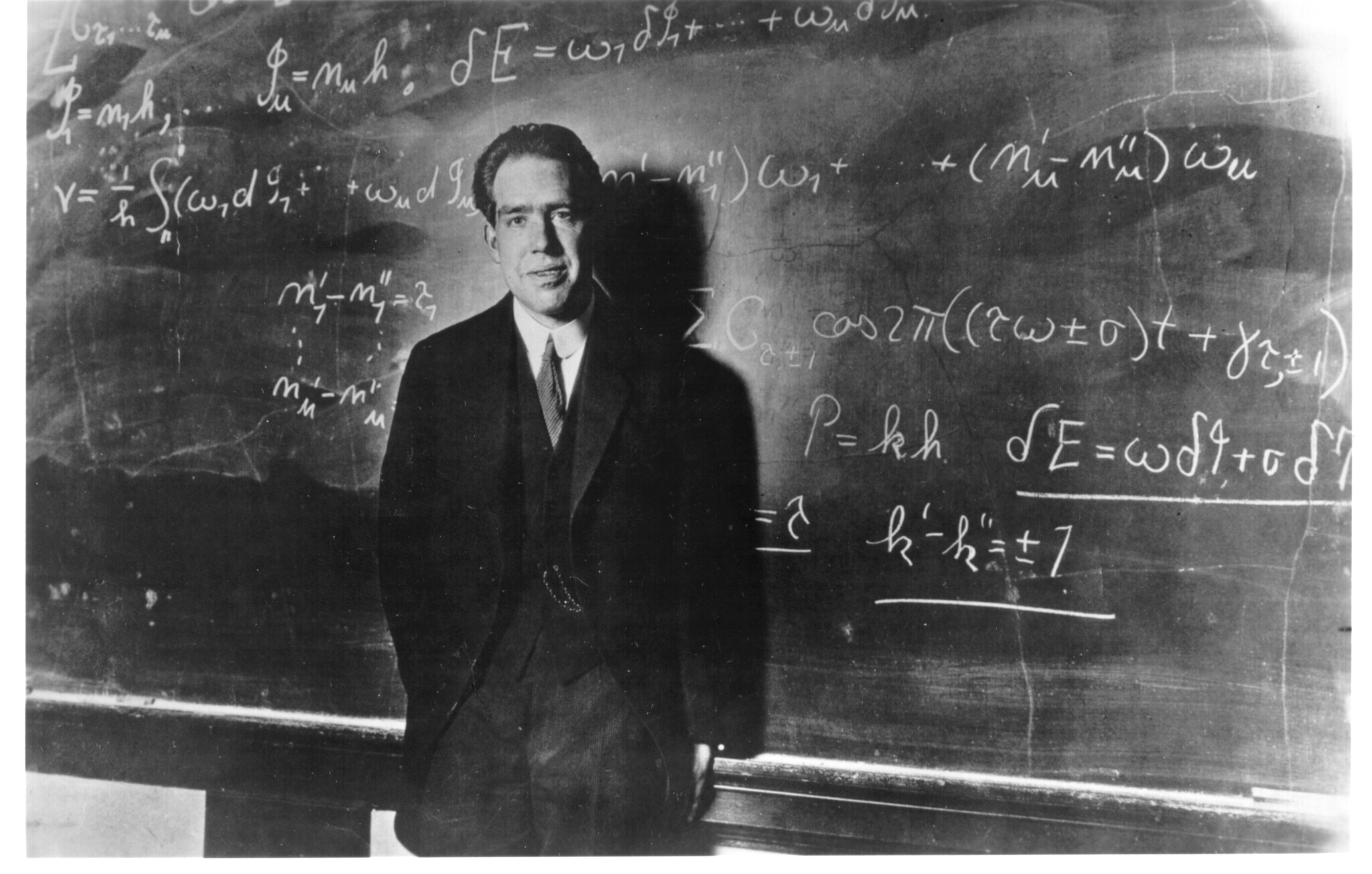
Niels Bohr as a younger man, at a chalkboard.

Niels Bohr, as a younger man, at the chalkboard. Atomic Archives

It is difficult to predict, especially the future.

  • Niehls Bohr, Danish physicist, 1885-1962 – attributed by Mark Kac, Statistics, 1975. Other sources say it is a Danish pun (anybody here speak Danish?) famous in the Danish parliament in the 1930s.

And as if in tribute to Bohr, Ed Brayton at Dispatches from the Culture Wars has a collection of creationist predictions that evolution theory will soon be dead — a series of predictions starting in 1904. Santayana’s Ghost urges you to read them, to avoid repeating history.