This is a story well told, but a story that appears to have fallen on deaf ears in the Trump administration. You should read this story, which can be found for a while on Threadreader App, and came from X.
This is a story of a great loss for the nation. Everything below this line is written by Dr. Farzad Mostashari.
1/ After residency at Mass General Hospital, I reported to Atlanta to meet my fellow CDC Epidemic Intelligence Service Officers.
I have never felt so intimidated by my peers
The best and the brightest, they were star clinicians, had served in disaster zones; MD/PhDs and MSF.
2/ We were placed at various centers throughout CDC, learning from the world’s experts- in tuberculosis, mosquito-borne diseases, food-borne diseases, …
and some of us were placed with state & local Health departments to be on the front lines of outbreak response
3/ In my first day on the job, I got into a city sanitation car to investigate an outbreak of bloody diarrhea at a state psychiatric facility.
My boss has served in the EIS. Her boss, the legendary head of the NYC Bureau of Communicable Disease had also.
Our commissioner too.
4/ Over the next 24 months we got intensive training in epidemiology, public health informatics, statistics.
But we also went to the bedside.
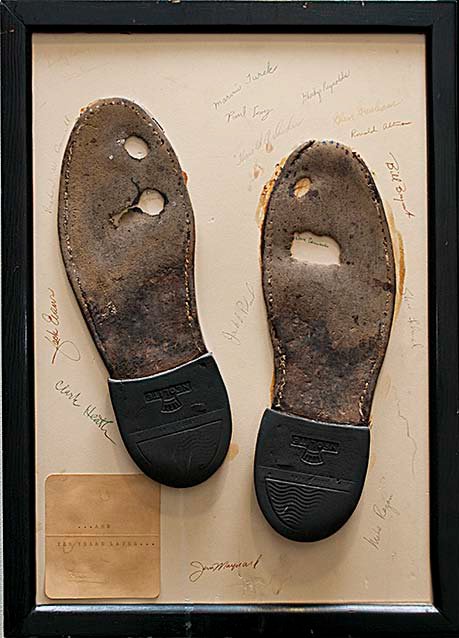
The logo of the EIS is a shoe with a hole on it
To me, the worn out shoe perfectly encapsulated the spirit of humility and service
5/ I investigated outbreaks of listeria that was causing deaths in cancer patients and pus-filled abscesses in stillborn children.
We found and recalled the contaminated hot dogs.
and innovated new genomic methods for identifying outbreaks faster.
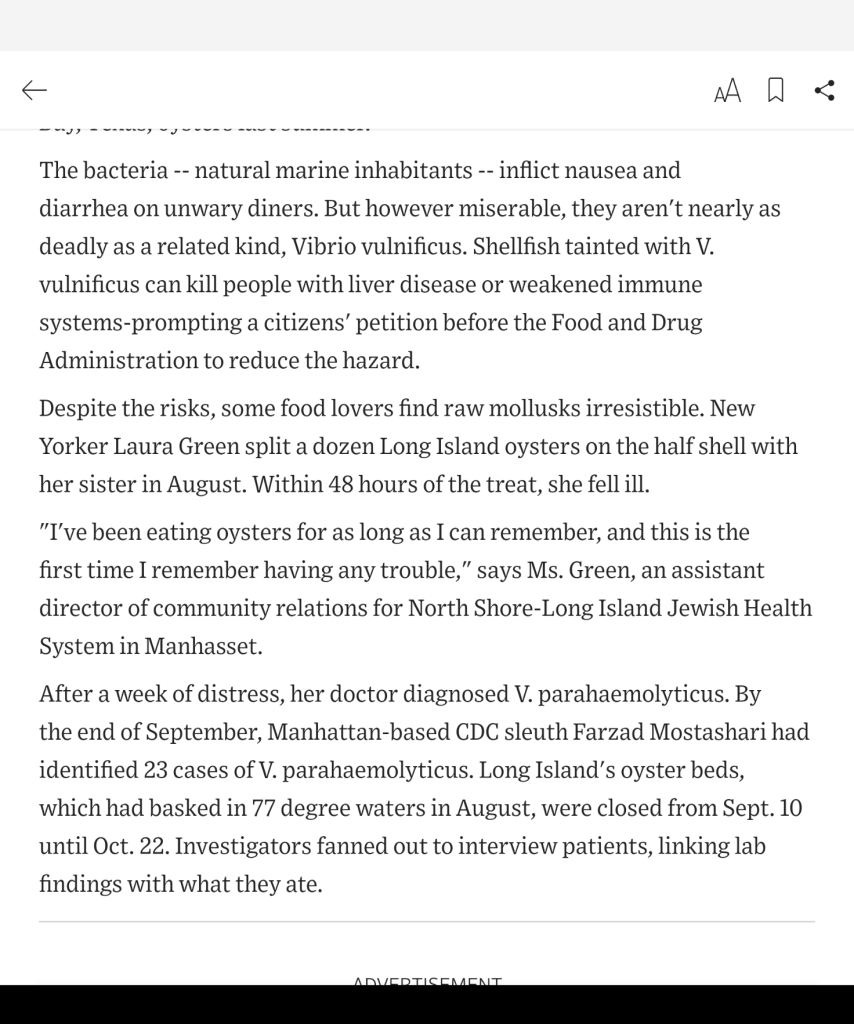
6/ I traced an outbreak of Vibrio (a cousin of the bacteria that causes cholera) to oysters harvested in Long Island Sound that had become contaminated in 77 degree August waters and put in a stop order that broke the outbreak.
7/ I was the officer on duty when a child was bitten by a bat that might have been rabid.
I was on call for clusters of salmonella, church and mosque potlucks, Hepatitis outbreaks among restaurant-goers, and more.
I was on vacation when birds started dying in a Bronx zoo
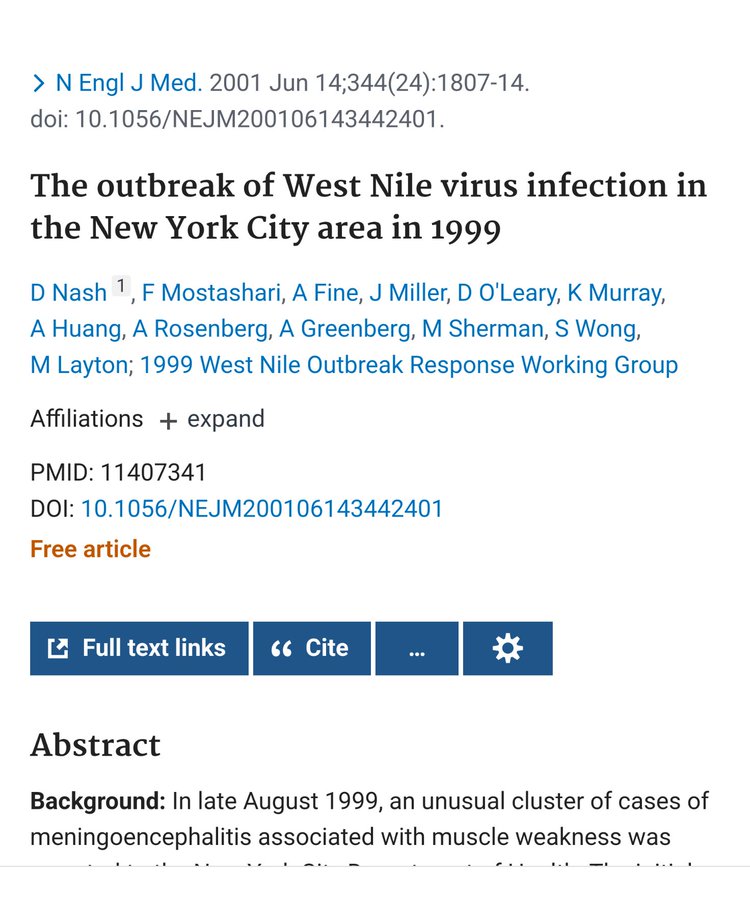
8/ There was also a cluster of cases of fever and encephalopathy in Queens. Many died.
We sent biopsies and blood tests to the only lab in the country that could diagnose what was going on.
West Nile Virus
The lab and the scientists proudly wore a CDC badge.
So did I
9/ This was the first time that virus had ever been seen in the New World, and birds-especially crows had fallen dead in piles in Queens before the human cases- they had no immunity
We developed a methodology to use statistical clustering to identify the spread of the virus.
10/ CDC’s experts had investigated West Nile – in Romania, and other arboviral illnesses- throughout the world.
So when the outbreak came to our shores they could advise the local health department.
My fellow EIS Officers helped me go door-to-door in Queens, drawing blood
11/ West Nile was the biggest public health response I had seen.
Until 9/11
I came out of the subway at Chambers-WTC to go to work shortly after the second plane hit.
I didn’t go home til dawn broke the next day, through streets filled with white ash and the burnt stench
12/ Some of the only planes that flew on Sept 12 carried EIS Officers from around the country to NYC to help.
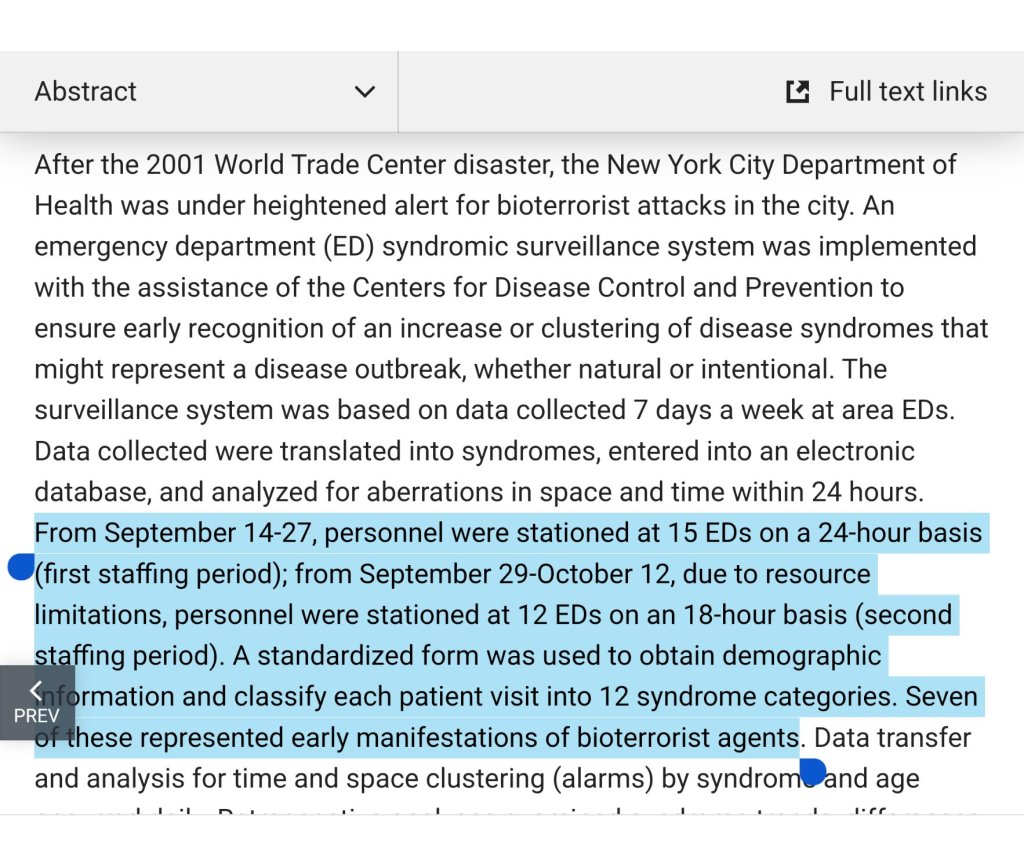
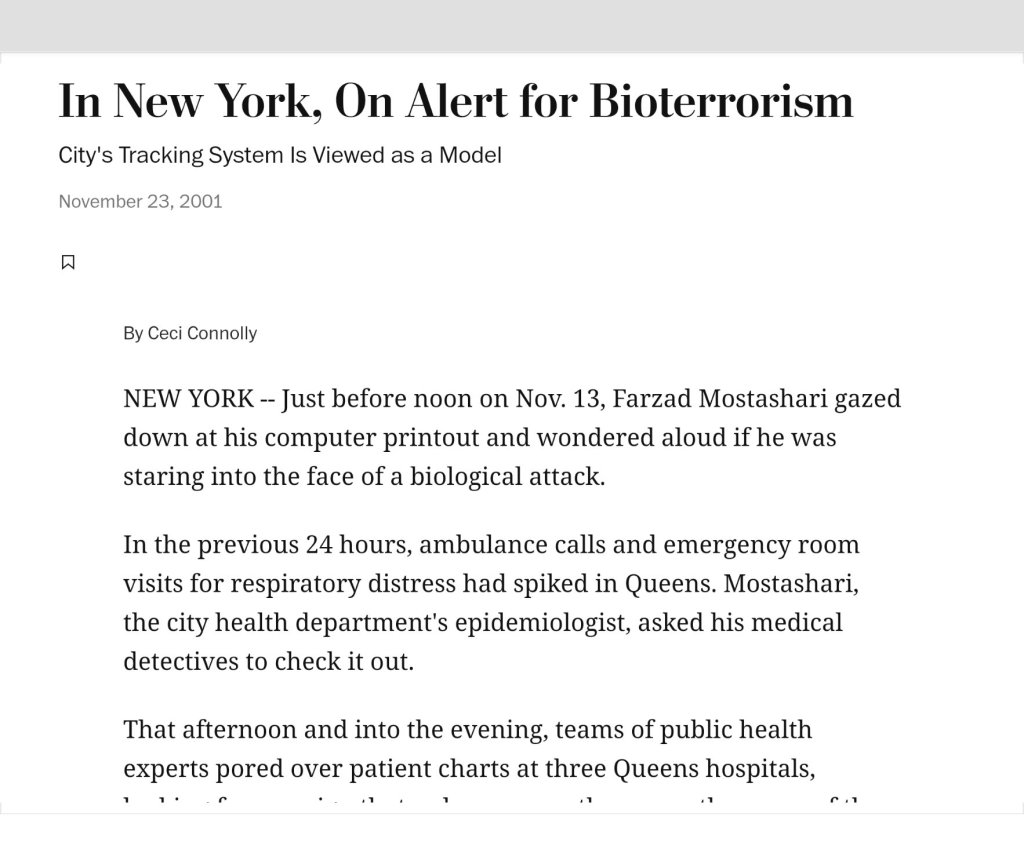
We were worried about a biterrorist attack, and rapidly set up a system that collected symptom data around the clock from patients coming into Emergency Departments.
13/ That rudimentary manual system – staffed by humans- public health workers- morphed into “syndromic surveillance” that analyzed electronic ED and hospital triage data to detect illness clusters.
A system that’s become a third pillar of public health surveillance today
14/ And then, a month later, we did have a bioterrorist attack- weapons-grade anthrax- through the mail.
I saw my first coal-black anthrax “eschar” then
And in a hospitalized baby the second
And worried that I might carry the spores home to our baby too.
But we kept working
15/ Those were some of my memories of my years spent at the EIS, with some of the brightest and hardest working colleagues I’ve ever had.
Many went on to lead their divisions at CDC, to become state health officers and city epidemiologists. Led international orgs
and now?
16/ When you hear, “the CDC’s Epidemic Intelligence Service class was cancelled and the officers fired” I hope this gives you a sense of what has been lost.
Not just the outbreaks that can’t be investigated, the surge capacity gone, but our future public health leadership lost
• • •
Spread the word; friends don't allow friends to repeat history.
Rachel Carson died in 1964, and although she attained some celebrity, there are not a lot of good images of Carson in circulation. I like to highlight images that come to light.
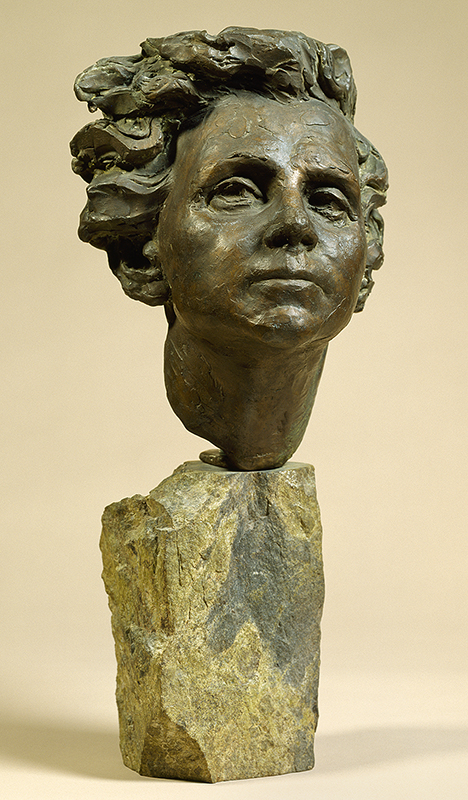
One image that is lesser known is Una Hanbury’s bust from 1965, in the collection of the U.S. National Portrait Gallery.
As a government scientist, Rachel Carson became concerned about the ecological impact of pesticides, especially DDT, and in 1962, she published the groundbreaking book, Silent Spring. Finely written and passionately reasoned, Silent Spring exploded into national consciousness and can be said to have started the modern environmental movement. Although some of its conclusions are still controversial today, the book was a warning that an active citizenry had to be skeptical of large institutions, an attitude that became a dominant theme of the 1960s and 1970s.
Una Hanbury and Carson met for the first and only time at an event in 1964. Following an impromptu speech by Carson, Hanbury approached Carson and asked if she could make her portrait. Carson willingly agreed to pose. Hanbury was impressed by Carson’s “tremendous vitality,” but when she called to arrange a sitting only four months later, Carson was nearing death. She passed away one week later, leaving Hanbury no option but to work from photographs and memories of their single meeting for the portrait bust. Life magazine provided her with pictures taken at Carson’s Maine tidal pools, and a number of Carson’s close friends advised the artist while she worked on the portrait.
Spread the word; friends don't allow friends to repeat history.
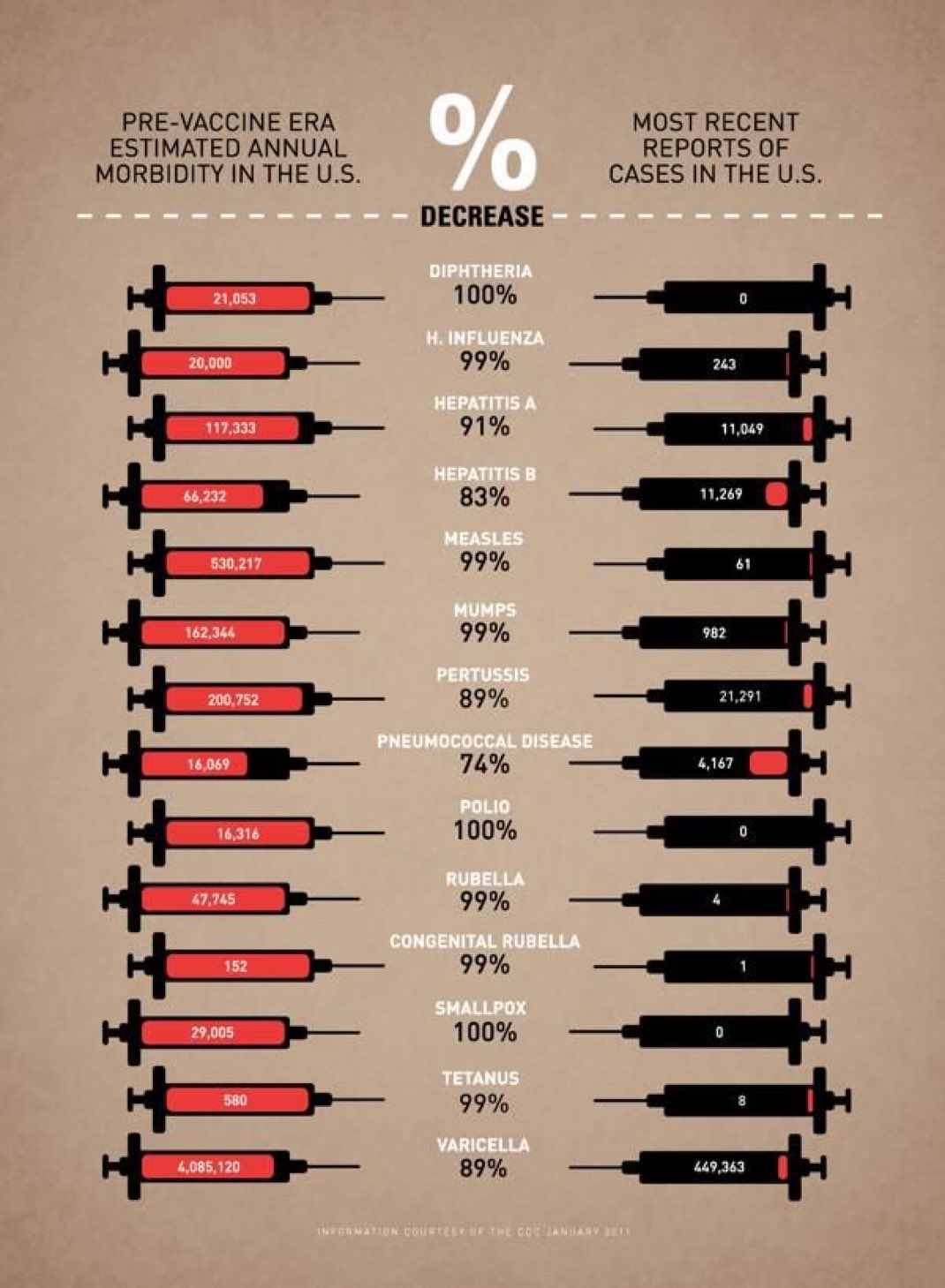
History tells us vaccines are wonderful things. Vaccines cut horrible, disifiguring, crippling and fatal diseases, and extended the life span of entire populations across the entire world.
Polioviruses in an electron micrograph. These little things cause the disease we call polio. CDC image via Wikipedia.
Fascinated with the drive by tech companies to sell the advantages of artificial intelligence (AI) machines to us.
Microsoft and Bing offer to answer any questions with their AI bot.
Why not give it a try?
I’ve been sorely disappointed at the festering swelling of people on social media in the past year who claim counter to history, science and common sense that DDT causes polio. As you might imagine, I’ve posted dozens of responses to these mislead goats.
U.S. President’s Malaria Initiative (PMI) Africa Indoor Residual Spraying (AIRS) Project found this warehouse with 119 tons of leftover, surplus and expired DDT in Ethiopia. In total, PMI AIRS Progect found 930 tons of unused DDT in Ethiopia, in 1,600 tons of expired pesticides total. Other nations have other surplus DDT stocks. Africa never suffered a shortage of DDT.
The claim that DDT (dichloro-diphenyl-trichloroethane), a pesticide, causes polio is a hoax. I asked Bing Chat with GPT-4, “How would I disprove the hoax claim that DDT causes polio?” Here is the response, which is really very good:
I am reminded of a Senate hearing during the Dust Bowl — is it an apocryphal story? An enormous windstorm picked up thousands of tons of dust from Texas, Oklahoma, New Mexico, Colorado, and sent it cross country.
A Department of Agriculture official trying to get the government to act heard of the storm, and tracked it. He asked a Senatte committee meeting on the Dust Bowl to take an early lunch break in a hearing.
When the committee hearing resumed after lunch, a senator asked the official if the Dust Bowl was really that big a deal — what would the effects be?
The Ag official got up from the table, went to the windows and opened them, so the dust could swirl into the hearing room. He said the dust had been topsoil used for farming a couple of days earlier. The dust had blown into Washington just after noon.
Congress acted. U.S. defeated the Dust Bowl and restored millions of acres of farmland.
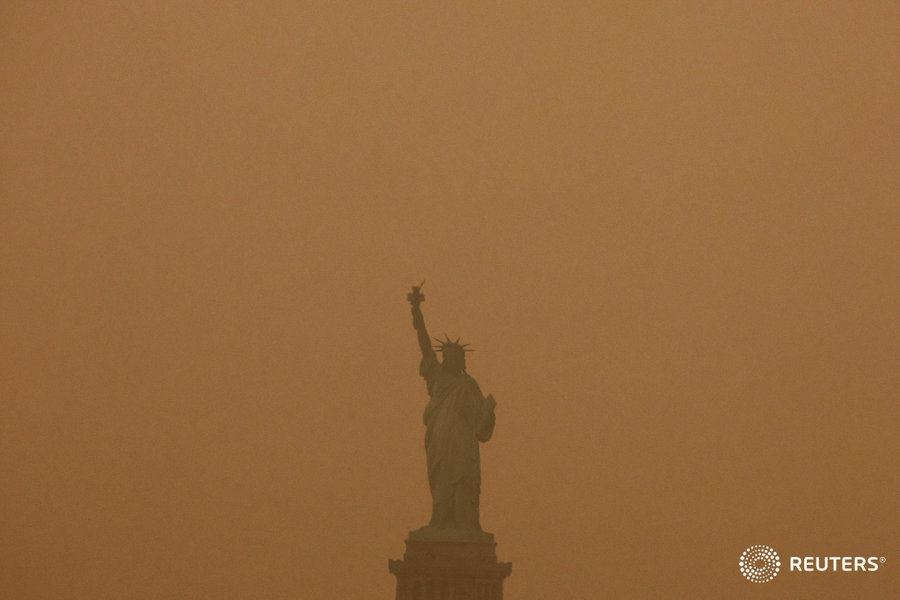
In New York and other eastern cities this week, smoke from wildfires in Canada settled in after a nearly 3,000-mile journey.
Who will act this time?
Statue of Liberty stands obscured and choked by smoke from wildfires in Western Canada. Reuters photo by Amr Alfiky | عمرو الفقي@alfiky_amr.
Global heating dries out western forests, and some effects cause trees to die, making them great tinder for fires. It’s clear to anyone who looks, to anyone who loves science, to anyone who loves Liberty.
In 2022, we may need this post more, to put up with anti-science backlash to the urgency of global heating, the threat of COVID-19, and still, to the defeat of Donald Trump.
Like faces in clouds, some people claimed to see a link. The first Earth Day, on April 22, 1970, coincided with Lenin’s birthday. There was no link — Earth Day was scheduled for a spring Wednesday, when the greatest number of college students would be on campus.
Google Doodle for Earth Day 2021
Now, years later, with almost-annual repeats of the claim from the braying right wing, it’s just a cruel hoax. It’s as much a hoax on the ill-informed of the right, as anyone else. Many of them believe it.
No, there’s no link between Earth Day and the birthday of V. I. Lenin:
One surefire way to tell an Earth Day post is done by an Earth Day denialist: They’ll note that the first Earth Day, on April 22, 1970, was an anniversary of the birth of Lenin.
Coincidentally, yes, Lenin was born on April 22, on the new style calendar; it was April 10 on the calendar when he was born — one might accurately note that Lenin’s mother always said he was born on April 10.
It’s a hoax. There is no meaning to the first Earth Day’s falling on Lenin’s birthday — Lenin was not prescient enough to plan his birthday to fall in the middle of Earth Week, a hundred years before Earth Week was even planned.
Does Earth Day Promote Communism?
Earth Day 1970 was initially conceived as a teach-in, modeled on the teach-ins used successfully by Vietnam War protesters to spread their message and generate support on U.S. college campuses. It is generally believed that April 22 was chosen for Earth Day because it was a Wednesday that fell between spring break and final exams—a day when a majority of college students would be able to participate.
U.S. Sen. Gaylord Nelson, the guy who dreamed up the nationwide teach-in that became Earth Day, once tried to put the whole “Earth Day as communist plot” idea into perspective.
“On any given day, a lot of both good and bad people were born,” Nelson said. “A person many consider the world’s first environmentalist, Saint Francis of Assisi, was born on April 22. So was Queen Isabella. More importantly, so was my Aunt Tillie.”
April 22 is also the birthday of J. Sterling Morton, the Nebraska newspaper editor who founded Arbor Day (a national holiday devoted to planting trees) on April 22, 1872, when Lenin was still in diapers. Maybe April 22 was chosen to honor Morton and nobody knew. Maybe environmentalists were trying to send a subliminal message to the national subconscious that would transform people into tree-planting zombies. One birthday “plot” seems just about as likely as the other. What’s the chance that one person in a thousand could tell you when either of these guys were born.
My guess is that only a few really wacko conservatives know that April 22 is Lenin’s birthday (was it ever celebrated in the Soviet Union?). No one else bothers to think about it, or say anything about it, nor especially, to celebrate it.
Certainly, the Soviet Union never celebrated Earth Day. Nor was Lenin any great friend of the environment. He stood instead with the oil-drillers-without-clean-up, with the strip-miners-without-reclamation, with the dirty-smokestack guys. You’d think someone with a bit of logic and a rudimentary knowledge of history could put that together.
Inventor of Earth Day teach-ins, former Wisconsin Governor and U.S. Senator Gaylord Nelson
The REAL founder of Earth Day, Wisconsin’s U.S. Sen. Gaylord Nelson, usually recognized as the founder and father of Earth Day, told how and why the organizers came to pick April 22:
Senator Nelson chose the date in order to maximize participation on college campuses for what he conceived as an “environmental teach-in.” He determined the week of April 19–25 was the best bet; it did not fall during exams or spring breaks, did not conflict with religious holidays such as Easter or Passover, and was late enough in spring to have decent weather. More students were likely to be in class, and there would be less competition with other mid-week events—so he chose Wednesday, April 22.
After President Kennedy’s [conservation] tour, I still hoped for some idea that would thrust the environment into the political mainstream. Six years would pass before the idea that became Earth Day occurred to me while on a conservation speaking tour out West in the summer of 1969. At the time, anti-Vietnam War demonstrations, called “teach-ins,” had spread to college campuses all across the nation. Suddenly, the idea occurred to me – why not organize a huge grassroots protest over what was happening to our environment?
I was satisfied that if we could tap into the environmental concerns of the general public and infuse the student anti-war energy into the environmental cause, we could generate a demonstration that would force this issue onto the political agenda. It was a big gamble, but worth a try.
At a conference in Seattle in September 1969, I announced that in the spring of 1970 there would be a nationwide grassroots demonstration on behalf of the environment and invited everyone to participate. The wire services carried the story from coast to coast. The response was electric. It took off like gangbusters. Telegrams, letters, and telephone inquiries poured in from all across the country. The American people finally had a forum to express its concern about what was happening to the land, rivers, lakes, and air – and they did so with spectacular exuberance. For the next four months, two members of my Senate staff, Linda Billings and John Heritage, managed Earth Day affairs out of my Senate office.
Five months before Earth Day, on Sunday, November 30, 1969, The New York Times carried a lengthy article by Gladwin Hill reporting on the astonishing proliferation of environmental events:
“Rising concern about the environmental crisis is sweeping the nation’s campuses with an intensity that may be on its way to eclipsing student discontent over the war in Vietnam…a national day of observance of environmental problems…is being planned for next spring…when a nationwide environmental ‘teach-in’…coordinated from the office of Senator Gaylord Nelson is planned….”
Nelson, a veteran of the U.S. armed services (Okinawa campaign), flag-waving ex-governor of Wisconsin (Sen. Joe McCarthy’s home state, but also the home of Aldo Leopold and birthplace of John Muir), was working to raise America’s consciousness and conscience about environmental issues.
Humor at The ObamaCrat: “Time reported that some suspected the date was not a coincidence, but a clue that the event was ‘a Communist trick,’ and quoted a member of the Daughters of the American Revolution as saying, ‘subversive elements plan to make American children live in an environment that is good for them.'” God forbid!
About.com, “Is Earth Day a communist plot?”; “U.S. Sen. Gaylord Nelson, the guy who dreamed up the nationwide teach-in that became Earth Day, once tried to put the whole “Earth Day as communist plot” idea into perspective.”On any given day, a lot of both good and bad people were born,” Nelson said. “A person many consider the world’s first environmentalist, Saint Francis of Assisi, was born on April 22. So was Queen Isabella. More importantly, so was my Aunt Tillie.”
Mike Ciandella campaigns for Pinocchios at CNS (Lenin asked for “days of service” to honor his birthday? Yeah, and those cans of dehydrated water have been recalled because the water they make isn’t wet.)
Do you know why Earth Day is April 22? (gds44.wordpress.com) [This blog appears not to accept any dissenting views . . . funny, Leninist tactics from a guy who claims not to like Lenin.]
Rich Kozlovich at Paradigms and Demographic; Kozlovich repeats these fantastic lies, without even bothering to hint at any backup: “There is one factor that is known. This whole green stuff was imposed in Nazi Germany and in Soviet Russia and their views are virtually identical to the views of modern greenies and it is a reasonable assumption to think they were inspirational to the green movement of today; who have morphed into the step child of socialism. I think it is fair to question any denials on their part, in that their denials can be being likened to cow flatulence. Back to today.” [Editor’s note: Complete and utter balderdash.]
Wall of Lenin’s Birthday Propaganda Shame from 2010:
David Zeimer, writing in The Wisconsin Law Journal (This guy is particularly nutty. He notes the successes of cleaning up the air and water in and around Milwaukee, and then claims that clean air and water are false goals. Nuts.)
One of the ways you know Earth Day is innocently timed is that the FBI investigated it; in 1970, the FBI investigated hippies, but not organized crime. Go figure.
Don Surber may be as nutty as Zeimer, above — he notes words of concern from 1970, then dismisses the progress that resulted because people worked to change things; clean air is bad, to him, I guess
Lesson is, we need to act now. The faster and harder we can act to block global heating, the greater chance we have of saving a place for humans on this planet without massive loss.
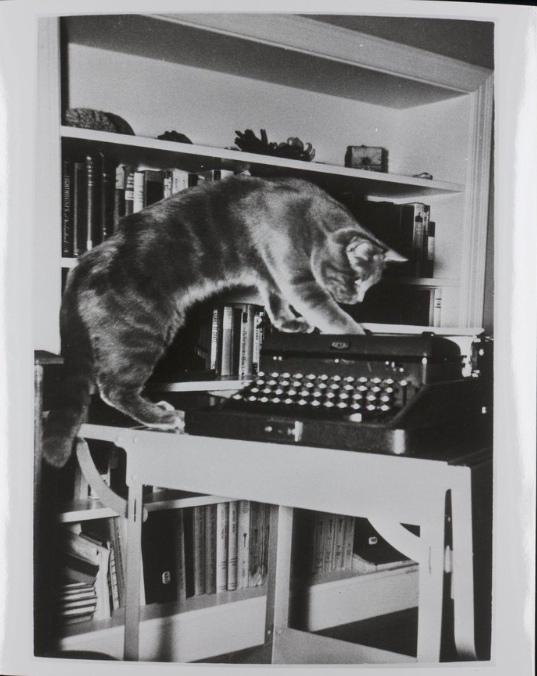
Beinecke Library at Yale is a repository for Rachel Carson’s papers, and much more.
Including this beguiling photo of Rachel Carson’s cat investigating the typewriter on which she wrote Silent Spring.
Maybe the cat is trying to find where all those beautifully-crafted words came from. Even decades before the internet, cats tortured their humans in the humans’ offices. Royal Typewriter in Rachel Carson’s Maryland house.
Researchers into Rachel Carson should check the on-line holdings of the Beinecke Library.
A running whine on Twitter and Facebook: ‘Can you name anything government ever got right?’
One such occasion was July 20, 1969, when humans first put foot on the Moon.
It’s a day to remember history. Do you remember that day, the first time humans landed on the Moon?
God knows we could use more Americans to have faith in the good intentions of NASA scientists today; we could use more dreams like those NASA gave us then, too.
Southwest Elementary in Burley, Idaho, existed in a world far, far away from the U.S. space program. We watched rocket launches on black and white televisions — the orbital launches were important enough my father let me stay home from school to watch, but when he dropped me off at school, I was in a tiny band of students who actually made it to school. Potato farmers and the merchants who supported them thought the space program was big, big stuff, worth missing school.
By John Glenn’s flight, a three-orbit extravaganza on February 20, 1962, a television would appear in the main vestibule of the school, or in the auditorium, and we’d all watch. There were very few spitballs. Later that year my family moved to Pleasant Grove, Utah.
Toward the end of the Gemini series, television news networks stopped providing constant coverage. The launch, the splashdown, a space walk or other mission highlight, but the nation didn’t hold its breath so much for every minute of every mission. Barry McGuire would sing about leaving the planet for four days in space (” . . . but when you return, it’s the same old place.“), then six days, but it was just newspaper headlines.
The Apollo 1 fire grabbed the nation’s attention again.Gus Grissom, one of the three who died, was one of the original space titans; death was always a possibility, but the U.S. program had been so lucky. Apollo’s start with tragedy put it back in the headlines.
The space program and its many successes made Americans hopeful, even in that dark decade when the Vietnam War showed the bloody possibilities of the Cold War. That darkest year of 1968 — see the box below — closed nicely with Apollo 8 orbiting the Moon, and the famous Christmas Eve telecast from the three astronauts, Frank Borman, Jim Lovell, and William A. Anders. The space program kept us hopeful.
By early 1969 many of us looked forward to the flight of Apollo 11 scheduled for July — the space flight that promised to put people on the Moon for the first time in history, the realization of centuries-old dreams.
Then I got my assignment for Scouting for the summer. Out of nearly 50 nights under the stars, one of the days would include the day of the space walk. Not only was it difficult to get televisions into Maple Dell Scout Camp, a good signal would be virtually impossible. I went to bed Sunday night knowing the next day I’d miss the chance of a lifetime, to watch the first moon landing and walk.
Just after midnight my sister Annette woke me up. NASA decided to do the first walk on the Moon shortly after touchdown, at an ungodly hour. I’d be unrested to check Scouts in, but I’d have seen history.
Texas Essential Knowledge and Skills (TEKS) used to list 11 dates for U.S. history as the touchstones kids need to have: 1609, the founding of Jamestown; 1776, the Declaration of Independence; 1787, the Constitutional Convention; 1803, the Louisiana Purchase; 1861-1865, the American Civil War; 1877, the end of Reconstruction; 1898, the Spanish American War; 1914-1918, World War I; 1929, the Stock Market Crash and beginning of the Great Depression; 1941-1945, World War II; 1957, the launching of Sputnik by the Soviets. Most teachers used to add the end of the Cold War, 1991; I usually included Apollo 11 — I think that when space exploration is viewed from a century in the future, manned exploration will be counted greater milestone than orbiting a satellite; my only hesitance on making such a judgment is the utter rejection of such manned exploration after Apollo, which will be posed as a great mystery to future high school students, I think.)
Happy to report the Texas State Board of Education has caught on. TEKS dates now include 1968 and assassination of Rev. Dr. Martin Luther King, Jr., 1969 and Apollo 11, plus the terrorist attacks on the World Trade Center in 2001 and the 2008 election of Barack Obama as president.
* Why 1968 was such a tough year, in roughly chronological order: 1968 produced a series of disasters that would depress the most hopeful of people, including: the Pueblo incident, the B-52 crash in Greenland, the Tet Offensive in Vietnam, the nerve gas leak at the Army’s facility at Dugway, Utah, that killed thousands of sheep, Lyndon Johnson’s pullout from the presidential race with gathering gloom about Vietnam, the Memphis garbage strike, the assassination of Martin Luther King, Jr., riots, the Black Panther shoot-out in Oakland, the Columbia University student takeover, the French student strikes, the tornadoes in Iowa and Arkansas on May 15, the Catonsville 9 vandalism of the Selective Service office, the sinking of the submarine U.S.S. Scorpion with all hands, the shooting of Andy Warhol, the assassination of Robert F. Kennedy, the Buenos Aires soccer riot that killed 74 people, the Glenville shoot-out in Cleveland, the cynicism of the Republicans and the nomination of Richard Nixon and Spiro Agnew, the Warsaw Pact invasion of Czechoslovakia crushing the “Prague Spring” democratic reforms, the Chicago Democratic Convention and the police riot, the brutal election campaign, the Tlatololco massacre of students in Mexico City, Black Power demonstrations by winning U.S. athletes at the Mexico City Olympics, coup d’etat in Panama. Whew!
Like faces in clouds, some people claimed to see a link. The first Earth Day, on April 22, 1970, coincided with Lenin’s birthday. There was no link — Earth Day was scheduled for a spring Wednesday, when the greatest number of college students would be on campus.
Google Doodle for Earth Day 2021
Now, years later, with almost-annual repeats of the claim from the braying right wing, it’s just a cruel hoax. It’s as much a hoax on the ill-informed of the right, as anyone else. Many of them believe it.
No, there’s no link between Earth Day and the birthday of V. I. Lenin:
One surefire way to tell an Earth Day post is done by an Earth Day denialist: They’ll note that the first Earth Day, on April 22, 1970, was an anniversary of the birth of Lenin.
Coincidentally, yes, Lenin was born on April 22, on the new style calendar; it was April 10 on the calendar when he was born — one might accurately note that Lenin’s mother always said he was born on April 10.
It’s a hoax. There is no meaning to the first Earth Day’s falling on Lenin’s birthday — Lenin was not prescient enough to plan his birthday to fall in the middle of Earth Week, a hundred years before Earth Week was even planned.
Does Earth Day Promote Communism?
Earth Day 1970 was initially conceived as a teach-in, modeled on the teach-ins used successfully by Vietnam War protesters to spread their message and generate support on U.S. college campuses. It is generally believed that April 22 was chosen for Earth Day because it was a Wednesday that fell between spring break and final exams—a day when a majority of college students would be able to participate.
U.S. Sen. Gaylord Nelson, the guy who dreamed up the nationwide teach-in that became Earth Day, once tried to put the whole “Earth Day as communist plot” idea into perspective.
“On any given day, a lot of both good and bad people were born,” Nelson said. “A person many consider the world’s first environmentalist, Saint Francis of Assisi, was born on April 22. So was Queen Isabella. More importantly, so was my Aunt Tillie.”
April 22 is also the birthday of J. Sterling Morton, the Nebraska newspaper editor who founded Arbor Day (a national holiday devoted to planting trees) on April 22, 1872, when Lenin was still in diapers. Maybe April 22 was chosen to honor Morton and nobody knew. Maybe environmentalists were trying to send a subliminal message to the national subconscious that would transform people into tree-planting zombies. One birthday “plot” seems just about as likely as the other. What’s the chance that one person in a thousand could tell you when either of these guys were born.
My guess is that only a few really wacko conservatives know that April 22 is Lenin’s birthday (was it ever celebrated in the Soviet Union?). No one else bothers to think about it, or say anything about it, nor especially, to celebrate it.
Certainly, the Soviet Union never celebrated Earth Day. Nor was Lenin any great friend of the environment. He stood instead with the oil-drillers-without-clean-up, with the strip-miners-without-reclamation, with the dirty-smokestack guys. You’d think someone with a bit of logic and a rudimentary knowledge of history could put that together.
Inventor of Earth Day teach-ins, former Wisconsin Governor and U.S. Senator Gaylord Nelson
The REAL founder of Earth Day, Wisconsin’s U.S. Sen. Gaylord Nelson, usually recognized as the founder and father of Earth Day, told how and why the organizers came to pick April 22:
Senator Nelson chose the date in order to maximize participation on college campuses for what he conceived as an “environmental teach-in.” He determined the week of April 19–25 was the best bet; it did not fall during exams or spring breaks, did not conflict with religious holidays such as Easter or Passover, and was late enough in spring to have decent weather. More students were likely to be in class, and there would be less competition with other mid-week events—so he chose Wednesday, April 22.
After President Kennedy’s [conservation] tour, I still hoped for some idea that would thrust the environment into the political mainstream. Six years would pass before the idea that became Earth Day occurred to me while on a conservation speaking tour out West in the summer of 1969. At the time, anti-Vietnam War demonstrations, called “teach-ins,” had spread to college campuses all across the nation. Suddenly, the idea occurred to me – why not organize a huge grassroots protest over what was happening to our environment?
I was satisfied that if we could tap into the environmental concerns of the general public and infuse the student anti-war energy into the environmental cause, we could generate a demonstration that would force this issue onto the political agenda. It was a big gamble, but worth a try.
At a conference in Seattle in September 1969, I announced that in the spring of 1970 there would be a nationwide grassroots demonstration on behalf of the environment and invited everyone to participate. The wire services carried the story from coast to coast. The response was electric. It took off like gangbusters. Telegrams, letters, and telephone inquiries poured in from all across the country. The American people finally had a forum to express its concern about what was happening to the land, rivers, lakes, and air – and they did so with spectacular exuberance. For the next four months, two members of my Senate staff, Linda Billings and John Heritage, managed Earth Day affairs out of my Senate office.
Five months before Earth Day, on Sunday, November 30, 1969, The New York Times carried a lengthy article by Gladwin Hill reporting on the astonishing proliferation of environmental events:
“Rising concern about the environmental crisis is sweeping the nation’s campuses with an intensity that may be on its way to eclipsing student discontent over the war in Vietnam…a national day of observance of environmental problems…is being planned for next spring…when a nationwide environmental ‘teach-in’…coordinated from the office of Senator Gaylord Nelson is planned….”
Nelson, a veteran of the U.S. armed services (Okinawa campaign), flag-waving ex-governor of Wisconsin (Sen. Joe McCarthy’s home state, but also the home of Aldo Leopold and birthplace of John Muir), was working to raise America’s consciousness and conscience about environmental issues.
Humor at The ObamaCrat: “Time reported that some suspected the date was not a coincidence, but a clue that the event was ‘a Communist trick,’ and quoted a member of the Daughters of the American Revolution as saying, ‘subversive elements plan to make American children live in an environment that is good for them.'” God forbid!
About.com, “Is Earth Day a communist plot?”; “U.S. Sen. Gaylord Nelson, the guy who dreamed up the nationwide teach-in that became Earth Day, once tried to put the whole “Earth Day as communist plot” idea into perspective.”On any given day, a lot of both good and bad people were born,” Nelson said. “A person many consider the world’s first environmentalist, Saint Francis of Assisi, was born on April 22. So was Queen Isabella. More importantly, so was my Aunt Tillie.”
Mike Ciandella campaigns for Pinocchios at CNS (Lenin asked for “days of service” to honor his birthday? Yeah, and those cans of dehydrated water have been recalled because the water they make isn’t wet.)
Do you know why Earth Day is April 22? (gds44.wordpress.com) [This blog appears not to accept any dissenting views . . . funny, Leninist tactics from a guy who claims not to like Lenin.]
Rich Kozlovich at Paradigms and Demographic; Kozlovich repeats these fantastic lies, without even bothering to hint at any backup: “There is one factor that is known. This whole green stuff was imposed in Nazi Germany and in Soviet Russia and their views are virtually identical to the views of modern greenies and it is a reasonable assumption to think they were inspirational to the green movement of today; who have morphed into the step child of socialism. I think it is fair to question any denials on their part, in that their denials can be being likened to cow flatulence. Back to today.” [Editor’s note: Complete and utter balderdash.]
Wall of Lenin’s Birthday Propaganda Shame from 2010:
David Zeimer, writing in The Wisconsin Law Journal (This guy is particularly nutty. He notes the successes of cleaning up the air and water in and around Milwaukee, and then claims that clean air and water are false goals. Nuts.)
One of the ways you know Earth Day is innocently timed is that the FBI investigated it; in 1970, the FBI investigated hippies, but not organized crime. Go figure.
Don Surber may be as nutty as Zeimer, above — he notes words of concern from 1970, then dismisses the progress that resulted because people worked to change things; clean air is bad, to him, I guess
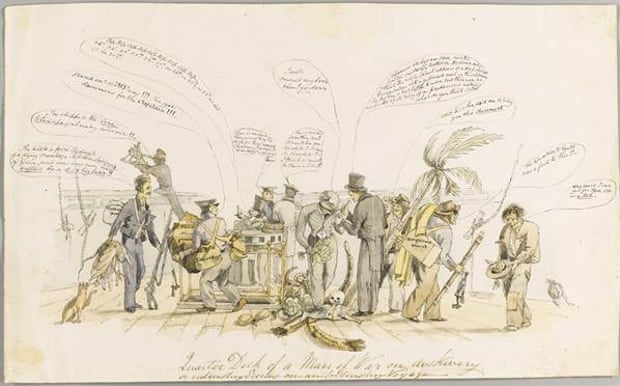
A cartoon of Charles Darwin and the crew of the HMS Beagle – believed to be the only image of the great naturalist on the voyage that inspired his theory of evolution – auctioned by Sotheby’s in December, 2015, for 52,500
The watercolour, painted while the Beagle was anchored off the Patagonian coast in 1832, around September 24, shows fossils and botanical specimens being hauled aboard for examination by Darwin, who commands the centre of the painting in top hat and tails. The event followed Darwin’s trip ashore at Bahia Blanca, Brazil. Painting is by by Augustus Earle, who was hired as shipboard artist by Capt. FitzRoy in October 1831, but had to quit the ship soon after this painting, due to ill health. From The Guardian.
No, Darwin was not racist.
I know many Darwin students, and science students, usually concede that Darwin was “racist by today’s standards,” but better than most of his pre-Victorian and Victorian colleagues. I think that’s an unnecessary and very much inaccurate concession. Darwin simply was not racist.
To come to that conclusion, one needs to read a bunch of Darwin’s writings, and see what he really said. Darwin was bound by English usage mostly in the first half of the 19th century, and that produces confusion among people who assume “savage” is a pejorative term, and not simply the pre-1860 version of “wild” or “aboriginal.”
But beyond that, a look at Darwin’s life should produce an appreciation of the remarkable lack of bias he shows to people of color — though he does demonstrate bias against French, Germans and Turks, and it’s difficult to understand if he’s being sarcastic in those uses.
We discussed this issue way back in 2007, at Dr. P. Z. Myers’s blog, Pharyngula, back when it was a part of a series of science blogs hosted by Seed Magazine, which has gone defunct. P. Z. took an answer I gave in one post, and made a freestanding post out of it.
I was surprised, but happy to bump into the answer recently — because it remains a good summary response. It would have benefited from links, but in 2007 I wasn’t adept at adding links in other blogs (didn’t even have this one), and links were limited, as I recall.
So I’ll add in links below.
Here’s my 2007 answer to the retort, “Darwin was racist,” with no editing, but links added.
Here’s the post from P. Z. Myers, featuring my answer.
Since Ed Darrell made such a comprehensive comment on the question of whether Darwin was as wicked a racist as the illiterate ideologues of Uncommon Descent would like you to believe, I’m just copying his list here.
Remember the famous quarrel between Capt. FitzRoy and Darwin aboard the Beagle? After leaving Brazil, in their mess discussions (remember: Darwin was along to talk to FitzRoy at meals, to keep FitzRoy from going insane as his predecessor had), Darwin noted the inherent injustice of slavery. Darwin argued it was racist and unjust, and therefore unholy. FitzRoy loudly argued slavery was justified, and racism was justified, by the scriptures. It was a nasty argument, and Darwin was banned to mess with the crew with instructions to get off the boat at the next convenient stop. FitzRoy came to his senses after a few days of dining alone. Two things about this episode: First, it shows Darwin as a committed anti-racist; second, it contrasts Darwin’s views with the common, scripture-inspired view of the day, which was racist.
Darwin’s remarks about people of color were remarkably unracist for his day. We should always note his great friend from college days, the African man, [freed slave John Edmonstone,] who taught him taxidermy. We must make note of Darwin’s befriending the Fuegan, Jeremy Jemmy Button [real name, Orundellico], whom the expedition was returning to his home. Non-racist descriptions abound in context, but this is a favorite area for anti-Darwinists to quote mine. Also, point to Voyage of the Beagle, which is available on line. In it Darwin compares the intellect of the Brazilian slaves with Europeans, and notes that the slaves are mentally and tactically as capable as the greatest of the Roman generals. Hard evidence of fairness on Darwin’s part.
Watch for the notorious quote mining of Emma’s remark that Charles was “a bigot.” It’s true, she said it. Emma said Charles was a bigot, but in respect to Darwin’s hatred of spiritualists and seances. Darwin’s brother, Erasmus, was suckered in by spiritualists. Darwin was, indeed, a bigot against such hoaxes. It’s recounted in Desmond and Moore’s biography, but shameless quote miners hope their audience hasn’t read the book and won’t. Down here in Texas, a lot of the quote miners are Baptists. I enjoy asking them if they do not share Darwin’s bigotry against fortune tellers. Smart ones smile, and drop the argument.
One might hope that the “Darwin-was-racist” crap comes around to the old canard that Darwin’s work was the basis of the campaign to kill the natives of Tasmania. That was truly a terrible, racist campaign, and largely successful. Of course, historians note that the war against Tasmanians was begun in 1805, and essentially completed by 1831, when just a handful of Tasmanians remained alive. These dates are significant, of course, because they show the war started four years prior to Darwin’s birth, and it was over when Darwin first encountered Tasmania on his voyage, leaving England in 1831. In fact, Darwin laments the battle. I have often found Darwin critics quoting Darwin’s words exactly, but claiming they were the words of others against Darwin’s stand.
Also, one should be familiar with Darwin’s writing about “civilized” Europeans wiping out “savages.” In the first place, “savage” in that day and in Darwin’s context simply means ‘not living in European-style cities, with tea and the occasional Mozart.’ In the second, and more critical place, Darwin advances the argument noting that (in the case of the Tasmanians, especially), the “savages” are the group that is better fit to the natural environment, and hence superior to the Europeans, evolutionarily. Darwin does not urge these conflicts, but rather, laments them. How ironic that creationist quote miners do not recognize that.
P. Z. closed off:
Isn’t it odd how the creationists are so divorced from reality that they can’t even concede that Darwin was an abolitionist, and are so reduced in their arguments against evolution that they’ve had to resort to the desperate “Darwin beats puppies!” attack?
Sadly, many of the posts in that old home for Pharyngula eroded away as the old Appalachian Mountain range eroded to be smaller than the Rockies. Time passes, even the rocks change.
Darwin’s still not racist. Creationists and other malignant forces revive the false claim, from time to time.
February 15th is Shoulders of Giants Day (unless you’re still on the Julian calendar).
Or should be.
Famous quotations often get cited to the wrong famous person. ‘Somebody said something about standing on the shoulders of giants — who was it? Edison? Lincoln? Einstein? Jefferson?’ It may be possible someday to use Google or a similar service to track down the misquotes.
The inspiration, perhaps
Robert Burton, melancholy scholar at Oxford
A dwarf standing on the shoulders of a giant may see farther than a giant himself.
Robert Burton (February 8, 1577-January 25, 1640), vicar of Oxford University, who wrote The Anatomy of Melancholy to ward off his own depressions
The famous quote
Sir Isaac Newton, by Sir Godfrey Keller, 1689
If I have seen further (than you and Descartes) it is by standing on the shoulders of Giants.
Sir Isaac Newton, letter to Robert Hooke, February 5, 1675, Julian/February 15, 1676, Gregorian
Newton consciously paid tribute to others who had plowed his science fields before, even if he came up with different crops, er, answers. All science is based on something that comes before it, and in the modern world science advances, oddly, by trying to disprove what scientists thought happened before.
But the sentiment applies equally well in business, in politics, in raising children. We are products of what we learn, and what we learn is a result of culture, which is a result of history. We all stand on the shoulders of those who came before us.
It’s our job to try to see farther, and not just look down, at how far up we are.
Someone will ask (since we so often discuss it), ‘can we fly our flags today?’
Of course you may fly your U.S. flag today. It’s not a day designated by law, but you may fly it in honor of Sir Isaac Newton’s letter if you wish. The U.S. flag code suggests times Americans may fly their flags, but does not require it, nor does law forbid flying the flag for other occasions, or just for every day.
Maybe better, climb to the top of the flag pole. What can you see, aided by a giant’s height?
Wikipedia chases the quote back to the 12th century — The metaphor of dwarfsstanding on the shoulders of giants (Latin: nanos gigantum humeris insidentes) expresses the meaning of “discovering truth by building on previous discoveries”.[1] This concept has been traced to the 12th century, attributed to Bernard of Chartres. Its most familiar expression in English is by Isaac Newton in 1676: “If I have seen further, it is by standing on the shoulders of giants.”[2]
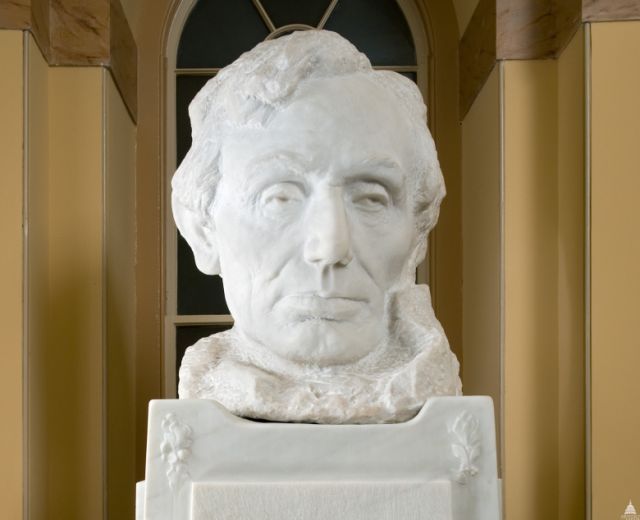
Gutzon Borglum’s 1908 bust of Abraham Lincoln in the Crypt of the U.S. Capitol – Architect of the Capitol photo
Lincoln would become one of our most endeared presidents, though endearment would come after his assassination. Lincoln’s bust rides the crest of Mt. Rushmore (next to two slaveholders), with George Washington, the Father of His Country, Thomas Jefferson, the author of the Declaration of Independence, and Theodore Roosevelt, the man who made the modern presidency, and the only man ever to have won both a Congressional Medal of Honor and a Nobel Prize, the only president to have won the Medal of Honor.
Charles Darwin statue, Natural History Museum, London – NHM photo
In his effort to keep the Union together, Lincoln freed the slaves of the states in rebellion during the civil war, becoming an icon to freedom and human rights for all history. Upon his death the entire nation mourned; his funeral procession from Washington, D.C., to his tomb in Springfield, Illinois, stopped twelve times along the way for full funeral services. Lying in state in the Illinois House of Representatives, beneath a two-times lifesize portrait of George Washington, a banner proclaimed, “Washington the Father, Lincoln the Savior.”
Darwin would become one of the greatest scientists of all time. He would be credited with discovering the theory of evolution by natural and sexual selection. His meticulous footnoting and careful observations formed the data for ground-breaking papers in geology (the creation of coral atolls), zoology (barnacles, and the expression of emotions in animals and man), botany (climbing vines and insectivorous plants), ecology (worms and leaf mould), and travel (the voyage of H.M.S. Beagle). At his death he was honored with a state funeral, attended by the great scientists and statesmen of London in his day. Hymns were specially written for the occasion. Darwin is interred in Westminster Abbey near Sir Isaac Newton, England’s other great scientist, who knocked God out of the heavens.
Lincoln would be known as the man who saved the Union of the United States and set the standard for civil and human rights, vindicating the religious beliefs of many and challenging the beliefs of many more. Darwin’s theory would become one of the greatest ideas of western civilization, changing forever all the sciences, and especially agriculture, animal husbandry, and the rest of biology, while also provoking crises in religious sects.
Lincoln, the politician known for freeing the slaves, also was the first U.S. president to formally consult with scientists, calling on the National Science Foundation (whose creation he oversaw) to advise his administration. Darwin, the scientist, advocated that his family put the weight of its fortune behind the effort to abolish slavery in the British Empire. Each held an interest in the other’s disciplines.
Both men were catapulted to fame in 1858. Lincoln’s notoriety came from a series of debates on the nation’s dealing with slavery, in his losing campaign against Stephen A. Douglas to represent Illinois in the U.S. Senate. On the fame of that campaign, he won the nomination to the presidency of the fledgling Republican Party in 1860. Darwin was spurred to publicly reveal his ideas about the power of natural and sexual selection as the force behind evolution, in a paper co-authored by Alfred Russel Wallace, presented to the Linnean Society in London on July 1, 1858. On the strength of that paper, barely noticed at the time, Darwin published his most famous work, On the Origin of Species, in November 1859.
Darwin and Lincoln might have got along well, but they never met.
What unusual coincidences.
Go celebrate human rights, good science, and the stories about these men.
A school kid could do much worse than to study the history of these two great men. We study them far too little, it seems to me.
Anybody know what hour of the day either of these men was born?
Yes, you may fly your flag today for Lincoln’s birthday, according to the Flag Code; the official holiday, Washington’s Birthday, is next Monday, February 15th — and yes, it’s usually called “Presidents Day” by merchants and calendar makers. You want to fly your flag for Charles Darwin? Darwin never set foot in North America, remained a loyal subject of Her Majesty, Queen Victoria, to the end of his days. But go ahead. Who would know?
Yes, this is an encore post. Defeating ignorance takes patience and perseverance.
Spread the word; friends don't allow friends to repeat history.
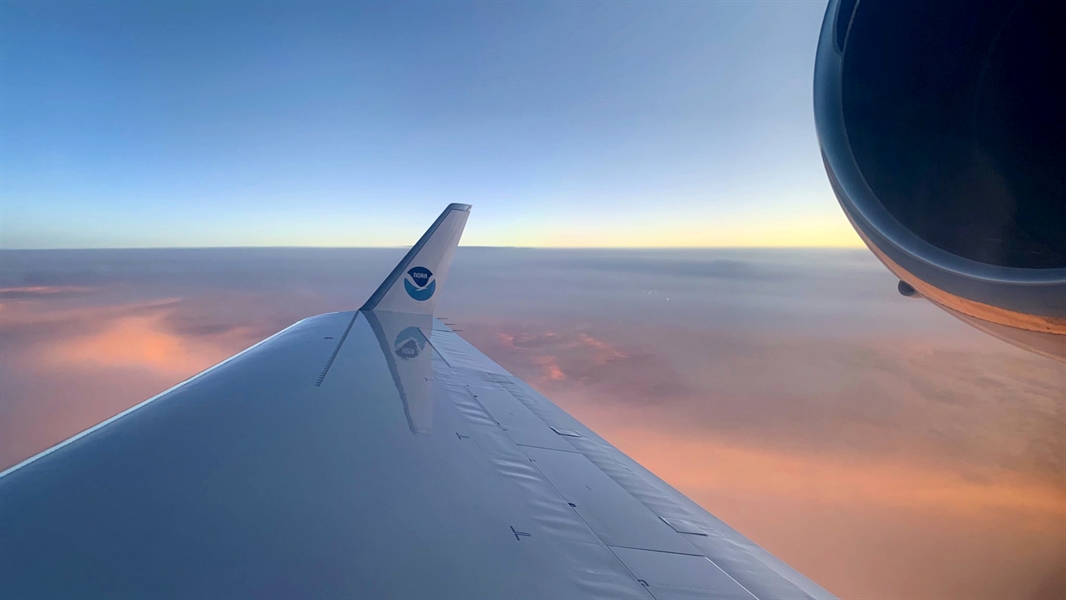
Photo from the window of a NOAA research flight. Masthead for NOAA press releases online.
NOAA’s chief scientist reminds everyone that accuracy with honor is necessary for science to be good.
Here is the entire message from NOAA Assistant Administrator Craig McLean, to NOAA staff, sent out Tuesday, September 10, 2019.
A Message from Craig McLean: Hurricane Dorian and Exceptional Service
This following is the original message Craig McLean, NOAA Research Assistant Administrator, sent to all NOAA Research employees on the morning of Monday, September 9th regarding Hurricane Dorian and its wide-ranging impacts.
Dear Colleagues,
The fierce storm we know as Hurricane Dorian has concluded its ferocious path through the Bahamas and along the U.S. East Coast. Many of you have contributed to the excellent science that has underpinned the forecasts and current understanding of storms such as this one, which accelerated quite rapidly in intensity. The storm also presented challenges in track which improved with enhanced observations. We know that our collective work, from the scientists in the aircraft penetrating the storm, to the scientists deploying the glider picket line, to the modelers and folks working the physics of the storms, across OAR and in our CI’s, and across all NOAA Lines, we are working the problem in order to give the NWS forecasters the best tools we possibly can to keep America and our neighbors safe. Thank you.
During the course of the storm, as I am sure you are aware, there were routine and exceptional expert forecasts, the best possible, issued by the NWS Forecasters. These are remarkable colleagues of ours, who receive our products, use them well, and provide the benefit of their own experience in announcing accurate forecasts accompanied by the distinction of all credible scientists—they sign their work. As I’m sure you also know, there was a complex issue involving the President commenting on the path of the hurricane. The NWS Forecaster(s) corrected any public misunderstanding in an expert and timely way, as they should. There followed, last Friday, an unsigned press release from “NOAA” that inappropriately and incorrectly contradicted the NWS forecaster. My understanding is that this intervention to contradict the forecaster was not based on science but on external factors including reputation and appearance, or simply put, political. Our NOAA Scientific Integrity Policy and Code of Scientific Conduct make clear that all NOAA employees shall approach all scientific activities with honesty, objectively, and completely, without allegiance to individuals, organizations, or ideology. The content of this press release is very concerning as it compromises the ability of NOAA to convey life-saving information necessary to avoid substantial and specific danger to public health and safety. If the public cannot trust our information, or we debase our forecaster’s warnings and products, that specific danger arises.
You know that the value of our science is in the complexity of our understanding, our ability to convey that understanding to a wide audience of users of this information, and to establish and sustain the public trust in the truth and legitimacy of that information. Unfortunately, the press release of last Friday violated this trust and violated NOAA’s policies of scientific integrity. In my role as Assistant Administrator for Research, and as I continue to administratively serve as Acting Chief Scientist, I am pursuing the potential violations of our NOAA Administrative Order on Scientific Integrity. Thankfully, we have such policies that are independently cited as among the best in the federal community, if not the best. Your NOAA and OAR management and leadership team believes in these policies and principles. I have a responsibility to pursue these truths. I will.
Thank you for your continued excellent work, and your trust. Carry on.
NOAA Assistant Administrator Craig McLean
Craig N. McLean Assistant Administrator Oceanic and Atmospheric Research National Oceanic and Atmospheric Administration
How many ways can we say happy birthday to a great scientist born on Pi Day? An encore post.
Happy Einstein Day! to us. Albert’s been dead since
1955 — sadly for us. Our celebrations now are more for our own
satisfaction and curiosity, and to honor the great man — he’s beyond
caring.
Almost fitting that he was born on π Day, no? I mean, is there an E=mc² Day? He’s 140 years old today, and famous around the world for stuff that most people still don’t understand.
E=energy; m=mass; c=speed of light
Fittingly, perhaps, March 14 now is celebrated as Pi Day, in honor of that almost magical number, Pi, used to calculate the circumference of a circle. Pi is 3. 1415~, and so the American date 3/14 got tagged as Pi Day.
Albert Einstein was born on March 14, 1879, in Ulm, Germany, to Hermann and Pauline Einstein.
26 years later, three days after his birthday, he sent off the paper on the photo-electric effect; that paper would win him the Nobel Prize in Physics in 1921.
In that same year of 1905, he published three other papers, solving the mystery of Brownian motion, describing what became known as the Special Theory of Relativity and solving the mystery of why measurements of the light did not show any effects of motion as Maxwell had predicted, and a final paper that noted a particle emitting light energy loses mass. This final paper amused Einstein because it seemed so ludicrous in its logical extension that energy and matter are really the same stuff at some fundamental point, as expressed in the equation demonstrating an enormous amount of energy stored in atoms, E=mc².
Any one of the papers would have been a career-capper
for any physicist. Einstein dashed them all off in just a few months,
forever changing the fields of physics. And, you noticed: Einstein did not win a Nobel for the Special Theory of Relativity, nor for E=mc². He won it for the photo-electric effect. Irony in history. Nobel committee members didn’t understand Einstein’s other work much better than the rest of us today.
114 years later, Einstein’s work affects us every day. Relativity theory at some level I don’t fully understand makes possible the use Global Positioning Systems (GPS), which revolutionized navigation and mundane things like land surveying and microwave dish placement.
Development of nuclear power both gives us hope for an energy-rich future, and gives us fear of nuclear war. Sometimes, even the hope of the energy rich future gives us fear, as we watch and hope nuclear engineers can control the piles in nuclear power plants damaged by earthquakes and tsunami in Japan.
Albert Einstein on a 1966 US stamp (Photo credit: Wikipedia)
If Albert Einstein was a genius at physics, he was more dedicated to pacifism. He resigned his German citizenship to avoid military conscription. His pacifism made the German Nazis nervous; Einstein fled Germany in the 1930s, eventually settling in the United States. In the U.S., he was persuaded by Leo Szilard to write to President Franklin Roosevelt to suggest the U.S. start a program to develop an atomic weapon, because Germany most certainly was doing exactly that. But while urging FDR to keep up with the Germans, Einstein refused to participate in the program himself, sticking to his pacifist views. Others could, and would, design and build atomic bombs. (Maybe it’s a virus among nuclear physicists — several of those working on the Manhattan Project were pacifists, and had great difficulty reconciling the idea that the weapon they worked on to beat Germany, was deployed on Japan, which did not have a nuclear weapons program.)
Everybody wanted to claim, and honor Einstein; USSR issued this stamp dedicated to Albert Einstein Русский: Почтовая марка СССР, посвящённая Альберту Эйнштейну (Photo credit: HipStamp)
Einstein was a not-great father, and probably not a terribly faithful husband at first — though he did think to give his first wife, in the divorce settlement, a share of a Nobel Prize should he win it. Einstein was a good violinist, a competent sailor, an incompetent dresser, and a great character.
His sister suffered a paralyzing stroke. For many months Albert spent hours a day reading to her the newspapers and books of the day, convinced that though mute and appearing unconscious, she would benefit from hearing the words. He said he did not hold to orthodox religions, but could there be a greater show of faith in human spirit?
When people hear clever sayings, but forget to whom the bon mots should be attributed, Einstein is one of about five candidates to whom all sorts of things are attributed, though he never said them. (Others include Lincoln, Jefferson, Mark Twain and Will Rogers). Einstein is the only scientist in that group. So, for example, we can be quite sure Einstein never claimed that compound interest was the best idea of the 20th century. This phenomenon is symbolic of the high regard people have for the man, even though so few understand what his work was, or meant.
Einstein in 1950, five years before his death
A most interesting man. A most important body of work. He deserves more study and regard than he gets, in history, diplomacy and science.
Does anyone know? What was Albert Einstein’s favorite pie?
Or, until that account is unsuspended by the forces supporting Donald Trump: Follow @FillmoreWhite, the account of the Millard Fillmore White House Library
We've been soaking in the Bathtub for several months, long enough that some of the links we've used have gone to the Great Internet in the Sky.
If you find a dead link, please leave a comment to that post, and tell us what link has expired.
Thanks!
Retired teacher of law, economics, history, AP government, psychology and science. Former speechwriter, press guy and legislative aide in U.S. Senate. Former Department of Education. Former airline real estate, telecom towers, Big 6 (that old!) consultant. Lab and field research in air pollution control.
My blog, Millard Fillmore's Bathtub, is a continuing experiment to test how to use blogs to improve and speed up learning processes for students, perhaps by making some of the courses actually interesting. It is a blog for teachers, to see if we can use blogs. It is for people interested in social studies and social studies education, to see if we can learn to get it right. It's a blog for science fans, to promote good science and good science policy. It's a blog for people interested in good government and how to achieve it.
BS in Mass Communication, University of Utah
Graduate study in Rhetoric and Speech Communication, University of Arizona
JD from the National Law Center, George Washington University