Not an emerald ash borer — but what is it?

August 21, 2013

Emerald green beetle, looks a lot like a longhorn.  I feared it to be a dreaded emerald ash borer, but it’s not.

Okay.  What is it?  Any body know?

From our Backyard Collection, two weeks ago:

What is this one? Looks like a longhorn beetle, emerald green.

What is this one? Looks like a longhorn beetle, emerald green. Not an emerald ash borer. Anyone know?

It’s too big to be an emerald ash borer.

Our mystery beetle is too big to be an emerald ash borer.

Our mystery beetle is too big to be an emerald ash borer. Brilliant orange underside.

Perhaps a flower longhorn beetle?

Caption from Field and Swamp Animals and their habitats:  Flower longhorn beetle (Encyclops caerulea), Glassmine Gap Trail, Macon County, NC, 5/28/13

Caption from Field and Swamp Animals and their habitats: Flower longhorn beetle (Encyclops caerulea), Glassmine Gap Trail, Macon County, NC, 5/28/13

Where’s Bug Girl when we need her?  (Moving?)  Roused Bear? Beetles in the Bush?

Update, mystery solved:  Ted C. MacRae said (see comments) it’s the bumelia borer (Plinthocoelium suaveolens).  He wrote about it here. So, Kathryn, what are they eating in our backyard? Bumelia lanuginosa is a Texas native; do we have one, or a relative, in the garden?  Dallas-area Dirt Doctor Howard Garrett says they’re mostly harmless in the garden.  (Here’s a closeup, from MacRae’s blog):

Brumelia borer, from Beetles in the Bush.  Photo by Ted C. MacRae

Bumelia borer, Plinthocoelium suaveolens,  from Beetles in the Bush. Photo by Ted C. MacRae


Annals of global warming: 2012 hits top 10 hottest years

August 6, 2013

NOAA’s article on the State of the Climate released today:

2012 was one of the 10 warmest years on record globally

The end of weak La Niña, unprecedented Arctic warmth influenced 2012 climate conditions

August 6, 2013

State of the Climate in 2012 - report cover.

The 2012 State of the Climate report is available online.
(Credit: NOAA)

Worldwide, 2012 was among the 10 warmest years on record according to the 2012 State of the Climate report released online today by the American Meteorological Society (AMS). The peer-reviewed report, with scientists from NOAA’s National Climatic Data Center in Asheville, N.C., serving as lead editors, was compiled by 384 scientists from 52 countries (highlights, full report). It provides a detailed update on global climate indicators, notable weather events, and other data collected by environmental monitoring stations and instruments on land, sea, ice, and sky.

“Many of the events that made 2012 such an interesting year are part of the long-term trends we see in a changing and varying climate — carbon levels are climbing, sea levels are rising, Arctic sea ice is melting, and our planet as a whole is becoming a warmer place,” said Acting NOAA Administrator Kathryn D. Sullivan, Ph.D. “This annual report is well-researched, well-respected, and well-used; it is a superb example of the timely, actionable climate information that people need from NOAA to help prepare for extremes in our ever-changing environment.”

Conditions in the Arctic were a major story of 2012, with the region experiencing unprecedented change and breaking several records. Sea ice shrank to its smallest “summer minimum” extent since satellite records began 34 years ago. In addition, more than 97 percent of the Greenland ice sheet showed some form of melt during the summer, four times greater than the 1981–2010 average melt extent.

Temperature in 2012 compared to the 1981-2010 average.

Temperature in 2012 compared to the 1981-2010 average. Credit: NOAA Climate.gov, based on NCDC data. See more.

The report used dozens of climate indicators to track and identify changes and overall trends to the global climate system. These indicators include greenhouse gas concentrations, temperature of the lower and upper atmosphere, cloud cover, sea surface temperature, sea-level rise, ocean salinity, sea ice extent and snow cover. Each indicator includes thousands of measurements from multiple independent datasets.

Highlights:

  • Warm temperature trends continue near Earth’s surface: Four major independent datasets show 2012 was among the 10 warmest years on record, ranking either 8th or 9th, depending upon the dataset used. The United States and Argentina had their warmest year on record.
  • La Niña dissipates into neutral conditions:  A weak La Niña dissipated during spring 2012 and, for the first time in several years, neither El Niño nor La Niña, which can dominate regional weather and climate conditions around the globe, prevailed for the majority of the year.
  • The Arctic continues to warm; sea ice extent reaches record low: The Arctic continued to warm at about twice the rate compared with lower latitudes. Minimum Arctic sea ice extent in September and Northern Hemisphere snow cover extent in June each reached new record lows. Arctic sea ice minimum extent (1.32 million square miles, September 16) was the lowest of the satellite era. This is 18 percent lower than the previous record low extent of 1.61 million square miles that occurred in 2007 and 54 percent lower than the record high minimum ice extent of 2.90 million square miles that occurred in 1980. The temperature of permafrost, or permanently frozen land, reached record-high values in northernmost Alaska. A new melt extent record occurred July 11–12 on the Greenland ice sheet when 97 percent of the ice sheet showed some form of melt, four times greater than the average melt this time of year.
  • Antarctica sea ice extent reaches record high: The Antarctic maximum sea ice extent reached a record high of 7.51 million square miles on September 26. This is 0.5 percent higher than the previous record high extent of 7.47 million square miles that occurred in 2006 and seven percent higher than the record low maximum sea ice extent of 6.96 million square miles that occurred in 1986.
  • Sea surface temperatures increase: Four independent datasets indicate that the globally averaged sea surface temperature for 2012 was among the 11 warmest on record.  After a 30-year period from 1970 to 1999 of rising global sea surface temperatures, the period 2000–2012 exhibited little trend. Part of this difference is linked to the prevalence of La Niña-like conditions during the 21st century, which typically lead to lower global sea surface temperatures.
  • Ocean heat content remains near record levels: Heat content in the upper 2,300 feet, or a little less than one-half mile, of the ocean remained near record high levels in 2012. Overall increases from 2011 to 2012 occurred between depths of 2,300 to 6,600 feet and even in the deep ocean.
  • Sea level reaches record high: Following sharp decreases in global sea level in the first half of 2011 that were linked to the effects of La Niña, sea levels rebounded to reach record highs in 2012. Globally, sea level has been increasing at an average rate of 3.2 ± 0.4 mm per year over the past two decades.
  • Ocean salinity trends continue: Continuing a trend that began in 2004, oceans were saltier than average in areas of high evaporation, including the central tropical North Pacific, and fresher than average in areas of high precipitation, including the north central Indian Ocean, suggesting that precipitation is increasing in already rainy areas and evaporation is intensifying in drier locations.

    Sea ice concentration reached a new record low in mid-September 2012.

    Sea ice concentration reached a new record low in mid-September 2012. Credit: NOAA Climate.gov, based on NSIDC data. See more.

  • Tropical cyclones near average: Global tropical cyclone activity during 2012 was near average, with a total of 84 storms, compared with the 1981–2010 average of 89. Similar to 2010 and 2011, the North Atlantic was the only hurricane basin that experienced above-normal activity.
  • Greenhouse gases climb: Major greenhouse gas concentrations, including carbon dioxide, methane, and nitrous oxide, continued to rise during 2012. Following a slight decline in manmade emissions associated with the global economic downturn, global CO2 emissions from fossil fuel combustion and cement production reached a record high in 2011 of 9.5 ± 0.5 petagrams (1,000,000,000,000,000 grams) of carbon , and a new record of 9.7 ± 0.5 petagrams of carbon  is estimated for 2012. Atmospheric CO2 concentrations increased by 2.1 ppm in 2012, reaching a global average of 392.6 ppm for the year. In spring 2012, for the first time, the atmospheric CO2concentration exceeded 400 ppm at several Arctic observational sites.
  • Cool temperature trends continue in Earth’s lower stratosphere: The average lower stratospheric temperature, about six to ten miles above the Earth’s surface, for 2012 was record to near-record cold, depending on the dataset. Increasing greenhouse gases and decline of stratospheric ozone tend to cool the stratosphere while warming the planet near-surface layers.

The 2012 State of the Climate report is peer-reviewed and published annually as a special supplement to the Bulletin of the American Meteorological Society. This year marks the 23rd edition of the report, which is part of the suite of climate services NOAA provides to government, the business sector, academia, and the public to support informed decision-making. The full report can be viewed online.

NOAA’s mission is to understand and predict changes in the Earth’s environment, from the depths of the ocean to the surface of the sun, and to conserve and manage our coastal and marine resources. Join us on FacebookTwitter and our other social media channels.

More:


Twitter open thread: Noah’s flood

July 30, 2013

No, the evidence doesn’t point to a Noachic flood.  Evidence contradicts the idea.

Welcome, @crazy_stairz @EdDarrell @paulmc107 @StrangerGirl2 @HomunculusLoikm @LogicBobomb, and anyone else who wants to join in.  Usual rules of civility apply.

Discussing this, and its many cousins:

http://twitter.com/crazy_stairz/status/362325832305348609


New Boy Scout merit badge: Sustainability

July 25, 2013

It’s Eagle required, too — well, Scouts can choose either Environmental Science or Sustainability, but must earn one or the other to earn Eagle rank.

Image of the Sustainability merit badge, from MeritBadge.org

Image of the Sustainability merit badge, from MeritBadge.org

Requirements for the new Sustainability merit badge were released on July 16, concurrent with the 2013 National Scout Jamboree at the Summit.  A lot of people missed the announcement, I’ll wager.

It’s good news.  Conservation and nature-related merit badges have suffered a decline in Scouting, it seems to me.  The conservation series was very much the keystone of a trek to Eagle when I was a Scout, at least as important as the citizenship series.  But I don’t see that emphasis in Scouting today, sadly.

BSA recently created a Mining merit badge, which created some quiet grumbles among conservationists — this new, Eagle-path badge more than makes up for that, I think (though mining is a great topic for Scouts, especially in the western U.S., I think).  This will not set well with the anti-conservation, anti-Agenda 21 crowd and their merry hoaxsters.  But nothing BSA does is removed from political criticism from the right any more (see this odd photo choice for the Sustainability badge notice at the radical right-wing Daily Caller site).

This announcement gives me hope.

More:

Below the fold, the requirements and announcement from Bryan on Scouting, at Scouting Magazine’s site, verbatim and in total.

Read the rest of this entry »


They’re coming for the science textbooks, again; join me in speaking up

July 23, 2013

I get e-mail, sometimes from the Texas Freedom Network. In this case, I’m happy to share. You need to know this.

Would you sign the petition?

Stand Up for Science

SUFS-Tex and T-Rex

Click Here to Sign the Petition

Dear Ed,

I’m worried about my kids’ future because of six words.

The Texas State Board of Education.

The state board has already begun working on its once-a-decade adoption of science textbooks for Texas classrooms. And for years, an anti-science faction of that board has done all it can to undermine the science of evolution and climate change by giving equal weight to nonscientific beliefs like climate change denial and the idea that dinosaurs and humans coexisted.

We’ve got news for those folks: Big Tex and T-Rex didn’t ride the range together.

It’s time to Stand Up for Science.

Click here to sign our petition and help us reach our goal of 5,000 signatures of Texans demanding that the State Board of Education approve science textbooks that are based on sound, peer-reviewed scholarship.

This fight is personal for me because from an early age, both my kids have loved science. In fact, my oldest son is enrolled in the “tech academy” at his middle school, where he’s learning about cool high-tech careers and honing computer skills that already put me to shame.

But whether you have school-aged kids or not, this fight is too important to the future of Texas and the nation to ignore. With over 5 million students, Texas is one of the country’s biggest buyers of textbooks. And that has an impact on other states because book publishers often follow our lead so that they don’t have to create different versions of the same science books.

I want my kids and every child to have classroom materials based on modern, mainstream science that gets them ready for college and prepares them for those high-tech jobs my son is learning about. Anything less handicaps their future and sets them up to fail.

For our children’s future, let’s win this.

Sign our petition to Stand Up for Science.

Regards,
Ryan Valentine
Deputy Director, Texas Freedom Network

They’re coming for Texas science textbooks, again; please stand up and speak out for science, for accuracy, for good education.

More:


Annals of global warming: Climate change hammers the Adelie penguins

July 22, 2013

Adelie penguins struggle to survive changes in their nesting and feeding sites caused by warming air and waters around Antarctica

Adelie penguins struggle to survive changes in their nesting and feeding sites caused by warming air and waters around Antarctica

New, very short film from the E. O. Wilson Biodiversity Foundation highlights threats to Adelie penguins from climate change, already.  Actor and conservation activist Harrison Ford narrated “Ghost Rookeries, Climate Change and the Adelie Penguin.”

Details from the Biodiversity Foundation at their YouTube site:

Published on Jun 26, 2013

“Ghost Rookeries,” narrated by actor, conservationist, and member of the E.O. Wilson Biodiversity Foundation (EOWBF) Board of Advisors Harrison Ford, conveys the story of the Adelie Penguin, whose habitat—and thus the biodiversity of all of Antarctica—is being threatened by real-time environmental changes.

“The consequences of a loss of biodiversity could encompass everything from altering key Antarctic marine food chains to the loss of species that may hold cures to cancer,” writes Dr. James McClintock, whose recent book, ‘Lost Antarctica: Adventures in a Disappearing Land’ (Palgrave/MacMilllan, 2012), forms the basis of “Ghost Rookeries.”

The E.O. Wilson Biodiversity Foundation (EOWBF) and the Association of Zoos and Aquariums (AZA) will be embarking on an exciting new initiative beginning in the summer of 2013. Beginning with “Ghost Rookeries: Climate Change and the Adelie Penguin” (4 minutes, 2013), short videos produced by the EOWBF will be shown at select AZA-accredited zoos and aquariums located in the United States. With the vast reach of AZA-accredited zoos and aquariums, “Ghost Rookeries” and future videos will be seen by millions of visitors.

Dr. Paula Ehrlich, President and CEO of the EOWBF, calls “Ghost Rookeries” and the partnership with AZA “. . . a wonderful way to engage audiences about the importance of preserving our biological heritage through story. The Adelie Penguin is an iconic story, a symbol, of the real-time effect of climate change on biodiversity.”

“Ghost Rookeries” was produced by the E.O. Wilson Biodiversity Foundation, with the University of Alabama at Birmingham, and the the Tennessee Aquarium.

This film looks at a small part of the Adelie penguin population, on Torgerson Island, near Palmer Station.  This population symbolizes the difficulties of dealing with climate change, or even knowing what the effects will be.  Critics of pollution control to stop climate change argue that populations of all animals and plants will adapt.  Indeed the last decade saw a rise in total numbers of Adelies across Antarctic waters, and Gentoo penguins have set up new colonies to avoid warming air and waters.

More careful watchers note problems, though.  Warming air, and decreasing hard ice, brings more snow — nominally good, if one assumes the snow turns to ice.  In this case, the snows are brief, and they melt quickly.  It’s the cold meltwater that kills the chicks, drowning them.  This may be counterintuitive, or even ironic,  that warming causes a cold water seabird to drown, or die of hypothermia.  Nature is stranger than we can imagine, and often strange enough that it defies the understanding of scientifically-dilettante politicians.

Generally the loss of ice is the biggest problem for penguins; specific populations face entirely different threats, however, depending on the local effects of climate change.

Dr. Jim McClintock, in Antarctica.  A professor at the University of Alabama-Birmingham

Dr. Jim McClintock, in Antarctica. A professor at the University of Alabama-Birmingham, he wrote Antarctica Lost, upon which the film about the Adelie penguins is based.

The film is a short project based off of the work of Dr. Jim McClintock, an almost-legendary Antarctic researcher based out of the University of Alabama at Birmingham (UAB).  McClintock published a book on his work last year that deals with many different aspects of climate change in the Southern Ocean and its continental land mass, Lost Antarctica, Adventures in a Disappearing Land.

More:


Humanity’s hope for the future: A giant leap for mankind on July 20, 1969

July 20, 2013

It’s a day to remember history.  Do you remember that day, the first time humans set foot on the Moon?

(This is based on an earlier post.)

Southwest Elementary in Burley, Idaho, existed in a world far, far away from the U.S. space program. We watched rocket launches on black and white televisions — the orbital launches were important enough my father let me stay home from school to watch, but when he dropped me off at school, I was in a tiny band of students who actually made it to school. Potato farmers and the merchants who supported them thought the space program was big, big stuff.

By John Glenn’s flight, a three-orbit extravaganza on February 20, 1962, a television would appear in the main vestibule of the school, or in the auditorium, and we’d all watch. There were very few spitballs. Later that year my family moved to Pleasant Grove, Utah.

Toward the end of the Gemini series, television news networks stopped providing constant coverage. The launch, the splashdown, a space walk or other mission highlight, but the nation didn’t hold its breath so much for every minute of every mission. Barry McGuire would sing about leaving the planet for four days in space (” . . . but when you return, it’s the same old place.”), then six days, but it was just newspaper headlines.

The Apollo 1 fire grabbed the nation’s attention again. Gus Grissom, one of the three who died, was one of the original space titans; death was always a possibility, but the U.S. program had been so lucky. Apollo’s start with tragedy put it back in the headlines.

The space program and its many successes made Americans hopeful, even in that dark decade when the Vietnam War showed the bloody possibilities of the Cold War. That darkest year of 1968 — see the box below — closed nicely with Apollo 8 orbiting the Moon, and the famous Christmas Eve telecast from the three astronauts, Frank Borman, Jim Lovell, and William A. Anders. The space program kept us hopeful.

By early 1969 many of us looked forward to the flight of Apollo 11 schedule for July — the space flight that promised to put people on the Moon for the first time in history, the realization of centuries-old dreams.

But, then I got my assignment for Scouting for the summer — out of nearly 50 nights under the stars, one of the days would include the day of the space walk. Not only was it difficult to get televisions into Maple Dell Scout Camp, a good signal would be virtually impossible. I went to bed knowing the next day I’d miss the chance of a lifetime, to watch the first moon landing and walk.

Just after midnight my sister Annette woke me up. NASA had decided to do the first walk on the Moon shortly after touchdown, at an ungodly hour. I’d be unrested to check Scouts in, but I’d have seen history.

And so it was that on July 20, 1969, Neil Armstrong became the first human to set foot on the Moon: “A small step for a man, a giant leap for mankind,” was what he meant to say in a transmission that was famously garbled (at least he didn’t say anything about jelly doughnuts).

P. Z. Myers says he remembers a lawnmower going somewhere. It must have been very bright in Seattle. (Thanks for the reminder, P.Z., and a tip of the old scrub brush to you.)

2013 will mark the 44th anniversary.

Texas Essential Knowledge and Skills (TEKS) lists 11 dates for U.S. history as the touchstones kids need to have: 1609, the founding of Jamestown; 1776, the Declaration of Independence; 1787, the Constitutional Convention; 1803, the Louisiana Purchase; 1861-1865, the American Civil War; 1877, the end of Reconstruction; 1898, the Spanish American War; 1914-1918, World War I; 1929, the Stock Market Crash and beginning of the Great Depression; 1941-1945, World War II; 1957, the launching of Sputnik by the Soviets. Most teachers add the end of the Cold War, 1981; I usually include Apollo 11 — I think that when space exploration is viewed from a century in the future, manned exploration will be counted greater milestone than orbiting a satellite; my only hesitance on making such a judgment is the utter rejection of such manned exploration after Apollo, which will be posed as a great mystery to future high school students, I think.)

* 1968, in roughly chronological order, produced a series of disasters that would depress the most hopeful of people, including: the Pueblo incident, the B-52 crash in Greenland, the Tet Offensive in Vietnam, the nerve gas leak at the Army’s facility at Dugway, Utah, that killed thousands of sheep, Lyndon Johnson’s pullout from the presidential race with gathering gloom about Vietnam, the Memphis garbage strike, the assassination of Martin Luther King, Jr., riots, the Black Panther shoot out in Oakland, the Columbia University student takeover, the French student strikes, the tornadoes in Iowa and Arkansas on May 15, the Catonsville 9 vandalism of the Selective Service office, the sinking of the submarine U.S.S. Scorpion with all hands, the shooting of Andy Warhol, the assassination of Robert F. Kennedy, the Buenos Aires soccer riot that killed 74 people, the Glenville shoot out in Cleveland, the cynicism of the Republicans and the nomination of Richard Nixon and Spiro Agnew, the Warsaw Pact invasion of Czechoslovakia crushing the “Prague Spring” democratic reforms, the Chicago Democratic Convention and the police riot, the brutal election campaign, the Tlatololco massacre of students in Mexico City, Black Power demonstrations by winning U.S. athletes at the Mexico City Olympics, coup d’etat in Panama. Whew!

More, from Millard Fillmore’s Bathtub:

And even more:


Again: Why do we worry about global warming? It ain’t the climate, it’s the people

July 15, 2013

This is almost entirely an encore post, repeated for the benefit of the millions who missed it the first time who make fools of themselves when they argue we don’t need to save trees.  It’s not about trees.

Kids hiking in a forest. These are the humans environmentalists worry about, these four, and a few billion like them.  Photo from American Forests.

Kids hiking in a forest. These are the humans environmentalists worry about, these four, and a few billion like them. Photo from American Forests.

Alun Salt gave great advice about not bothering to engage idiots, pigs, denialists or trolls (here, among other places).  He said I should avoid lengthy answers to blogs that have little audience.

This is probably one of those occasions.

But in a running attempt to stimulate serious thought at a denialist blog, I got a question that has been rather common, and a question which indicates the deep serious misunderstanding denialists and even some well-meaning, overly-skeptical sensible people have:

Why worry about  climate change, since the climate is changing all the time?  Especially, why are people like Al Gore urging that we stop climate change, when CO2 has no great direct effect on human health?  Shouldn’t environmentalists be cheering climate change on, since it’s a “natural process?”

The answer is lost on the other blog, as Mr. Salt predicted it would be.  But since I’ve gotten some version of the question repeatedly in the last month, I may as well repeat the answer here, for the record.

The short answer to why we worry about climate change is that, as with almost all environmental protection, we are worried first about the quality of life of humans, and ultimately about the ability of human life to survive at all.

Here’s the question put to me there:

Ed I’m a little confused. I thought we were talking about the effect of co2 on the climate not the effect of co2 on human health. Co2 is not a toxic gas and would have no effect on human health. The fact that humans weren’t around when co2 was 10-20 times higher has absolutely nothing to do with its effect on climate.
Ed there was no runaway greenhouse effect [link added here] or climate catastrophe. The planet was fine during the phanerazoic. There is actually a lack of co2 in the atmopshere comapred to that time.

Here’s my answer, with a few more links than their format would allow:

No, you’re not a little confused.  You’re a lot confused, greatly misinformed, and not thinking hard.

We worry about CO2’s effects on climate only because we worry about the future of humanity.  Many of us who have children and wish them the same blessings of having children and grandchildren, have thought through the truth of the matter that we don’t possess and rule the Earth for ourselves, but instead act only as stewards for future generations.

No Earth, no humans; but at the same time, no habitable Earth, no humans.  In the long run, Earth doesn’t care.  It’ll do fine — without humans.

We can’t damage the planet.  We can only damage its habitability for humans.

I don’t know what sort of dystopian Randian future you and other Do Nothings hope for, but it’s a future contrary to human life, American values, and all known religions.

We’re talking about the future of humans.  I tell “skeptics,” “If you don’t care, butt out.  You’ll be dead in the short run anyway, but that’s no reason to stand in the way of action not to ensure a livable planet for our grandchildren.”

You also fail to understand chemistry, pollution, and how the world works.  CO2 is indeed a toxic gas.  For about a century now we’ve had indoor air standards that require air circulation to keep CO2 down below concentrations of about 500 5000 ppm [see comments], because at that level it starts to have dramatic effects on humans working.  It clouds their thinking and causes drowsiness.  CO2 is a conundrum, in that it is also necessary to trigger mammalian breathing.  If CO2 drops too low, we don’t take in enough oxygen and may pass out.  Too much oxygen in place of CO2 is a problem in that regard.  A substance can be both essential and a  pollutant, at the same time. (This has vexed food safety experts for years, especially after the 1958 Delaney Clause; substances we know to be essential nutrients can be carcinogenic, in the same concentrations, or in the same concentrations with a slight twist in chemical formula — how do we regulate that stuff?)

English: Main symptoms of carbon dioxide toxic...

Main symptoms of carbon dioxide toxicity (See Wikipedia:Carbon_dioxide#Toxicity). References: Toxicity of Carbon Dioxide Gas Exposure, CO2 Poisoning Symptoms, Carbon Dioxide Exposure Limits, and Links to Toxic Gas Testing Procedures By Daniel Friedman – InspectAPedia Davidson, Clive. 7 February 2003. “Marine Notice: Carbon Dioxide: Health Hazard”. Australian Maritime Safety Authority. Model: Mikael Häggström. To discuss image, please see Template talk:Häggström diagrams (Photo credit: Wikipedia)

CO2 is toxic in much greater proportions — it was a CO2 cloud that killed thousands in Cameroon 30 years ago or so, if you know history.

Clearly you did not know that we’ve regulated indoor CO2 for decades.  Clearly you haven’t looked at the medical journals‘ discussion on CO2 — and I’ll wager you’d forgotten the Cameroon incident, if you ever knew about it.

CO2 is a toxic gas (the dose is the poison); CO2 has dramatic effects on human health — too little and we die, too much and we die.

The fact that humans were not around when CO2 was much higher is exactly the point.  That was presented here, as it is in most venues, as support for a claim that we don’t need to worry about CO2 pollution.  Well, that’s right — if we don’t care about a habitable Earth.  But when CO2 was higher, life for humans was impossible.

I think it’s reckless to run an experiment on what would happen with higher CO2 levels, using the entire planet as a testing place, and testing the hypotheses on just how much CO2 will kill us all off, and how.

How about a control group, at least?

In the past, massive CO2 created massive greenhouse effects that would devastate us today — not as a toxic gas, but as a result of the warming that greenhouse gases do.

Let us understand the physical conundrum of CO2 here:  Without the greenhouse effect from the human-historic levels of CO2, this would be an ice planet.  Our lives today depend on the greenhouse effects of CO2.

Consequently, anyone who claims there is no greenhouse effect fails to understand physics, chemistry, biology and history.  (Heck, throw in geology, too.)  Life would be impossible but for the greenhouse effect.  Life is impossible without water, too, but you can’t live totally surrounded by water.

Can it be true that there can never be too much of a good effect, with regard to greenhouse gases?  Ancient Greek ideas of “all things in moderation” applies here.  We need a Goldilocks amount of CO2 in our atmosphere — not to much, not too little; not too hot, not too cold.

To the extent that higher CO2 levels didn’t produce a total runaway greenhouse effect, as some hypothesize exists on Venus, we know that was due to other feedbacks.  Early on, for example, CO2 began to be reduced by photosynthesizing life.  Animal life today would be impossible but for that occurrence.  Few if any modern chordates could breathe the very-low oxygen atmosphere of the early Earth, and live.  Those feedbacks and limiting situations do not exist today.

Greenhouse Effect

Greenhouse Effect. Wikipedia image

So now we face a double or triple whammy.  The reduction in CO2 in the air was accomplished through a couple billion years of carbon sequestration through plants.  In fact, a lot of carbon was sequestered in carbon-rich fossils, stuff we now call coal and oil.  Oxygen replenishment was accomplished with massive forests, and healthy oceans, with a great deal of photosynthesis.  This created a rough CO2 equilibrium (with fluctuations, sure) that existed we know for at least the last 50,000 years, we’re pretty sure for the last 100,000 years (we know that from carbon-dating calibration exercises).

Today we have removed fully 30% of the forests that used to replenish oxygen and lock up a lot of CO2 (some estimates say 50% of the forests are gone); modern plant communities cannot pluck CO2 out fast enough.  Plus, we’re releasing a lot of that old, sequestered carbon in coal and oil — at rates unprecedented in human history.

Will more CO2 warm the planet?  We know from the fact that the planet is warm enough for life, that more CO2 will warm the planet more.  Anyone who says differently does not know physics and chemistry, nor history.

Is there anything that can stop that effect?  Sure — healthy, massive forests, and healthy oceans.  Reducing carbon emissions could help a lot, too.  But we’re committed for about a century.  CO2 in the atmosphere doesn’t fall to the ground like particulate pollution.  it drifts until it is incorporated into something else, either through photosynthesis or other chemical reactions.  It takes a mole of CO2 a couple of centuries to come out of the air.  We’re stuck with elevated and elevating CO2 regardless our actions, for a century or two, even if we are wildly successful in reining in emissions and creating sequestration paths.

What happens when CO2 levels get higher than 350 ppm?  History, physics and chemistry tells us glaciers will melt, rainfall patterns will alter dramatically, sea levels will rise, carbon will be absorbed by the seas in increasing amounts (causing acidification — simple chemistry).  [See the counter in the right column of this blog; by July 2013, CO2 temporarily climbed above 400 ppm in a spike, and rested dangerously close to 400 ppm constantly.]

It’s a very exciting experiment.  The entire human race is at stake. How much CO2 will it take to produce the effects that kill us all?  It’s likely that changing rainfall patterns and rising sea levels will produce wars over resources, long before CO2 itself starts being physically toxic.  That’s what the Pentagon’s big thinkers say.  That’s what the Chinese big thinkers say, which is why they are working to reduce emissions even without an enforceable treaty.

As experiments go, I think it’s immoral to use humans in experimentation without getting their consent, and without passing the entire experiment through the Institutional Review Board to make sure the experiment is useful, necessary, and done ethically.

Do you have those consent statements?  All seven billion of them?  Have you got approval from the research overseers of the institution?

If you don’t have permission to proceed with this progeny-killing experiment, why do you propose to proceed?  Many people believe that, if the courts on Earth don’t get us, a higher court will.

How will you plead wherever the call to justice is delivered?

More:


Thunder is impressive, but it’s lightning that does the work

July 11, 2013

Nice photo from Texas Storm Chasers:

David Reimer's great shot of lightning, about 10:00 p.m. in Norman, Oklahoma, July 11, 2013

David Reimer’s great shot of lightning, about 10:00 p.m. in Norman, Oklahoma, July 11, 2013

Good luck, and keep ’em coming, David!

(Mark Twain observed:  “Thunder is good, thunder is impressive; but it is lightning that does the work.” (Letter, August 28, 1908))


Annals of global warming: Arizona wildfires 2013 and “the new normal”

July 6, 2013

A burned home is seen in an unidentified neighborhood west of Highway 89 in Yarnell, Arizona July 3, 2013. Reuters

A burned home is seen in an unidentified neighborhood west of Highway 89 in Yarnell, Arizona July 3, 2013. Reuters, via International Business Times

From a much longer story you should read by Felicity Barringer and Kenneth Chang  in The New York Times, Tuesday, July 2, 2013, page A13 of the National Edition:

Since 1970, Arizona has warmed at a rate 0.72 degrees per decade, the fastest among the 50 states, based on an analysis of temperature data by Climate Central, an independent organization that researches and reports on climate. Even as the temperatures have leveled off in many places around the world in the past decade, the Southwest has continued to get hotter.

“The decade of 2001 to 2010 in Arizona was the hottest in both spring and the summer,” said Gregg Garfin, a professor of climate, natural resources and policy at the University of Arizona and the executive editor of a study examining the impact of climate change on the Southwest.

Warmer winters mean less snowfall. More of the winter precipitation falls as rain, which quickly flows away in streams instead of seeping deep underground.

The soils then dry out earlier and more quickly in May and June. “It’s the most arid time of year,” Dr. Garfin said. “It’s windy as well.”

The growing season also starts earlier, so there is more to burn.

“The fire season has lengthened substantially, by two months, over the last 30 years,” said Craig D. Allen, a research ecologist at the United States Geological Survey station at Bandelier National Monument in New Mexico.

The fire potential is exacerbated by the past policy, beginning around 1900, of putting out all fires. Fires are a natural way of clearing out the underbrush. With that natural rhythm disrupted, the flammable material piled up, so when it did catch fire, it ignited a giant fire that burned hotter and wider.

This total-suppression policy began to ease as early as the 1950s, when scientists began to see fire’s role in ecosystems. It was completely abandoned nearly two decades ago.

But in the 1970s, the Southwest entered a wet period, part of a climate cycle that repeats every 20 to 30 years. “That wet period helped keep a lid on fires,” Dr. Allen said. “And it also allowed the forests to fluff up.”

Since 1996, the climate pattern, known as the Pacific decadal oscillation, has swung to the dry end of the spectrum, and the region is caught in a long-term drought.

Stephen J. Pyne, one of the nation’s leading fire historians and a professor at Arizona State University, said, “How we live on the land, what we decide we put on public and private lands, how we do things and don’t do things on the land, changes its combustibility.”

In many landscapes, he added, “you’ve enhanced the natural combustibility” by building hundreds of thousands of homes in fire-prone areas, and for years suppressing natural fires, allowing a buildup of combustible materials like the “slash” debris left behind by logging.

The article explains how this is the dry phase of the Pacific Decadal Oscillation; so we can hope the wet phase will be wet enough to suppress fires.  However, the simple fact of additional effects brought on by PDO does not mean warming goes away when the PDO switches phases.  Note especially the lengthening fire season over three decades; incrementally, warming is making these well-known cycles, warmer, and too often, destructive or more destructive.

More: 

Sign welcoming visitors to Yarnell, Arizona:

Sign welcoming visitors to Yarnell, Arizona, with wildfire in the background: “Elevation 4,850 ft., ‘Where the desert breeze meets the mountain air.'” Sedonaeye.com image


English: Monthly values for the Pacific decada...

Monthly values for the Pacific decadal oscillation index, 1900 – 2010 Black line:121-month smooth Data source: http://jisao.washington.edu/pdo/PDO.latest (Photo credit: Wikipedia)


One more time: Basic climate science with Bill Nye

July 4, 2013

What year is this? 2013?

Shouldn’t the Sputnik Revolution in science education have obviated the need for this video, like 30 years ago?

One more time, the basics of climate change/global warming, with Bill Nye the Science Guy explaining; from the ClimateRealityProject.org:

http://vimeo.com/climatereality/climate101

climate change, CO2, global warming, science, Bill Nye, environmental protection, Clean Air, Air Pollution

More:

Newsweek, March 4, 1957,

Cover of Newsweek Magazine, from March 4, 1957; notice this concern about U.S. science competency came seven months before Sputnik was launched by the Soviet Union. Science deniers then delayed action until after the Soviets demonstrated clearly that the U.S. was behind. (Image from Computer History.org)


For the birds, scientists at work

July 2, 2013

A scientist at work:

Amanda Holland with one of her research subjects, in South Carolina

Amanda Holland with one of her research subjects, in South Carolina

Kathryn’s cousin, Amanda Holland, moved from researching condors in California, to buzzards in Georgia and South Carolina (for the University of Georgia, I think).

Here she is with one of her research subjects.  Much lore is out there about handling carrion-eating birds for research — they vomit on you only if they like you, for example — but wholly apart from that, how great is this photo of a scientist at work?

I told her to copyright the photo (it is), and to hand on to the meme.  Can’t you see a character in Game of Thrones, or some other fantasy, who carries her own vultures to clean up after she devastates some other army in battle?

Eagles and falcons and owls are okay, but what other bird could conceal the results of the battle, so the warrior princess could move on in stealth?

Science field work looks like great stuff.  My experience is that it’s tiring, and sometimes lonely (though in very beautiful locations) — but the psychic rewards of actually increasing knowledge keep a lot of scientists going.  There’s not a lot of money in it.

Look at the friends you could make!


Can a person of science really appreciate beauty? (Feynman!)

June 28, 2013

Don Prothero posted this on his Facebook feed, from Unearthed Comics:

Scientists' view of vacations, Unearthed Comics, Sarah Zimmerman, copyright 2013

Unearthed Comics, Sarah Zimmerman, copyright 2013

It’s an old question:  Can one understand the science behind the beauty, and still be in awe of the beauty?

Can one understand evolution in biology, or geology, or physics, and still be in awe of the universe?

About a year ago I wrote on this issueMark Twain said no; Richard Feynman says yes, and the scientist appreciates the beauty more.

What do you think?

From my earlier post:

Mark Twain wrote about how too much knowledge can spoil beauty for a beholder. In Life on the Mississippi, Twain described how the natural beauty of the river changed for him once he started serious study to be a river pilot. That wonderful sunset revealed the river was high, hiding objects of danger. That beautiful little ripple told him a snag waited underwater to pierce his boat.

Cover of

Cover via Amazon

. . . The face of the water, in time, became a wonderful book — a book that was a dead language to the uneducated passenger, but which told its mind to me without reserve, delivering its most cherished secrets as clearly as if it uttered them with a voice. And it was not a book to be read once and thrown aside, for it had a new story to tell every day. Throughout the long twelve hundred miles there was never a page that was void of interest, never one that you could leave unread without loss, never one that you would want to skip, thinking you could find higher enjoyment in some other thing. There never was so wonderful a book written by man; never one whose interest was so absorbing, so unflagging, so sparkingly renewed with every re-perusal. The passenger who could not read it was charmed with a peculiar sort of faint dimple on its surface (on the rare occasions when he did not overlook it altogether); but to the pilot that was an ITALICIZED passage; indeed, it was more than that, it was a legend of the largest capitals, with a string of shouting exclamation points at the end of it; for it meant that a wreck or a rock was buried there that could tear the life out of the strongest vessel that ever floated. It is the faintest and simplest expression the water ever makes, and the most hideous to a pilot’s eye. In truth, the passenger who could not read this book saw nothing but all manner of pretty pictures in it painted by the sun and shaded by the clouds, whereas to the trained eye these were not pictures at all, but the grimmest and most dead-earnest of reading-matter.

Now when I had mastered the language of this water and had come to know every trifling feature that bordered the great river as familiarly as I knew the letters of the alphabet, I had made a valuable acquisition. But I had lost something, too. I had lost something which could never be restored to me while I lived. All the grace, the beauty, the poetry had gone out of the majestic river! I still keep in mind a certain wonderful sunset which I witnessed when steamboating was new to me. A broad expanse of the river was turned to blood; in the middle distance the red hue brightened into gold, through which a solitary log came floating, black and conspicuous; in one place a long, slanting mark lay sparkling upon the water; in another the surface was broken by boiling, tumbling rings, that were as many-tinted as an opal; where the ruddy flush was faintest, was a smooth spot that was covered with graceful circles and radiating lines, ever so delicately traced; the shore on our left was densely wooded, and the somber shadow that fell from this forest was broken in one place by a long, ruffled trail that shone like silver; and high above the forest wall a clean-stemmed dead tree waved a single leafy bough that glowed like a flame in the unobstructed splendor that was flowing from the sun. There were graceful curves, reflected images, woody heights, soft distances; and over the whole scene, far and near, the dissolving lights drifted steadily, enriching it, every passing moment, with new marvels of coloring.

I stood like one bewitched. I drank it in, in a speechless rapture. The world was new to me, and I had never seen anything like this at home. But as I have said, a day came when I began to cease from noting the glories and the charms which the moon and the sun and the twilight wrought upon the river’s face; another day came when I ceased altogether to note them. Then, if that sunset scene had been repeated, I should have looked upon it without rapture, and should have commented upon it, inwardly, after this fashion: This sun means that we are going to have wind to-morrow; that floating log means that the river is rising, small thanks to it; that slanting mark on the water refers to a bluff reef which is going to kill somebody’s steamboat one of these nights, if it keeps on stretching out like that; those tumbling ‘boils’ show a dissolving bar and a changing channel there; the lines and circles in the slick water over yonder are a warning that that troublesome place is shoaling up dangerously; that silver streak in the shadow of the forest is the ‘break’ from a new snag, and he has located himself in the very best place he could have found to fish for steamboats; that tall dead tree, with a single living branch, is not going to last long, and then how is a body ever going to get through this blind place at night without the friendly old landmark.

No, the romance and the beauty were all gone from the river. All the value any feature of it had for me now was the amount of usefulness it could furnish toward compassing the safe piloting of a steamboat. Since those days, I have pitied doctors from my heart. What does the lovely flush in a beauty’s cheek mean to a doctor but a ‘break’ that ripples above some deadly disease. Are not all her visible charms sown thick with what are to him the signs and symbols of hidden decay? Does he ever see her beauty at all, or doesn’t he simply view her professionally, and comment upon her unwholesome condition all to himself? And doesn’t he sometimes wonder whether he has gained most or lost most by learning his trade? (From Life on the Mississippi, Chapter 9; from the University of Virginia Library, Electronic Text Center)

Oh, it’s great literature. But I’ve always been troubled by the anti-science nature of Twain’s complaint, that if you know something really well, you’ll lose respect for its beauty. What better way to discourage a young person from learning science, from learning about the stars, the trees, the rivers and mountains?

It was not so for me. The more I learned about western trees, and grasses and wildflowers, the better I grew to love the dry, hot western desert mountains. The more I yearned to learn about the geology that carved spectacular canyons and isolated pinyon pines from ponderosa with a sea of sagebrush — and the more I learned, the more I appreciated how delicately balanced the whole thing was.

Then I found Feynman. He put into a few words what I felt. He described a continuing discussion he had with artists, about beauty and the relationship of science to the appreciation of it. He recorded an interview for the BBC in which he reiterated much of the story, with the added advantage of his wry delivery.

I have a friend who’s an artist, and he sometimes takes a view which I don’t agree with. He’ll hold up a flower and say, “Look how beautiful it is,” and I’ll agree. But then he’ll say, “I, as an artist, can see how beautiful a flower is. But you, as a scientist, take it all apart and it becomes dull.” I think he’s kind of nutty. […] There are all kinds of interesting questions that come from a knowledge of science, which only adds to the excitement and mystery and awe of a flower. It only adds. I don’t understand how it subtracts. (From What Do You Care What Other People Think? page 28)

What do you think? Can scientists appreciate beauty as well as artists?  How about the rest of us?

Does learning improve our appreciation of beauty as we increase our understanding of nature, or is learning a barrier to awe?


Annals of global warming: Keeling Curve gone vertical

June 22, 2013

What is the Keeling Curve?

What does it look like now?  See this graphic from the New York Times:

Keeling Curve graph and grahic, New York Times, May 11, 2013

New York Times, May 11, 2013

See the daily update of the Keeling Curve at the Scripps Institute site, University of California at San Diego.

More:


Rachel Carson project won first at National History Day competition

June 19, 2013

News from the San Ramon (California) Express [links added here, except for reporter’s contact]:

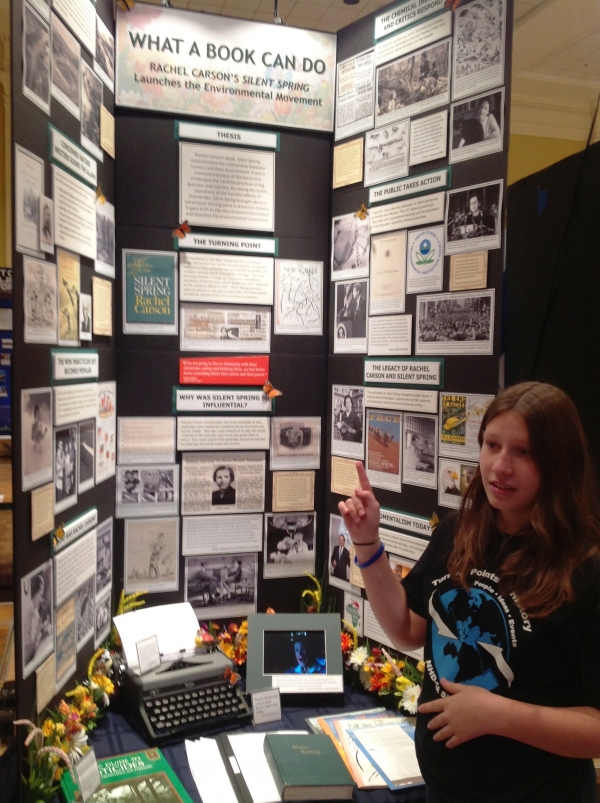
Julienne Sauer in front of her project,

Julienne Sauer in front of her project, “What a book can do — Rachel Carson‘s Silent Spring Launches the Environmental Movement.” (© 2013 San Ramon Express)

San Ramon student takes first at National History Day contest

by Jessica Lipsky

Windemere Ranch Middle School student was one of 30 recognized by the National Endowment for the Humanities (NEH) for their impressive use of historic newspapers in projects presented at National History Day.

Julienne Sauer, who graduated from eighth grade last week, took first place in NEH’s individual exhibit junior division for her project titled “What a book can do — Rachel Carson’s Silent Spring Launches the Environmental Movement.” This year’s National History Day theme was “Turning Points in History: People, Ideas, Events.”

Julienne was also named a National Endowment Humanities Scholar.

The annual event is the culmination of a year-long academic program in which students in middle and high school conduct original historical research for papers, exhibits, websites, documentaries and public performances. Each year more than 600,000 students compete in local, regional and state competitions for a chance to win a spot at the national finals.

This year was the first time NEH awarded prizes to students who incorporated into their projects research using Chronicling America, a free online database of 5 million pages of historic US newspapers dating from 1836 to 1922, digitized through a partnership between NEH and the Library of Congress.

Julienne won a national finalist award at the 2011 National History Day exhibit for her exhibit titled “The Cable Car Wars: A City Debates to Preserve its Character.”

Carson’s work was good enough that, even 49 years after her death, 51 years after the publication of Silent Spring, Carson and the book still inspire students to heights of excellence in study.

More: