How about another cup of coffee? (Global Warming Conspiracy and Starbucks Cup #289)

June 19, 2013

Encore post from September 17, 2007, and August 2009 — maybe more appropriate today than ever before.

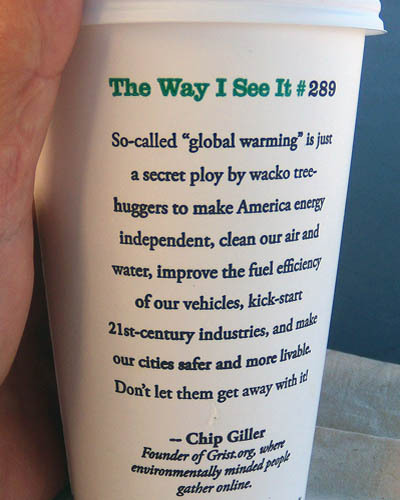
Found this on my coffee cup today (links added here):

The Way I See It #289

So-called “global warming” is just

a secret ploy by wacko tree-

huggers to make America energy

independent, clean our air and

water, improve the fuel efficiency

of our vehicles, kick-start

21st-century industries, and make

our cities safer and more livable.

Don’t let them get away with it!

Chip Giller
Founder of Grist.org, where
environmentally-minded people
gather online.

Starbucks Coffee Cup, The Way I See It #289 (global warming)

Look! Someone found the same cup I found!

I miss those old Starbucks cups — but then, they killed the Starbucks in our town.  I don’t buy the 100 cups of Starbucks coffee I used to get in a year.

More:

Save


Querying the Rachel Carson Critics (who turned out the light?)

June 19, 2013

Another question of mine that will probably never see the light of day.  This group has no answer, so why would they allow the question?

I stumbled across a blog-looking page from the American Council on Science and Health, an industry apologist propaganda site, on World Malaria Day, which was April 25.  You may recognize the name of the group as one of the industry-funded sites that constantly attacks Rachel Carson, and often the World Health Organization, with the unscientific and false claims that environmentalists bannned DDT and thereby condemned millions of Africans to die from malaria — which, ASCH claims, could have easily been eradicated with more DDT poisoning of Africa.

On World Malaria Day, ASCH took note, flirted with the facts (that DDT doesn’t work as it once was thought to work), but then backed away from the facts — that the ban on DDT in the U.S. came years AFTER WHO suspended the malaria eradication campaign in Africa when it was discovered DDT couldn’t kill DDT-adapted mosquitoes, already subject to years of abuse of DDT by agriculture and other industries.  ASCH said:

DDT kills mosquitoes, although not as well as it did 60 years ago. But it also irritates them and repels them, so the small amount sprayed inside homes effectively reduces the transmission of the malarial microbe substantially. The banning of DDT, based upon political anti-chemical bureaucrats and “environmentalists” inspired by Carson’s “Silent Spring” who ran our EPA in 1972, helped to impede the malaria control program led by the UN’s WHO.

Impede?  Impossible for a 1972 ban to have been responsible for the earlier suspension of the WHO campaign, not to mention EPA’s ban ended at the U.S. borders.  So I asked:

Screen capture of query to ACSH on how EPA's ban "impeded" WHO's campaign against malaria, ended years earlier.

Screen capture of query to ACSH on how EPA’s ban “impeded” WHO’s campaign against malaria, ended years earlier.

Ed Darrell Reply

June 19, 2013 at 5:16 am

Your comment is awaiting moderation.

I would be very interested in just how the 1972 ban on DDT in the U.S. “impeded” the UN’s antimalaria campaign, which stopped using DDT heavily seven years earlier, and was suspended in 1969.

After the ban on U.S. use of DDT, all of U.S. manufacture was dedicated to export to Africa and Asia, which greatly increased DDT supplies available there.

How did this impede?

Want to wager a guess as to whether they’ll ever allow the comment to see the light of day at their site, let alone answer it?

More:

Wall of Shame – Sites that continue to spread the pro-DDT hoax as fact:

DDT is good for me advertisement

“DDT is good for me advertisement” from circa 1955.  Photo image from the Crossett Library Bennington College.  This ad today is thought to be emblematic of the propaganda overkill that led to environmental disasters in much of the U.S. and the world.  DDT cleanups through the Superfund continue to cost American taxpayers millions of dollars annually.


Quote of the moment: Rachel Carson, on why her nature writing sounds so much like poetry

June 14, 2013

Rachel Carson said:

“If there is poetry in my book about the sea, it is not because I deliberately put it there, but because no one could write truthfully about the sea and leave out the poetry.”

Cover of The Gentle Subversive, by Mark Hamilton Lytle, for Oxford University Press.

Cover of The Gentle Subversive, by Mark Hamilton Lytle, for Oxford University Press.

Bug Girl wrote a fine review last year of an often over-looked book on Carson, The Gentle Subversive: Rachel Carson, Silent Spring, and the Rise of the Environmental Movement  (Mark Hamilton Lytle, 2007. Oxford Univ. Press.)  It’s worth your click over there to read a nice piece on Carson, on women in science, and on nature writing.

Bug Girl spends the necessary time and space answering critics of Carson, of Silent Spring, and those few odd but incredibly active and loud advocates who claim we can conquer disease if we can only spread enough DDT poison around the Earth.  Go see.

I find it impossible to stand in a place like Yosemite and not hear John Muir‘s voice — and it’s probably that John Muir found that, too.  Or stand on the shores of Waldon Pond and not hear Henry David Thoreau, or stand on sandy soil in Wisconsin and not hear Aldo Leopold, or sit on a redrock outcropping in southern Utah and not hear Ed Abbey.  They probably heard similar voices.  But they had the presence of mind to write down what they heard.

Writing wonderful prose, or poetry, must be easier when the subject sings of itself in your ears, and paints itself in glory for your eyes.

If Carson’s prose borders on poetry, does that add to, or subtract from its science value?

More:

U.S. President Theodore Roosevelt (left) and n...

U.S. President Theodore Roosevelt (left) and nature preservationist John Muir, founder of the Sierra Club , on Glacier Point in Yosemite National Park. In the background: Upper and lower Yosemite Falls. Wikipedia image


Sky that makes people repent

June 7, 2013

May 28, 2013, in Buffalo, Oklahoma.

May 28, 2013, in Buffalo, Oklahoma. Photo by Chris Sanner, Tornado Titans

Tornado Titans comment at Facebook:

“Main Street Buffalo” – Looking down Main Street of Buffalo, Oklahoma as a severe thunderstorm dumping large hail sits nearly stationary just north of town. I’ve been wanting to get a scene like this for a long time. This was still in the late afternoon and it looked like evening outside, the locals were wondering why I’d keep running out in the middle of the road in between traffic with my camera one guy stopped to ask us if we were broke down. Great people!

You see a few of these skies in a week, you’re not so anxious to stand outside and deny global warming caused by humans.  With luck, enough people will be driven to repent of their denialism, and we can get some serious action to restore the atmosphere.


Why it’s important to have accurate history and science on the internet: Don’t lie to kids about DDT

June 6, 2013

Great accomplishment by this kid from Hudson, Massachusetts — but troubling, too.  He’s winning a persuasive speech competition, persuading people against history, law and science, calling for a return of DDT.

Andrew Brandt of Hudson MA, persuasive speaking champion

Andrew Brandt of Hudson holds his winning certificate at the regional speech and debate tournament in New Hampshire in April. He was one of seven to advance to the national competition. (Photo/submitted)

Hudson – Andrew Barndt, 13, from Hudson will be traveling to Tulsa, Okla., in June to join more than 500 students competing in a National Speech and Debate Tournament.

Andrew has qualified to compete in the Persuasive Speech category with the National Christian Forensics and Communications Association (NCFCA). Home-schooled students aged 12 to 18 compete at local and regional tournaments around the country in the winter and spring, culminating in the national tournament in June.

In April, at the regional tournament in Concord, N.H., 27 students competed in the Persuasive Speech category. Andrew’s speech, “DDT: What You Think You Know May Not Be So,” was one of seven chosen to move on the national competition.

According to the NCFCA, “a persuasive speech is an original platform speech that attempts to persuade the audience to adopt a particular point of view or course of action.”

A competitor will give a speech three times in front of different three-judge panels. Judges can be other parents, members of the community or former competitors. The judges rank them on 17 criteria, including: using outside evidence, relating a clear thesis, demonstrating a logical flow of ideas, incorporating proper vocal technique, having good energy level and making eye contact. The top candidates advance to a final round and the winners are decided. Winners receive a trophy and recognition on the NCFCA website.

Andrew will present his winning speech at the national competition held at Oral Roberts University June 18-22. His speech has three parts: debunking the myth of birds’ eggs being harmed due to DDT, disproving the claim that DDT causes cancer in humans, and pointing out that DDT has saved hundred of millions of lives by reducing mosquitoes that carry malaria. He concludes by urging his listeners to repeal the ban on DDT.

“I’m an avid birdwatcher,” Andrew said. “which is how I became familiar with DDT in the first place.”

According to his mother, Ann Barndt, Andrew also competes in debate. “This year he and his brother, Jonathan, 16, partnered together as a team,” she said. “However, their record was not high enough to advance.”

She said the brothers did enjoy preparing for the tournaments, researching various aspects of the this year’s topic, the United Nations. They plan to partner together again next year.

“As for my future, I’m still thinking about how to merge [bird watching] with a sustainable livelihood,” Andrew said.

For more information about the tournament, visit www.ncfca.org.

At the site of the Hudson Community Advocate, I offered what I hope is gentle but persuasive advice to the kid, from one old debater to another:

I commend the young man on his speaking prowess — but he needs a lot of help with his research chops.

1. Birds eggs are harmed by DDT; worse, that’s just one of four ways DDT kills birds. It also poisons chicks outright, in the eggs, poisons the adults (especially migratory birds), and it disrupts the nervous systems of chicks so that, even when they do hatch, they don’t survive.

2. Although it’s a weaker carcinogen, DDT is listed as a “suspected human carcinogen” by the American Cancer Society, CDC and WHO. DDT’s carcinogenic qualities were evidenced long after EPA banned its use because it kills wildlife systems.

3. While DDT played a role in defeating malaria in some countries, it was overused, and it ceased to be so effective as it was. However, malaria rates of infection and total deaths from malaria now are much, much lower than they ever were with DDT. Since malaria deaths are reduced by more than 75%, it’s incorrect math to claim millions died without DDT, wholly apart from the history.

3.1 DDT has never been banned for use against malaria, anywhere. The U.S. ban on DDT, in fact, allowed manufacturing to continue in the U.S., with all DDT dedicated to export. So the U.S. ban, which saved the bald eagle, osprey, peregrine falcon and brown pelican, among others, also multiplied the amount of DDT available to fight malaria in Africa and Asia.

Andrew must be very, very persuasive, to persuade people that DDT, a deadly and mostly useless pollutant, should be revived. Good luck to him in his tournament, and good luck finding better sources next year.

Mr. Brandt must be excused, partly, for his error.  There remains a dedicated and well-funded disinformation assault on the reputation of Rachel Carson, author of Silent Spring, on the World Health Organization, on malaria fighters, on scientists and “environmentalists,” and this assault largely succeeds in ruthlessly elbowing aside the facts in internet searches, and elsewhere.  Fox News still employs serial-prevaricator Steven Milloy whose assault hoaxes on Carson and science of DDT should be more legendary than they are.  So-called Christian organizations join the political fray, while Christians like the Methodists actually fight malaria with the Nothing But Nets campaign — the workers are too busy to crow, the crowers are too busy to fight malaria.  (One may wonder about this Christian debate group — it caters to the small band of home schoolers.  Their evidence standards aside — standards which would disqualify most of the claims against Rachel Carson and for DDT — one wonders how a speaker would fare in this competition,  who praised Rachel Carson and the EPA for banning DDT, and for keeping the ban.  Accuracy of information is not among the criteria to be used in judging.)

The problem with lying to kids is they often believe the lies.  This isn’t a case of scientific disputes, or conflicting studies or information.  Not a jot nor tittle of Rachel Carson’s research citations has ever been questioned.  What she wrote about DDT in 1962 remains valid today, supported by more than a thousand follow-up studies and contradicted by none.  The destructive nature of DDT on bird populations is not questioned by scientists nor experienced bird watchers.  Where did this well-intentioned kid get led so far astray?

Science communicators?  What’s the solution to this problem?

More:


May 25, 1961, 52 years ago: John Kennedy challenged America to go to the Moon

May 26, 2013

President Kennedy at Congress, May 25, 1961

President John F. Kennedy speaking to a special joint session of Congress, on May 25, 1961; in this speech, Kennedy made his famous statement asking the nation to pledge to put a man on the Moon and bring him back safely, in the next ten years.

It was an era when Congress would respond when the President challenged America to be great, and Congress would respond positively.

On May 25, 1961, President Kennedy delivered a special message to Congress, on the challenges facing the U.S. around the world, in continuing to build free market economies, and continuing to advance in science, as means of promoting America’s future.  He closed with the words that have become so famous.  From the Apollo 11 Channel, excerpts from the speech, via Fox Movietone news:

History from the Apollo 11 Channel:

In an address to a Joint session of the United States Congress, Kennedy announces full presidential support for the goal to “commit…before this decade is out, to landing a man on the Moon and returning him safely to the Earth” and urges Congress to appropriate the necessary funds, eventually consuming the largest financial expenditure of any nation in peacetime.

Though Kennedy had initially been convinced that NASA should attempt a manned mission to Mars, NASA Associate Administrator Robert Seamans spent three days and nights working, ultimately successfully, to convince him otherwise.

The complete speech is 46 minutes long.  The JFK Library has a longer excerpt in good video I haven’t figured out how to embed here, but it’s worth your look.  The Library also features the entire speech in audio format.

The complete copy of the written text that President Kennedy spoke from, is also available at the JFK Library.

NASA has a good site with solid history in very short form, and links to a half-dozen great sites.

Can you imagine a president making such a challenge today?

More:


Poster for World Turtle Day (May 23)

May 23, 2013

World Turtle Day, Share the Roads!

Nice reminder, featuring an Eastern Box Tortoise (I think). Image from Conscious Companion.


More:


May 23 is World Turtle Day

May 23, 2013

English: Turtles. Français : Tortoises. Deutsc...

English: Turtles. Français : Tortoises. Deutsch: Schildkröten. Griechische Schildkröte (Testudo graeca). ¼. Klappschildkröte (Cinosternum pensylvanicum). ¼. Sumpfschildkröte (Cistudo lutaria). ¼. Matamata (Chelys fimbriata). 1/16. Großkopfschildkröte (Platysternum megalocephalurn). ¼. Lederschildkröte (Dermatochelys coriacea). 1/20. Karettschildkröte (Chelone imbricata). 1/20. (Photo credit: Wikipedia)

Just found out.  Never heard of it before — and I’m rather a turtle & tortoise kind of guy, so you’d think I’d know that.

May 23 is World Turtle Day.  In fact, this is the 13th World Turtle Day.

No grand pronouncements from Congress, probably — American Tortoise Rescue picked a day, and that was that.

American Tortoise Rescue (ATR) is sponsoring its 13th annual World Turtle Day 2013 on May 23rd.  The day was created as an annual observance to help people celebrate and protect turtles and tortoises and their disappearing habitats around the world.  Susan Tellem and Marshall Thompson, founders of ATR, advocate humane treatment of all animals, including reptiles.  Since 1990, ATR has placed about 3,000 tortoises and turtles in caring homes.  ATR assists law enforcement when undersize or endangered turtles are confiscated and provides helpful information and referrals to persons with sick, neglected or abandoned turtles.

“World Turtle Day was started to increase respect and knowledge for the world’s oldest creatures.  These gentle animals have been around for about 200 million years, yet they are rapidly disappearing as a result of the exotic food industry, habitat destruction, global warming and the cruel pet trade,” says Tellem. “We are seeing smaller turtles coming into the rescue meaning that older adults are disappearing from the wild thanks to the pet trade, and the breeding stock is drastically reduced.  It is a very sad time for turtles and tortoises of the world.”  (See slide show here http://www.slideshare.net/tellem/where-have-all-the-turtles-gone.)

Turtles, Tortoises, and Terrapins are reptiles...

Turtles, Tortoises, and Terrapins are reptiles of the Order Testudines (all living turtles belong to the crown group Chelonia), most of whose body is shielded by a special bony or cartilagenous shell developed from their ribs. (Photo credit: Wikipedia)

Tellem says, “We are thrilled to learn that organizations throughout the world now are observing World Turtle Day, including those in India, Australia, the UK and many other countries.”  Tellem notes that biologists and other experts predict the complete disappearance of these reptiles within the next 50 years.  She recommends that adults and children do a few small things that can help to save turtles and tortoises for the next generation:

  • Never buy a turtle or tortoise from a pet shop as it increases demand from the wild.
  • Never remove turtles or tortoises from the wild unless they are sick or injured.
  • If a tortoise is crossing a busy street, pick it up and send it in the same direction it was going – if you try to make it go back, it will turn right around again.
  • Write letters to legislators asking them to keep sensitive habitat preserved or closed to off road vehicles, and to prevent off shore drilling that can lead to more endangered sea turtle deaths.
  • Report cruelty or illegal sales of turtles and tortoises to your local animal control shelter.
  • Report the sale of any turtle or tortoise of any kind less than four inches.  This is illegal throughout the U.S.

“Our ultimate goal is to stop the illegal trade in turtles and tortoises around the world.  Our first priority here in the U.S. is to stop pet stores and reptile shows from selling illegal hatchling tortoises and turtles,” says Thompson.  “We also need to educate people who are unfamiliar with their proper care about the real risk of contracting salmonella from turtles.  Schools and county fairs are no place for turtles. Wash your hands thoroughly every time you touch a turtle or its water, and do not bring turtles into homes where children are under the age of 12.”

For answers to questions and other information send e-mail to info@tortoise.com; on Twitter @tortoiserescue; “Like” American Tortoise Rescue at www.Facebook.com/AmericanTortoiseRescue; and join World Turtle Day on www.Facebook.com/WorldTurtleDay.

Here’s to you Freddie, the Western Box Tortoise from Idaho, and Truck, the desert tortoise from Southern Utah, the friends of my youth.  And all you others.

Red-eared sliders, turtles at Texas Discovery Gardens - photo by Ed Darrell

Red-eared sliders cluster together to catch the sun on a spring day at Texas Discovery Gardens at Fair Park in Dallas. Photo by Ed Darrell, 2010

More:


Pay attention to the science: James Hansen proved right, critics wrong (reprise)

May 22, 2013

This is mostly a reprise of a post from October, in which we noted that climate scientist James Hansen‘s off-handed prediction of what might be warming damage to New York had come true.  Not that Hansen wanted it to ever occur, but Hansen’s conjecture had been the subject of great ridicule attempts in the warming [choose one: denialists’, critics’, apologists’s] Gish Gallop rebuttal attempts.

As it is again.  This time, a discussant pointed the Anthony Watts’s Carnival of Misbelief as the source of a claim which, the discussant said, proved liberals don’t like facts.

Here’s the run-up question, and my response:

http://twitter.com/EdDarrell/status/336945436613038080

Mr. Mears tried to extend his argument:

http://twitter.com/dave_mears/status/336963677947301889

He should have quit at bafflegab.  His link runs to Anthony Watts’s place, with the same attempted ridicule of James Hansen’s nightmare.

Watts made the same error Steve Goddard made, of course.  Watts corrected one erroneous detail — the time in which Hansen said it might occur — but tried to make the ridicule stick:

As of this update in March 2011, we’re 23 years into his prediction of the West Side Highway being underwater. From what I can measure in Google Earth, Dr. Hansen would need at least a ten foot rise in forty years to make his prediction work. See this image below from Google Earth where I placed the pointe over the West Side Highway, near the famous landmark and museum, the USS Intrepid:

According to Google Earth, the West Side Highway is 10 feet above sea level here – click to enlarge

The lat/lon should you wish to check yourself is: 40.764572° -73.998498°

We turn to the events of last October, and the storm that was Hurricane Sandy, which slammed into New Jersey and New York, and that same West Side Highway.

I noted in an earlier post, on October 30 of last year:

Over at Rabbett Run:

tonylearns said…
Could someone go over to Goddard’s blog for me ( I have been banned three times most recently for having the gall to suggest he was wrong in ridiculing the possibility of a new record minimum SIE this year. ) and ask for his apology to Hansen for ridiculing the possibility of the West Side Highway being underwater. I just saw a video showing the West Side Highway underwater.
29/10/12 7:46 PM

No! Someone whose comments don’t show up at Steve Goddard’s blog? Must be some massive disruption in the force of the Tubes of the Interweb thingy.

What is this guy Tony on about?

At Steve Goddard’s blog — this is the same guy who said the western drought was over because Lake Powell rose a few feet, though the drought raged on everywhere else — Goddard and his flying and limping monkeys have been poking fun at something James Hansen is alleged to have said:

According to NASA’s top scientist, Manhattan has been underwater for the past four years, and is experiencing a horrific drought.

While doing research 12 or 13 years ago, I met Jim Hansen, the scientist who in 1988 predicted the greenhouse effect before Congress. I went over to the window with him and looked out on Broadway in New York City and said, “If what you’re saying about the greenhouse effect is true, is anything going to look different down there in 20 years?” He looked for a while and was quiet and didn’t say anything for a couple seconds. Then he said, “Well, there will be more traffic.” I, of course, didn’t think he heard the question right. Then he explained, “The West Side Highway [which runs along the Hudson River] will be under water. And there will be tape across the windows across the street because of high winds. And the same birds won’t be there. The trees in the median strip will change.” Then he said, “There will be more police cars.” Why? “Well, you know what happens to crime when the heat goes up.”

And so far, over the last 10 years, we’ve had 10 of the hottest years on record. [Quoting an article at Salon]

The West Side Highway under water?  Ha.

Goddard’s blog has used Hansen’s quote as a regular punchline, not noticing that Hansen said “in 20 to 30 years,” and assuming he was just awfully, comically wrong.  30 years from 1988 will be 2018.  This year is 2012, six years to go.  Goddard tried to ridicule Hansen a few times over the past couple of years, for example:

  1. Here on October 4, 2010;
  2. Here on October 10, 2010;
  3. Here on November 13, 2010;
  4. Here on December 19, 2010 (with a photo of Al Gore, Barack Obama and an unidentified guy, maybe Goddard himself?);
  5. Here on January 15, 2011;
  6. Again on March 14, 2011;
  7. A special St. Patrick’s Day posting, March 17, 2011;
  8. Here on April 9, 2011;
  9. Here on May 22, 2011;
  10. Here on May 30, 2011; and obviously running out of comedy material, Goddard went for two in one day,
  11. Here on May 30, 2011, and by this time it’s such a regular meme attempting to mock James Hansen with same old material, Goddard doesn’t refer to the actual quote from Hansen;
  12. Here on June 15, 2011;
  13. Here on July 20, 2011;
  14. Here on July 21, 2011;
  15. Here on August 25, 2011;
  16. Here on May 7, 2012;
  17. Here on May 8, 2012;
  18. Here on May 23, 2012;
  19. June 25, 2012;
  20. August 9, 2012;
  21. August 23, 2012;
  22. August 31, 2012;
  23. September 28, 2012.

AP may complain about this use, but this is an academic, learning exercise:

Photo showing West Side Highway underwater from Hurricane Sandy

Caption from Yahoo! News: This photo provided by Dylan Patrick shows flooding along the Westside Highway near the USS Intrepid as Sandy moves through the area Monday, Oct. 29, 2012 in New York. Much of New York was plunged into darkness Monday by a superstorm that overflowed the city’s historic waterfront, flooded the financial district and subway tunnels and cut power to nearly a million people. (AP Photo/Dylan Patrick) MANDATORY CREDIT: DYLAN PATRICK

Dylan Patrick got the photographic evidence that shows, once again, warming denialists really are a classless, fact-lacking bunch.  CNN has photos from Dylanphoto1 (the same guy, almost certainly), in a slide show, noting, “Most of the Westside Highway south of 49th street is flooded all the way down, and in front of the USS Intrepid.”  Across from Pier 88 and the USS Intrepid, the street is indeed underwater.

So we learn that, as a comedian, Steve Goddard has an extremely limited range and depends on a sympathetic room to get laughs; and as a climate scientist, he is even more limited, and wrong, with 6 years to go in the 20 to 30 year range James Hansen offered.  And we learn once again, sadly, that James Hansen was right back in 1988 when he hit the claxons to warn us of global warming.

23 times Goddard repeated the charge?  Do you get the idea that “climate skeptics” ran out of material years ago, and have been dancing a cover-up for a very, very long time?  Hurricane Sandy blew and floated his claim away.

In this reprise post, I add three photos to make it even more clear what happened:

West Side Highway at Pier 88, flooded

From CNN: By dylanphoto1 | Posted October 29, 2012 | NYC, NY, New York — CNN PRODUCER NOTE dylanphoto1 told me, ‘It was fairly quiet with large gusts of wind and some rain. There were other people out and about taking photos and commenting on how crazy it is to see the water covering the highway. Cops were out chasing people off the highway.’

Yes, Dear Reader, that is indeed Pier 88.  New Yorkers probably recognize it as the berthing place of the U.S.S. Intrepid, the same ship Watts shows in his photo, while laughingly promising that the West Side Highway would never be flooded by the ocean at that spot.  Never?

West Side Highway flooded by Sandy, at Pier 88

CNN image, photo by dylanphoto1; in this view, Pier 88’s denizen, the U.S.S. Intrepid, can clearly be seen by the name on the stern of the ship.

One more photo from dylanphoto1:

Pier 88 during Sandy - CNN image from dylanphoto1

At New York City’s Pier 88, the U.S.S. Intrepid, with the West Side Highway in the foreground, covered by surging and rising ocean waters.

So there you have it.  Some conservatives will deny the science they claim to cling to, blaming liberals or James Hansen for being right all along.

Is this stuff from the anti-warms the Cargo Cult Science Dr. Feynman warned us about, do you think?

More (list from the October post):

Even more, a bit later:

And even more, from May 2013:


Oklahoma storms, as viewed by NASA

May 21, 2013

Oklahoma storm of May 20, 2013, as viewed by NASA Goddard's Aqua satellite.

Oklahoma storm of May 20, 2013, as viewed by NASA Goddard’s Aqua satellite.

Residents of Moore got several minutes of warning before the tornado struck, saving perhaps hundreds of lives.

Can the U.S. afford to keep cutting resources from NASA and NOAA?  Seriously?


Feynman: Last Journey of a Genius (NOVA, 1998)

May 12, 2013

Feynman and the famous C-clamp experiment -- in a glass of ice water -- at the Challenger Commission.

Feynman and the famous C-clamp experiment — in a glass of ice water — demonstrating how rubber O-rings failed in launch, at the Challenger Commission. (Why are there so few good photos of this event?)

Geography and history teachers, you should watch this on the day after Feynman Day.  Can you make use of this in your classes — say, after the state tests?

How about you physics and science teachers?

English: Green: Tuvan People's Republic

Tuvan People’s Republic, marked in green. Wikipedia image

In 1998 NOVA produced and broadcast a film that rather defies categorization.  Biography? Drama? Humor? Frustrated travelogue?

“Last Journey of a Genius” tells a lot of biography of Dick Feynman, but it focuses on his unusual drive to learn about, and travel to an obscure Central Asian country/province/area/culture called Tannu Tuva.  Feynman’s close friend Ralph Leighton plays a big role in this film, too.  This film reveals more about the character of Richard Feynman, his overwhelming curiosity and humanity, than you can get any other place, including his memoirs (which every civil human should read).

NOVA captivates me almost every week.  Good fortune found me in front of a television somewhere when this was first broadcast.  For several reasons, I’ve been unable to get a VHS, or a DVD version of the story despite many attempts over the years.

But fortune and good history smile again.  Open Culture collected the film, and it’s available for free in their documentary section.

Drumming, story telling, geography, Cold War politics, ballet, more drumming, some nuclear physics, astronomy, a lot of good humor, and a plea for orange juice.  It still makes me smile.

From Open Culture:

In 1989, PBS’ NOVA aired The Last Journey of a Genius, a television film that documents the final days of the great physicist Richard Feynman and his obsession with traveling to Tannu Tuva, a state outside of outer Mongolia, which then remained under Soviet control. For the better part of a decade, Feynman and his friend Ralph Leighton schemed to make their way to Tannu Tuva, but Cold War politics always frustrated their efforts. The video runs roughly 50 minutes and features an ailing Feynman talking about his wanderlust and their maneuverings. He died two weeks later, having never made the trip, though Ralph Leighton and Feyman’s daughter Michelle later landed in their Shangri-La. Her journey was recorded by the Russian service of the BBC.

The film now appears in the Documentary section of our collection of Free Movies Online.

via Metafilter

Related Content:

Richard Feynman’s Physics Lectures Online

The Pleasure of Finding Things Out

Hang on to this link for Feynman Day 2014 (May 11).  What’s your favorite Feynman story?

This kind of history and science is exactly the sort of stuff CSCOPE critics in Texas, and critics of the Common Core standards, worry that children will see.  Very odd, because stuff this good is not even mentioned in CSCOPE, nor in CCSS.

Tip of the old scrub brush to Kenny Darrell, who found this film and let me know about it.

More:


Feynman Day! Richard Feynman, mensch, drummer, Nobel winner, born May 11, 1918

May 11, 2013

No, we’re not joking.

May 11 is the anniversary of the birth of Richard Feynman.

Richard Feynman

Richard Feynman. Borrowed from Luciano’s Tumblr, LikeaPhysicist

In addition to his winning the Nobel Prize for Quantum Electrodynamics (QED), Feynman popularized the critique of science and other enterprises with what we now call Cargo Cult science, or education, or whatever, where people follow the dance steps, but without the rhythm and music.

Those two things alone would make him a remarkable man.  But, like a product offered for $19.95 as a good buy in a 2:00 a.m. infomercial, with Feynman, there’s more.  With Feynman, there is always more.

I got alerted to Feynman in the first days of the old Quality Paperback Book Club, when they featured his new memoir, Surely You’re Joking, Mr. Feynman!  QPBC was hot on the book, and with a title like that, how could I resist?  When I got the book a week or so later, I read it within two days, while attending law school and working full time.  I remember Feynman.

Norton published the book — and their description, alone, should make you want to read it:

A New York Times bestseller—the outrageous exploits of one of this century’s greatest scientific minds and a legendary American original.

In this phenomenal national bestseller, the Nobel Prize­-winning physicist Richard P. Feynman recounts in his inimitable voice his adventures trading ideas on atomic physics with Einstein and Bohr and ideas on gambling with Nick the Greek, painting a naked female toreador, accompanying a ballet on his bongo drums and much else of an eyebrow-raising and hilarious nature.

All true, and that’s not even the half of the outrageousness, all done with great good humor, about a life lived in great good humor through what should have been a memorable age, but often was just terrifying.

I think sometimes that Feynman’s calm, alone, borne of that great good humor and insatiable curiosity,  may have gotten us through the birth of the atomic age and the Cold War.

Feynman was a giant, and we don’t revere him enough.  Consider:

  • Feynman’s high school sweetheart, Arlene, came down with tuberculosis.  He married her, and took her with him to New Mexico to make the atom bombs.  The stories of her confinement to a hospital, and the laborious trekking he had to make between Los Alamos and her bedside in Santa Fe, are touching, and heartbreaking.  It is one of the great love stories of the 20th century, certainly, and perhaps for all time.  It also provided the title for his second memoir, What Do You Care What Other People Think?
  • Every single, college-age man should read Feynman’s stories of how to date, and how to seduce women.  His approach was unique, and endeared him to women — in legend, to many women.  Feynman’s dating must have been part of the inspiration for the comedy series, “Big Bang Theory.”  Feynman’s stories are better.  (Heck, it’s even the subject of a popular, classic XKCD comic — probably only Feynman and Einstein among Nobel-winning physicists have made so much money for so many cartoonists.)
US postage stamp featuring Richard Feynman

US postage stamp featuring Richard Feynman

  • Yeah, he’s already been featured on a postage stamp, see at right.  That’s not good enough for Feynman, though — the U.S. Postal Service created a special cancellation stamp for Feynman, featuring a version of his Feynman Diagrams.

    A special postal cancel was authorized by the USPS (United States Postal Service) to honor the 80th birthday of Richard Feynman. This cancel was used in Lake Worth, Florida. For this special day the post office was renamed “Feynman Station.”

    Feynman Commemorative Cancel Feynman Diagram

    The Feynman Diagram used for the postal cancel on this envelope depicts what is known as a “bubble process.” It shows a high energy particle, for example, a cosmic ray (a) from a distant supernova, which emits a high energy photon, for example, a gamma ray (b). The photon, in turn, creates a particle (c) and an anti-particle (d) that exists for a brief moment and then recombines.

    As Feynman liked to point out, an anti-particle is the same thing as a particle with negative energy traveling backward in time (which is why the arrow at (d) points backwards, i.e. to the left). So you could say the photon created only one particle that, at first, traveled forward in time (the bottom semi-circle) and then reversed and went back in time (the top semi-circle) and annihilated itself! By inventing diagrams like this, Richard Feynman made it much easier to understand what is going on in the interactions between sub-atomic particles without getting lost in tremendous amounts of tedious math

  • Working at Los Alamos on the Manhattan Project, Feynman developed a keen appreciation for bureaucracy and all its follies.  His vexations for the security managers are also legendary.  Here’s a quick version of one story — he asked friends and family to write to him in code, but to not include a key to the code, so he’d have to crack the code to read the letter.  Feynman could do it, but the security people couldn’t.  Hilarity ensued.
  • Feynman developed a love for the still-relatively unknown, landlocked Asian nation of Tannu Tuva.  It’s just the sort of place to appeal to a character like Feynman — so obscure most atlases didn’t, and don’t, show it at all — seemingly consumed by the Soviet Union, but held in a special status.  Home of throat singing — and almost impossible to get to.  During the Cold War, Feynman struck up correspondence with people in Tuva, to the concern of Soviet and American intelligence agencies, who seemed not to understand someone might do such thing out of curiosity.  Feynman hoped to travel there to visit new friends, but his final bouts of cancer took him before it was possible.  Tuva, famous among philatelists only, perhaps, honored Feynman with postage stamps and postcards.
  • Just try to find a photo of Feynman not smiling. The man was a joy to be around, for most people, most of the time.
  • Quantum electro dynamics?  No, I can’t explain it, either — but his work had a lot to do with how particles wobble.  I remember that because, according to Feynman, he got the inspiration for the work for which he won the Nobel while spinning plates, like a Chinese acrobat on the Ed Sullivan Show, to the delight of students in the Cornell University cafeteria, and the shock and horror of the food service people.  Who else has yet confessed to such an inspiration for a Nobel?

There’s more — a lot more.  Feynman outlined our current generation of computer memory devices — in 1959.  No, he didn’t patent the idea.  He did patent an idea for a nuclear-powered spacecraft.  Another delightful story.

Feynman in an Apple ad

Feynman was featured in print and broadcast ads for Apple — not one, but two (did anyone else get that honor from Apple?). “Think Different.” This is one of Apple Computer’s most successful advertising campaigns. The theme of the campaign is one that celebrates figures in history who changed the world by thinking differently. Richard Feynman was among the chosen figures.

Feynman served on the board that approved science books for the California school system — his stories of that work will shock some, but it will make others shake their heads as they recognize the current crop of cargo-cultists and political bullies who dominate textbook approval processes, knowing nothing at all about what they are doing, or why.

No, I didn’t forget his brilliant work on the commission that studied the Challenger disaster, for NASA. There’s so much stuff to glorify!

In history, Feynman should be remembered much as we remember Thomas Jefferson, as a renaissance man in his time, a man who put great intellect to great work for his nation and all humanity.

Feynman's second Apple ad

The second Apple ad featuring Richard Feynman. An excerpt from Apple Computer’s campaign commercial: “Here’s to the crazy ones, the misfits, the rebels, the troublemakers, the round pegs in the square holes, the ones who see things differently. They’re not fond of rules and they have no respect for the status quo. You can quote them, disagree with them, glorify or vilify them… about the only thing you can’t do is ignore them, because they change things, they push the human race forward; and while some may see them as the crazy ones, we see genius, because the people who are crazy enough to think they can change the world are the ones who do.”

The sages say we shouldn’t have regrets, but I do have one.  When the Challenger Commission was meeting in Washington, D.C., I was working on another commission up the street.  I knew Feynman was ill, but our work was important, and we’d heard his disease was in remission.  I didn’t goof off a day and go to any of the hearings to see him, to get an autograph, to meet the man.  I though I’d have other opportunities to do that.  Now I regret not having met him in person.

In print, and in film, I know him well.  In our family, reading Feynman is something everybody does.  Feynman’s memoir was one of the last books I read to our son, Kenny, as he was growing up, and growing into reading on his own.  Even reading about Feynman, together, was an adventure.  Our son, James, took us into the real physics of Feynman, and though I struggle with it more than James, we still read Feynman, for humor, and physics.

What would be appropriate ways to mark Feynman’s birth?  At some future date, I hope we’ll have public readings of his books, showings of the documentaries about him, recreations of his lectures, perhaps.  And then everyone can get in a circle, beating drums and singing about getting some orange juice, before sending postcards to our friends in Tuva.

Richard Feynman, we still need you, and miss you dearly.

Tannu Tuva

Tuva’s capital is the delightfully-named Kyzyl. From this map, can you figure out where Tuva is, or how to get there — without Google, or Bing?

Tuva postcard honoring Richard Feynman

Tuva postcard, in honor of Richard Feynman — who loved to drum.

There will always be “More” about Richard Feynman, if we’re lucky:

Have a great Feynman Day!


Grosbeak!

May 1, 2013

Our goldfinches left several weeks ago.  The cedar waxwings came through in at least three big waves, starting in February (and the last just over a week ago).  House finches moulted, and the breeding males have bright red heads. Migrating robins left us by the end of January, but a lot more residents stayed with us.

We have at least one, and maybe three cardinal families.  A black-capped chickadee family stuck around.  Haven’t seen a titmouse in a month, but I think they’re still in the neighborhood.  The black-chinned hummingbird family is back, and maybe a few other hummers.  The resident blue jays and white-winged doves duke it out every day.  Carolina wren stayed, and may have already fledged; but there are too many wrens for one family — is that a Bewick’s wren?

What’s THAT?

White winged dove and rose-breasted grosbeaki

White-winged dove, left, can’t scare away the rose-breasted grosbeak from the songbird feeder. Photo by Ed Darrell

IMGP4861

Look closer. Photo by Ed Darrell

It’s a rose-breasted grosbeak, Pheucticus ludovicianus.  It seems late for migrating birds, but only because so many migratory species migrate earlier these days.

Haunts of the rose-breasted grosbeak, from Cornell University's ornithological laboratory.

Haunts of the rose-breasted grosbeak, from Cornell University’s ornithological laboratory.

Would love to have a grosbeak family, but the Cornell ornithologists say this is fly-through territory.  Maybe that explains why it won’t scare by the white-winged dove, Zenaida asiatica.  Dallas is the western edge of the grosbeaks’ migratory path, but the eastern edge of the dove’s territory.  They probably don’t see much of each other.

We don’t even advertise clean restrooms.

More:


Resources for World Malaria Day 2013

April 25, 2013

Not a word about condemning Rachel Carson.  No plea to use DDT to try to poison Africa or Asia to health.  That’s a great start.

More:

Mother and son under a protective bednet, the most efficient method to prevent malaria.  Columbia University MVSim image

Mother and son under a protective bednet, the most efficient method to prevent malaria. Columbia University MVSim image


April 25 is World Malaria Day — right, Bill?

April 24, 2013

He’s absolutely right.

English: World Malaria Day Button (english)

English: World Malaria Day Button (english) (Photo credit: Wikipedia)

What are you doing to fight malaria today?

More: