March 17, 2010
Remember the sage grouse? People groused because the U.S. Department of Interior Fish and Wildlife Service determined most populations of western sage grouse are threatened enough to earn listing as an endangered species under the Endangered Species Act — but then refused to list the bird, because other plants and animals are even more threatened, and need attention sooner. (I was one of those people complaining.)
It’s a new administration. U.S. Department of Agriculture offered $16 million for projects to protect the bird’s habitat. This ruling put increased pressure on state wildlife agencies, in an interesting if not unique twist of the issue of federalism, state vs. federal responsibility for wildlife and wild lands. Wyoming wants $3 million right away, for projects mostly on private land.
In other words, the administration will sometimes find ways to do the right thing without doing the most difficult or controversial thing. Ranchers and energy developers cheered by original decision are also happy about Ag’s proposed spending. Environmentalists unhappy with the first ruling shouled be cheered by Ag’s action, too. State agencies that worked hard to make the case for listing the bird may be cheered, also.

Sage grouse habitat threatened by deveolopment, in Nevada - Las Vega Sun graphic
Readers of the Las Vegas Sun learned about the program last week — the Sun has covered the sage grouse as part of its coverage of alternative energy programs. Much sage grouse habitat in Nevada overlaps wind energy and geothermal energy development zones.
Ranchers across the west are being offered millions of dollars in aid from the federal government to make their operations more environmentally sustainable and reduce their impact on the sage grouse the U.S. Department of Agriculture announced today.
“USDA will take bold steps to ensure the enhancement and preservation of sage grouse habitat and the sustainability of working ranches and farms in the western United States,” Agriculture Secretary Tom Vilsack said. “Our targeted approach will seek out projects that offer the highest potential for boosting sage-grouse populations and enhancing habitat quality.”
The Department of Agriculture’s Natural Resources Conservation Service will soon begin accepting applications for two federal programs aimed at reducing threats to the birds such as disease and invasive species and improving sage-grouse habitat. The agency will have up to $16 million at its disposal for the programs.
The Wilderness Habitat Incentive Program provides up to 75 percent cost-share assistance to create and improve fish and wildlife habitat on private and tribal land.
Sage grouse face a difficult future. State wildlife management agencies face a tough future, too, in trying to save the birds. The nation needs energy resources found, often, where the sage grouse need lands to meet, mate and raise their young. It’s a difficult balancing act.
More information:
Spread the word; friends don't allow friends to repeat history.
 1 Comment |
  Biology, endangered species, Environmental protection, Natural history, Natural resources, Regulation, Science, Wildlife | Tagged: Biology, endangered species, Environmental protection, Natural resources, Sage Grouse, Science, Wildlife |
  Permalink
 Posted by Ed Darrell
March 17, 2010
Tuesday, March 16 was the 259th anniversary of the birth of James Madison, the Father of the Constitution, the sponsor of the Bill of Rights, the life-long campaigner for good government based on knowledge of the errors of history, especially in the area of religious freedom.
Under social studies standards proposed by the Texas State Board of Education, Texas students will never study Madison’s views, or Madison’s Constitution, without intervention by their parents or good teachers who run some risk to teach the glories of American history to students.
Newspaper stories across the nation concentrated on Madison’s birthday expressed revulsion and rejection of the crabbed and cramped views of the Texas SBOE, and the cup of revulsion runneth over.
For example, the attempted evisceration and hobbling of science standards occurred last year, but the editorial cartoon in USA Today reached back to remind us just what is going on in Austin.

By Scott Stantis, Chicago Tribune, for USA TODAY, March 16, 2010
More comment to come.
Tip of the old scrub brush to Christina Castillo Comer.
Spread the word; friends don't allow friends to repeat history.
2 Comments | Accuracy, America's founding, American Revolution, Economics, Education, Education quality, Evolution, History, Science, Social Studies, State school boards, Texas | Tagged: Economics, Education, education standards, Evolution, History, Science, Social Studies, Texas State Board of Education | Permalink
Posted by Ed Darrell
March 17, 2010
Steve Schafersman sends along a press release; Texas college biology departments continue to advance science and education despite foggings from the State Board of Education. Odd thought: You can be relatively certain that you can avoid Don McLeroy, David Bradley or Cynthia Dunbar, by being at the Alkek Library Teaching Theatre on the evening of March 23; learning will be occurring there at that time, and so it is a cinch that the leaders of the Austin Soviet will not be there:
Evolution expert to deliver lecture at Texas State
SAN MARCOS — Jerry A. Coyne, professor in the Department of Ecology and Evolution at the University of Chicago, will present an evening talk and book signing at 7 p.m. Tuesday, March 23, at the Alkek Library Teaching Theatre on the campus of Texas State University-San Marcos.

Jerry Coyne and friend (image stolen from Larry Moran's Sandwalk; pretty sure he won't mind)
Coyne’s presentation is titled Why Evolution is True (and why many think that it’s not) and is based on his latest similarly-titled book.
Admission is free and doors will open at 6:30 p.m. A book signing with light refreshments will take place following the lecture.
Coyne is an evolutionary biologist whose work focuses on understanding the origin of species. He has written more than 100 peer-reviewed scientific papers on the subject.
In addition, he is a regular contributor to The New Republic, the Times Literary Supplement, and other periodicals. He runs the popular Why Evolution is True blog, and is an internationally known defender of evolution and critic of creationism and intelligent design.
The book Why Evolution is True has received widespread praise for providing a clear explanation of evolution, while succinctly summarizing the facts supporting this revolutionary theory.
Coyne’s lecture is sponsored by the Department of Biology and the Philosophy Dialogue Series at Texas State. Contact Noland Martin (512) 245-3317 for more information. For more information about Coyne and his book, please visit his blog: http://www.jerrycoyne.uchicago.edu. [and Why Evolution is True]
This lecture is part of a larger series on philosophy and science, featuring a few lectures that appear designed solely to irritate P. Z. Myers:
Philosophy dialogue to take up evolution, identity

Texas State philosopher Jeffrey Gordon will be among the speakers at the university’s Philosophy Dialogue Series in the next two weeks. Texas State photograph.
STAFF REPORT
The Philosophy Dialogue Series at Texas State will present evolution and identity as its discussion topic for the next two weeks in Room 132 of the Psychology Building on campus.
Following is the schedule of events, giving the discussion titles, followed by the speakers.
March 16: 12:30 p.m. – Evolution and the Culture Wars, Victor Holk and Paul Valle (Dialogue students). 3:30 p.m. – Arabic Culture 101: What You Need to Know, Amjad Mohammad (Arabic Language Coordinator).
March 17: 2 p.m. – Phenomenology of Humor, Jeffrey Gordon (Philosophy)
March 18: 12:30 p.m. – Stayin’ Alive: Does the Self Survive? Blaze Bulla and Sky Rudd (Dialogue students).
March 19: 10 a.m. – Sustainability group, topic be announced, Laura Stroup (Geography). 12:30 p.m. – Talk of the Times, open forum.
March 23: 12:30 p.m. – Evolution: An Interdisciplinary Panel Discussion, Harvey Ginsberg (Psychology), Peter Hutcheson (Philosophy), Kerrie Lewis (Anthropology), Rebecca Raphael (Philosophy & Religious Studies). Special guest panelist, Jerry Coyne, University of Chicago (Evolutionary Biology). Evening lecture – Why Evolution is True, Jerry Coyne, University of Chicago, time and place to be announced.
March 25: 12:30 p.m. – Constructing a Masculine Christian Identity: Sex, Gender, and the Female, and Martyrs of Early Christianity, L. Stephanie Cobb, Hofstra University (Religion and Women’s Studies).
March 26: 10 a.m. – Sustainability Group: Civic Ecology, and The Human Rights of Sustainability, Vince Lopes (Biology), Catherine Hawkins (Social Work). 12:30 p.m. – Talk of the Times, open forum.
Sponsors of the Philosophy Dialogue Series include: the American Democracy Project, the College of Liberal Arts, Common Experience, the Gina Weatherhead Dialogue Fund, the New York Times, the National Endowment for the Humanities, Phi Sigma Tau, University Seminar, the University Honors Program, the Provost and Vice President for Academic Affairs and the Vice President for Student Affairs.
For more information about this topic, contact Beverly Pairett in the Department of Philosophy at (512) 245-2285, or email philosophy@txstate.edu. A complete schedule of discussion topics and presentations can be found at http://www.txstate.edu/philosophy/dialogue-series/Dialogue-Schedule.html.
Probably can’t make it to San Marcos from Dallas on a school night. San Marcos biology and social studies students, and teachers, should plan to be there.
Spread the word; friends don't allow friends to repeat history.
2 Comments | Biology, Books, Education, Evolution, Science, Science and faith, Texas, Texas Citizens for Science | Tagged: Biology, Books, Education, Evolution, Jerry Coyne, Philosophy, Science, Texas, Texas State University - San Marcos, Why Evolution Is True | Permalink
Posted by Ed Darrell
March 14, 2010
Broadcast from March 13, 2010; transcript and link to MP3 version of the broadcast, here.
A few minor errors, but overall a good history of Rachel Carson and DDT.
Spread the word; friends don't allow friends to repeat history.
Leave a Comment » | DDT, Environmental protection, Government, Rachel Carson, Radio, Research, Science, Wildlife | Tagged: Biology, DDT, Environmental protection, Rachel Carson, Science, US Fish and Wildlife Service, Voice of America, Wildlife | Permalink
Posted by Ed Darrell
March 10, 2010
A new paper in the Journal of Science Communication offers a critique of the workings and effectiveness of science bloggers.
Happily for us, the paper is open access, freely available.
The article appears to be from some research for a Ph.D.:
Inna Kouper is a doctoral candidate in the School of Library and Information Science, Indiana University
Bloomington. Her current research interests lie broadly in the areas of language and information; the role
of science in society; and the evolution of information and communication technologies generally
described as social or participatory media (such as blogs, wikis, podcasts, etc.).
Several bloggers say the paper gets wrong what science bloggers do, and what they should do.
Perhaps — you can read the paper yourself and compare it with the criticism.
I do want to call your attention to a very good feature of the paper. It analyzes postings on 11 of the top science blogs in the world.
1 Pure Pedantry scienceblogs.com/purepedantry
2 Synthesis http://www.synthesis.cc
3 MicrobiologyBytes http://www.microbiologybytes.com/blog
4 Wired Science http://www.wired.com/wiredscienc
5 BioEthics blog.bioethics.net
6 DrugMonkey scienceblogs.com/drugmonkey
7 Scientific Activist scienceblogs.com/scientificactivist
8 Pharyngula scienceblogs.com/pharyngula
9 Panda’s Thumb http://www.pandasthumb.org
10 ScienceBlog scienceblog.com
11 Cosmic Variance blogs.discovermagazine.com/cosmicvariance
How can you tell the paper’s serious? The 11 blogs analyzed do not include any of the junk science blogs, like Uncommon Descent or Watt’s Up With That?
If you listen carefully, you can hear Bill Dembski and Anthony Watts stewing.
Spread the word; friends don't allow friends to repeat history.
3 Comments | History, Journalism, Science, Weblogs | Tagged: Accuracy, blogs, Journalism, Science, Weblogs | Permalink
Posted by Ed Darrell
March 9, 2010
Sage grouse don’t vote. If they did vote, they’d have a difficult time picking between Democrats and Republicans on their own life and death issues.
Of course, there aren’t enough sage grouse to make much of a difference on election day. That’s the problem.

Courting sage grouse - Photo from Gail Patricelli, University of California - Davis
Last week the U.S. Department of the Interior released a decision on the fate of the sage grouse: Near enough to extinction to merit protection under the Endangered Species Act, but too far down the list of endangered plants and animals to merit action on anything at the moment.
That means that the vanishing habitats of the little, magnificent bird, can be crushed by trucks making tracks across westerns prairies, deserts and mountains searching for oil.
Exxon-Mobil 1, Sage Grouse 0. One might must hope that’s an early game score, and not the population counts.
Jim Tankersly explained the situation, more dispassionately, in The Los Angeles Times:
Reporting from Washington — The Interior Department declared Friday that an iconic Western bird deserves federal protection under the Endangered Species Act, but declined to offer that protection immediately — a split decision that will allow oil and gas drilling to continue across large swaths of the mountainous West.
The department issued a so-called “warranted but precluded” designation for the greater sage grouse, meaning that the bird merits protection but won’t receive it for now because other species are a higher priority.
My childhood was marked by rapidly plummeting bird populations all around us. Stopping the use of DDT benefited some of them, the Endangered Species Act benefited others. Conservation efforts of groups like Ducks Unlimited and the Audubon Society saved others, and helped all of them. While I lived near a great river, a view of a heron, egret or crane is not what I recall from my childhood. Our children know the birds well.
Land birds, like turkeys, are even more rare. Turkeys, mostly in eastern forested areas, at least well out of the Mountain West, made dramatic recoveries with massive aid from state game commissions. I recall one column from the Washington Post’s recently retired hunting and outdoors columnist, Angus Phillips, in which he confessed that with the aid of professional guides paid from the paper’s expense accounts, in more than 15 years of hunting he had heard, but never seen, a wild turkey. This was two weeks after we had come upon a flock just off the side of the Baltimore-Washington Parkway, the first I’d ever seen.
I remembered Phillips’ confession a few months later as I sat in the cold, at dawn, in a field at the Land Between the Lakes preserve of the Tennessee Valley Authority with other staff and members of the President’s Commission on Americans Outdoors, when a guide summoned seven magnificent, lustful wild turkey toms to race across a field toward the lustful hen sounds the guide made with a part of a birth control diaphragm as a calling device.
In my years tramping the west for fun, in the months camping with the Scouts, in the professional tramping with the Air Pollution Lab and the Senate and the Utah Wilderness Commission, and just for fun, I’ve never seen a sage grouse.
Whether my children get such an opportunity, and their children, is a decision for the moment left to private interests, especially private groups with a financial stake in trampling out the nestings where the youth of grouse are grown.
Exxon-Mobil, will you and your colleagues go easy on the grouse, please?
More:
- You will enjoy Phillips’ last column, even if you are not a lover of the outdoors. I was happy to see that he no longer complains of never having seen a turkey. He’s also hunted grouse, successfully — though, perhaps not sage grouse. One of the things that makes a great newspaper like the Washington Post a great newspaper, is the assignment of fine and curious writers like Phillips to beats that may appear to be backwaters to too many. Who succeeded him at the Post?
- Western Watersheds, a Wyoming-based group that advocates protection of mountain watersheds in the west, filed a supplement to their 2006 federal suit in Boise, Idaho, to contest part of the decision by the U.S. Fish and Wildlife Service (USFWS). Story from the San Jose Mercury-News. More from the Idaho Statesman.
- Rocky Mountain oil explorers aren’t happy with the decision, either — if it means they still have to be careful, according to the Colorado Independent.
- Nevada wildlife and ranching poobahs are unhappy with the ruling, too – San Francisco Chronicle.
- Christopher Smart writes about the decision in the Salt Lake Tribune (news, not commentary)
- Press release from Western Watersheds at Ralph Maughan’s Wildlife News; commentary on Nevada grousing about the grouse decision, too; Jon Marvel’s comments on the USFWS decision
Spread the word; friends don't allow friends to repeat history.
4 Comments | endangered species, Environmental protection, History, Natural history, Research, Science, Wildlife | Tagged: Endangered Species Act, Environmental protection, Government, Natural history, Research, Sage Grouse, Wildlife | Permalink
Posted by Ed Darrell
March 6, 2010
Three earthquakes in a week do not make a swarm. Interesting that the last post on an earthquake in Oklahoma drew earthquake conspiratorialists and “skeptics.” Too many people distrust all science and sources of information these days.
Here’s the dirt on Oklahoma’s shaking in the last week, from the U.S. Geological Service site:
Earthquake List for Map Centered at 36°N, 97°W
Update time = Sat Mar 6 18:00:02 UTC 2010
Here are the earthquakes in the Map Centered at 36°N, 97°W area, most recent at the top.
(Some early events may be obscured by later ones.)
Click on the underlined portion of an earthquake record in the list below for more information.
This isn’t unusual at all, of course. I think many people just don’t understand that earthquakes happen all the time, but they usually get crowded out of the newspaper because no one really cares.
For contrast, take a look at this animated map of a strip a little wider than Utah, covering from north of the Yellowstone Caldera to Arizona. Run the animation. Generally on any day there will have been at least two dozen earthquakes in the previous week, several magnitude 3, occasionally a magnitude 4 thrown in.
Almost none of those quakes make any news.
Maybe it’s the Earth, laughing. We can hope.
Laugh, and the world laughs with you;
Weep, and you weep alone.
For the sad old earth must borrow it’s mirth,
But has trouble enough of its own.
Sing, and the hills will answer;
Sigh, it is lost on the air.
The echoes bound to a joyful sound,
But shrink from voicing care.
(Excerpted from “Solitude,” 1917, by Ella Wheeler Wilcox (1850-1919))
Spread the word; friends don't allow friends to repeat history.
1 Comment | earthquakes, Geography - Physical, geology, History, Journalism, Natural history, News, Newspapers, Poetry, Science | Tagged: denialism, earthquakes, Ella Wheeler Wilcox, geography, geology, History, Journalism, Oklahoma, Science, Skepticism, Solitude | Permalink
Posted by Ed Darrell
March 4, 2010
Here’s another point of science that will give rational people concern, and which cannot in any way be explained as “no problem” by stolen e-mails: Methane releases from the floor of the East Siberian Arctic are much larger than predicted.
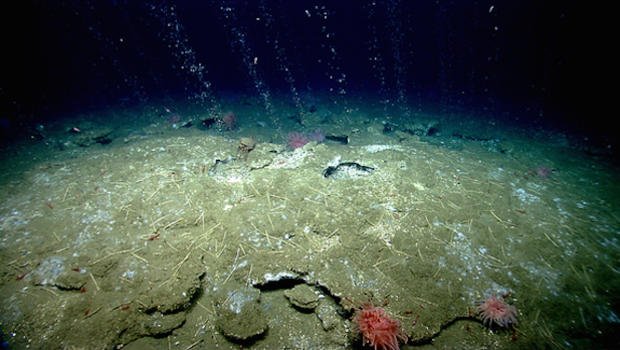
Underwater methane gas plumes, Photo: NOAA Okeanos Explorer Program, 2013
Methane is a more powerful greenhouse gas than carbon dioxide. Frozen forms of methane dot the bottoms of our oceans. Warming of the oceans might be able to trigger an explosive thawing of the methane hydrates, as the frozen forms are known, seriously adding to our worldwide greenhouse gas problems.
Story here at Global Change. Science article on which that post is based, here.
Cool SONAR pictures of methane bubbling up from the floor of the Arctic Ocean, but scary once you realize what they are, at this vintage post at Millard Fillmore’s Bathtub.
Is there any chance this research will merit a mention at the climate denialist blogs?
Spread the word; friends don't allow friends to repeat history.
11 Comments | Climate change, climate_change, Geography - Physical, Global warming, Globalization, Green Politics, oceans, Science | Tagged: Climate change, geography, Global warming, Methane, Methane Hydrates, Ocean Acidification, Oceanography, oceans | Permalink
Posted by Ed Darrell
March 4, 2010

Quake rankings of states
Which states shake the most? Here are the top 20.
Surprised that Maine makes the list?
Much more from the US Geological Survey here, “Top Earthquake States.”
Spread the word; friends don't allow friends to repeat history.
5 Comments | earthquakes, Geography - Physical, Geography - Political, geology, History, Science | Tagged: earthquakes, geography, geology, Top 20 Earthquake States, U.S. history, US Geological Survey | Permalink
Posted by Ed Darrell
March 1, 2010

RMS Titanic sank? No one alive today saw it sink. According to Salt's site, iIntercepted memoranda raise doubts about alleged boat's alleged sinking, and alleged engineering and design errors.
Alun Salt has the full story:
I don’t know about you but I’ve been absolutely riveted by the recent release of records from a break-in at the White Star line. No really, it’s not just a stream of bilge from people who may not be experts but reckon something. Frankly I can’t get enough of hearing about the same claim that one memo by one of the workers on the Titanic project clearly confirms the ship was ‘unsinkable’. This should finally put to rest the biggest hoax of the 20th century, that the Titanic sunk in the North Atlantic. Still there’s always someone who isn’t going to find a bit of a memo quoted out-of-context convincing so it’s worth recapping the clear evidence that the ’sinking’ of the Titanic is a scam.
Specifics, with applause by Anthony Watts and Joanne Nova, at Archaeoastronomy. (Well, no, not really; neither Watts nor Nova would link to such a reasonable site as Salt’s.)
Spread the word; friends don't allow friends to repeat history.
10 Comments | Climate change, climate_change, Global warming, Hoaxes, Political Smear, Politics, Reason, Science | Tagged: Climate change, Environmental protection, Global warming, Hacked E-Mails, Hadley CRU, Hoaxes, Political Smear, Politics, Science | Permalink
Posted by Ed Darrell
March 1, 2010
While attention was on Hawaii, wondering about the tsunami’s effects there, Oklahoma got hit with an earthquake of magnitude 4.1, a big one for such a flat, geologically inactive state (link goes to USGS site).

Epicenter of Oklahoma earthquake, February 27, 2010
Most likely there is no connection between the Oklahoma quake and any other shaking on Earth in the past week or so.
Spread the word; friends don't allow friends to repeat history.
10 Comments | earthquakes, Geography - Physical, Geography - Political, geology, Science | Tagged: Earthquake, geography, geology, Oklahoma, Oklahoma Earthquake, Science, USGS | Permalink
Posted by Ed Darrell
February 28, 2010
Hawaii missed a big tsunami.
That’s probably not entirely accurate, let’s rephrase: Hawaii didn’t get a significant tsunami from the Chilean quake. The Hawaiians didn’t miss it at all. Hawaiians moved to higher ground. They prepared for disaster. Then the disaster didn’t occur.
That’s good news, especially since there remains disaster in Chile to worry about.
How long before some yahoo complains we shouldn’t trust USGS, nor NOAA?
Resources:
Spread the word; friends don't allow friends to repeat history.
1 Comment | Disasters, earthquakes, Geography - Physical, geology, History, Science | Tagged: Disasters, Forecasting, geography, geology, Hawaii, History, Science, Tsunami | Permalink
Posted by Ed Darrell
February 27, 2010
As I write this it’s more than five hours away.

Earthquake map from USGS, showing location of the Chile quake 2-27-2010 - click on map to go to interactive version at USGS site
A horrible, devastating earthquake hit Chile last night, on the west coast of South America. Scientists at the Pacific Tsunami Warning Center fear it may have triggered a tsunami that will hit Hawaii today (an AP story says at 5:19 p.m. Eastern; that’s 4:19 p.m. Central, and just after 11:00 a.m. in Honolulu, Hawaii, Hawaiian-Aleutian Standard Time (HAST).
HONOLULU (Reuters) – Hawaii prepared to start evacuations ahead of a tsunami generated by a massive earthquake in Chile, a civil defense official on the U.S. island said on Saturday.
It planned to sound civil defense sirens across the island state at 6 a.m. local time (11 a.m. EST) after the Pacific Tsunami Warning Center said a tsunami was generated that could cause damage along the coasts of all the Hawaiian islands,
“Get off the shore line. We are closing all the beaches and telling people to drive out of the area,” said John Cummings, Oahu Civil Defense spokesman.
Buses will patrol beaches and take people to parks in a voluntary process expected to last five hours.
More than an hour before sirens were due to sound lines of cars snaked for blocks from gas stations in Honolulu.
“Urgent action should be taken to protect lives and property,” the Warning Center said in a bulletin. “All shores are at risk no matter which direction they face.”
* * * * * * * *
The warning follows a huge earthquake in Chile that killed at least 82 people and triggered tsunamis up and down the coast of the earthquake-prone country.
The center estimates the first tsunami, which is a series of several waves in succession, will hit Hawaii at 11:19 a.m. Hawaii time (4:19 p.m. EST) in the town of Hilo on the Big Island of Hawaii, with waves in Honolulu at 11:52 a.m.
Sardina said the Hawaiian islands could expect waves of six feet (two meters) in some places. Other estimates have been higher but he could not confirm those were likely.
Plate tectonics at work — the Pacific plate pushing underneath South America. The epicenter was 22 miles deep. We get a glimpse into how geologists and others work with a report from the Times of London:
Several big aftershocks later hit the south-central region, including ones measuring 6.9, 6.2 and 5.6.
The earthquake was caused by the floor of the Pacific being pushed below South American land mass.
This sudden jerking of the sea-floor displaced water and triggered a tsunami, which is now crossing the ocean at a speed of a jet plane.
The Pacific Tsunami Warning Center issued a warning for Chile and Peru, and a less-urgent tsunami watch for Ecuador, Colombia, Panama, Costa Rica and Antarctica.
A spokesman said: “Sea level readings indicate a tsunami was generated.
Will a potential disaster in human lives be averted?
Isn’t this exactly how science is supposed to work? Will the anti-science yahoos ignore the warnings?
Woo notice: Our dogs were restless last night. I had to get up twice to let them out just to bark with the rest of the dogs in the neighborhood, who all seemed to be going nuts at once. Looking at the news stories, it was just a bit before the big quake hit Chile. It doesn’t make sense to me that dogs so far away from the epicenter would be affected that way.
Resources:

Hawaii map and threat map from the Pacific Tsunami Warning Center, February 27, 2010. Click on image for current information.
Spread the word; friends don't allow friends to repeat history.
9 Comments | Disasters, earthquakes, Geography - Physical, geology, Science | Tagged: Chile, Disasters, earthquakes, geography, geology, Hawaii, Science, Tsunami | Permalink
Posted by Ed Darrell
February 20, 2010
Actual observations of the world show global warming. Time-lapse photos of the destruction of the Columbia Glacier, in Alaska, by James Balog, should make any person start wondering how to control warming processes.
It’s a film documenting warming, a film that Joanne Nova and Anthony Watts hope you will never see.*
James Balog, at TEDS, explains the stuff in under 20 minutes:
From National Geographic’s site:
© 2008 James Balog/Extreme Ice Survey
This remarkable image sequence captures a series of massive calving events at Columbia Glacier near Valdez, Alaska. Composed of 436 frames taken between May and September of 2007, it shows the glacier rapidly retreating by about half a mile (1.6 kilometers), a volume loss of some 0.4 cubic miles (1.67 cubic kilometers) of ice or 400 billion gallons (1.5 trillion liters) of water.
The time-lapse was taken as part of the ongoing Extreme Ice Survey (EIS), an ambitious project to capture global warming-induced glacial retreat in the act. Beginning in December 2006, photographer James Balog and his colleagues set up 26 solar-powered cameras at glaciers in Greenland, Iceland, Alaska, the Alps, and the Rocky Mountains. Each unit will take a photograph every daylight hour until fall 2009.
In 2008, Balog’s team began to return to each of the camera sites to collect images. In the end, they will have more than 300,000 images to analyze and stitch together to produce more dramatic videos like this one.
This kind of multiyear effort, says Balog, is necessary to “radically alter public perception of the global warming issue.”
Don’t miss: Extreme Ice a NOVA/National Geographic Television special airing on PBS March 24, 2009 at 8:00 p.m.
Resources:
- James White, Director of INSTAAR, the Institute of Arctic and Alpine Research, at the University of Colorado, Boulder, answers questions at Balog’s site, regarding glaciers and warming. He is also a Professor of Environmental Studies and of Geological Sciences at the university.
- Sea level change maps
- “Quantifying global warming from the retreat of glaciers,” Johannes Oerlemans, Science 8 April 1994: Vol. 264. no. 5156, pp. 243 – 245. DOI: 10.1126/science.264.5156.243
- Economics of Global Warming, William R. Cline, Institute for International Economics, 1992
- Global Warming and the World Trading System, Gary Clyde Hufbauer, Steve Charnovitz, and Jisun Kim, Institute for International Economics, 2009
- Policy papers on global warming from the Institute for International Economics
- “How Much More Global Warming and Sea Level Rise?” Gerald A. Meehl, Warren M. Washington, William D. Collins, Julie M. Arblaster, Aixue Hu, Lawrence E. Buja, Warren G. Strand, Haiyan Teng, Science 18 March 2005: Vol. 307. no. 5716, pp. 1769 – 1772 DOI: 10.1126/science.1106663
- “The Climate Change Commitment,” T. M. L. Wigley, Science 18 March 2005: Vol. 307. no. 5716, pp. 1766 – 1769, DOI: 10.1126/science.1103934 (This is a paper whose existence is denied by Joanne Nova and other contrarians and denialists.)
_____________
* Am I too harsh? Go over to those blogs and see if you can find the WordPress pingback listed in the comments to those posts, for this post’s link to them. No? Then they’ve gone in and deleted the message. It’s automatic on WordPress, and it works wonderfully. But if they have the readership they claim, and if they are so certain of their views, why do they fear Millard Fillmore’s Bathtub?
Spread the word; friends don't allow friends to repeat history.
9 Comments | Climate change, climate_change, Glaciers, Global warming, Politics, Science | Tagged: Alaska, Climate change, Columbia Glacier, Glaciers, Global warming, James Blalog | Permalink
Posted by Ed Darrell
February 14, 2010
From the introduction to Colorado River Basin Water Management: Evaluating and Adjusting to Hydroclimatic Variability, Water Science and Technology Board (WSTB), National Academies Press (2007):
The 20th century saw a trend of increasing mean temperatures across the Colorado River basin that has continued into the early 21st century. There is no evidence that this warming trend will dissipate in the coming decades; many different climate model projections point to a warmer future for the Colorado River region.
Modeling results show less consensus regarding future trends in precipitation. Several hydroclimatic studies project that significant decreases in runoff and streamflow will accompany increasing temperatures. Other studies, however, suggest increasing future flows, highlighting the uncertainty attached to future runoff and streamflow projections. Based on analysis of many recent climate model simulations, the preponderance of scientific evidence suggests that warmer future temperatures will reduce future Colorado River streamflow and water supplies. Reduced streamflow would also contribute to increasing severity, frequency, and duration of future droughts.
Spread the word; friends don't allow friends to repeat history.
2 Comments | Climate change, climate_change, Conservation, Cost of Green, Deserts, Environmental protection, Geography - Physical, geology, Science | Permalink
Posted by Ed Darrell





