Instapundit’s Glenn Reynolds poisoned by DDT

May 24, 2010

You can read about it here, at Instapundit.

Reynolds wants DDT back because dengue fever showed up at Key West.  News for Reynolds:  We see it in Texas all the time, but usually among poorer people with Hispanic heritage who live along the Rio Grande.  (Funny how these conservative nutballs all worry about people, so long as they’re white, and rich enough to travel to tropical vacation spots; where’s Reynolds to worry about the people who supply his fruits and vegetables?)

One solution:  Improve health care to cure humans with dengue, and then mosquitoes that spread it have no pool of infection to draw from — mosquito bites become just mosquito bites.

Other preventives:  Drain mosquito breeding areas (tires, flower pots, potholes, etc.) within 50 yards of human habitation.  Mosquitoes don’t fly far, and if they can’t breed where people are, they won’t travel to find human victims.

Stupid, destructive solutions:  Spray DDT.  DDT kills insects, bats and birds that prey on mosquitoes much more effectively than it kills mosquitoes, and mosquitoes evolve resistance faster, and rebreed faster. DDT is especially deadly against brown pelicans — maybe Reynolds figures we don’t need to worry about them any more, since they’re under assault from the oil slick that threatens to kill the estuaries of Louisiana.  Were he concerned about the birds, surely he’d have realized his error, right?

So, why did Glenn Reynolds get stupid about DDT?  Why is he promoting DDT, instead of promoting ways to fight dengue?

____________

But, then, Glenn Reynolds has been a fool for poisoning (anyone but himself) for a long time:

_____________

United Conservatives of Virginia swallow the DDT poison, too.  Don’t these people ever study history?

Transmission of Dengue Fever

Transmission of Dengue Fever

Help Glenn Reynolds recover from DDT poisoning, let others know the facts:

Add to FacebookAdd to NewsvineAdd to DiggAdd to Del.icio.usAdd to StumbleuponAdd to RedditAdd to BlinklistAdd to TwitterAdd to TechnoratiAdd to Furl


Wildflower Monday: Calfornia poppies

May 17, 2010

California poppies, near Bitter Creek - photo by Amanda Holland

California poppies, near Bitter Creek - photo by Amanda Holland

Kathryn got stuck in traffic on Spur 408 Friday evening.  She happily reported that a few bluebonnets remain, covered by now-taller grasses.  We’re in the seventh week of our Texas wildflower panorama.

But Amanda Holland’s shot of California poppies in the wild hills near Bitter Creek caught my eye.  Amanda’s out saving birds — the best photos of the wild almost always come while you’re on the way to do great stuff, I think.  That’s a good reason to find a job that gets you out of doors, and into the wild.

Notice that, even in the wild, in near-wilderness, there are still signs of human actions.  See the contrails?


Dan Valentine – Salt Lake City

May 16, 2010

By Dan Valentine

No tale of trial and tribulation today.

These past many years, I’ve been writing lyrics, a trunk full, concentrating on what they call “money” songs–holiday songs, city songs. One hit Christmas song and you can retire for life, or so they say; same goes for a hit New York or San Francisco song.

There are only a handful of Salt Lake songs. John Lange, the father of Hope Lange, the actress, wrote one: “I Lost My Sugar in Salt Lake City.” Johnny Mercer recorded it and made it a hit for a time. The Beach Boys had a hit with “Salt Lake City.”  And that’s about it.

They say write what you know about. So, here goes. I wrote it pacing up and down Jamaica Beach, TX. I had the series “Big Love” in mind.

SALT LAKE CITY, UTAH!
(c) 2010 by Daniel Valentine

Salt Lake City! SALT LAKE CITY, UTAH!
As nice a town as any ever you saw …
Lovers zig-zag down the slopes and embrace.
I put my bag down and said, “This is the place!”

Salt lake City! SALT LAKE CITY, UTAH!
I found the sweetest angel ever you saw.
When I walked by ‘er, she smiled and I swear
Hymns from a choir singin’ filled the town square.

Lost my last buck
Shootin’ craps in Las Vegas.
Thought I’d run plumb outta luck,
But I rolled a seven
When I hitched a ride
To a suburb of heaven.

Salt Lake City! SALT LAKE CITY, UTAH!
Of all the happy fellas ever you saw,
Sisters and brothers, I’m lovin’ my life,
Tho’ unlike others I’ve got only one wife.

Lost my last buck
Shootin’ craps in Las Vegas.
Thought I’d run plump outta luck,
But I rolled a seven
When I hitched a ride
To a suburb of heaven.

Salt Lake City! SALT LAKE CITY, UTAH!


Colleague’s Fulbright-Hays trip to Senegal

April 26, 2010

One of my colleagues — an art teacher; you know, the adventurous type — heads off to Senegal this summer on a Fulbright-Hays program.

I’m sorta jealous, of course.  I need time to push our history course to championship level, though — I didn’t apply for anything this summer.

You can track Mr. Adkins’ trip and progress at a blog he’s set up, appropriately called Mr. Adkins’ Great Adventure in Senegal.

If you’re teaching world history, or art, or government, or environmental science, or geography, this might be a great blog to track.

Senegal is a very interesting place.  Note on the map how it completely surrounds its neighbor nation of The Gambia.

FAA map of Senegal

Senegal, map courtesy of the U.S. Federal Aviation Administration (FAA)

France held the nation as a colony once upon a time, from 1850 to independence of the Mali Federation in 1960 — one of the national languages is French, but regional languages are numerous, Wolof, Soninke, Seereer-Siin, Fula, Maninka, and Diola.  The Mali Federation was short-lived, and Senegal broke off in August of 1960.

If you listen to NPR, you’ve probably heard their reporter signing off in that distinct way she does, “Tthis is Ofeibea Quist-Arcton, for NPR, in Dah-KAHHH!”  (Not to be confused with Dacca, Pakistan).

According to the CIA Factbook (online version):

The French colonies of Senegal and the French Sudan were merged in 1959 and granted their independence as the Mali Federation in 1960. The union broke up after only a few months. Senegal joined with The Gambia to form the nominal confederation of Senegambia in 1982, but the envisaged integration of the two countries was never carried out, and the union was dissolved in 1989. The Movement of Democratic Forces in the Casamance (MFDC) has led a low-level separatist insurgency in southern Senegal since the 1980s, and several peace deals have failed to resolve the conflict. Nevertheless, Senegal remains one of the most stable democracies in Africa. Senegal was ruled by a Socialist Party for 40 years until current President Abdoulaye WADE was elected in 2000. He was reelected in February 2007, but has amended Senegal’s constitution over a dozen times to increase executive power and weaken the opposition, part of the President’s increasingly autocratic governing style. Senegal has a long history of participating in international peacekeeping and regional mediation.

The country is tropical, hot and humid.  Geographically, it is low, rolling plains.

Dakar is about as far west as one can go on the African continent.   (See the map inset — Senegal is in dark green).

Senegal has iron ores, and phosphorus (ancient bird droppings?).  It’s not a rich nation, but it’s better off than many developing countries.

Adkins is in for a great adventure, no?

Africa, showing Senegal - CIA Factbook

Africa, showing Senegal - CIA Factbook


Mushroom seminar in Brunswick, Maine – January 30

January 29, 2010

Biology covers vast fields, with experts in some areas able to spend entire lives without touching other areas of the science of living things.

Working on the effects of climate change, many different areas of biology need to be tapped to figure out what is going on, and what might happen.

Mushrooms, anyone?

Old friend Greg Marley, one of the very few I’d trust to identify edible wild ‘shrooms, presents a session on mushrooms in Maine, tomorrow.  Mushrooms had a tough go of it in Maine over the last season.  Why?  Marley may offer suggestions, you may have some data.

Mushrooms for Health, Greg Marley

Greg Marley is the author of Mushrooms for Health

In any case, if you’re in or near Brunswick, Maine, this is one of the better things you could do tomorrow; I hear from Marley:

The Maine Mycological Association is holding their second Winter Lecture this Saturday, Jan 30 In Brunswick.

Many people talk about the cold wet year that we just allowed to slip into history.  “Boy, it must have been a fantastic year for mushrooms!” they say.  Well, in reality it wasn’t.  We didn’t see many common species at all or in anything approaching normal numbers.  Other species were delayed or fruited in very different habitats that usual.  It was a very odd mushroom season.

Greg Marley will be leading a discussion and showing slides of mushrooms fruiting in 2009.  We will look at weather patterns and talk about out ideas on what happened and, more importantly, what we can learn from the year’s lessons.

Please come, bring your ideas and opinions along with your mushroom stories from 2009 and join the conversation!

Saturday, January 30.  9-11:30am
Free and open to all.
Curtis Memorial Library
Pleasant St
Brunswick, ME

Exit 28 from I-295 onto Route 1 (Pleasant St).  At the 3rd traffic light continue straight as Rt 1 bears left.   Curtis Library is 2.5 blocks down on the right, across from the Post office.


Yellowstone earthquake swarm, 2010

January 25, 2010

Stop me if you’ve heard this one:

Earthquake swarm hits the area of the Yellowstone Caldera, around Yellowstone Park; wackoes start predicting the End of the World As We Know It, at least for West Yellowstone, Montana, and Jackson Hole, Wyoming.  Unless they are Bobby Jindal, and they predict that the quakes didn’t even happen.

Oh, yeah — that was the series of earthquake swarms in late 2008 and early 2009, right?

Not exactly.  It’s happened again.

Yellowstone Volcano Observatory logo
YELLOWSTONE VOLCANO OBSERVATORY INFORMATION STATEMENT
Thursday, January 21, 2010 2:26 PM MST (Thursday, January 21, 2010 2126 UTC)

Yellowstone Volcano
44°25’48” N 110°40’12” W, Summit Elevation 9203 ft (2805 m)
Current Volcano Alert Level: NORMAL
Current Aviation Color Code: GREEN

The earthquake swarm on the northwest edge of Yellowstone Caldera that began on January 17, 2010 continues.

PRESS RELEASE FROM YVO PARTNER UNIVERSITY OF UTAH SEISMOGRAPH STATIONS

Released: January 21, 2010 2:00PM MST

This release is a continuation of information updates building upon our two previous press releases on the ongoing earthquake swarm on the west side of Yellowstone National Park. The University of Utah Seismograph Stations reports that a pair of earthquakes of magnitude 3.7 and 3.8 occurred in the evening of January 20, 2010 in Yellowstone National Park.

The first event of magnitude 3.7 occurred at 11:01 PM and was shortly followed by a magnitude 3.8 event at 11:16 PM. Both shocks were located around 9 miles to the southeast of West Yellowstone, MT and about 10 miles to the northwest of Old Faithful, WY. Both events were felt throughout the park and in surrounding communities in Wyoming, Montana, and Idaho.

These two earthquakes are part of an ongoing swarm in Yellowstone National Park that began January 17, 2010 (1:00 PM MST). The largest earthquake in the swarm as of 12 PM, January 21, 2010, was a magnitude 3.8. There have been 901 located earthquakes in the swarm of magnitude 0.5 to 3.8. This includes 8 events of magnitude larger than 3, with 68 events of magnitude 2 to 3, and 825 events of magnitude less than 2. There have been multiple personal reports of ground shaking from observations inside the Park and in surrounding areas for some of the larger events (for felt reports, please visit http://earthquake.usgs.gov/eqcenter/dyfi/). Earthquake swarms are relatively common in Yellowstone.

The swarm earthquakes are likely the result of slip on pre-existing faults rather than underground movement of magma. Currently there is no indication of premonitory volcanic or hydrothermal activity, but ongoing observations and analyses will continue to evaluate these different sources.

Seismic information on the earthquake can be viewed at the University of Utah Seismograph Stations: http://www.seis.utah.edu/.

Seismograph recordings from stations of the Yellowstone seismograph network can be viewed online at: http://quake.utah.edu/helicorder/yell_webi.htm.

Anyone who has felt earthquakes in the swarm are encouraged to fill out a form on the USGS Community Felt reports web site: http://earthquake.usgs.gov/eqcenter/dyfi/.

This press release was prepared by the Yellowstone Volcano Observatory partners of the U.S. Geological Survey, the University of Utah, and the National Park Service: http://volcanoes.usgs.gov/yvo/

The Yellowstone Volcano Observatory (YVO) is a partnership of the U.S. Geological Survey (USGS), Yellowstone National Park, and University of Utah to strengthen the long-term monitoring of volcanic and earthquake unrest in the Yellowstone National Park region. Yellowstone is the site of the largest and most diverse collection of natural thermal features in the world and the first National Park. YVO is one of the five USGS Volcano Observatories that monitor volcanoes within the United States for science and public safety.

CONTACT INFORMATION:
Peter Cervelli, Acting Scientist-in-Charge, USGS

pcervelli@usgs.gov (650) 329-5188


The Yellowstone Volcano Observatory (YVO) was created as a partnership among the U.S. Geological Survey (USGS), Yellowstone National Park, and University of Utah to strengthen the long-term monitoring of volcanic and earthquake unrest in the Yellowstone National Park region. Yellowstone is the site of the largest and most diverse collection of natural thermal features in the world and the first National Park. YVO is one of the five USGS Volcano Observatories that monitor volcanoes within the United States for science and public safety.

Here’s the map as of Sunday night, January 24, 9:10 p.m. MST (where the observatory is located); while this map may update here, you may want to click over to the observatory for more information (click on the map):

Yellowstone National Park Special Map, showing earthquakes in last week.

Yellowstone National Park Special Map, showing earthquakes in last week.

Eruptions has a short post on the swarmVolcanism, which covers volcanoes better than Sherwin-Williams covers the world, has a short post, probably appropriate to the newsworthiness.  Stoichiometry mentions them.  Not much to say yet, right?  Yellowstone Insider doesn’t seem too alarmed.

In mass media, The Billings (Montana) Gazette notes that these quakes are probably just shifting rocks, and not volcanic activity.  The headline in the Bozeman (Montana) Daily Chronicle captures the news:  “Earthquake Swarm Suggests Just Another Day in Yellowstone.”

Meanwhile, Scott Bowen at True/Slant sounds just a little alarmistRalph Maughan sets the right tone:  “No, it doesn’t mean the end is near.”  The tinfoil hat concessions probably won’t make nearly the money they did a year ago.

Outside of the Yellowstone and Intermountain areas, students will probably ask about 2012.  Tell them the Mayans didn’t know anything about Old Faithful.

Resources:

Shake a little news to the rest of the world:

Add to FacebookAdd to NewsvineAdd to DiggAdd to Del.icio.usAdd to StumbleuponAdd to RedditAdd to BlinklistAdd to TwitterAdd to TechnoratiAdd to Furl


Black Forest Cafe and the “Too Fat Polka”

December 6, 2009

Foray to the Container Store a success, the question:  What to do about dinner?

Kathryn asked, “How about that little German joint in back of Half Price Books?”

The Black Forest Cafe and Bakery.  Legendary for its Black Forest Cake.  For years it had a small shop inside the “mother ship” of Half Price Books a half-block away.  Before Starbucks, in Dallas there was the Black Forest Cafe.

It’s really more like a delicatessan.  Out of the way.  A real hidden kitchen of Dallas.  A refuge for Germans and lovers of German meats, mustards, chocolates.

Not immune to kitsch, though.

We were surprised to find the place packed late on a Friday.  At a couple of tables, obviously a part.  A private function?  We found a table at the rear of the cafe.

And along the way we passed the guy in leiderhosen.  He carried a large, burgundy-colored accordion with a German-sounding name.

Soon after we got our seat, he stood up at a microphone in a corner of the place, said a few things and I heard “most popular song of 1957.”  Vic Damone on an accordian?  Frank Sinatra?  Buddy Holly?

“Too Fat Polka!”  Kathryn and I both laughed.  We knew it from Bob Wills’ repertoire, old cowboy movies.  In a crowd of mostly young Dallasites, we would be the only ones to recall it (1957?).

From the opening notes and especially through the chorus, the entire crowd sang along.

Who knew?

The Hungarian-spiced bratwursts exploded with flavor, and the mustard was perfect.

Note: No, it was 1947.  An Arthur Godfrey success, McGuire Sisters.   And anyone else who had a band and a recording contract in 1947.


Good excuse to get to Houston: QWERTY, a typewriter exhibt at the Museum of Printing History

November 28, 2009

Well, yeah, its that kind of quirky museum you love — one topic, so you know the kind of history you’re going to get.

And this particular subtopic?  Just right square in the middle of the road — that is, up my alley!

QWERTY Exhibit at the Museum of Printing History, Houston

QWERTY Exhibit at the Museum of Printing History, Houston

QWERTY: A Typewriter Retrospective

October 8, 2009– March 20, 2010 Typewriters inhabit a special place in the American psyche. No longer in widespread use, typewriters have been outsourced by the desktop computer, although they maintain a special air of nostalgia. Americans remember their junior high typing class, while many of today’s youngsters have never set eyes on such a machine. Tucked away in closets and in office corners, many typewriters are still occasionally put to good use. In addition to being beautiful specimens of design, who can forget the characteristic music of taps and bells created by a manual typewriter? From the collection of the Museum of Printing History.

More details on the Museum:

The Museum of Printing History
1324 W. Clay Street
Houston, Texas 77019
Hours:
10 a.m. – 5 p.m.
Tuesday – Saturday
713-522-4652
Free admission for self-guided tours


El Grito de Dolores, September 16 (2009 edition)

September 16, 2009

An encore post, repeated:

No, Cinco de Mayo is not Mexico’s “Independence Day.”

It’s amazing what is not available on video for use in the classroom.

Texas kids have to study the “Grito de Dolores” in the 7th grade – the “Cry from Dolores” in one translation, or the “Cry of Pain” in another (puns in Spanish! Do kids get it?). Father Miguel Hidalgo y Castillo made the speech on September 16, 1810, upon the news that Spanish authorities had learned of his conspiracy to revolt for independence. The revolution had been planned for December 8, but Hidalgo decided it had to start early.

This date is celebrated in Mexico as Independence Day. Traditionally the President of Mexico issues an update on the Grito, after the original bell that Father Hidalgo used is rung, near midnight.

Hidalgo himself was captured by the Spanish in 1811, and executed.

Father Hidalgo issues the Grito

Statue of Father Hidalgo in Dolores, Mexico.

It’s a great story. It’s a good speech, what little we have of it (Hidalgo used no text, and we work from remembered versions).

Why isn’t there a good 10- to 15-minute video on the thing for classroom use? Get a good actor to do the speech, it could be a hit. Where is the video when we need it?

Update for 2008: Glimmerings of hope on the video front:  Amateur videos on YouTube provide some of the sense of what goes on in modern celebrations.

And, see this re-enactment from Monterrey:

Update for 2009: The Library of Congress’s Wise Guide for September features the history of the day:

The Grito de Dolores (“Cry of/from Dolores”) was the battle cry of the Mexican War of Independence, uttered on September 16, 1810, by Miguel Hidalgo y Costilla, a Roman Catholic priest from the small town of Dolores, near Guanajuato, Mexico.

“My Children, a new dispensation comes to us today…Will you free yourselves? Will you recover the lands stolen 300 years ago from your forefathers by the hated Spaniards? We must act at once.”

Although many mistakenly attribute the Cinco de Mayo holiday as the celebration of Mexican independence, Sept. 16 was the day the enthusiastic Indian and mestizo congregation of Hidalgo’s small Dolores parish church took up arms and began their fight for freedom against Spain.

Touring Turn-of-the-Century America: Photographs from the Detroit Publishing Company, 1880-1920” has a rich collection of photographs of Mexico. To view these pictures, search the collection on “Mexico.”

Portals to the World contains selective links providing authoritative, in-depth information about the nations and other areas of the world. Resources on Mexico include information on the country’s history, religion, culture and society to name a few.

September is also a notable month for Hispanic culture with the celebration of Hispanic Heritage Month Sept 15 – Oct. 15. Sept. 15 is significant because it is the anniversary of independence for Latin American countries Costa Rica, El Salvador, Guatemala, Honduras and Nicaragua. In addition to Mexico’s independence day on Sept. 16, Chile recognizes its independence day Sept.18. Also, Columbus Day or Día de la Raza, which is Oct. 12, falls within this 30-day period.

The theme for the 2009 Hispanic Heritage Month is “Embracing the Fierce Urgency of Now!” To coincide with the celebration, the Library and several partners present a website honoring Hispanic culture and people.

Viva la república! Viva el Cura Hidalgo! Una página de Gloria, TITLE TRANSLATION: Long live the republic! Long live Father Hidalgo! A page of glory. Between 1890 and 1913. Prints and Photographs Division. Reproduction Information: Reproduction Nos.: LC-USZ62-98851 (b&w film copy neg.), LC-DIG-ppmsc-04595 (digital file from original, recto), LC-DIG-ppmsc-04596 (digital file from original, verso); Call No.: PGA - Vanegas, no. 123 (C size) [P&P] Catalog Record: http://hdl.loc.gov/loc.pnp/ppmsc.04595A street in Guanajuato, Mexico. Between 1880 and 1897. Prints and Photographs Division. Reproduction Information: Reproduction No.: LC-D418-8481 (b&w glass neg.); Call No.: LC-D418-8481 <P&P>[P&P] Catalog Record: http://hdl.loc.gov/loc.pnp/det.4a27131

Specifically on the Grito de Dolores, see the Library of Congress’s American Memory Project:

Cry of Dolores

My Children, a new dispensation comes to us today…Will you free yourselves? Will you recover the lands stolen three hundred years ago from your forefathers by the hated Spaniards? We must act at once.Cry of Dolores, attributed to Father Miguel Hidalgo y Costilla, September 16, 1810.

The Palace from the Cathedral, city of Mexico
The [National] Palace from the Cathedral, city of Mexico,
William Henry Jackson, photographer,
between 1880 and 1897.
Touring Turn-of-the-Century America: Photographs from the Detroit Publishing Company, 1880-1920

Early on the morning of September 16, 1810, Father Miguel Hidalgo y Costilla summoned the largely Indian and mestizo congregation of his small Dolores parish church and urged them to take up arms and fight for Mexico’s independence from Spain. His El Grito de Dolores, or Cry of Dolores, which was spoken—not written—is commemorated on September 16 as Mexican Independence Day.

Father Hidalgo was born into a moderately wealthy family in the city of Guanajuato, northwest of Mexico City, in 1753. He attended the Jesuit College of San Francisco Javier, received a bachelor’s degree from the University of Mexico in 1774, and was ordained into the priesthood in 1778. He soon earned the enmity of the authorities, however, by openly challenging both church doctrine and aspects of Spanish rule by developing Mexican agriculture and industry.

In 1803, Hidalgo accepted the curacy of the small parish of Dolores, not far from his native city of Guanajuato. Between 1803 and 1810, he directed most of his energy to improving the economic prospects of his parishioners. He also joined the Academia Literaria, a committee seeking Mexico’s independence from Spain.

Guanajuato, Mexico
Guanajuato, Mexico,
William Henry Jackson, photographer,
between 1880 and 1897.
Touring Turn-of-the-Century America: Photographs from the Detroit Publishing Company, 1880-1920

In September 1810, Spanish authorities learned of the group’s plot to incite a rebellion. On September 13, they searched the home of Emeterio González in the city of Queretaro where they found a large supply of weapons and ammunition. Warned of his impending arrest, Hidalgo preempted authorities by issuing the El Grito de Dolores on the morning of September 16. Attracting enthusiastic support from the Indian and mestizo population, he and his band of supporters moved toward the town of San Miguel.

The rebel army encountered its first serious resistance at Guanajuato. After a fierce battle that took the lives of more than 500 Spaniards and 2,200 Indians, the rebels won the city. By October, the rebel army, now 80,000 strong, was close to taking Mexico City. Hidalgo, fearful of unleashing the army on the capital city, hesitated, then retreated to the north. He was captured in Texas, then still a part of the Spanish empire, and executed by firing squad on July 31, 1811. After ten more years of fighting, a weakened and divided Mexico finally won independence from Spain with the signing of the Treaty of Córdoba on August 24, 1821.

Learn more about Mexico:

Resources, other material:

Share this bit of history:

Add to FacebookAdd to NewsvineAdd to DiggAdd to Del.icio.usAdd to StumbleuponAdd to RedditAdd to BlinklistAdd to TwitterAdd to TechnoratiAdd to Furl


Best burger in the nation

September 6, 2009

Sophia Dembling wrote about it in today’s Dallas Morning News:  The Owl Burger, from the Owl Café — this one in San Antonio, New Mexico.

It’s the best burger in the world, I think.  It reminds me, and it’s a painful memory.

Back in better younger days, before I’d left American Airlines, Kathryn and I made one last run to Salt Lake City to retrieve the last of the stuff in storage.  It was a motley combination of stuff, mostly hers, that we couldn’t fit into our apartments on Capitol Hill in Washington, and then that we just didn’t need during law school.  The monthly storage bill finally got to be a burr after we’d settled in Dallas, and we had room for the stuff in the house.

We gave the kids a vacation with Grandma and Grandpa, flew to Salt Lake, rented a much-too-large truck (the smaller one we reserved wasn’t in), loaded up and headed out.

A drive from Salt Lake to Dallas can be dull as dishwater, but we worked to add some spice.  “Adventure in Moving,” the old U-Haul slogan ran — and one usually works to avoid such adventures at all costs.  But this was different.  This was planned adventure.  We took the Xtreme Scenic Route™, through Southwestern landscapes that squeeze the creationism out of the most fundamentalist Christians.

The first night we camped in Torrey, Utah, at the edge of Capitol Reef National Park.  Someone recommended a local Mexican restaurant in an old farmhouse, a place that was really top notch, as demonstrated by the autographed photo in thanks from Robert Redford behind the cash register.  Redford knows almost all of the great places to eat, and stop and look, in Utah and much of the Four Corners area (ask me about Redford and Dick Cavett in Farmington, New Mexico, sometime).  Great dinner in a great place.

(Can I remember the name of the restaurant more than 20 years later?  Not at all.  I could drive to it . . . if it’s still there.  Perhaps this is its successor.  If so, it’s gotten a lot fancier, and to me, less charming.  You don’t expect such fine dining in such a small town.)

Coyotes started to howl about 2:00 a.m.  We hadn’t bothered to pitch a tent, the weather being what it almost always is in Utah in the summer.  I don’t know how long I sat up, looked at the stars and listened to the coyotes all around the canyon, next to Kathryn as she slept.  It was one of those nights you remember for the rest of your life.

Coyotes sang til dawn.

Capitol Reef N.P. demands more than one night’s stay — we had both been there before, though, and our task was moving furniture.   From Torrey we drove through Capitol Reef and on to the Moqui Dugway, about an 1,100-foot drop down off the Mogollon Rim, on the way to Monument Valley.

Moqui Dugway, from the rim -- see the road at the bottom, in the middle of the picture

Moqui Dugway, from the rim — see the road at the bottom, in the middle of the picture.  The sign reads “Mokee Dugway Elev. 6,425 Ft. – 1,100 Ft Drop Next 3 Miles”

Remember, this was a big truck.  It was over 20 feet long, but just how much over I don’t remember.  I do remember that when we stopped at the overlook at the top, some guy on a Harley came over to ask if we were going to “try to drive down,” and when we said yes, he said he was betting we would make it, and he had some good money riding on it.  He wished us luck.

A note in the visitor center at Natural Bridges National Monument explains, now:

MOKEE (MOKI, MOQUI) DUGWAY

SAN JUAN COUNTY, UT.

The Mokee Dugway is located on Utah Route 261 just north of Mexican Hat, UT. It was constructed in 1958 by Texas Zinc, a mining company, to transport uranium ore from the “Happy Jack” mine in Fry Canyon, UT. to the processing mill in Mexican Hat. The three miles of unpaved, but well graded, switchbacks descend 1100 feet from the top of Cedar Mesa (on which you are now standing). The State of Utah recommends that only vehicles less than 28 feet in length and 10,000 pounds in weight attempt to negotiate this steep (10% grade), narrow and winding road.

Here’s the Moqui Dugway (or Moki, depending on how much paint the sign maker has):

The Moqui Dugway -- no place for too-big trucks, or trailers - photo from Craig Holl at Midwestroads.com

The Moqui Dugway — no place for too-big trucks, or trailers – photo from Craig Holl at Midwestroads.com

We waited until there was no traffic coming from the bottom for several miles, and started down.  About six switchbacks down we encountered a long, crew-cabbed duelly pickup towing about a 30-foot cabin cruiser boat.  Fortunately we found a wide spot so he could get by, though it took him what seemed like a half-hour to make one turn in the road, and I swear he had wheels spinning in air at one point.

If the motorcycleman did indeed wager on us, he won.

The Mittens, sandstone formations in Monument Valley, Navajoland - Wikipedia image

The Mittens, sandstone formations in Monument Valley, Navajoland – Wikipedia image

We camped again at the Monument Valley Tribal Park, on the Navajo Nation.  The Mittens dominated the skyline; I remember the frustration at being unable to capture the beauty of the place through the lens of a 35-mm SLR on any film.  Images could not be big enough, exposures could not do justice to the color and natural beauty of the place.  In some SUVs and RVs in the campground, people retired to watch television in their vehicles.  They were probably the same ones who pulled out at 6:00 a.m., unable to wait to watch the sunrise complete its glorious stretch across the desert.

The third day we planned to stop and see my widowed Aunt Fay in Farmington, New Mexico.  For a couple of years in college I had the pleasure of doing air pollution research in and around Farmington after the Four Corners Power Plant was in operation, and before the San Juan Power Station came on line.   Uncle Harry Stewart, my mother’s brother, lived there and worked with El Paso Natural Gas.  Weekends I spent with Harry and Fay and their friends the Woodburys.  Harry died a few years earlier — I hadn’t seen Fay in 15 years at least.

But first, I got us stuck in the sand about 50 miles west of Farmington.  We pulled off the road to check the map — off the road meant “into the sand,” though it looked firm from the highway.  Tow trucks were 80 miles away.  A passing woman drove me 40 miles to the home of a Navajo Tribal Policeman, and back; by the time we got back a passing couple from Tucson, Arizona, and a couple of local guys with shovels had dug away feet of sand to hard soil and stone; we gunned it out of the barrow and onto the road.  (How it works today, with cell phones and satellite phones — I hope it works better.)

We had a nice visit with Aunt Fay.

Owl Cafe at night, Albuquerque, New Mexico. Owl Cafe image (?) TripAdvisor

Owl Cafe at night, Albuquerque, New Mexico. Owl Cafe image

There is no way to avoid scenery between Farmington and Albuquerque.  We pulled into the intersection of Interstates 25 and 40 in Albuquerque near 8:00 p.m., found a hotel, and were happy to find a decent-looking café nearby, with an odd, 50-foot owl at one end.  The Owl Cafe.

Who possibly could have guessed?

We seemed to be among the last people there.  It was not crowded.  I probably had a beer.  And I ordered a burger.  “Owl burger?” the waitress asked.  “Made from owls?” I asked back.

She explained it had a touch of a green chile sauce on it.  Sounded good.

She came back.  “I mean, it’s hot.  You’re not from New Mexico, right?”  I stuck with it.

Wow.

I mean, WOW!  It’s made from sirloin — moist and tender, not overcooked.  The bun is fresh, heavy and yeasty.  And I think it was the green chile stuff — heaven!  I told Kathryn I thought it might be the best burger anywhere.

Now, I’ve had some good burgers at roadhouses and fancy restaurants.  I’ve had burgers in the burger outlets near the stockyards of Greeley, Colorado, Fort Worth, Kansas City and Chicago.  I’ve had aged and marinated burgers at little joints around the Saranac Lakes of New York.  I’ve had burgers at restaurants overlooking the cities of Phoenix, San Francisco, Seattle, Indianapolis, New York and Denver.

And if I’ve eaten one Big H from Hires Drive-in in Salt Lake City, I’ve had a hundred (and would like a hundred more).  I used to argue that the Big H was the El Supremo of burgers.

The Owl Burger topped them all.

When I finished the Owl Burger, I ordered apple pie, and I wondered out loud if I should just have another burger instead.

In the morning, we found the place open for breakfast.  I joked about having another Owl Burger for breakfast — and it was on the menu.  But I didn’t.  I had some great egg dish.

Before we got out of Albuquerque, I regretted not having another Owl Burger.  All day long as we drove to Dallas I thought about that burger I didn’t have.

I’ve thought about that burger now for the better part of two decades.  The closest I’ve come to the Owl Café is a couple of passes through Albuquerque’s airport on the way to other places.

I opened the paper this morning, and there was that burger!

Owl Burger, from the Owl Cafe in San Antonio, New Mexico (photo from ABQStyle.com -- not from the online DMN)

Owl Burger, from the Owl Cafe in San Antonio, New Mexico (photo from ABQStyle.com — not from the online DMN)

Alas, according to Dembling in the DMN, management of the Albuquerque Owl Café differs now from the San Antonio Owl Café — can the burger recipes be the same?  Do we now have to make the drive to San Antonio (New Mexico)?

•Owl Bar & Café, State Highway 1 and U.S. Highway 380, San Antonio, N.M.; 575-835-9946. There’s an Owl Café in Albuquerque, but it isn’t under the same management.

The San Antonio site has some history related to development of the atomic bomb and the nearby Trinity bomb site.  One could study history, and have an historic burger at the same time.  I’ve wondered:  If the Germans had had Owl Burgers, would they have gotten the A-bomb first?  It’s that good.

[I did get excited three years ago to read that another Owl was open in San Antonio, Texas — but reading the article, I discerned that the author was unaware of a San Antonio in the Land of Enchantment.  Geographical error, gustatory disappointment.  If any of my students are reading this, that’s why you have to know geography — so you don’t drive to San Antonio, Texas, and find yourself 542 miles off target (thanks to Geobytes for the distance calculation).]

Be polite:  Please share!

Add to FacebookAdd to NewsvineAdd to DiggAdd to Del.icio.usAdd to StumbleuponAdd to RedditAdd to BlinklistAdd to TwitterAdd to TechnoratiAdd to Furl

Save


Where did North Dakota go?

August 15, 2009

I think it was during the Los Angeles Olympics that I read a story about a guy in Albuquerque, New Mexico, who had called the toll-free number to purchase tickets to some Olympic events.  The seats were available and everything went fine, through the giving of the credit card number — until the woman asked him for his mailing address. [I’ll keep searching for that story . . .]

When he gave his mailing address in Albuquerque, New Mexico, the woman said, “I’m sorry, we can’t sell tickets outside the United States,” or words to that effect.

Despite the man’s pleas that New Mexico is part of the U.S., the woman refused to complete the sale.

Now, Google has lost North Dakota.

Photo below, from Art Hunt’s recent cross country driving extravaganza.

Art Hunt said:  The trip was not without its glitches, such as when we discovered we had apparently reached the end of the world

Art Hunt said: "The trip was not without its glitches, such as when we discovered we had apparently reached the end of the world"


48 years ago today, in Berlin

August 13, 2009

Soviet-bloc communism disabused us of a lot of ideas, including pointing out that when the amplification was turned up a lot, even Robert Frost could be wrong in the voice of his farmer and neighbor character, because high, concrete and concertina wire fences don’t make good neighbors.

A rock wall in Vermont, like the one Robert Frost wrote about -Wikimedia image

A rock wall in Vermont, like the one Robert Frost wrote about -Wikimedia image

Of course, even in demonstrating Frost in error, the communists made the opening clause of “Mending Fences” more poignant:  “Something there is that doesn’t love a wall . . .”

Residents of Berlin awoke on August 13, 1961, to discover that the Soviet-dominated East Germany had begun constructing a wall across Berlin, to keep East Berlin residents from escaping the clutches of communism and walking to freedom in West Berlin.

Go see other Bathtub posts on the topic:

And remember the poet’s telling, “Something there is that doesn’t love a wall.”

A wall Robert Frost would not love - Berlin Wall at Potsdamer Platz, November 1975, from West Berlin - Wikimedia photo

A wall Robert Frost would not love - Berlin Wall at Potsdamer Platz, November 1975, from West Berlin - Wikimedia photo


Free Bing! Ransom the kid home from Japan

August 13, 2009

Bing still has both his ears -- but look what they did to the ears of the kid in back of him.  Help bring Bing home!

Bing still has both his ears -- but look what they did to the ears of the kid in back of him. Help bring Bing home!

Bing Haubrich has made new friends in Japan, but they want to keep him there. In fact, they have threatened to hold him for ransom unless his American friends and family do two things:

1. Answer questions about Japan/Nippon culture and cuisine.

2. Donate money to help his mother pay the plane fare for his trip.

It’s tempting for a young man to stay in Japan, because so far he has found the food to be awesome and the shopping (even in vending machines) to be, let’s say, “unique.” In fact, the Japanese students think that if he stays long enough he could use his ninja powers to be Emperor someday. I don’t think that this would be a good thing for world peace, as Bing has not worked out his “Megalomania” issues and

So, here is one of the questions that they want you to answer:

15. In World War I, the Japanese:

a. Joined the Axis.
b. Joined the Allies.
c. Maintained a strict neutrality.
d. Considered it a European War.

Do you know the answer?  Quick!  Get over to Tangled Up In Blue Guy, and help bring Bing back!

(Hey, head over there if you don’t know the answer. Maybe you’ll learn something — I did!)


Bad guys of Baltimore

August 12, 2009

Or, “How a little study of history can make your visit to a city so much more entertaining and fun.”  At Clio Bluestocking Tales.

Why do visitors leave pennies at this gravesite?  Read the story at Clio Bluestocking Tales

Why do visitors leave pennies at this gravesite? Read the story at Clio Bluestocking Tales

For five weeks, I walked around the streets of Baltimore, or at least the distance between a certain major university known for its doctors, the Inner Harbor, and Fells Point — especially Fells Point — with some diversions elsewhere. As I walked, I began to notice landmarks of some very bad guys who have graced the streets of this interesting city.

Fans of “The Wire” will especially want to read it.  Did you catch the reason Clio is in Baltimore, for the full effect?

It’s not that history tells you how to live your life, or save it; it can make your life worth the living and saving.


India today, in photos

August 3, 2009

Geography teachers, get out your PowerPoints and Keynotes.

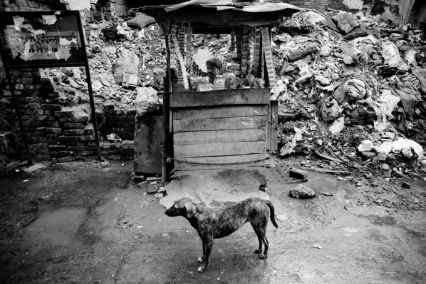
Photo of life in Delhi, India.  From a collection by Belgian photographer Frederik Buyckx, 2009

Photo of life in Delhi, India. From a collection by Belgian photographer Frederik Buyckx, 2009

Thought provoking, occasionally breath-taking photos from a 6:00 a.m. walkaround in Delhi, India; Belgian photographer Frederick Buyckx promises more photos from his recent trip to India and Pakistan, at his blog.

Please share:

Add to FacebookAdd to NewsvineAdd to DiggAdd to Del.icio.usAdd to StumbleuponAdd to RedditAdd to BlinklistAdd to TwitterAdd to TechnoratiAdd to Furl