Without hysterics, the Obama eligibility issue

December 5, 2008

In a conference today [December 5, 2008] the Supreme Court will reconsider together whether to take on a suit challenging the eligibility of Barack Obama to be president of the United States under a sometimes-arcane  section of Article II of the Constitution.

Is Barack Obama a “natural born” citizen of the U.S.?

In the building where “Equal Justice Under Law” is engraved high over the front door, poker-player Leo Donofrio’s challenge will be examined to see whether at least four of the nine justices of the Court think he has enough of a case to actually merit a hearing.  Justice David Souter rejected Donofrio’s case earlier, so this is a hail-Mary play on the part of Obama’s opponents.
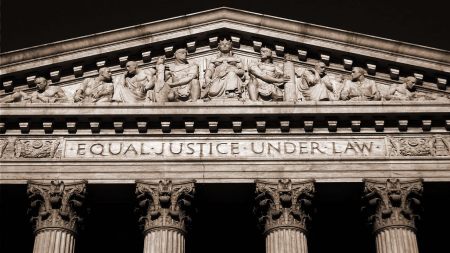
Equal Justice Under Law, the West Pediment of the U.S. Supreme court. AAPF image

Equal Justice Under Law, the West Pediment of the U.S. Supreme court. AAPF image

The Court takes seriously the principle engraved over the door, however.  This is the same Court that ruled earlier this year an accused terrorist and all-around bad guy held at Guantanamo Bay has the right to a writ of habeas corpus over the objections of the Most Power Man in the World, U.S. President George W. Bush.  The humble, gritty, or even unsavory history of litigants does not limit their rights under the law.

Leo Donofrio in his usual office. Leo Donofrio image

Leo Donofrio in his usual office. Leo Donofrio image

So the question is, what sort of case does Donofrio have against Obama’s eligibility?

Would Justice Clarence Thomas have agreed to bring this case to the conference if it doesn’t have a chance to succeed?

I’ve not lunched with Thomas in more than two decades, so I can’t speak with any inside knowledge.  Historically, the Court, and indeed all the federal courts, have agreed to examine cases like this often simply to provide an authoritative close to the issue.  In this case, the outright hysteria of the anti-Obama partisans suggests the issue should be put to bed if possible.

Under usual Court procedures, we won’t learn the results of the conference until Monday.  I would not be surprised if the results are announced today, just to promote the settling of the issue.

Does Donofrio have a case?

I don’t see a case.  It’s clear that Obama is a U.S. citizen now.  Donofrio’s argument is rather strained, and sexist.  He claims that Obama’s father having been a British subject in 1961 (Kenya was not yet independent), Obama had dual citizenship at birth — and, further, Donofrio alleges, this dual citizenship trumps both Obama’s birth on U.S. soil (which should be dispositive) AND Obama’s mother’s U.S. citizenship, conferring a special status that doesn’t meet the intentions of the framers of the Constitution.

Donofrio’s claim is odd in that it would grant a lesser-status to children of legal immigrants than is allowed by law to children of illegal immigrants, or temporary visitors.  It also is bizarre, to me, in the way it dismisses Obama’s mother’s existence as a factor in Obama’s citizenship status — and while equal rights for women were not wholly obtained in 1961, no one has successfully argued that the citizenship of the father trumps that of the mother in citizenship cases.

Donofrio is arguing that Obama’s dual citizenship at birth disqualifies him from holding the presidency, technically, in a very narrow reading — though Obama would have absolutely every other right of a natural born citizen.

A couple of observations:

First, this is not an easy issue to litigate. Standing is the easiest way for a federal court to avoid a decision — what harm can a citizen claim from letting Obama be president?  It’s difficult to find an injury even were Donofrio’s claims valid.  No blood, no foul.  No injury, no standing to sue.  It is upon this basis that most of the cases against Obama’s eligibility have been tossed out, as Donofrio’s has been tossed, twice already.

Second, it is unclear what entity enforces the eligibility clause of the Constitution, or indeed, whether any entity can. For most of the summer Obama’s critics were pressuring the Federal Election Commission (FEC) to do something, even though the FEC lacks a quorum of members to do anything.  More to the point, there is nothing in any law that confers on the FEC the function of checking the citizenship status of any candidate.  Sometime in October they finally figured out that state secretaries of state might have a role, since they set up the ballots in each state.

I admit I thought that, until I reflected on the issue of the electoral college.  In U.S. presidential elections, voters do not vote directly for president and vice president.  Instead, we vote to elect people who will be the electors who decide — electors of the electoral college.  The history of this institution can be found elsewhere.  For the sake of these suits, however, it means that the secretaries of state have no role at all in the eligibility of the candidates.  They rule on the eligibility of the electors, which is an entirely different kettle of fish. Some states even list the electors on the ballot.

But in any case, it means Donofrio is suing the wrong entity, even if we can’t tell him what the correct entity is.

Third and most important, Donofrio is asking for U.S. citizenship law to be overturned in a most inconvenient time and place. Dual citizenship is a bar to very little in American life.  There is an assumption that people who hold that status are fully American citizens, absent a showing of contrary facts.  There are no contrary facts in evidence from Donofrio, nor from anyone else, despite promises of the revelation of conspiracies.

In short, Donofrio is arguing that there is, somewhere, somehow, some information that Barack Obama is not the shining patriot his life story reveals.  Donofrio doesn’t know what that information is, or where it might be found, but he thinks maybe the State of Hawaii is complicit in a conspiracy to hide this information, which is hidden on the hand-written records of Obama’s birth in 1961.  You might think Donofrio has watched “National Treasure” a few too many times, and whether it’s that movie or some other source, you’d be right — paranoid suspicions of conspiracy are not the stuff good court cases are made of.

The dozen or more cases against Obama’s eligibility all suffer from this astounding, dramatic lack of evidence.  Is there an affidavit from someone who alleges that Obama’s citizenship should be called into question?  If so, they’ve not been presented to any court.  (Obama tormentor Corsi claims to have interviewed Obama’s Kenyan grandmother, and he alleges she said through an interpreter that Obama was born in Kenya; oddly, he didn’t bother to get an affidavit from the woman, nor from anyone else — and others who listen to the tape think she thought Corsi was asking about the birth of her son, not grandson.  This is not solid evidence.)

I argued earlier there is a long chain of evidence creating rebuttable presumptions that Obama’s a natural born U.S. citizen.  To contradict this chain of evidence, contestants should provide extraordinary, clear evidence of contradiction.  What is offered by Donofrio is neither extraordinary, nor clear, nor necessarily contradictory to the presumptions.

This is not an issue solely for the hysterical.  Lawyers and scholars have looked at the issue through the years, and intensely this year, and arrived at the conclusion that Obama is perfectly eligible for the presidency.

Will sanity ever prevail?

Resources you may want to consult:

Vodpod videos no longer available.


Don’t vote. Don’t tell 5 friends. Just don’t

November 1, 2008

This one’s safe for work:

This one, not safe for work (profanity, usually mild – democratic ideas), but much funnier, and much more serious at the same time — I wish I’d known about it two months ago.  Not nearly enough people have watched these, according to the YouTube counts:

If I can get five readers of this post, we’re home free, right?

Tip of the old scrub brush to UBZonker.


Federal judge dismissed the challenge to Obama’s birth certificate

October 26, 2008

As expected, a federal judge in Philadelphia late Friday dismissed a challenge to the campaign of Barack Obama to produce yet another copy of his birth certificate. District Judge R. Barclay Surrick ruled that the plaintiff, screwball attorney Philip J. Berg, lacked standing to sue.

Appearing to take his inspiration from the Monty Python character, the Black Knight, Berg promised to appeal the decision to the Supreme Court of the U.S.

Among reputable media, only the Philadelphia Daily News took note of the dismissal early on:

Obama and the Democratic National Committee had asked Surrick to dismiss Berg’s complaint in a court filing on Sept. 24.

They said that Berg’s claims were “ridiculous” and “patently false,” that Berg had “no standing” to challenge the qualifications of a candidate for president because he had not shown the requisite harm to himself.

Surrick agreed.

In a 34-page memorandum and opinion, the judge said Berg’s allegations of harm were “too vague and too attenuated” to confer standing on him or any other voters.

Surrick ruled that Berg’s attempts to use certain laws to gain standing to pursue his claim that Obama was not a natural-born citizen were “frivolous and not worthy of discussion.”

The judge also said the harm Berg alleged did “not constitute an injury in fact” and Berg’s arguments to the contrary “ventured into the unreasonable.”

For example, Berg had claimed that Obama’s nomination deprived citizens of voting for Sen. Hillary Clinton in November. (Berg backed Clinton in the primaries.)

Berg could not be reached for comment last night.

Obama was born in Honolulu on Aug. 4, 1961, and the campaign posted a document issued by Hawaii on its Web site, fight thesmears.com, confirming his birth there.

Berg said in court papers that the image was a forgery.

The nonpartisan Web site FactCheck.org examined the original document and said it was legitimate.

Further, a birth announcement in the Aug. 13, 1961, Honolulu Advertiser listed Obama’s birth there on Aug. 4.

Dozens of bloggers bought new rolls of aluminum foil to make protective hats, and questioned the dismissal, or jumped to other equally unwarranted conclusions. Near total insanity.

Resources:

________

Update, 10-27-2008:  Here’s an example of how lunatic this issue is, and how bizarre are the arguments.  This blog argues that Judge Surrick had the decision dictated to him from someone else in the Obama camp — the same lunatic argument creationists made against the decision of Judge Jones in the Dover, Pennsylvania, “intelligent design” trial.  Could it be that all lunatics are creationists?  Or is it just that lunatics all stumble into the same lunatic arguments?


Should a teacher let students know her voting preferences?

October 14, 2008

Law professor Stanley Fish tackled the issues around teachers wearing campaign buttons in the classroom, at his blog with the New York Times.

Fish says teachers don’t have a free speech right to wear buttons supporting their favorite candidates.

My point is made for me by William Van Alstyne, past President of the AAUP and one of the world’s leading authorities on the first amendment. In a letter to current president Nelson, Van Alstyne corrects his view that faculty “have a first amendment right” to wear campaign buttons. “I have no doubt at all,” he declares, “that a university rule disallowing faculty members from exhibiting politically-partisan buttons in the classroom is not only not forbidden by the first amendment; rather, it is a perfectly well-justified policy that would easily be sustained against a faculty member who disregards the policy.”

Right! It’s no big deal. It’s a policy matter, not a moral or philosophical matter, and as long as the policy is reasonably related to the institution’s purposes, it raises no constitutional issues at all. On Oct. 10, the United Federation of Teachers filed suit to reverse the button ban, claiming that the free speech rights of teachers had been violated. If that’s their case, they’ll lose.

I think he’s right — check out his post, and tell us what you think.


“Dare to call for justice, get labeled ‘terrorist'”

October 10, 2008

This is where we are: Marylanders who exercised their rights guaranteed under the First Amendment, peacefully gathering to call for changes in law, were labeled “terrorists” by the Maryland State Police, and reported to federal databases that way.

Do you wonder why you get searched every time you fly?  Remember that letter you wrote to your Congressman complaining about high taxes?  Remember that phone conversation with your brother-in-law over whether either of you would serve in the military today, without the threat of a draft?

Remember that time you taught the Cub Scouts how to fold the flag?

All of these things used to thought of as patriotic participation in government by citizens.  But not any more.

All of these things are protected under the First Amendment.  But if you use those First Amendment rights, and you’re in Maryland, watch out.

The abuses of the system were discovered and exposed by the Maryland attorney general.

And if you don’t live in Maryland?  That doesn’t make you safe.  It only means your state’s attorney general has not investigated what the cops are doing.

Your vote on November 4 is important.

You can also vote in a poll at the Baltimore Sun, asking whether such surveillance is okay.  (No, it’s not.)

Below the fold:  The New York Times editorial on the issue.  Also, the editorial from the Baltimore Sun.

Read the rest of this entry »


Vigilante book banners

October 1, 2008

As we ponder how to keep freedom in America in the middle of Banned Books Week, I worry about the dangers of vigilantes acting to effect a ban on a particular book, despite official actions.

How to fight these anti-reading, anti-American vigilantes?  People in Lewiston, Maine, came up with the fantastic idea of simply buying more books.

Vigilantes sometimes check out the books they want to ban, and then simply don’t bring the book back to the library.  If there’s no book on the shelf to be checked out, they reason, no one else can check it out.  One such vigilante in Lewiston, an activist in favor of homophobia it appears, refused even a court order to return the book she wanted to ban, Robie Harris’s It’s Perfectly Normal.

Cover of Robie Harriss childrens health book, Its Perfectly Normal

Cover of Robie Harris's children's health book, It's Perfectly Normal

Jail time for the vigilante?  Oh, the law would allow that.  But instead, freedom fighters purchased four more copies of the book for the library.

Voting with ideas.  What a concept!

Full text of the American Library Association press release, below the fold.

Read the rest of this entry »


Bush readies troops to suppress American dissent

September 26, 2008

William K. Wolfrum writes “satire and commentary.”  This would make great satire — but, darn it, it’s not:  “Bush unleashes surge in War on Americans.”

What sort of riots does Bush expect?  When?

Is there a Poe’s Law of politics?  Can we impeach someone who follows that law, and quickly, please?

From Army Times:

The 3rd Infantry Division’s 1st Brigade Combat Team has spent 35 of the last 60 months in Iraq patrolling in full battle rattle, helping restore essential services and escorting supply convoys.

Now they’re training for the same mission — with a twist — at home.

*     *     *     *     *

They may be called upon to help with civil unrest and crowd control or to deal with potentially horrific scenarios such as massive poisoning and chaos in response to a chemical, biological, radiological, nuclear or high-yield explosive, or CBRNE, attack.

Training for homeland scenarios has already begun at Fort Stewart and includes specialty tasks such as knowing how to use the “jaws of life” to extract a person from a mangled vehicle; extra medical training for a CBRNE incident; and working with U.S. Forestry Service experts on how to go in with chainsaws and cut and clear trees to clear a road or area.

The 1st BCT’s soldiers also will learn how to use “the first ever nonlethal package that the Army has fielded,” 1st BCT commander Col. Roger Cloutier said, referring to crowd and traffic control equipment and nonlethal weapons designed to subdue unruly or dangerous individuals without killing them.

“It’s a new modular package of nonlethal capabilities that they’re fielding. They’ve been using pieces of it in Iraq, but this is the first time that these modules were consolidated and this package fielded, and because of this mission we’re undertaking we were the first to get it.”

The package includes equipment to stand up a hasty road block; spike strips for slowing, stopping or controlling traffic; shields and batons; and, beanbag bullets.

“I was the first guy in the brigade to get Tasered,” said Cloutier, describing the experience as “your worst muscle cramp ever — times 10 throughout your whole body.

“I’m not a small guy, I weigh 230 pounds … it put me on my knees in seconds.”

The brigade will not change its name, but the force will be known for the next year as a CBRNE Consequence Management Response Force, or CCMRF (pronounced “sea-smurf”).

“I can’t think of a more noble mission than this,” said Cloutier, who took command in July. “We’ve been all over the world during this time of conflict, but now our mission is to take care of citizens at home … and depending on where an event occurred, you’re going home to take care of your home town, your loved ones.”

You read it right.  The Army is coming to “take care of you in your home town.”

Were they being deployed to rebuild New Orleans, I’d regard it as a noble undertaking.  Am I wrong to worry about what is up with this?

Whatever happened to the posse comitatus nuts?

Comments are open.  What do you think?

Resources:


Encore Post: Constitution Day!

September 17, 2008

Are you ready for it, teachers?

Howard Chandler Christy's painting of the Scene at the Signing of the Constitution

2008: I wasn’t ready to blog about it today.  Texas requires one day of instruction on the Constitution in every social studies class.  In government today, it happened to fit.  We discussed the Constitution earlier in world history, and we will return to it at various points through the year.


Can Texas split itself into five states? Is West Virginia legal?

September 15, 2008

Elektratig has found a legal scholar with a wild bent who has penned a couple of scholarly articles designed to give heart to conspiracy nuts, anarchists and radical libertarians.

One article [by Michael Stokes Paulsen], “Let’s Mess With Texas,” actually was published in the Texas Law Review in 2004, arguing the case that the odd treaty negotiations/statehood legislation that led to Texas becoming part of the U.S. in 1845 included a clause that would allow Texas to split itself into as many as five states.  The authors speculate as to chaos this would cause in U.S. politics.  The article is available in a free download from SSRN.

The other, “Is West Virginia Unconstitutional” was published in the California Law Review. It offers a good history of the creation of West Virginia from the northwestern territory of Virginia in 1863, when the pro-Union counties of the northwest part of the state declared a government in exile and consented to the Union’s partition of Virginia.

Both stories pose interesting questions for government classes, U.S. history classes (especially with regard to the Civil War), and possibly for Texas history classes, though the discussions may not seem germane to the 7th grade minds it would need to entertain.

Both articles breezily discuss history in a wry, humorous way.  A lot more history for high school students should be written this way.

I can’t find it at the moment, but it seems to me that most authorities determined Texas’s right to self-partition expired when the state tried to secede in 1861, and, in any case, did not survive the readmission process subsequent to the end of the war and reconstruction. Although Texas U.S. Rep. John Nance Garner (future vice president under FDR) threatened to exercise the clause in 1930 to fight a tariff he didn’t like, it’s unlikely Texans would consent to lose their bragging rights to being bigger than anybody else in the Lower 48.  The issue is generally considered dead to Texans, if not in law.

Plus, there isn’t enough hair in the Lone Star State for four more Rick Perrys.

If you think history can’t be fun, you haven’t read this stuff.  Go check it out.

Resources:


Dirty play on PUMA blogs, and election history (1800)

September 1, 2008

Oh, it’s only a little dirty, sure.  With but with Democrats like the PUMAs, sometimes you wonder why we need Karl Rove.  With Hillary supporters like a few of the PUMAs, who needs Monica Lewinsky?

At the Confluence, anything that displeases the board moderators gets edited to say something completely trivial and, the board’s moderators appear to hope, embarrassing.  Even compliments from people they don’t like get edited.  So much for robust discussion and debate.  So much for fairness.

The Ghost of Goebbels smiles.  The Ghost of Alexander Hamilton paces nervously. Hamilton, you recall, paid editors and writers to put all sorts of scandal and calumny against Thomas Jefferson into their newspapers, in 1796 and 1800.  Dumas Malone wrote in his Pulitzer Prize-winning biography of Jefferson that fully half the American electorate was convinced that Jefferson was an atheist who hated religious freedom by election day, 1800.  Still, Americans voted overwhelmingly for the Jefferson/Burr ticket.  So Hamilton’s skullduggery didn’t pay off.

Alas, prior to the 12th Amendment, electors in the electoral college all had two votes, and the rule was that the winner became president, the 2nd place person became vice president.  The electors of the Democratic Republican Party (the modern-day Democrats) each cast a vote for Jefferson for President, and a vote for Burr.  In electoral votes, there was a tie for the presidency.  The election went to the House of Representatives (see the Constitution, Article II, Section 1, Clause 3).

The new Congress had not been sworn in yet, so the old, Federalist-controlled Congress got to make the decision between the two top electoral college vote getters (same as today — the old congress decides).  A history site at the City University of New York gives the short version:

Uneasy about both men, the Federalists in the House of Representatives took five days and 35 ballots to choose Jefferson over Burr. The deadlocked election between the two allies spawned the Twelfth Amendment to the U.S. Constitution in 1804, which led to separate Electoral College ballots for president and vice-president. Jefferson called the election the “Revolution of 1800.”

35 ballots in the House of Representatives, before Jefferson was chosen on the 36th! When an election goes to the House, each state gets one vote; the Representatives and Senators must decide how to cast that state’s vote.  34 times that ballot came up inconclusive between Jefferson and Burr, both men despised by the Federalists due to the poisoned waters from the campaign.

Alexander Hamilton knew both men well.  Hamilton and Jefferson both served in Washington’s cabinet.  He had been a friend of Jefferson and guest at Jefferson’s table for the great compromise that gave us the first U.S. bank and put the capital on the Potomac.   Hamilton had worked closely with James Madison on policy and speeches in the Washington administration, an on the conspiracy to get the Constitution before that — Madison was Jefferson’s “campaign manager” in the election.  Hamilton also had crossed paths with Aaron Burr in New York, where both men practiced law.  Eventually, Hamilton persuaded a few Federalists to vote for Jefferson over Burr, and persuaded a few others to abstain from voting in their state delegations, throwing those delegations to Jefferson, too.  Jefferson was thus elected president, and Burr became vice president. Alexander Hamilton had to eat crow to keep his worst enemy, Burr, from becoming president.

Hamilton’s agonies did not end there.  After engineering Burr’s defeat in New York’s gubernatorial election in 1804, Burr claimed Hamilton had insulted Burr’s reputation.  A string of letters failed to resolve the situation, and Burr challenged Hamilton to a duel.  On July 11, 1804, Burr mortally wounded Hamilton in a dawn duel at Weehawken, New Jersey (dueling being illegal in New York).

Alexander Hamilton, hero of the American Revolution, created much of the financial underpinnings of our modern economic system, with a central bank and a view looking toward promoting trade to benefit the citizens of the nation.  He worked with Madison and Washington to created the Constitution, and worked with Jay and Madison to compose what became the Federalist Papers, originally a set of essays to persuade New Yorkers to ratify the Constitution, now a legal and history backgrounder in what the Constitution is and how it is supposed to work. Few important events in international or domestic affairs did not feature work by Hamilton, from Washington’s inauguration in 1789 to Hamilton’s death in 1804.  When his country called, Hamilton responded.

Hamilton’s death creates one of the greatest “what if” questions in American history:  What if Hamilton had lived, perhaps to serve as president himself? Opportunities lost do not knock again.

Resources:

Alexander Hamiltons gravestone, in the courtyard of Trinity Church, close to the location of the former towers of the World Trade Center, New York. AmericanRevolution.com

Alexander Hamilton’s gravestone, in the courtyard of Trinity Church, close to the location of the former towers of the World Trade Center, New York. AmericanRevolution.com

Another version of the same photo, Alexander Hamilton’s grave.


Ladies’ choice: Happy birthday, women’s suffrage!

August 18, 2008

Ouch! Almost missed it: Today is the anniversary of the ratification of the 19th Amendment to the U.S. Constitution, on August 18, 1920. Tennessee was the 36th state to ratify, pushing the total to three-fourths of the 48 states.  (12 more states ratified later, including North Carolina in 1971, and Mississippi in 1984.)

The Amendment reads:

The right of citizens of the United States to vote shall not be denied or abridged by the United States or by any State on account of sex.

Congress shall have power to enforce this article by appropriate legislation.

One of the better moves our nation ever made, in my opinion. Abigail Adams was right; John should have listened to her.

Abigail Adams who urged the vote for women in 1776, by Benjamin Blythe, 1766 (Wikimedia and Millsaps College)

Abigail Adams who urged the vote for women in the late 18th century; portrait by Benjamin Blythe, 1766 (Wikimedia and Millsaps College)

And “Vox Day” and Ann Coulter are both idiots.

Tip of the old scrub brush to Reed Cartwright at De Rerum Natura.


John McCain: Constitution, yes or no?

August 9, 2008

In Denver, Colorado, John McCain has an opportunity to stand up and defend the First Amendment and the rest of the Constitution. All he needs to do is issue a statement that he disagrees with the prosecution of the peaceful woman — he could do even more asking the prosecutor to drop the charges.

Ed Brayton describes the case at Dispatches From the Culture Wars.

The silence from McCain: Will it grow deafening?

More reading:


Encore post: Jefferson on religious freedom, “infidels of every denomination”

July 31, 2008

Jefferson on religious freedom

Thomas Jefferson

August 1, 2006

 *

In his Autobiography Jefferson recounted the 1786 passage of the law he proposed in 1779 to secure religious freedom in Virginia, the Statute for Religious Freedom:

The bill for establishing religious freedom, the principles of which had, to a certain degree, been enacted before, I had drawn in all the latitude of reason and right. It still met with opposition; but, with some mutilations in the preamble, it was finally passed; and a singular proposition proved that its protection of opinion was meant to be universal. Where the preamble declares, that coercion is a departure from the plan of the holy author of our religion, an amendment was proposed, by inserting the word “Jesus Christ,” so that it should read, “a departure from the plan of Jesus Christ, the holy author of our religion;” the insertion was rejected by a great majority, in proof that they meant to comprehend, within the mantle of its protection, the Jew and the Gentile, the Christian and the Mahometan, the Hindoo, and the Infidel of every denomination.

Life and Selected Writings of Thomas Jefferson, Modern Library 1993 edition, pp. 45 and 46.

* Image is a photo of detail from a painting of Jefferson by Rembrandt Peale, courtesy of the New York Historical Society by way of the Library of Congress.

[Encore post from August 1, 2006]

An encore post; fighting ignorance takes repetition.

Save

Save


400 years of river history: NY celebrates Hudson, Champlain and Fulton in 2009

July 26, 2008

Okay, it’s the 202nd anniversary of Robert Fulton’s historic, 32-hour steamboat trip from New York City to Albany, demonstrating the viability of steamboat travel for commerce on the Hudson.  But for such a historic river, why not delay that fete for a couple of years and roll it into the 400th anniversary of Champlain’s exploration of the lake that now bears his name, and Henry Hudson’s discover of the mouth of the river to the south, the Hudson, whose mouth is home to New York City.

400 years of Hudson River history in 2009 - Hudson, Champlain, Fulton

400 years of Hudson River history in 2009 - Hudson, Champlain, Fulton

And so 2009 marks the Quadricentennial Celebration on the Hudson, honoring Hudson, Fulton and Champlain.

Alas, the committee to coordinate the celebration along the length of the river was not put in place until February, so there is a scramble.  Local celebrations will proceed, but the overall effort may fall short of the 1909 tricentennial, with replicas of Hudson’s ship, Half Moon, and Champlain’s boats, and Fulton’s steamer, and parades, and festivals, and . . .

Still, the history is notable, and the stories worth telling.

Most of my students in U.S. and world history over the past five years have been almost completely unaware of any of these stories.  One kid was familiar with the Sons of Champlin, the rock band of Bill Champlin, because his father played the old vinyl records.  Most students know nothing of the lore of Hudson, the mutiny and the old Dutch stories that have thunder caused by Hudson and his loyal crewman bowling in the clouds over the Catskills.  They don’t even know the story of Rip van Winkle, since it’s not in the Texas Essential Knowledge and Skills (TEKS) list and so gets left out of even elementary school curricula.  Is this an essential piece of culture that American children should know?  American adults won’t know it, if we don’t teach it.

Henry Hudson, from a woodcut

Henry Hudson, from a woodcut

Explorations and settlement of Quebec by Samuel de Champlain get overlooked in post-NCLB texts.  Texts tend to make mention of the French settlement of Canada, but placing these explorations in the larger frame of the drive to find a route through or around North America to get to China, or the often-bitter contests between French, English, Spanish, Dutch and other European explorers and settlers gets lost.  French-speaking Cajuns just show up in histories of Texas and the Southwest, with little acknowledgment given to the once-great French holdings in North America, nor the incredible migration of French from Acadia to Louisiana that gives the State of Louisiana such a distinctive culture today.

French explorer and settler Samuel de Champlain

French explorer and settler Samuel de Champlain

Champlain’s explorations and settlement set up the conflict between England and France that would result in the French and Indian War in the U.S., and would not play out completely until after the Louisiana Purchase and War of 1812.

Fulton’s steamboat success ushered in the age of the modern, non-sail powered navies, and also highlights the role geography plays in the development of technology. The Hudson River is ideally suited for navigation from its mouth, north to present-day Albany.  This is such a distance over essentially calm waters that sail would have been preferred, except that the winds on the Hudson were not so reliable as ocean winds.  Steam solved the problem.  Few other rivers in America would have offered such an opportunity for commercial development — so the Hudson River helped drive the age of steam.

New York City remains an economic powerhouse.  New York Harbor remains one of the most active trading areas in the world.  Robert Fulton helped propel New York ahead of Charleston, Baltimore and Boston — a role in New York history that earned him a place in for New York in the U.S. Capitol’s Statuary Hall.  The steamboat monopoly Fulton helped establish was a key player in Gibbons v. Ogden, the landmark Supreme Court case in which the Court held that Congress has the power to regulate commerce between states — an upholding of the Commerce Clause against the old structures created under colonial rule and the Articles of Confederation.

Robert Fultons statute in the U.S. Capitol - photo by Robert Lienhard

Robert Fulton's statute in the U.S. Capitol - photo by Robert Lienhard

400 years of history along the Hudson, a river of great prominence in world history.  History teachers should watch those festivities for new sources of information, new ideas for classroom exercises.

Resources:


Bloggers’ rights: A quandary

July 25, 2008

Freedom of expression is the key to all other rights in our American system of government, I am convinced. Defending the First Amendment becomes the way to defend all other rights. Telling the King he has no clothes, without fear of retribution, makes it possible to keep the King clothed.

I support most groups and efforts to defend and protect the First Amendment. I’ve been a member of the Society of Professional Journalists for most years since 1974, I’ve been a member of the National Freedom of Information coordinating committee, and I’ve worked in three states and the federal legislature to expand freedom of information, reporters’ access to information, and especially the people’s right to know.

In the press, there are few hard-core idiots. A few exist, but they are outweighed by the many who make sincere efforts to get the story right. That’s a long way of saying, it’s easy to support rights of people who aren’t always yapping at you.  Their existence puts me in a little quandary, and I need to resolve it.

Last night I found one more deluded, on-line writer working against the First Amendment and, IMHO, hammering away at the foundations of the Constitution in other ways. (Incredibly, this guy asked Jonathan Rowe to abandon commenting at his blog, suggesting Rowe’s carefully crafted, court-tested, generally take-’em-to-the-bank correct ideas about history are “lies.” Yeah, he has a right to hold foolish opinions.)

Does he have a right to do that, on-line?

Yes he does have that right. As I’ve often said before, I put a lot of stock into the old Ben Franklin maxim that truth wins in a fair fight. So we need to keep the fight fair.

We also need to defend the rights of bloggers whose work helps expose the truth, even at the expense of defending the deluded writers who get it wrong.

What are blogger’s rights and protections? The Electronic Frontier Foundation (EFF) put together a concise and nearly complete legal guide for bloggers — you can find it here.

EFF campaigns to protect and defend bloggers’ rights. Bloggers, and other supporters of freedom, should join that campaign. Millard Fillmore’s Bathtub will display a badge of the campaign to encourage others to join it.

Bloggers' Rights at EFF

Do you like freedom? Do you read a lot? Do you read on-line? Do you express your opinions? Then you have a vested interest in supporting these groups. Since you’re reading this on-line, you have a vested interest in supporting the Electronic Freedom Foundation’s work to defend bloggers’ rights. Click over to EFF, get informed, lend some support, and get involved.

This blog is banned in Turkey, prohibited from viewing in China, non-grata in much of Singapore and Iran, and blocked from the Duncanville, Texas, Independent School District.  I appreciate the freedom to blog, and I hope we can keep blogging free everywhere else, and make blogging free in those areas darkened by bans on expression.

(Okay, I like the cat in the one badge from the EFF — would it kill them to put a dog in one?)
