Now is the time for all good citizens to phone legislators for the sake of their country . . .

March 31, 2011

Ready to start dialing?  It’s time to dial to save your country.

MoveOn.org asks Texans to phone their U.S. senators for help:

Dear Ed,

Heads up: Congress is debating a budget plan that would be devastating to Texas. Will you pass this along?

Senators Kay Hutchison and John Cornyn need to hear from all of us about it right now, before they cut a deal in the next few days.

Please spread the word about all of these proposed cuts to Texas:

  • $98 million would be cut from federal funds for clean and safe water in Texas.1
  • 12,000 Texas children would be immediately cut from Head Start, which provides comprehensive early childhood development services for at-risk children ages zero to five.2
  • $391 million would be cut from Pell Grants, affecting all 664,000 higher education students with those grants in Texas.3
  • Job training and employment services would be effectively eliminated for 5,800 dislocated workers, 99,000 low-income adults, and 16,000 youths age 14 to 21.4
  • $10 million would be cut from law enforcement assistance, taking cops off the beat.5

It’s especially galling when the same budget protects tax breaks for corporations like GE and the very rich.

Just last night the news broke that Congress may be close to striking a deal on the budget. Now is the only time we can influence the outcome.

Can you call Sens. Hutchison and Cornyn and ask them to oppose these cuts in the budget? You can pick one of the cuts in this list to highlight in your call.

Senator Kay Hutchison
Phone: 202-224-5922

Senator John Cornyn
Phone: 202-224-2934

Click to report your call. Then pass this email along locally!

http://pol.moveon.org/call?tg=FSTX_1.FSTX_2&cp_id=1547&id=26722-5763840-yqXs_sx&t=2

The cuts that the Republicans are proposing would disproportionately hit those who can least afford it in Texas, and it’s up to us to stop them.

Thanks for all you do.

-Daniel, Amy, Milan, Tate, and the rest of the team

Sources:

1. “House Bill Means Fewer Children in Head Start, Less Help for Students to Attend College, Less Job Training, and Less Funding for Clean Water,” Center on Budget and Policy Priorities, March, 1, 2010
http://www.cbpp.org/cms/index.cfm?fa=view&id=3405

2. “Projected Reduction in Children Served in Head Start Based on H.R. 1—Fiscal Year 2011 Continuing Resolution,” Center for Law and Social Policy
http://www.moveon.org/r?r=207278&id=26722-5763840-yqXs_sx&t=3

3. “House Bill Means Fewer Children in Head Start, Less Help for Students to Attend College, Less Job Training, and Less Funding for Clean Water,” Center on Budget and Policy Priorities, March, 1, 2010
http://www.cbpp.org/cms/index.cfm?fa=view&id=3405

4. Ibid

5. Ibid

Want to support our work? We’re entirely funded by our 5 million members—no corporate contributions, no big checks from CEOs. And our tiny staff ensures that small contributions go a long way. Chip in here.

Meanwhile, the Texas House of Representatives scheduled the start of debate on H. 1 for Friday, April 1 — the budget resolution that would gut Texas schools and higher education, and set Texas on a course of decline that will make California’s troubles look serene by comparison.

NEA’s Texas affiliate, the Texas State Teachers’ Association, asks teachers to call their Texas representatives to weigh in against the drastic budget cuts (and you can call, too):

March 30, 2011

House Bill 1 is an assault on the public schools!

This Friday, April 1, the Texas House of Representatives is scheduled to begin debate on House Bill 1, its version of the state budget for 2012-2013. If this bill were to become law in its present form, it would cut almost $8 billion from public education and, with it, tens of thousands of school district jobs.

Unfortunately, this is no April Fool’s joke.

It is, instead, the proposal of a state leadership that would rather plug a huge hole in the state budget by firing teachers, packing kids into overcrowded classrooms and closing neighborhood schools than by adequately investing in our state’s future.

NOW is the time to call your legislator and let him or her know what these budget cuts will mean in your classroom, your school and your community. We must stop House Bill 1, and your call is critical!

To contact your state representative, call 800-260-5444, and we will connect you [That’s the number for TSTA members, but try it — I’ll bet they’ll accept your help!]. You can call any time, day or night, but you need to call before Friday. Leaving a voice message with your representative’s office is just as good as talking to a staff member.

It is important to include the following points in your conversation or message:

  • Your name, that you are a TSTA member and that you live and vote in their district.
  • An overwhelming number of people in your community – parents, teachers and other taxpayers – oppose cuts that would harm public schools.
  • Your own story, how laying off educators, cramming children into crowded classrooms and closing neighborhood schools would have a harmful impact on your students and community.
  • Ask your representative to find the revenue necessary to avoid harmful budget cuts, restore full education funding and end this assault on our public schools.

This will take only a few minutes of your time, and it will be time well spent. Your representative needs to hear from you before Friday!

Pick up your telephone and strike a blow for freedom, democracy, education and sanity in government.


Relief for Rand Paul’s toilet problem

March 17, 2011

David Roberts at the online Grist site has a toilet that will solve Rand Paul’s problem, as Paul let slip at a Senate hearing earlier this week.  A couple of interesting videos accompanied Roberts’ article:

And this one, which makes me happy we didn’t have this toilet when our kids were toddlers, and at war with each other, or just happy to study hydraulics with frequent flushes, frequently with stuff that shouldn’t be flushed:

Bill Scher, also at Grist, did the shopping earlier that Rand Paul appears unable  to do — there are several toilets available to solve Paul’s problem, many of them made in America.

Almost three years ago we replaced the three toilets in our home with two Toto models and one Kohler, all low-flow, water miser editions.  They work fine. (We also shopped our local area, and found prices considerably below those listed, at several different outlets.)  Kohler, in fact, enlists the help of a fetching plumber named Jo.  She steps into a well-appointed bathroom and invites you to test Kohler’s toilets — you pick something in the bathroom, and she flushes it.  Bye bye, rubber duckie.  So long, handtowel.  Four bottles of shampoo at once.

Test Kohler toilets with Jo, the plumber

Click image to test Kohler toilets [Update, August 2012: Alas, Kohler seems to have deactivated the interactive site.] [BUT, see update below.]

Kohler, clearly, had someone with Sen. Paul’s, er, um, problem, in mind!

So, Rand Paul no longer has a reason to be full of s—.  It’s time he vote to endorse saving energy, as appliance and lightbulb manufacturers have done.  Why is Paul so opposed to American business anyway?

Update: The Trophy Wife™ suggested somebody stage a showdown, or flush off between Jo the Plumber and Sen. Rand Paul.  Jo the Plumber could see how well the Republican budget whacks flush away . . . “H.R. 1:  Flushes cleanly!  382 pages gone!  Appropriately disposed of!  What do you want to flush next?”

Perhaps someone adept at editing flash videos could make that happen . . .

Update, May 2020: Fortunately, Kohler did a video of their interactive ad, and that still exists. I admit I enjoyed pointing to odd objects in the game, which Jo the Plumber then dutifully flushed. Video gives you an idea of what the toilet can handle, enough to handle Rand Paul and Donald Trump together, probably.


Rand Paul’s confession: Constipated for years, he can’t see the light

March 17, 2011

In what must be one of the most bizarre but informative exchanges we’ve ever heard from a Tea Partier, Kentucky Sen. Rand Paul reveals what bugs so many Tea Partiers.  His toilets don’t work, and haven’t for 20 years.

That’s not supposed to be a straight line for a gag.

You can’t get the information from just listening to him, however — you have to have some additional facts so you can read between the lines.

From this exchange at the Senate Committee on Energy and Natural Resources, we learn:

  1. Rand Paul trivializes abortion and women’s rights.  He appears to think babies are similar to incandescent light bulbs; he’s pretty clueless about either pregnancies or light bulbs.  Could there be a more offensive way to introduce this topic, than to claim his right to buy an incandescent light bulb and waste energy is equal, somehow, to a woman’s right to choose whether to carry a baby?
  2. Rand Paul doesn’t know how to shop.  Rand Paul isn’t much of a plumber.  He apparently bought a defective toilet some years ago, one that either doesn’t work or just can’t deal with the amount of effluent he personally produces, and he blames government for his bowel issues and his plumbing issues.  Well-working, low-water-use toilets have been available for decades in Europe and Asia, and are now available in the U.S., but he can’t be bothered to shop for them.  If he could maintain his old, water-wasting toilet, he’d have no kick, of course.  But he can’t be bothered to shop for a plumber who knows plumbing, and he can’t figure out how to do it himself.
  3. Rand Paul is incompetent at economics and constitutional law, at the same time.  Rand Paul thinks government should regulate things for his satisfaction, keeping products available that are no longer economical to produce — and if government fails to force businesses to do his bidding, it’s government’s fault; but the fact that Paul lives in the 19th century in his mind and no one else wants what he wants, never occurs to him.
  4. Rand Paul wants government to subsidize his bad choices.

Oy.

Let’s go to the video:

Can somebody get Rand Paul a competent plumber?  Can somebody show him how to use Google or Bing or Yahoo! to shop for good toilets and good plumbers?   The nation needs Paul to return to sanity, decency, and sanitation.

[Update:  Paul could learn about efficient, U.S.-built toilets, here.]

Am I wrong to think Paul is making an attack on wise conservation in general?  Why?

Paul’s smug, self-satisfied invincibility of incompetence and learned helplessness is appalling.  (Take that, Protein Wisdom; it’s just you, Jeff G. — everybody else sees Ms. Morgan as composed against Paul’s overweening smugness.)

Can somebody explain this to me:  This moment of extreme embarrassment to Sen. Paul is posted by his office at his YouTube site.  What were they thinking?

Somebody give a medal to Energy’s Deputy Assistant Secretary Kathleen Morgan for not teeing off on the guy.  Letting him twist in the wind is good enough.

By the way, the bill Paul complains about?  The manufacturers agreed to the standards voluntarily, and have already agreed to comply — the bill adds no regulations they say they cannot meet; Hogan’s statement noted:

S.398 codifies agreements that were negotiated, signed, and promoted by a cross-section of stakeholders representing consumer advocacy groups, manufacturers, manufacturer trade associations, and energy efficiency advocacy organizations, all of whom support this bill. The negotiated consensus agreements would establish energy conservation standards for 14 products, several of which are in the midst of DOE’s ongoing standards and test procedure rulemakings.

Also constipated:

Resources, good information:


Typewriter of the moment: Daniel Patrick Moynihan’s policy machine and crystal ball

January 15, 2011

Daniel Patrick Moynihan at his typewriter - photo from the American Academy of Political and Social Science

Daniel Patrick Moynihan at his typewriter – photo from the American Academy of Political and Social Science

This photo adorns the page announcing and asking for nominations to the annual Daniel Patrick Moynihan Prize, at the site of the American Academy of Political and Social Sciences.

Moynihan was the always-opinionated, rarely un-informed social scientist who caused a firestorm of criticism to rain down on Richard Nixon when Moynihan, working for Nixon, suggested that civil rights might benefit from a period of  “benign neglect” by the President.  Later he caused another firestorm, and along period of reflection, when he worried in a paper about the potential bad effects of social welfare programs that would ease suffering, but fail to achieve all of their loftier goals — the workers compensation program that could not restore a worker to full service, the program to provide food and shelter to the children of out-of-work parents if the parents could not find new jobs, etc.  He worried about the ‘culture of poverty.’

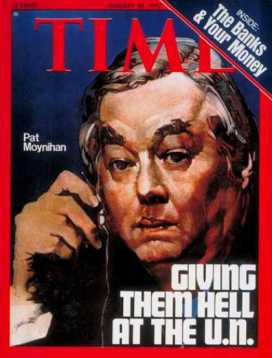
He raised hell as the U.S. Ambassador to the United Nations.

Time Magazine cover of UN Ambassador Daniel Patrick Moynihan

Time Magazine cover of UN Ambassador Daniel Patrick Moynihan

I knew him as the U.S. Senator from the State of New York, where he would shock his staff by showing up early on a Saturday morning to knock out a few letters to the editor, and op-ed pieces on his typewriter, without the bother of an in-session Senate to slow him down.  Later I worked for Checker Finn, who had worked with Moynihan when Moynihan was U.S. Ambassador to India.  Finn adopted many of his scholarly habits from Moynihan.  While working for Finn, nearly 25 years ago at the Department of Education, I got a taste of the world to come when Finn aggressively adopted e-mail messaging for himself and anyone of any executive influence under him, at the old Office of Educational Research and Improvement (OERI).  Aggressive adoption of new technologies can greatly improve organizations and organizational effectiveness.

Almost always with a bow tie.  Usually heavily editing his speeches, or writing his own op-ed pieces while other officials paid ghosts to do it for them.  Thinking thoughts Republicans would come to love, while a Democrat, but years before Republicans would come to love them.  Thinking thoughts Democrats would learn to love, but much later.

Few topics evaded his attention and careful thought.  He talked at length with David Gergen about the problem of Wikileaks, a dozen years before Wikileaks came to public attention (and years before Wikileaks even existed.)  He wrote books about international affairs, and education at home.  He pushed environmental laws to be better. Moynihan worried about the health of American families while James Dobson was still learning what a microphone and a family were.  In 1970, Moynihan warned the U.S. president that global warming is a problem.

Moynihan often appeared as the man who went everywhere, and did everything — after leaving Tulsa.  Moynihan studied everywhere.  He worked under New York Gov. Averell Harriman, and Presidents Kennedy, Johnson, Nixon and Ford, before serving a quarter century in the U.S. Senate (Is there some magic in that seat?  His predecessor was James Buckley; his successor was Hilary Rodham Clinton).   Here’s his brief Congressional biography:

MOYNIHAN, Daniel Patrick, a Senator from New York; born in Tulsa, Tulsa County, Okla., March 16, 1927; attended the public and parochial schools of New York City; attended City College of New York 1943; graduated, Tufts University, Medford, Mass., 1948; received graduate and law degrees from the Fletcher School of Law and Diplomacy 1949, 1961, 1968; studied as a Fulbright fellow, London School of Economics and Political Science 1950-1951; served in the United States Navy 1944-1947; Navy reserve 1947-1966; assistant and secretary to New York Governor W. Averell Harriman 1955-1958; member, New York State Tenure Commission 1959-1960; director, Syracuse University’s New York State Government Research Project 1959-1961; director, Joint Center for Urban Studies, Massachusetts Institute of Technology and Harvard University 1966-1969; author; held cabinet or sub-cabinet positions under Presidents John Kennedy, Lyndon Johnson, Richard Nixon, and Gerald Ford 1961-1976; Ambassador to India 1973-1975; United States Permanent Representative to the United Nations 1975-1976; elected as a Democrat to the United States Senate in 1976; reelected in 1982, 1988, and 1994 and served from January 3, 1977, to January 3, 2001; was not a candidate for reelection in 2000; chairman, Committee on the Environment and Public Works (One Hundred Second and One Hundred Third Congresses); Committee on Finance (One Hundred Third Congress); awarded the Presidential Medal of Freedom on August 9, 2000; professor at Syracuse University’s Maxwell School 2001; senior scholar, Woodrow Wilson International Center for Scholars 2001-2003; died of complications from a ruptured appendix on March 26, 2003; interment at Arlington National Cemetery.

Moynihan was a man ahead of his time.

In this photo, he’s making use of the technology of his time:  A typewriter (I think it’s an old Royal).  How much different would the world be had there been personal computers, and the internet, for Moynihan to toy with?

Moynihan was a writer, and the typewriter the chief tool of his trade.  How important was writing?  He gets his own page at Amazon.com.   Hendrik Hertzberg, in The New Yorker, last year:

Nevertheless, Pat Moynihan was, first, last, and always, a writer. “When I was five years old, I asked my mother, what does Dad do?” his daughter, Maura, recalls in a charming afterword to a splendid new book. “She replied, he’s a writer. And he was: he wrote every day—even at Christmas—articles, books, speeches, and, in great abundance, letters.” You might say he wrote his way to power. Without the writing, no foot-in-the-door job in John F. Kennedy’s Labor Department (and no influence once he was there), no high domestic-policy post in Richard Nixon’s White House, no ambassadorships to India and the United Nations, no twenty-four years in the Senate—and no Moynihan Station.

More, Resources:

Daniel Patrick Moynihan and typewriter, Harvard University

Daniel Patrick Moynihan and typewriter (Smith-Corona, I think) in his office at Harvard University – 1971. George Tames/The New York Times.


Just how broken is the U.S. Senate?

January 3, 2011

Important question.

George Packer asked in back in August, in an article he wrote for The New Yorker, “The Empty Chamber.”

Illustration of U.S. Senators for New Yorker, August 2010

Illustration from The New Yorker. Caption from the magazine: “Sit and watch us for seven days,” one senator says of the deadlocked chamber. “You know what you’ll see happening? Nothing.” (Is there any Republican portrayed in this illustration?)

It’s troubling to me that back in August Packer could note a list of subjects critical to our nation that the Senate had been blocked from considering, and even after a “record setting” lame-duck session, all but one of those issues remain untouched.

Packer wrote:

On July 21st, President Obama signed the completed bill. The two lasting achievements of this Senate, financial regulation and health care, required a year and a half of legislative warfare that nearly destroyed the body. They depended on a set of circumstances—a large majority of Democrats, a charismatic President with an electoral mandate, and a national crisis—that will not last long or be repeated anytime soon. Two days after financial reform became law, Harry Reid announced that the Senate would not take up comprehensive energy-reform legislation for the rest of the year. And so climate change joined immigration, job creation, food safety, pilot training, veterans’ care, campaign finance, transportation security, labor law, mine safety, wildfire management, and scores of executive and judicial appointments on the list of matters that the world’s greatest deliberative body is incapable of addressing. Already, you can feel the Senate slipping back into stagnant waters.

Read more http://www.newyorker.com/reporting/2010/08/09/100809fa_fact_packer#ixzz19wpuFk4q

Only food safety got done, though a few judicial appointments squeaked through (less than two dozen).

Meanwhile, in Appleton, Wisconsin . . .

August 1, 2010


Grave of Sen. Joe McCarthy, in Appleton, Wisconsin - photo copyright by James Darrell

The world is still safe for fairness.

The world is still safe for fairness.

The world is still safe for fairness.

No resurrection of McCarthyism this year.

Tip of the old scrub brush to James.  Photo of the grave of Sen. Joseph R. McCarthy, from Appleton, Wisconsin, copyright by James Darrell.


Republican advice to incest/rape victims: ‘Make lemonade’

July 9, 2010

You couldn’t make this stuff up if you tried.  I get e-mail from Democrats who think incest and rape victims should be protected:

Angle’s Lemons

Nevada Republican Sharron Angle might want to steer clear of radio talk shows.

Angle – who wants abortion banned under all circumstances – suggested that a 13-year-old girl who was raped by her father should just turn “a lemon situation into lemonade.” This is the same woman who suggested that getting pregnant after a rape just might be “God’s plan.”

This kind of utter disdain for the impact of rape on women’s lives simply can’t be tolerated – especially in the United States Senate.

Join us in telling Sharron Angle that her views are insensitive and out of touch.


Great tribute to Mike Mansfield

July 3, 2010

If you come here often you may remember my views of my first real boss, Sen. Mike Mansfield, D-Montana.

Senate Majority Leader Mike Mansfield, oil on canvas painting by Aaron Shikler, 1978 - Wikimedia image

Senate Majority Leader Mike Mansfield, oil on canvas painting by Aaron Shikler, 1978 - Wikimedia image

For Memorial Day, author James Grady (Six Days of the Condor) wrote a tribute to Mansfield for Politics Daily.  Grady makes the history sing nicely, I think — and he included a key photo taken by his son.  You should go read the piece, and maybe save it, if you have any tributes to veterans coming up in your future.

But, particularly, it’s interesting to read about the Majority Leader under whom the late Sen. Robert C. Byrd, D-West Virginia, rose to power.  Both men were great in their own right.  Mansfield opened the doors and knocked down a few barriers so that Byrd could succeed.  Without Mansfield’s gentle handling of Byrd, especially through the crush of civil rights legislation in the 1960s, could Byrd have so masterfully crafted his life?

Thanks for the Mansfield history contribution, Mr. Grady.

Read the rest of this entry »


Wikipedia loses Sen. Arthur V. Watkins – can you help with the rescue?

May 30, 2010

Utah Sen. Arthur V. Watkins on the cover of Time Magazine, 1954; copyright Time, Inc.

Utah Sen. Arthur V. Watkins on the cover of Time Magazine, 1954 (copyright Time, Inc.) Can Wikipedia find enough information here to add to Watkins’s biography?  Are we really to believe a Time cover subject has disappeared from history?

Utah’s Sen. Arthur V. Watkins, a Republican, made the history books in 1954 when he chaired a special committee of the U.S. Senate that investigated actions by Wisconsin’s Sen. Joseph McCarthy with regard to hearings McCarthy conducted investigating communists in the U.S. Army.

This is all the biography at Wikipedia is, now, in May 2010:

Arthur Vivian Watkins (December 18, 1886 – September 1, 1973) was a Republican U.S. Senator from 1947 to 1959. He was influential as a proponent of terminating federal recognition of American Indian tribes.

[edit] References

  • Klingaman., William The Encyclopedia of the McCarthy Era, New York : Facts on File, 1996 ISBN 0816030979. Menominee Termination and Restoration [1]

[edit] External links

What is there is of little use.  It doesn’t even mention the work Watkins is most famous for, the brave action that brought him fame and electoral defeat, the censure of Sen. Joseph McCarthy during the Red Scare.  As a biography, it’s insultingly small, trivial, and misleading.

Here in Texas we have a school board that wishes to promote Joe McCarthy to hero status, to sweep under the rug the actual history of what he did, the inaccurate and vicious claims he made against dozens of people including his own colleagues in the U.S. Senate.  Good, readily available biographies of the people who stopped McCarthy, and good, readily available histories of the time can combat that drive for historical revisionism.

Wikipedia, in its extreme drive to prevent error, is preventing history in this case.  Wikipedia is no help.  For example, compare the article on Watkins with the article on Vermont Sen. Ralph Flanders, the man who introduced the resolution of censure against McCarthy. Flanders’s article is enormous by comparison, and no better documented. Why the snub to Watkins?

It’s odd.  Here I am providing a solid example of the evils of Wikipedia to warm the cockles of the heart of Douglas Groothuis, if he has a heart and cockles.   Facts and truth sometimes take us on strange journeys with strange traveling companions, even offensive companions.  Ultimately, I hope Wikipedia will wake up and choose to reinstate a useful and revealing biography of Watkins, to make Groothuis frostier than usual.

What to do?

Here is what follows, eventually below the fold:  I’ve copied one of the old biographies of Watkins from Wikipedia. Much of the stuff I recognize from various sources.  If there are inaccuracies, they are not intentional, nor are they done to impugn the reputation of any person (unlike the purging of Watkins’ biography, which unfortunately aides the dysfunctional history revisionism of Don McLeroy and the Texas State Soviet of Education).  I have provided some links to on-line sources that verify the claims.

Can you, Dear Reader, provide more and better links, and better accuracy?  Please do, in comments.  Help rescue the history around Sen. Watkins from the dustbin.

Will it spur Wikipedia to get its biographer act together and fix Watkins’s entry?  Who knows.

Here is the Wikipedia bio, complete with editing marks, and interspersed with some of my comments and other sources:

”’Arthur Vivian Watkins”’ (December 18, 1886 – September 1, 1973) was a Republican [[United States Senate|U.S. Senator]] from 1947 to 1959. He was influential as a proponent of terminating [[Federally recognized tribes|federal recognition]] of [[Native Americans in the United States|American Indian]] [[Indian tribe|tribes]] in order to allow them to have the rights of citizens of the United States.

Watkins’s life is available in basic outline form at a number of places on-line.  A good place to start is with the biographical directory of past members available from the U.S. Congress.  These sketches are embarrassingly short, but Watkins’s entry is four times the size of the Wikipedia entry, with about 20 times the information.  There is the Utah History Encyclopedia, with an article by Patricia L. Scott.  Her biography is copied by the Watkins Family History Society.

Watkins was born in [[Midway, Utah]]. He attended [[Brigham Young University]] (BYU) from 1903 to 1906, and [[New York University]] (NYU) from 1909 to 1910. He graduated from [[Columbia University Law School]] in 1912, and returned to Utah. There he was admitted to the bar the same year and commenced practice in [[Vernal, Utah]].

He engaged in newspaper work in 1914 (”The Voice of Sharon”, which eventually became the ”Orem-Geneva Times”, a weekly newspaper in [[Utah County, Utah|Utah County]].) [Sharon is an area in what is now Orem, Utah; the local division of the Church of Jesus Christ of Latter-day Saints is called the Sharon Stake, where Watkins was a member. ]In 1914 Watkins was appointed assistant county attorney of [[Salt Lake County, Utah|Salt Lake County]]. He engaged in agricultural pursuits 1919-1925 with a <span style=”white-space:nowrap”>600&nbsp;acre&nbsp;(2.4&nbsp;km²)</span> [[ranch]] near [[Lehi, Utah | Lehi]].

Watkins served as district judge of the Fourth Judicial District of Utah 1928-1933, losing his position in the [[Franklin Delano Roosevelt|Roosevelt]] Democratic landslide in 1932. An unsuccessful candidate for the [[Republican Party (United States)|Republican]] nomination to the Seventy-fifth Congress in 1936, Watkins was elected as a Republican to the [[United States Senate]] in 1946, and reelected in 1952. He served from January 3, 1947, to January 3, 1959. An [[Elder (LDS Church)|elder]] in [[The Church of Jesus Christ of Latter-day Saints]], Watkins was widely respected in Utah. {{Fact|date=August 2007}}

In 1954, Watkins chaired the committee that investigated the actions of Wisconsin Senator [[Joseph McCarthy]] to determine whether his conduct as Senator merited censure. As Chairman, Watkins barred [[television]] cameras from the hearings, and insisted that McCarthy conform to Senate protocol. When McCarthy appeared before the Watkins committee in September 1954 and started to attack Watkins, the latter had McCarthy expelled from the room.

This material comes from an oft-repeated, probably cut-and-pasted story, such as this biography of Watkins at the alumni association of his old high school, the experimental Brigham Young High.  It is confirmed in a thousand places, and one wonders why Wikipedia thought it undocumented, or inaccurate.  See Time’s contemporary report, for example (with a co-starring turn from a young Sen. Sam Ervin, D-North Carolina — the man who would later chair the Senate’s Watergate hearings).

The committee recommended censure of Senator McCarthy. Initially, the committee proposed to censure McCarthy over his attack on General [[Ralph Zwicker]] and various Senators, but Watkins had the charge of censure for the attack on General Zwicker dropped. The censure charges related only to McCarthy’s attacks on other Senators, and excluded from criticism McCarthy’s attacks on those outside of the Senate.

Watkins’s appearance on the cover of Time was the October 4, 1954, edition, reporting McCarthy’s censure.  The story accompanying that cover is here.  The Senate Resolution censuring McCarthy is designated as one of the 100 most important documents in American history by the National Archives and Records Administration — see the document and more history, here.  See more at the Treasures of Congress exhibit’s on-line version.

McCarthy’s anti-communist rhetoric was popular with Utah’s electorate, however. Former [[Governor of Utah|Utah Governor]] [[J. Bracken Lee]] took the opportunity in 1958 to oppose Watkins for the nomination in the senatorial election. Though Watkins won the Republican [[primary election|primary]], Lee ran as an [[independent (politics)|independent]] in the [[general election]]. This caused a split in the Republican vote and allowed Democrat [[Frank E. Moss]] to win the seat. Lee went on to a long career as [[mayor]] of [[Salt Lake City, Utah|Salt Lake City]]. Moss served three terms in the Senate, losing to Republican [[Orrin Hatch]] in 1976.

I’m not sure why Wikipedia’s editors rejected that historical paragraph.  Most of the points can be confirmed on Wikipedia, just following who sat where in the Senate.  Time Magazine covered the election shenanigans of 1958, with an article, “Feud in the desert,” detailing the fight between Watkins and Lee — July 14, 1958.

Watkins served as chair of the [[United States Senate Committee on Indian Affairs|Senate Interior Committee Subcommittee on Indian Affairs]]. He advocated [[Indian termination policy|termination]] of [[List of Native American Tribal Entities|Indian Tribal Entities]] in the belief that it was better for tribal members to be integrated into the rest of American life. He believed that they were ill-served by depending on the federal government for too many services.

Watkins called his policy the “freeing of the Indian from wardship status” and equated it with the Emancipation Proclamation, which freed slaves during the Civil War. Watkins was the driving force behind termination. His position as chairman of the Senate Subcommittee on Indian Affairs gave him tremendous leverage to determine the direction of federal Indian policy. His most important achievement came in 1953 with passage of House Concurrent Resolution No. 108, which stated that termination would be the federal government’s ongoing policy. Passage of the resolution did not in itself terminate any tribes.

That had to be accomplished one tribe at a time by specific legislation. The [[Bureau of Indian Affairs]] (BIA) began to assemble a list of tribes believed to have developed sufficient economic prosperity to sustain themselves after termination. The list was headed by the Menominee Tribe of Wisconsin. One reason the BIA chose the Menominee was that the tribe had successful forestry and lumbering operations which the BIA believed could support the tribe economically. Congress passed an act in 1954 that officially called for the termination of the Menominee as a federally recognized Indian tribe.

Termination for the Menominee did not happen immediately. Instead, the 1954 act set in motion a process that would lead to termination. The Menominee were not comfortable with the idea, but they had recently won a case against the government for mismanagement of their forestry enterprises, and the $8.5 million award was tied to their proposed termination. Watkins personally visited the Menominee and said they would be terminated whether they liked it or not, and if they wanted to see their $8.5 million, they had to cooperate with the federal government{{Fact|date=February 2009}}. Given this high-handed and coercive threat{{POV assertion|date=June 2009}}, the tribal council reluctantly agreed.

To set an example, Watkins pushed for termination of Utah Indian groups, including the Shivwits, Kanosh, Koorsharem, and Indian Peaks Paiutes. Once a people able to travel over the land with freedom and impunity, they were forced to deal with a new set of unfamiliar laws and beliefs. He terminated them without their knowledge or consent.

After Watkins left the Senate, he served as a member of the U.S. Indian Claims Commission from 1959 to 1967. He retired to Salt Lake City, and in 1973, to Orem.

In 1969 Watkins published a book about his investigation of McCarthy, ”Enough Rope: The Inside Story of the Censure of Senator Joe McCarthy by his Colleagues: The Controversial Hearings that Signaled the End of a Turbulent Career and a Fearsome Era in American Public Life”, (Englewood Cliffs, New Jersey: Prentice-Hall, 1969).

It’s astounding to me that mentions of Watkins’s book would be struck by Wikipedia, as if it were questionable that Watkins and the book ever existed.  Did the editor who cut that reference doubt sincerely?

Caption from the Utah Historical Society: Arthur Watkins (seated, center), a United States Senator from Utah, is shown here at a book signing for his book, "Enough Rope" at Sam Weller's Bookstore."Enough Rope" was a book about Joe McCarthy and the red scare. Rights management Digital Image (c) 2004 Utah State Historical Society. All Rights Reserved. (use here allowed by UHS, for education)

Caption from the Utah Historical Society: Arthur Watkins (seated, center), a United States Senator from Utah, is shown here at a book signing for his book, “Enough Rope” at Sam Weller’s Bookstore.”Enough Rope” was a book about Joe McCarthy and the red scare. Rights management Digital Image (c) 2004 Utah State Historical Society. All Rights Reserved. (use here allowed by UHS, for education)

State and local historical groups curate remarkable collections of images, now digitized and available free, online.  The Utah Historical Society offers a wealth of images in their collection.  Among them, we find a 1969 photograph of former-Sen. Watkins at a book signing at Sam Weller’s Zion Bookstore, the Salt Lake City monument to bookophilia and still one of the best bookstores in the world.  (Mormons read a lot, but Weller’s is not an official outlet of Mormon ideas; the store is a bastion of learning in a learned culture that pushes the envelope by challenging that culture at many turns; Weller’s bookstore is a nightmare to people who wish to cover up history).  Watkins is the guy seated at the table signing books — the other two men are not identified.  What more proof would one need of the existence of the book?

The book is referenced at the U.S. Congress biographical guideYou can find it at Amazon.com, though you’d have to buy it used or remaindered (hey! Call Sam Weller’s Zion Bookstore!)

A project of the [[United States Bureau of Reclamation|U.S. Bureau of Reclamation]], the Arthur V. Watkins Dam north of [[Ogden, Utah]], created Willard Bay off of the [[Great Salt Lake]]

U.S. Bureau of Reclamation, Christopher J. McCune, “The Weber Basin Project,” Historic Reclamation Projects Book; accessed May 29, 2010.  Scientific Commons lists Watkins’s papers, at Brigham Young University.  That listing can lead you to the Western Waters digital library, which contains an astonishing amount of information, including photos and newspaper clippings.   Watkins’s lifelong work in water and irrigation was the spur to name the BuRec dam after him.  (The Western Waters Digital Project is a good exemplar of the exquisite detail possible in a publicly-available, online archive.)

Watkins died in [[Orem, Utah]].

His son, Arthur R. Watkins, was a professor of German at [[Brigham Young University]] for more than 25 years.

I offered material to Wikipedia’s article on Watkins more than two years ago, when I discovered the article was little more than a repeat of the Congressional biography guide.  At the time I had a couple of inquiries from reporters and others watching elections in Utah, especially the reelection of Orrin Hatch, to the seat Watkins held (from 1946 to today, that seat has been held by just three people, Watkins, Ted Moss, and Hatch).  It was historical curiosity.

Recently in Texas we’ve seen that absence of good history can lead to distortions of history, especially distortions in the history to be taught in public schools.  It would serve the evil ends of the Texas Taliban were Arthur V. Watkins to be “disappeared” from history.  (See this astoundingly biased account from a guy named Wes Vernon; according to Vernon, McCarthy was improperly lynched.)

Let’s not let that happen, at least, not at Wikipedia.

_____________

Update: A reader more savvy than I in the ways of Wikipedia has restored most of the old biography.  Now it’s an effort to beef up references.

Wow.  Ask, and it’s done.  Good friends make things much better.

Add to FacebookAdd to NewsvineAdd to DiggAdd to Del.icio.usAdd to StumbleuponAdd to RedditAdd to BlinklistAdd to TwitterAdd to TechnoratiAdd to Furl

Save

Save


Dan Valentine – Muggy

May 24, 2010

By Dan Valentine

Sen. Orrin Hatch (R-Utah) likes a staffer around when he speaks, so he can get some immediate feedback afterward, and one night the task fell upon me, his speechwriter at the time, because Paul Smith, his press secretary, who usually accompanies him, was off on vacation.

Afterward I walked him to his car, telling him along the way basically three words. “You were great!”

“What did you think?”

“Senator, you were great.”

“Think it went well?”

“You were great.”

He had strayed from the prepared remarks and rambled all over the place, going on a tangent about a recent Supreme Court decision. (“I just want to say one thing … I just want to add one thing … And let me just say …”) But that’s his speaking style.

As the Senator got into his car, he said, “I’d like to see more like it.”

I closed the door behind him. He unrolled the window. “I need a speech on drugs. Can you write me one?”

“Sure,” I said. “No problem. For or against?” I had lots of confidence back in those days.

He looked at me, shook his head. I watched him drive off. Then, briefcase in hand, I thought to myself: Okay, now for that drink!

I hailed a cab and said, getting in, “A little muggy.”

It was mid-August. D.C. was built on a swamp and even at night the heat is stifling.

The cabbie looked up at me in the rearview mirror. “What’s the–?”

“Muggy?” How to explain? “You know. Hot. Sticky.” I loosened my tie. “Makes you want to take off all your clothes.” I unbuttoned my top shirt button.

“Hot? Sticky? You like–?”

“Muggy? I can take it or leave it.”

He asked: “You police?”

I shook my head.

“Just checking.” He hit the meter. “In my country of Bangladesh, muggi is word for–how do you say?–hooker.” He pulled into traffic. “Redhead, you like that? You want blonde? Two blondes?”

“Just a minute,” I said.

“Short one, tall one? Yes? No? Just let me know. I know big, big blonde.” He took his hands off the wheel to form imaginary large breasts in the air–

“Hey! Look out!”

–and almost ran into an on-coming car. “Very nice. She does everything.”

“Listen–”

“I think you like her.”

“Will you listen?”

“Yes?” he said.

“I think we have a little misunderstanding here.”

“No muggi?” He was very disappointed.

“No muggi!”

“All right, all right. Relax, my friend. No need to get excited. Where do you want to go”

A few blocks later the taxi pulled to a stop in front of my destination. I paid the fare and got out.

“How about twins?”

“No!” I slammed the door. “No muggi.”


Constitutional drama, under our noses, off the radar

May 2, 2010

What about that impeachment trial, eh?  Planning to watch it?

Your best bet might be C-SPAN, but I wouldn’t wager the mortgage were I you.

Impeachment trial of President Andrew Johnson in the U.S. Senate, 1868; from Harper's Weekly, April 11, 1868 - public domain

Impeachment trial of President Andrew Johnson in the U.S. Senate, 1868; from Harper's Weekly, April 11, 1868 - public domain

Federal Judge Thomas Porteous of New Orleans got four articles of impeachment approved against him by the U.S. House of Representatives on March 10.  The first article got a nearly unanimous vote — who says the House is divided? — 412 to 0.  Three other articles got similar margins, 410-0, 416-0, and 423-0.

Unless you live in New Orleans or have a strange fascination for that great newspaper, The New Orleans Times-Picayune, you probably heard nothing about this great Constitutional drama. If you get the Times-Picayune, you’ve had good coverage of the issue so far.

Under its own special rules of impeachment, the Senate appointed a committee led by Sen. Claire McCaskill, D-Missouri, which will hold the actual trial and report results to the full Senate for action.  Sen. McCaskill said she expects the trial to begin in early August, and that the report to the full Senate could come as soon as September.

While news media and bloggers chase ghosts and hoaxes, real work continues in Washington, D.C.  You just don’t hear much about it.

You likely have not heard of Judge Proteous’s troubles, though they are long-standing, because the issue was a local, Louisiana and New Orleans affair.  Heaven knows New Orleans has had its share of other stories to knock off the front pages the ethical lapses of a sitting federal judge who was once a promising attorney.

Should you have heard?  How can we judge?  Should we not be concerned when a relatively important story is not only bumped to the back pages of newspapers, but bumped completely out of them, and off the radar of people who need to be informed about how well our government works?

My alert to this story came through a back-door route.  On the list-serv for AP Government, someone asked who presides at the impeachment trial of the Chief Justice — remember, the Constitution spells out that the Chief Justice is the presiding officer in the impeachment of the President or Vice President.  My memory is that the Senate rules on impeachments, and there is a committee that effectively presides, and that the impeachment of a Vice President or President merits special attention because the Vice President is the official, Constitutionally-mentioned presiding officer.  We can’t have the vice president presiding at the trial of himself or herself, nor of the president.  Looking up impeachment procedures, I stumbled across the pending impeachment of Judge Porteous.  I don’t think it has appeared in our local newspaper, The Dallas Morning News.

Other judges have been impeached.  Here in Texas, within the past three years, we had a federal judge impeached, Samuel Kent.  You’d think Texas media would be sensitive to such stories. (Kent resigned before the trial could begin.)

I perceive that media are ignoring several important areas of federal governing, not necessarily intentionally, but instead by being distracted by nonentity stories or stories that just don’t deserve the inflated coverage they get.  Among undercovered areas are the environment, energy research, higher education, foreign aid, management of public lands and justice, including indictments, trials and convictions.  A vast gray hole where should be the news of Judge Porteous’s pending impeachment is just one symptom.

Several news outlets carried stories:

More:


Ugly when they pretend to care

December 28, 2009

Kids dressing up as adults are cute.

Adults dressing up as things they are not can be entertaining at a masquerade.  It’s generally pretty ugly when they dress up as things they are not, for purposes of deception.

Joe Carter, the superstar blogger of evangelical Christians, posted at First Things, pretending to be upset that Democrats and others who work to control and ameliorate global warming, are missing the boat (so to speak) by not complaining about air pollution from ships, especially super-sized cargo ships.

(Even the title of the thing is offensive, either in or out of context:  “Sink a ship, save a planet.”  Ah, the humor of the conservative, reality- and humor-challenged.  I’m sure al Quaeda would be happy to oblige Carter and the headline writers.)

Carter thinks he’s caught environmentalists in some sort of hypocritical stance, worrying about global warming and urging clean air everywhere but from the ships that bring us oil:  ‘If you’re so gosh-darn concerned about global warming, why not worry about the pollution from ships, smarty-pants?’ Joe laments.

You’d think he’d have bothered to Google the issue first, before pretending he’s the only one who noticed.

Joe wrote:

Changing the emissions regulations on the shipping industry seems like a modest, commonsense step toward reducing air pollution. So why doesn’t it get more political attention? Why do hypothetical concerns about potential catastrophic problems always trump those that are causing massive deaths right now?

With all the focus on man-made global warming, its easy to overlook the fact that man-made pollution is already killing millions of people every year.

*   *   *   *   *   *   *   *

Imagine the effect we could have on pollution if we spent as much time, energy, and money on solutions that make a difference for other people’s lives rather than those that merely make us feel good about ourselves.

Imagine, indeed.  The gall of those environmentalists, warning about global warming but letting their friends in the shipping business get off scot-free, no?

Reality is that the liberal environmentalists and federal regulators were on the issue earlier, sponsoring legislation to deal with the issue — and President Obama’s Environmental Protection Agency got an agreement earlier this year to go at least part-way to resolving the problems.  EPA monitored air pollution from ships from long ago — at this 2001 EPA meeting in San Francisco, Fischbeck offered a .pdf PowerPoint summary of EPA’s work, the problems of air pollution from ships, the strategies to control the pollution and the benefits of such control.

Several Members of Congress introduced legislation to fix marine air pollution in the last Congress, and hearings were held on bills that didn’t quite make it into law.  These efforts were follow-on to an international treaty to control marine air pollution; according to the Congressional Research Service’s explanation of the bills and the issue:

In 1997, the United States and most countries signed an international agreement known as MARPOL Annex VI, setting extremely modest controls on air pollution from ships. The agreement did not enter into force until 2005, and the United States took until July 21, 2008, to enact legislation to implement it (P.L. 110-280). Negotiations to strengthen Annex VI accelerated in 2008, however, and discussions regarding GHG emissions have also begun. While awaiting congressional action and international agreement, the Environmental Protection Agency (EPA), port cities, and states have begun to act on their own. In the 110th Congress, legislation was introduced (S. 1499 / H.R. 2548) to require EPA to dramatically strengthen ship emission standards under the Clean Air Act. S. 1499 was reported, but no further action was taken.

I suppose it’s too much to expect hard-core rightists to pay attention to international news, but marine air pollution is a topic of international concern, obviously indicated by the MARPOL treaty, but with a lot of other indicators for anyone who chooses to look and study the issue.

Ships pour out great quantities of pollutants into the air in the form of sulphur and nitrogen oxides.

The emissions from ships engaged in international trade in the seas surrounding Europe – the Baltic, the North Sea, the north-eastern part of the Atlantic, the Mediterranean and the Black Sea – were estimated to have been 2.3 million tonnes of sulphur dioxide and 3.3 million tonnes of nitrogen oxides a year in 2000.

In contrast to the progress in reducing emissions from land-based sources, shipping emissions of sulphur and nitrogen oxides are expected to continue increasing by 40-50 per cent up to 2020. In both cases, by 2020 the emissions from international shipping around Europe will have surpassed the total from all land-based sources in the 27 EU member states combined.

Joe Carter is right that air pollution from ships should be of great concern.  He would be wise to listen to those like former U.S. Rep. Hilda Solis, who sponsored a bill in the 110th Congress to fight marine air pollution.

And, now that we’ve established that cleaning up marine air pollution is a good idea, and the liberals and environmentalists and Obama administration are already on the job, wouldn’t it also be great if the conservatives who  look at these issues, too, listen to these same people when they warn about the dangers of global warming, and of the dangers of failing to act soon to stop it?

Joe Carter identified a problem, and he’s discovered that the environmentalists and Democrats he wished to ding for not paying enough attention instead were there before him, and resolved much of the difficulty.

Anyone want to bet whether Carter will give credit to Obama, EPA and the Democrats in Congress for solving the problems?

Add to FacebookAdd to NewsvineAdd to DiggAdd to Del.icio.usAdd to StumbleuponAdd to RedditAdd to BlinklistAdd to TwitterAdd to TechnoratiAdd to Furl


50 U.S. Senators missing — can you help find them?

November 13, 2009

No, not current senators — don’t get your ignoble hopes up.

With more than 40,000 photographs and other images, the Senate Historical Office has images of almost all people who have served as members of the U.S. Senate.  5o members are completely absent from the Senate collection, however.

Got any idea where to find images of these guys?  This comes from the Senate Historical Office:

Senators Not Represented in Senate Historical Office Photo Collection

The Senate Historical Office maintains a collection of more than 40,000 still pictures, slides, and negatives. The collection includes photographs and illustrations of most former senators, but to date no photo or other illustration of about fifty members has been found. Below is a list (by state) of U.S. Senators for whom we have no image in our collection. If you have an image, or information that may lead us to an image, please contact the Senate’s photo historian.

__________________________

Alabama: – 2
William Kelly, 1822-1825
John Williams Walker, 1819-1822

Connecticut: – 2
Thaddeus  Betts, 1839-1840
Perry Smith, 1837-1843

Delaware: – 1
Outerbridge Horsey, 1810-1821

Georgia: – 5
William Bellinger Bulloch, 1813-1813
Thomas Willis Cobb, 1824-1828
Alfred Cuthbert, 1835-1843
James Gunn, 1789-1801
Josiah Tattnall, 1796-1799

Kentucky – 1
George Walker, 1814-1814

Louisiana – 3
Eligius Fromentin, 1813-1819
Allan Bowie Magruder, 1812-1813
Robert Carter Nicholas, 1836-1841

Massachusetts – 1
Eli Porter Ashmun, 1816-1818

Maryland – 6
John Henry, 1789-1797
Robert Henry Goldsborough, 1813-1819, 1835-1836
James Lloyd, 1797-1800
William Dunhurst Merrick, 1838-1845
John Selby Spence, 1836-1840
David Stewart, 1849-1850

Mississippi – 4
Robert Huntington Adams, 1830-1830
John Black, 1832-1838
Joseph Williams Chalmers, 1845-1847

New Hampshire – 2
Charles Cutts, 1810-1813
Nahum Parker, 1807-1810

New Jersey: – 3
Jonathan Elmer, 1789-1791
Aaron Kitchell, 1805-1809
James Jefferson Wilson, 1815-1821

New York – 1
Obadiah German, 1809-1815

North Carolina – 4
Timothy Bloodworth, 1795-1801
Jesse Franklin, 1799-1805, 1807-1813
Francis Locke, 1814-1815
James Turner, 1805-1816

Ohio – 3
Stanley Griswold, 1809-1809
Joseph Kerr, 1814-1815
John Smith, 1803-1808

Pennsylvania – 1
Samuel Maclay, 1803-1809

Rhode Island – 7
Nathan Dixon, Sr., 1839-1842
Benjamin Howland, 1804-1809
Henry Frederick Lippitt, 1911-1917
Francis Malbone, 1809-1809
Samuel John Potter, 1803-1804
Joseph Stanton, Jr., 1790-1793
William Sprague, 1842-1844

South Carolina – 1
John Hunter, 1796-1798

Tennessee – 3
Daniel Smith, 1798-1799, 1805-1809
Jesse Wharton, 1814-1815
Jenkin Whiteside, 1809-1811

Vermont – 4
Dudley Chase, 1813-1817, 1825-1831
Nathaniel Chipman, 1797-1803
Jonathan Robinson, 1807-1815
Israel Smith, 1803-1807

_________________________

You just know that somewhere out there, a local museum has a painting of one of these guys.  Or, someone has a painting or drawing of an old-timey guy hanging over a fireplace, a family heirloom that features one of these guys.  I mean, how could a guy like Outerbridge Horsey fail to inspire an artist somewhere?

Do you know of one?  Contact the Senate Historical Office, and let us know here, too.


End the hoaxes, part 3a: Government plans pay for cancer treatment, private insurance no better

August 23, 2009

Sad story out of Oregon, but a familiar story to anyone who has followed health care issues during any part of the past 40 years:  A woman gets cancer, her physician recommends a pharmaceutical or surgical procedure, but the insurance company denies coverage.

In this case, the story is being pushed by opponents to health care reform as a scare tactic.  ‘Health care reform means cancer-fighting drugs won’t be covered.’  The tenuous link to reality this argument has is this:  The woman is insured by Oregon’s public insurance alternative, a one-state effort to do what private insurance failed to do.  So, the critics reason, if she can’t get coverage under Oregon’s public plan, no one will get coverage under any government plan.

The pharmaceutical is a recently-developed cancer fighter, Tarceva.

It’s a crude bluff.  Reality is different.

  1. Medicare may pay for coverage of the drug in question, Tarceva. The Oregon public program has a rather high standard for coverage — 5% chance of survival for 5 months or more, established in clinical trials — but Medicare supplemental insurance plans, a federal program, will pay for Tarceva for non-small cell lung cancer treatments.  Oregon’s program may not be equivalent to the federal program proposed.
  2. Private insurance companies often deny coverage for cancer treatments. The story from Oregon shows the disparities in care, and it demonstrates well that rationing of health care is a key feature of the current system, a key reason to work for reform.  But denial of coverage occurs across the nation, and, I think statistics would show, more often from private insurance companies, often for less judicious reasons.  In Kansas, Mary Casey got the rejection from her private insurance company:  “But when Casey went to fill her Tarceva prescription at the pharmacy, her insurer, Coventry Health Care of Kansas, denied her coverage for the drug, saying it considered Tarceva experimental in her case, even though Tarceva is FDA approved for other lung and pancreatic cancers.”  There is no significant difference between private coverage and the Oregon public plan.
  3. Private insurance failed:  This woman is on the Oregon plan because private insurance didn’t provide any coverage for her.

Barabara Wagner’s story troubles anyone with a heart.  It’s not an argument against reforming health care and health care insurance, however, because Wagner wouldn’t be alive to this point without a government plan in Oregon, analogous to the public option proposed in the House bill; because private insurance does not differ significantly in its coverage of cancer victims; and because this woman is on a public program in the first place because private insurance simply failed to cover her at all.  Under private insurance, this woman would have been dead months ago, if not longer.

Other notes:


Happy birthday, Toni Novello

August 23, 2009

She looks stuffy in the photographs, but Toni Novello is one of the most genuine people and funniest women I’ve ever worked with — sometimes without intention.  When veterans of the old Senate Labor Committee chairman’s staff get together, we still laugh over Toni’s return from a weekend health care seminar raving about “Cahoon cooking.”

We were puzzled until somebody remembered the seminar she spoke at was in New Orleans.  In her Puerto Rican view, Cajun was just pronounced a little differently.

Brilliance packaged in a human exterior.

Today in Science History tells us Toni was born on August 23, 19√∞.  “Physician and public official, the first woman and the first Hispanic to serve as surgeon general of the United States.”