Why read the Constitution?

October 17, 2007

Every Member of Congress needs someone to read the Federal Register daily, the Congressional Record each day, and the Constitution regularly.

The Federal Register records agency actions, many of them quite obscure, but all of the agency actions that affect a member’s state or district. Sometimes an agency will try to sneak something past a member, and sometimes they’ll simply fail to notify the member of something that really deserves a lot of attention. The Congressional Record does the same thing for Congress. It’s a difficult read, but someone who knows it well can tell when conditions are ripe to get action on some measure.

Al Kamen at The Washington Post gives an object lesson on why knowledge of the Constitution is important. In this case, Senate Majority Leader Harry Reid’s Constitution experts invoked the clause that prevents a president from making recess appointments.

This may be inside baseball to most people. Kamen’s story demonstrates why a party will elect someone like Reid as their leader. He may not be as suave and funny as Jack Kennedy on camera, but he knows where the buttons are that open and close the automatic doors of power.

The detente the two sides reached over the Senate’s August break — which saw the Senate approve dozens of nominees in exchange for a no-recess-appointment pledge — is over.

That deal was reached in part because Senate Majority Leader Harry Reid (D-Nev.) dusted off an old weapon — the pro forma session — which would mean theoretically that the Senate would never be in recess. When both sides negotiate anew, that weapon looms large.

Turns out the pro forma session originally had nothing to do with recess appointments. It comes from Article I, Section 5 of the Constitution, which says neither the House nor Senate may be out for more than three days while the other body is in session, without the consent of that other body.

But neither chamber wanted to seek “permission” from the other one for anything. Bad form and all that.

Did you know what was in Article I, Section 5?

Perhaps more important, this was covered by the much-maligned-in-blogdom “Main Stream Media” (MSM). Can you find a blogger who broke this story before Kamen? I’ll wager you can’t.


Putting a face on Congressional constipation

October 4, 2007

Tom Coburn.

Is this man fit to bring water to a dying Rachel Carson? Then why do we tolerate his snide remarks and blocking of a bill to honor her memory? Why do we allow him to defend racist murderers by blocking the Emmett Till law?

100 holds? The man has some obsession syndrome. Can he see a doctor?*

Sen. Tom Coburn of Oklahoma, profile at left, working a crossword puzzle at the hearing on the nomination of John Roberts to be Chief Justice of the Supreme Court.

Sen. Tom Coburn of Oklahoma, profile at left, working a crossword puzzle at the hearing on the nomination of John Roberts to be Chief Justice of the Supreme Court.

Perhaps Coburn could blame it all on his crossword addiction. Caught doing a crossword puzzle while presiding over the Senate, he came back to get caught doing a crossword at the nomination hearing for the Supreme Court Chief Justice John Roberts, in 2005.

Tip of the old scrub brush to Leesburg Tomorrow. And thanks to Atrios for the Coburn photo.

* Yes, of course I know Coburn’s an M.D. That doesn’t make him immune to disorders, and especially it doesn’t mean he should eschew the advice of trained professionals and people who know. It’s time he stop stopping up the Senate.


Bring back the OTA!

September 14, 2007

Imagine the United States government had an agency that was staffed with experts who were respected by scientists and policy makers of all political stripes.

Imagine this agency did studies on serious issues that would affect the nation in the future, and recommend policies that would allow our nation to take advantage of technology to promote human welfare and our economy, and that would allow our nation to resolve issues that threaten our health, domestic welfare and national security.

Imagine that, because the agency had such strong support and credibility, policy makers would enact recommendations the agency made.

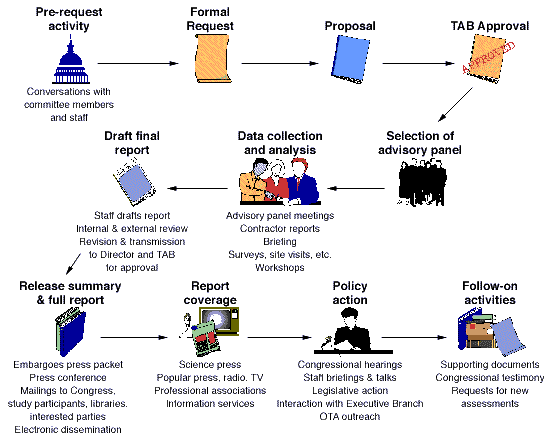
Imagine!?! No, all you need to do is remember the Office of Technology Assessment (OTA), an arm of Congress that provided powerful information, insight and recommendations on technology policies for about two decades, from about 1974 to 1995.

OTA assessment steps Click on thumbnail for chart of the assessment process used by the Office of Technology Assessment to advise Congress on important technology issues.

Now, think about how useful it would be to have such an agency back, to advise our nation on climate change, emergency preparedness, weapons of mass destruction in the post-Soviet era, malaria eradication policies, internet safety and security, and other key issues.

It’s time to bring back the OTA.

Mark Hoofnagle at the Denialism Blog started sounding the conch:

The fact of the matter is that our government is currently operating without any real scientific analysis of policy. Any member can introduce whatever set of facts they want, by employing some crank think tank to cherry-pick the scientific literature to suit any ideological agenda. This is truly should be a non-partisan issue. Everybody should want the government to be operating from one set of facts, ideally facts investigated by an independent body within the congress that is fiercely non-partisan, to set the bounds of legitimate debate. Everybody should want policy and policy debates to be based upon sound scientific ground. Everybody should want evidence-based government.

Go read what he said. Check in with P. Z. Myers’ view. See what John Wilkins says. Hoofnagle lists actions you can take, today, to get the ball rolling.

In the meantime, wander over to the Princeton University site where the OTA’s reports are now archived (I understand the government was going to take it offline, sort of a latter-day burning of the library at Alexandria). Noodle around and look at the report titles. Notice that, though the agency was killed dead by 1995, the agency had reports on climate change. Notice that the agency was a decade or two ahead in urging policies to encourage the internet. Look at the other issues the agency dealt with, look at the legislation that resulted — and you’ll lament with me that we don’t have the agency around today, when the issues are tougher, the technology more difficult to understand, and politics more driven by rumor than fact.

Killing the OTA was the Pearl Harbor of the present war on science. It’s time we started to fight back, to take back the scientific Pacific — our nation’s future is no less in peril now from the war on science, than it was then from hostile nations.

Resources:


August 7, 1964: Gulf of Tonkin Resolution

August 7, 2007

August 7 is the 43rd anniversary of the Gulf of Tonkin Resolution, the resolution which authorized President Lyndon B. Johnson to move troops into South Vietnam to defend U.S. interests.

The resolution passed Congress after what appeared to be attacks on two U.S. Navy ships in the Gulf of Tonkin.  At the time, and now, evidence is weak that such attacks took place.

Santayana’s ghost looks on in wonder.


Didn’t know insanity is contagious: Sen. Tom Coburn

June 27, 2007

Several outbursts of insanity in Washington, D.C., lately make one wonder if there is some contagious disease that prompts these outbursts.

Although, I must admit, this outburst was before the Cheney/Snow claims that the nation’s chief executive and vice chief executive are not executive branch members.

In a flash of irony that shattered irony meters across libraries, laboratories and the research facilities in Oklahoma universities, Oklahoma’s U.S. Sen. Tom Coburn placed a hold on the bill to name a post office in honor of Rachel Carson, accusing Carson of “junk science.” What Coburn failed to say — or, God forbid, failed to notice — is that the criticisms of Carson are truly junk science.

In the Washington Post Coburn offered this inexplicable explanation:

In a statement on his Web site yesterday, Coburn (R) confirmed that he is holding up the bill. In the statement, he blames Carson for using “junk science” to turn public opinion against chemicals, including DDT, that could prevent the spread of insect-borne diseases such as malaria, which is spread by mosquitoes.

Coburn, whose Web site says he is a doctor specializing in family medicine, obstetrics and allergies, said in the statement that 1 million to 2 million people die of malaria every year.

“Carson was the author of the now-debunked ‘The Silent Spring,’ ” Coburn’s statement reads. “This book was the catalyst in the deadly worldwide stigmatization against insecticides, especially DDT.”

This issue is arcane enough that history aficionados reading may not be fully aware of the problems with Coburn’s claims. Let me explain.

First, Carson didn’t complain about insecticides, but instead pointed out that overuse of some insecticides is damaging to the environment, and ultimately frustrates their use as intended. As Carson pointed out, DDT was ceasing to be effective in the fight against malaria due to this overuse. In other words, Carson’s advocacy, if it was as effective as Coburn imagines, saved DDT as an effective tool in the fight against malaria. But Coburn blames her for the opposite. It’s as if he were treating a kid who fell out of a tree, and he blamed the broken arm on a cold virus, because the kid’s nose was running.

Second, DDT is a deadly killer. It’s not like DDT is perfectly harmless. Carson, using studies by insecticide manufacturers and entomologists accumulated over the previous 20 years, pointed out that broadcast use of DDT to protect cotton from boll weevils not only failed to protect the cotton, it also endangered humans. Overuse of any insecticide tends to drive evolution of resistance in the insects targeted, and this is exactly what happened, and what Carson reported. That’s not junk science in any form. It’s accurate, real science, that benefits humans.

Had Carson’s book not appeared when it did, it is quite possible, maybe even likely, that it would have been rendered completely useless against insects.

But even worse, animals don’t evolve resistance as quickly as insects can, and the levels of DDT and its daughter compounds were multiplied in living things as they were higher in a local food chain. DDT is absorbed into living tissues very effectively, so it does not remain floating about, say, in the water of a swamp where it is sprayed for mosquitoes. Instead it is absorbed by other insects, by plants, and then by the animals that consume those insects and plants, and then by the predators at the top of the food chains. Carson was way ahead of her time in understanding this relationship, but the science at the time supported her conclusions exactly, and every study done since then has reinforced Carson’s reporting of the scientific conclusions.

This was important because, as concentrated especially in birds, DDT and its daughters cause eggs to be non-viable, and it even changes the behaviors of birds in raising their young. DDT kills the next generation of birds. It is especially deadly against raptors at the top of the food chain — America’s symbol, the bald eagle, for example, was driven to the brink of extinction by DDT — but it also kills the songbirds which, in a well-balanced ecosystem, keep mosquito populations down and prevent the spread of mosquito-borne diseases like malaria or dengue fever.

So DDT use, as Sen. Coburn appears to defend it, would have left the world malaria and mosquito-ridden, exactly the opposite of his claims.

Third, Carson’s book has been verified in hundreds of studies. To call it “debunked” is either a total purchase of junk science, or a dastardly distortion of the the facts. Carson worried that DDT might be a cause of cancer, a carcinogen. Knowledge of carcinogens was so limited when she wrote that Congress and the medical establishment — two groups Coburn belongs to — endorsed the Delaney Clause to the Food and Drug Act in 1957, ordering that nothing that caused cancer be allowed as an additive in foods or food supplements. This seems almost naive today, when we know that some things, like selenium, are both essential nutrients and carcinogenic, and when we can detect vanishingly small traces of carcinogens in almost everything. Carson called our attention to potential dangers of DDT.

And, it turns out, she was mostly right about DDT and cancer. The good news is that DDT is not a potent carcinogen in humans that we know. Coburn appears to rest his entire case on a misunderstanding of that last sentence. Anti-Carson screeds tend to note that DDT has not been found to be a major cause of breast cancer in women. While true, that study leaves these facts: DDT is a known carcinogen in mammals (and we know of no carcinogen that affects other mammals that is not also a carcinogen for humans, who are mammals); DDT’s effects would be expected to show up in liver cancer, because DDT is a toxin and toxins damage the liver even as the organ does its job in cleaning the toxin out; DDT is a known toxin to human livers, causing liver damage leading to liver disease. Liver disease is a frequent precursor to liver cancer. We need more studies, but it is simply false to say that we know DDT is not a carcinogen. DDT is a carcinogen; the only thing we don’t know is how potent it is in humans.

So here we have Sen. Coburn, an MD in the Senate, a man who has the training of a scientist, a guy who used to practice medicine, helping people avoid things that harm or kill them, falling victim to junk science claims about Rachel Carson and her work, and DDT and what it does, and how it does it.

It ain’t the things we don’t know that get us into trouble, some wag once said: It’s the things we know that ain’t so.

Perhaps you could drop Dr. Coburn a letter, gently inform him of the facts, and ask that he release the hold on honoring Rachel Carson, winner of the Presidential Medal of Freedom, the woman who saved DDT from becoming a useless limb in the war against insect-borne disease? It would be the patriotic thing to do.


Who was the first woman in the U.S. Senate?

May 25, 2007

If you answered “Margaret Chase Smith, the Senator from Maine,” you’d be close, but not close enough. Can you tell when she served, even?

David Parker is back from his vacation; in merely noting that he’s back, he pointed to this article about the first woman to serve in the U.S. Senate. Having spent so much time prowling those halls, and having lived with so many people who are so steeped in Senate history, the information caught me a little off guard. Rebecca Latimer Felton, the first woman to serve in the U.S. Senate

Who is it, if it’s not Smith? Read the rest of this entry »


Tangled web

April 26, 2007

In the middle of the Ray Donovan mess* I was dispatched one afternoon to the Labor Department to see Donovan’s press conference on some complaint the Senate Labor Committee had misrepresented the misrepresentations about testimony offered to the committee. Donovan was mad, but I didn’t realize just how mad until I was stopped at the door — my I.D. was flagged as persona non grata, apparently. Either that or they thought Sen. Orrin Hatch would try to sneak a subpoena in with his press guy.

A friendly reporter standing behind me in line added me to his crew, and I got the handouts.

That was retail, face-to-face scandal. Nothing like this:

Anything like “OllieNorthinthebasement.net?”

* It’s amazing how little of this history is available on line.


Eleanor McGovern

February 2, 2007

The past few weeks have been studded with the deaths of people important to my life, or important in history. The string is a long, unnecessary reminder that there are a lot of people holding history in their memories whom more historians need to get out and interview, even (and perhaps especially) high school-age historians.

Eleanor and George McGovern

Eleanor McGovern died in Mitchell, South Dakota, last week. I wonder how many of the town’s high school history teachers ever thought to invite the woman to speak?

McGovern was the probably the first spouse of a presidential candidate to campaign alone, without the candidate along. The respectful, rather long obituary in the Los Angeles Times made that a focus point of its tribute (free subscription will eventually be required). That was the place I first got the news of her death, while I participated in a Liberty Fund seminar in Pasadena, California, last week.

I was recruited to politics by a McGovernite in early 1972, in Utah. Over the next few months we saw Eleanor McGovern look cool, calm, intelligent and charming in her husband’s losing campaign. She may not always have been so cool as we saw — the Times piece mentions she was nearly ill before the first-ever Sunday interview program solo appearance by a candidate’s wife.

That she was both pretty and smart probably scared the opposition more than anything she ever said. Read the rest of this entry »


Ford tells Nixon: ‘Take these guys’

January 4, 2007

President Ford, National Archives photo

[I hear from teachers who want lesson plans dealing with Gerald Ford. Here’s one I came across from the National Archives.]

Vice President Spiro Agnew was forced to resign in late 1973 in lieu of being prosecuted for bribery. The 25th Amendment allows a president to nominate a new vice president in the event of a vacancy. It was passed after the assassination of President Kennedy, when heart-attack victim Lyondon Johnson held office for over a year with no vice president, but it had never been used. With more than two years to go on his second term, Nixon was encouraged to fill the office.

Eventually Nixon picked Gerald Ford, putting Ford in line to become the first U.S. president to hold the office without ever having been elected to either the presidency or vice presidency, though that was unknown in the fall of 1973. What Nixon needed was someone who could pass the “advice and consent” test of the U.S. Senate. He got a letter from the Republican leader in the House, Gerald Ford, a long-time Michigan congressman, who named several others.

Whose names did Ford suggest to Nixon?

That letter is the focus of a lesson plan suitable for high school U.S. history or government classes, which comes with images of the letter and suggested activities from the National Archives.

The National Archives has lesson plans for all eras of U.S. history.


Living history – Voting Rights Act

July 21, 2006

Congress this week approved a renewal of the 1965 Voting Rights Act, the Senate voting yesterday, 98-0. The Act was a watershed in civil rights legislation, a law whose effects are clearly visible in the diversity of people who populate government in municipal, state and federal government now.

Lews & Kennedy discuss VRAct

This photo by Doug Mills of the New York Times is worth several thousand words. Its caption: Representative John Lewis, left, and Senator Edward M. Kennedy in the room where President Lyndon B. Johnson signed the Voting Rights Act.

The New York Times story (free subscription required) said:

As the Senate voted, Representative John Lewis, Democrat of Georgia, who was beaten in the 1965 voting rights march on Montgomery, Ala., came to the floor, and other lawmakers provided their memories of the era as they spoke in support of the legislation.

“I recall watching President Lyndon Baines Johnson sign the 1965 act just off the chamber of the Senate,” said Senator Edward M. Kennedy, Democrat of Massachusetts and one of three current senators serving when the law was originally passed. “We knew that day we had changed the country forever, and indeed we had.”

This event is a good lynch-pin for history lessons on the civil rights movement. Teachers may want to clip the story and photos from today’s papers to save for lesson plans through the year.

(West Virginia Sen. Robert Byrd is one of the other three senators who were there in 1965. Who is the third?)