ObamaCare working in Utah?

October 11, 2013

GOP panic spreads.  But will they run the correct way in their panic, say to vote for a clean, 12-month continuing resolution and and a raise to $18 trillion in the debt ceiling?

ObamaCare working in Utah.  Who would have imagined that?  The Sherburnes seem happy with what they bought.

Chris Detrick | The Salt Lake Tribune Phil Sherburne and his wife Leia Bell pose for a portrait with their kids Cortez, 11, Oslo, 6, and Ivan, 9, at their home in Salt Lake City Wednesday October 9, 2013. Sherburne and Bell, owners of the frame and art store called Signed & Numbered, succeeded last weekend in signing up for health coverage on healthcare.gov.

Chris Detrick | The Salt Lake Tribune Phil Sherburne and his wife Leia Bell pose for a portrait with their kids Cortez, 11, Oslo, 6, and Ivan, 9, at their home in Salt Lake City Wednesday October 9, 2013. Sherburne and Bell, owners of the frame and art store called Signed & Numbered, succeeded last weekend in signing up for health coverage on healthcare.gov.

More:

M. Turner snapped this self-portrait that went viral in the debate over President Obama's Affordable Health Care Act.  M. Turner photo, via CNN

M. Turner snapped this self-portrait that went viral in the debate over President Obama’s Affordable Health Care Act. M. Turner photo, via CNN


Millard Fillmore nominates the government of the Utah Territory

September 9, 2013

Interesting exercise, probably for an undergraduate college history student:  What became of these men during their service in the Utah Territory, and afterward?  What effect did they have on Utah’s history, and Utah on them?

In September 1850, Millard Fillmore sent the Senate, for confirmation, his nominations of officers to run the Utah Territory, three years after Brigham Young had led the first band of Latter-day Saints into the Salt Lake Valley to settle:

Letter from President Millard Fillmore to the U.S. Senate, nominating people (all men) to govern the Utah Territory, September 26, 1850 - U.S. National Archives image

Letter from President Millard Fillmore to the U.S. Senate, nominating people (all men) to govern the Utah Territory, September 26, 1850 – U.S. National Archives image

Page 2:

Page 2 of President Fillmore's letter to the U.S. Senate, nominating officers to govern the Utah Territory , in 1850.  National Archives image

Page 2 of President Fillmore’s letter to the U.S. Senate, nominating officers to govern the Utah Territory , in 1850. National Archives image

National Archives notes:  Executive Nominations for the First Session of the 31st Congress, 12/03/1849 – 09/30/1850

Production Dates: 09/26/1850

Notes in red ink indicate that confirmation dates for each of these nominees — all but one done two days later.  Fillmore’s nominee to be U.S. marshall in the territory wasn’t confirmed until the following February.

Amazing to think of the speed with which these confirmations occurred, compared to today’s U.S. Senate — and remembering that Congress was not particularly friendly to Fillmore.

An animated GIF of the as it evolved from 1850...

An animated GIF of the Utah Territory as it evolved from 1850 to 1896, when statehood was granted. (Territory boundaries not exact, especially in the west, where early proposals took in parts of California) Wikipedia image

Nominations were:

  • Brigham Young, of Utah, to be governor of the Utah territory
  • Broughton Davis Harris, of Vermont, to be Secretary of the territory
  • Joseph Buffington, of Pennsylvania, to be Chief Justice of the Supreme Court of the Utah Territory
  • Perry E. Brocchus, of Alabama, to be Associate Justice of the Supreme Court of the Utah Territory
  • Zerubabbel Snow, of Ohio, to be Associate Justice of the Supreme Court of the Utah Territory
  • Seth Blain, of Utah, to be U.S. Attorney
  • Joseph L. Haywood, of Utah, to be U.S. Marshall.

What other odd little delights are hidden away in the on-line holdings of the National Archives?  What sort of DBQ exercise can history teachers make out of this stuff?

More:

Brigham Young in 1851; photo from LDS archives

Brigham Young in 1851; photo from LDS archives


Mt. Timpanogos and the U.S. flag

June 18, 2013

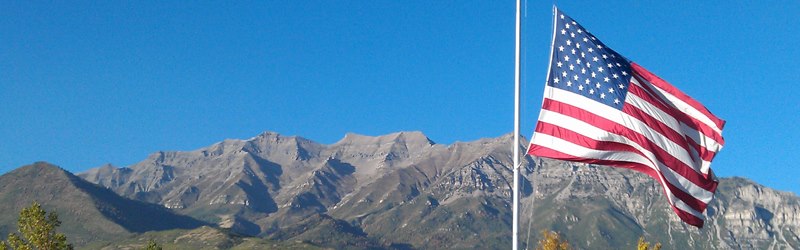
Found just the perfect photo of Mt. Timpanogos and the U.S. flag.  I may use it a lot, unless Bob Walker, the guy who took it, complains.

No, I have no idea who Bob Walker is, other than some guy on Facebook, who lives in Orem, Utah (and may be a member of the Mormon Tabernacle Choir).

Mt. Timpanogos and the U.S. flag. Photo by Bob Walker of Orem, Utah; from Orem, circa September 2012. That's Mt. Baldy on the left. This site is about six miles from our old home in Pleasant Grove, Utah.

Mt. Timpanogos and the U.S. flag. Photo by Bob Walker of Orem, Utah; from Orem, circa September 2012. That’s Mt. Baldy on the left. This site is about six miles from our old home in Pleasant Grove, Utah.

And, again, yes, you may fly your flag today, any day.  According to the flag code, flags can be flown any day, appropriately, in addition to the score of dates recommended in the Flag Code.

More:


Birdbrains, in Canyonlands National Park

May 6, 2013

Bewick's Wrens nesting in skull of a bull, Canyonlands NP

From Canyonlands NP Facebook page: “View from the Maze: A pair of Bewick’s Wrens makes a nest in the brain cavity of an old bull’s skull. Where bovine ruminations once roamed a quick feathered flickering now prevails. If your skull ended up in a tree what species of bird would you like your brain cavity to host? (GC)”

Years ago in the Salt Lake Valley my sister Annette had a home on Wren Road.

One day she and a friend watched birds scurrying all over the property, plucking nesting materials.  “I wonder what kind of birds those are,” my sister said.

“Did you ever wonder why they named it ‘Wren Road?'” her friend replied.

If you want your bird watching friends to think you’re experienced at it, remember Bewick’s, as in “Bewick’s wren,”  is pronounced like the automobile, “Buick’s.”

More:


Other side of the mountain: Timpanogos

February 26, 2013

East side of Timpanogos, by the Heber Valley Convention and Visitors Bureau:

Timpanogos from the east - replacement for photo that originally nested here. Utah.com image

Timpanogos from the east – replacement for photo that originally nested here. Utah.com image

Mt. Timpanogos, east side. Heber Valley CVB photo

Mt. Timpanogos, east side. Heber Valley CVB photo. Click image for larger view.

Tip of the old scrub brush to Susan Reeve Lewis.


Millard Canyon, Utah — not named for Millard Fillmore

January 14, 2013

Winter view of Millard Canyon, Canyonlands NP, Utah

Caption from the NPS crew at Canyonlands National Park: View from the Maze: Millard Canyon’s winter mood. We are looking north. Note how the heat from the east to southeast facing cliffs has melted the snow below – even in this ultra-frigid time. Taking a break under a southeast facing cliff is a good way to warm up while on a Canyonlands hike. (GC) (via Facebook)

In a state where they once named the proposed state capital “Fillmore,” and the county in which that town sat, “Millard,” to try to curry favor with President Millard Fillmore for the state’s petition to gain statehood, one might logically think that a spectacular desert canyon not far away called Millard Canyon might also be named in honor of our 13th president.

LocMap Canyonlands National Park

Location map, Canyonlands National Park, image from Wikipedia

Not so, in this case.  According to John W. van Cott’s Utah Place Names (University of Utah Press, 1990):

MILLARD CANYON (Garfield County) originates at French Springs southeast of Hans Flat. The canyon drains north northeast into the Green River at Queen Anne Bottom. According to Baker, “They learned later that they had misunderstood this name; instead of honoring a president, it was named for an undistinguished `Miller’ who did nothing more than leave this small, mistaken mark on the map” (Baker, Pearl. Robbers Roost Recollections. Logan, UT: Utah State University Press, 1976, p. 33). The name was even misspelled Millard.

Millard Fillmore is off the hook on this one.

Garfield County, Utah, was named after President James Garfield.

So, who was this “Miller” guy?

(Post inspired by image from the Canyonlands NP Facebook site; temperature at the time of the photo was near 0°F.)

More:


Utah statehood: A coda, and a flag code violation

January 6, 2013

Holly Munson at the Constitution Center wrote up a piece about Utah’s perhaps odd path to statehood, certainly complementary to my reminder that you could fly your flags on January 4, to honor Utah’s statehood, under the U.S. Flag Code.  Munson’s piece was distributed on Yahoo! News.

Her report is very solid, even though brief.  Utah history is nothing if not a convoluted path to statehood through what amounted to a civil war, the Mexican War, the discovery of gold in California, the transcontinental railroads, mining and immigration, Indian wars, old west shootouts, rampant environmental destruction with sheep grazing and mineral extraction and smelting, union strife, astonishing agricultural applications, and a lot of books written from tens of thousands of Mormon pioneer journals — Mormonism appears to be impossible without ink and paper and time to write.

Go read her story.

What caught my eye was the George W. Reed photograph of the Salt Lake City Temple of the Church of Jesus Christ of Latter-day Saints — the LDS, or Mormon church.  The Temple and the Tabernacle, also in the photo, both have their own unique architectural histories, and quirks that make them noteworthy purely from architecture.  (This George W. Reed should not be confused with the Civil War Medal of Honor winner, George W. Reed)

Reed was an early photographer for newspapers in Salt Lake City, and he took some wonderful photos for posterity.  He was also a founder of the leading non-Mormon paper in the state, The Salt Lake Tribune.  At points in its history, it’s been known as an anti-Mormon paper.  The University of Utah’s library holds about five dozen of his photos in their collection, indexed electronically if not quite available yet; there Reed is described:

A pioneer in the development of Utah newspapers, George Reed was originally employed by the Deseret News and in 1871 helped in establishing the Salt Lake Tribune. His photographs include nineteenth century views of Salt Lake City, individuals at Reed’s Avenue home, Wasatch Resort in Little Cottonwood Canyon, and a photograph of the American flag hung on the Salt Lake Temple in 1896 to commemorate Utah’s statehood.

In the collection of Utah State University, in Logan, Reed has yet more papers.  There we get a bit more of his history:

A pioneer in Utah journalism, George W. Reed was born in London, England, on April 7, 1833. He emigrated to Utah in 1862 and became manager of the Deseret News, a position he held until 1871 when he founded the Salt Lake Tribune. In 1882, after a decade at the Tribune, Reed sold his interest in the paper to P. H. Lannan. He married Elizabeth Tuddenham in 1866 and passed away December 1, 1909.

U.S. flag on the Mormon Temple, at Utah statehood in 1896

The Mormon Temple in Salt Lake City, Utah, draped with a U.S. flag in 1896, commemorating the completion of Utah’s statehood campaign when President Grover Cleveland declared Utah a member of the Union. Photo by George W. Reed; Reed worked for the Deseret News, and helped found the Salt Lake Tribune. I do not know whether this photo was published in either paper.  From the George W. Reed Collection, University of Utah Libraries.

Yes, you’re right!  That flag is backwards.  Well, it’s backwards according to the modern U.S. Flag Code, which specifies that when hung from a building, the flag’s union should always be in the viewer’s upper left corner (“northwest” corner were it a standard map).  In the photograph, the union is in the opposite corner.  No, we know the photo is not reversed, because it accurately portrays the location of the Tabernacle, to the west and slightly south of the Temple.

But we hear the protests:  The U.S. Flag Code did not exist in 1896!  How can that be a violation of a code that did not exist?

That’s right, too.

That is an indication that the traditions of flag display that some people get riled up about, that many people think we should amend the Constitution to protect, are new inventions more than old traditions.  Flag code violations are legion by well-meaning citizens celebrating the flag and patriotism, and rare by anyone with any malignant motives.

After a 49-year fight for statehood, through wars with the U.S., fighting with the U.S. forces in Mexico, the administrations of several presidents and 25 different U.S. Congresses, and pledges to change the rules of the church to ban polygamy and put that ban in the state constitution,  the people of Utah, especially the Mormon officials, were not trying to insult America by displaying the flag incorrectly.  Somebody said ‘fly the flag from the Temple,’ and some engineer or custodian got it done.  By 1896, most of the First Amendment litigation done in the U.S. had involved whether Mormons could keep their marriage policies (Mormons lost).  There was no intent to violate any rule of separation of church and state — nor would that be considered a violation today.  Churches may fly the nation’s flag with all the approval that suggests; it’s the government which may not fly a church’s flag.

Finally, there is no grand story in the flag’s being flown backwards.  It’s just one of those historical footnotes that mark the changing mores of the times, in this case, for standards of how to fly the U.S. flag.

Perhaps Utah history textbooks should make note of the day the U.S. flag was flown, backwards, to honor statehood.

More, and related resources:


January 4 – Fly your flag for Utah statehood

January 4, 2013

Utah Capitol, with flags

South entrance (main) to the Utah State Capitol, with U.S. and Utah flags flying on the single flag poll, and the snow-dusted Wasatch Mountains in the background. Utah State Law Library photo.

Utah joined the Union on January 4, 1896.  It had been a 49-year slog to statehood for Deseret, the Mormon settlement in the Desert.  The size had been pared down, so it would not be the biggest state, incorporating parts of what is now Nevada, Arizona, Oregon, Idaho, Colorado and New Mexico.  New capitals had been tried and cast aside (Fillmore, Utah).  Democratic Party rule was broken when LDS church authorities went door-to-door, calling every other family to the Republican Party, and party parity.  The Mormon Church abandoned polygamy, and adopted a state constitution that gave the vote to women.

Finally, Utah became the 45th state.

You may fly your U.S. flag today for Utah statehood, especially if you’re in Utah.

More:

U.S. flag in Capitol Reef NP

U.S. flag flying at Capitol Reef National Park, in Utah. Photo by longyang0369, via Flickr


Flash mob in the BYU library

December 2, 2012

When flash mobs go Mormon, and invade sacred spaces like libraries, in Provo, Utah . . . well, that’s pushing the boundaries a bit, and telling the aging of the ritual, too.

How many times have you sung in the atrium of a library and thought it would be a great place for a choir?

Notes from the BYU Singers at YouTube (I added links, except for the first YouTube link):

http://youtu.be/LkE_vk86fq0?t=1h7m10s is the link to hear the BYU Singers perform it in concert!

The BYU Singers appear out of the crowd to sing O Sapientia in the BYU Library. For a brief minute, the library stood still! The audience was captivated, and asked for more. We told them that it sounds better live and invited them to our concert!

And, in comments:

Thank you so much for listening to the BYU Singers! Some viewers asked for a recording of us singing “O Sapientia” by Bob Chilcott without the background noise of the library. We’ve put a link into this video’s description, as well as in an annotation during the first 10 seconds of the video. The link goes directly to us singing “O Sapientia” during a broadcast of our concert on Saturday, November 17, 2012 in the DeJong Concert Hall at BYU. Thank you again for listening!

When I attended college at Utah’s senior (and superior) educational institution (back when Dinosaur Jim Jensen was hunting them live in Central Utah), J. Willard Marriott gave $1 million to the University of Utah to finish the library, and a couple of years later gave $1 million to BYU to finish the basketball center.  We noted that Marriott was a good judge of where the priorities lay at each institution.  Since then, BYU built a new library which is, I hear, quite glorious as a study location.  Except, of course, it’s located on the campus of BYU.  If you’re studying late nights there, let’s just say you’d better have had a good night’s sleep the previous week, because caffeine is going to be hard to come by.

I think the Franklin Stewart Harris Fine Arts Center, home of the DeJong Concert Hall, is the only college building in this nation named after a relative of mine.  In the center of an academic institution that often troubled me deeply, it was the site of many a pleasant day in extension classes (here’s to you, Max Golightly), student performances, and debate headquarters.  I’ve taken solace in the building’s being dedicated to arts and performance, which transcends all the other problems I have with the school.

Those kids sing pretty well, don’t you think?

Did you also notice?  No one shushed them.  I mean, it sounded pretty noisy for a library — but it’s still a library!

Tip of the old scrub brush to Evelyn Earl Jeffries.

More:


Utah’s Mount Timpanogos, no PhotoShop needed

November 16, 2012

Here’s a good demonstration of why you don’t need PhotoShop, but a decent camera and a steady hand instead.

Utah's Mt. Timpanogos in snow, by Craig Clyde, 2012

Utah’s Mt. Timpanogos in snow, by Craig Clyde, 2012 (rights probably reserved).  Click for larger version.

Craig Clyde took this photo of Utah Valley‘s Mt. Timpanogos, probably from Saratoga Springs, on the west side of Utah Lake, after one of the first snows of 2012.  (This area had a few farm fields when I grew up there.)  It’s a great photo for several reasons.

It’s a formerly unusual view, there being so few people on the west side of the lake until recent development.  It pictures all of Timpanogos, with American Fork Canyon on the left, Mahogany Mountain, Big Baldy, and Provo Canyon on the right.  It’s an afternoon shot, you can tell from the angle of the sun (the mountain runs on a north-south axis), and the darkness on the lower mountains may be caused by the Sun’s setting behind the mountain range on the west side of  the lake.  Timpanogos in white, in the afternoon sunshine, is one of the greatest images of a mountain you’ll ever see.

Tip of the old scrub brush to Craig Clyde.  Mr. Clyde and I attended high school together — haven’t seen him in more than 30 years; not sure, but I don’t think he’s the same Craig Clyde in the movie business.

More:


Utah is a special place

November 8, 2012

We might have thought it from time to time — especially when I lived there*.  But I never would say it out loud, let alone have been so bold as to put it into a headline at USA Today.

Talking about Utah election results — it seems only a short while ago Scott Matheson won election as governor, and Orrin Hatch as U.S. Senator, and now Matheson’s kid, Jim Matheson, finishes his 6th term in the U.S. House and got elected to a 7th, and Hatch is the longest-serving Republican U.S. Senator; Jim Matheson scraped out a victory over GOP rock star Mia Love . . . and so on —  and Mr. Jim Butler, the grammar and spelling stickler, called my attention to it.

Look, there on the left hand side, under “Story Highlights,” where it mentions that “Mitt Romney won Utah” — how does it describe the state?  Mostly what?

USA Today headline, "Utah is mostly moron state"

Unfortunate typographical error in USA Today — there should be two of the letter “m” in “Mormon.”  Screen shot courtesy of Kathryn Knowles.

What’s that again?

Moron state close up, USA Today Typo

On the one hand, you wonder, do they have copy editors at USA Today? Then it strikes you: Yes, yes they do.

Did the copy editors intend to say that, that Utah is “a largely moron state?”  It’s been up for more than 36 hours that way.  They didn’t capitalize “moron,” so maybe they didn’t mean “Mormon.”

They can’t say that, can they?

It’s probably an unintentional slip, an unintended and unexpected blurting out of some truth or other.

Will USA Today ever correct it?

_____________

As I drove up the canyon towards Evanston, Wyoming, upon my move out of Utah in 1978, I remember thinking that I would never live in another place in America where it was so difficult to get a drink, nor to find a good cup of coffee.  About a decade later, I moved to Texas, and found that our area of the county was completely dry.  Though we now have beer and wine sales in this end of Dallas County, we’ve lost our better beer and wine stores in the recession, and Starbucks moved out, so I have to get the New York Times at 7-11, if you can believe it.  This was brought to mind in an e-mail conversation with my sister, who is back in Salt Lake.  On election day, they voted and went out for coffee at a local hangout.  I asked where they get a good cup of coffee these days.  Annette wrote back:

We have such a deal!  When Annette’s Place is closed or lazy, we walk to an Einstein’s, which is just across a parking lot from Starbuck’s.  Einstein’s coffee is as good as Starbucks and cheaper, and their mudslides, bagels, and other treats are much better than Starbucks.  Or we just walk next door to a newly opened smoke shop, which also sells great coffee drinks.  They open at 7:00 most days and that’s usually early enough. 

Obviously you should move to Salt Lake.  We have fabulous, local coffee shops and beer makers.  Coffee Garden, Raw Bean, Beans & Brews, Squatter’s, Wasatch Brewing Co., Epic, and the great High West Brewery in Park City, making the best Rye, Whiskey and Vodka made in the US.  A Ski-in distillery, no less. 

There are no ski-in distilleries in Texas, I’ll tell you that.


Sometimes beauty is in the timing . . . Capitol Reef National Park

November 8, 2012

Long-time Scout friend Hal Rosen said he caught some good photos here, too — but none at this precise moment:

Temple of the Sun, Capitol Reef NP, photo by Mike Saemisch, October 29, 2012

Temple of the Sun, Capitol Reef NP, photo by Mike Saemisch, October 29, 2012

First you must get to Capitol Reef National Park, in Utah — one of Utah’s unfairly large number of five National Parks.  Then you take your “high-clearance vehicle” (not necessarily 4-wheel drive) out on the dirt roads in Cathedral Valley, and you hope for a crystal blue sky like this one.  Then you happen to get there just as the sun is right at the peak of the formation . . .

You had to be there.  Mike Saemisch was there just over a week ago, on October 29, 2012, and fortunately caught this photograph with the Sun as part of a sparkling spire on a sandstone formation known as the Temple of the Sun.

Digital photography changes the way one tours these places.  Fortunately.  Take the kids, and make sure they find it on a map so they can use your trip as fodder for their 9th grade geography class.

More:

  • A different angle, at a different time, by Scott Jarvie:  “A 3.5hr timelapse taken late on a cloudy night at the Temple of the Moon with the Temple of the Sun in the background. March 17, 2012.”

Paramount logo inspiration: Mt. Ben Lomond, in Utah

July 1, 2012

This is mostly an encore post — a tribute to Paramount Pictures in the company’s centennial year.

There’s a geography exercise and social studies bell ringer in this somewhere [links added]:

Ben Lomond Peak towers above Ogden. The mountain is believed to have inspired the Paramount movie logo, below, in use since 1914. (Ravell Call, Deseret News)

From the Deseret News: “Ben Lomond Peak towers above Ogden (Utah). The mountain is believed to have inspired the Paramount movie logo, below, in use since 1914. (Ravell Call, Deseret News)

What is the most “paramount” mountain in Utah?

How about Timpanogos Peak, Kings Peak, Mount Nebo, Mount Olympus. Lone Peak or Twin Peaks?

It’s none of the above because one of Hollywood’s most familiar images — the famous Paramount Pictures logo — was inspired by Weber County’s Ben Lomond Peak.

As such, Ben Lomond — not even the highest summit in Weber County — may be the most famous mountain in the Beehive State.

The peak is given credit for prompting creation of the majestic but fictional mountain in the popular Paramount design, based on two histories of the motion-picture company.

According to Leslie Halliwell’s “Mountain of Dreams,” a biography of Paramount, founder William Hodkinson grew up in Ogden and the logo was “a memory of childhood in his home state of Utah.”

Compare it to the Paramount Pictures logo now:

Paramount Pictures logo

Paramount Pictures logo

Teachers may want to hustle over to the Deseret News site to capture the story for classroom use — the online version includes a short set of slides of a hike to the top of the peak (it’s a climb most reasonably healthy people can make in a day – “reasonably healthy” to include acclimated to the altitude).

What other geographic features have become commercial logos? How do images of geography affect our culture?

For my money, I still like Timpanogos better, even if the Osmonds did use it.

Mt. Ben Lomond, in Utah, from a Flickr file

This image of Mt. Ben Lomond looks more like the Paramount logo, some might say.

More, Related Articles:


Salt Lake Tribune obit for journalist Ernie Ford

June 4, 2011

The Salt Lake Tribune carried an obituary for my old journalism professor Ernie Ford today.

Small world:  Good words about Ernie came from an official at KSL-Television, Con Psarras, Vice President for Editorials and Special Projects.  Con is former news director at KSL, the job that many said Ernie was perfect for, but  could never have because he wasn’t in with the owners of the station.  Con is also a former colleague of mine from the University of Utah debate squad (he was a much better debater than I)*.

Con Psarras, KSL’s vice president of editorials and special projects, remembered Ford as “a one-of-a-kind character.”

“He was inspirational to a lot of people,” said Psarras, KSL’s former news director. “He was a real journalist who cared about all those fundamental things that make journalists good at what they do. He was a stickler for detail. If you got something wrong, it was not a pleasant experience. Someone said they earned their first layer of thick skin from Ernie Ford.”

Stickler for detail, sure.  Ford was a great copy editor, and as a managing editor he worried about getting things right, for the readers’ sake in addition to avoiding libel suits.  But I didn’t find it unpleasant to get those fact challenges from Ford.  He knew where the weak spots of a story were likely to be, and he asked the questions that exposed those weaknesses to the writer.  I enjoyed that banter and process — which prevented mistakes from getting into print. (There weren’t idiots as editors of the Chronicle — accuracy, shoe leather and decent writing lived in that paper, often.)

Where are schools of journalism these days?  I was shocked that Texas A&M dropped its journalism program a few years back.  The best intern I ever had came out of A&M’s program.  Liz Newlin wrote concisely and well, and she could smell the heart of a news story, and put it into the lead so you’d have to follow the arteries deeper into the thing to see what happened.  Newlin could have been another Ernie Ford — but she married a guy named Taylor (you figure out the married name), went to law school and became a water law expert in Tucson.

Who trains good journalists by the score in good journalism practices anymore?  Who would want to go into such a field, with newspapers coming down around those left in the newsrooms, and with every fourth yahoo with an internet connection blogging away? [Yeah, me too.]

_____________

*  We got a couple of good reporters out of that debate squad.  Good training for a reporter, I think.  Steve Christensen signed up with UPI back when it was still a noble outfit; I don’t know where he is these days.  Tim Weiler reported for several years in and around Salt Lake.   Carolyn Young, one of  our graduate assistants back in the Early Later Than You Think Holocene reported for KSL’s rival, KUTV, but she headed out to Oregon.  Of course, none of them were journalism majors.  Go figure.


Quiet giant of Utah journalism, Ernie Ford

June 2, 2011

Sometimes the news comes slow.

Jake Sorenson at the Daily Utah Chronicle sent out a notice that Ernie Ford died last night.  Cardiac issues.  He was 70, after all — young by today’s standards, and not yet used up.

Ford was adjunct faculty and adviser to the Chronicle when I wrote there, and took classes from him.  Ford and Roy Gibson were veterans of Utah journalism who could offer a couple of chapters of a textbook they never wrote on how to write well, and how to write good news stories — with just their markups, questions and corrections in the margins of the news story one had to meet deadline on.

Gibson died several years ago.

More than once I regretted that I had to send the copy, with Ford’s comments, off to “typesetting” in the backshop, knowing I’d never see it again.  We didn’t have a photocopier to just make another copy.

Details to come, Jake said.  We’re losing more than just old, established newspapers.  We’re losing the men and women who made the news, news, and made the news readable, and understandable.

Ford made his reputation at KSL Television News and the Salt Lake TribuneHere’s a 1989 story on his leaving KSL to move to a Dallas station.  Sometime after that he moved on to run the Society of Professional Journalists, in Indiana.  Details on Ford’s life and death to follow, but probably no film at 11:00.

When enough of the big trees fall, you can’t call it a forest any more, you know?

_______________

DePauw University put out a release on Ernie Ford:

Former Prof. Ernie Ford Passes Away at Age 70

98198

Veteran reporter, editor and journalism professor Ernie Ford died June 1 in Greencastle, Indiana

June 2, 2011, Greencastle, Ind. —  Ernest J. “Ernie” Ford Jr., a respected journalist and former member of the DePauw University faculty, passed away yesterday. He was 70 years old.

Ford was born on June 7, 1940, in Salt Lake City, and earned bachelor’s and master’s degrees in journalism from the University of Utah. After a lengthy career in print and broadcast journalism, Ford came to Greencastle in the spring of 1992 when he was named executive director of the Society for Professional Journalists (SPJ). The organization, which was founded by student journalists at DePauw University as Sigma Delta Chi (SDX) in 1909, is the nation’s most broad-based journalism organization. SPJ had its national headquarters in Greencastle in the 1990s. 98200

“Ernie Ford was selected because of his strong management experience in broadcast and print journalism,” said Georgiana Vines, assistant managing editor of the Knoxville News Sentinel and chair of the search committee, when Ford’s appointment was announced.

Ford had served as SPJ’s national president during 1991-92 before taking a paid post with the organization. He became a member of SPJ’s national board of directors in 1984, when he was elected Region 9 director, and served as chair of the Ethics Committee, Publication Committee, and the Legal Defense Fund.

98201

Photo, l-r: Ford and David Bohmer '69, director of the Pulliam Center for Contemporary Media Center and Media Fellows Program, with former The DePauw editors Eric Aasen '02 and Andrew Tangel '03 in October 2010

A regular lecturer to students in journalism classes and members of the DePauw Media Fellows program, Ford served as a part-time instructor in University Studies during the 2001-02 academic year. Ernie Ford and his wife, Linda, who survives, are also known to a generation of DePauw students as owners of the Fine Print Bookstore, which they operated on Greencastle’s square for 15 years.

He also served as an adjunct instructor at the University of Utah, Brigham Young University and Utah State University.

“Ernie was a great teacher who helped his students understand the media industry and journalism,” recalls Andrew Tangel, a 2003 DePauw graduate and former editor of The DePauw who now a reporter at New Jersey’s Bergen Record. “A former investigative reporter himself, he seemed to relish asking tough questions at public meetings on campus and in town. He passed along tips to student journalists and encouraged them to be aggressive, hard-nosed reporters.”

Before coming to Indiana, Ford’s journalism career which included stints as managing editor of KSL-TV in Salt Lake City, assistant news director of KDFW-TV in Dallas, assistant city editor of the Salt Lake Tribune, wire editor of the Idaho Post-Register in Idaho Falls, and general assignment reporter for the Deseret News in Salt Lake City. He collected numerous journalism awards, including a 1980 Sigma Delta Chi award for broadcast public service, regional Emmys, the Eudora Welty Award and the DuPont Award. A strong advocate for the First Amendment and the rights of journalists, Ford testified before Congress in support of the Freedom of Information Act and organized a a petition drive that led move the U.S. Supreme Court to permit still cameras in the 47517courtroom.

In 2006, Ford was inducted into the Hall of Fame of the Daily Utah Chronicle, the University of Utah’s student newspaper, where he cuts his reporting teeth as an undergraduate and later served as faculty adviser.

Ford served on the boards of the Putnam County Humane Society, Great Lakes Booksellers Association, served of president of Main Street Greencastle, and was a longtime supporter of the Putnam County Playhouse.

A celebration of Ernie Ford’s life will be held at 2 p.m. Sunday at the Putnam County Playhouse, 715 South County Road 100 East, Greencastle.

An obituary is accessible at the website of Greencastle’s Banner-Graphic.