How can you tell I’m behind the scope and sequence?
I was just reminded today of how neat this site is: Imaging the French Revolution. Good stuff comes out of George Mason University from time to time. This site is part of that stuff.
11. Le plus Grand, des Despotes, Renversé par la Liberté (Place Vendôme). [Place Vendôme, The Greatest of Despots Overthrown by Freedom] Source: Museum of the French Revolution 88.170 Medium: Etching and colored wash Dimensions: 17.2 x 24.4 cm Commentary (numbers refer to pages in essays): General analysis – Day-Hickman, 5 Reasonable crowd – Day-Hickman, 2
Associated Press 1941 file photo of a small boat assisting in rescue of Pearl Harbor attack victims, near the U.S.S. West Virginia, as the ship burns.
Today is the 65th [67th] anniversary of Japan’s attack on the U.S.’s Pacific Fleet at Pearl Harbor, Hawaii.
Our local newspaper, The Dallas Morning News, has a front-page story on survivors of the attack, who have met every five years in reunion at Pearl Harbor. Today [2006] will be their last official reunion. The 18-year-olds who suffered the attack, many on their first trips away from home, are in their 80s now. Age makes future reunions impractical.
From the article:
“We’re like the dodo bird. We’re almost extinct,” said Middlesworth, now an 83-year-old retiree from Upland, Calif., but then – on Dec. 7, 1941 – an 18-year-old Marine on the USS San Francisco.
Nearly 500 survivors from across the nation were expected to make the trip to Hawaii, bringing with them 1,300 family members, numerous wheelchairs and too many haunting memories.
Memories of a shocking, two-hour aerial raid that destroyed or heavily damaged 21 ships and 320 aircraft, that killed 2,390 people and wounded 1,178 others, that plunged the United States into World War II and set in motion the events that led to atomic bombings of Hiroshima and Nagasaki.
“I suspect not many people have thought about this, but we’re witnessing history,” said Daniel Martinez, chief historian at the USS Arizona Memorial. “We are seeing the passing of a generation.”
Another article notes the work of retired history professor Ron Marcello from the University of North Texas, in Denton, in creating oral histories from more than 350 of the survivors. This is the sort of project that high school history students could do well, and from which they would learn, and from which the nation would benefit. If you have World War II veterans in your town, encourage the high school history classes to go interview the people. This opportunity will not be available forever.
There is much to be learned, Dr. Marcello said:
Dr. Marcello said that in doing the World War II history project, he learned several common themes among soldiers.
“When they get into battle, they don’t do it because of patriotism, love of country or any of that. It’s about survival, doing your job and not letting down your comrades,” he said. “I heard that over and over.”
Another theme among soldiers is the progression of their fear.
“When they first got into combat, their first thought is ‘It’s not going to happen to me.’ The next thought is ‘It might happen to me,’ and the last thought is ‘I’m living on borrowed time. I hope this is over soon,’ ” Dr. Marcello said.
Dr. Marcello said the collection started in the early 1960s. He took charge of it in 1968. Since Dr. Marcello has retired, Todd Moye has taken over as the director.
Tugster is an outstanding repository of images of tugboats, ships and other things related to the commerce of Greater New York Harbor, and boats on the water generally. Tugster’s collection of images should be regular source material for teachers of history, economics, geography and government.
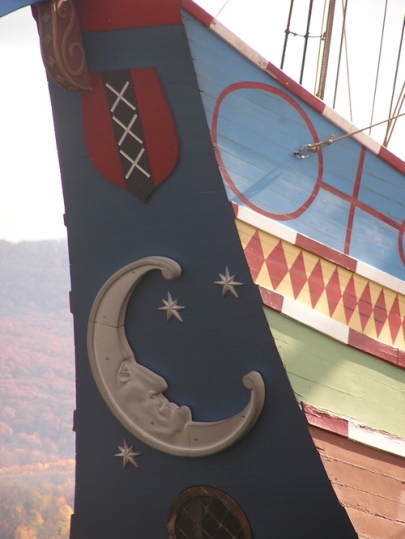
Stern of Half Moon, Henry Hudson's ship; from Tugster: A Waterblog
Notice how the figurehead frightens even the trees to blazing red.
Bowsprite of Henry Hudson's Half Moon, via Tugster: A Waterblog
Tugster tells us that Henry Hudson himself is blogging, channeling across 400 years — perhaps tired of duckpins with his crew in the Adirondacks (hello, Rip van Winkel!). Can your students correspond with Henry Hudson?
“Warsaw 1920, a quality read” – What? Your world history text didn’t mention Poland’s abortive attempt to liberate the Ukraine from the USSR in 1920, nor Lenin’s invasion of Poland and march on Berlin, nor the heroic stand at the Vistula described here as one of the most important military victories in history? You’e better read this post, too, and maybe buy the book.
“The coming anarchy – Kaplan’s piece and the blog” — Robert Kaplan’s article in the 1994 The Atlantic described the woes of Africa. 14 years later, it’s still a good read and full of insight. I wasn’t thinking of using that in world history in 1994 . . . I wasn’t thinking of teaching in 2008 in 1994. Eoin Purcell’s reminders and pointers prove useful and informative once again.
Spread the word; friends don't allow friends to repeat history.
The Maharajah of CashmereThe Illustrated London News December 18, 1875 (From a longer story on the Prince of Wales visit to India in 1875.) – “With regard to the Maharajah of Cashmere, whose residence and political relations, beneath the Himalayas and in the Valley of the Upper Indus, are very remote from Bombay, we defer any notice of him till the Prince of Wales goes to visit him in Cashmere. The portrait of this Maharajah is from a photograph by Messrs. Bourne and Shepherd, of India.”
World history teachers, bookmark this site: Harappa.com
It’s a rich site about India and Pakistan, and includes information and images about the Harappa and Mohenjo-Daro civilizations.
Great images for your classrooms, or for your students’ projects.
Tip of the old scrub brush to John Maunu teaching AP World History in Grosse Ile, Michigan.
(Full text of description of site from the Asian Studies WWW Monitor below the fold.)
A smaller, less-highly regarded force of Athenians faced a larger, better trained, more experienced army of Persians. Sparta’s promised reinforcements had not yet arrived.
And yet the Greeks triumphed over the Persians at Marathon. How?
Two Greek generals followed the dictates of Santayana, whose ghost couldn’t exist because his corporeal existence was nearly 2,500 years in the future — they studied history, and they made plans to avoid the errors others had made in the past.
The two Athenian commanders, Callimachus and Miltiades (the latter having fought in the Persian army himself), used their knowledge of Persian battle tactics to turn the tide further in their favor. As the clatter of spears, swords and shields echoed through the valley, the Greeks had ensured that their best hoplites (heavily armed infantry) were on the flanks and that their ranks were thinned in the center. Persian battle doctrine dictated that their best troops, true Persians, fought in the center, while conscripts, pressed into service from tribute states, fought on the flanks. The Persian elite forces surged into the center of the fray, easily gaining the ascendancy. But this time it was a fatal mistake. The Persian conscripts whom the Hellenic hoplites faced on the flanks quickly broke into flight. The Greeks then made another crucial decision: Instead of pursuing their fleeing foes, they turned inward to aid their countrymen fighting in the center of the battle.
By then, the Persians were in a state of utter confusion. Their tactics had failed, their cavalry was absent and their archers were useless. Their more heavily armed and armored opponents, who could sense that victory was close, were attacking them from three sides and pushing them into the sea. The Persians fled back to their ships. Many of the Athenians, buoyed by their success, dragged several of the Persian vessels to shore, slaughtering those on board.
When the day was over, the Greeks had won one of history’s most famous victories, claiming to have killed about 6,400 Persians for the loss of only 192 Athenians. The Spartans eventually arrived, but only after the battle was long over. To assuage their disbelief in the Athenians’ victory, they toured the battlefield. To their amazement, they found the claim of victory was indeed true. The Athenians had defeated the most powerful empire in the Western world.
It was a great victory. The Athenians had been so certain of defeat, however, that they had made plans to burn Athens and have Athenians left behind commit suicide rather than be captured by the Persians. In order to prevent the plans from going through, they needed one more tremendous piece of history, and they called on their runner:
With time of the essence, the Athenians dispatched Pheidippides to inform Athens’ populace of their victory before the troops arrived. The tale goes that after running the 26 miles from Marathon to Athens, Pheidippides exclaimed: “Rejoice! We conquer!” then died from exhaustion. Whether true or not, that is the source of the modern-day marathon race; the distance of the modern race reflects the distance Pheidippides ran.
I opened world history this year asking how many had seen the movie “300.” It produced some excitement, which I was glad to see. Not enough students knew that it was based on a real battle. We recounted the story of the victories at Thermopylae and Salamis, and then told the story of the set up for that war, the Greek victory at Marathon. It was just after the Olympics closed — tying the battles to the last event of the Olympics, in honor of Pheidippides, made for a great class, for me. For the students? I hope so.
One of my intended learning points was that history is about the stories, not about memorizing dates and places. Stories, they like. Dates and places, not so much.
Another point: History is all around us, even when we play couch potato and just watch the Olympics.
I knew I’d scored when a student asked me after class whether I knew when this year’s marathon would be rebroadcast, so she could watch it.
Spread the word; friends don't allow friends to repeat history.
It’s largely forgotten now, especially in history texts in high schools. After the Spanish-American War, when the U.S. wrested several territories from Spain, including Guam, Cuba, Puerto Rico and the Philippines, the U.S. quickly got mired in one of the original guerrilla wars in the Philippines. It took 15 years, but the U.S. finally put down the rebellion — 15 brutal, bloody years. The conduct of that war shocked many people, including Mark Twain.
This piece was written partly in response to that war.
Many Americans, like Twain, who questioned the war, in turn had their patriotism questioned. Why wouldn’t they get on board with the war, and kill off those Filipino rebels? the critics asked.
Today is the 63rd anniversary of “Victory Japan” Day, or VJ Day. On that day Japan announced it would surrender unconditionally.
President Harry Truman warned Japan to surrender, unconditionally, from the Potsdam Conference, in July. Truman warned that the U.S. had a new, horrible weapon. Japan did not accept the invitation to surrender. The announced surrender came nine days after the U.S. dropped an atomic bomb on Hiroshima, and six days after a second bomb was dropped on Nagasaki. The actual surrender occurred on September 2, 1945, aboard the battleship U.S.S. Missouri, anchored in Tokyo Harbor.
Celebrations broke out around the world, wherever U.S. military people were, and especially across the U.S., which had been hunkered down in fighting mode for the previous four years, since the attack on Pearl Harbor by the Japanese on December 7, 1941.
President Lyndon B. Johnson looks on as U.S. Secretary of State Dean Rusk prepares to join foreign ministers from more than 50 other nations in signing the Nuclear Nonproliferation Treaty, July 1, 1968. Photo from the LBJ Presidential Library, Austin, Texas, via the Nuclear Archive.
Another missed anniversary — but a found archive of original documents on a key issue of our time which has flared up into worldwide controversy in the past year: On July 1, 1968, nations that had nuclear weapons and nations capable of making such weapons — more than 50 nations total — joined in the Nuclear Nonproliferation Treaty (NPT) designed to discourage anyone else from getting “the bomb.” In the past 40 years, few other arms treaties, or any treaties, have worked so well, reducing by two-thirds the potential growth of “the Nuclear Club.”
Signed into law on July 1, 1968, the historic Nuclear Nonproliferation Treaty (NPT) was a major step towards creating a world that had the potential to be a bit safer from the threat of nuclear annihilation. This particular collection of documents related to the NPT was brought together through the diligence of staff members at the Archive’s Nuclear Documentation Project and released to the public in July 2008. The site starts off with a narrative essay which describes the backdrop to the signing of the NPT in 1968, along with offering a bit of additional context about the international political climate at the time. The site’s real gems are the 34 documents which include State Department cables, internal planning documents, and other items that reveal the nature of the political machinations involved with this process. [KMG]
Nuclear Archive does a good job itself — eminently readable, suitable for high school and maybe junior high:
Near the end of the protracted negotiations that produced the historic Nuclear Nonproliferation Treaty (NPT) 40 years ago, U.S. government officials warned that countries could legally reach “nuclear pregnancy” under the Treaty and then withdraw and quickly acquire nukes, according to declassified U.S. government documents published on the Web today by the National Security Archive (www.nsarchive.org).
The documents detail the well-known resistance to the NPT from countries like India (“China at her back, and Pakistan lurking on the sidelines”) but also from more unusual objectors such as Australia (concerned that the Western Pacific security situation might worsen) and Italy (unhappy about the “second-class status” of non-nuclear states). The documents suggest that the current crisis in the NPT system has deep historical roots, but also that current headlines overlook the long-term achievements of the NPT regime.
During the mid-1960s, prior to the NPT, U.S. intelligence had warned that as many as 15 countries had incentives to become nuclear weapons states but after the Treaty was signed, only five additional countries have developed such weapons (Israel, India, Pakistan, South Africa, and North Korea, while South Africa has renounced them). How much of an impact the Treaty had on keeping the numbers low can be debated, but the non-nuclear standard that it set remains a central goal of the world community to this date.
This is a fantastic source for student projects, for reports, for teachers putting together presentations, for students to read on the Cold War, on 1968, on nuclear weapons, on the Johnson administration, on foreign affairs and how treaties work and are negotiated.
The slides show people in a lot of everyday activities, providing good, visual examples of how people lived then. An instructive comparison: Can your students find photos of Indians carrying out similar activities today? How has India changed, for how much of its population? I suspect you can find cases where Some Indians have leaped into the 21st century, and other examples where the lives of many millions of people have not changed all that much.
Several of the photos remind that they were taken 40 years or more before India won independence from Britain. These may pertain to discussions of empires and imperialism, and other economic issues, too.
One commenter asked the blogger to share the slides, but I don’t see a positive response.
Don’t ask me to explain the music the blogger selected for the slides.
George W. Bush was famously untravelled as a candidate for the U.S. Presidency. He had spent more time hanging out in bars just over the border in Juarez than hanging with diplomats anywhere. In 2000, conservatives found this lack of care about foreign nations, U.S. interventions, and foreign people to be “charming,” sort of a poke-in-the-eye to the Rhodes scholar-rich Democratic Party who worried about things like peace in Palestine and getting the North Koreans to agree to stop building nuclear devices (who could be afraid of a bad-hair guy like Kim Jong-Il anyway?).
That was then. Now they desperately have to find something about Barack Obama to complain about. Never mind that Obama has spent more time overseas and in Iraq than George W. Bush, still. While John McCain can get his information in a one-day, flack-jacketed, armored personnel-carrier tour of Iraq, Obama’s two days isn’t enough to please Glenn Reynolds at Instapundit nor Jim Geraghty at National Review Online.
Observation: Conservatives are really, really desperate to find mud on a nice guy; Reynolds and others really are losing badly on issues, to make so much of so little. Also, William F. Buckley has been dead for just over three months, and NR has already gone to hell, deteriorating to a barking-dog cutout of its former intellectual heft.
Spread the word; friends don't allow friends to repeat history.
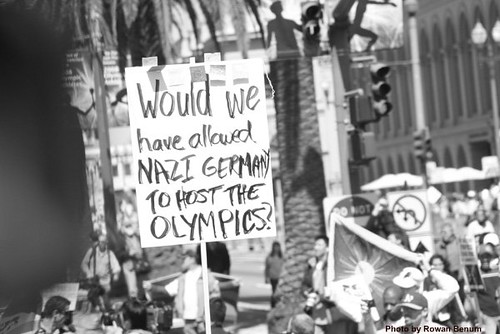
Do you think the sign maker was jesting? Or do you think the sign maker genuinely didn’t know? (See: 1936 Olympics in Berlin)
While we wait to see whether someone will confess to PhotoShopping this picture, we teachers might consider using this photo as a hook for a lesson on the differences between the rising totalitarian state of Nazi Germany in 1936, and the rising, increasingly economically free state of the People’s Democratic Republic of China today.
One more lesson plan for this year — it’s reusable next fall, with the added bonus then that by then you’ll have the headlines of the actual Olympics to add to the discussion.
Update: The photo is said to have been was taken by Rowan Benum at a California site (see Mr. Benum’s comment). Since it’s all the rage on conservative sites, where the history ignorance is condemned but the conservative bloggers can’t quite bring themselves to endorse the Communist Chinese, I strongly suspect wondered about a PhotoShop origin. The torch was run through San Francisco; there are few palms in San Francisco (Californians: Can you identify the location?).
Update 5-13-2008: The photographer kindly dropped by comments to note the authenticity of the photo. I agree, the Tibetan prayer flags suggest authenticity; would a hoaxer think of such details?
“Olympism is a philosophy of life, exalting and combining in a balanced whole the qualities of body, will and mind. Blending sport with culture and education, Olympism seeks to create a way of life based on the joy found in effort, the educational value of good example and respect for universal fundamental ethical principles.”
Olympic Charter, Fundamental principles, paragraph 2
Since the International Olympics Committee (IOC) is an avowedly non-political international agency, is it fair or rational to protest the siting of an Olympics on political grounds?
What do the protesters ask the IOC to do? What do the protesters ask others to do?
Under international law, what are the rights and duties of the Peoples Republic of China (PRC)?
Did the IOC ask anything of the government of the Peoples Republic of China of a political nature? Would such requests be fair, or rational?
Other international organizations function in other nations where governments do not have good records on human rights, such as the Red Cross/Red Crescent, Scouting, UNICEF, and others (can you add to this list?). What considerations must such organizations give to local politics where human rights are at issue?
Look at other protests involving the Olympics, especially in 1980 and 1984. Did those protests achieve what the protesters had hoped? Does the success or failure of past protests augur well for current protests?
The creator of the protest sign in the photograph appears to have not known about the 1936 Olympics, which were hosted in Berlin, then under the control of the Nazi government of Germany. The Olympics were sited in Berlin prior to the rise of the Nazi government. Does the protester’s ignorance of history affect the message of the sign? Does it reflect well on the cause the protester advocates?
What other famous or notorious examples of ignorance of history can you find?
Do you ever get embarrassed for the people captured in Jay Leno’s “Jaywalking” segments?
Georges Santayana (1863-1952) famously said, “Those who cannot remember the past are condemned to repeat it.” Do you find that statement to be true? Does this affect the course of history? (Students may want to explore the history of invasions of Russia by Napoleon and Hitler, or the history of invasions of Afghanistan by Britain, the Soviet Union, and the U.S.)
Spread the word; friends don't allow friends to repeat history.
Real science is almost so much more interesting than faux science. #39 features the discussions about the claims that the Hobbits had dental fillings. While such a claim is damaging either to the claims of the age of Homo floresiensis or to the claims about the age of the specimens and, perhaps, human evolution, no creationist has yet showed his head in the discussion. When real science needs doing, creationists prefer to go to the movies. There is even a serious discussion of culture, and what it means to leadership of certain human tribes, with nary a creationist in sight.
#40 at Remote Central is every bit as good. World history and European history teachers will want to pay attention to the posts on extinctions on the islands of the Mediterranean. Any one of the posts probably has more science in it in ten minutes’ reading than all of Ben Stein’s mockumentary movie, “Expelled!” That’s true especially when science is used to skewer the claims of the movie, or when discussion turns to the real problems the mockumentary ignores.
Enjoy the cotton candy.
Spread the word; friends don't allow friends to repeat history.
Or, until that account is unsuspended by the forces supporting Donald Trump: Follow @FillmoreWhite, the account of the Millard Fillmore White House Library
We've been soaking in the Bathtub for several months, long enough that some of the links we've used have gone to the Great Internet in the Sky.
If you find a dead link, please leave a comment to that post, and tell us what link has expired.
Thanks!
Retired teacher of law, economics, history, AP government, psychology and science. Former speechwriter, press guy and legislative aide in U.S. Senate. Former Department of Education. Former airline real estate, telecom towers, Big 6 (that old!) consultant. Lab and field research in air pollution control.
My blog, Millard Fillmore's Bathtub, is a continuing experiment to test how to use blogs to improve and speed up learning processes for students, perhaps by making some of the courses actually interesting. It is a blog for teachers, to see if we can use blogs. It is for people interested in social studies and social studies education, to see if we can learn to get it right. It's a blog for science fans, to promote good science and good science policy. It's a blog for people interested in good government and how to achieve it.
BS in Mass Communication, University of Utah
Graduate study in Rhetoric and Speech Communication, University of Arizona
JD from the National Law Center, George Washington University


 Posted by Ed Darrell


![The Maharajah of Cashmere The Illustrated London News December 18, 1875 [From a longer story on the Prince of Wales visit to India in 1875.] With regard to the Maharajah of Cashmere, whose residence and political relations, beneath the Himalayas and in the Valley of the Upper Indus, are very remote from Bombay, we defer any notice of him till the Prince of Wales goes to visit him in Cashmere. The portrait of this Maharajah is from a photograph by Messrs. Bourne and Shepherd, of India.](https://i0.wp.com/www.harappa.com/engr/gif/kashmah.gif "Maharaja of Cashmere 1875, Harappa.com")







 Millard Fillmore's Bathtub